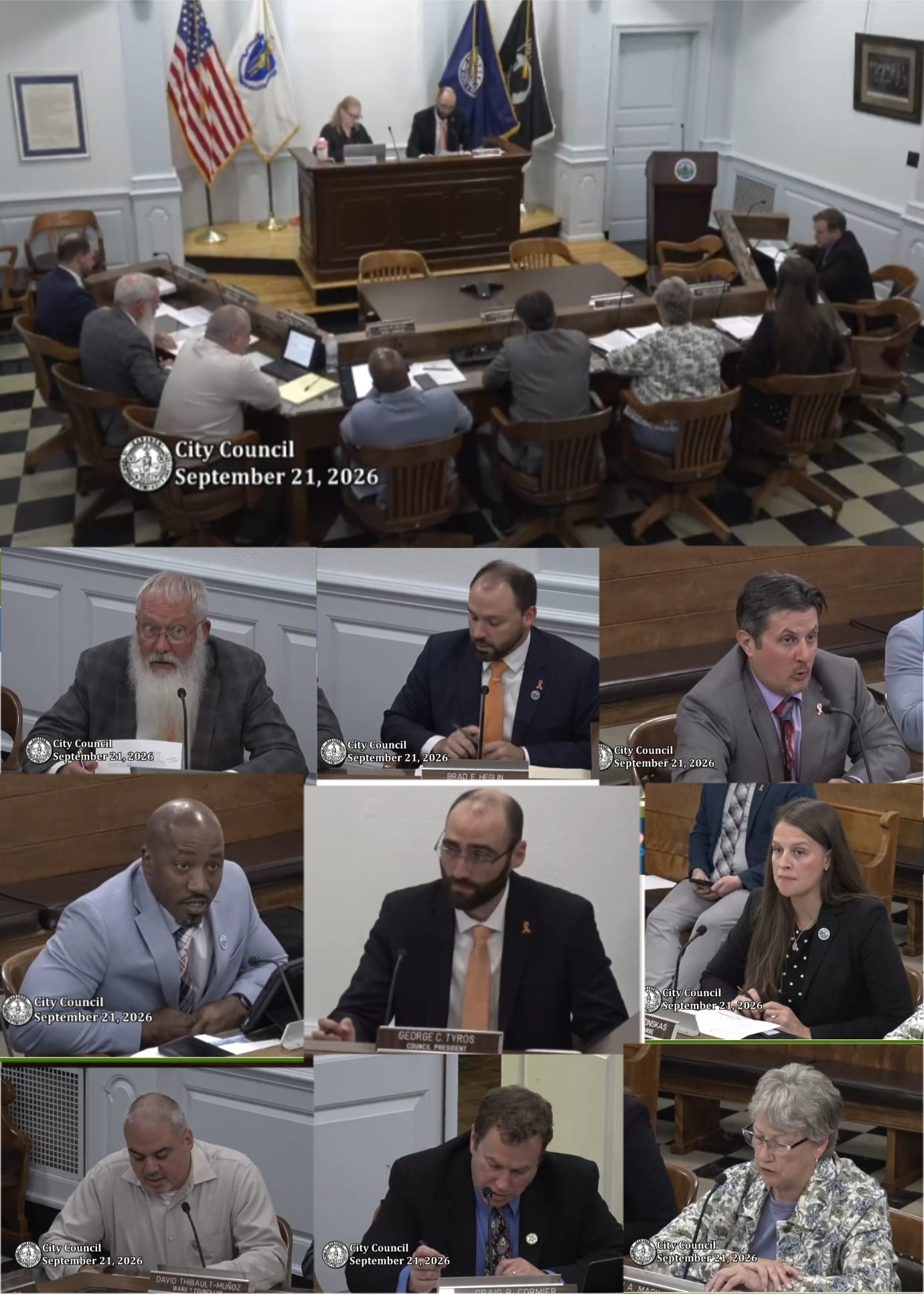
At the City Council meeting of September 21st, 9 Councilors participated in person with Councilor Tassone calling in remotely and Councilor Hardern was absent, still recovering from back issues.
Gardner City Council meets on the Last Day of Summer 2026
Listen to the entire meeting on any device, CLICK PLAY,
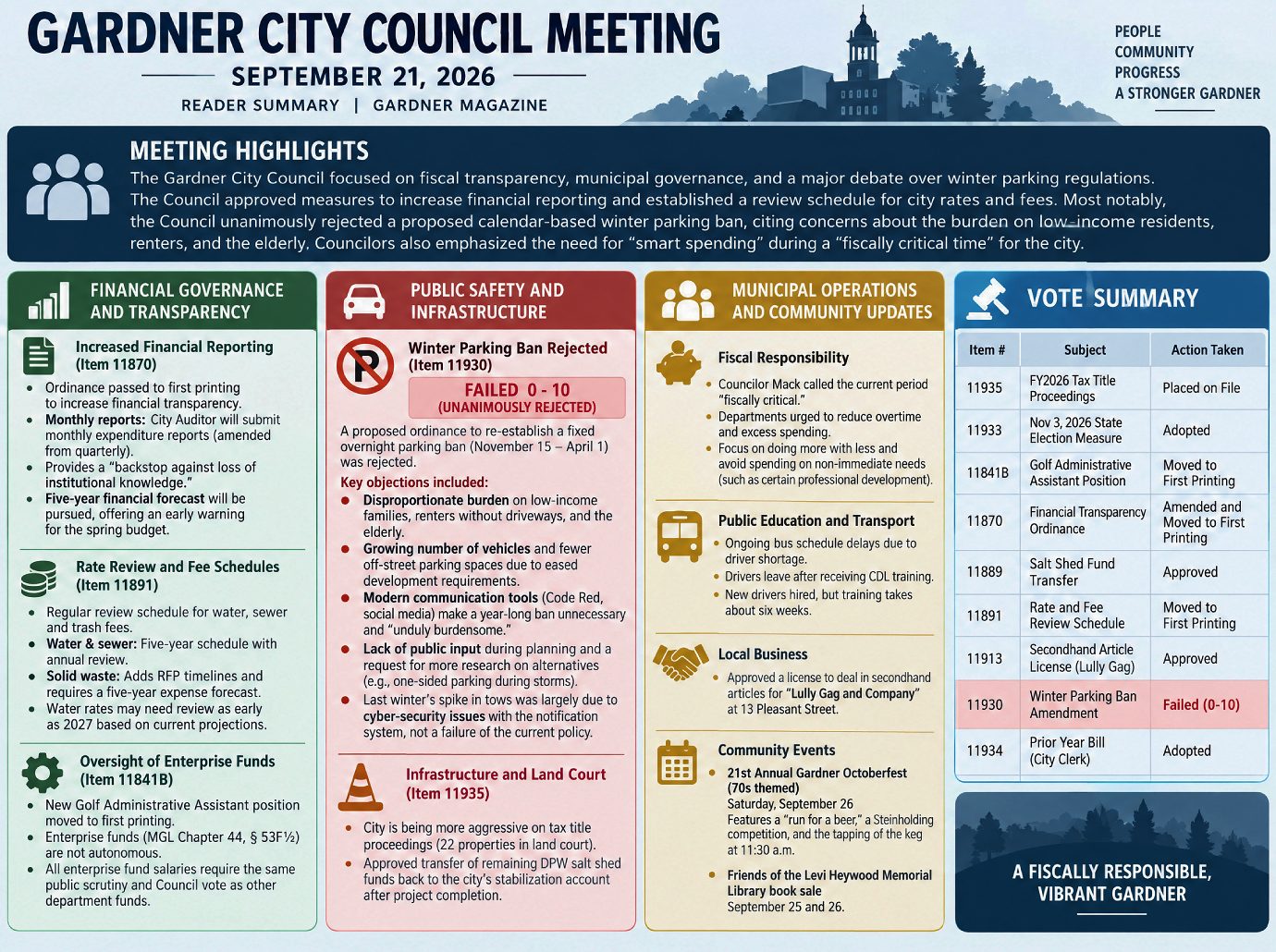
The Gardner City Council meeting held on September 21, 2026, focused on fiscal transparency, municipal governance, and a significant debate regarding winter parking regulations.
The Council approved measures to increase the frequency of financial reporting and established a regular review schedule for various city rates and fees.
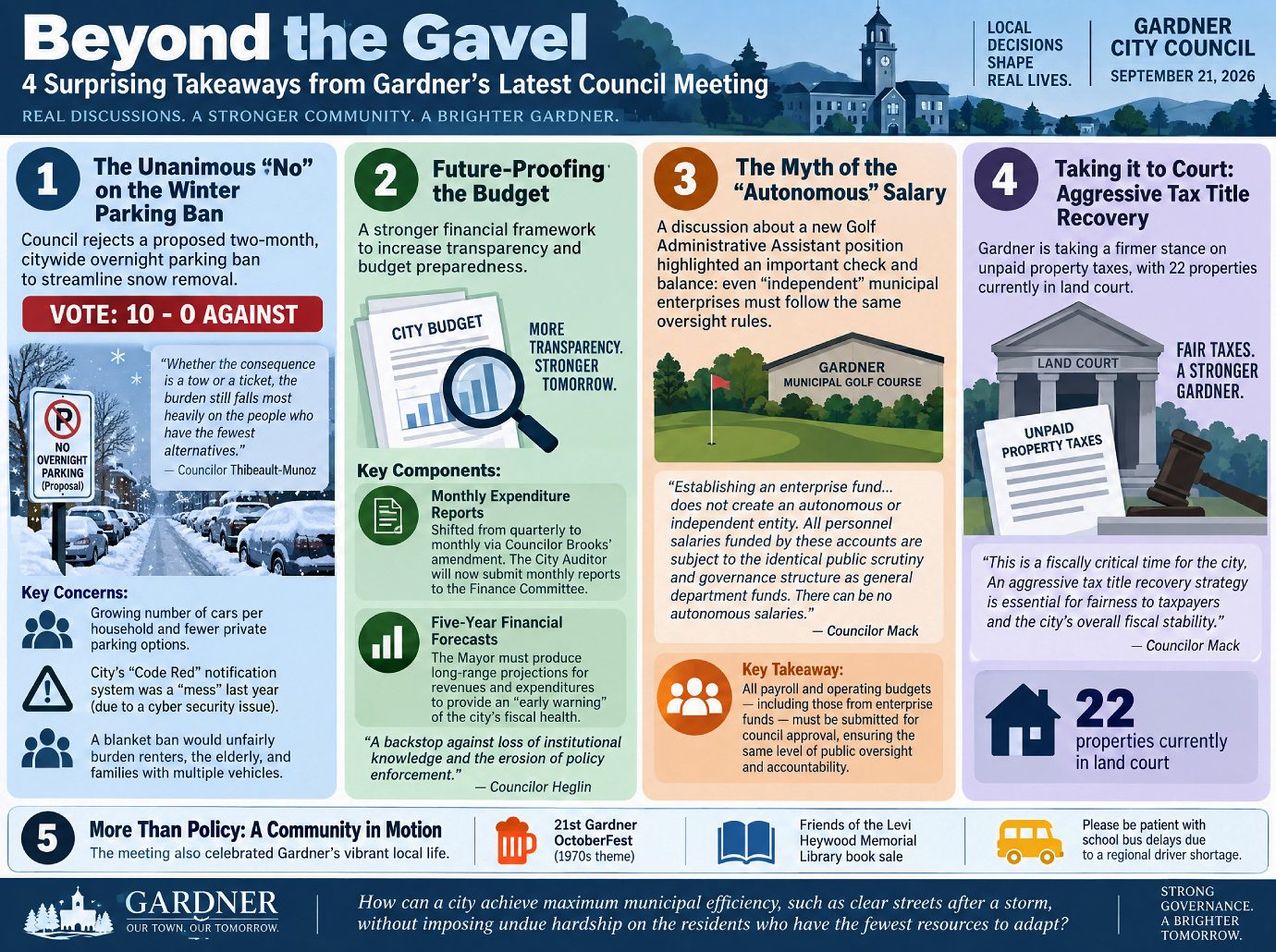
Most notably, the Council unanimously rejected a proposed ordinance to re-establish a calendar-based winter parking ban, citing concerns over the burden it would place on low-income residents, renters, and the elderly.
Additionally, councilors emphasized the need for “smart spending” during a “fiscally critical time” for the city.
Financial Governance and Transparency: The Council processed several items aimed at refining the city’s financial oversight and ensuring the accountability of municipal funds. Increased Financial Reporting (Item 11870) – An ordinance was passed to its first printing intended to increase financial transparency and budget preparedness.
- Monthly Reports: Originally proposed as quarterly, the ordinance was amended by Councilor Heglin (supported by Councilor Brooks) to require the City Auditor to submit monthly reports on current expenditures to the Finance Committee.
- Institutional Backstop: Councilor Heglin noted the ordinance serves as a “backstop against loss of institutional knowledge” and ensures future councils have the necessary tools to make informed decisions.
- Five-Year Forecast: Councilor Brooks, a retired city auditor, expressed that while five-year financial forecasts are difficult to execute, the attempt is worthwhile, and revenue projections provided by the Mayor offer a necessary “early warning” for the spring budget.
Rate Review and Fee Schedules (Item 11891): The Council approved an ordinance creating a regular review schedule for water, sewer, and trash fees to ensure long-term financial viability.
- Water and Sewer: Proposals for rate changes will be on a five-year schedule with an annual review mechanism.
- Solid Waste: The ordinance adds timelines for solid waste hauling contract RFPs and requires a five-year forecast for expenses in the solid waste enterprise account.
- Urgency: While the ordinance focuses on even-numbered years (e.g., 2028), Councilor Brooks and Councilor Dernolowicz noted that water rates specifically may require review as early as 2027 based on current projections.
Oversight of Enterprise Funds (Item 11841B): A new position for a Golf Administrative Assistant was moved to its first printing to bring its compensation under official city ordinance.
- Regulatory Compliance: Councilor Mack clarified that Massachusetts municipal enterprise funds (under MGL Chapter 44, § 53F½) are not autonomous.
- Council Oversight: All salaries funded by enterprise accounts are subject to the same public scrutiny and Council vote as general department funds to prevent “autonomous salaries.”
Public Safety and Infrastructure: Rejection of the Winter Parking Ban (Item 11930) The Council engaged in a comprehensive debate regarding a proposed amendment to Chapter 600 of the city code, which would have reinstated a fixed overnight parking ban (November 15 – April 1). The motion failed 0-10.
Key Objections Included:
- Disproportionate Burden: Councilor Thibeault-Munoz argued the ban would fall hardest on low-income families, renters without driveways, and the elderly, who would be forced to walk long distances from designated lots in the dark over snow and ice.
- Current Infrastructure: Councilor Mack and Councilor Brooks noted that the number of vehicles in the city has grown significantly while parking requirements for new developments have been eased, creating a systemic shortage of off-street parking.
- Technology vs. Tradition: Several councilors, including Councilor Dernolowicz, suggested that with modern communication technology (Code Red, social media), a year-long or permanent calendar-based ban is unnecessary and “unduly burdensome.”
- Lack of Public Input: Councilors highlighted a lack of resident feedback during the planning stages and requested more research into alternatives, such as one-sided street parking during storms.
- System Effectiveness: Councilor Heglin noted that the “spike in tows” last winter was largely due to cyber-security issues with the notification system rather than a failure of the current storm-contingency policy.
Infrastructure and Land Court (Item 11935)
- Tax Title Proceedings: The city is becoming “more aggressive” in pursuing properties behind on taxes, with 22 properties currently in land court.
- Salt Shed Completion: The Council approved the transfer of remaining funds from the DPW salt shed account back to the city’s stabilization account following the project’s completion.
Public Education and Transport: Councilor Heath addressed ongoing issues with the Gardner Public Schools bus schedules.
- Driver Shortage: The delays are attributed to the turnover of drivers who leave after receiving CDL training. New drivers have been hired, but the training process takes approximately six weeks.