Templeton MA
TEMPLETON WEATHERTown of Templeton MA on Gardner Magazine
Templeton MA Local News and Community Information

Jump to: Around the Community – Templeton Map – Templeton Photos – Service pages and outside links — View current Calendar (opens in new window)
- Templeton PD Advisory

Override Defeat Already Having a Negative Public Safety Effect in Templeton
As predicted by this publication and others, the Town of Templeton desperately needs to send a different signal that Templeton is protected from crooks. Commit a crime in Templeton and they’ll catch you. The Templeton PD put out a public advisory on the morning of September 30th because of an increase in property crime:
“Templeton Police Department Public Advisory – September 30, 2026 –
Residents are advised to take immediate precautions to secure their homes and personal property due to a recent increase in reported breaking and entering incidents in the area.
Please ensure all doors, windows, garages, sheds, vehicles, and off-road vehicles are secured and locked whenever possible. Remove valuables from plain sight and consider storing recreational vehicles and equipment in a secure location.
Remain vigilant and report any suspicious activity to local authorities. A few simple precautions can help prevent further incidents and protect our community.”
- Templeton 9-28 Vote Results
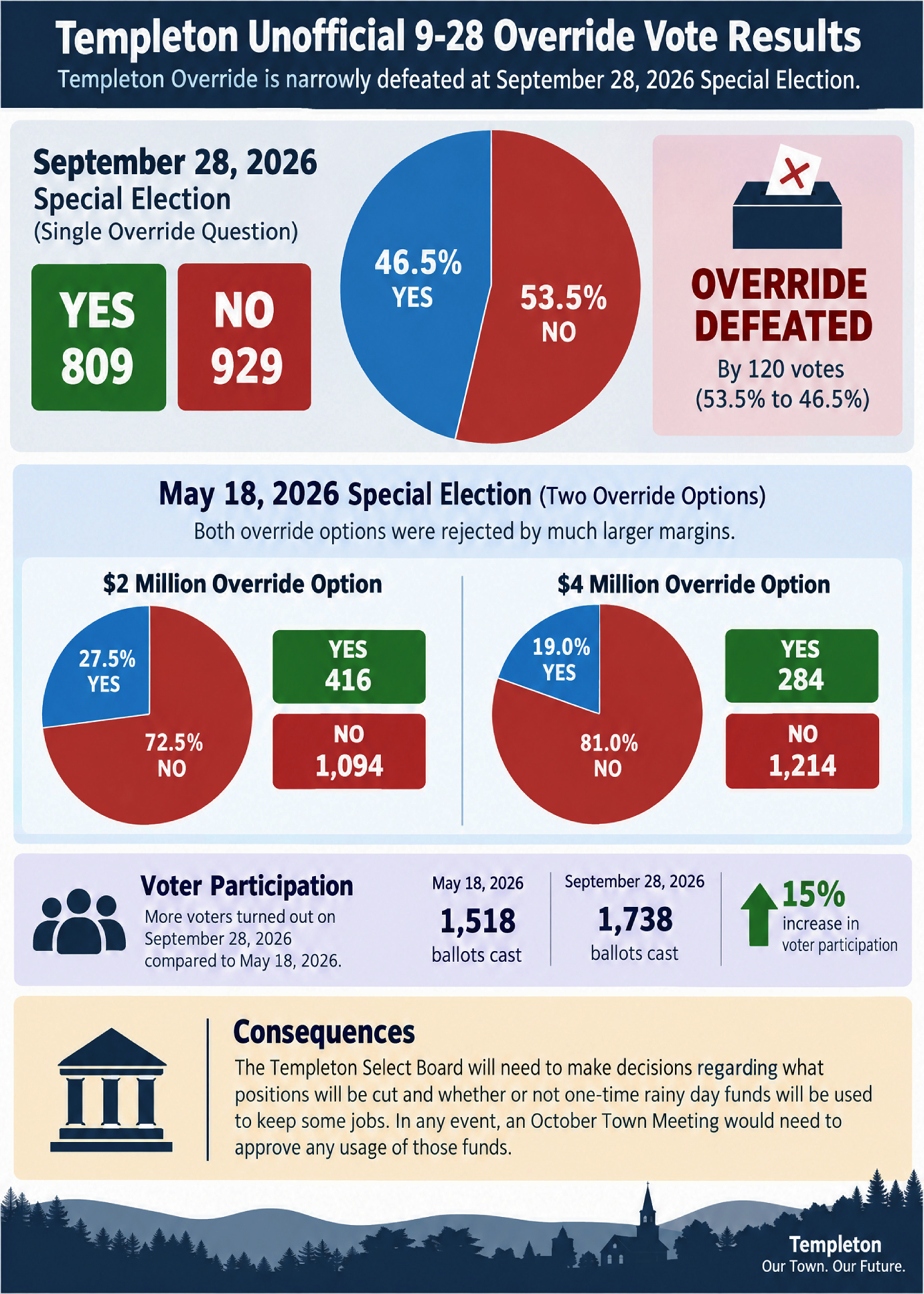
Templeton Override is narrowly defeated at September 28, 2026 Special Election.
YES: 809 NO: 929
46.5% YES, 53.5%
In the May 18, 2026 Special Election in which voters had 2 override options, the differences were much greater with a $2 million override option rejected with 416 Yes votes and 1094 No votes and a $4 million option rejected with 284 Yes votes and 1214 No votes. At that time 1518 registered voters cast their ballots compared to 1738 this time, a 15% increase in voter participation.
Consequences: The Templeton Select Board will need to make decisions regarding what positions will be cut and whether or not one-time rainy day funds will be used to keep some jobs. In any event, an October Town Meeting would need to approve any usage of those funds.
At the Select Board Meeting on September 28th which lasted until after unofficial election results were known, all 5 members made comments regarding the failed override vote: Listen on any device, CLICK PLAY.Templeton Select Board comments 9-28-26 On September 28, 2026, the Templeton Select Board meeting was already underway and members responded following a town vote that appears to have rejected the proposed $1.38 million override measure. While official numbers were still being finalized, the preliminary results indicate a defeat for the measure, leading to immediate and severe consequences for the municipality. The Board’s commentary reflects a state of professional and personal distress, centered on three critical areas: the immediate termination of town employees, a perceived crisis in public communication, and a heightened concern for public safety during the upcoming winter months. The failure of the vote is attributed largely to voter anxiety surrounding historic inflation, specifically regarding heating oil and grocery costs.
Impact on Municipal Personnel and Services: The primary and most immediate consequence of the vote is the reduction in the town’s workforce. Board members expressed profound regret regarding the disruption of lives due to these institutional circumstances.
- Employee Layoffs: The Board acknowledged that town employees will lose their jobs as a direct result of the voting outcome. Members extended apologies and well-wishes for the displaced staff to find new employment quickly.
- Service Reductions: There is a stated heartbreak over the town’s inability to “obtain these services” that the funding was intended to secure.
- Volunteer and Staff Recognition: Despite the negative outcome, the Board recognized the difficult work performed by election staff and those who attempted to advocate for the measure.
The concern is exacerbated by the fact that many surrounding communities have also failed their overrides and are facing similar layoffs. This regional reduction in force means that if a fire or emergency occurs, the “wait is going to be longer” for mutual aid or emergency response, creating a high-risk environment for the community. The Templeton Select Board views the recent vote as a “devastating” and “sad day for the community.” While acknowledging the legitimate financial fears of the citizenry, the Board warns that the resulting loss of personnel and the potential for public safety crises represent a new “rock bottom” for the town. The immediate focus moves toward managing the transition for terminated employees and urging the public to engage with official communication channels to navigate the coming months.
- April Cover – Statement of LOVE
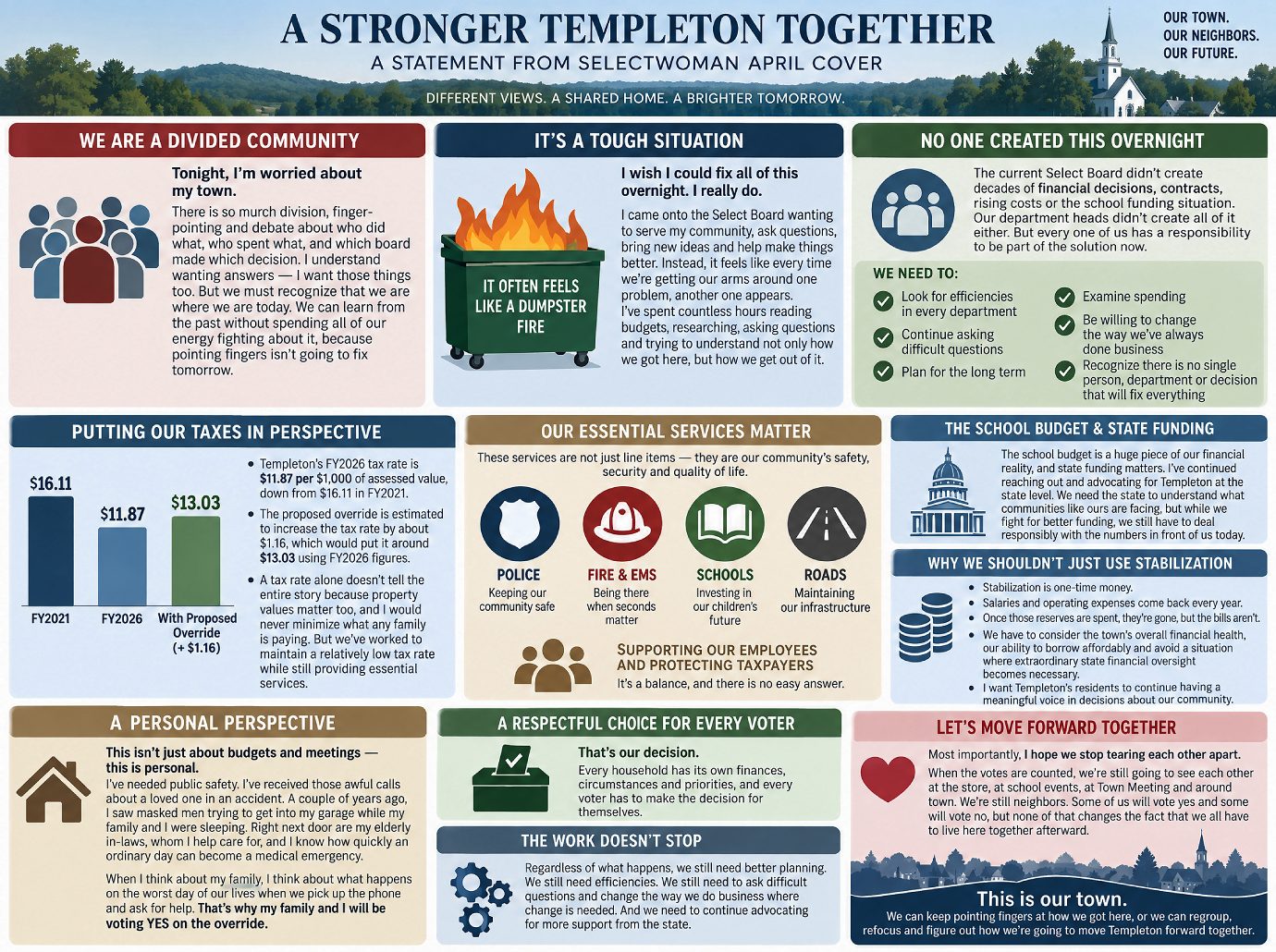
Templeton SelectWoman April Cover tonight released a statement of LOVE to her fellow Templeton residents. Cover’s statement is also in favor of a YES vote on the September 28th override vote. Entire statement on PDF, CLICK HERE. Gardner Magazine has created the graphic below of April Cover’s statement of LOVE to her community:
- Candace Graves 9-22-26

Templeton at a Fiscal Crossroads – The Candace Graves Interview
Listen to the interview on any device, CLICK PLAY.
Candace Graves Interview 9-22-26
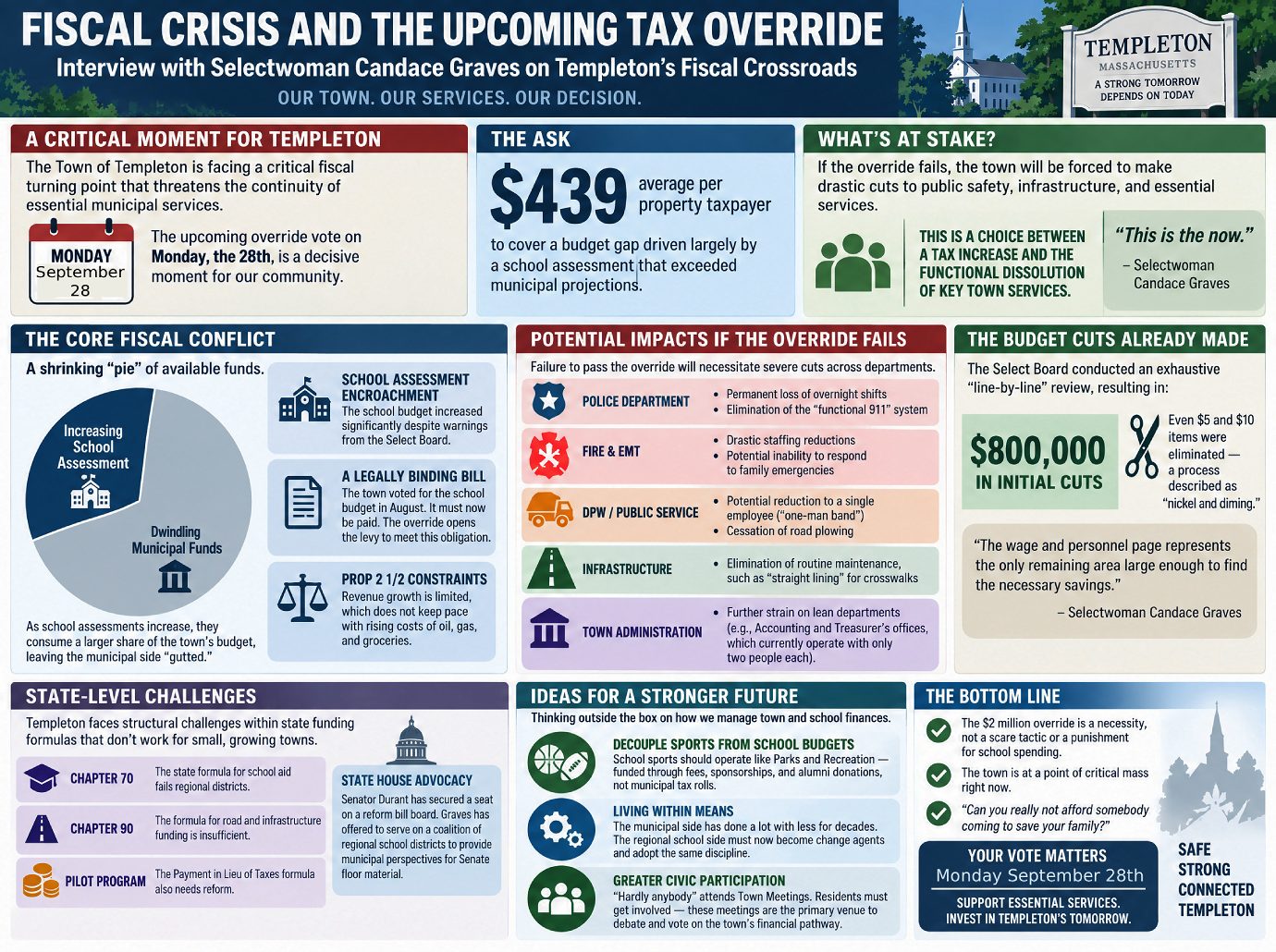
In this interview, Selectwoman Candace Graves discusses the severe fiscal crisis facing the town of Templeton, Massachusetts. She advocates for a tax override to address a massive budget shortfall caused by rising regional school district assessments and stagnant state funding formulas. Graves warns that failing to approve the measure in the Special Election on Monday, September 28th will result in devastating cuts to essential services, including public safety and road maintenance. By detailing the “line by line” cuts already made to municipal departments, she emphasizes that the town can no longer function without additional revenue. Ultimately, she calls on residents to vote yes to preserve the community’s core infrastructure while pushing for long-term legislative reform at the state level.The Core Fiscal Conflict: The “Pie” and the School Assessment: Templeton’s financial distress is defined by a structural imbalance between revenue and mandated costs. The “pie” of available funds must cover both municipal services (public safety, roads, administration) and regional school assessments.
- School Assessment Encroachment: Graves notes that the school district is taking an increasing share of the town’s budget, leaving the municipal side “gutted.” Despite warnings from the Select Board in the fall of the previous year regarding a lack of surplus funds, the school budget increased significantly.
- The “Payable Bill”: Because the town voted for the school budget in August, it is now a legally binding “bill” that must be paid. The override is the mechanism to “open the levy” to meet this obligation.
- Prop 2 1/2 Constraints: Like many Commonwealth communities, Templeton’s revenue growth is limited by Proposition 2 1/2, which Graves argues does not provide enough funding to keep pace with the rising costs of oil, gas, and groceries.
The Choice for Voters: Residents are faced with a choice between a tax increase and the functional dissolution of public safety and public works. As Graves states: “Can you really not afford somebody coming to save your family? … This is the now.”
- Bennett – Ryan Interview 9-21-26
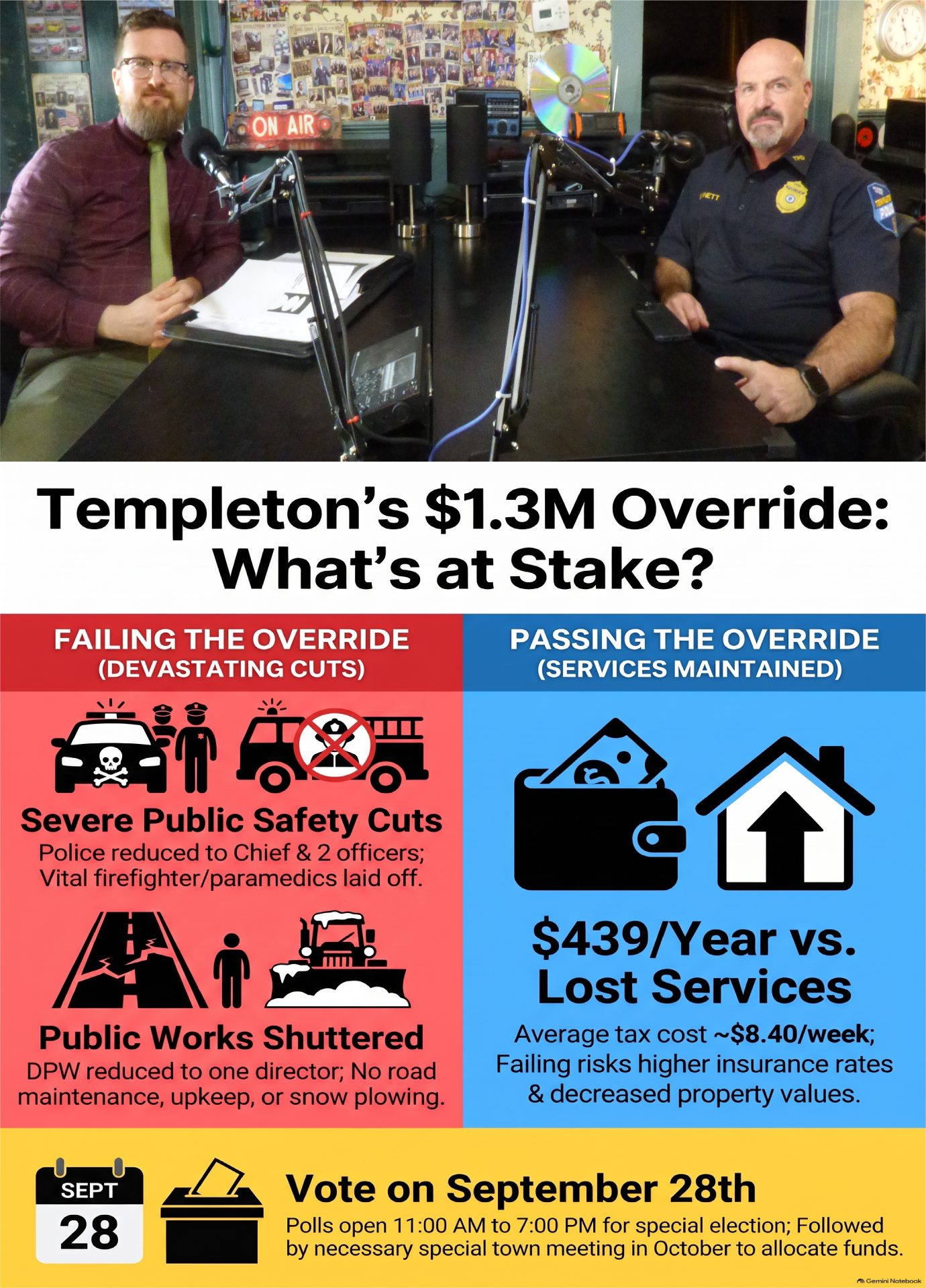
An interview with Templeton Town Administrator James Ryan and Police Chief Michael Bennett
Listen to this interview on any device, CLICK PLAY
Bennett- Ryan Interview 9-21-26 In this interview, Templeton Town Administrator James Ryan and Police Chief Michael Bennett discuss a looming budget deficit and a critical tax override vote scheduled for September 28th. The officials explain that approving a $1.3 million funding increase is necessary to maintain essential town services and restore a midnight police shift. Failure to pass the measure would result in severe personnel cuts, including the layoff of nearly all public works employees and a drastic reduction in the police and fire departments. Chief Bennett highlights the public safety risks of relying on state police coverage, while Ryan clarifies that one-time grants cannot solve the town’s structural financial issues. Ultimately, the leaders emphasize that the community must decide between a modest tax increase or the loss of local emergency response and infrastructure maintenance.
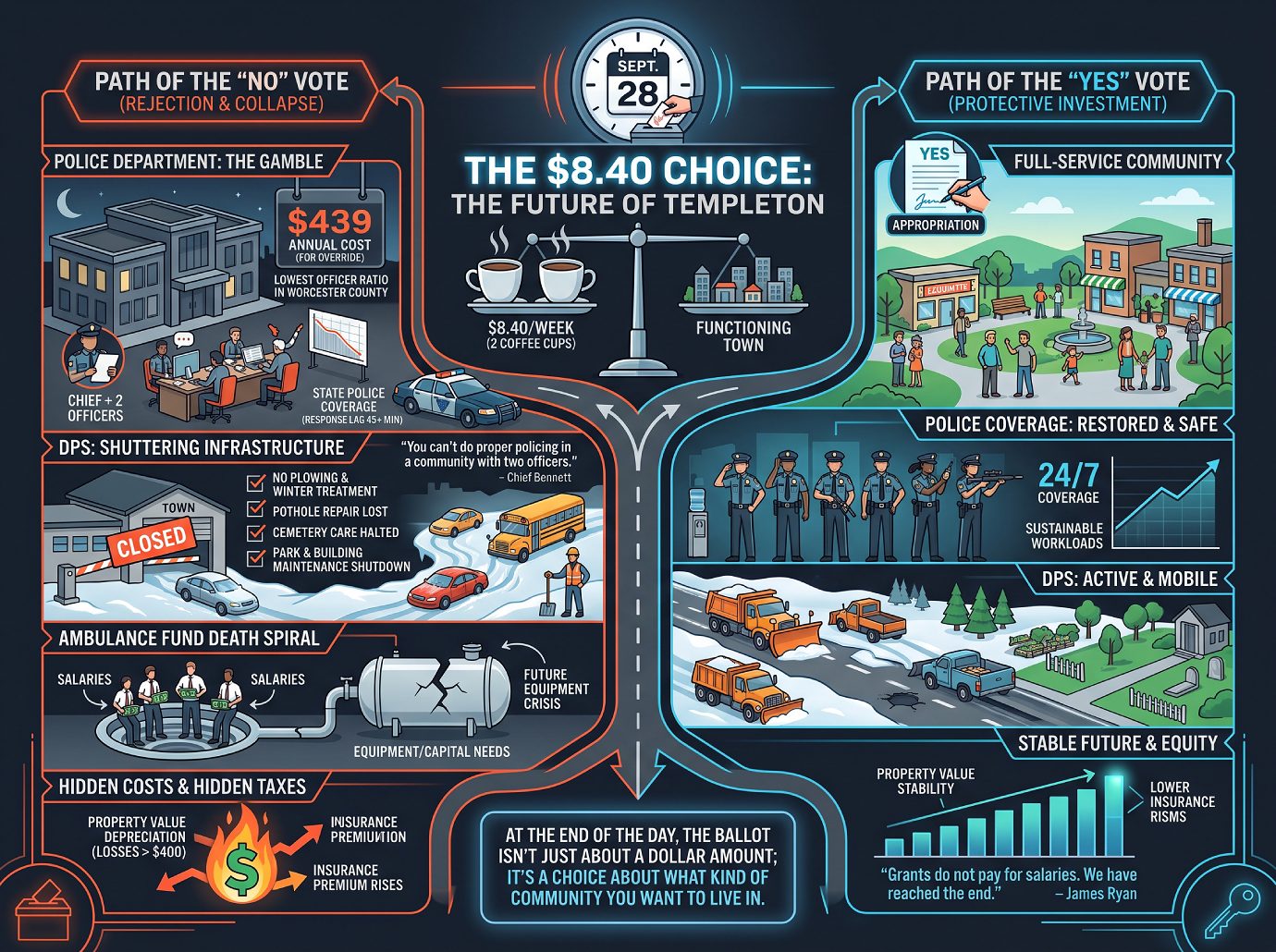
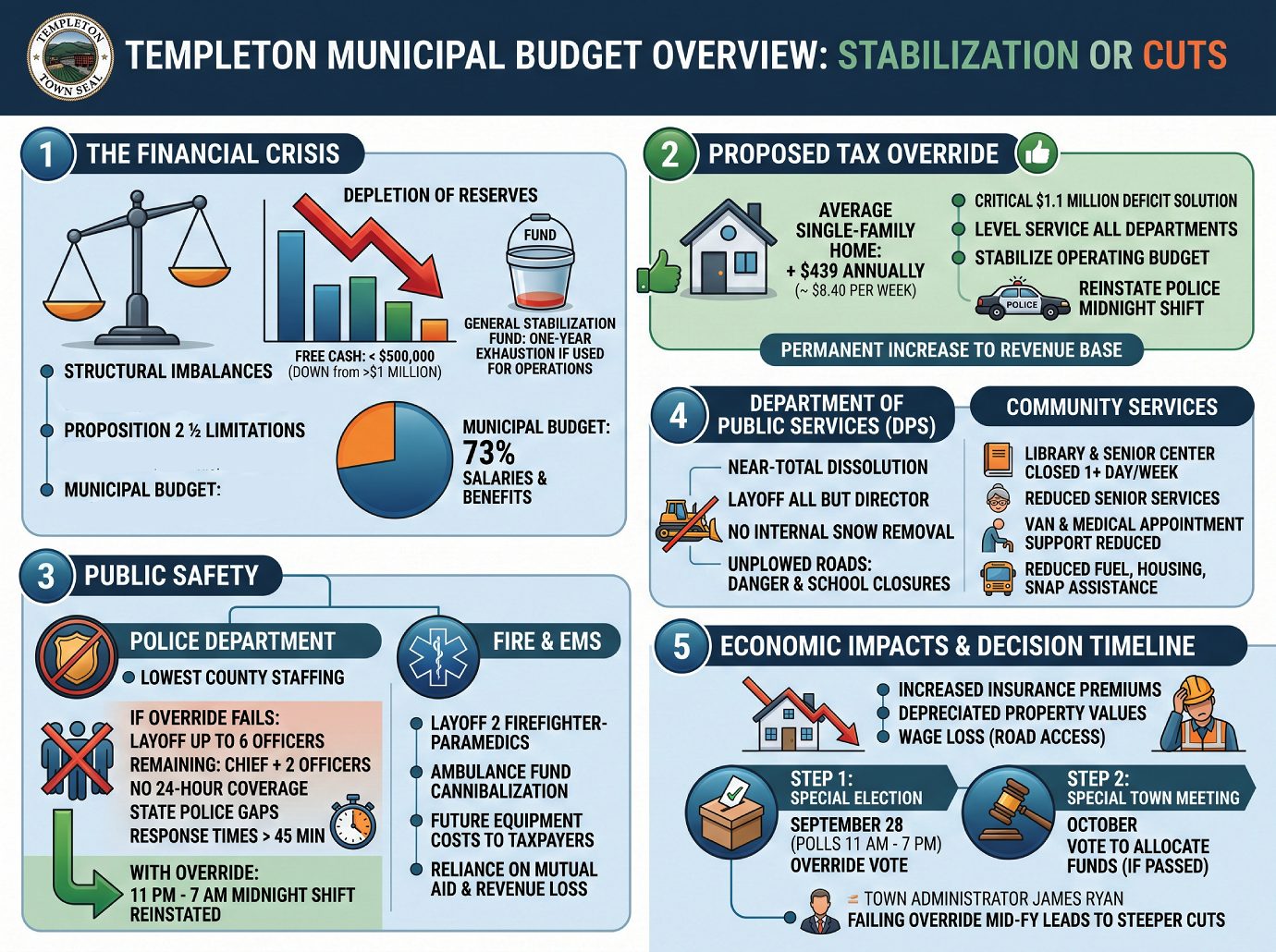
The Town of Templeton faces a critical $1.1 million budget deficit that threatens the continuity of essential municipal services. On September 28, residents will vote on a $1.3 million tax override designed to stabilize the town’s operating budget. Approval of the override would allow the town to “level service” its departments and reinstate a dedicated police midnight shift. Failure to pass the override will trigger drastic personnel cuts, effectively shuttering the Department of Public Services (DPS) and reducing the Police Department to only the Chief and two officers. For the average single-family home, the override represents an estimated increase of $439 annually, or approximately $8.40 per week.
Overview of the Financial Crisis
The current deficit is the result of years of structural financial imbalances. The town has historically avoided asking for tax increases by implementing expense-side cuts—often deferring equipment replacement and maintenance—and using one-time revenue sources like “free cash” to plug operating gaps.
- Depletion of Reserves: Free cash certification has dropped from over $1 million to under $500,000 in just a few years.
- Limitations of One-Time Funds: Town officials emphasize that the $1.5 million general purpose stabilization fund cannot solve the problem; using it for operating expenses would exhaust the fund within a year, leaving the town in an even worse position.
- Revenue Constraints: Proposition 2 ½ limits annual tax levy increases. The override provides a permanent increase to the revenue base, which is necessary to cover recurring operating costs such as salaries and benefits, which comprise 73% of the municipal budget.
Impact on Public Safety
Police Department
The Templeton Police Department currently operates with the lowest number of officers per 1,000 residents in Worcester County.
- Consequences of Override Failure: The department would be forced to lay off up to six officers, leaving only the Chief and two officers. This staffing level is insufficient to maintain even a consistent day shift, let alone 24-hour coverage.
- Loss of Midnight Shift: Currently, the town lacks an 11:00 p.m. to 7:00 a.m. shift. State Police coverage for this period is unreliable, as only two troopers cover a 500-square-mile area. Response times can reach 45 minutes or more.
- Operational Strain: Existing officers are working 60 to 80 hours per week to cover gaps. Two officers have already left due to job insecurity, and two others are out with injuries.
- Long-term Recovery: Rebuilding the department would take over a year per officer due to academy and field training requirements, assuming qualified candidates can be recruited.
Fire and EMS
- Staffing Reductions: Failure of the override would result in the layoff of two firefighter-paramedics.
- Ambulance Fund Cannibalization: To save the general fund, the town has shifted firefighter salaries to the ambulance receipts account. This account, intended for capital needs like ambulances and defibrillators, will eventually become insolvent, forcing equipment costs back onto the taxpayers.
- Service Disruptions: Loss of staff may lead to reliance on mutual aid from neighboring towns (Winchendon or Hubbardston). This results in a loss of revenue for Templeton, as the responding agency collects the insurance payments.
Impact on Infrastructure and Community Services
Department of Public Services (DPS):The most visible impact of a failed override would be the near-total dissolution of the DPS.
- Staffing Cuts: Every employee in the department would be laid off except for the Director. This includes highway staff, mechanics, and buildings and grounds personnel.
- Snow Removal: The town would lose its ability to plow roads internally. Outsourcing is difficult and expensive, as the state pays significantly higher rates for private plow contractors.
- Safety and Schools: Unplowed roads pose a danger to public safety vehicles and would likely lead to frequent school closures, disrupting parents’ ability to work.
- Maintenance: Maintenance of municipal buildings, parks, and cemeteries would cease.
Community Services
- Library and Senior Center: Both facilities would be forced to close at least one additional day per week.
- Senior Support: Reductions would impact van services for medical appointments and assistance programs for fuel, housing, SNAP, and other essential benefits.
Economic and Strategic Considerations: Town leadership identifies several hidden costs associated with voting against the override:
Factor Potential Negative Impact of Override Failure Insurance Premiums Home insurance rates may increase due to diminished public safety services. Property Values Real estate values may depreciate as municipal services (schools, safety, infrastructure) decline. Employment Residents may lose wages if unmaintained roads prevent them from reaching their jobs. Grants While the town pursues grants, these funds only cover one-time projects and cannot be used for the salaries and benefits that drive municipal operations. Timeline for Decision: The town has outlined a two-step process for resolving the budget crisis:
- Special Election (September 28): Residents vote on the authority to tax above the levy limit. Polls are open from 11:00 a.m. to 7:00 p.m.
- Special Town Meeting (October): If the override passes, the town meeting must then vote to officially allocate the funds to the specific departments.
Town Administrator James Ryan noted that because this vote occurs mid-fiscal year, the cuts implemented in the event of a failure must be “steeper” to compensate for funds already spent during the first portion of the year.

- Police Local Endorses Override
Publisher’s Note: Gardner Magazine research has found that in communities which have substantially cut public safety funding the following consequences have occurred: 1. Property values have decreased 10 to 15% which in Templeton is $40,000 to $60,000 on the average home (compared to average annual cost of $439 of YES vote) 2. In both large cities and small towns, a substantial cutback on public safety funding has resulted in a documented increase in crime.
Templeton MA Police Local 155 Endorses YES vote on Override
The Templeton MA Police Local 155 released a statement in support of a YES vote on the September 28th override.
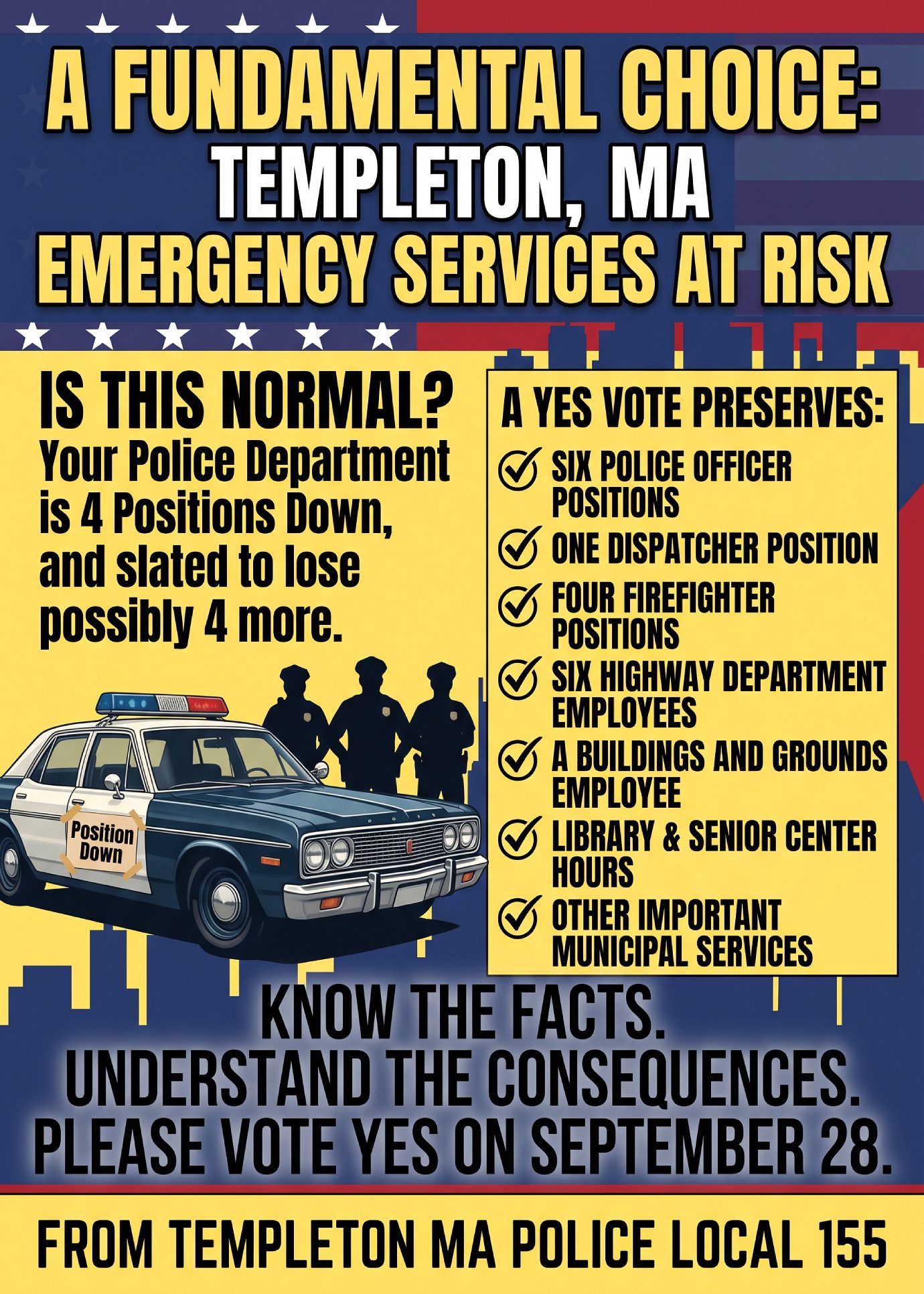
Statement: Templeton MA Police Local 155 Has Anyone asked the Question why Emergency Services have been hit so hard? Is this Normal under these circumstances? Currently Your Police Department is 4 Position down, and slated to lose possibly 4 more.
A Fundamental Choice
On September 28, Templeton voters will make a decision about the future of essential public services.
The proposed override would preserve:
Six police officer positions
One dispatcher position
Four firefighter positions
Six Highway Department employees
A Buildings and Grounds employee
Library and Senior Center hours
Other important municipal services
This is not an abstract budget question. It’s about whether Templeton will have the people necessary to answer emergencies, protect neighborhoods, maintain roads and serve residents.
Know the facts. Understand the consequences. Please vote YES on September 28.
- Templeton 9-14-26
Templeton Select Board Meeting August 14, 2026 Templeton Select Board Meets on Regular Items and has Special Guests
Narragansett School District Superintendent Chris Casavant spoke to the Select Board about Civic Engagement. Gardner Mayor Michael Nicholson spoke on grant funding opportunities and answered questions about how Gardner has been successful with grants. The Templeton Select Board took up a number of agenda items. Listen to the entire September 14, 2026 meeting on any device, CLICK PLAY.
Templeton Select Board 9-14-26 The Select Board approved a Special Town Meeting for Wednesday October 21, 2026 at 6pm
The Select Board meeting centered on the upcoming fiscal override vote scheduled for September 28, 2026, and its profound implications for town operations, particularly public safety.
- Public Safety Crisis: The Fire Department is operating at a significant deficit, facing three vacancies with two more departures imminent. The board authorized immediate job postings to mitigate response risks.
- Fiscal Strategy: A detailed proposal was reviewed regarding the transition to a professional grant-writing firm (such as Keller Partners or other fim ) to secure federal and state funding, modeled after the successful program in the City of Gardner.
- Civic Engagement: The board is initiating a partnership with the Narragansett Regional School District to integrate students into local governance through mock town meetings and voting education.
- Administrative Reform: A policy workshop is scheduled for September 24 to refine Select Board operating procedures, specifically addressing citizen input follow-up and meeting efficiency.
- Energy Assistance: Approximately $6,700 in interest from town trust funds has been identified for heating assistance to residents in need.
- Hiring Authorization: Despite a general hiring freeze, the board voted to allow the Fire Chief to post for full-time firefighter positions. This proactive measure aims to have applications ready for review immediately following the September 28 override vote.
- On-Call Roster: To reduce overtime costs and ensure coverage, the board authorized the hiring of additional on-call firefighters. These positions are paid only when they respond to calls, though the town must cover equipment costs (gear) for new hires. CLICK Infographic for larger view.
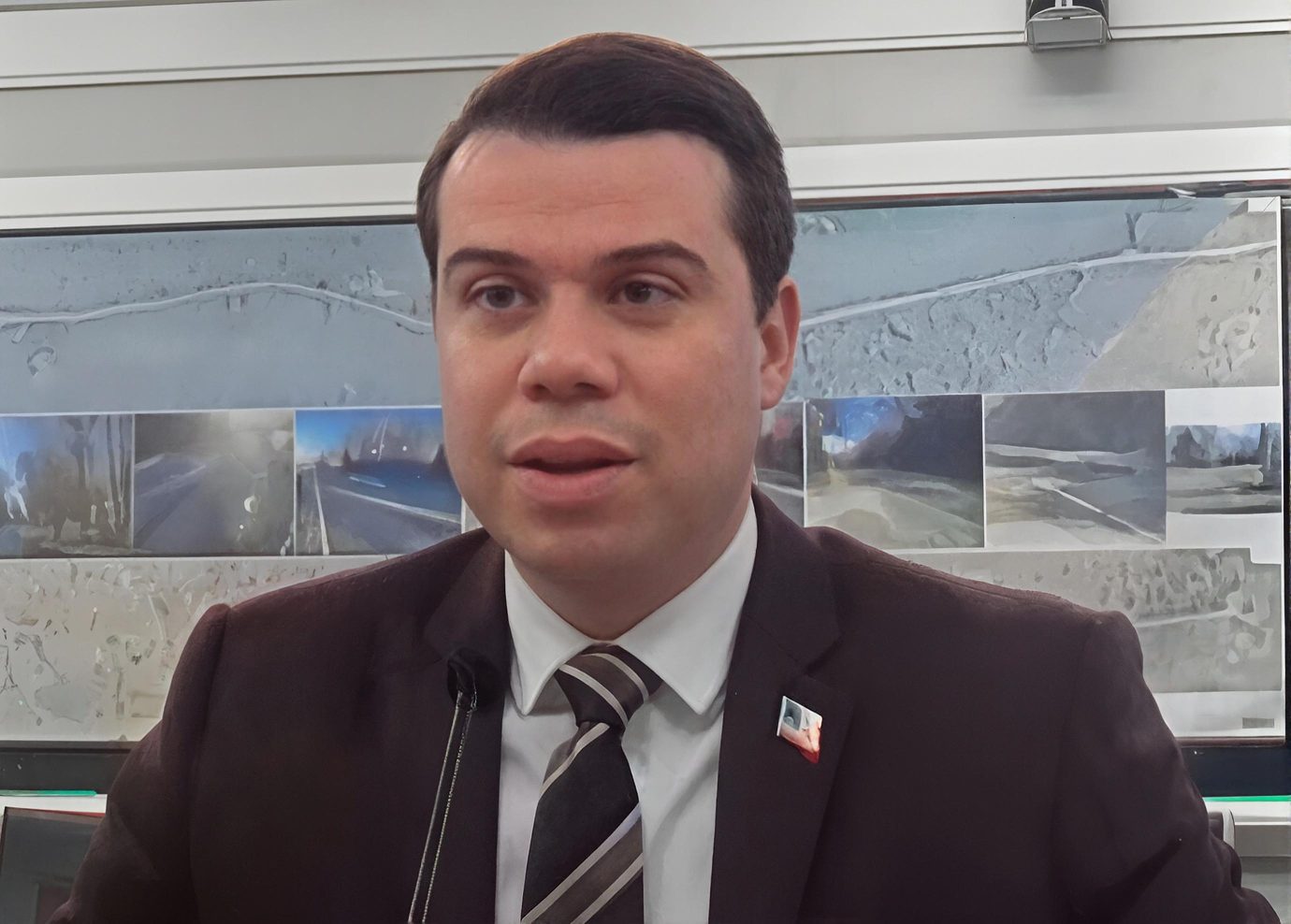
Gardner Mayor Michael Nicholson at Templeton Select Board Meeting of August 14, 2026 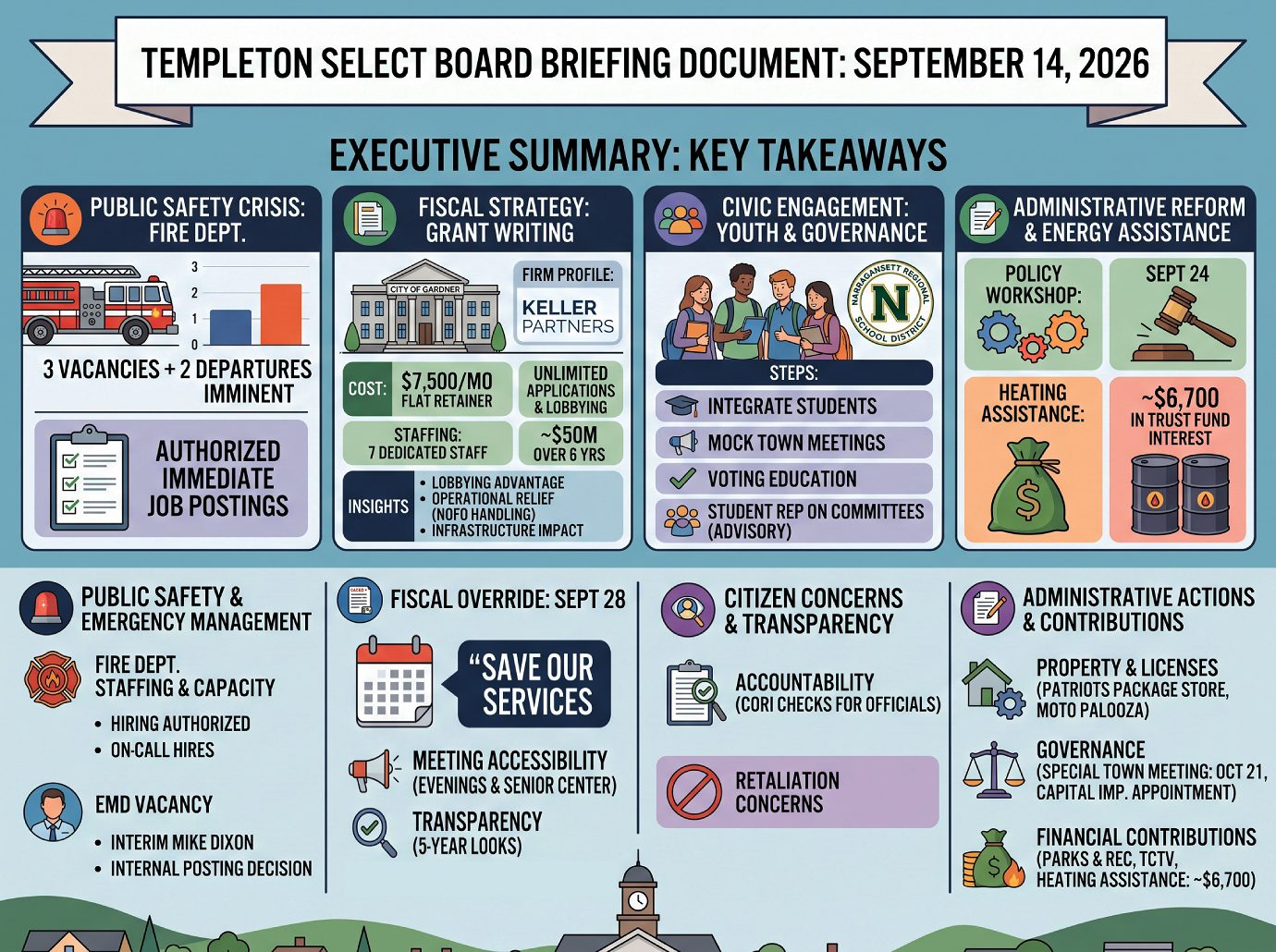
- Editorial – Templeton Override

Editorial: Why Voting for the Templeton Override Makes Sense
Why voting for the $1.38 million override in the Templeton Special election on September 28, 2026 makes sense:
Why voting for the override is in your best interest – the real reasons: In my opinion, finger-pointing is not the answer. I don’t think any municipal government in this State is as efficient as it could be, but that’s because I’m cheap and try to spend both sides of a quarter – I have unrealistic expectations.
Voters approved the School Budget narrowly which has left the rest of the town budget in crisis if the override is not approved. Just like everybody else, I don’t like my taxes going up, but, and here’s the big but, I’d rather spend an extra dollar or 2 per day to have full police coverage, to have full fire coverage, and to have other departments fully staffed and have the services we’ve come to expect.
While I have no current intention to sell my Templeton home, I would like to have the option. If the override is defeated, it is likely that the value of the average home would fall by 10 to 15%, which could easily mean $40,000 – $60,000 loss for many homeowners in Templeton. Is it worth screwing ourselves over just to prove a point. I’m in favor of the override coming up on September 28th, not because I think having to do it is wonderful – but I do think voting for it is necessary to preserve the safety of people in the community, to preserve the character of Templeton, and to preserve property values. This is not something I pulled out of thin air – there is anecdotal evidence of property values falling in communities when funding has been cut. And once the damage is done, it’s hard to recover.
For whatever reason you choose to vote for the override on September 28th, there are so many people who will be positively impacted and I will tell you exactly who they are:
1. The Police, Fire, and other team members who will keep their jobs.
2. The person who’s life is saved because public safety personnel could arrive at their house fire or their auto accident.
3. The person who is saved because criminals will know that Templeton is defended by our men and women in blue and not left open to marauders who would take advantage of the security lapse.
4. The person who does decide to sell their home, and instead of taking a huge loss actually gets full value because people hear that Templeton is a great community and want to move here.
5. The children you have now who later in life will thank you for keeping the wonderful character of Templeton alive and well.
6. You – it will positively impact you and it’s a relatively small price to pay for the benefit.
Werner Poegel – Publisher.
- State Rep Race
Update 9-4-26 9am: Nate Boudreau has formally endorsed Gardner Mayor Michael Nicholson stating: “this November, I’m voting for Michael J. Nicholson” Read Boudreau’s entire statement here on PDF, CLICK HERE.
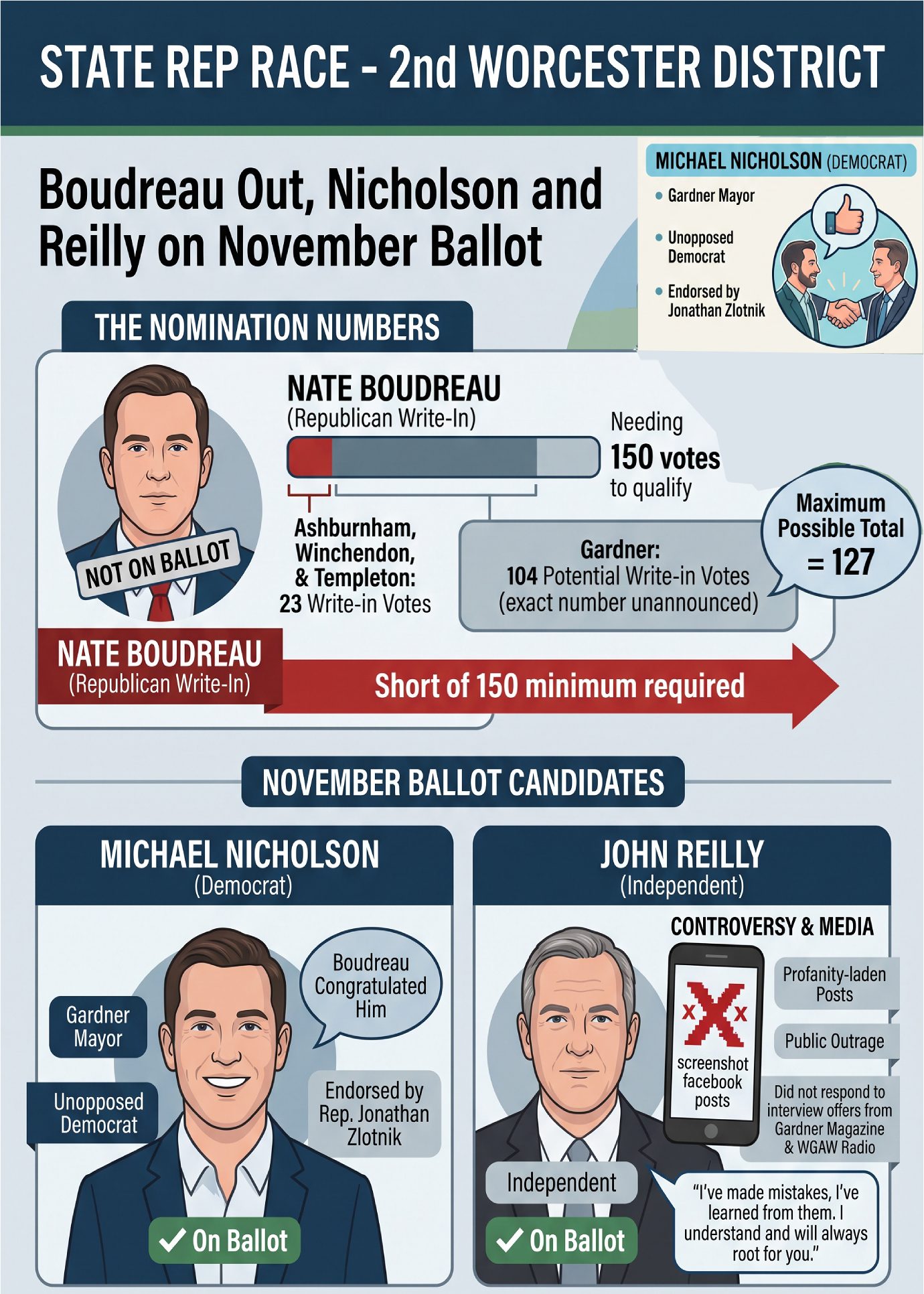
Nate Boudreau Out, Nicholson and Reilly on November Ballot in 2nd Worcester District Rep Race
While the exact number of write-in Republican votes for Nathan Boudreau in Gardner has not been announced, a win is a mathematical impossibility. The candidate won a total of 23 write-in votes total among Ashburnham, Winchendon, and Templeton. If Boudreau ends up winning 100% of the write-in 104 votes from Gardner, the total would still be only 127, 23 short of the 150 minimum required to secure the Republican nomination and be on the November ballot. Gardner Mayor Michael Nicholson was unopposed as a Democrat, and John Reilly is running as an Independent.
Boudreau prematurely congratulated Mike Nicholson in a post: “First, congratulations to Representative-elect Mike Nicholson. I wish him well, and I sincerely hope he succeeds for Gardner, Ashburnham, Templeton and Winchendon. When he succeeds for this district, we all do.” Boudreau also thanked his supporters. There is a reason why Nate Boudreau did not consider that John Reilly has a realistic chance – Besides Reilly’s lack of government experience, it may be because it has become known that Reilly had a number of profanity-laden facebook posts which have been screenshot and publicized. (In our opinion, the Reilly posts were so nasty and vile we will not publish them here.)
John Reilly Jr. responded to the public outrage by posting: “I did and said a lot of wild and crazy things when I was younger. I’ve never claimed to be perfect or a “mainstream candidate.” I’m in this for us though. I’ve made a lot of mistakes, I’ve learned from all of them. I’ve said and done a lot of things, some I wish I could take back. I never give up though. Everyone has to make adjustments from time to time. I understand and will always root for you.”
Interview Opportunities were offered to Reilly: Gardner Magazine has done interviews with Nicholson and Boudreau and offered the same opportunity to Reilly. Local radio station WGAW has done interviews with Nicholson and Boudreau and offered the same opportunity to Reilly and all candidates for office. Reilly has given no response.
The current State Representative of the 2nd Worcester District, Jonathan Zlotnik has publicly endorsed Gardner Mayor Michael Nicholson for the position.
- Templeton Select Board 8-24-26
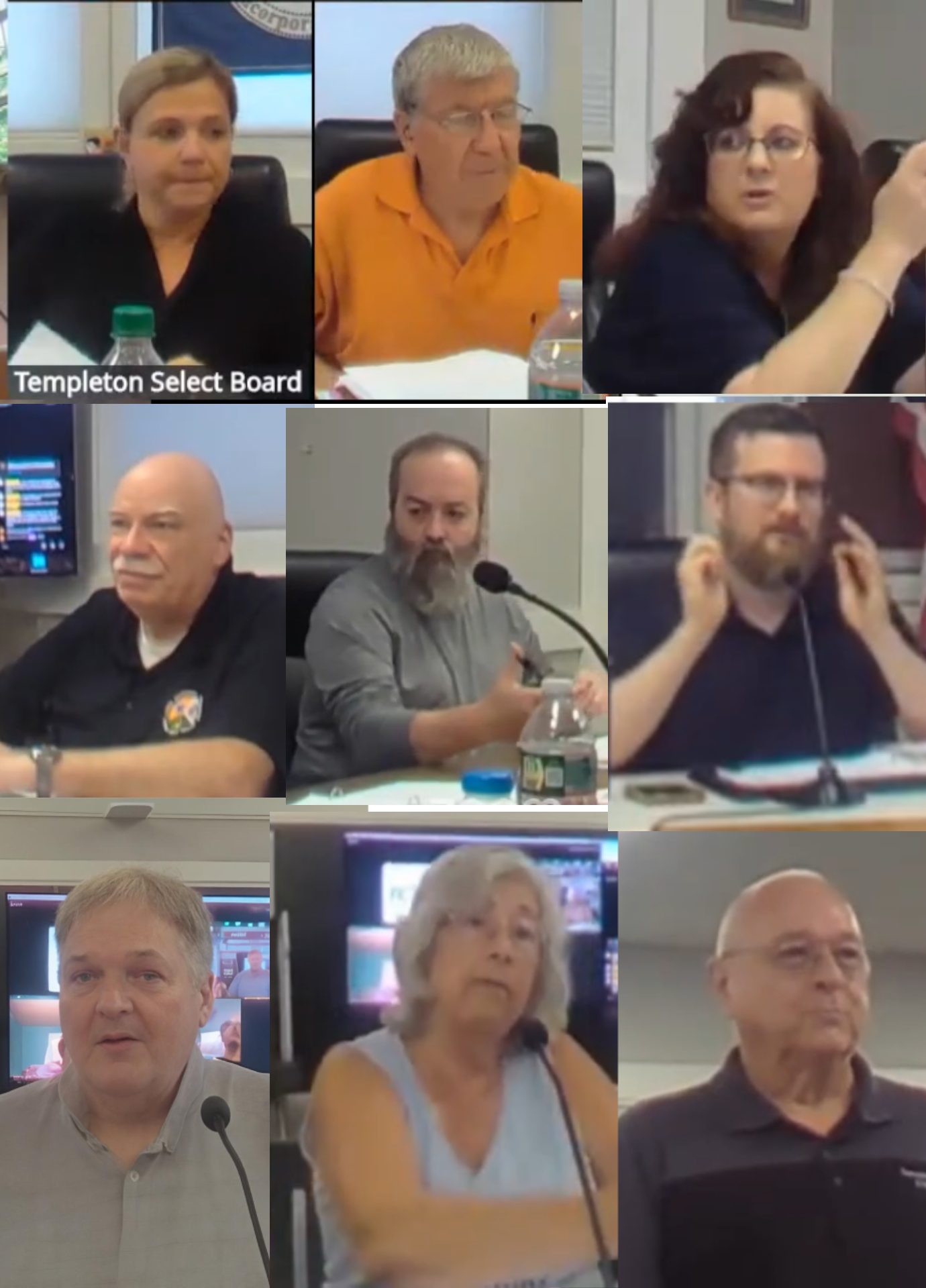
Templeton 2 Hour Select Board Meeting – Challenges and Transitions
Listen to the entire meeting on any device, CLICK PLAY.
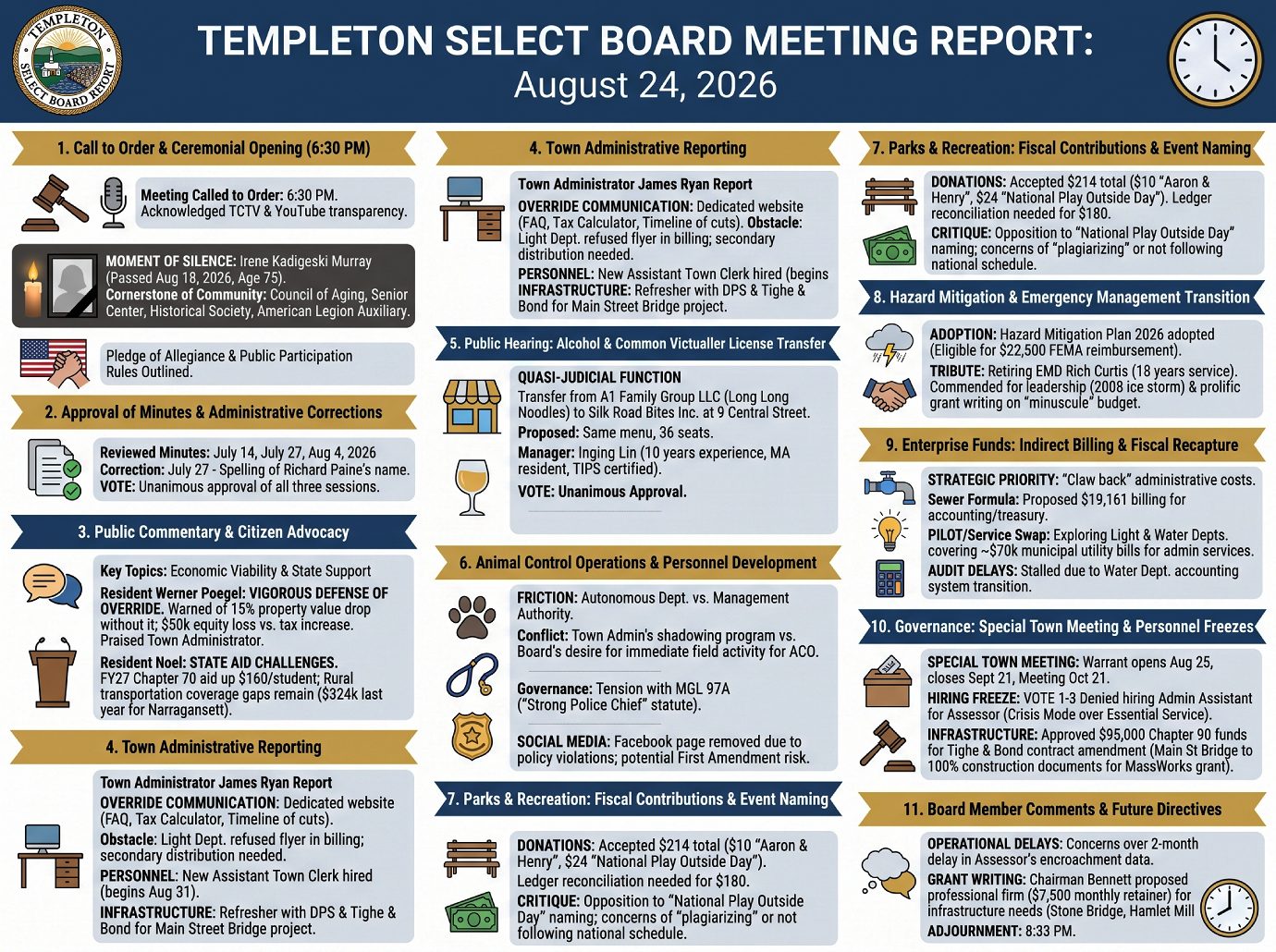
Templeton Select Board 8-24-26 The Templeton Select Board meeting of August 24, 2026 addressed critical municipal transitions and fiscal challenges. The session begins with a memorial for Irene Murray before moving into a public hearing regarding a restaurant license transfer for Long Long Noodle.. Substantial discussion follows concerning a proposed tax override, where residents and officials discuss the potential impact on property values and public safety services. The board also reviews the status of animal control officer training, updates on the Main Street Bridge project, and the retirement of the Emergency Management Director. Finally, the board explores strategies for indirect billing of enterprise funds and the pursuit of professional grant writing services to improve the town’s long-term financial health.
At the end of the meeting, Select Board Chair Bennett praised Gardner Mayor Nicholson who has reached out regarding grants. Here’s what Bennett said. CLICK PLAY.
Bennett re Nicholson 8-24-26 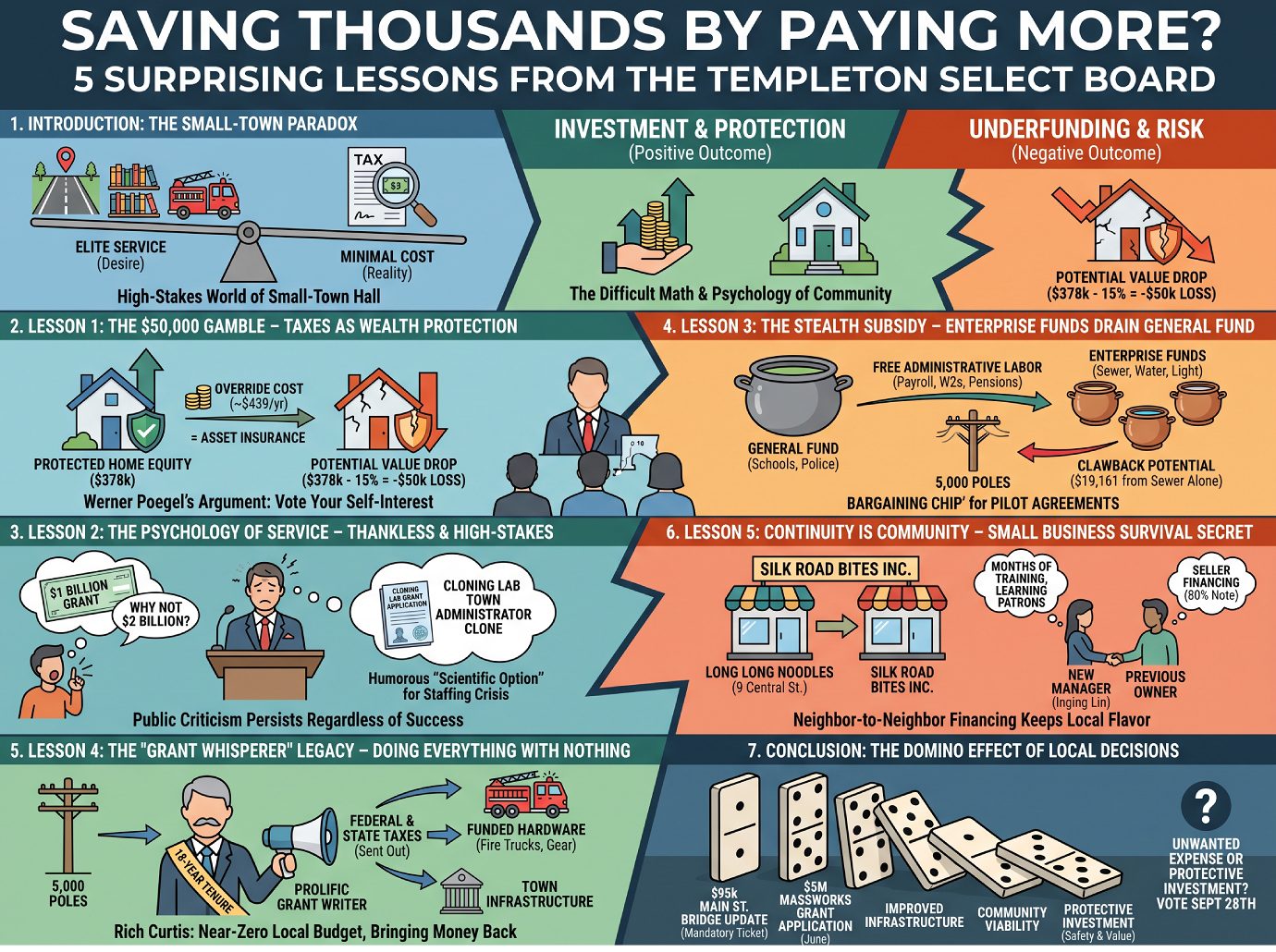














WGAW Weekdays In the Community



Greater Gardner Weather Center, CLICK HERE. 
The Fiscal 6 Project Covering 5 Years of Gardner Success, CLICK HERE 
Gardner City Council page, CLICK HERE 
Non-Profits – Public Service Organizations Listing, CLICK HERE 
Schools page, CLICK HERE 
Original Music page 
Interviews, CLICK HERE 
Gardner Magazine Editorials, CLICK HERE.










Around the Templeton MA Community
Community Facts
Templeton is a town in Worcester County Massachusetts with a population of around 8200 people. Templeton is unique with four main villages of Templeton Center, East Templeton, Baldwinville, and Otter River. The Town of Templeton records most meetings and uploads them to YouTube. To watch, CLICK HERE.
Schools
Narragansett Regional School District: (978) 939-5661
Narragansett Regional High School: (978) 939-5388
Narragansett Middle School: (978) 939-5928
Templeton Elementary School: (978) 939-8892
Government
Town Administrator: (978) 894-2755
Town Clerk: (978) 894-2758
Fire Department: (978) 939-2222
Police Department:(978) 939-5638
Select Board: (978) 894-2755
Organizations
Community Services: (978) 894-2783
Boynton Public Library: (978) 939-5582
Templeton Food Pantry: (508) 826-4258
Templeton Senior Community Center: (978) 894-2780
Interactive Map of Templeton MA
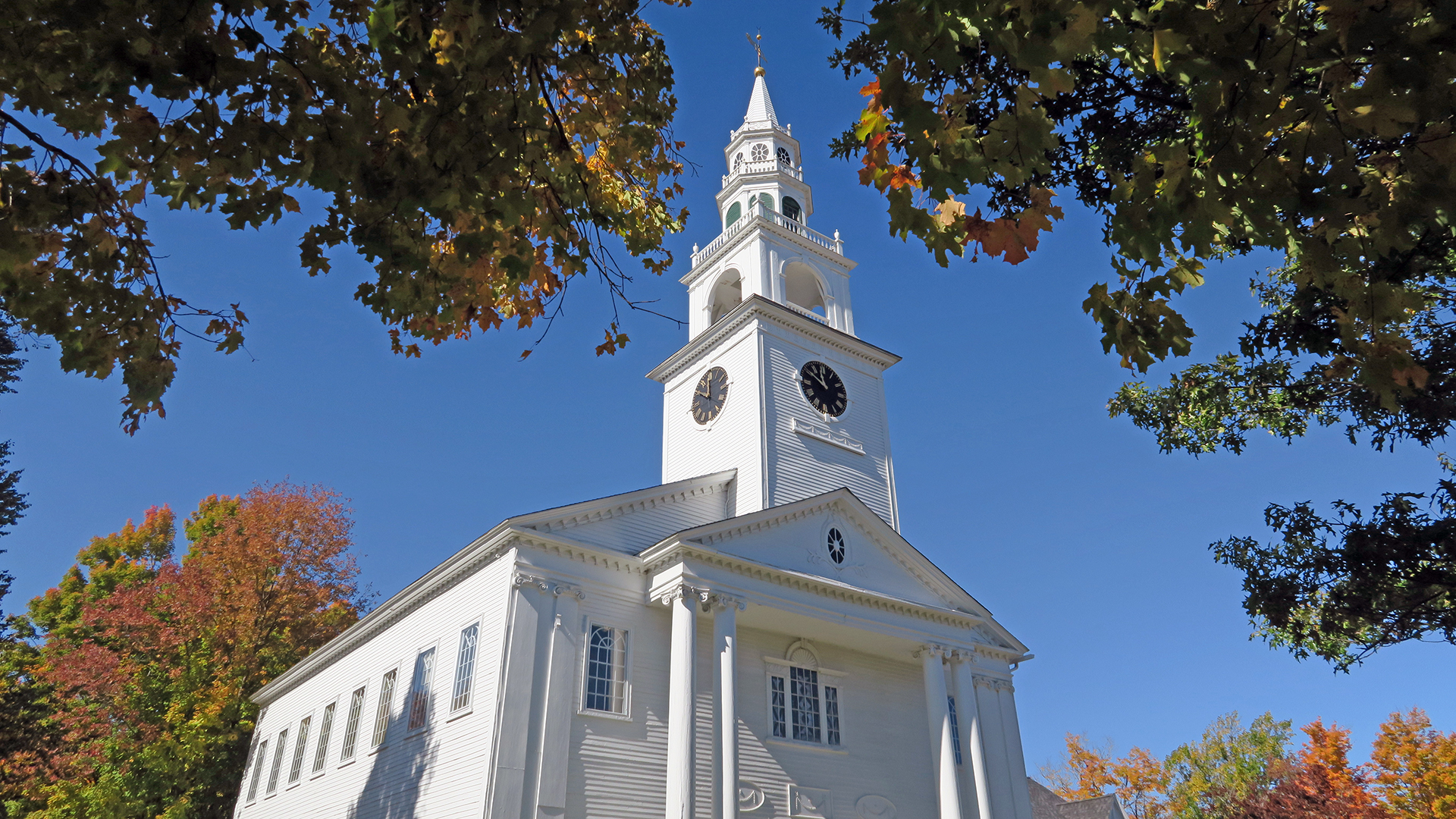
Town of Templeton MA Photos

Gardner Magazine Service Pages and Outside Links for Templeton MA



























Gardner Magazine Cities and Towns
Other Helpful Resources on the WebTech Online Network