
GAAMHA – Non-Profit Human Services Organization – Gardner Magazine Reports

Jump to a page section:
GAAMHA: Redefining Community Support and Human Services
GAAMHA Program Service Portfolio: A Multi-Disciplinary Intervention Ecosystem
Here are five ways this ecosystem is redefining the architecture of community support.
Watch this video which explains GAAMHA:
Listen to this DEEP DIVE on any device, CLICK PLAY.
GAAMHA: Redefining Community Support and Human Services
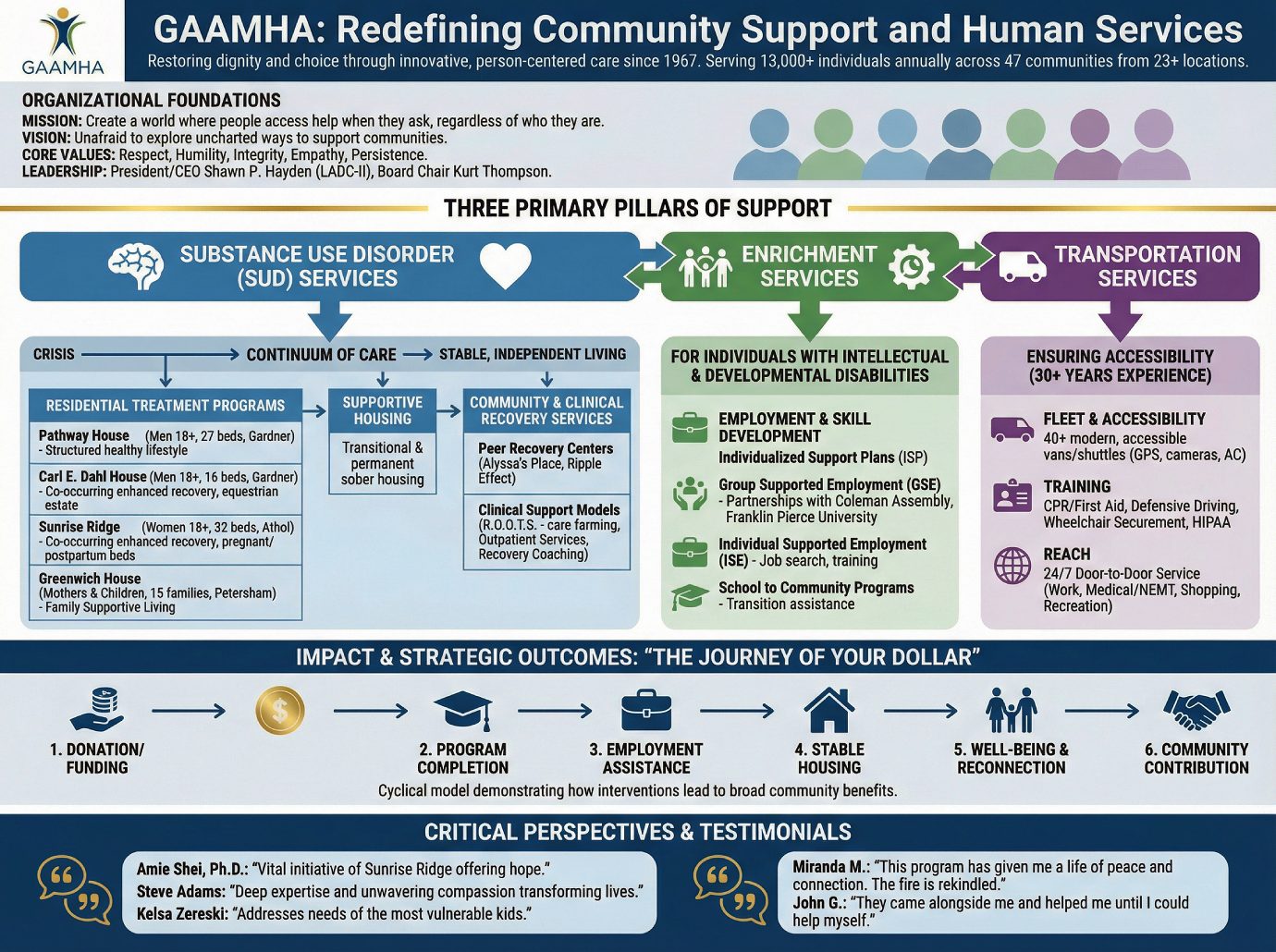
GAAMHA: Redefining Community Support and Human Services
Summary
GAAMHA is a comprehensive human services ecosystem based in Gardner, Massachusetts, dedicated to restoring dignity and choice to individuals in need of support. Established in 1967, the organization has spent over 58 years challenging the status quo of traditional support methods through innovative, person-centered care. GAAMHA serves more than 13,000 individuals annually across 47 communities, operating from over 23 program locations.
The organization’s service model is built upon three primary pillars: Substance Use Disorder (SUD) Services, Enrichment Services for individuals with intellectual and developmental disabilities, and Transportation Services. By integrating clinical care, housing, employment assistance, and peer support, GAAMHA facilitates a “continuum of care” designed to transition clients from crisis to stable, independent living and active community contribution.
——————————————————————————–
Organizational Foundations
Mission and Vision
• Mission: To create a world where people can access help when they ask for it, regardless of who they are.
• Vision: To be a human services organization unafraid to explore uncharted ways to support its communities.
• Core Values: Respect, Humility, Integrity, Empathy, and Persistence.
Leadership and Governance
GAAMHA is led by President/CEO Shawn P. Hayden (LADC-II) and a specialized team of directors covering clinical services, developmental services, peer services, and operations. The organization is governed by a Board of Directors chaired by Kurt Thompson.
——————————————————————————–
Substance Use Disorder (SUD) Services
GAAMHA provides a person-centered recovery ecosystem that combines clinical treatment with housing and peer support.
Residential Treatment Programs
The organization operates several specialized residential facilities designed for sustainable recovery:
| Program | Target Demographic | Capacity/Location | Description |
|---|---|---|---|
| Pathway House | Men (18+) | 27 beds; Gardner, MA | Highly structured residential treatment for healthy lifestyle adoption. |
| Carl E. Dahl House | Men (18+) | 16 beds; Gardner, MA | Co-occurring enhanced recovery set on a 115-acre equestrian estate. |
| Sunrise Ridge | Women (18+) | 32 beds; Athol, MA | Co-occurring enhanced recovery; includes 4 beds for pregnant/postpartum women. |
| Greenwich House | Mothers & Children | 15 families; Petersham, MA | Family Supportive Living focusing on strengthening family bonds during recovery. |
| Supportive Housing | Adults (18+) | Various | Transitional and permanent sober housing for those returning to independent living. |
Community and Clinical Recovery Services
• Peer Recovery Centers:
◦ Alyssa’s Place (Gardner): A CAPRSS-certified resource center for individuals in recovery and their loved ones.
◦ Ripple Effect (Leominster): The first center of its kind in Leominster, filling a critical service gap in a major gateway city.
• Clinical Support Models:
◦ R.O.O.T.S. (Gardner): An innovative program for ages 12–24 that integrates “care farming” with therapeutic services.
◦ Outpatient Services: Person-centered, trauma-informed individual and group therapy.
◦ Recovery Coaching & Navigation: Personalized case management and social systems navigation.
——————————————————————————–
Enrichment Services
These programs are designed to help adults with intellectual and developmental disabilities find “a seat at the table” through training, employment, and community engagement.
Employment and Skill Development
• Individualized Support Plans (ISP): Every participant creates a plan based on their unique passions and needs.
• Group Supported Employment (GSE): Supports skill development through collaborations with partners like Coleman Assembly & Packaging, Franklin Pierce University’s dining hall, and internal cleaning and clerical crews.
• Individual Supported Employment (ISE): Employment Specialists assist with resumes, job searches, interviews, and on-the-job training for community-based roles.
• School to Community Programs: Facilitates the transition for students moving from the school system into adult community programs.
——————————————————————————–
Transportation Services
With over 30 years of experience, GAAMHA’s transportation wing ensures that communal experiences remain accessible, serving more than 200 riders daily.
Service Features
• Fleet and Accessibility: Operates over 40 modern, fully accessible vans and shuttles equipped with GPS, audio-enabled cameras, and air conditioning.
• Training: Drivers are trained in CPR/First Aid, Defensive Driving, Wheelchair Securement, and HIPAA compliance.
• Reach: Provides 24/7 door-to-door service for work, medical appointments (Non-Emergency Medical Transportation), shopping, and recreation.
——————————————————————————–
Impact and Strategic Outcomes: “The Journey of Your Dollar”
GAAMHA utilizes a cyclical model of support that demonstrates how interventions lead to broad community benefits:
1. Donation/Funding: Enables client enrollment in specialized programs.
2. Program Completion: Clients progress through the continuum of care.
3. Employment Assistance: Clients secure work, fostering independence and self-worth.
4. Stable Housing: Employment income leads to housing stability.
5. Well-being and Reconnection: Stability improves mental/physical health and allows for family reunification.
6. Community Contribution: Thriving individuals give back to the community via volunteering, which encourages further investment in GAAMHA.
——————————————————————————–
Critical Perspectives and Testimonials
Partner Insights
• Amie Shei, Ph.D. (The Health Foundation of Central MA): Highlights the “vital initiative” of Sunrise Ridge in offering hope to women.
• Steve Adams (President, CFNCM): Credits the team’s “deep expertise” and “unwavering compassion” for transforming lives, specifically through the Dahl House program.
• Kelsa Zereski (President, Reliant Foundation): Notes that GAAMHA’s approach addresses the needs of the “most vulnerable kids” in the community.
Participant Testimonials
• Miranda M. (Sunrise Ridge Resident): “This program has given me a life of peace and connection. The fire is rekindled in me.”
• John G. (Dahl House Alumni): “They came alongside me and helped me until I could help myself.” ————————-
GAAMHA Program Service Portfolio: A Multi-Disciplinary Intervention Ecosystem
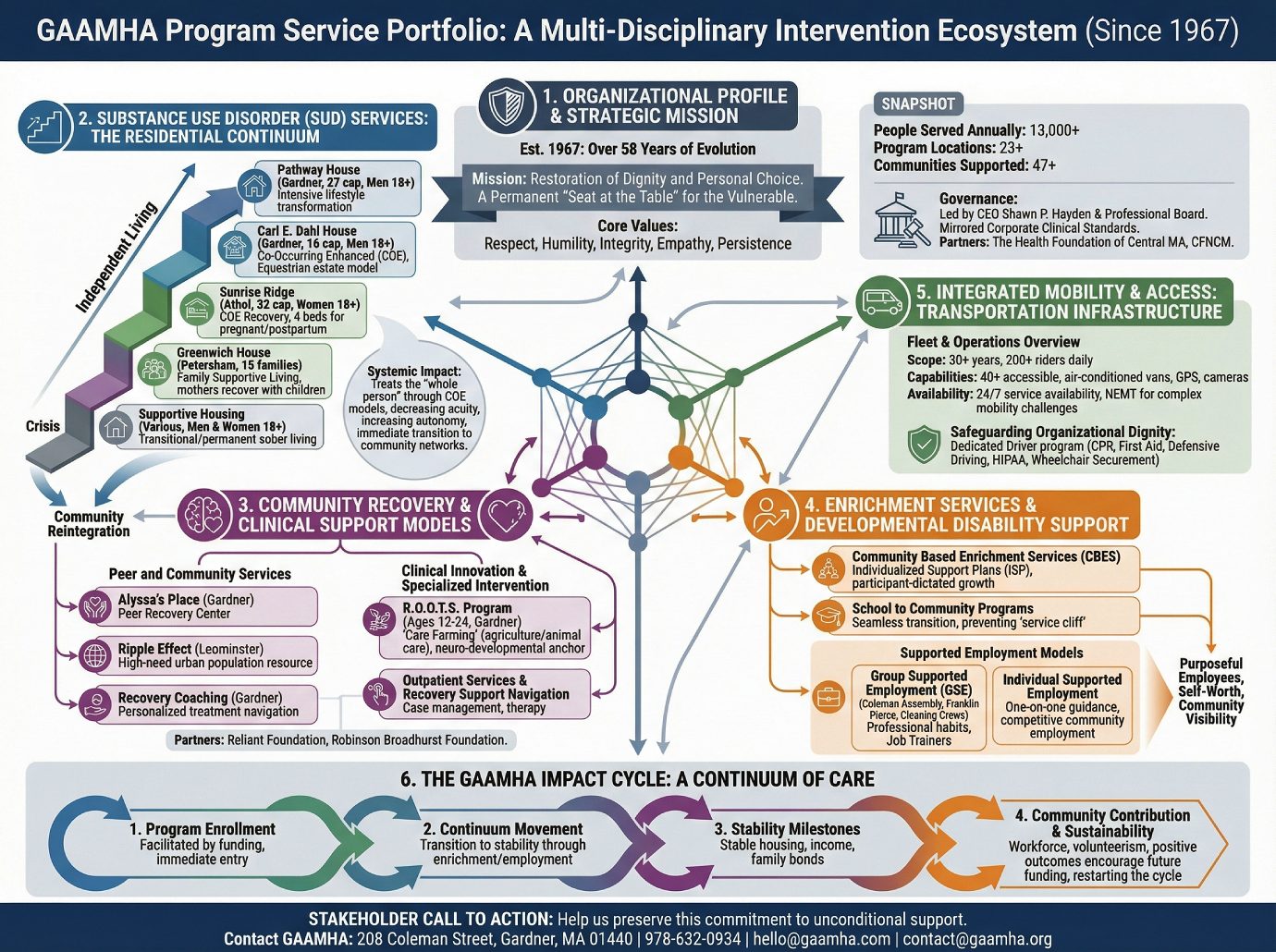
GAAMHA Program Service Portfolio: A Multi-Disciplinary Intervention Ecosystem
1. Organizational Profile and Strategic Mission
Established in 1967, GAAMHA has spent over 58 years evolving from a localized service provider into a sophisticated human services ecosystem. This architecture is designed to challenge the status quo of community support by moving beyond mere administrative aid to a philosophy rooted in the restoration of dignity and personal choice. By functioning as a resource, partner, and employer, GAAMHA mitigates the longitudinal risks of chronic homelessness, systemic poverty, and recidivism, ensuring that the most vulnerable members of society have a permanent “seat at the table.”
Organizational Snapshot: Strategic Reach and Metrics
| Metric | Impact Detail |
|---|---|
| People Served Annually | 13,000+ individuals across the care continuum |
| Program Locations | 23+ specialized facilities |
| Communities Supported | 47+ municipalities in Massachusetts and beyond |
| Core Values | Respect, Humility, Integrity, Empathy, and Persistence |
GAAMHA’s mission—to ensure help is accessible to all who ask—is realized through a narrative of innovation and “uncharted” service methods. This high-stakes intervention model is stabilized by a rigorous governance structure. Led by President and CEO Shawn P. Hayden and a professional Board of Directors, the organization maintains an oversight level that mirrors corporate clinical standards. This professional rigor is validated by institutional partners such as The Health Foundation of Central Massachusetts and the Community Foundation of North Central Massachusetts (CFNCM), whose investments acknowledge GAAMHA’s capacity for transforming regional health outcomes.
——————————————————————————–
2. Substance Use Disorder (SUD) Services: The Residential Continuum
Since 1972, GAAMHA has utilized residential treatment as the cornerstone for “contented and sustainable recovery.” This domain is not a static collection of beds but a tiered residential intervention designed to guide individuals from the volatility of crisis to the stability of independent living.
Residential Treatment Portfolio
| Program Name | Target Demographic/Capacity | Location | Unique Service Model & Strategic Impact |
|---|---|---|---|
| Pathway House | Men 18+ (27 capacity) | Gardner, MA | Intensive, highly structured residential treatment focused on radical lifestyle transformation and the adoption of healthy behavioral habits. |
| Carl E. Dahl House | Men 18+ (16 capacity) | Gardner, MA | Co-Occurring Enhanced (COE): A 115-acre equestrian estate model that treats mental health and substance use simultaneously rather than sequentially. |
| Sunrise Ridge | Women 18+ (32 capacity) | Athol, MA | COE Recovery Home: Specialized clinical support including a dedicated 4-bed provision for pregnant and postpartum women to ensure maternal-child stability. |
| Greenwich House | Mothers & Children (15 families) | Petersham, MA | Family Supportive Living: An innovative model allowing mothers to recover alongside their children, breaking the cycle of generational trauma. |
| Supportive Housing | Men & Women 18+ | Various | Transitional and permanent sober living that serves as the final bridge to independent living for individuals post-residential treatment. |
Systemic Impact: From Crisis to Community Reintegration
The strategic “so what” of this continuum lies in its ability to treat the “whole person” through specialized models. By employing the COE (Co-Occurring Enhanced) model at sites like the Dahl House, GAAMHA addresses complex clinical profiles that traditional, single-focus programs often fail to stabilize. This tiered architecture ensures that as a resident’s clinical acuity decreases, their personal autonomy increases, supported by an immediate transition into community-integrated clinical and peer networks.
——————————————————————————–
3. Community Recovery and Clinical Support Models
As individuals exit residential care, the GAAMHA ecosystem provides the “connective tissue” required to prevent recidivism. This phase shifts from intensive supervision to community-integrated support, heavily leveraging the power of lived experience.
Peer and Community Services
• Alyssa’s Place (Gardner, MA): A CAPRSS-certified Peer Recovery and Resource Center fostering a localized support network for individuals and families.
• Ripple Effect (Leominster, MA): Strategically located in one of Massachusetts’ largest “Gateway Cities,” this center fills a critical high-stakes service gap, providing a first-of-its-kind resource for a high-need urban population.
• Recovery Coaching (Gardner, MA): Offers personalized, affordable treatment navigation, helping individuals rebuild the social capital necessary for long-term recovery.
Clinical Innovation and Specialized Intervention
GAAMHA’s clinical methodology is characterized by trauma-informed, person-centered care, supported by institutional stakeholders like the Reliant Foundation and the Robinson Broadhurst Foundation.
A primary differentiator in this domain is the R.O.O.T.S. program (Ages 12-24, Gardner, MA). By integrating “care farming” (agriculture and animal care) with therapeutic services, R.O.O.T.S. builds “habits of consistency” in vulnerable youth. The responsibility of maintaining living systems provides a neuro-developmental anchor that traditional talk therapy alone cannot provide for this demographic. These efforts are augmented by Outpatient Services and Recovery Support Navigation, which provide the essential case management and individual/group therapy required to navigate complex social systems.
——————————————————————————–
4. Enrichment Services and Developmental Disability Support
GAAMHA’s commitment to “supporting the whole human” ensures that adults with intellectual and developmental disabilities are active community contributors.
• Community Based Enrichment Services (CBES): This program utilizes the Individualized Support Plan (ISP) model, where participants dictate their own growth trajectories based on personal passions, ensuring true personal autonomy.
• School to Community Programs: Ensures a seamless transition for students aging out of the school system, preventing the “service cliff” that often leads to regression.
• Supported Employment Models:
◦ Group Supported Employment (GSE): Through partnerships with Coleman Assembly & Packaging and Franklin Pierce University, as well as internal units like the GAAMHA Cleaning Crews and various clerical positions, participants develop professional habits. Job Trainers focus on fostering the teamwork and communication skills necessary for workforce integration.
◦ Individual Supported Employment: Employment Specialists focus on the long-term career trajectory, providing one-on-one guidance in resume crafting, interviewing, and on-the-job training to secure competitive community employment.
These programs transform participants from passive recipients of care into purposeful employees, directly enhancing their self-worth and community visibility.
——————————————————————————–
5. Integrated Mobility and Access: Transportation Infrastructure
Reliable transportation is a fundamental determinant of health. Without access, the “ecosystem” remains fragmented. GAAMHA’s transportation infrastructure provides the physical mobility required for clients to access clinical care, employment, and social connection.
Fleet and Operations Overview
• Service Scope: 30+ years of operational experience, serving 200+ riders daily.
• Capabilities: A fleet of 40+ fully accessible, air-conditioned vans equipped with GPS and audio-enabled cameras.
• Operational Availability: While standard administrative hours are Monday–Friday (6am–5pm), GAAMHA provides 24/7 service availability to meet specific travel and scheduling needs for contracts and NEMT.
• Specialized Functions: Providing Non-Emergency Medical Transportation (NEMT) for individuals with complex mobility challenges.
Safeguarding Organizational Dignity
GAAMHA’s Dedicated Driver program is a critical risk-management and dignity-preservation tool. Drivers undergo rigorous certification, including CPR and First Aid, Defensive Driving, HIPAA compliance, and Wheelchair Securement. This ensures that the journey itself is a clinical extension of GAAMHA’s commitment to safety and respect.
——————————————————————————–
6. The GAAMHA Impact Cycle: A Continuum of Care
The service lines detailed above function as a single, powerful intervention ecosystem. When integrated, they create a predictable cycle of socioeconomic and personal improvement for the region.
The Journey of Impact
1. Program Enrollment: Facilitated by donor and partner funding, providing an immediate entry point into the system.
2. Continuum Movement: Clients transition from primary clinical or residential intervention to secondary stability through enrichment and employment.
3. Stability Milestones: Participants achieve critical markers including stable housing, sustainable income, and the reconnection of family bonds.
4. Community Contribution & Sustainability: Stable individuals contribute to the community via workforce participation and volunteerism. These positive outcomes encourage future institutional and private donations, ensuring the financial sustainability of the ecosystem and restarting the cycle for the next individual in need.
Stakeholder Call to Action
GAAMHA provides a higher standard of community support, moving beyond traditional methods to provide innovative, “uncharted” solutions. We invite stakeholders and partners to help us preserve this commitment to unconditional support.
Contact Information: GAAMHA 208 Coleman Street Gardner, MA 01440 Phone: 978-632-0934 Email: hello@gaamha.com / contact@gaamha.org —————————————————
Beyond the Safety Net: 5 Surprising Ways This “Human Services Ecosystem” is Redefining Community Support
For anyone who has ever navigated the labyrinth of community support, the experience is often defined by a crushing sense of fragmentation. You find a program for mental health, only to realize it doesn’t bridge the gap to housing. You secure a bed for recovery, but the path to employment remains a dead end. Too often, our social “safety net” feels less like a woven fabric and more like a series of disconnected ropes, leaving the most vulnerable among us to navigate the gaps alone.
In North Central Massachusetts, GAAMHA is quietly dismantling this fragmented status quo. With a 58-year legacy of service, GAAMHA has evolved from a traditional nonprofit into a sophisticated “human services ecosystem.” Based in Gardner but reaching far into the surrounding regions, they don’t just “treat” problems; they make communities whole by restoring dignity and choice to the individual.
Here are five ways this ecosystem is redefining the architecture of community support.
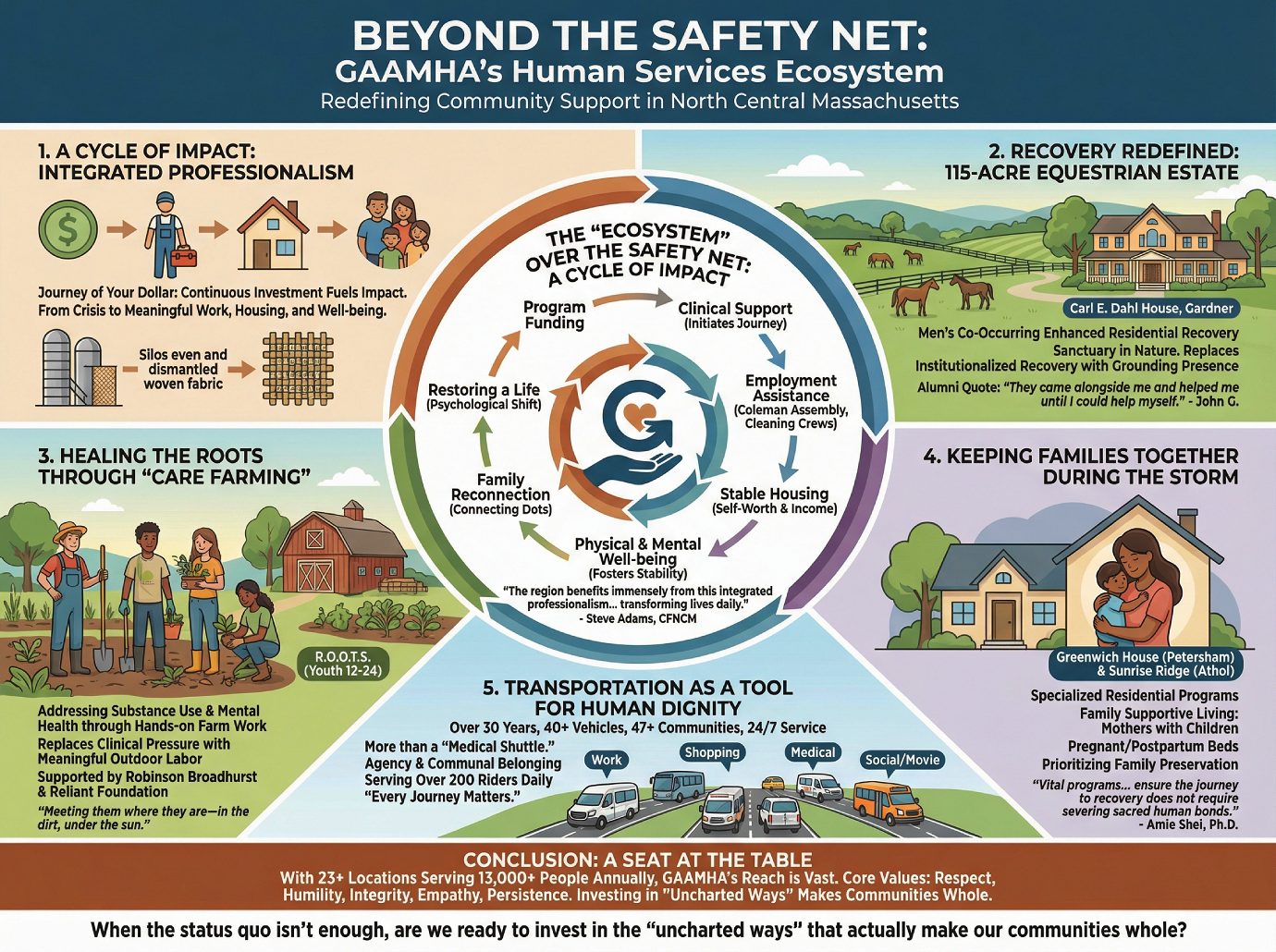
Here are five ways this ecosystem is redefining the architecture of community support.
1. The “Ecosystem” Over the Safety Net: A Cycle of Impact
Traditional social services often operate in silos, addressing a single crisis before moving the individual along. GAAMHA’s model recognizes that a human life cannot be compartmentalized. They describe this through the “Journey of Your Dollar”—a narrative of investment that fuels a continuous “Cycle of Impact.”
In this ecosystem, program funding is merely the catalyst. It initiates clinical support, which naturally transitions into employment assistance through initiatives like Coleman Assembly & Packaging or cleaning crews. As individuals secure meaningful work, they gain the self-worth and income necessary for stable housing. That stability, in turn, fosters the physical and mental well-being required to reconnect with families and loved ones. By connecting these dots, GAAMHA moves beyond temporary fixes toward a psychological shift: restoring a life rather than just managing a disorder.
As Steve Adams, President of CFNCM, observes, the region “benefits immensely” from this integrated professionalism, noting that the team’s “unwavering compassion and deep expertise transform lives daily.”
2. Recovery Redefined on a 115-Acre Equestrian Estate
The environment in which healing happens is often as vital as the clinical care itself. GAAMHA’s Carl E. Dahl House in Gardner represents a radical departure from the sterile, urban settings typical of residential care. Situated on a sprawling 115-acre equestrian estate, the Dahl House acts as a sanctuary where the landscape itself becomes a clinical partner.
This facility focuses on Men’s Co-Occurring Enhanced Residential Recovery, supporting those navigating the complex intersection of substance use and mental health challenges. Here, the “status quo” of institutionalized recovery is replaced by the grounding presence of the natural world. For alumni like John G., this shift in environment and approach was the turning point: “They came alongside me and helped me until I could help myself.”
3. Healing the Roots through “Care Farming”
Innovation at GAAMHA is particularly vibrant in their work with the next generation. The R.O.O.T.S. program serves youth and young adults (ages 12-24) in Gardner and Winchendon, addressing substance use and mental health through the innovative model of “care farming.”
For many “vulnerable kids,” a traditional clinical office can feel like an interrogation room. R.O.O.T.S. replaces that pressure with the grounding, hands-on work of a farm. By integrating therapeutic services with meaningful outdoor labor, healing feels natural rather than forced. This approach has gained significant local weight, receiving support from the Robinson Broadhurst Foundation for its impact in Winchendon. Kelsa Zereski, President of the Reliant Foundation, notes that this approach resonates deeply because it addresses the pressing needs of youth by meeting them where they are—in the dirt, under the sun, and away from the stigma of traditional therapy.
4. Keeping Families Together During the Storm
Perhaps the most heart-wrenching barrier to recovery is the fear that seeking help means losing one’s children. GAAMHA addresses this through specialized residential programs that prioritize family preservation. In the quiet community of Petersham, Greenwich House offers an innovative Family Supportive Living program where mothers can live with their children while participating in a recovery community.
This philosophy of “hope and healing” extends to Athol at Sunrise Ridge. While providing co-occurring enhanced recovery for women, the facility includes four specialized beds specifically designated for pregnant and postpartum women. As Amie Shei, Ph.D., of The Health Foundation of Central Massachusetts, emphasizes, these programs are “vital” because they ensure that the journey to recovery does not require the severing of the most sacred human bonds.
5. Transportation as a Tool for Human Dignity
In many rural or suburban communities, a lack of mobility is a sentence of isolation. GAAMHA views transportation not as a logistical detail, but as a fundamental tool for communal belonging. With over 30 years of experience, their service is far more than a “medical shuttle.”
Operating a fleet of 40+ fully accessible, air-conditioned vehicles, GAAMHA provides 24/7, person-centered transportation across 47+ communities. Dignity means more than just getting to a doctor’s appointment; it means having the agency to go to work, go shopping, or visit a movie theater. Serving over 200 riders daily, GAAMHA reinforces the idea that “every journey matters.” By making “communal experiences” accessible, they ensure that older adults and those with physical or sensory challenges remain active participants in the world around them.
Conclusion: A Seat at the Table
With 23+ locations serving 13,000+ people annually, GAAMHA’s reach is vast, yet its core remains intimate, guided by five central values: Respect, Humility, Integrity, Empathy, and Persistence.
Persistence is perhaps the most critical of these; it is the refusal to give up on an individual when traditional systems have exhausted their “safety net.” By weaving together clinical care, employment, and transportation, GAAMHA ensures that everyone—regardless of their struggle—has a seat at the table. They are proving that when we invest in the “uncharted ways,” we don’t just save individuals; we make our entire community whole.
When the status quo isn’t enough, are we ready to invest in the “uncharted ways” that actually make our communities whole?