

The History of Winchendon, Massachusetts, “The Toytown”
Listen to a “Deep Dive” about the History of Winchendon on any device, CLICK PLAY.
Listen to a “DEBATE” on whether Winchendon should stick to its Toytown moniker. CLICK PLAY.
More Than Just a Playground: 5 Surprising Truths About Massachusetts’ “Toy Town”
From Frontier to Factory: The Industrial Evolution of Winchendon
Winchendon Historical Profile
Winchendon Historical Profile
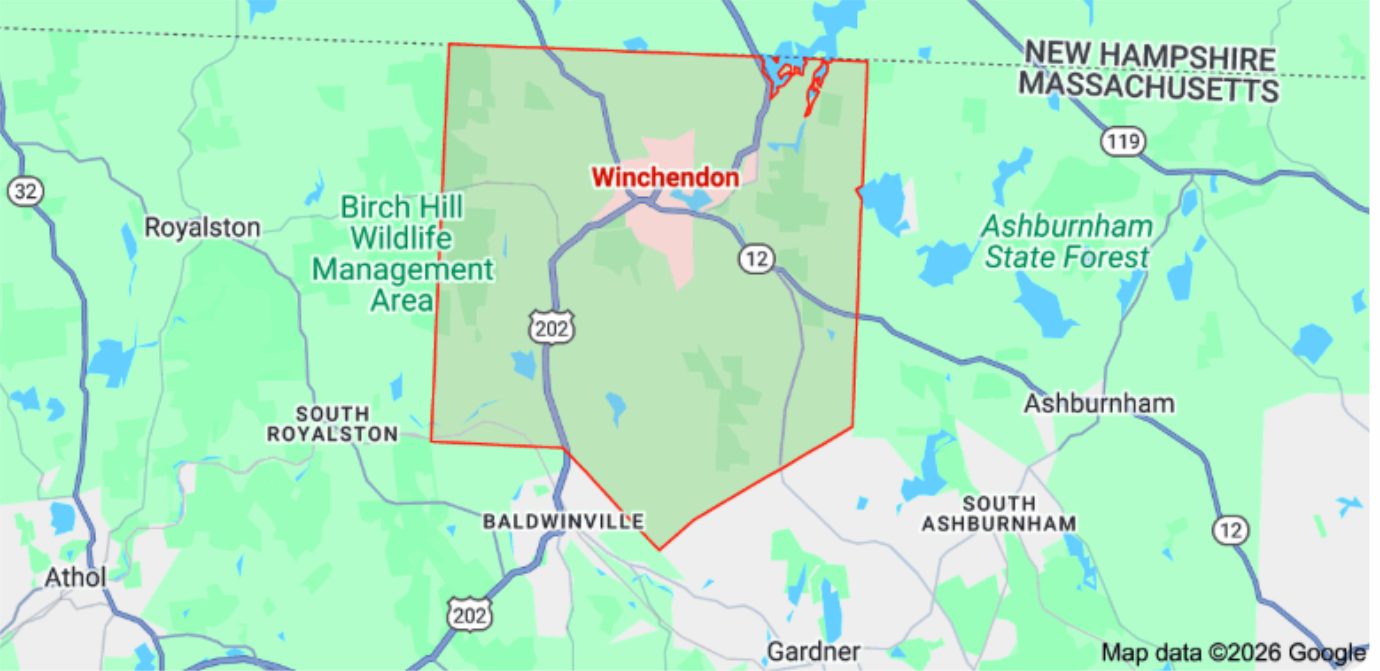
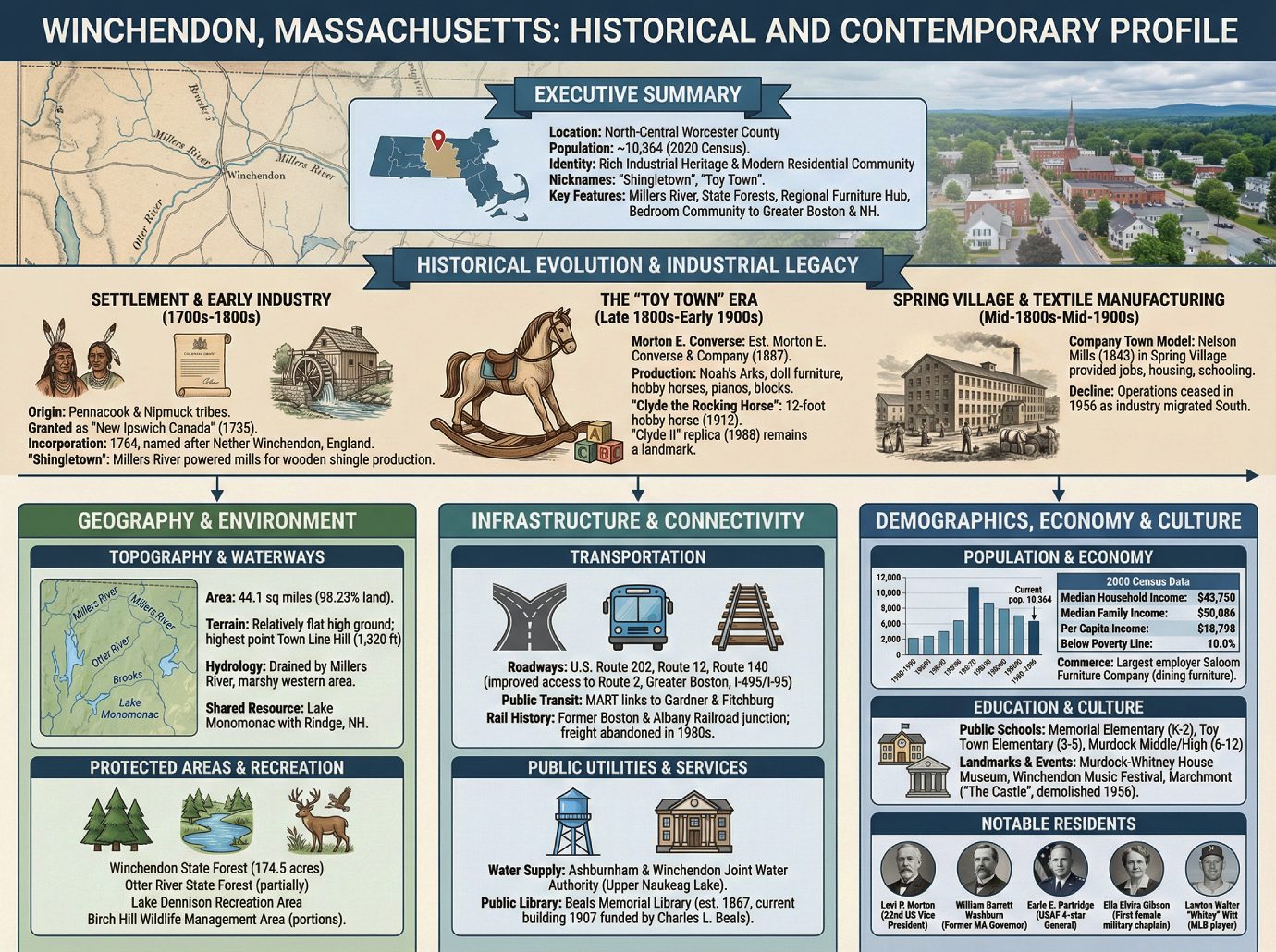
Winchendon, Massachusetts, located in north-central Worcester County, is a town of approximately 10,364 residents (2020 Census) characterized by a rich industrial heritage and a modern identity as a residential community. Historically nicknamed “Shingletown” and later “Toy Town,” the municipality was a major center for woodenware and textile manufacturing during the 19th and early 20th centuries. While its industrial peak has passed, Winchendon remains a regional hub for furniture manufacturing and serves as a “bedroom community” with strategic access to Greater Boston and New Hampshire. The town is defined by its significant natural resources, including the Millers River and multiple state forests, and maintains a distinct cultural identity rooted in its history of toy production.
Historical Evolution and Industrial Legacy
Settlement and Early Industry
• Origin: Originally inhabited by the Pennacook and later the Nipmuck/Nipnet tribes, the area was granted as “New Ipswich Canada” in 1735 to veterans of the 1690 expeditions against Canada.
• Incorporation: The town was officially incorporated in 1764 and named after Nether Winchendon, Buckinghamshire, England.
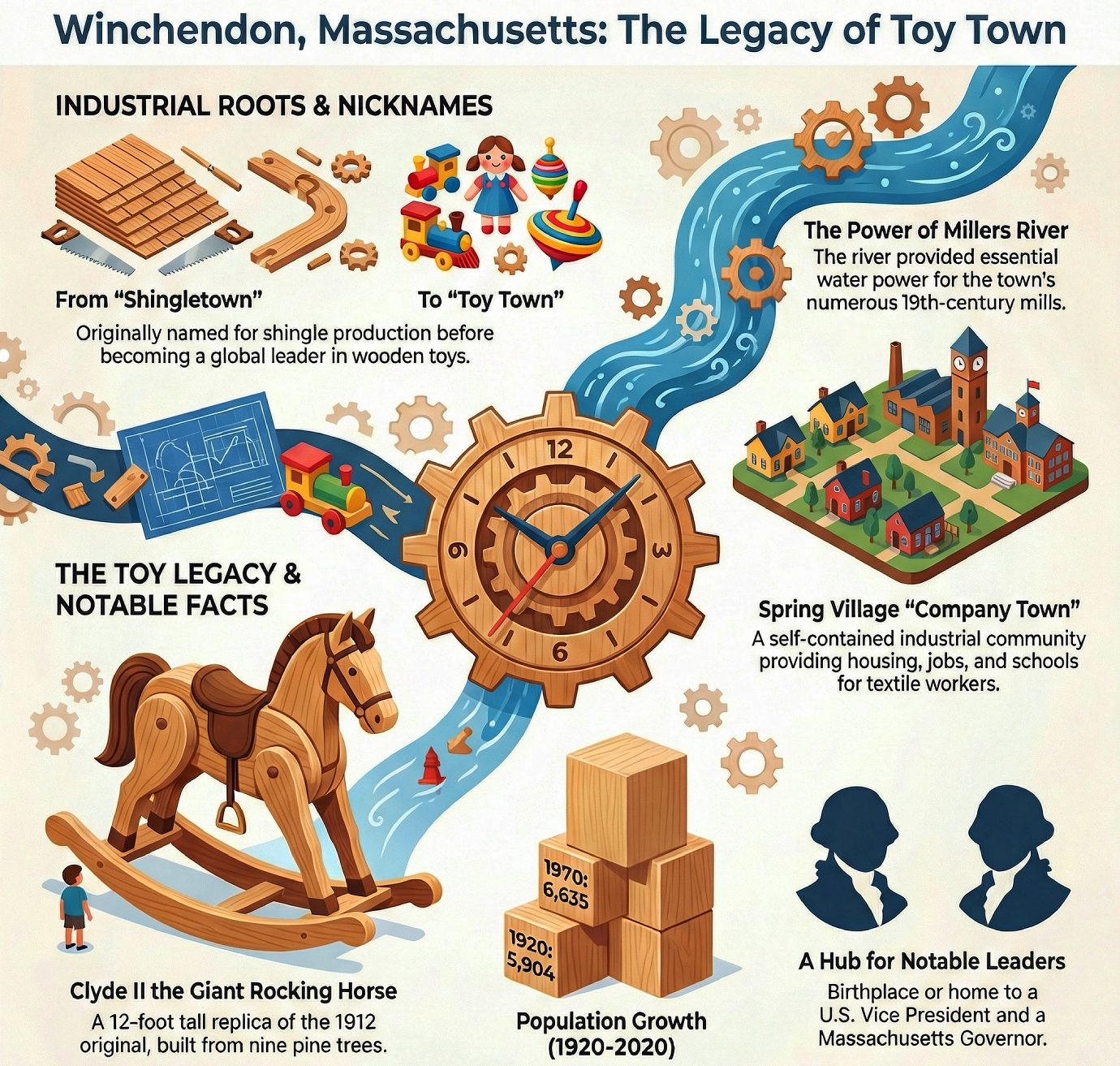
• Water Power: The Millers River provided the necessary power for early mills. The town’s initial industrial identity was “Shingletown,” due to its prolific production of wooden shingles.
The “Toy Town” Era
The town’s most enduring nickname, “Toy Town,” stems from the activities of Morton E. Converse and his successors.
• Morton E. Converse: Beginning in 1873, Converse transitioned from acid manufacturing to wooden products and toys. By 1887, he established Morton E. Converse & Company.
• Production Scale: The company produced a vast array of items, including Noah’s Arks, doll furniture, hobby horses, pianos, and building blocks.
• Clyde the Rocking Horse: In 1912, Converse built “Clyde,” a 12-foot hobby horse copied from the company’s #12 model. A replica, “Clyde II,” was sculpted in 1988 and remains a local landmark in a covered pavilion.
Spring Village and Textile Manufacturing
Winchendon was a pioneer in the “company town” model during the Industrial Revolution.
• Nelson Mills: Purchased in 1843 by Joseph “Deacon” White and his son Nelson, the mill in Spring Village became the center of a self-contained community providing jobs, housing, and schooling for workers.
• Decline: The textile business thrived through World War II and the Korean War (primarily producing denim), but operations ceased in 1956 as the industry migrated to the Southern United States.
Geography and Environment
Winchendon occupies a total area of 44.1 square miles, of which 98.23% is land.
Topography and Waterways
• Terrain: The town sits on relatively flat high ground; its highest point is the western slope of Town Line Hill (1,320 ft).
• Hydrology: Drained by the Millers River. The western part of the town features marshy land fed by several brooks and the Otter River.
• Shared Resources: The town shares Lake Monomonac with Rindge, New Hampshire.
Protected Areas and Recreation
The town hosts several state-managed recreational and conservation areas:
• Winchendon State Forest: 174.5 acres.
• Otter River State Forest: Partially located within the town’s southwestern corner.
• Lake Dennison Recreation Area: A primary point of interest for local recreation.
• Birch Hill Wildlife Management Area: Portions of this protected area extend into Winchendon.
Infrastructure and Connectivity
Transportation
• Roadways: Major routes include U.S. Route 202, Route 12, and Route 140. The rerouting of Route 140 in the 1970s improved access to Route 2, facilitating Winchendon’s growth as a bedroom community for Greater Boston and I-495/I-95 corridors.
• Public Transit: The Montachusett Regional Transit Authority (MART) provides links to Gardner and Fitchburg.
• Rail History: Formerly an important junction for the Boston & Albany Railroad, freight service was abandoned in the 1980s.
Public Utilities and Services
• Water Supply: Municipal water is provided by the Ashburnham & Winchendon Joint Water Authority, sourced from the spring-fed Upper Naukeag Lake in Ashburnham.
• Public Library: The Beals Memorial Library was established in 1867. The current facility was funded by local businessman Charles L. Beals in 1907 after Andrew Carnegie declined to provide more than $12,500 in funding.
Demographics and Socioeconomics
Population Trends
Winchendon has seen steady growth over the last century, with a significant 25.4% population spike between 1980 and 1990. As of 2020, the population stands at 10,364.
Economic Indicators (Based on 2000 Census Data)
| Metric | Detail |
|---|---|
| Median Household Income | $43,750 |
| Median Family Income | $50,086 |
| Per Capita Income | $18,798 |
| Individuals Below Poverty Line | 10.0% |
Commerce
The town’s largest current employer is the Saloom Furniture Company, a dining furniture manufacturer operating two factories totaling 100,000 square feet.
Education and Culture
Public School System
Winchendon operates three primary educational facilities:
• Memorial Elementary School: Grades K–2.
• Toy Town Elementary School: Grades 3–5.
• Murdock Middle/High School: Grades 6–12.
Local Landmarks and Events
• Murdock-Whitney House Museum: Preserves local history.
• Winchendon Music Festival: A notable local cultural event.
• Marchmont (The Castle): A significant historical structure built in 1888 and demolished in 1956.
Notable Residents
Winchendon has been home to several figures of national significance, including:
• Levi P. Morton: 22nd Vice President of the United States.
• William Barrett Washburn: Former Governor of Massachusetts.
• Earle E. Partridge: U.S. Air Force four-star general.
• Ella Elvira Gibson: The first female military chaplain in the United States.
• Lawton Walter “Whitey” Witt: Major League Baseball player (1916–1926).
More Than Just a Playground: 5 Surprising Truths About Massachusetts’ “Toy Town”
More Than Just a Playground: 5 Surprising Truths About Massachusetts’ “Toy Town”
1. The Town with the Massive Mascot
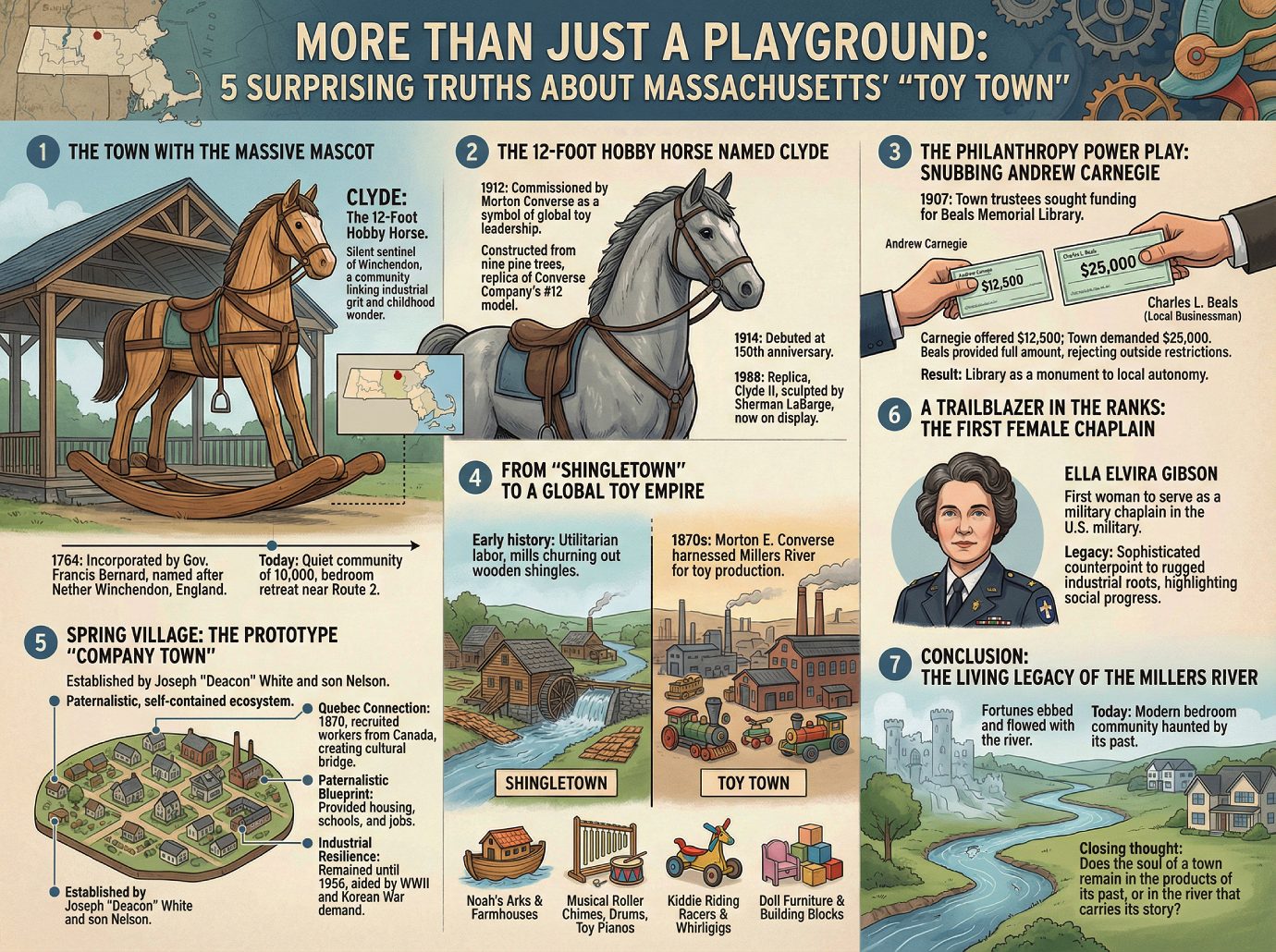
If you find yourself navigating the winding backroads of north-central Massachusetts, you might be startled by the looming, timber-framed silhouette of a playground titan. This is “Clyde,” a 12-foot-tall rocking horse that stands as the silent sentinel of Winchendon, a community where industrial grit and childhood wonder have been inextricably linked for centuries.
Before it was a manufacturing powerhouse, Winchendon was the land of the Pennacook and Nipmuc tribes, eventually incorporated in 1764 by Governor Francis Bernard. Bernard, who signed the town into law on his own land, named it after Nether Winchendon in Buckinghamshire, England—the very village where he would later spend his final days.
Today, this quiet community of 10,000 residents serves as a peaceful bedroom retreat for those commuting toward the Route 2 corridor. Yet, its identity remains firmly anchored in a past defined by the churning waters of the Millers River and the whimsical objects it once produced for the world.
2. The 12-Foot Hobby Horse Named Clyde
In 1912, local industrialist Morton Converse sought a symbol that reflected the town’s status as a global leader in toy production. The result was Clyde, a massive grey hobby horse constructed from the wood of nine pine trees, designed as a perfect scale replica of the Converse Company’s popular #12 model.
Clyde made his grand debut during the town’s 150th anniversary in 1914, and for decades, he stood guard at the local railroad station and the Toy Town Tavern. Though the original eventually succumbed to the New England elements, the town’s devotion to its mascot remained unshakable.
A replica, Clyde II, was sculpted in 1988 by Winchendon native Sherman LaBarge, using the original as a model. He is now on display in a covered pavilion.
3. The Philanthropy Power Play: Snubbing Andrew Carnegie
There is a distinct brand of New England independence that defines Winchendon, perhaps best illustrated by the story of the Beals Memorial Library. While the town’s commitment to literacy began as early as 1867, the trustees approached the steel magnate Andrew Carnegie in 1907 to fund a permanent home for their collection.
Carnegie offered a grant of $12,500, but the town, possessing a high sense of local pride, insisted they required $25,000 to match their ambitions. When the billionaire declined to increase his offer, Winchendon did not settle; instead, local businessman Charles L. Beals stepped forward and wrote a check for the full $25,000. By rejecting the restricted terms of an outside titan, the town ensured its library would be a monument to local autonomy rather than industrial charity.
4. From “Shingletown” to a Global Toy Empire
Long before the air was filled with the sounds of play, Winchendon was a place of utilitarian labor known as “Shingletown.” The hills were once thick with the scent of fresh pine shavings as mills along the Millers River churned out massive volumes of wooden shingles.
The transition to “Toy Town” began in the 1870s when Morton E. Converse harnessed the river’s water power to create a lost era of Victorian play. The factories transformed rough lumber into exquisite artifacts of childhood:
• Intricate Noah’s Arks and miniature farmhouses.
• Musical roller chimes, drums, and toy pianos.
• Kiddie riding racers and hand-painted floor whirligigs.
• Finely crafted doll furniture and building blocks.
5. Spring Village: The Prototype “Company Town”
The industrial narrative of Winchendon extended beyond toys into the realm of social engineering at Winchendon Springs. Here, Joseph “Deacon” White and his son Nelson established a textile empire that operated as a paternalistic, self-contained ecosystem known as Spring Village.
• The Quebec Connection: In 1870, Joseph N. White personally traveled to Quebec to recruit workers, creating a distinct cultural bridge between Canada and north-central Massachusetts.
• The Paternalistic Blueprint: The White family didn’t just build mills; they constructed a comprehensive “company town” that provided housing, schools, and jobs for their laborers.
• Industrial Resilience: While most New England textile operations fled south in the 1930s, the White Brothers, Inc. remained until 1956, their looms kept alive by the urgent demand for denim during World War II and the Korean War.
6. A Trailblazer in the Ranks: The First Female Chaplain
Winchendon has always been a place where traditional roles were quietly challenged amid the hum of the factories. The town was home to Ella Elvira Gibson, a woman of remarkable fortitude who broke one of the most significant barriers in American military history. Gibson holds the distinction of being the first woman to serve as a military chaplain in the United States military. Her legacy provides a sophisticated counterpoint to the town’s rugged industrial roots, reminding us that Winchendon’s history is as much about social progress as it is about manufacturing.
7. Conclusion: The Living Legacy of the Millers River
The fortunes of Winchendon have ebbed and flowed with the currents of the Millers River. The town has seen the rise of global empires and the quiet disappearance of its architectural crown jewels, such as “Marchmont” (also known as “The Castle”), which was demolished in 1956 as the textile era drew to a close.
Today, Winchendon navigates its future as a modern bedroom community, yet it remains haunted by the beautiful things it once made. The spirit of the town is still found in the grain of the wood and the memory of the mills, proving that our collective identity is forged not just by where we live, but by the objects we once gave to the world.
As the factories go silent, does the soul of a town remain in the products of its past, or in the river that continues to carry its story toward the sea?
More Than Just a Playground: 5 Surprising Truths About Massachusetts’ “Toy Town”
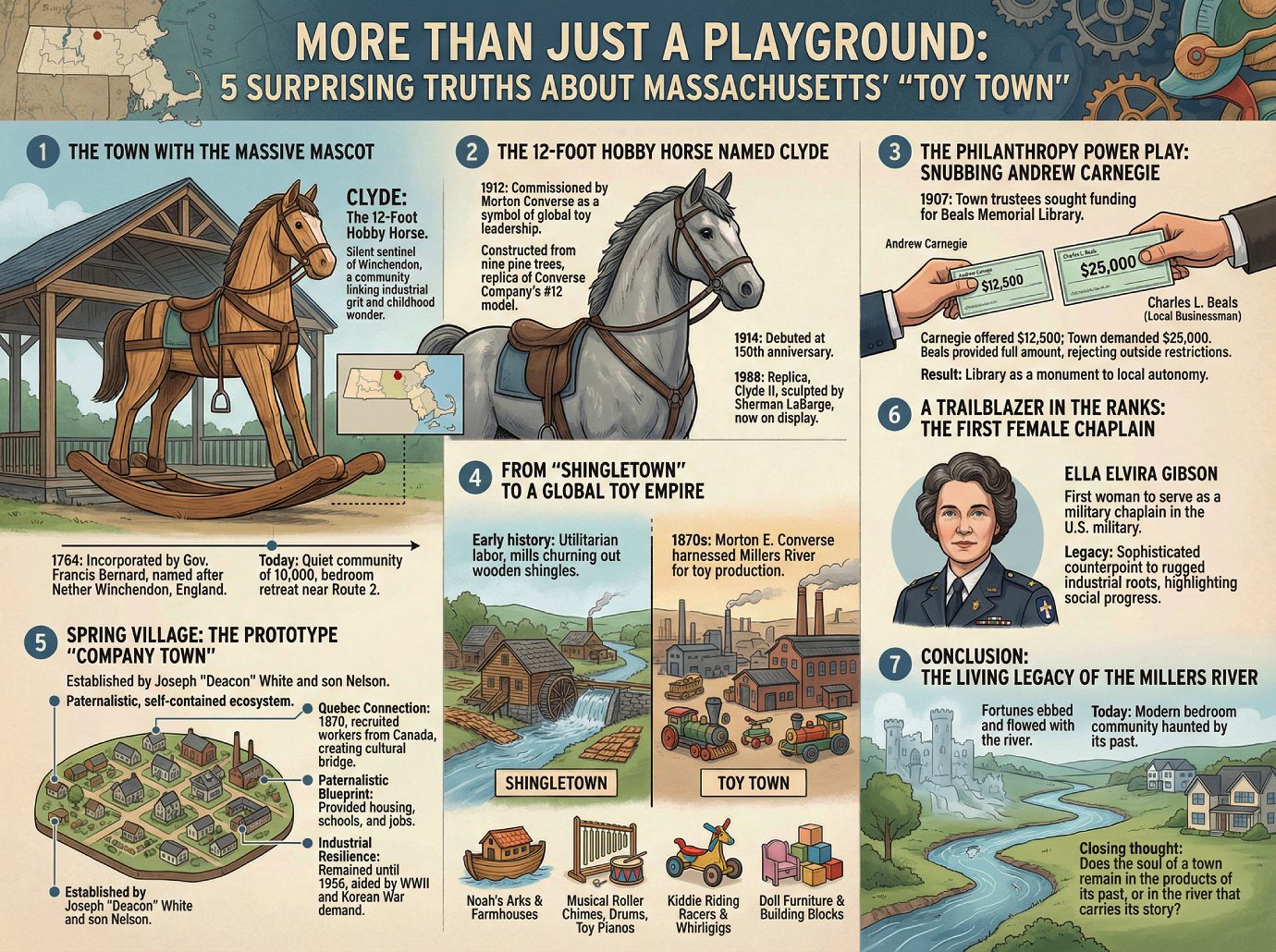
More Than Just a Playground: 5 Surprising Truths About Massachusetts’ “Toy Town”
1. The Town with the Massive Mascot
If you find yourself navigating the winding backroads of north-central Massachusetts, you might be startled by the looming, timber-framed silhouette of a playground titan. This is “Clyde,” a 12-foot-tall rocking horse that stands as the silent sentinel of Winchendon, a community where industrial grit and childhood wonder have been inextricably linked for centuries.
Before it was a manufacturing powerhouse, Winchendon was the land of the Pennacook and Nipmuc tribes, eventually incorporated in 1764 by Governor Francis Bernard. Bernard, who signed the town into law on his own land, named it after Nether Winchendon in Buckinghamshire, England—the very village where he would later spend his final days.
Today, this quiet community of 10,000 residents serves as a peaceful bedroom retreat for those commuting toward the Route 2 corridor. Yet, its identity remains firmly anchored in a past defined by the churning waters of the Millers River and the whimsical objects it once produced for the world.
2. The 12-Foot Hobby Horse Named Clyde
In 1912, local industrialist Morton Converse sought a symbol that reflected the town’s status as a global leader in toy production. The result was Clyde, a massive grey hobby horse constructed from the wood of nine pine trees, designed as a perfect scale replica of the Converse Company’s popular #12 model.
Clyde made his grand debut during the town’s 150th anniversary in 1914, and for decades, he stood guard at the local railroad station and the Toy Town Tavern. Though the original eventually succumbed to the New England elements, the town’s devotion to its mascot remained unshakable.
A replica, Clyde II, was sculpted in 1988 by Winchendon native Sherman LaBarge, using the original as a model. He is now on display in a covered pavilion.
3. The Philanthropy Power Play: Snubbing Andrew Carnegie
There is a distinct brand of New England independence that defines Winchendon, perhaps best illustrated by the story of the Beals Memorial Library. While the town’s commitment to literacy began as early as 1867, the trustees approached the steel magnate Andrew Carnegie in 1907 to fund a permanent home for their collection.
Carnegie offered a grant of $12,500, but the town, possessing a high sense of local pride, insisted they required $25,000 to match their ambitions. When the billionaire declined to increase his offer, Winchendon did not settle; instead, local businessman Charles L. Beals stepped forward and wrote a check for the full $25,000. By rejecting the restricted terms of an outside titan, the town ensured its library would be a monument to local autonomy rather than industrial charity.
4. From “Shingletown” to a Global Toy Empire
Long before the air was filled with the sounds of play, Winchendon was a place of utilitarian labor known as “Shingletown.” The hills were once thick with the scent of fresh pine shavings as mills along the Millers River churned out massive volumes of wooden shingles.
The transition to “Toy Town” began in the 1870s when Morton E. Converse harnessed the river’s water power to create a lost era of Victorian play. The factories transformed rough lumber into exquisite artifacts of childhood:
• Intricate Noah’s Arks and miniature farmhouses.
• Musical roller chimes, drums, and toy pianos.
• Kiddie riding racers and hand-painted floor whirligigs.
• Finely crafted doll furniture and building blocks.
5. Spring Village: The Prototype “Company Town”
The industrial narrative of Winchendon extended beyond toys into the realm of social engineering at Winchendon Springs. Here, Joseph “Deacon” White and his son Nelson established a textile empire that operated as a paternalistic, self-contained ecosystem known as Spring Village.
• The Quebec Connection: In 1870, Joseph N. White personally traveled to Quebec to recruit workers, creating a distinct cultural bridge between Canada and north-central Massachusetts.
• The Paternalistic Blueprint: The White family didn’t just build mills; they constructed a comprehensive “company town” that provided housing, schools, and jobs for their laborers.
• Industrial Resilience: While most New England textile operations fled south in the 1930s, the White Brothers, Inc. remained until 1956, their looms kept alive by the urgent demand for denim during World War II and the Korean War.
6. A Trailblazer in the Ranks: The First Female Chaplain
Winchendon has always been a place where traditional roles were quietly challenged amid the hum of the factories. The town was home to Ella Elvira Gibson, a woman of remarkable fortitude who broke one of the most significant barriers in American military history. Gibson holds the distinction of being the first woman to serve as a military chaplain in the United States military. Her legacy provides a sophisticated counterpoint to the town’s rugged industrial roots, reminding us that Winchendon’s history is as much about social progress as it is about manufacturing.
7. Conclusion: The Living Legacy of the Millers River
The fortunes of Winchendon have ebbed and flowed with the currents of the Millers River. The town has seen the rise of global empires and the quiet disappearance of its architectural crown jewels, such as “Marchmont” (also known as “The Castle”), which was demolished in 1956 as the textile era drew to a close.
Today, Winchendon navigates its future as a modern bedroom community, yet it remains haunted by the beautiful things it once made. The spirit of the town is still found in the grain of the wood and the memory of the mills, proving that our collective identity is forged not just by where we live, but by the objects we once gave to the world.
As the factories go silent, does the soul of a town remain in the products of its past, or in the river that continues to carry its story toward the sea?
From Frontier to Factory: The Industrial Evolution of Winchendon
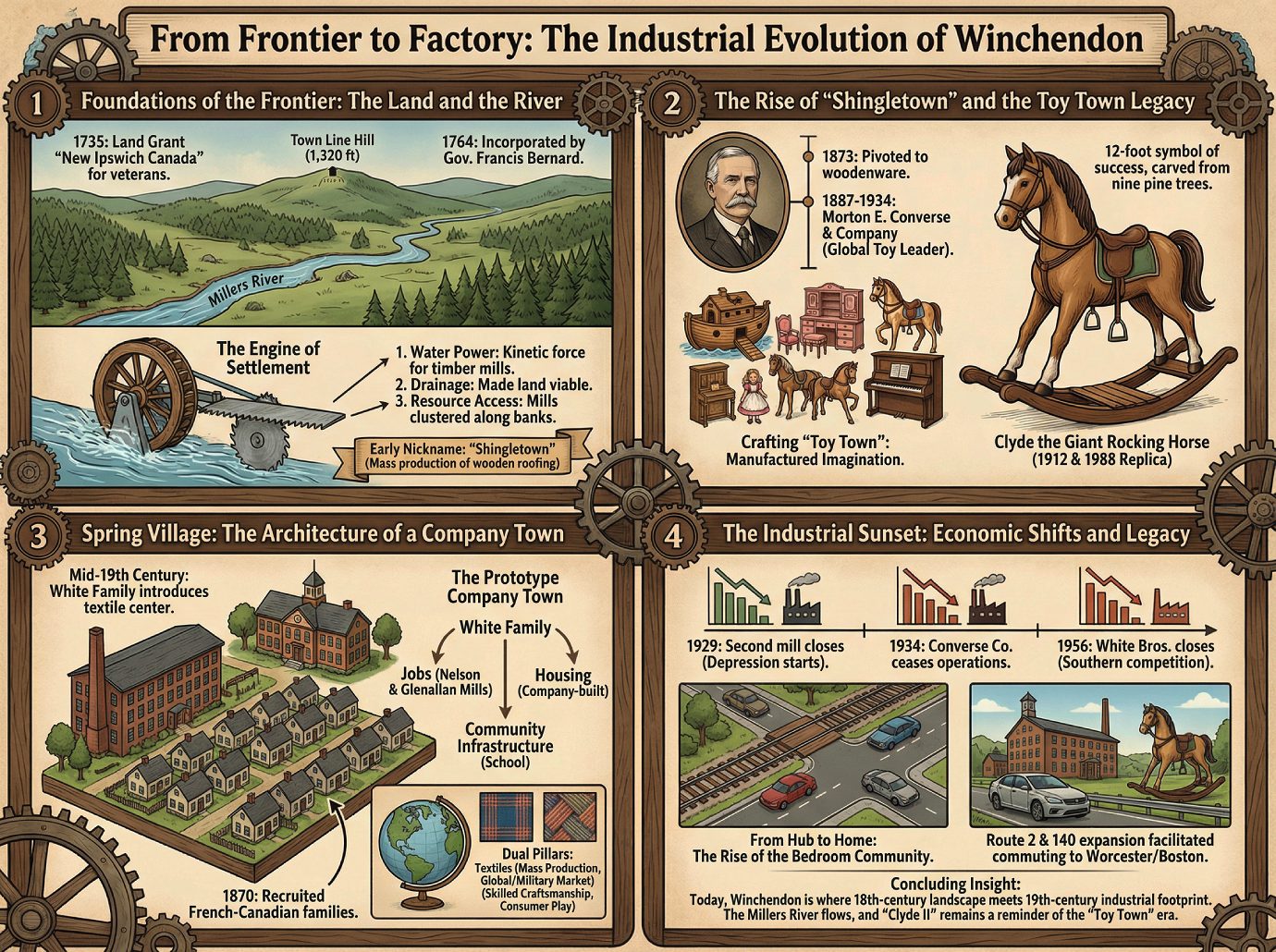
From Frontier to Factory: The Industrial Evolution of Winchendon
The story of Winchendon, Massachusetts, is more than a collection of dates; it is a narrative of the mechanization of a landscape. It is a chronicle of how a rugged wilderness, once a labyrinth of marshy brooks and dense forests, was tamed by the ingenious application of water power and the organized ambition of industrial pioneers. By tracing the transition from colonial grants to the global fame of “Toy Town,” we can visualize the very blueprint of the American Industrial Revolution.
1. Foundations of the Frontier: The Land and the River
The origins of Winchendon lie in a debt of war. On June 10, 1735, the Massachusetts House of Representatives issued a land grant known as “New Ipswich Canada.” This was not a mere expansion of the colony, but a hard-won payment to Lieutenant Abraham Tilton and the veterans of the 1690 expeditions against Canada. For these survivors and their heirs, the grant represented a tangible reward for enduring the hardships of the northern frontier.
The town was officially incorporated in 1764 under Governor Francis Bernard. He named the settlement after his own estate, Nether Winchendon in Buckinghamshire, England—the very place where the Governor would return to spend his final days, dying fifteen years after the town’s incorporation. While the name was English, the town’s destiny was forged by the kinetic energy of the Millers River.
• Indigenous Roots: Long before the surveyor’s chain, this was the territory of the Pennacook and the Nipnet (Nipmuck) people.
• 1735: Land grant established as “New Ipswich Canada” for military veterans.
• 1764: Incorporation by Governor Francis Bernard, connecting the town to the English gentry.
• Topography: The settlement sits on high ground, peaking at Town Line Hill (1,320 ft), overlooking the river valleys below.
The “So What?” for the Learner: The Engine of Settlement
To the 18th-century eye, a river was not just a scenic feature; it was a source of raw, mechanical power. The Millers River became the town’s primary geographical asset for three critical reasons:
1. Water Power: The river’s descent provided the kinetic force required to drive the heavy saws of early timber mills.
2. Drainage: The Millers River and its tributary, the Otter River, served as the natural drainage system for the surrounding marshy brooks, making the land viable for settlement.
3. Resource Access: The river dictated where life happened. Mills and homes clustered along its banks, where the water was fastest and the timber most accessible.
This abundance of timber, paired with the roar of the falls, allowed settlers to produce wooden roofing materials at an industrial scale. This early mastery of the forest earned Winchendon its first gritty nickname: “Shingletown.”
2. The Rise of “Shingletown” and the Toy Town Legacy
As the 19th century dawned, the town’s economy evolved from providing basic construction materials to crafting specialized consumer goods. This transition was personified by Morton E. Converse. A man of remarkable 19th-century adaptability, Converse began his career in New Hampshire manufacturing acids. However, in 1873, he pivoted toward the forest, purchasing a mill in Winchendon to produce woodenware.
The Evolution of the Converse Legacy
| Era/Company Name | Key Partners | Primary Products |
|---|---|---|
| Mason & Converse (1873–1883) | Morton E. Converse & Orland Mason | Early wooden toys and household woodenware |
| Converse Toy & Woodenware Co. (1883–1887) | Morton E. Converse & Alfred C. Converse | Specialized toys and high-quality wood products |
| Morton E. Converse & Company (1887–1934) | Morton E. Converse & Atherton D. Converse | A global leader in diverse toy manufacturing |
The “So What?” for the Learner: Crafting “Toy Town”
Winchendon became “Toy Town” because the Converse family didn’t just manufacture items; they manufactured imagination. Their catalog was an encyclopedia of Victorian play, including:
• Miniature Worlds: Noah’s Arks, doll furniture, and intricate farm houses.
• Motion and Speed: Hobby horses, kiddie riding racers, and floor whirligigs.
• Music and Skill: Pianos, musical roller chimes, and ten pins.
Iconic Symbolism: Clyde the Giant Rocking Horse
In 1912, Morton Converse sought a symbol that matched the scale of his success. He commissioned “Clyde,” a 12-foot hobby horse that was a feat of forest engineering, carved from nine individual pine trees. Clyde was a giant replica of the company’s #12 rocking horse and became a local legend. While the original 1912 version eventually succumbed to the elements after decades of display, the town’s identity remained so intertwined with the image that a replica, Clyde II, was sculpted in 1988 to stand guard over Winchendon’s history.
Even as the scent of pine shavings defined the Converse shops, a different aroma—the steam and starch of textile production—began to rise from the headwaters of the Millers River.
3. Spring Village: The Architecture of a Company Town
In the mid-19th century, the White family (led by Joseph “Deacon” White and his son Nelson) introduced a different industrial logic to the town. In 1843, they purchased a mill in Spring Village (Winchendon Springs), transforming it into a high-efficiency textile center.
The Prototype Company Town
The Whites created a “prototype company town,” a self-contained industrial island where every facet of a worker’s life was integrated into the company ecosystem. The family provided:
1. Jobs: Employment at the Nelson Mills or the massive Glenallan Mill (built in 1887).
2. Housing: Company-built residences that kept the labor force within earshot of the mill whistle.
3. Community Infrastructure: A dedicated school for the children of workers, ensuring the next generation was groomed for the mill life.
To satisfy the hunger of their expanding looms, Joseph N. White traveled to Quebec in 1870 to recruit French-Canadian families, forever changing the cultural fabric of the community.
Dual Pillars of Winchendon Industry
| Industrial Pillar | Nature of Labor | Target Market & “So What?” |
|---|---|---|
| Woodenware & Toys | Skilled Craftsmanship: Focus on woodworking and fine detailing. | Consumer Play: Focused on children and domestic joy; established the town’s global nickname. |
| Textiles (White Bros) | Mass Production: Large-scale mill operations and heavy machinery. | Global & Military: Specifically produced denim that clothed soldiers in World War II and the Korean War, linking Winchendon to global history. |
As the 20th century progressed, these two pillars, which once seemed immovable, began to tremble under the weight of a changing world.
4. The Industrial Sunset: Economic Shifts and Legacy
The decline of Winchendon as a manufacturing hub was a casualty of shifting geography. As the American South modernized in the 1930s, New England’s mills, with their older machinery and higher costs, could no longer compete. The Great Depression accelerated this sunset.
Timeline of Industrial Closure
• 1929: The second mill in Winchendon Springs shutters as the economic depression begins.
• 1934: Morton E. Converse & Company ceases operations, ending the golden age of Toy Town.
• 1956: White Brothers, Inc. closes its doors, citing insurmountable economic pressure from the industrialized South.
From Hub to Home: The Rise of the Bedroom Community
The final blow to Winchendon’s status as a self-contained industrial island came with the death of the railroad. The Boston & Albany Railroad, which once served as the town’s umbilical cord to the world, saw its freight service abandoned in the 1980s. However, as the rails were pulled up, the roads were paved.
The expansion of Route 2 and Route 140 in the late 20th century facilitated a new identity. Winchendon transitioned into a “bedroom community,” where residents could enjoy the historic hills and the quiet of the Millers River while commuting to employment centers in Worcester or Greater Boston. The car replaced the locomotive, and the commuter replaced the mill hand.
Concluding Insight
Today, Winchendon is a place where the 18th-century landscape meets the 19th-century industrial footprint. While the mills have gone silent, the Millers River still flows through the town, and “Clyde II” remains a towering reminder of an era when this small settlement was the toy capital of the world.
Reflective Question: As Winchendon moves further away from its identity as a mill town, how do you think its natural geography—the river and the hills—will continue to influence its future differently than it did in the 1700s?
Economic Development Prospectus: Winchendon, Massachusetts – The Evolution of “Toy Town” into a Regional Industrial Hub
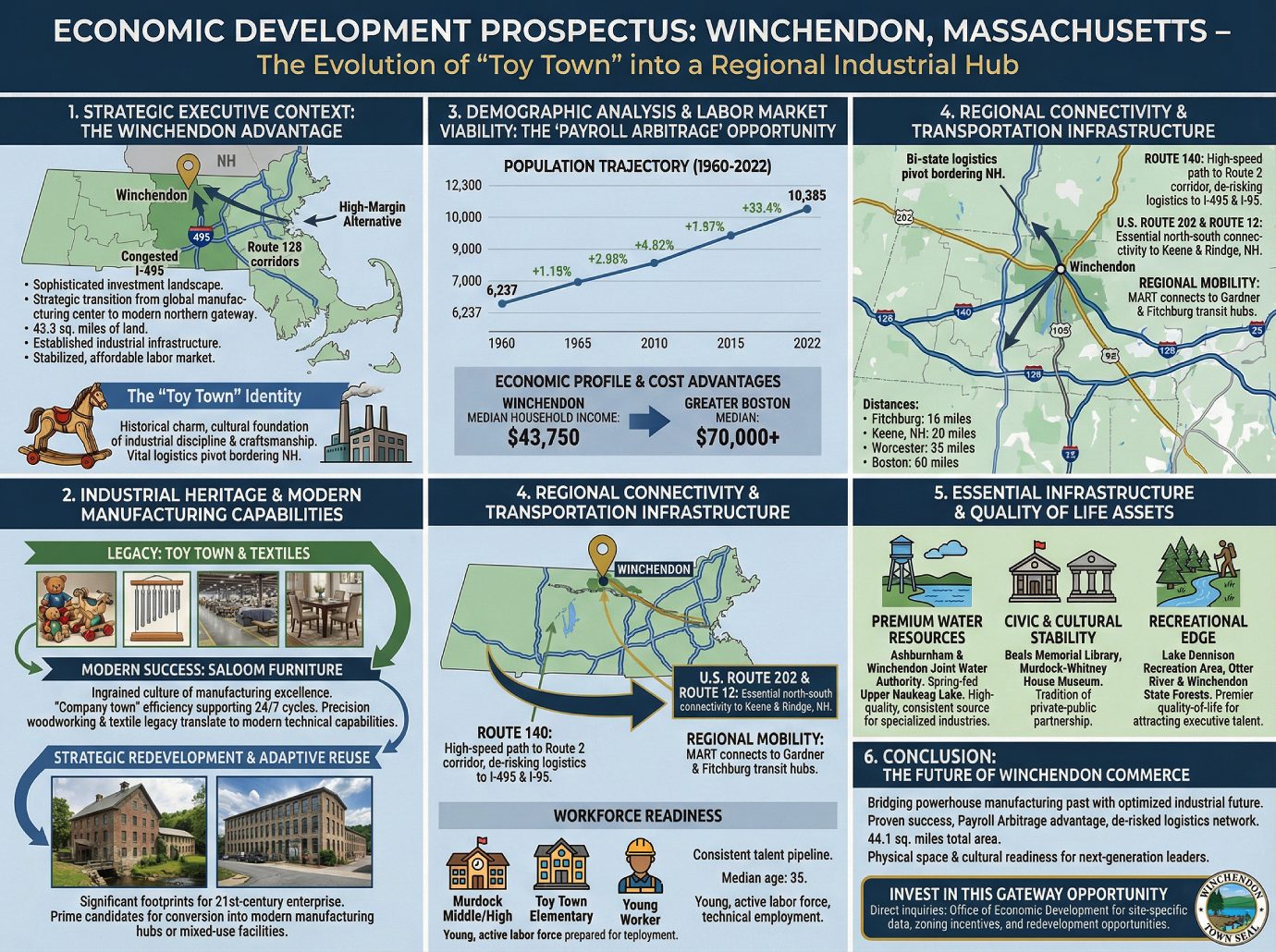
Economic Development Prospectus: Winchendon, Massachusetts – The Evolution of “Toy Town” into a Regional Industrial Hub
1. Strategic Executive Context: The Winchendon Advantage
Winchendon, Massachusetts, offers a sophisticated investment landscape for commercial developers seeking a high-margin alternative to the congested I-495 and Route 128 corridors. Historically known as “Toy Town,” the municipality is strategically transitioning from its legacy as a global manufacturing center to a modern, accessible northern gateway. For the discerning investor, Winchendon represents a rare opportunity: a community with 43.3 square miles of land area that combines established industrial infrastructure with a stabilized, affordable labor market.
The town’s “Toy Town” identity, forged by the Morton E. Converse toy empire and a dominant shingle-production industry, provides more than just historical charm; it has cultivated a cultural foundation of industrial discipline and craftsmanship. Today, Winchendon serves as a vital logistics pivot bordering New Hampshire, offering a unique blend of historical stability and modern connectivity within Worcester County. This prospectus details the town’s specific manufacturing assets and demographic advantages, presenting a compelling case for immediate commercial and industrial expansion.
——————————————————————————–
2. Industrial Heritage and Modern Manufacturing Capabilities
A municipality’s “industrial DNA” is a primary indicator of its capacity to support resilient, high-output operations. Winchendon possesses an ingrained culture of manufacturing excellence and “company town” efficiency that supports 24/7 industrial cycles—a significant selling point for modern investors.
The Saloom Case Study: Proven Scalability
The viability of large-scale manufacturing is best demonstrated by the Saloom Furniture Company, the town’s largest employer. Operating out of two facilities totaling 100,000 square feet, Saloom’s success in high-quality dining furniture production proves that Winchendon’s infrastructure and workforce can sustain sophisticated, high-yield wood-product manufacturing.
The “Toy Town” Legacy: From Precision to Production
The precision woodworking skills established by Morton E. Converse & Company—which produced everything from musical roller chimes to hobby horses—remain a hallmark of the local labor pool. This century-long immersion in craftsmanship directly translates to the technical capabilities required for modern production. Furthermore, the textile legacy of the Nelson Mills, established by the White family in 1857, pioneered a model of integrated community support and operational efficiency that continues to define the town’s pro-business environment.
Strategic Redevelopment and Adaptive Reuse
With 43.3 square miles of land, Winchendon offers significant footprints for 21st-century enterprise. Prime candidates for adaptive reuse include the historic Glenallan Mill (operational until 1929) and the former Nelson Mills facilities in the Spring Village area. These sites, once powered by the Millers River, are ideally suited for conversion into modern manufacturing hubs or mixed-use industrial facilities.
——————————————————————————–
3. Demographic Analysis and Labor Market Viability: The “Payroll Arbitrage” Opportunity
Winchendon’s demographics represent a significant competitive advantage for employers seeking to optimize overhead. The town offers a stable population trajectory and a median income level that facilitates “Payroll Arbitrage”—the ability to achieve higher margins by leveraging a lower-cost labor pool without sacrificing manufacturing quality.
Population Trajectory
Since 1960, Winchendon has demonstrated predictable, steady expansion. The consistent growth over sixty years highlights a community that is both stable and capable of retaining its workforce.
| Year | Population | Growth (%) |
|---|---|---|
| 1960 | 6,237 | -5.3% |
| 1970 | 6,635 | +6.4% |
| 1980 | 7,019 | +5.8% |
| 1990 | 8,805 | +25.4% |
| 2000 | 9,611 | +9.2% |
| 2010 | 10,300 | +7.2% |
| 2020 | 10,364 | +0.6% |
| 2022 (Est.) | 10,385 | +0.2% |
Economic Profile and Cost Advantages
The median household income of $43,750 and median family income of $50,086 suggest a highly competitive labor cost environment. By locating in Winchendon, businesses can realize significant payroll savings compared to the $70,000+ medians typical of the Greater Boston area. This affordability makes Winchendon an ideal location for labor-intensive manufacturing and logistics operations.
Workforce Readiness
The local talent pipeline is anchored by Murdock Middle/High School and Toy Town Elementary School, ensuring a consistent flow of graduates into the regional economy. With a median age of 35, Winchendon offers a young, active labor force prepared for technical and industrial employment.
——————————————————————————–
4. Regional Connectivity and Transportation Infrastructure
Winchendon’s position as a “middle town” bordering New Hampshire’s Cheshire County transforms it into a bi-state logistics pivot, providing streamlined access to both the Massachusetts and New Hampshire markets.
Primary Artery Analysis and Logistics De-risking
The town’s transportation network has been engineered for commercial viability:
• Route 140: The 1970s rerouting of Route 140 was a transformative strategic investment. By bypassing Gardner’s local traffic, this artery provides a clear, high-speed path to the Route 2 corridor, de-risking logistics for companies requiring fast access to I-495 and I-95.
• U.S. Route 202 and Route 12: These routes provide essential north-south connectivity, linking Winchendon directly to the economic centers of Keene and Rindge, NH.
Regional Mobility
The Montachusett Regional Transit Authority (MART) facilitates labor mobility by connecting Winchendon to the transit hubs of Gardner and Fitchburg, expanding the accessible talent pool for local employers.
Proximity to Economic Centers
• Fitchburg: 16 miles
• Keene, NH: 20 miles
• Worcester: 35 miles
• Boston: 60 miles
——————————————————————————–
5. Essential Infrastructure and Quality of Life Assets
Municipal reliability and resident satisfaction are key to long-term business retention. Winchendon provides the essential resources needed for industrial scale and executive recruitment.
• Premium Water Resources: Served by the Ashburnham & Winchendon Joint Water Authority, the town draws from the spring-fed Upper Naukeag Lake. This high-quality, consistent water source is a major draw for specialized manufacturing, food processing, or precision industries requiring pure input.
• Civic and Cultural Stability: Institutions like the Beals Memorial Library (funded by local businessman Charles L. Beals) and the Murdock-Whitney House Museum reflect a long-standing tradition of private-public partnership and community investment.
• Recreational Edge: Access to the Lake Dennison Recreation Area, Otter River State Forest, and Winchendon State Forest provides a premier quality-of-life advantage, essential for attracting and retaining executive-level talent who value outdoor amenities.
——————————————————————————–
6. Conclusion: The Future of Winchendon Commerce
Winchendon is a community that has successfully bridged the gap between its powerhouse manufacturing past and a strategically optimized industrial future. With the proven success of Saloom Furniture, a significant “Payroll Arbitrage” advantage, and a de-risked logistics network connecting Massachusetts to New Hampshire, Winchendon is uniquely prepared for new commercial partnerships.
The town’s 44.1 square miles of total area offer the physical space and the cultural readiness for the next generation of industrial leaders. We invite investors to capitalize on this gateway opportunity.
Direct inquiries for site-specific data, zoning incentives, and redevelopment opportunities to the Office of Economic Development.