
News Around Greater Gardner MA
Top 100 Current Headlines – 2025: October — September —August — July— June — May — April — March — February — January 2024: December — November — October – September – August – July – June – May – April –March – February – January —- 2023: December – November – October – September – August – July – June – May – April – March – February – January —- 2022: December – November – October – September – August – July – June – May – April – March – February – January —- 2021: December – November – October – September – CIRCULATION: 25,000+ UNIQUE HOUSEHOLDS —-Politics 2023 —- Editorials —- Environment —- Non-Profits —- Public Safety —- Fictional Fun Links Content is being restored gradually to the following pages: Top 50 Interviews – Original Songs – Hotline Radio Shows – City Council – School Committee – DEEP DIVE podcasts – Editorial and Commentary – Gardner Success next 120 stories, CLICK HERE. Gardner Magazine is also Gardner Herald, and a newspaper of general circulation for Greater Gardner MA. Contact Us: News@GardnerMagazine.com or via voicemail at (978) 632-6324
- Nicholson – 35 Endorsements
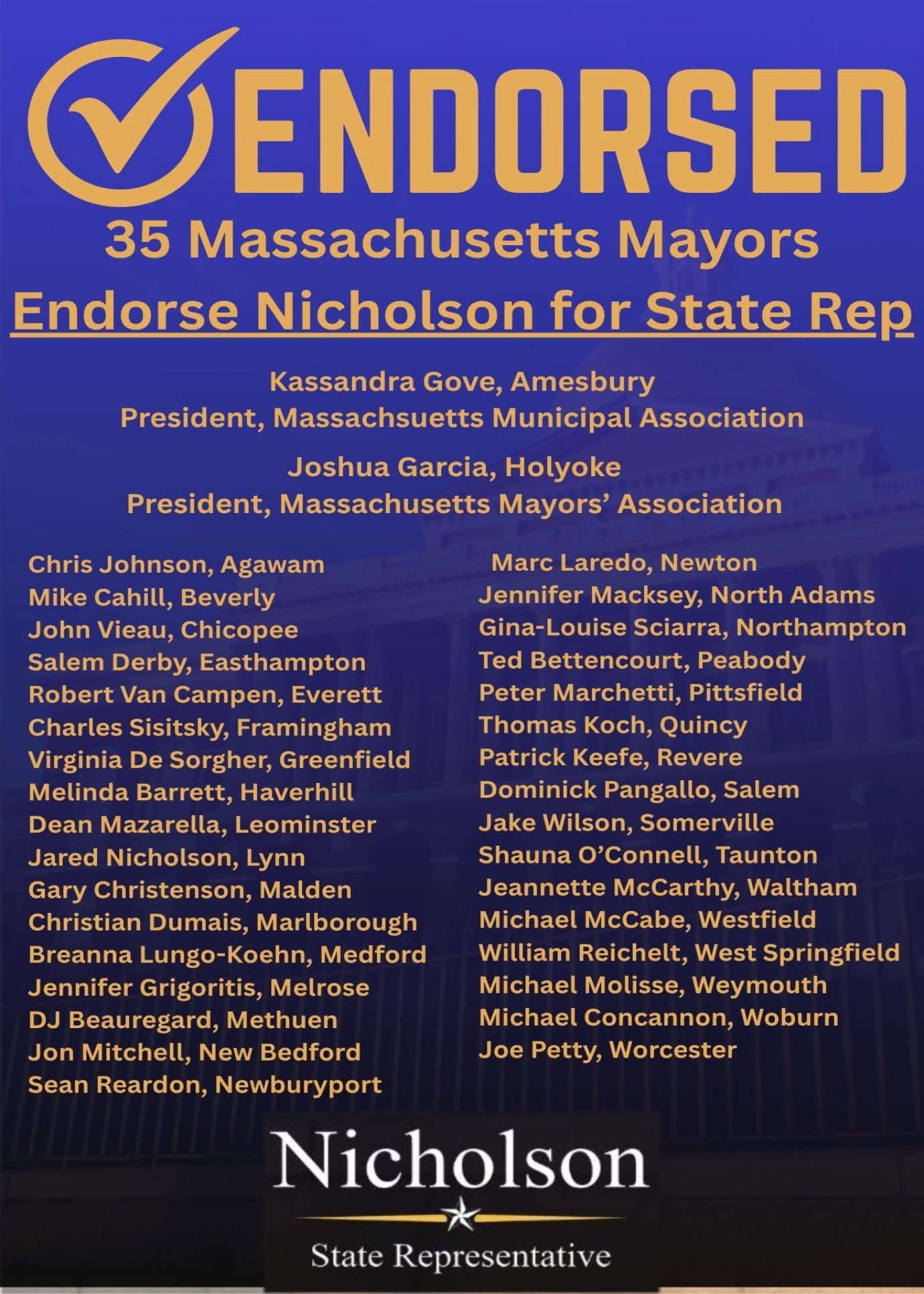
Gardner Mayor Nicholson Endorsed for State Representative by 35 Massachusetts Mayors
On October 26, 2026, Gardner Mayor Michael Nicholson announced that he had received the endorsement of “35 of my fellow mayors from across Massachusetts” stating “Across the Commonwealth, our cities and towns are struggling. As Mayor and a former Town Administrator, I’ve been on the side of the table that has had to make tough decisions about local services. Bringing this perspective to Beacon Hill is vital to strengthening the bond between our state and local government. I have been proud to serve alongside my fellow Mayors, especially as President of the Massachusetts Mayors’ Association last year, and I look forward to continuing to work to provide a strong voice for our communities.” The complete list of mayors is in the article graphic.
Here are some of the comments made by mayors in the State about Gardner’s current Mayor and candidate for representative in the 2nd Worcester District:
“Mayor Nicholson is a dedicated, caring leader, and a wonderful colleague. He shows up for his community every day, and understands the priorities of cities and towns. I’m proud to work alongside him and support his campaign for state representative, a champion for his district and local government across Massachusetts.”- Mayor Kassandra Gove, Amesbury
“Mike Nicholson has a proven track record as Mayor of Gardner. He also has been a proven leader, mentor, and trusted colleague to Mayors’ across Massachusetts. If you want someone on Beacon Hill who is going to remember where he came from, fight for cities and towns, advocate for his constituents, and work hard on your behalf, join me in supporting him for State Representative!“- Mayor Jennifer Macksey, North Adams
“Over the last seven years, Mayor Mike Nicholson has been an exceptional colleague to work with and brainstorm how we can best support our communities. He knows the issues cities and towns face from housing and transportation to the critical funding needs of our cities and schools. He’s been an advocate trying to push the state to increase our general local aid and when in Beacon Hill I know he will continue to push for more support for us.”- Mayor Breanna Lungo-Koehn, Medford
“I’m proud to endorse Mayor Mike Nicholson for State Representative. Having worked with Mike as a fellow Mayor, I have seen how he truly wants to see the Commonwealth succeed as a whole, across Western, Central, and Eastern Massachusetts. He understands what cities and towns need to succeed and has been a true leader in the fight to build a stronger Massachusetts from the community level up. I know he’ll be the strong voice cities and towns need on Beacon Hill.” – Mayor Peter Marchetti, Pittsfield
“As a fellow mayor, I know firsthand the challenges that communities face every day and how important it is to have people on Beacon Hill who understand local government. Michael Nicholson brings that perspective through his experience serving as Mayor of Gardner. We need strong partnerships between our cities and towns and state government, and we need legislators who understand the impact that decisions made on Beacon Hill have on our communities. I have appreciated the opportunity to work alongside Michael as a fellow mayor and value the perspective he brings to conversations about the future of our Commonwealth.”- Mayor Sean Reardon, Newburyport
- Pumpkins 2026

Pick your Pumpkin at the Big Chair on National Pumpkin Day
National Pumpkin Day 2026 is celebrated on Monday, October 26, 2026, which is five days before Halloween. Greater Gardner MA Fact: The Hope Masonic Lodge Annual Pumpkin Sale is taking place next to the Big Chair at 130 Elm Street, Gardner. Thousands of pumpkins being sold.
Overview & History
- Date: Annually on October 26 (Monday in 2026).
- Origin: Pumpkins are native to North America, with early domestication tracing back 5,000 to 7,500 years in Mexico.
- Cultural Roots: Indigenous peoples used them for food, bowls, and storage. Later, Irish traditions of carving turnips for jack-o’-lanterns adapted to larger pumpkins in the United States.
- Production: The U.S. produces about 1.5 billion pounds of pumpkins each year, with Illinois leading production (including Morton, Illinois, which packages a vast majority of the world’s canned pumpkin)
National Pumpkin Day is celebrated on Monday, October 26, 2026. Falling exactly five days before Halloween, this annual unofficial holiday honors the ultimate symbol of the autumn harvest.
Ways to Celebrate
- Visit a patch: Gather family or friends to pick out the perfect gourd at a local farm.
- Get carving: Scoop out the seeds and carve your best jack-o’-lantern design ahead of Halloween.
- Bake comforting classics: Whip up delicious treats like pumpkin pie, silky soup, or warm pumpkin bread.
Fast Pumpkin Facts
- Botanical status: Pumpkins are technically fruits, specifically a type of berry called a pepo.
- Ancient roots: They are native to North America, with the oldest domesticated seeds discovered in Mexico dating back to 7,500–5,500 B.C.
- Top producer: Illinois grows the most pumpkins in the United States, producing a massive portion of the nation’s 1.5 billion annual pounds
- Cannabis Truths
Cannabis Truths – A Gardner Magazine Report
Voters on November 3rd will decide whether to continue the legal use of cannabis in Massachusetts. Voters should know that studies show people who use cannabis and drive will do so whether it’s legal or not. Here’s a debate on the issue, CLICK PLAY.
DEBATE – Cannabis Use and Driving The apparent real issue is education. Specifically, the issue is that some drivers don’t understand or ignore the dangers of cannabis use prior to driving a vehicle and people are dying. To its credit, the Gardner Police Department has made outreach efforts a priority to educate students and prevent deaths in the community.
Gardner Magazine is publishing this article to save lives. The infographics in this article have a printable version available. Just click on the link in the caption below each graphic.
Beyond the High: 4 Counter-Intuitive Truths About Cannabis and Driving Safety: A widespread assumption among motorists is that cannabis poses minimal risk behind the wheel compared to alcohol, especially as sweeping legalization spreads nationwide. Public conversation has centered heavily on policy reform, legal access, and personal choice.
However, recent public health and medical data reveal a starkly different reality about what is happening on American roads. Beyond legislative debates, objective research uncovers critical, counter-intuitive truths about cannabis-impaired driving that every motorist needs to understand.
Point 1: More Than 40% of Drivers in Fatal Crashes Test Positive for Active THC: A six-year study analyzing coroner records of 246 deceased drivers involved in fatal crashes in Montgomery County, Ohio, between January 2019 and September 2024 uncovered alarming positivity rates. Findings presented at the American College of Surgeons (ACS) Clinical Congress 2025 Scientific Forum revealed that 41.9% (103 drivers) tested positive for active delta-9-tetrahydrocannabinol (THC) in their blood. (Note: These preliminary abstract data were reviewed and selected by a program committee and are awaiting formal peer review.) The concentration of active THC detected in these motorists was remarkably severe. The average blood level reached 30.7 ng/mL—a figure that drastically exceeds the standard legal impairment threshold of 2 to 5 ng/mL set by most states. Because coroner blood samples are collected within hours of death, these elevated concentrations confirm active intoxication during the crash. Rather than edge cases involving minor background exposure, these drivers were operating vehicles with active THC levels multiple times higher than legal safety boundaries.
Point 2: Legalizing Cannabis Didn’t Change Impaired Driving Behaviors: Advocates and opponents alike often assume that statutory policy changes directly trigger sudden spikes or shifts in impaired driving habits. Yet data from the ACS study demonstrated that driver THC positivity remained consistently high across the six-year observation period, ranging annually from 25.7% to 48.9%. When Ohio officially legalized recreational cannabis in 2023, driver positivity rates before and after the law changed showed no statistically significant shift. The positivity rate stood at 42.1% prior to legalization and 45.2% following the statutory change. This stability indicates that an individual’s choice to drive after consuming cannabis operates independently of its legal status. If statutory shifts do not dictate driving habits, the next critical question is whether these positive blood tests reflect recent, acute consumption or merely lingering traces from previous days.
Point 3: High Blood THC Levels Point to Acute Use, Not Lingering Traces: A pervasive myth among consumers is that positive drug screens simply detect inactive, residual traces lingering in the body days after consumption. However, toxicological blood samples drawn by coroners shortly after a fatal crash capture a precise biological snapshot of immediate state and active impairment.
Medical research from the Centers for Disease Control and Prevention (CDC) warns that active cannabis use targets brain regions controlling movement, balance, coordination, memory, and judgment. Consequently, acute consumption slows reaction time and decision-making, impairs physical coordination, and distorts spatial perception. Dr. Akpofure P. Ekeh, MBBS, FACS, lead study author and professor of surgery at Wright State University in Dayton, Ohio, emphasized that these elevated blood concentrations point directly to recent consumption: “I was surprised to see that level,” said lead author Akpofure P. Ekeh, MBBS, FACS. “An average level of 30.7 ng/mL generally means those people must have consumed marijuana at some time close to driving. This isn’t about residual use; it’s about recent consumption.”
Point 4: Public Safety Warnings Have Fallen Behind Legalization Efforts: While legislative advocacy for cannabis legalization has moved rapidly across the country, public health awareness campaigns regarding driving risks have lagged behind. CDC data highlights that cannabis is the second most common substance associated with impaired driving after alcohol, with roughly 1 in 8 high school drivers in 2017 reporting driving under the influence of cannabis at least once in the past month. Public health research also warns that combining substances—such as using cannabis and alcohol simultaneously—further amplifies overall neurological impairment. Dr. Ekeh emphasized this growing divide between public policy momentum and public safety education: “The messaging over the last few years has been just the push towards recreational legalization,” Dr. Ekeh noted. “The problem is that from a public health standpoint, there has not been enough emphasis on some of the downsides and the dangers that can occur. People should treat smoking marijuana just like they treat alcohol: don’t smoke and drive.”
To bridge this educational gap and prevent impaired driving, the CDC outlines actionable prevention steps:
- Choose not to drive if you plan to use, are using, or have used alcohol or drugs, including cannabis, and remind friends and family to do the same.
- Assign a trusted designated driver who will not drink or use drugs when going out with a group of people you know.
- Plan on getting a ride home from someone who has not been drinking alcohol and/or using drugs, using a rideshare service, or calling a taxi.
Just as landmark public awareness campaigns historically transformed societal attitudes toward drunk driving and established norms like designated drivers, cannabis messaging must now evolve. Addressing roadway safety requires elevating cannabis-impaired driving to the same level of cultural seriousness, educational focus, and personal accountability long applied to alcohol. Should cannabis still be legal in Massachusetts? Voters will decide on November 3rd. However, one thing is true. Just like alcohol, cannabis causes dangerous impairment. Don’t drive after consumption of either and you’ll live a longer life.
- Weekly Briefing 10-25-26
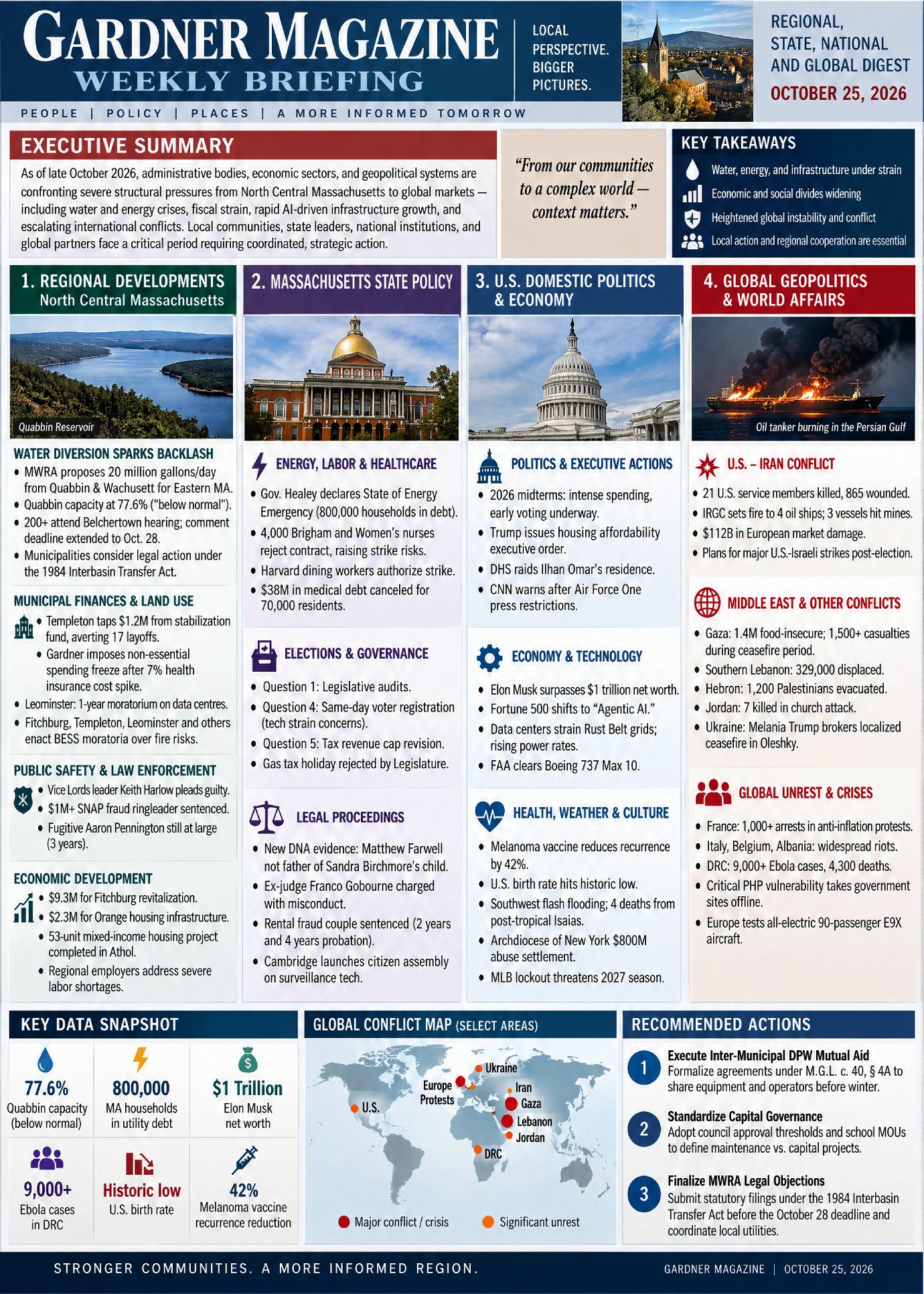
For more news check out the individual news briefings for: North Central MA News — State News of the Week —- National News of the Week — World News of the Week
Publisher’s spotlight: This week’s WGAW Hotline Radio Show features both episodes of a lengthy podcast on the murder of Brianne Pennington and features an interview with renowned reporter Steve Landry of the Gardner News. Here’s the article and link to the show.
Weekly Briefing – Gardner Magazine Reports – for the Week of October 25, 2026
This week there was so much news the Weekly Briefing went over an hour again. Listen on any device, CLICK PLAY.
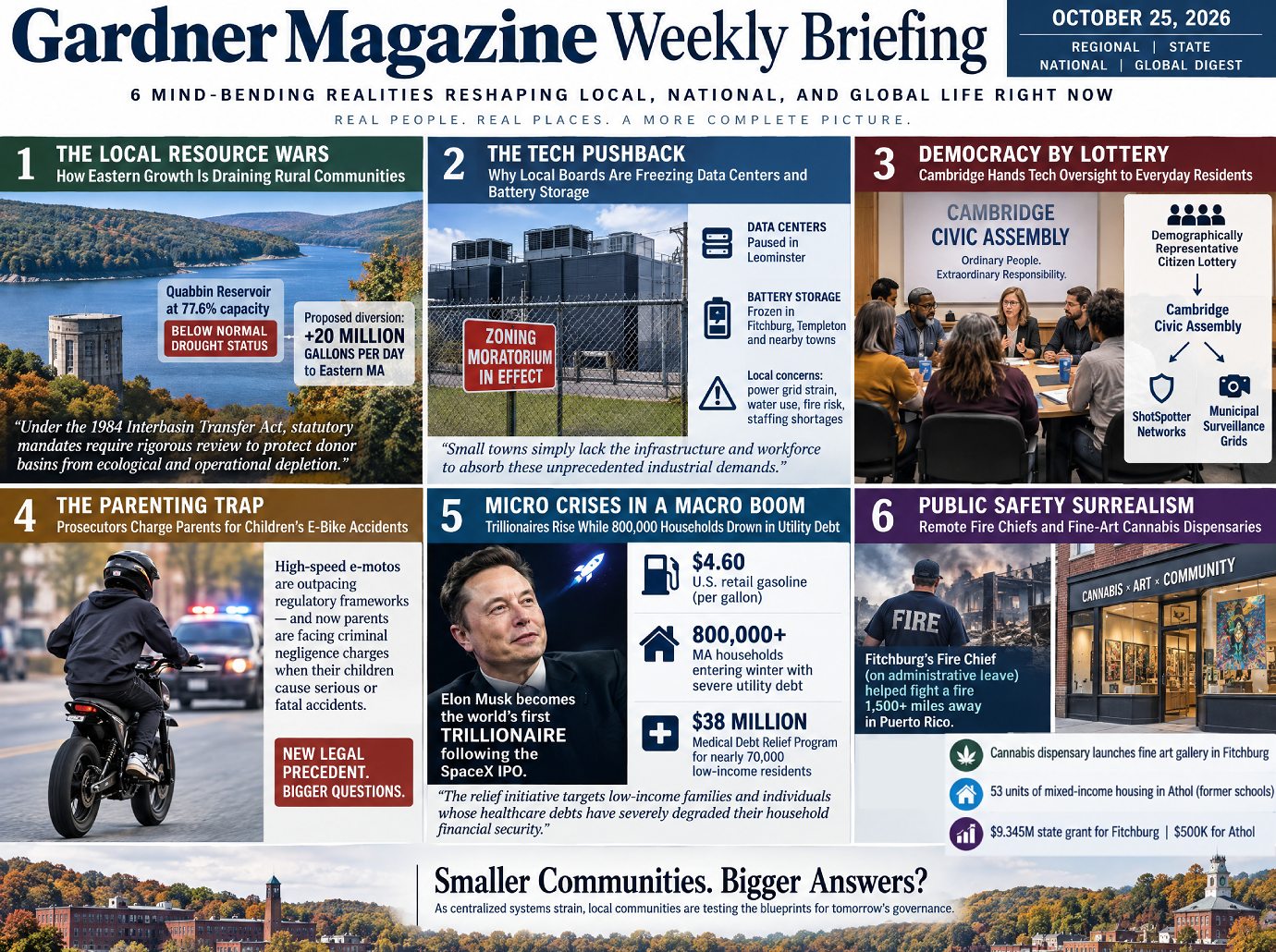
Weekly Briefing 10-25-26 Gardner Magazine Gardner Magazine Weekly Briefing: Regional, State, National, and Global Digest (October 25, 2026)
North Central Massachusetts & North Quabbin Regional Developments
Regional Environmental & Water Policy Battles
Environmental stewardship in Central Massachusetts has reached a critical juncture defined by an intensifying structural tension between state-mandated growth strategies in Eastern Massachusetts and localized natural resource depletion across donor basins. For decades, the watershed communities of northern Worcester County and the North Quabbin region have served as the primary ecological reservoir for the Commonwealth’s urban east. However, as localized drought conditions worsen and regional storage levels drop, municipal leaders and residents are confronting state policies that prioritize metropolitan real-estate expansion at the direct expense of local environmental stability and municipal sovereignty.
The primary regional flashpoint centers on a proposal by the Massachusetts Water Resources Authority (MWRA) to extract an additional 20 million gallons of water per day (MGD) from the Quabbin and Wachusett Reservoirs. This diverted volume is intended to support ongoing commercial and residential real-estate development across expanding eastern municipalities. The plan has ignited fierce, unified resistance across Athol, Orange, New Salem, Belchertown, and Greater Gardner. Public opposition culminated in a marathon four-hour public hearing in Belchertown, which drew over 200 municipal officials, conservationists, and residents. In response to intense regional pressure, state regulatory authorities extended the public review deadline to October 28, 2026. Regional legislators and municipal councils are actively evaluating statutory legal challenges under the 1984 Interbasin Transfer Act, arguing that the MWRA proposal circumvents statutory protections explicitly designed to protect donor basins from ecological depletion. Frustration is further compounded by state policies that waive the standard $5 million entrance fee for new eastern municipal members, even as payments in lieu of taxes (PILOT) granted to local watershed towns remain persistently low.
Executive Callout: Quabbin Diversion Controversy & Local Impact
- Proposed MWRA Diversion: Extract an additional 20 MGD from Quabbin and Wachusett Reservoirs for Eastern MA growth.
- Financial Friction: Standard $5M entrance fees waived for eastern towns while donor basin PILOT rates remain static.
- Local Hydrological Status: Quabbin capacity down to 77.6% (“below normal” drought index); mandatory local water restrictions enforced.
- Statutory Pushback: Interbasin Transfer Act legal challenges mobilized prior to the extended October 28, 2026 review deadline.
This export strategy directly conflicts with deteriorating localized hydrological metrics. The Quabbin Reservoir’s storage capacity has dropped to 77.6%, placing it in “below normal” status under official drought indices. While state planners evaluate large-scale water transfers, municipalities across northern Worcester County continue enforcing mandatory outdoor water-use restrictions on their own property owners—though Athol temporarily eased certain limits following autumn rainfall. Public recreational access has also shifted under seasonal and environmental schedules: the official 2026 Quabbin Reservoir boating season closed on October 17, 2026, though shoreline fishing remains open through December 31, subject to ice conditions.
At the municipal level, water departments and ecological groups are executing necessary utility shifts and conservation measures. The Gardner Water Department announced a scheduled transition for October 28, 2026, reverting to standard chloramine treatment after temporarily utilizing free chlorine sourced from Snake Pond. Concurrently, volunteer conservation groups completed fall biomonitoring and stream health assessments along Athol’s Mill Brook basin, while the Friends of Quabbin collaborated with the Department of Conservation and Recreation (DCR) to finish stone masonry stabilization on the historic Keystone Bridge within the watershed.
MWRA Export Policy & Incentives Local Hydrological Realities & Restrictions Proposed Extraction: Divert +20 MGD from Quabbin/Wachusett for Eastern MA growth. Reservoir Status: Quabbin storage dropped to 77.6% (“below normal” drought status). Financial Incentives: State waives standard $5M entrance fee for new eastern towns. Local Mandates: Mandatory outdoor water-use restrictions imposed on donor town residents. Statutory Framework: Proposal relies on state-level interbasin allocation waivers. Legal Response: Regional leaders preparing 1984 Interbasin Transfer Act challenges. Local Fiscal Impact: Watershed towns operate under persistently low state PILOT payments. Public Impact: 2026 boating season closed Oct 17; local public hearings draw massive protests. These escalating natural resource vulnerabilities directly mirror the severe operational and fiscal hurdles currently confronting local governing boards across the region.
Municipal Governance, Fiscal Controls, and Land-Use Moratoria
Small-town municipal governments across North Central Massachusetts are increasingly deploying defensive administrative instruments—ranging from emergency non-essential spending freezes to multi-year zoning moratoria—to protect public budgets and local infrastructure. Confronted by non-discretionary operational inflation, strict statutory tax caps under Proposition 2½, and rapid technological development, local boards are reasserting statutory authority to maintain basic fiscal solvency and municipal safety.
To guard against unsustainable demands on municipal utility networks and protect local emergency services, regional planning boards are executing temporary land-use freezes on high-density tech and energy facilities:
- Leominster Commercial Data Center Moratorium: City officials enacted a one-year municipal moratorium on commercial data center developments to protect the municipal power grid and local water tables from heavy industrial consumption.
- Battery Energy Storage Systems (BESS) Moratoria: Planning boards in Fitchburg, Templeton, and neighboring North Quabbin towns have drafted and enforced zoning moratoria on utility-scale BESS installations, establishing a regulatory pause to evaluate thermal runaway fire hazards, specialized fire suppression requirements, and grid stability factors.
Strategic Context: These localized planning pauses are not isolated NIMBYism; rather, they represent the leading edge of a national infrastructure boundary where small-town planning boards are forcing a pause on Big Tech’s unconstrained grid demands, directly foreshadowing national energy grid crises unfolding across the Rust Belt.
Executive Callout: Regional Municipal Fiscal Interventions
- City of Gardner: Executive non-essential spending freeze instituted by Mayor Nicholson to absorb a 7% Medics health insurance cost spike. Legislative advancement of Item 1184 (Tyros Ordinance / Chapter 676).
- Town of Templeton: Special Town Meeting approved Article 2, transferring $1.2M from General Purpose Stabilization to FY27 operating budget after failed tax overrides, preventing ~17 municipal layoffs but reducing reserves to ~$300k. Debt rescissions of $4.2M approved under Articles 4 & 5.
In the City of Gardner, Mayor Michael Nicholson issued an executive spending freeze on non-essential operations to absorb unexpected non-discretionary cost spikes, highlighted by a 7% premium increase during the renewal of the Medics municipal health insurance plan. On the legislative front, the Gardner City Council advanced Item 1184 (proposed Chapter 676, commonly known as the “Tyros Ordinance,” introduced by Council President George Tyros) to its second printing. The ordinance mandates explicit City Council approval for capital projects exceeding $150,000 and requires the creation of citizen advisory committees for projects exceeding $500,000.
This legislative push has created jurisdictional debate with School Superintendent Dr. Mark Pellegrino regarding City Charter Section 40, which governs authority over school facility maintenance versus capital alterations. This friction is highly significant: it represents a fundamental constitutional dispute between municipal legislative oversight over capital debt obligations versus school department autonomy over day-to-day facility operations. In municipal administration, the City Council confirmed Dane Arnold as Public Works Director (who takes leadership over a DPW operating at a severe 33% vacancy rate, short 9 positions) and appointed Tyler Chase Ellison as Conservation Agent. Additionally, the Board of Assessors completed state LA3, LA4, and LA13 recapitalization tax filings.
In the Town of Templeton, voters at the October 21 Special Town Meeting approved Article 2 by a two-thirds majority, authorizing a $1.2 million transfer from the General Purpose Stabilization Fund into the FY27 operating budget following failed property tax override votes. The emergency drawdown averted approximately 17 municipal layoffs across the police, fire, and highway departments. However, the Templeton Advisory Committee formally opposed the transfer, warning that drawing emergency reserves down to roughly $300,000 threatens the town’s municipal bond rating and breaches state-recommended reserve buffers (5%–10%). Voters also approved Articles 4 and 5, rescinding over $4.2 million in authorized but unissued debt from completed or abandoned historical landfill and capital projects, while citizen petitions regarding non-disclosure agreements, Saturday town meetings, and randomized warrants were defeated.
These fiscal pressures and administrative adjustments directly influence the capacity of local governments to maintain public safety operations and manage high-stakes law enforcement actions across the region.
Regional Crime, Public Safety, and Judicial Enforcement
Public safety management across northern Worcester County requires a continuous operational intersection between municipal emergency services, regional tactical response units, and federal law enforcement agencies. Managing community safety involves addressing organized drug distribution networks and systemic public fraud alongside localized emergency deployments and administrative leadership disputes.
Defendant / Case Jurisdiction / Court Charges & Key Details Current Status / Outcome Jacob Comeau-Karlon (35) South Ashburnham / Gardner District Court Disturbance at All Town Convenience Store; flight; drone and K9 search forcing shelter-in-place across 3 schools. Apprehended; formal criminal charges filed in Gardner District Court. Keith Harlow (“Lord Savage”) Athol / Federal Court Leader of Vice Lords gang; firearm trafficking, armed robbery conspiracy, narcotics distribution, home invasion. Federal guilty plea entered. Raul Fernandez Vicioso Fitchburg / Federal Court Ringleader of multi-tiered “El Primo” SNAP benefit fraud ring diverting over $1M in food assistance. Sentenced to 2 years in federal prison; $1.1M restitution ordered. LaMar Cook Federal Court Wire fraud, SNAP benefit fraud, and regional drug trafficking charges. State bail officially revoked following federal indictments. Aaron Pennington Gardner Area / State & Federal High-profile primary suspect in ongoing fugitive murder investigation. Multi-agency manhunt active (3 years). Beyond judicial prosecutions, public safety departments are navigating internal administrative friction and evolving operational methodologies. The Gardner Firefighters Association (Local 3128) executed a formal Vote of No Confidence against their Fire Chief, citing escalating leadership disputes and administrative policies. In Fitchburg, news surfaced that the city’s Fire Chief, while placed on administrative leave, actively assisted local emergency crews in suppressing a major structure fire while traveling in Puerto Rico.
Tactically, police departments across Northern Worcester County report an expanding reliance on regional drone support units and K9 assets for emergency searches and high-risk operations. Meanwhile, regional narcotics task forces secured indictments targeting distribution networks along the Route 2 corridor, supported by a major federal seizure of over 3 kilograms of fentanyl and commercial packaging equipment in Worcester County. On campus security, Fitchburg High School administrators and local police conducted comprehensive security protocol reviews following back-to-back disciplinary incidents.
These law enforcement interventions and operational stabilization efforts provide the foundational security required for regional political engagement, economic investment, housing development, and commercial revitalization.
Regional Political Dynamics, Housing, Economic Revitalization, and Infrastructure
Electoral competition and civic engagement across North Central Massachusetts are heating up as the 2026 midterms approach. In the 1st Congressional District, incumbent Democratic Representative Richard Neal and Independent challenger Nadia Milleron engaged in sharp debates regarding regional economic access and rural priorities. Milleron built her platform around eliminating federal income taxes on earnings below $100,000, funded by foreign military spending cuts, while criticizing Neal for declining a separate televised debate. Neal countered by emphasizing his legislative seniority and established track record of delivering federal infrastructure funding to Central and Western Massachusetts. Gardner Mayor Michael Nicholson faces off against John Reilly in the State Representative race. Notably, John Reilly has not participated in any interviews with Gardner Magazine, WGAW Radio, or the Gardner News despite being afforded the opportunity.
Voter engagement is further driven by Ballot Question 1 (Legislative Audits), which has generated high interest across northern Worcester County regarding public records transparency and state legislative oversight. Grassroots mobilization was highlighted by Indivisible North Quabbin hosting a “No Kings – Vote Early Block Party” in Orange, drawing over 200 attendees and collecting food donations for local pantries, while local groups partnered with the ACLU and Common Cause to train non-partisan poll monitors across North Quabbin voting sites.
Simultaneously, communities across North Central Massachusetts are actively leveraging state discretionary capital allocations, public-private partnerships, and adaptive reuse projects to counter post-industrial economic decline and mitigate chronic housing shortages:
- Fitchburg Urban Core: Allocated a $9.345 million state downtown revitalization grant dedicated to downtown infrastructure updates and mixed-income development.
- Athol Residences at the Park: Non-profit developer NewVue Communities hosted a ribbon-cutting ceremony for a 53-unit mixed-income housing complex created through the adaptive reuse of the historic Riverbend and Ellen Bigelow elementary schools.
- Athol Commercial Corridor: Secured nearly $500,000 through the state One Stop for Growth program for vacant storefront restoration, downtown parking redesigns, and the scheduled demolition of the blighted York Theater.
- Orange Residential Infrastructure: Received $2.3 million from the Executive Office of Housing and Livable Communities (EO HLC) for utility extensions to support affordable housing expansion.
Commercial shifts reflect ongoing economic adaptation. Organic grocer and café Roots Natural Foods completed its relocation from Leominster into an expanded storefront in downtown Fitchburg. In a novel fusion of culture and retail, a licensed adult-use cannabis dispensary in Fitchburg launched an ongoing fine art gallery series showcasing local painters and mixed-media artists. To support industrial retention, the North Central Mass Chamber of Commerce convened regional business leaders to address labor shortages affecting the region’s 445 plastics and manufacturing facilities. Environmentally, the Town of Athol received a statewide Mass Save Impact Award for municipal weatherization projects and carbon reduction initiatives. In community recreation, the Orange YMCA completed facility expansions within the Orange Innovation Center, adding a 2,400-square-foot functional training room and hosting the Spartan DEKA STRONG competition.
Regional social safety nets and educational institutions are also expanding programs:
- Social & Health Services: State Representative Natalie Higgins and Senator John Cronin secured $65,000 for Ginny’s Helping Hand in Leominster, which supports over 5,000 monthly visits. Worcester County Sheriff Lew Evangelidis conducted his annual winter coat drive for the Spanish American Center (Leominster), Compass Clubhouse (Fitchburg), and Alyssa’s Place (Gardner), while distributing inmate-grown organic produce to regional pantries. The Spanish American Center celebrated 60 years of service, and the United Way of North Central Mass deployed volunteers across 43 sites for its 31st Day of Caring. Athol Hospital qualified for up to $2.5 million in federal rural healthcare stabilization funds. Furthermore, under the Healey-Driscoll administration’s $13 million federal pass-through traffic safety pool, targeted road safety grants were awarded to Petersham ($13,320), Athol ($9,422), and Royalston ($7,991).
- Education Infrastructure: The Board of Higher Education authorized Fitchburg State University to launch a new Bachelor of Science in Finance degree focused on corporate finance and market analytics. Following the statewide elimination of the MCAS graduation requirement, regional school committees are re-evaluating local high school graduation standards, while several districts contracted the Massachusetts Association of School Committees (MASC) for superintendent searches. In Paxton, the bankrupt Anna Maria College received no qualified bids during its campus auction. Finally, Gardner Public Schools rolled out the Beacon Connect Family App for real-time municipal bus tracking.
These regional developments reflect broader statewide policy shifts, legislative friction, and executive interventions across the Commonwealth of Massachusetts.
Massachusetts Commonwealth Policy & Statewide News Digest
Statewide Energy Emergency, Labor Strain, and Economic Relief
The Commonwealth of Massachusetts is navigating systemic energy affordability challenges and widespread labor disputes, prompting high-level executive interventions and state-backed economic relief programs.
Mounting utility debt has created an acute financial strain for low- and middle-income households. Over 800,000 Massachusetts utility customers have accumulated severe energy debt amid surging electric and home heating rates. This crisis is hit by a direct regional catalyst: surging heating oil costs directly impacting over 200,000 Massachusetts households heading into winter, many concentrated in Central and Western Massachusetts. In response, Governor Maura Healey issued an executive order declaring a proactive state of energy emergency to accelerate regulatory relief measures. However, legislative leaders on Beacon Hill officially rejected Governor Healey’s concurrent proposal to suspend the state gas tax, maintaining that fuel tax revenues are necessary to safeguard state transportation infrastructure funds.
Executive Callout: Commonwealth Energy & Labor Emergency
- Utility Debt Crisis: Over 800,000 customers in severe debt; Gov. Healey declares Energy Emergency driven by heating oil surges affecting >200,000 households.
- Legislative Resistance: House leadership officially rejects Governor’s gas tax suspension proposal.
- Labor Volatility: ~4,000 Brigham & Women’s nurses reject contract; Harvard dining staff authorize strike; RegalCare nursing homes face state quality intervention.
This state-level energy shock is not occurring in a vacuum; it is directly connected to global Middle East oil transit disruptions, where Persian Gulf maritime volatility directly compounds home heating costs across Central Massachusetts.
Simultaneously, labor friction is escalating across critical healthcare and academic sectors:
- Brigham and Women’s Hospital: Approximately 4,000 nurses represented by the Massachusetts Nurses Association (MNA) voted overwhelmingly to reject management’s latest contract offer, citing inadequate base pay increases and patient safety concerns. The vote re-establishes the immediate threat of an extended strike following a period of reliance on temporary travel nurses.
- Harvard University: Campus dining staff voted to authorize a strike following unresolved contract negotiations regarding wage scales and healthcare benefit contributions.
- RegalCare Facilities: State health inspectors launched a major quality intervention across RegalCare nursing homes after leaked internal employee logs exposed systemic oversight and staffing failures.
To mitigate compounding cost-of-living pressures, state officials executed a targeted economic relief initiative that erased $38 million in medical debt for nearly 70,000 low-income residents, targeting households whose financial security has been compromised by unpaid healthcare bills.
These economic and labor pressures directly color the political landscape as the Commonwealth approaches the 2026 midterm elections.
Midterm Election Dynamics, Legislative Controversies, and Ballot Questions
With the 2026 midterm elections less than two weeks away, political activity across Massachusetts is marked by high-stakes constitutional ballot measures, competitive executive campaigns, and unexpected electoral disruptions.
In the gubernatorial contest, The Boston Globe editorial board formally endorsed incumbent Democratic Governor Maura Healey for reelection while calling on state lawmakers to address slowing private-sector job growth. Republican challenger Mike Minogue, a businessman and West Point graduate, centered his campaign platform on expanding charter school capacity and enacting a state-level Scholarship Tax Credit program. The Republican executive ticket experienced significant late-stage disruption following the arrest of its lieutenant governor candidate. Meanwhile, high-profile incumbents, including Senator Elizabeth Warren, deployed out-of-state to assist Democratic candidates in midwestern swing-state races. Grassroots groups, such as the “No Kings” movement, pivoted away from large Boston Common demonstrations toward targeted early-voting turnout drives.
Measure / Policy Proposed Action Impact / Municipal Concerns Question 1 Legislative Audit Authority Proposes granting State Auditor authority to audit the Legislature; high voter interest in North Central MA, opposed by Beacon Hill leadership. Question 4 Same-Day Voter Registration Proposes same-day voter registration; municipal clerks warn of severe technical and IT infrastructure strain on local networks. Question 5 Revision of State Tax Cap (Ch. 62F) Revises the 40-year-old state tax cap baseline; could increase taxpayer refunds while tightening state operating budget limits. Gas Tax Relief Gas Tax Suspension Proposed by Gov. Healey but officially rejected by House leaders to safeguard transportation infrastructure revenue. Cannabis Rollback Rollback of Adult-Use Legalization Public campaign advocating to roll back legal marijuana laws, alleging traffic safety risks; contested by data researchers. Municipal governance controversies have also surfaced across the state. The Lawrence City Council executed a formal vote of no confidence against the sitting mayor, escalating an administrative crisis. In Springfield, a Superior Court judge referred a compliance dispute between the City of Springfield and MGM Springfield regarding host community agreement terms back to the Massachusetts Gaming Commission. Additionally, federal law enforcement agencies initiated investigations after suspicious mail was delivered to multiple state and local government offices across Massachusetts.
These political and legislative battles unfold alongside major judicial proceedings and novel municipal policy experiments.
Judicial Reckonings, Law Enforcement Operations, and Municipal Experiments
State and federal courts across Massachusetts are processing high-profile criminal trials, judicial misconduct inquiries, and landmark fraud sentencings, while municipalities test novel administrative policies.
In federal court, the trial of former police officer Matthew Farwell—charged in connection with the death of Sandra Birchmore—advanced with FBI testimony regarding recovered text messages. Court-admitted forensic DNA results conclusively established that Farwell was not the father of Sandra Birchmore’s unborn child, forcing both prosecution and defense teams to recalibrate core trial arguments. In judicial oversight, the Massachusetts Commission on Judicial Conduct filed formal charges against retired Fall River District Court Judge Franco Gobourne for judicial misconduct, alleging he improperly detained a defense attorney in a holding cell without legal justification. In housing fraud, “Professional Tenants” Russell and Linda Callahan were sentenced in Worcester Superior Court (Russell to two years in jail; Linda to four years of probation) after pleading guilty to a systematic scheme where they exploited statutory housing protections to live rent-free across multiple properties. In Uxbridge, the Worcester District Attorney’s Office concluded its investigation into the death of Police Officer Stephen LaPorta, ruling that no criminal charges will be filed against the truck driver involved in the icy highway collision.
Federal agencies also executed major operations, including a Boston cruise line child exploitation bust resulting in over 120 arrests of crew members, and the dismantling of an Eastern Massachusetts marriage fraud ring. Additional law enforcement actions include a homicide investigation into an officer-involved shooting outside a Stoughton pub, the extradition of a Reading matricide suspect from Vermont, a Wellesley grand jury indictment regarding the deaths of two children, a civil rights lawsuit against the Southwick school superintendent over proposed lunch privilege withholdings, an Abington Walmart bodycam release showing a foot pursuit of an armed teenager, and a $700,000 trip-and-fall lawsuit filed against the historic Witch House in Salem.
Executive Callout: Urban Policy & Civic Governance Experiments
- Somerville Path Speed Controls: Municipal crews installed physical rumble strips along the multi-use Community Path to forcibly slow down fast-moving e-bikes and e-scooters.
- Cambridge Lotterocracy: Launched inaugural Civic Assembly selecting a demographically representative, randomly selected citizen panel with binding advisory authority over surveillance tech (including ShotSpotter).
At the municipal level, infrastructure and governance experiments are drawing national attention. Somerville’s physical rumble strips reflect an escalating urban culture war over micromobility speeds. Cambridge’s Civic Assembly tests whether lottocracy can manage technology policy more effectively than traditional political bodies. Additionally, state officials announced structural reforms for the Massachusetts State Police Academy, and West Springfield initiated litigation against a local Chick-fil-A over severe drive-thru traffic gridlock.
These Commonwealth-level developments reflect broader macroeconomic trends, federal executive actions, and national policy debates across the United States.
Publisher’s Notes: From the municipal council chambers of Greater Gardner to national economic debates and global security flashpoints, late October 2026 reveals a connected landscape defined by institutional adaptation and resource management. Whether local planning boards in Leominster and Templeton are enacting defensive moratoria to protect local power grids from AI data center demands, state leaders are managing energy emergencies linked to global oil volatility, or international bodies are navigating complex geopolitical crises, the ability of local communities to maintain strategic planning, fiscal discipline, and self-determination remains essential to navigating broader global volatility. For more news check out the individual news briefings for: North Central MA News — State News of the Week —- National News of the Week — World News of the Week
- Hotline Radio 10-24-26

An A-Maze-Ing Hotline Radio Show of October 24, 2026
Listen to the entire program on any device, CLICK PLAY.
WGAW Hotline Radio 10-24-26 First up on the show: Gardner Mayor Mike Nicholson who spoke about the Heywood Hospital Healthy Harvest 5K held today: There were over 200 runners. Reminds people about being active while giving back. “It was a really great time.” “Heywood Hospital is a huge help to us in the community.” “Having a top-notch hospital in our backyard is a huge benefit.” — A discussion about upcoming food drives: The Gardner City Council has partnered with the Gardner CAC and MVOC to collect food before the holidays. — Host Steve Wendell asked Mayor Nicholson about Christmas season events. Nicholson noted that while a schedule is being put together for a number of December events, the Sunday after Thanksgiving is the tree-lighting ceremony. — Mayor Nicholson spoke about a grant celebrated this week involving the MVP Academy where students can take shop classes at Monty Tech – a local restaurant building will be renovated with grant funding and culinary classes will be added to the available options. “It’s a great program that continues to grow.” Steve Wendell spoke with the Mayor about politics – people are doing standouts for Nicholson today in all 4 communities in the 2nd Worcester District: Gardner, Templeton, Ashburnham, and Winchendon. Deadline to register to vote is 5pm today. —
Steve Wendell highlighted that he has offered ½ hour of free airtime to all candidates. Wendell mentioned that candidate John Reilly has not responded to interview requests from WGAW, Gardner Magazine, and the Gardner News.
Steve Wendell interviewed various individuals at the Heywood Healthcare Healthy Harvest 5K where over 200 runners participated.
Mike Urban did a commentary on corruption in Massachusetts politics. Topics included $1.4 million benefit fraud case in MA, Levels of Corruption, Problems with Illegals, Food Stamp Fraud in MA, Stolen Identities, Individual Fraud, Gang Fraud
Steve Wendell reiterated that a $40,000 reward has been offered for the conviction of those responsible for previous sabotage of the station.
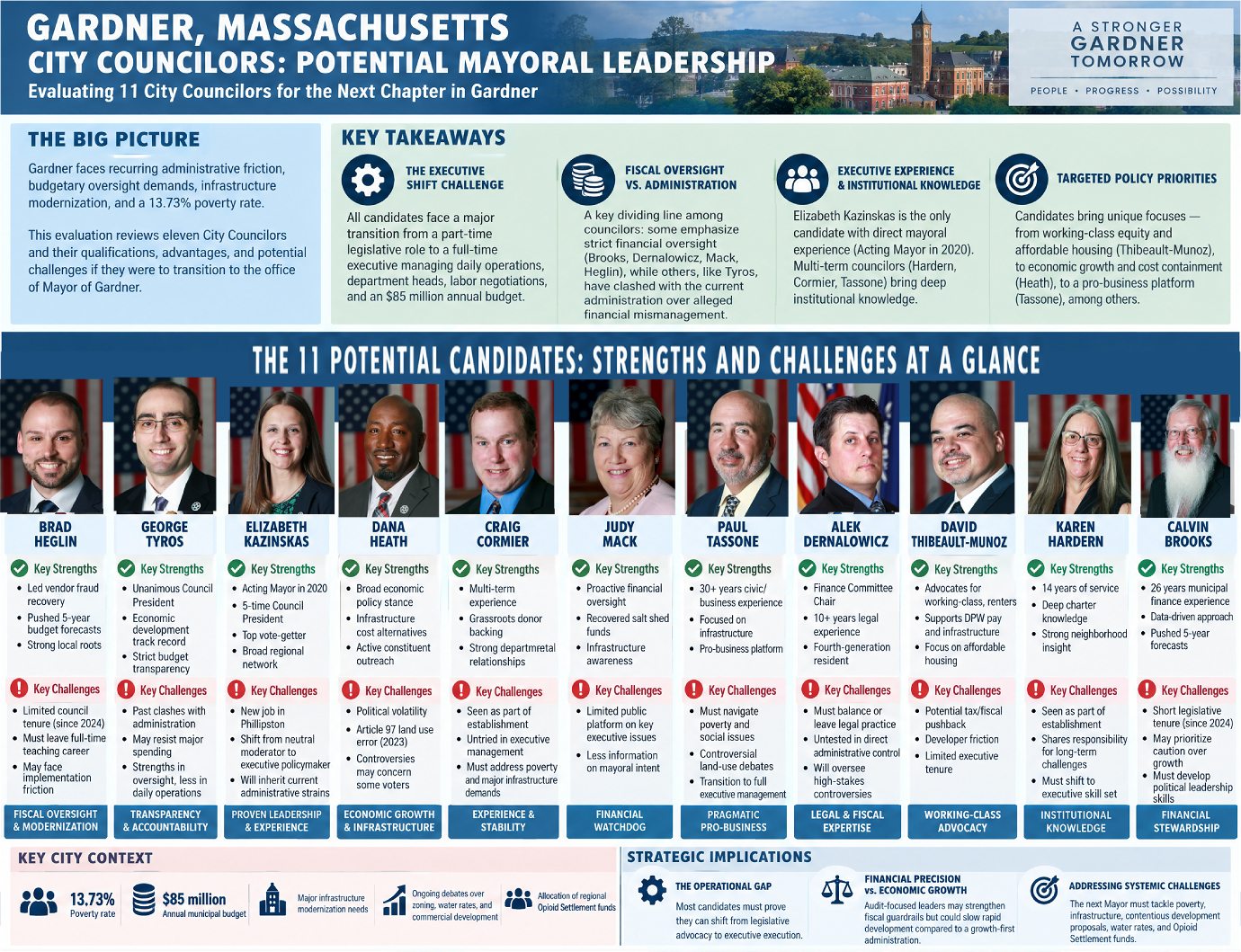
Commentary from Werner Poegel – the Mayoral Matrix – A review of all 11 Gardner City Councilors who might be in the running for Mayor. Host Steve Wendell stated that he predicts Brad Heglin would become City Council President and then take over as Acting Mayor in January.
SPECIAL HOTLINE REPORT – The Pennington Murder of October 2023, 3 years ago. Brianne Pennington was allegedly murdered by her husband Aaron Pennington who is on the FBI’s Most Wanted List.
- Heywood 5k 2026

Mother Nature Providing Great Weather for Heywood Healthcare 5K on Saturday
The Heywood Healthcare Healthy Harvest 5K is Saturday October 24th. Registration opens at 8am (you can register same day if you want) Race start time is 9am. It’s a fundraiser for local healthcare programs.
The 2026 Heywood Healthcare Healthy Harvest 5K (HH5K) is a family-friendly community run and walk hosted by Heywood Healthcare. Here are the event details:
- Date: Saturday, October 24, 2026
- Start Time: 9:00 AM Eastern Time (registration opens at 8 am)
- Location: Heywood Hospital, 242 Green St, Gardner, MA 01440
- Format: Self-timed 5K run or walk, open to all ages and abilities (runners, walkers, strollers, and costumed participants are welcome).
- Activities: Features local health organization information tables, a resource fair, and a festive fall atmosphere.
- Awards: Given for Top Male & Female Finishers (Top 3) and Most Spirited (individuals and teams).
- Proceeds: Support local healthcare programs and Heywood Healthcare’s mission.
- Westminster – 2 Updates

Westminster MA: South Street Sentinel November 2026 and Town Crier Episode 36 – FULL COVERAGE and ANALYSIS
First, 2 podcasts. A Deep Dive with the Chair Man and the Chair Lady going through all of the information in the November South Street Sentinel (CLICK HERE FOR FULL PDF), and, the October 20th Town Crier hosted by Westminster Town Administrator Stephanie Lahtinen.
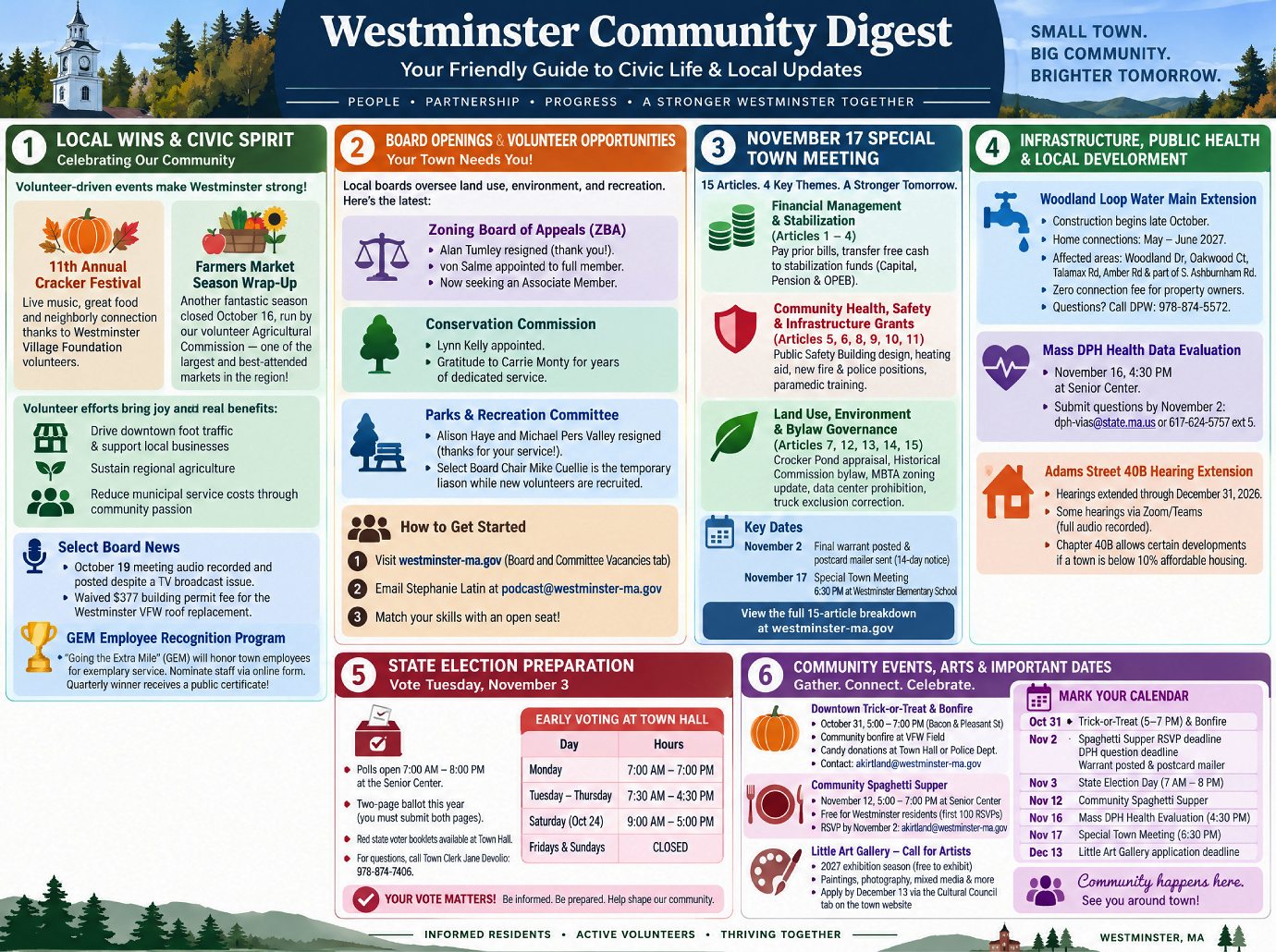
Podcast – South Street Sentinel November 2026 Town Crier Episode 36 – with Stephanie Lahtinen Gardner Magazine has an extensive set of infographics below on both the Westminster South Street Sentinel and the Town Crier, and a 53 page report on PDF, CLICK HERE. To view a complete infographic, CLICK on the image for a larger view.
Key developments covered in the South Street Sentinel include:
- Electoral Administration: Mandatory registration and ballot request deadlines leading up to the November 3, 2026 Massachusetts State Election, alongside preparations for the November 17, 2026 Special Town Meeting.
- Infrastructure & Public Safety: Selection of Vertex by the Public Safety Building Committee to conduct property and safety assessments; transition from Code Red to the Everbridge emergency alert system; establishment of a new school speed zone on State Road East; and the retirement of firefighter Tim Hurd after over 43 years of service.
- Public Health & Economic Assistance: A formal public update on November 16 regarding the Department of Public Health’s (DPH) Town-Wide Health Data Evaluation, alongside winter fuel assistance programs (EHHAP) and local charitable drives.
- Community Integration: A series of public engagement events hosted by Community Services, including the inaugural Community Spaghetti Supper, a Holiday Swap, and youth programming at the Forbush Memorial Library.
Fall 2026 Special Town Meeting
- Date & Time: Tuesday, November 17, 2026, at 6:30 PM.
- Location: Westminster Elementary School (9 Academy Hill Road).
- Process & Approvals: The Warrant was reviewed during the October 5 and October 19 Select Board meetings and discussed on the Town Crier Podcast. Final approval of the warrant occurs at the November 2 Select Board meeting, with public posting on the town website on November 3. Details are also distributed via mail postcards.
- Contact: Tamie Chiarelli at 978-874-7408 or
tchiarelli@westminster-ma.gov
Emergency Alert System Transition: Everbridge
Westminster has decommissioned the Code Red platform and partnered with Everbridge for emergency management and routine public notifications (e.g., severe weather, fires, floods, road closures, and water utility maintenance).
- Account Migration Requirement: While user data from Code Red was migrated automatically, residents and business owners must create a new Everbridge account and manually configure personal settings to ensure preferred delivery (cell phone, SMS, home phone, or email).
- Registration Portal:
https://member.everbridge.net/93013422375055/login
Key Matters covered in the Town Crier podcast #36 with Stephanie Lahtinen include:
Preparations for the Special Town Meeting scheduled for November 17, featuring a 15-article warrant addressing financial stabilization, public safety staffing, land appraisals, and zoning bylaw amendments.
Key administrative initiatives include the rollout of the “Going the Extra Mile” (GEM) employee recognition program, critical public health data updates from the Massachusetts Department of Public Health (Mass DPH), and the commencement of Phase 1 construction for the privately funded Woodland Loop water main extension to address groundwater contamination. Additionally, the town is preparing for early voting and the November 3 State Election featuring a two-page ballot, alongside several community events managed by the newly established Community Services Department.
Master Community Calendar: Mark your calendars with these key town dates and deadlines:
- October 31: Downtown Trick-or-Treat (5:00 PM – 7:00 PM) & VFW Field Bonfire
- November 2:
- Deadline to RSVP for First-Ever Community Spaghetti Supper
- Deadline to submit advance questions for Mass DPH Health Evaluation Meeting
- Official posting date of Special Town Meeting Warrant & postcard mailer dispatch
- November 3: State Election Day (Polls open 7:00 AM – 8:00 PM at Senior Center)
- November 12: First-Ever Community Spaghetti Supper (5:00 PM – 7:00 PM at Senior Center)
- November 16: Mass DPH Health Data Evaluation Meeting (4:30 PM at Senior Center)
- November 17: Special Town Meeting (6:30 PM at Westminster Elementary School)
- December 13: Priority Application Deadline for Little Art Gallery 2027 Exhibition Season
Westminster Community Digest 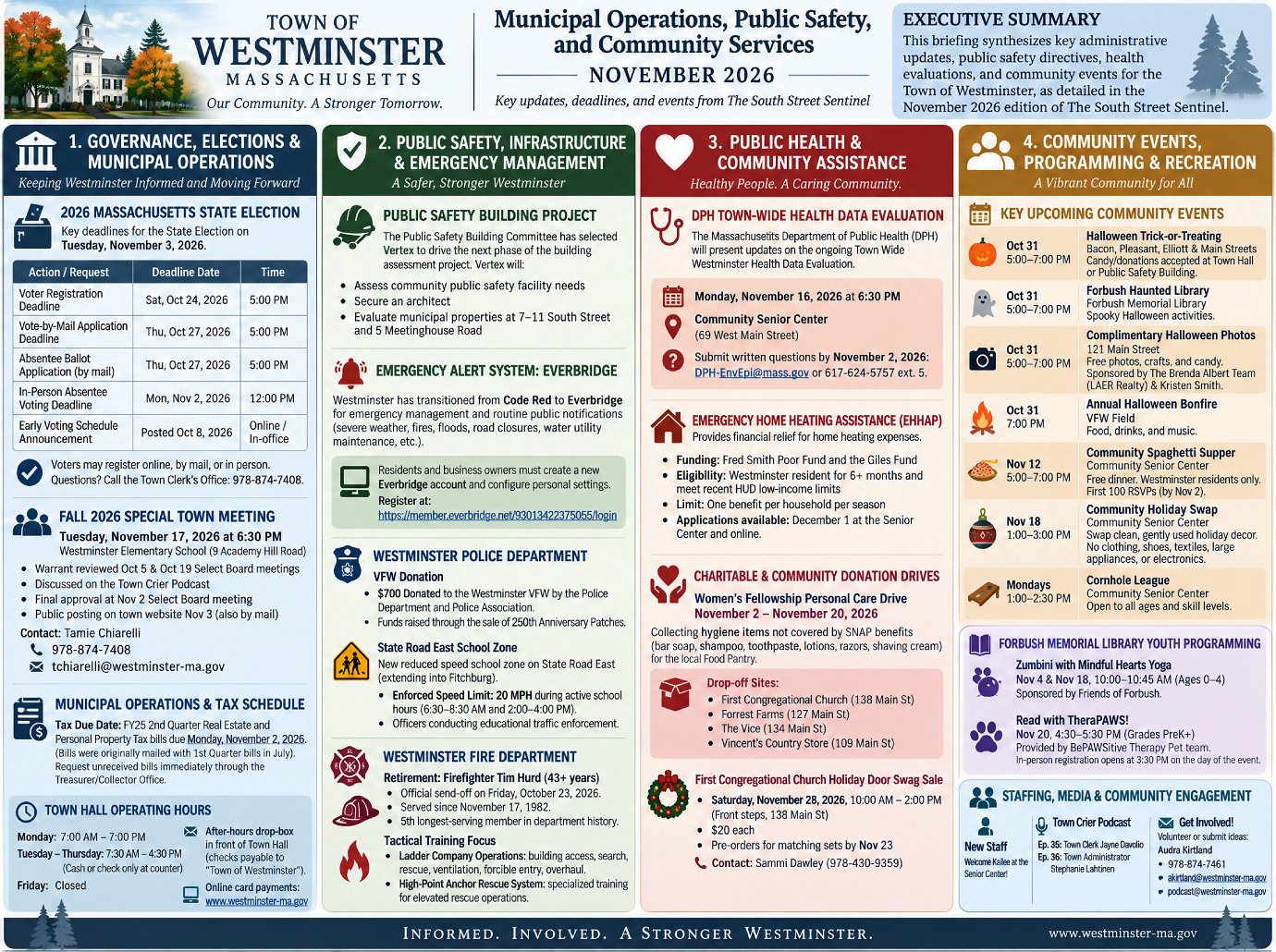
Municipal Operations – Public Safety – Community Services 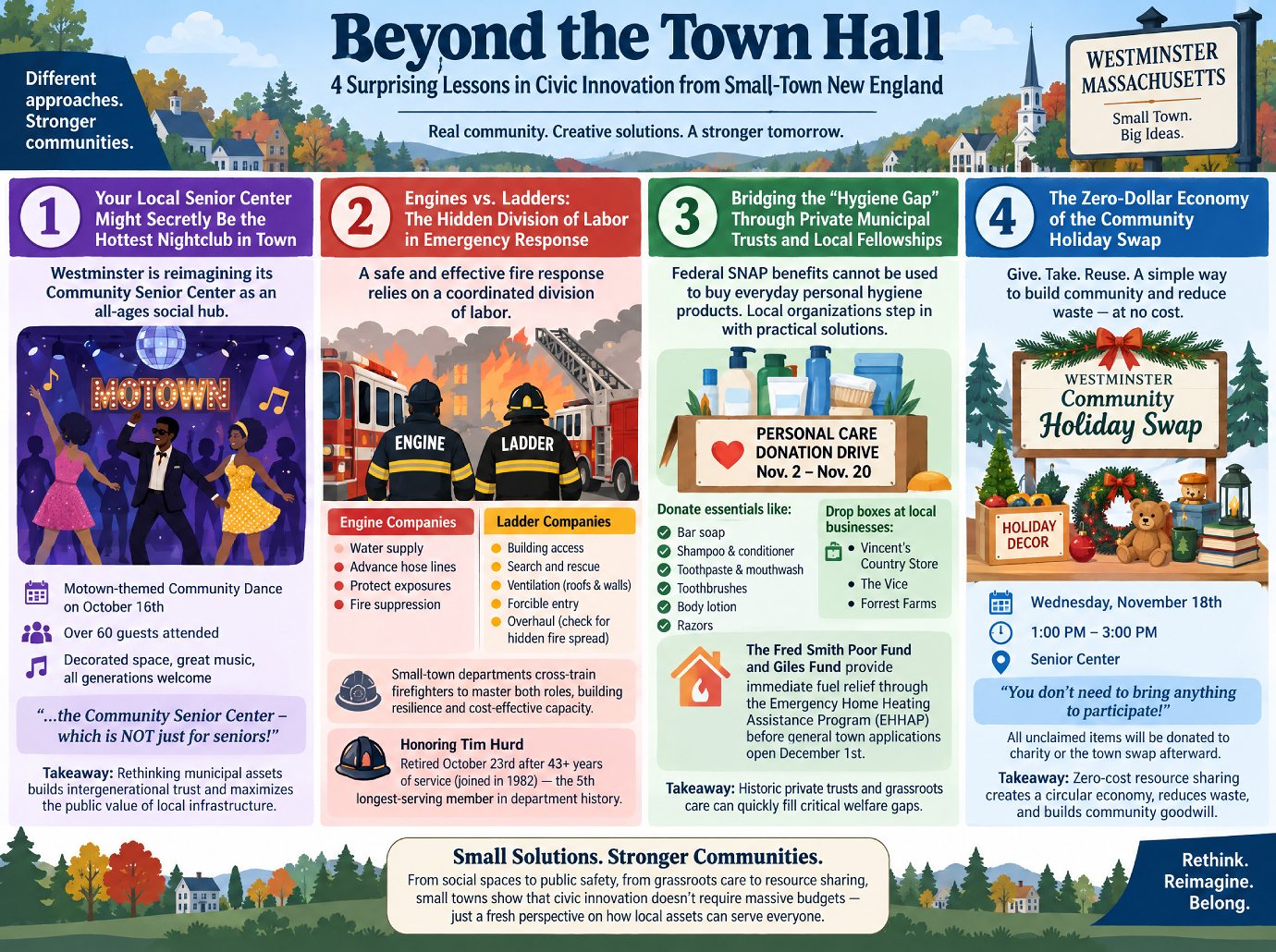
Beyond the Town Hall 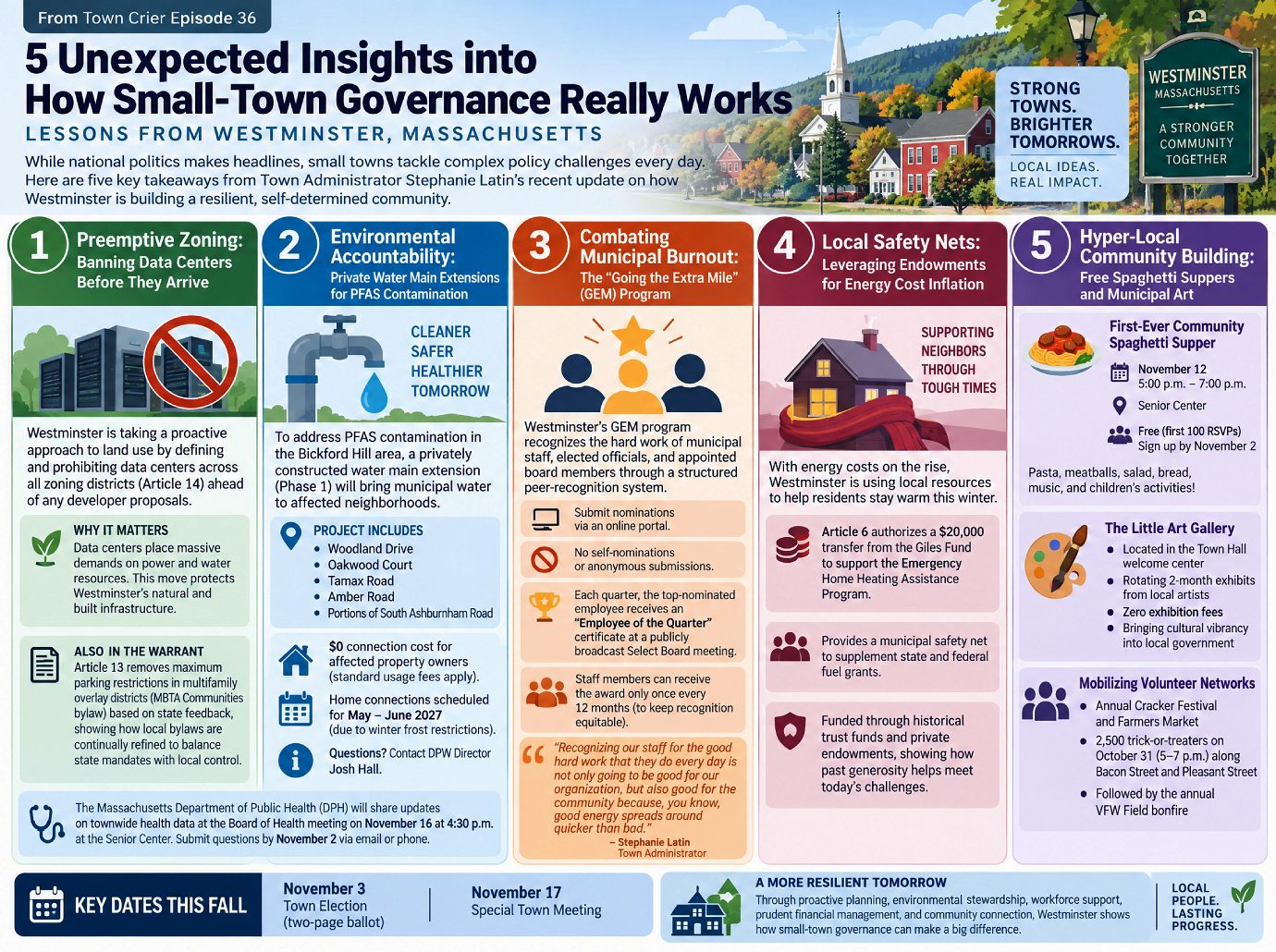
5 Unexpected Insights 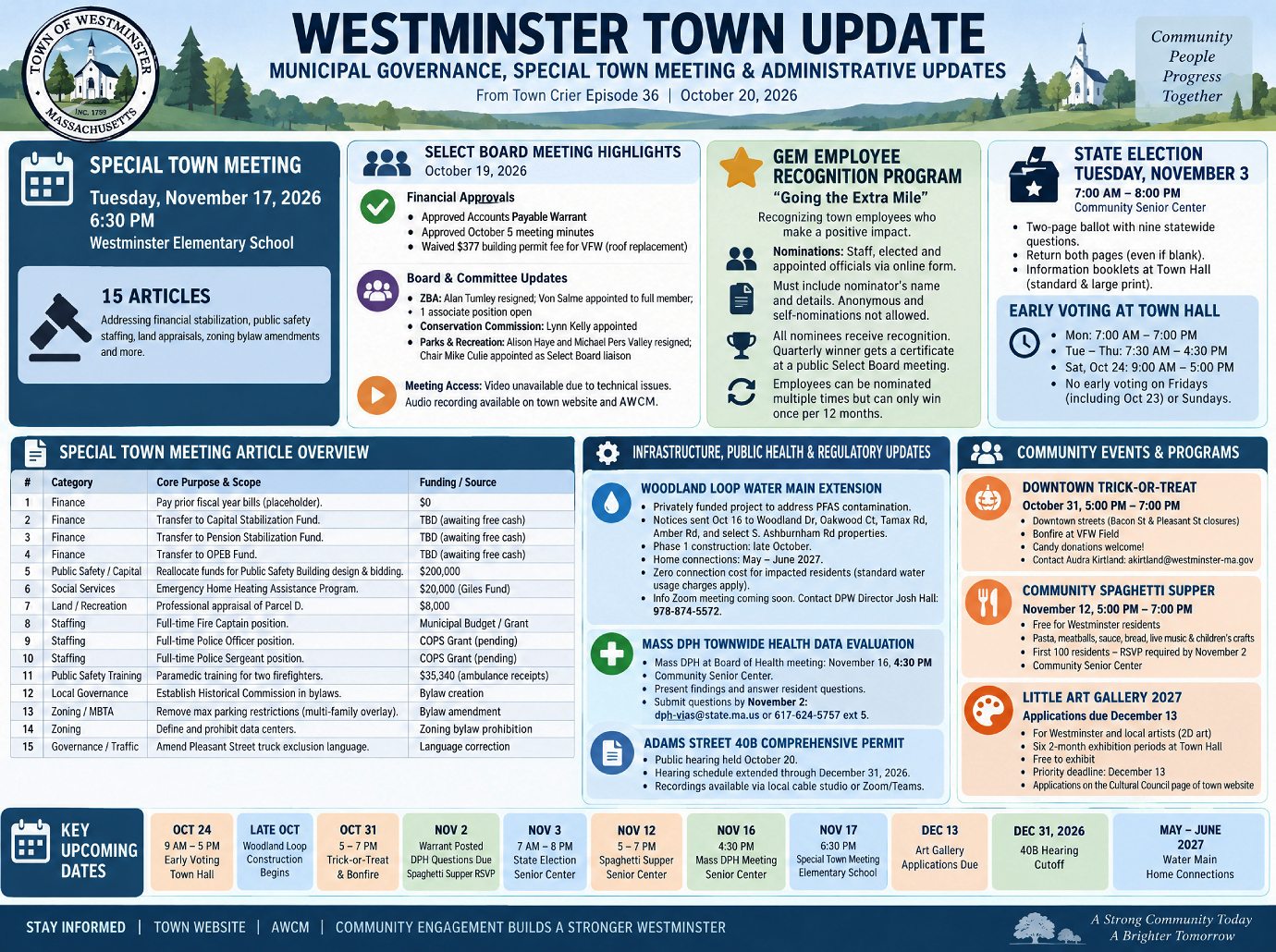
Westminster Town Update 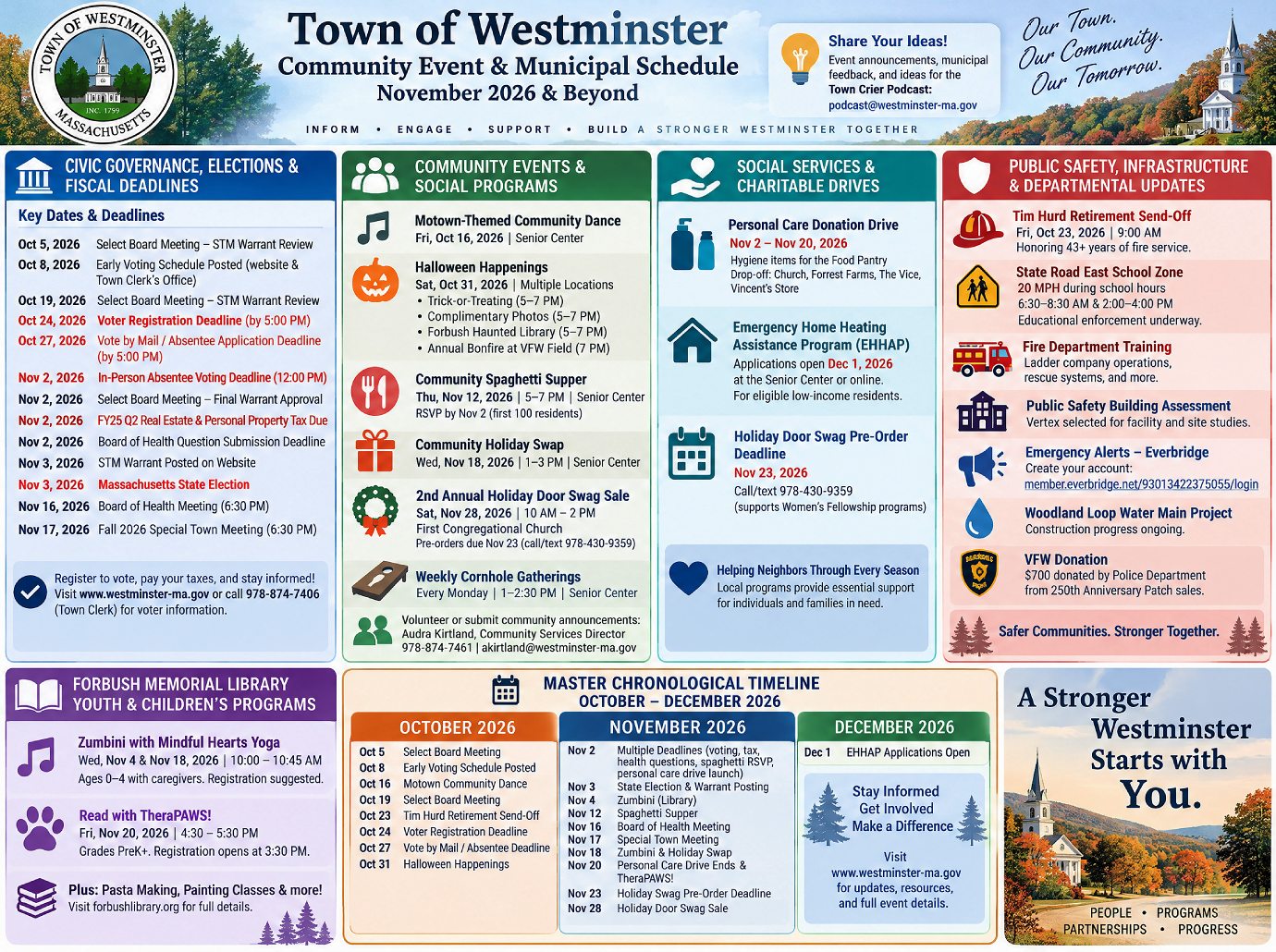
Westminster Community Events and Municipal Schedule
- Templeton 10-21-26
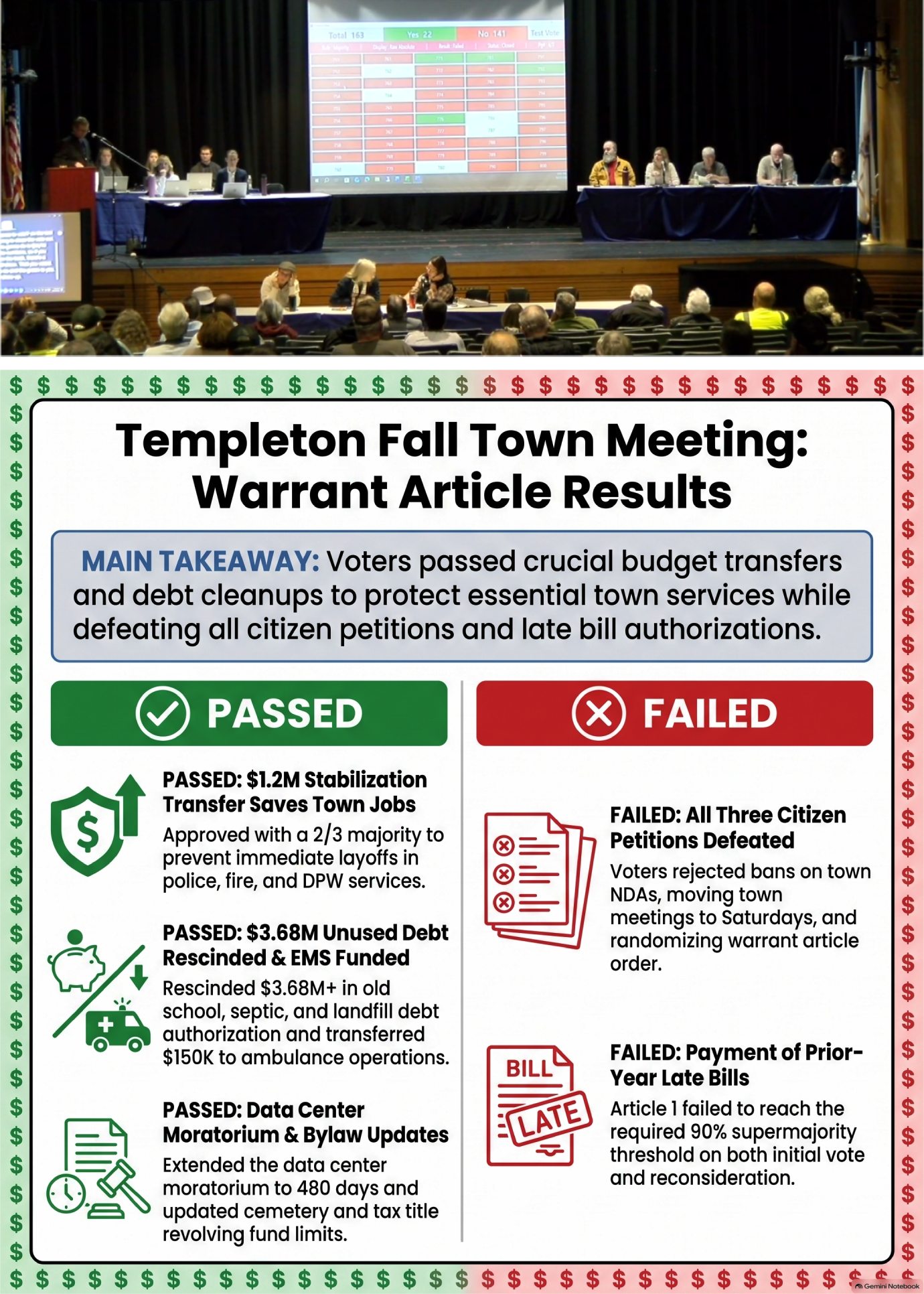
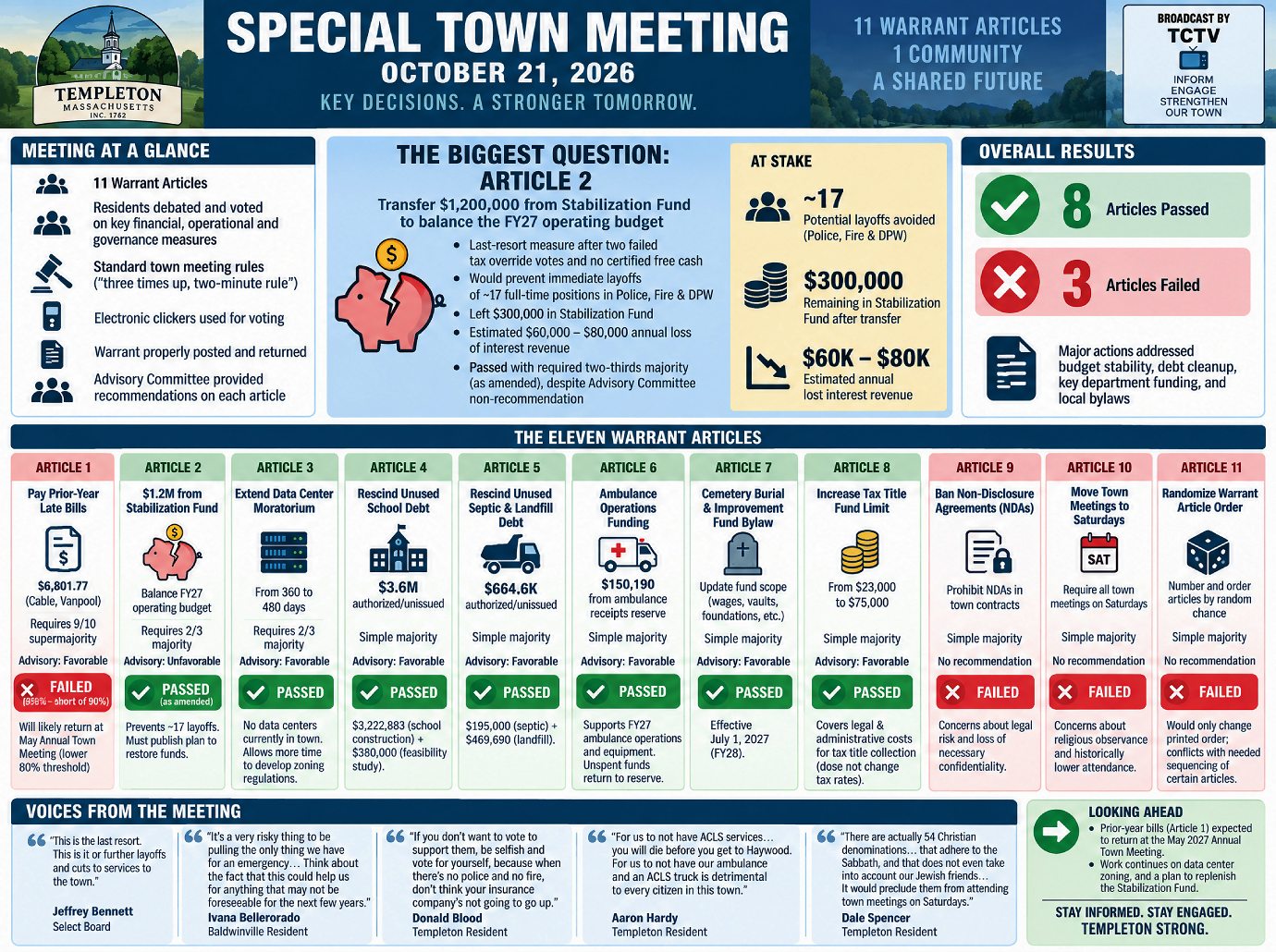
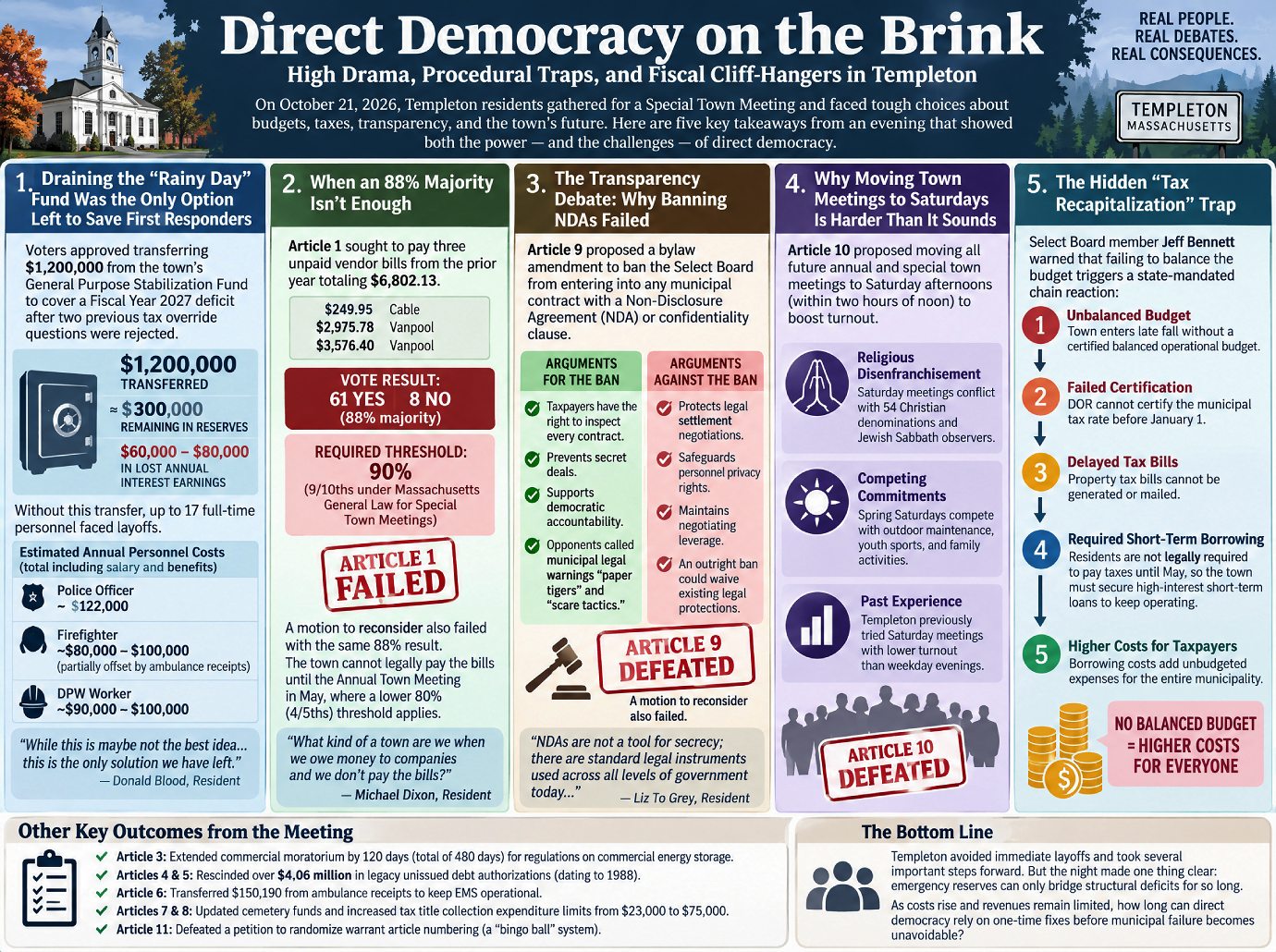
We are providing two additional infographics below for further information on the meeting. CLICK Image for larger view.
Templeton Special Town Meeting – Complete Coverage
Listen to the entire meeting of October 21, 2026 on any device, CLICK PLAY. (silence during voting periods has been removed)
Templeton Special Town Meeting 10-21-26 On October 21, 2026, the Town of Templeton held a Special Town Meeting. The assembly addressed eleven warrant articles encompassing emergency fiscal stabilization transfers, debt rescissions, departmental fund transfers, and citizen-sponsored governance bylaws.
The central debate of the evening focused on Article 2, a proposal to transfer $1,200,000 from the General Purpose Stabilization Fund to balance the Fiscal Year 2027 (FY27) operating budget. The measure was introduced as a last-resort action following the failure of two tax override ballot questions and the unavailability of certified free cash. Despite non-recommendation from the Advisory Committee due to policy non-compliance and long-term financial risk, the article passed with the requisite two-thirds majority as amended, preventing immediate layoffs across the Police, Fire, and Public Works (DPW) departments—totaling roughly 17 full-time municipal positions.
In other action, the town voted to extend a moratorium on data centers (Article 3), rescinded over $4.2 million in authorized but unissued debt from past school, septic, and landfill projects (Articles 4 and 5), and authorized funding adjustments for ambulance operations (Article 6), cemetery burial funds (Article 7), and tax title collections (Article 8). Conversely, a supermajority requirement led to the repeated failure to authorize payment for prior-year late bills (Article 1), and voters rejected three citizen petitions attempting to ban non-disclosure agreements (Article 9), reschedule town meetings to Saturdays (Article 10), and randomize warrant article ordering (Article 11).
Detail on Article 2: Supplemental Appropriation for FY2027 Operating Budget via Stabilization Fund
- Motion: Appropriate $1,200,000 for supplemental appropriations to the FY27 operating budget by transferring said sum from the General Purpose Stabilization Fund.
- Voting Requirement: 2/3 Majority.
- Advisory Committee Recommendation: Unfavorable. The committee cited fiscal responsibility concerns and noted the action puts town stabilization policies out of compliance.
- Select Board Rationale: Select Board member Jeffrey Bennett stated that while withdrawing from stabilization violates financial management policies, it was the only remaining mechanism to eliminate the FY27 budget deficit following two failed override votes. Certified free cash was unavailable. Failure to pass the article would necessitate immediate layoffs of up to 17 full-time personnel and severe operational cuts.
Key Financial Metrics & Cost Estimates Disclosed During Debate:
- Remaining Stabilization Reserves: Transferring $1.2M leaves approximately **$300,000** in the General Purpose Stabilization Fund.
- Lost Interest Revenue: Estimated at $60,000 to $80,000 annually.
- Per-Employee Operational Costs (Salary & Benefits):
- Police Officer: ~$122,000 per officer.
- Firefighter: ~$80,000 to $100,000 (supplemented partially by ambulance receipts).
- DPW / Highway Worker: ~$90,000 to $100,000.
- Tax Recapitalization Warning: Select Board member Bennett warned that an unbalanced budget halts state certification of the town tax rate. If tax bills are not dispatched prior to January 1, residents are not obligated to pay until May, forcing the town into expensive short-term borrowing to maintain operations.
Floor Amendments to Article 2:
- First Amendment (Submitted by Justice Graves): Modified the language to clarify that the $1,200,000 transfer was structured to meet the operating budget appropriation established under Article 27 of the May 13, 2026 Annual Town Meeting, rather than expanding total expenditure authority.
- Status: Passed at 6:48 PM.
- Second Amendment (Submitted by Rachel Herman): Added a stipulation requiring the Select Board to publish a definitive plan outlining how and when the funds drawn from the General Purpose Stabilization Fund will be restored.
- Status: Passed by simple majority at 7:03 PM.
Final Outcome:The main motion for Article 2, incorporating both amendments, passed by the required two-thirds majority at 7:07 PM. A subsequent motion by Sean McDonald at 7:24 PM to reconsider Article 2 failed.
- Templeton Special Town Meeting 10-21-26
8:00pm 10-21-26: Article 2 passed at the Templeton Town Meeting, which means that $1.2 million in stabilization funds will be used to maintain the positions previously outlined by the Select Board. More detailed coverage on the meeting will be provided tomorrow.
- Stay Ahead of Parking Bans

Bookmark the official municipal website, subscribe to CodeRED emergency alerts, and save the dedicated (978) 991-1515 hotline number, so you can easily navigate Gardner’s winter season. It’s really that easy…it really is!
Essential Ways to Stay Ahead of Winter Parking Bans in the City of Gardner
Waking up to a fresh blanket of snow in Gardner, MA brings plenty of winter charm, but nothing ruins a cozy morning faster than finding a costly ticket or an empty curb where your car used to be. When severe weather hits our area, knowing whether an emergency parking ban is active is essential for every local driver. To keep our community safe and stress-free, the City of Gardner provides three direct, official communication channels so you are never caught off guard when the plows roll out.
Your Central Information Hub is the official City of Gardner website: Having a single, bookmarkable source of truth is your best first line of defense when storm forecasts start brewing. The City of Gardner maintains a dedicated municipal webpage designed specifically to deliver real-time press updates and detailed municipal parking policy notices during winter weather events. Access the website, CLICK HERE.
Don’t waste precious minutes searching through search engines while scraping frost off your windshield. Bookmark this link or add a browser shortcut directly to your phone’s home screen today so official city announcements are always just a single tap away.Direct-to-Phone Emergency Notifications (CodeRED Alerts): If you prefer passive, hands-off convenience, sign up to have critical emergency alerts pushed directly to your phone the second a parking ban is officially declared. By enrolling in Gardner’s automated alert system, you eliminate the daily guesswork entirely and ensure you receive immediate notifications via phone call, text, or email. It’s easy to sign up for CodeRED alerts at this website page, CLICK HERE. — Registering proactively for automated alerts ensures official ban announcements reach you wherever you are, saving you from manually checking weather bulletins every afternoon. Setting up your notification preferences ahead of time guarantees you won’t miss midnight ban declarations while relaxing at home.
The Instant Hotline Check (A Simple Phone Call): For those moments when you are commuting home, driving hands-free, or away from a reliable internet connection, a quick phone call offers a fast, non-digital status check. The city maintains a dedicated telephone line continuously updated to broadcast current parking ban statuses.Dedicated Hotline: Check active status anytime by calling (978) 991-1515. Save (978) 991-1515 in your smartphone contacts right now under “Gardner Snow Ban Line”. Giving this line a quick call before you park on the street for the evening provides complete peace of mind in less than thirty seconds.
It’s a choice of Preparedness over Panic: By bookmarking the official municipal website, subscribing to CodeRED emergency alerts, and saving the dedicated hotline number, you can easily navigate Gardner’s winter season without ticket or tow anxieties. Combining these three simple tools ensures you stay one step ahead of every snowstorm, protecting your vehicle and keeping our city streets clear for plow crews. Have you saved these three vital connections to your phone yet, or will you be left guessing when the next storm rolls in
- City Council 10-19-26
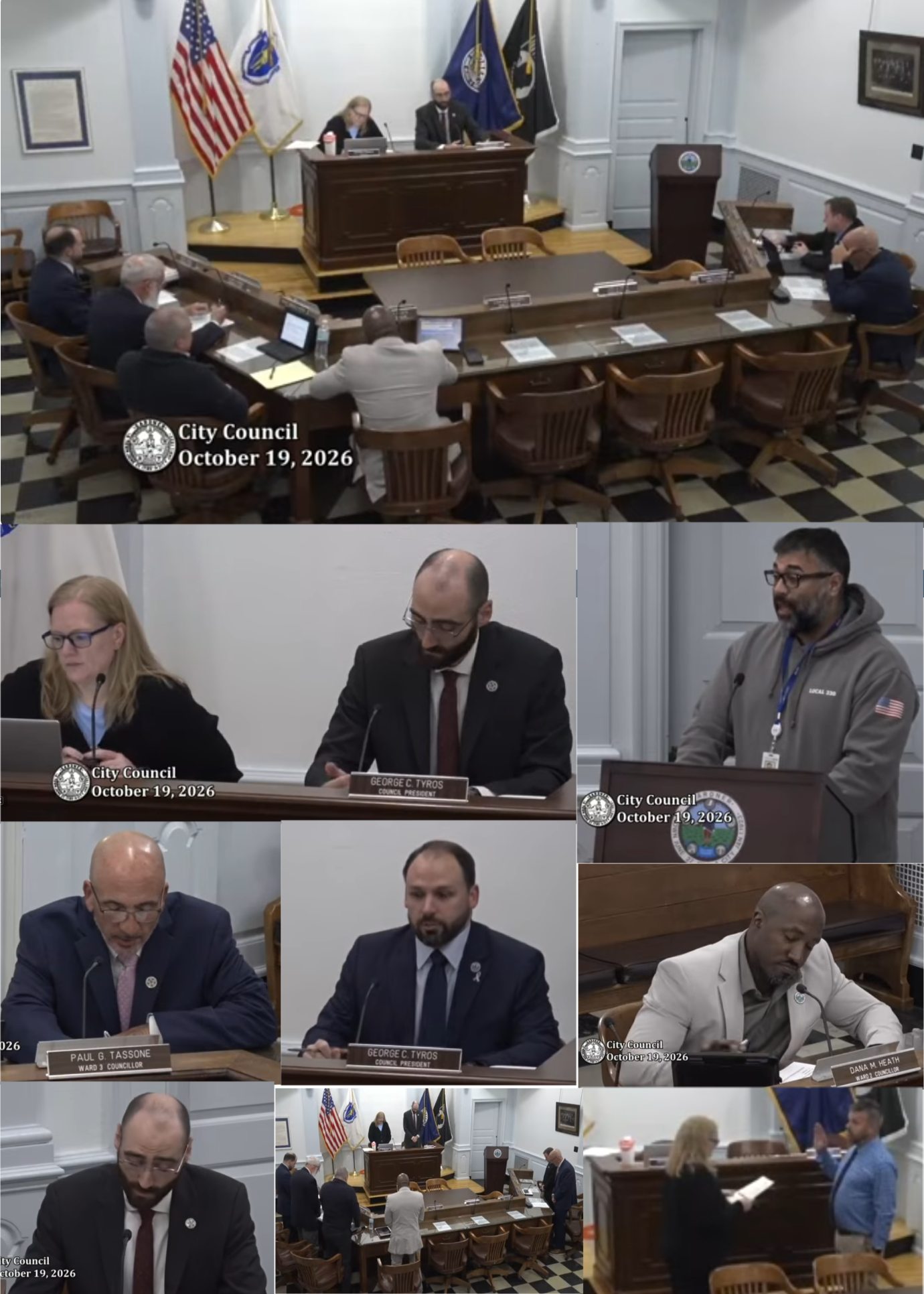
Only 7 members of the 11 member Gardner City Council attended the meeting on October 19, 2026.
City Council Meets – Sends “Tyros Ordinance” to Second Printing
Listen to the Gardner City Council meeting of October 19,2026 on any device, CLICK PLAY.
City Council 10-19-26 The meeting addressed capital project oversight, municipal appointments, local utility infrastructure, and public safety communication initiatives. The most prominent item of debate centered on an ordinance designed to strengthen transparency and municipal oversight regarding capital improvement planning and projects, the “Tyros Ordinance” —specifically addressing recent frictions between the City Council, the School Committee, and the School Department administration. Additionally, the Council confirmed two major municipal administrative appointments including Roland Jean as Building Commissioner and Alan Specht as Alternate Inspector of Wires , approved utility infrastructure requests from National Grid, and announced a new automated winter parking ban notification system developed in coordination with the Gardner Police Department.
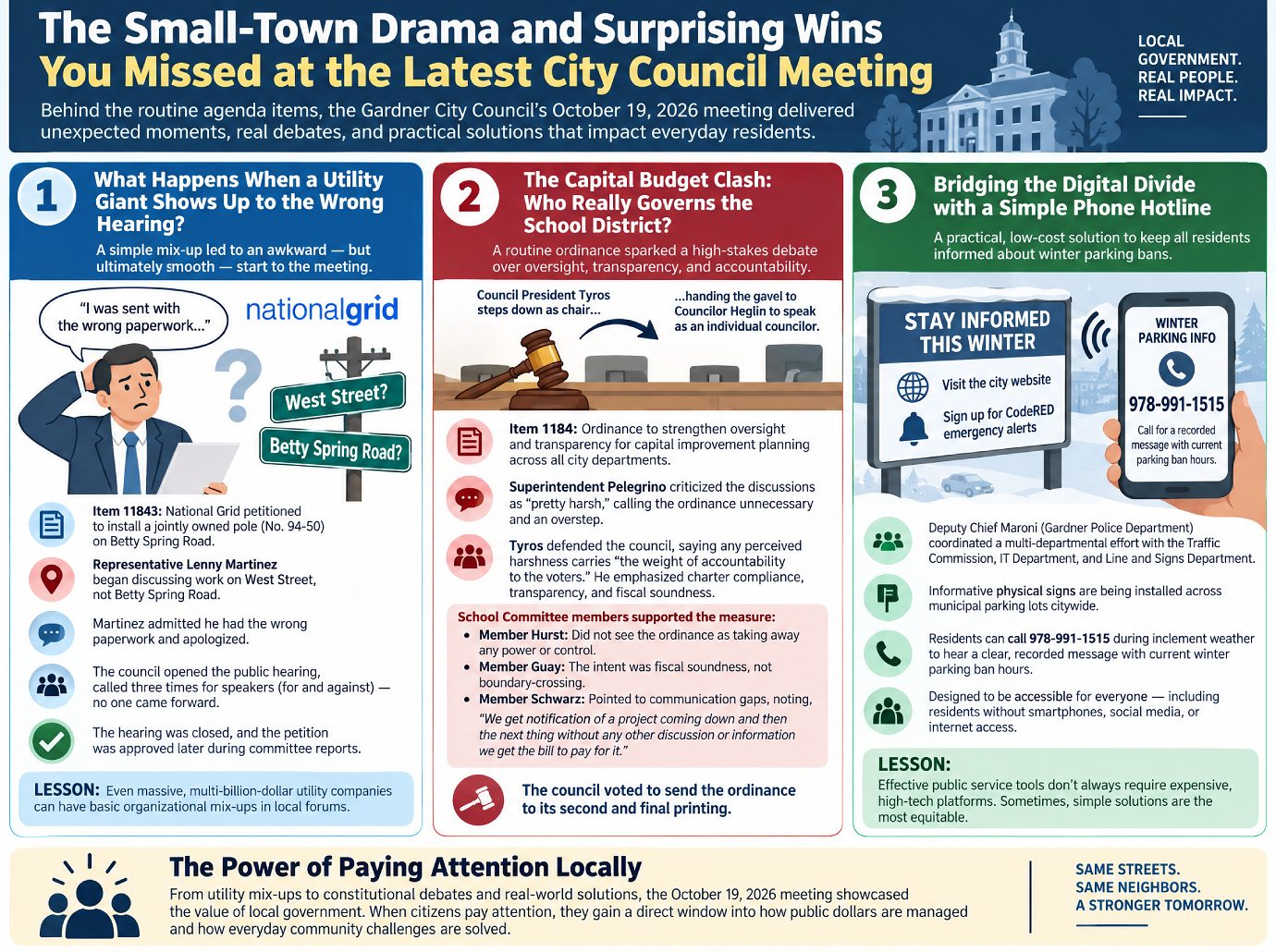
The Council voted to send Item 1184—an ordinance establishing heightened transparency and oversight for capital improvement planning—to its second and final printing. To participate in debate on the floor, Council President Tyros temporarily yielded the chair to Councillor Heglin.
Core Debate and Inter-Departmental Friction: The ordinance addresses procedural gaps in capital planning oversight, particularly regarding school department expenditures. Council President Tyros countered recent public pushback from School Superintendent Pellegrino, who had characterized prior City Council comments as “pretty harsh” and asserted that the Council was attempting to “separate the school department from the school committee.”
Key aspects of the debate and evidence cited during the session include: Council Rationale: Council President Tyros emphasized that Council debates maintain a high bar of decorum, objectivity, and factual accuracy. He stated that the ordinance aims to close loopholes exposed by recent events, ensure fiscal soundness, and enforce the governing role of the School Committee as defined by the City Charter. School Committee Perspectives: Tyros cited statements from members of the Gardner School Committee made during a recent facilities meeting, demonstrating internal concurrence with the Council’s oversight goals.
Following council feedback, Deputy Chief Maroni of the Gardner Police Department, in collaboration with the Traffic Commission, the Line and Signs Department, and the IT Department, created an educational outreach initiative for winter parking bans: Infographic Signage: Municipal parking lots across the city will feature new informational signs detailing winter storm parking rules, website information, and CodeRED emergency alert registration instructions. Automated Information Line: For residents without access to social media or digital alerts, an automated phone system has been implemented to broadcast real-time parking ban status updates. Dedicated Information Phone Line: (978) 991-1515
Councilor Hardern Health Update: Council President Tyros shared that Councilor Hardern underwent two successful surgical operations in Worcester the previous week. She is currently recovering, undergoing physical therapy, and remaining actively updated on City Council operations via regular phone updates.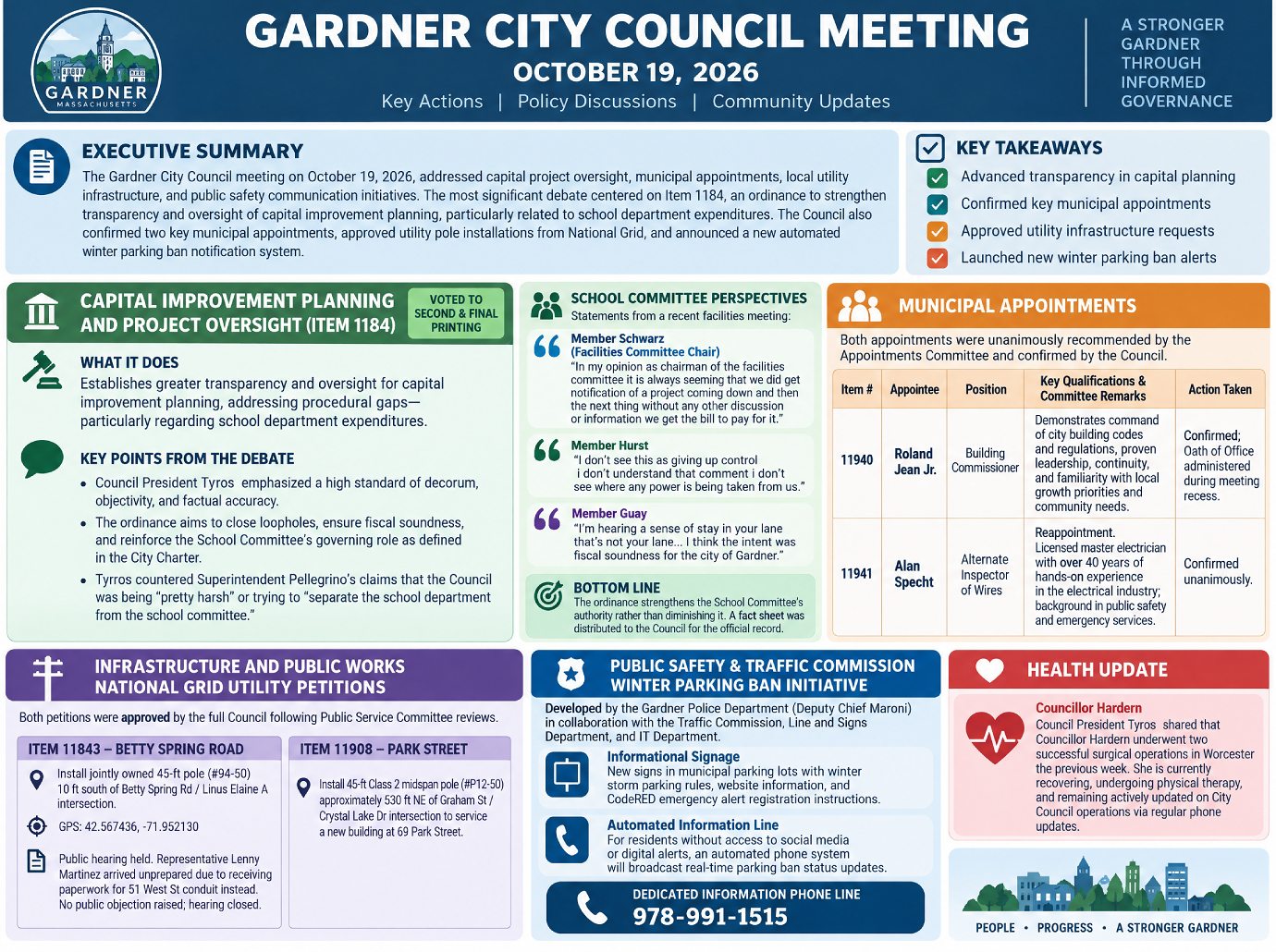
- Old Burying Ground Tours

Halloween Morning Tours of the Old Burying Ground on Green Street in Gardner
From the Levi Heywood Memorial Library: “Levi Heywood Memorial Library and Gardner Historical Commission Partner for Halloween Morning Walking Tours of the Old Burying Ground 28 Green St. Gardner, MA. Guided tours celebrate Gardner’s founders and Revolutionary War soldiers. GARDNER, MA: The Levi Heywood Memorial Library is partnering with the Gardner Historical Commission to offer walking tours of the Old Burying Ground on Saturday, October 31, from 10:00 AM to 12:00 PM. The tours offer a unique way to spend Halloween morning while learning about the people who shaped the city. Participants will meet at 28 Green Street and learn about Gardner’s founders who are buried at the site, as well as the Revolutionary War soldiers laid to rest there. Tours will be offered throughout the morning, allowing visitors to join at a time that suits their schedule. “We are thrilled to partner with the Gardner Historical Commission on this event. Both of our organizations hold important pieces of Gardner’s history, and we’re delighted to come together on this project.” said Gina Verrelli, Assistant Director.
The tours are free and open to all ages. On-street parking is available near the site. Event Details: What: Walking Tours of the Old Burying Ground When:Saturday, October 31, 10:00 AM – 12:00 PM (tours offered throughout the morning) Rain or Shine Where: Meet at 28 Green Street, Gardner, MA . Cost: Free Who: All ages. Presented by: Levi Heywood Memorial Library in partnership with the Gardner Historical Commission. About the Levi Heywood Memorial Library. The Levi Heywood Memorial Library is the public library of Gardner, Massachusetts, located at 55 West Lynde Street. For more information, visit lhml.org.
- Templeton Advisory
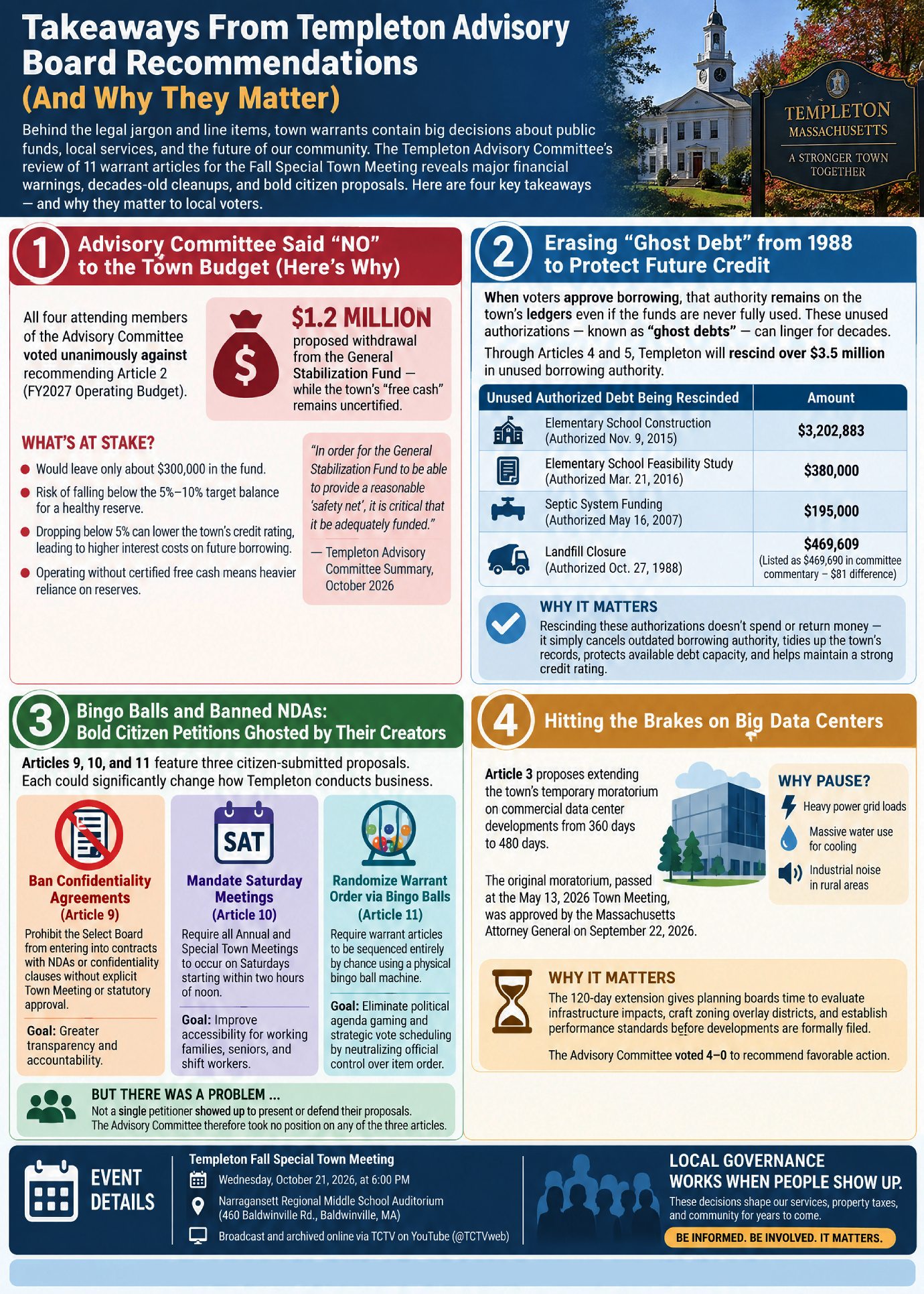
Templeton Advisory Committee Releases Recommendations in Advance of October 21st Special Town Meeting
Listen to this debate podcast on the various issues (including use of Stabilization Funds) on any device, CLICK PLAY.
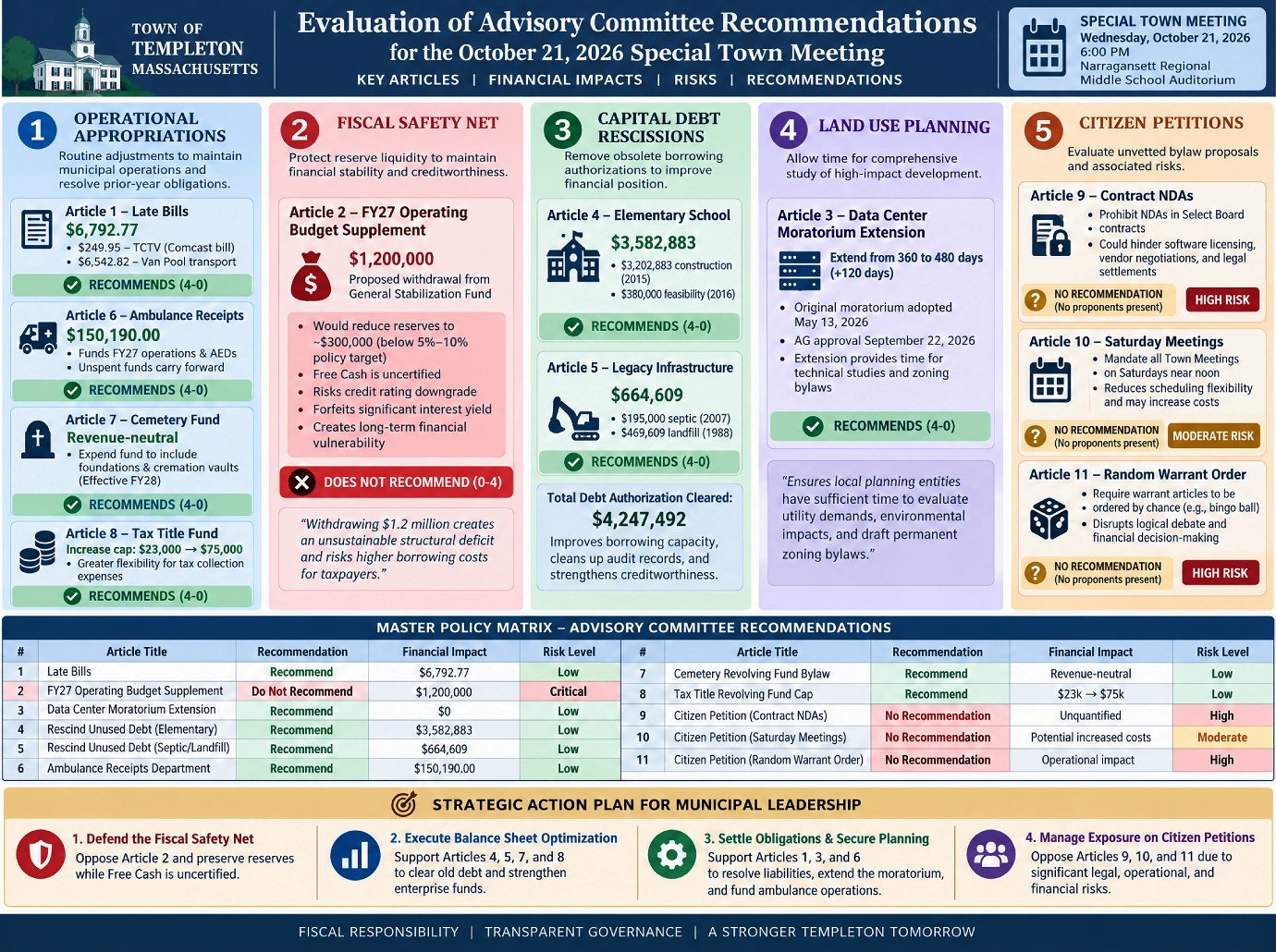
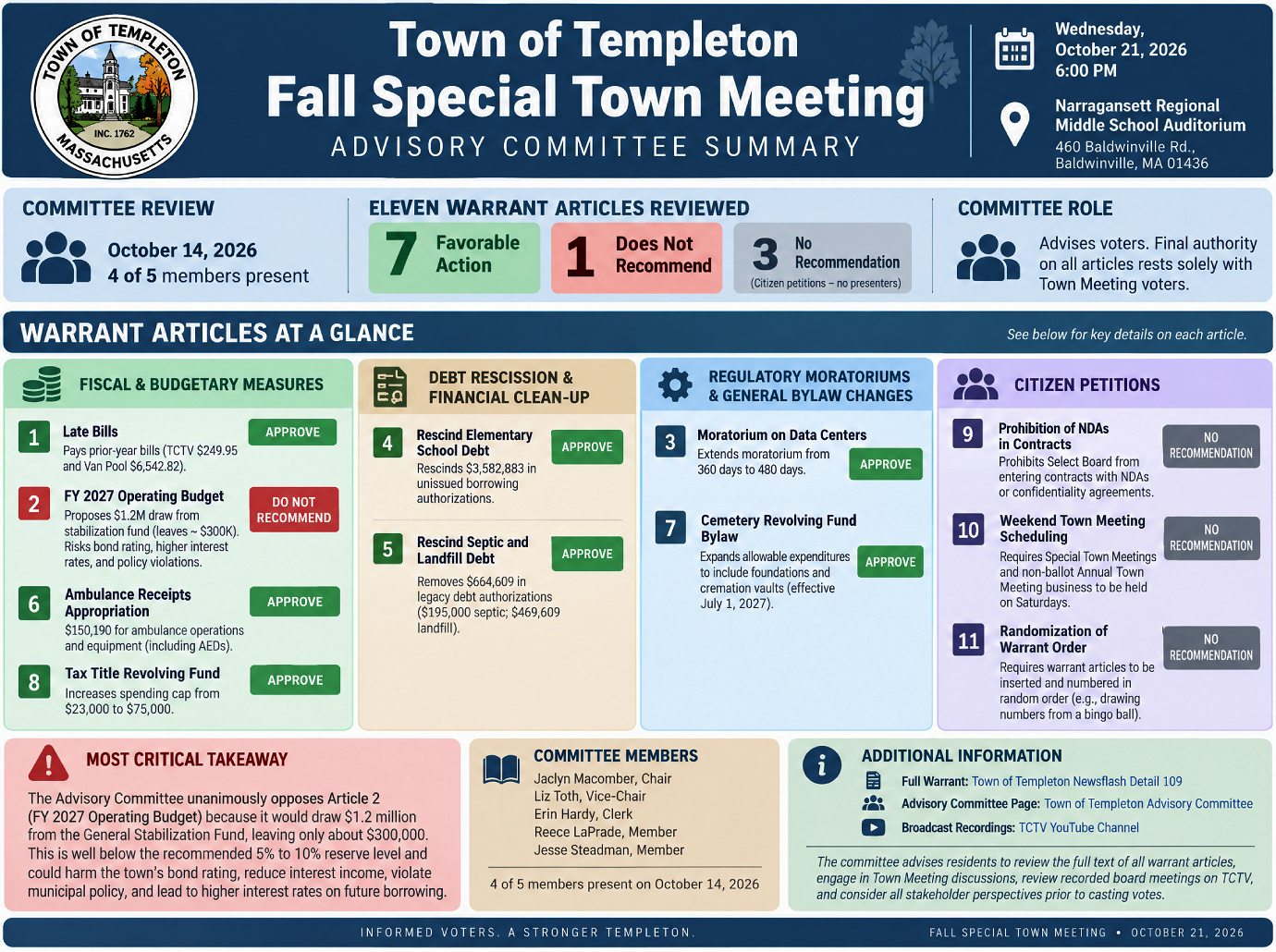
DEBATE – Use of Stabilization Funds Town of Templeton Advisory Committee evaluated eleven warrant articles scheduled for the Fall Special Town Meeting on October 21, 2026.
The committee, operating with four of its five members present, issued affirmative recommendations for seven articles, opposed one major fiscal article, and issued no recommendation on three citizen petitions due to the absence of sponsors at the review meeting.
The most critical item from the evaluation is the Advisory Committee’s unanimous opposition to Article 2 (Fiscal Year 2027 Operating Budget). The proposal seeks to draw $1.2 million from the General Stabilization Fund while free cash remains uncertified. The committee warned that reducing the fund balance to approximately $300,000 drops the reserve well below the recommended threshold of 5% to 10% of the annual operating budget, directly endangering the town’s bond rating, causing lost interest income, violating municipal policy, and forcing higher interest rates on future borrowing.
Other significant recommendations include: Favorable Action (Recommends Approval): Settlement of prior-year bills (Article 1); extension of the data center moratorium to 480 days (Article 3); rescission of over $4.2 million in unused, outdated municipal debt authorizations (Articles 4 and 5); appropriation of $150,190 for ambulance operations (Article 6); expansion of the Cemetery Revolving Fund parameters (Article 7); and an increase in the Tax Title Revolving Fund spending limit (Article 8). No Recommendation: Three citizen petitions covering prohibitions on nondisclosure agreements (Article 9), rescheduling Town Meetings to Saturdays (Article 10), and randomizing warrant article ordering (Article 11). More detail in the infographics below.
- The Tyros Ordinance
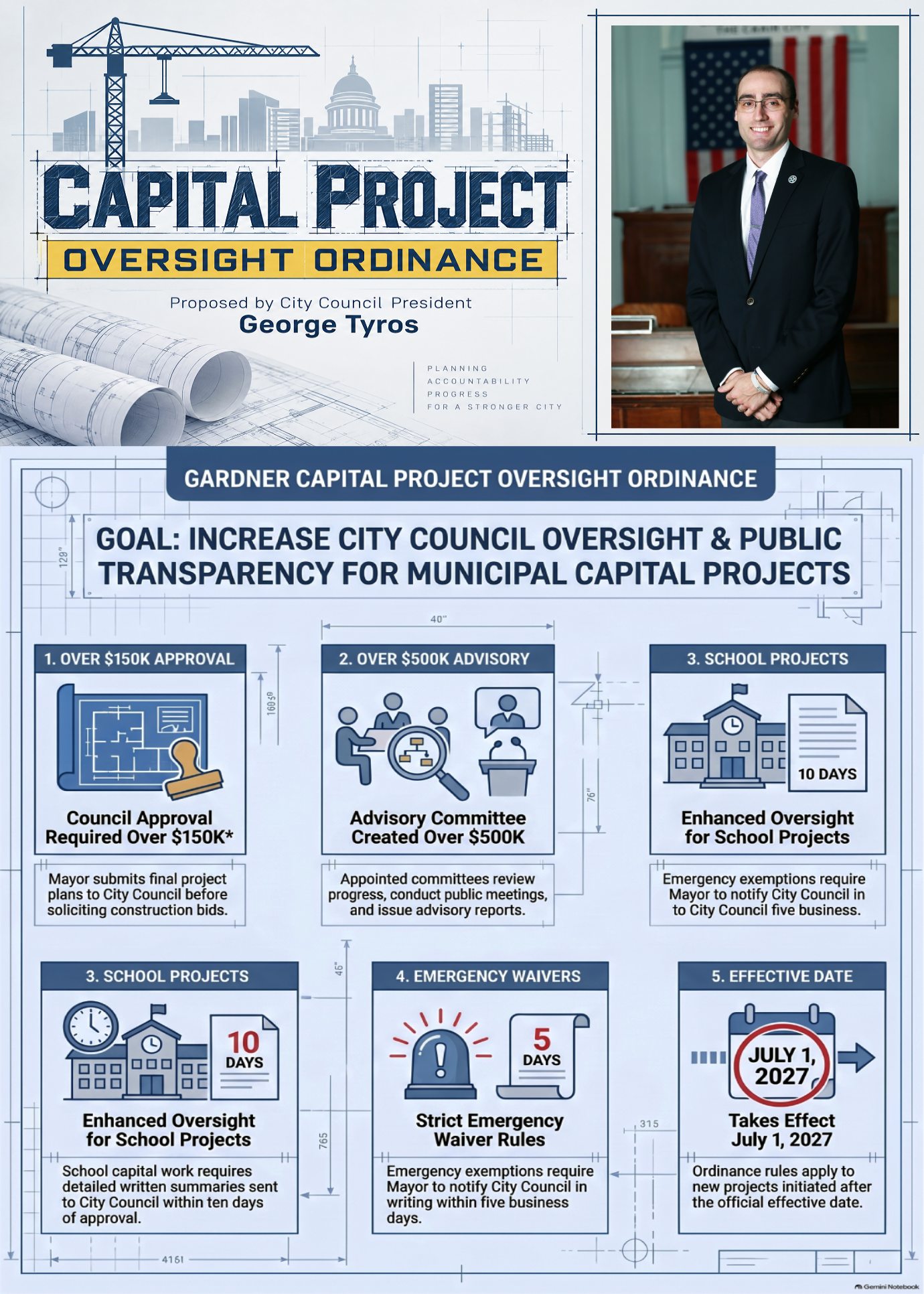
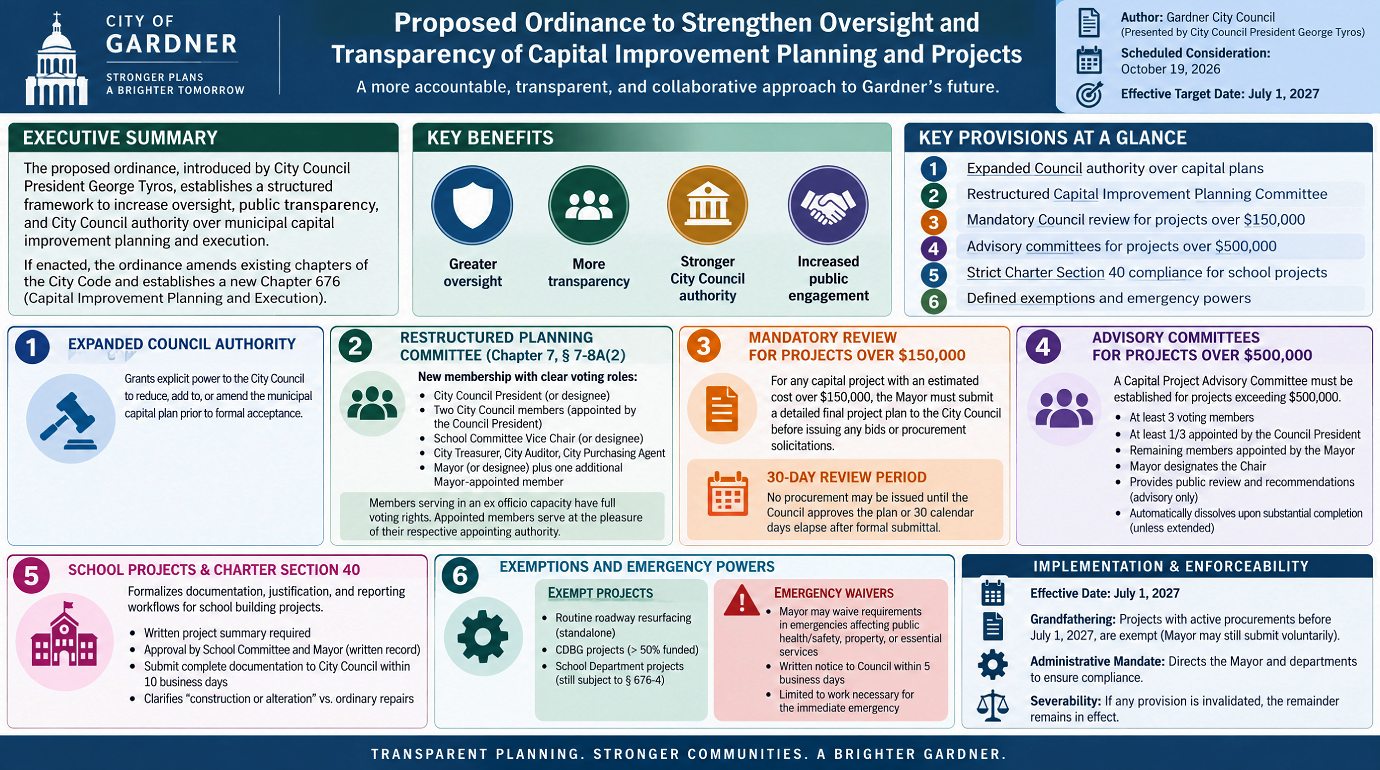
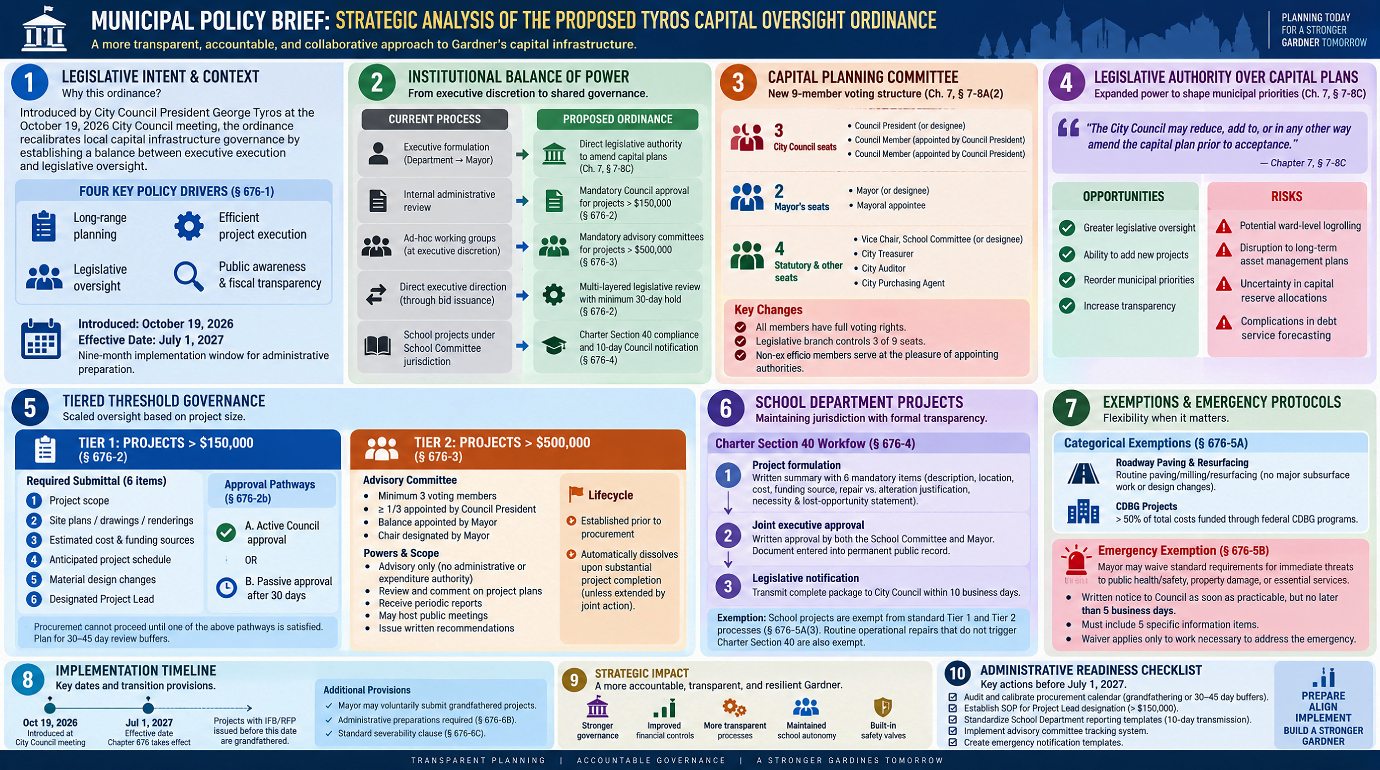
Gardner Magazine has prepared a complete report and policy analysis on PDF, CLICK HERE. We also have the 3 infographics below. CLICK Image for larger view.
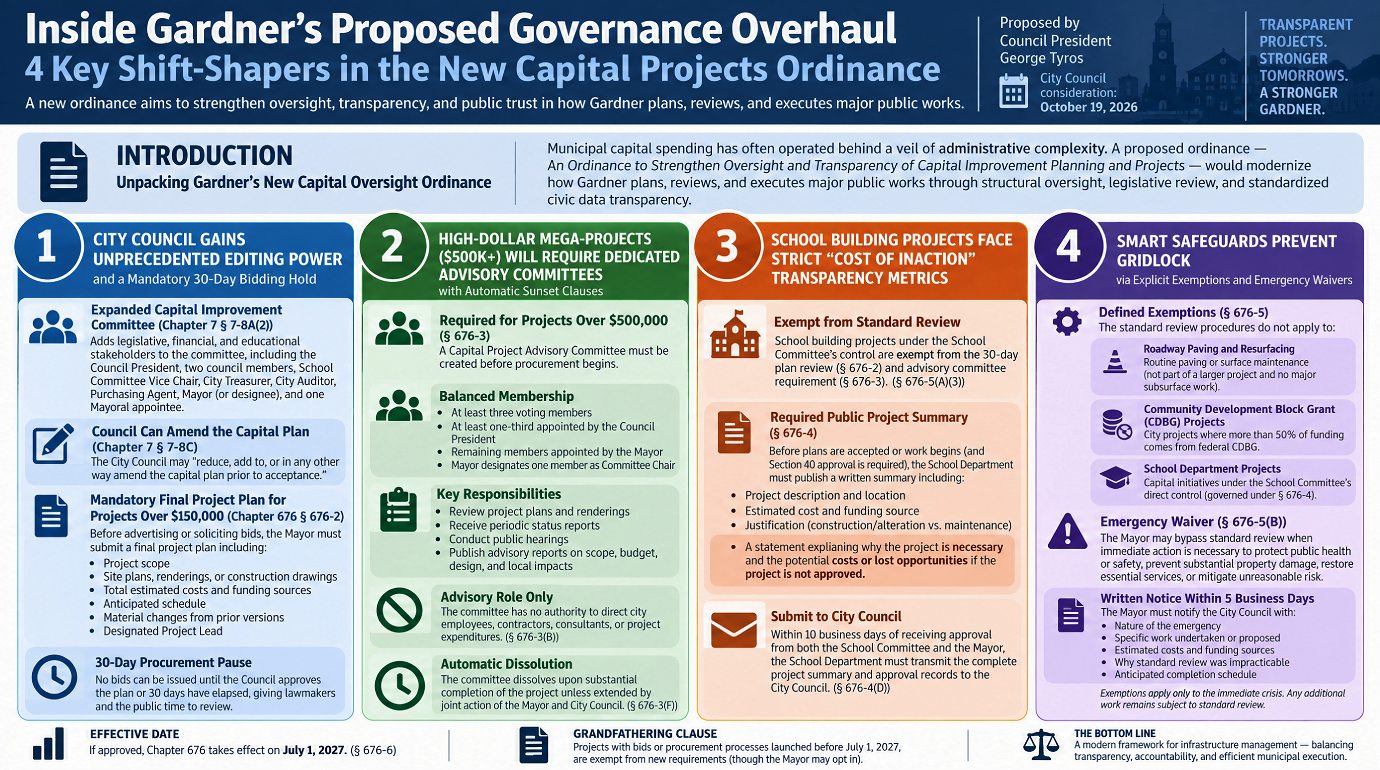
The Tyros Ordinance – Complete Report – Analysis and Debate
On Monday, October 19,2026 the Gardner City Council will take up the “Tyros Ordinance”. The proposal has its proponents and its detractors. We’ve enlisted Max and Maxine Rogers to debate both sides of the issue just like the City Councilors might on Monday. CLICK PLAY.
DEBATE – The Tyros Ordinance The proposed ordinance, (Full content on PDF CLICK HERE) introduced by Gardner City Council President George Tyros, establishes a structured framework designed to increase oversight, public transparency, and City Council authority over municipal capital improvement planning and execution. If enacted, the ordinance amends existing chapters of the City Code and establishes a new chapter—Chapter 676 (Capital Improvement Planning and Execution). The key provisions of the ordinance include:
- Expanded Council Authority over Capital Plans: Grants explicit power to the City Council to reduce, add to, or amend the municipal capital plan prior to formal acceptance.
- Restructured Planning Committee: Reconfigures the membership of the Capital Improvement Planning Committee, establishing clear voting roles and appointing authorities across the City Council, Administration, School Committee, and municipal financial officers.
- Mandatory Review for Projects Over $150,000: Requires the Mayor to submit detailed final project plans to the City Council for approval prior to issuing bid solicitations for any capital project exceeding $150,000, enforcing a 30-day review period or explicit Council approval.
- **Creation of Advisory Committees for Projects Over $500,000:** Mandates the establishment of a multi-member Capital Project Advisory Committee for major projects ($500,000+) to solicit public feedback and review progress.
- Strict Charter Section 40 Compliance for School Projects: Formalizes documentation, justification, and reporting workflows between the School Department, Mayor, and City Council regarding school building alterations versus ordinary repairs.
- Defined Exemptions and Emergency Powers: Establishes specific carve-outs for routine roadway resurfacing, majority CDBG-funded projects, and School Department projects, while providing a strictly conditioned emergency waiver process for the Mayor.
- Who Should be Mayor?
Publisher’s Note: Gardner Magazine does not agree with all of the assertions made in the DEBATE, but we present it here because it results from an objective analysis and will help create discussion.
Who Should Lead Gardner – An Objective Gardner Magazine Report
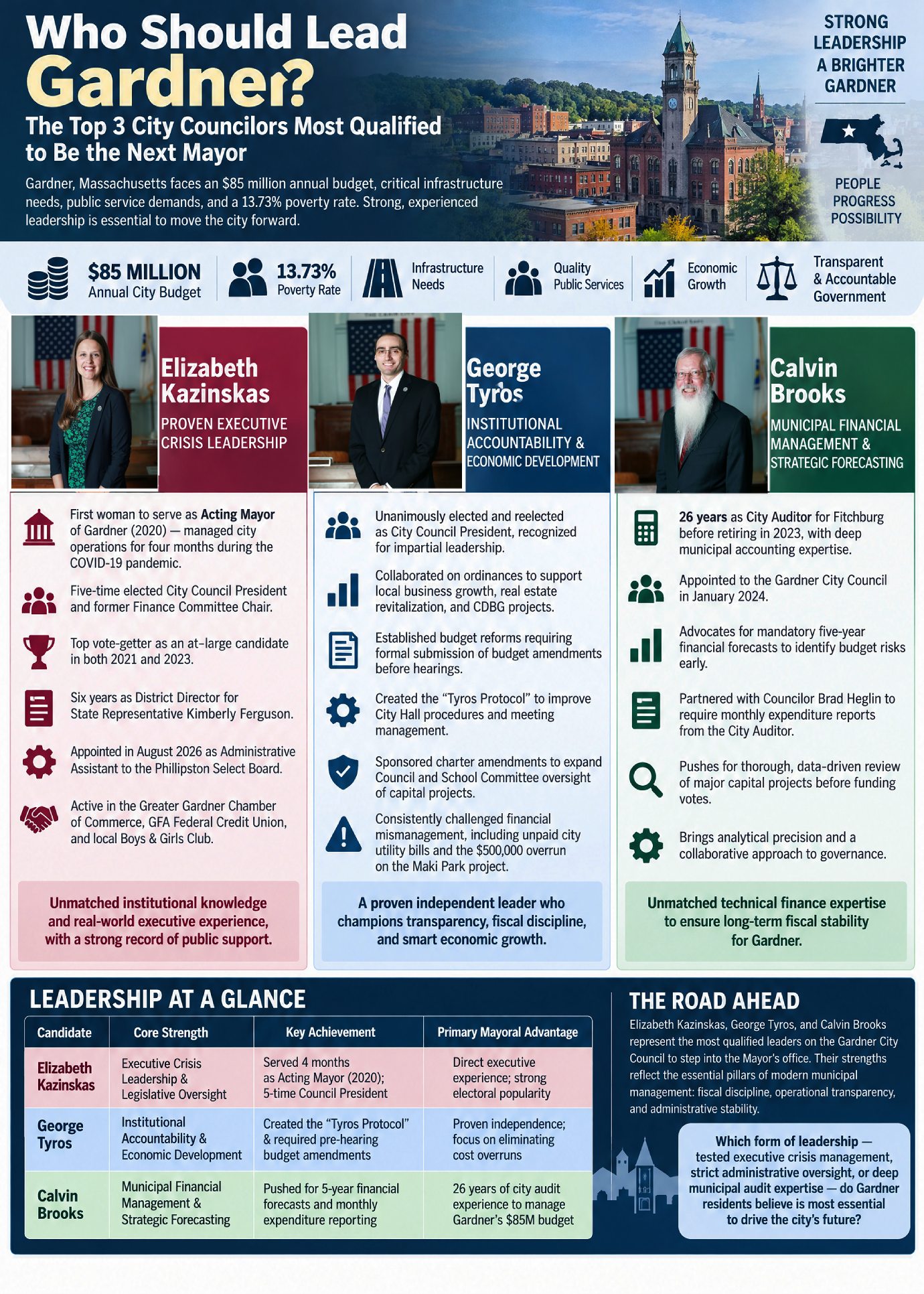
Gardner Magazine put all the Pros and Cons through the paces and we ran all the data through an extensive and comprehensive AI examination. What emerged was that Elizabeth Kazinskas, George Tyros, and Calvin Brooks are the Gardner City Councilors most qualified to be Mayor should current Mayor Nicholson win a seat in the State Legislature. A City Council President will be elected in January and that person would be Acting Mayor if there is a vacancy.
Listen to this debate about Who Should Lead Gardner on any device, CLICK PLAY.
DEBATE – Who Should be the Mayor of Gardner? Listen to this DEEP DIVE report about Who Should Lead Gardner on any device. CLICK PLAY.
Deep Dive – Who Should be Mayor? Transitioning from a legislative role within the Gardner City Council to the executive office of the Mayor represents a fundamental shift in leadership scope, operational accountability, and administrative responsibility. While a city councilor functions within a collective body focused on policy deliberation, legislative voting, ordinance formulation, and constituent advocacy, the Mayor serves as the Chief Executive Officer. In Gardner’s municipal governance structure, the executive office demands direct management of daily city administration, supervision of municipal department heads, oversight of collective bargaining and public safety unions, and full accountability for executing Gardner’s $85 million annual operating budget. Evaluating a sitting councilor’s readiness for executive office requires assessing not only their legislative record, but also their capacity to command administrative processes, navigate complex municipal financial systems, and manage systemic operational risks.
Analytical Evaluation Criteria
To evaluate the prospective executive readiness of Gardner’s sitting councilors, this assessment applies a standardized, four-pillar framework:
- Fiscal Oversight & Budgetary Management: The demonstrated capacity to analyze, manage, and modernize Gardner’s $85 million annual budget. This includes identifying financial discrepancies, implementing long-range financial forecasting, establishing structural audit procedures, and exercising prudence regarding capital investments and municipal stabilization funds.
- Administrative & Executive Experience: Direct experience in managing personnel, leading organizational processes, executing daily municipal or professional operations, navigating crisis environments, and collaborating across governmental departments and regional boards.
- Legislative Track Record & Policy Initiatives: A proven history of formulating and enacting local ordinances, championing charter amendments, driving economic development projects, and advocating for structural governance reforms or community-level improvements.
- Governance Risk & Operational Friction: An analysis of potential vulnerabilities, including personal or professional conflicts of interest, external employment commitments, policy vetting oversights, political friction with the administrative branch, or challenges in transitioning from legislative moderation to executive decision-making. Here is the complete 25 page report on PDF, CLICK HERE.
- Weekly News Briefing 10-18-26
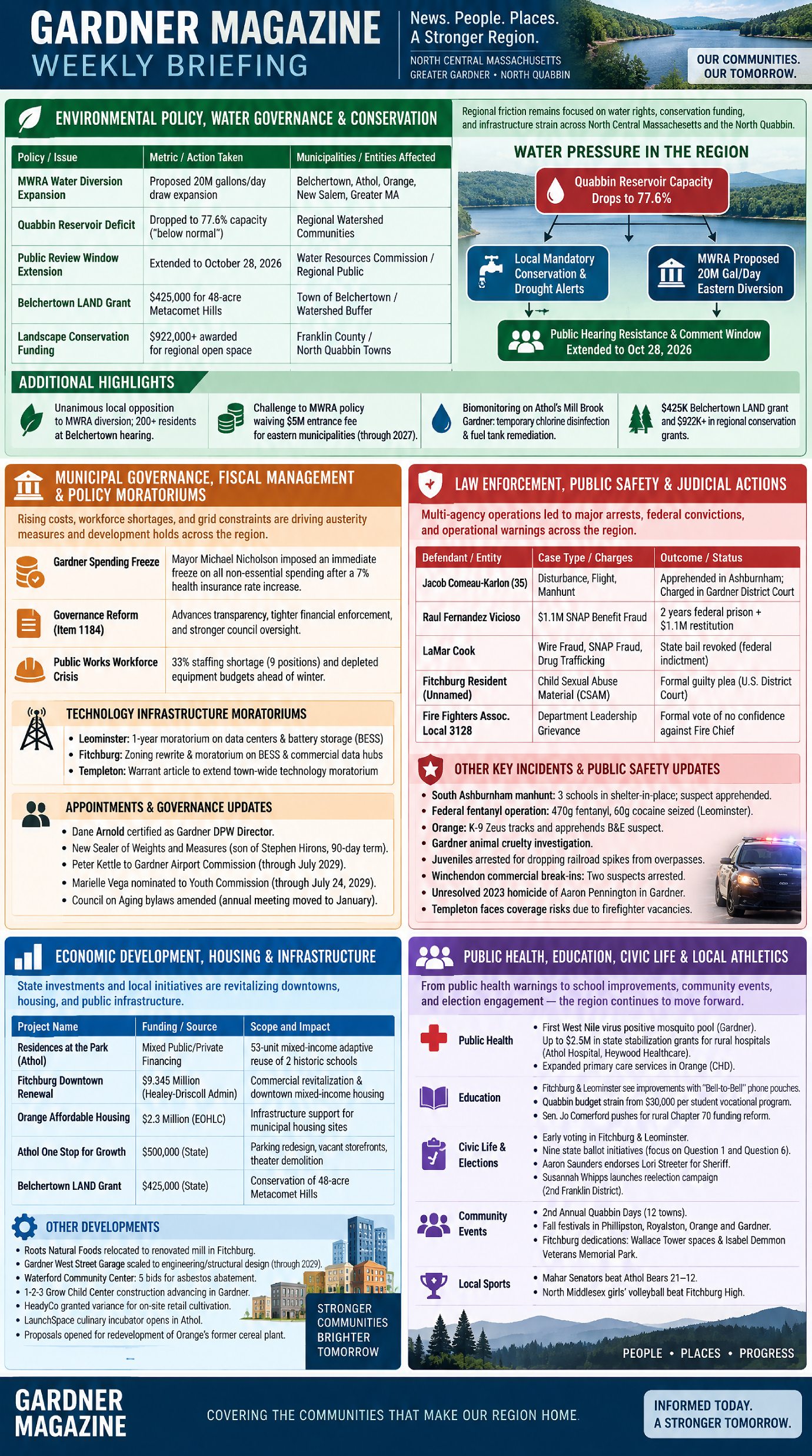
Want even more detail? We have individual comprehensive Weekly News Briefings on North Central MA, Massachusetts, National News and World News. Each has a separate podcast, narrative, and infographics for your perusal.
Gardner Magazine News Briefing for the Week of October 18, 2026
It was a busy news week and the Weekly News Briefing is comprehensive, 1 hour long. Listen on any device, CLICK PLAY.
As of mid-October 2026, severe geopolitical tensions, domestic political volatility, fiscal strains, and regional environmental conflicts are converging simultaneously across global, national, state, and local domains.
At the regional level in North Central Massachusetts, Greater Gardner, and the North Quabbin, municipal governments are navigating severe fiscal constraints, DPW workforce shortages, and policy moratoriums targeting commercial data centers and battery energy storage systems (BESS). The primary regional point of friction remains the Massachusetts Water Resources Authority’s (MWRA) proposal to divert 20 million gallons of water daily from the Quabbin and Wachusett Reservoirs to support Eastern Massachusetts real estate expansion, drawing unanimous local resistance as Quabbin water levels drop to 77.6% capacity. Simultaneously, regional developments continue through targeted state funding, law enforcement takedowns of major drug networks, and downtown housing revitalization projects.
There are 4 additional infographics at the bottom of this article focusing on various aspects of the subjects and issues of the news this week.
At the state level in Massachusetts, the gubernatorial race between Governor Maura Healey and Republican challenger Mike Minogue has reached its final stretch alongside the launch of statewide early in-person voting. The administration is managing public backlash over executive statements regarding law enforcement scandals, alongside an active State of Energy Emergency declared to alleviate severe winter heating costs. High-profile judicial proceedings—including a $6 million defamation verdict in the David Sabatini trial, unsealed federal disclosures in the Sandra Birchmore case, and mistrial developments in the Lindsay Clancy case—dominate state legal news.
At the global and national level, the joint U.S.-Israel war against Iran has entered its eighth month, marked by expanding strategic operations, escalating military casualties, severe maritime disruptions in the Strait of Hormuz, and significant political debate over civilian casualties. Amid an active partial federal government shutdown, the U.S. national budget deficit has reached a five-year high of nearly $2 trillion. Domestically, the 2026 Midterm Elections approach with record-breaking ad spending surpassing $10 billion, while President Donald Trump’s job approval rating has dropped to a two-term low of 36%. Financial markets face contractions driven by cooling tech-sector artificial intelligence hardware valuations, while domestic crises—including the 26th school shooting of the year in Bend, Oregon, and destructive wildfires in Southern California—continue to test emergency response systems.
Regional Developments: North Central Massachusetts, Greater Gardner, and North Quabbin
Environmental Policy, Water Governance, and Conservation: Regional friction remains focused on regional water rights, conservation funding, and infrastructure strain across North Central Massachusetts and the North Quabbin.
Environmental Policy / Issue Metric / Action Taken Primary Municipalities / Entities Affected MWRA Water Diversion Expansion Proposed 20M gallons/day draw expansion Belchertown, Athol, Orange, New Salem, Greater MA Quabbin Reservoir Deficit Dropped to 77.6% capacity (“below normal”) Regional Watershed Communities Public Review Window Extension Extended to October 28, 2026 Water Resources Commission / Regional Public Belchertown LAND Grant $425,000 for 48-acre Metacomet Hills Town of Belchertown / Watershed Buffer Landscape Conservation Funding $922,000+ awarded for regional open space Franklin County / North Quabbin Towns [Quabbin Reservoir Capacity Drops to 77.6%] │ ┌────────────────────────────┴────────────────────────────┐ ▼ ▼ [Local Mandatory Conservation & Drought Alerts] [MWRA Proposed 20M Gal/Day Eastern Diversion] │ │ └────────────────────────────┬────────────────────────────┘ ▼ [Public Hearing Resistance & Comment Window Extended to Oct 28, 2026]- MWRA Water Diversion Opposition: The MWRA’s proposal to draw an additional 20 million gallons of water daily from the Quabbin and Wachusett Reservoirs to support real estate expansion in Eastern Massachusetts met unanimous pushback from local watershed leaders. A four-hour public hearing in Belchertown drew over 200 vocal residents. Regulators extended the public review deadline on the diversion framework to October 28, 2026.
- Drought Limits vs. Fee Waivers: Regional officials criticized state policies permitting eastern water diversions while local North Quabbin and Greater Gardner residents remain under strict mandatory local water conservation rules. Representatives are formally challenging an MWRA policy that waives the traditional $5 million entrance fee for new eastern municipalities through 2027.
- Regional Conservation Projects:
- Belchertown: Secured a $425,000 state LAND grant to permanently protect the 48-acre Metacomet Hills area adjacent to the Quabbin watershed.
- North Quabbin Grants: Over $922,000 in state landscape-level grants was awarded across Franklin County and North Quabbin towns to protect wetlands and forests.
- Biomonitoring & Infrastructure: Environmental teams initiated aquatic health biomonitoring along Athol’s Mill Brook. Gardner implemented temporary chlorine disinfection across municipal water lines and allocated emergency capital funds to remediate decaying underground fuel tanks on public property.
Municipal Governance, Fiscal Management, and Policy Moratoriums
Facing health insurance cost spikes, workforce shortages, and power grid constraints, municipal governments across the region are instituting austerity measures and developmental holds.
- Gardner Municipal Spending Freeze: Following a 7% rate increase during the Medics health plan renewal that drove up municipal health insurance costs, Gardner Mayor Michael Nicholson imposed an immediate spending freeze on all non-essential operational expenditures.
- Gardner Governance Reform (Item 1184): The City Council advanced Item 1184, a legislative reform ordinance designed to increase administrative transparency, tighten financial enforcement, and require stricter council oversight regarding administrative appropriations and reorganizations.
- Public Works Workforce Crisis: The Gardner DPW reported a 33% staffing shortage (short 9 full-time positions), alongside depleted equipment maintenance budgets ahead of winter operations.
- Technology Infrastructure Moratoriums:
Regional Infrastructure Moratoriums: ├── Leominster: 1-Year Moratorium on Data Centers & Battery Energy Storage Systems (BESS) ├── Fitchburg: Zoning Rewrite & Moratorium on BESS & Commercial Data Hubs └── Templeton: Warrant Article to Extend Town-Wide Technology Moratorium- Administrative & Municipal Appointments:
- Gardner DPW: The Appointments Committee certified Dane Arnold as DPW Director to lead upcoming water main and wastewater plant upgrades.
- Weights and Measures: Following the retirement of Stephen Hirons after 36 years, his son was confirmed for a temporary 90-day appointment as Sealer of Weights and Measures.
- Board Appointments: Peter Kettle was appointed to the Gardner Airport Commission (through July 2029); Marielle Vega was nominated to the Youth Commission (through July 24, 2029).
- Council on Aging: Amended bylaws to align with the City Charter, eliminating associate positions and shifting the annual meeting window from May to January.
Law Enforcement, Public Safety, and Judicial Actions: Multi-agency law enforcement operations across the region resulted in several major arrests, federal convictions, and emergency operational warnings.
Defendant / Entity Case Type / Charges Legal Outcome / Status Jacob Comeau-Karlon (35) Disturbance, Flight, Manhunt near schools Apprehended in Ashburnham; Charged in Gardner District Court Raul Fernandez Vicioso $1.1 Million SNAP Benefit Fraud Sentenced to 2 years federal prison + $1.1M restitution LaMar Cook Wire Fraud, SNAP Fraud, Drug Trafficking State bail revoked following federal indictment Fitchburg Resident (Unnamed) Child Sexual Abuse Material (CSAM) Formal guilty plea entered in U.S. District Court Fire Fighters Assoc. Local 3128 Department Leadership Grievance Formal Vote of No Confidence executed against Fire Chief - South Ashburnham Standoff and Manhunt: Following a violent disturbance at the All Town Convenience Store on October 14, 2026, a multi-agency manhunt using K9 units, drones, and State Police aircraft captured Jacob Comeau-Karlon, 35. Three local schools near Oakmont Regional High School temporarily entered shelter-in-place status during the search.
- Federal Fentanyl Operation: A federal undercover operation outside a Leominster residence led to the arrest of two local residents and one Worcester resident, resulting in the seizure of 470 grams of fentanyl and 60 grams of cocaine.
- Regional Law Enforcement Actions:
- Orange: K-9 Zeus assisted officers in tracking and apprehending a breaking-and-entering suspect in local woods.
- Gardner Animal Cruelty: Police opened a criminal investigation after finding dead animals and one malnourished pet at a deserted Park Street residence.
- Highway Overpass Arrests: Authorities arrested juveniles for dropping heavy railroad spikes from overpasses onto moving vehicles.
- Winchendon Break-Ins: Police arrested two suspects linked to commercial burglaries at Winchendon Self Storage on Gardner Road.
- Unresolved Homicide: Authorities continue tracking leads regarding the 2023 homicide of Aaron Pennington in Gardner.
- Federal Sentencings: Raul Fernandez Vicioso, operator of El Primo Market in Fitchburg, was sentenced to two years in federal prison and ordered to pay $1.1 million in restitution for SNAP fraud.
- Emergency Services Strain: Fitchburg Fire Fighters Association Local 3128 executed a vote of no confidence against the city’s fire chief. In Templeton, municipal leaders warned of operational coverage risks due to three firefighter vacancies and multiple pending resignations.
Economic Development, Housing Revitalization, and Infrastructure
State grant allocations and mixed-use initiatives are supporting downtown revitalization and commercial shifts across the region.
Project Name Funding / Source Scope and Impact Residences at the Park (Athol) Mixed Public/Private Financing 53-unit mixed-income adaptive reuse of 2 historic schools Fitchburg Downtown Renewal $9.345 Million (Healey-Driscoll Admin) Commercial revitalization & downtown mixed-income housing Orange Affordable Housing $2.3 Million (EOHLC Grant) Infrastructure support for municipal housing sites Athol One Stop for Growth $500,000 (State Award) Downtown parking redesign, vacant storefronts, theater demolition Belchertown LAND Grant $425,000 (State LAND Award) Conservation of 48-acre Metacomet Hills watershed buffer - Housing Revitalization:
- Residences at the Park: Executive Director Gonzalo Puigbo led an October 14 ribbon-cutting for NewVue Communities’ 53-unit mixed-income complex in Athol, which redeveloped the vacant historic Riverbend and Ellen Bigelow elementary schools.
- Fitchburg & Orange Allocations: Fitchburg received $9.345 million for downtown mixed-income infrastructure, while the EOHLC granted $2.3 million to Orange for municipal affordable housing infrastructure.
- Athol Redevelopment: Athol secured $500,000 in One Stop for Growth grants to fund downtown parking redesigns, a vacant storefront initiative, and the demolition of the York Theater. Proposals were also opened to redevelop Orange’s vacant former cereal plant.
- Commercial & Municipal Capital Upgrades:
- Roots Natural Foods: Completed its relocation from Leominster to a renovated historic mill on the Nashua River in Fitchburg.
- West Street Garage Realignment: Gardner city planners downscaled their $1.2 million federal RAISE sub-grant to focus exclusively on engineering and structural parking designs through 2029.
- Waterford Community Center: Gardner received five bids for asbestos abatement in the senior wing ahead of roof replacements and solar panel installation, funded via redirected CDBG funds.
- Child Care Rebuild: Construction advanced on the 1-2-3 Grow Child Center on West Street in Gardner to replace the facility destroyed by fire.
- HeadyCo Variance: The Gardner Planning Board approved an operational variance allowing HeadyCo’s cultivation facility to integrate on-site retail operations.
- Culinary Incubator: LaunchSpace launched a shared commercial kitchen inside Athol’s former Pleasant Street School for local food entrepreneurs.
Public Health, Education, Civic Life, and Local Athletics
- Public Health Warnings: The Gardner Health Department confirmed the region’s first autumn mosquito pool testing positive for West Nile virus. State agencies allocated up to $2.5 million in stabilization grants for qualifying rural hospitals, supporting institutions including Athol Hospital and Heywood Healthcare. Primary care services were expanded in Orange through the Center for Human Development (CHD).
- Educational Policy and Costs: Fitchburg and Leominster Public Schools reported instructional improvements following the adoption of “Bell-to-Bell” phone-locking pouches. Quabbin Regional School District flagged budget strains from specialized Vocational Agricultural program enrollments costing $30,000 per student annually. State Senator Jo Comerford initiated regional discussions to reform Chapter 70 public school aid formulas for rural districts.
- Civic Life and Regional Elections: Early voting opened at Fitchburg City Hall and Leominster City Hall. Regional voters are evaluating nine state ballot initiatives, with focus centered on Question 1 (public records transparency for state executive/legislative offices) and Question 6 (environmental policy). State Representative Aaron Saunders endorsed Lori Streeter for Franklin County Sheriff, while Representative Susannah Whipps opened her reelection campaign as an unenrolled candidate for the 2nd Franklin District.
- Local Cultural Events & Commemorations:
- Fitchburg: The Housing Authority dedicated renovated function spaces at Wallace Tower to foremen Bucky and Marc Cunningham, while Veterans Services unveiled Isabel Demmon Veterans Memorial Park featuring a public mini putting green.
- Quabbin Days: The Friends of the Quabbin hosted the 2nd Annual “Quabbin Days” across 12 watershed towns.
- Regional Fairs: Autumn festivals were hosted in Phillipston (Pumpkin Weigh-Off), Royalston (Fall Fair with 75+ vendors), Orange (North Quabbin Garlic & Arts Festival), and Gardner (Fiber Fest).
- High School Athletics Results:
- Football: The Mahar Regional Senators ended a multi-year losing streak against the Athol High School Bears with a 21–12 victory.
- Volleyball: The North Middlesex Regional High School girls’ team secured a victory against Fitchburg High to move closer to postseason qualification.
Massachusetts State Politics, Legal Battles, and Statewide Policy
Gubernatorial Campaign, Debates, and State Policy: Statewide in-person early voting opened on Saturday, October 17, and runs through Friday, October 30, setting the stage for the final political stretch between Governor Maura Healey and Republican challenger Mike Minogue.
[MA State Policy & Politics] │ ┌───────────────────────────┼───────────────────────────┐ ▼ ▼ ▼ [Final Debate] [Energy Emergency] ["Things Happen"] Healey vs. Minogue Declared by Healey Admin; Controversy re: State on economy, spending, expands heating aid to Police barracks rape and emergency Mgmt. ~50,000 middle-class families. report response.- Final Gubernatorial Debate: Governor Healey and challenger Mike Minogue clashed over state spending efficiency, economic metrics, and emergency management. Conservative columnist Howie Carr criticized current administration spending programs, characterizing them as a “perfect no-fingerprints grift” in state political history.
- Executive Controversy: Governor Healey faced sharp criticism from progressive organizations and survivor advocacy groups following her response to a reported rape incident at a Martha’s Vineyard State Police barracks. While defending appointed State Police leadership, Healey remarked that “things happen,” provoking severe political fallout.
- State of Energy Emergency: Anticipating severe winter utility spikes, the Healey-Driscoll administration officially declared a State of Energy Emergency. The executive order expands home heating fuel assistance to approximately 50,000 middle-class families reliant on heating oil.
- Grassroots Strategy: The progressive “No Kings” coalition pivoted from anti-Trump demonstrations toward nonpartisan voter turnout, hosting community walks to the polls, cookouts, and rallies across Boston, Worcester, Brookline, and Falmouth.
- Election Office Threat Alerts: State and political offices were placed on heightened alert after receiving suspicious packages containing unknown substances, triggering an active FBI criminal investigation.
Major State Judicial Proceedings and Public Safety Actions
- Sabatini Defamation Verdict: A Suffolk County jury concluded deliberations in the trial involving biologist David Sabatini, awarding $6 million in defamation damages. The suit, stemming from a Boston Globe Spotlight report, involved competing claims of sexual misconduct and abuse of power versus retaliatory actions over a consensual relationship.
- Sandra Birchmore Case Disclosures: Federal prosecutors unsealed text messages and forensic search histories detailing the interactions between Sandra Birchmore and former detective Matthew Farwell prior to her death.
- Lindsay Clancy Case Fallout: Following a mistrial, a holdout juror publicly stated that the “methodical” nature of the tragedy prevented a unanimous verdict.
- LaMar Cook Search Warrants: Federal authorities unsealed search warrants targeting LaMar Cook, a former aide to Governor Healey, regarding federal charges involving wire fraud, SNAP benefit fraud, and cocaine distribution networks.
- SJC Rulings & Fire Regulations: The Supreme Judicial Court (SJC) reaffirmed the legality of the MBTA Communities housing law, upholding municipal housing mandate requirements. Following last year’s Gabriel House fire in Fall River that killed 10 residents, the Board of Fire Prevention Regulations mandated annual fire safety inspections for all assisted living facilities statewide.
Transportation, Demographics, and Educational Innovation
- MBTA & Infrastructure Procurement: Leaked internal documents revealed ongoing procurement delays affecting MBTA system operations and capital repairs. In Boston, infrastructure managers officially cancelled the planned Columbus Avenue dedicated bus lane project.
- Demographic Outmigration Analysis: A statewide study identified the primary drivers behind residents relocating out of Massachusetts:
Reasons for Moving Out of Massachusetts: - Closer to Family: [23%] - Out-of-State Job: [22%] - Retirement: [15%]- AI Integration in Classrooms: Diverging from ban policies in other major cities, Boston Public Schools introduced artificial intelligence directly into instructional curricula. The Eliot K-8 Innovation School in the North End is piloting the program utilizing “AI Navigators” for student group learning.
- State Sports Highlights:
- Boston Bruins: Earned a 4-2 comeback victory against the Anaheim Ducks; goaltender Michael DiPietro logged his first career NHL win. Former teammates Jeremy Swayman and Linus Ullmark hold the top two statistical spots in NHL goalie rankings.
- Boston Celtics: A reserve lineup entering the game with one combined game of NBA experience defeated the Philadelphia 76ers in an overtime preseason matchup.
- High School Football: Four of the state’s top 11 ranked teams suffered Week 6 upset losses, including Walpole defeating Milton behind receiver Shane Harrington.
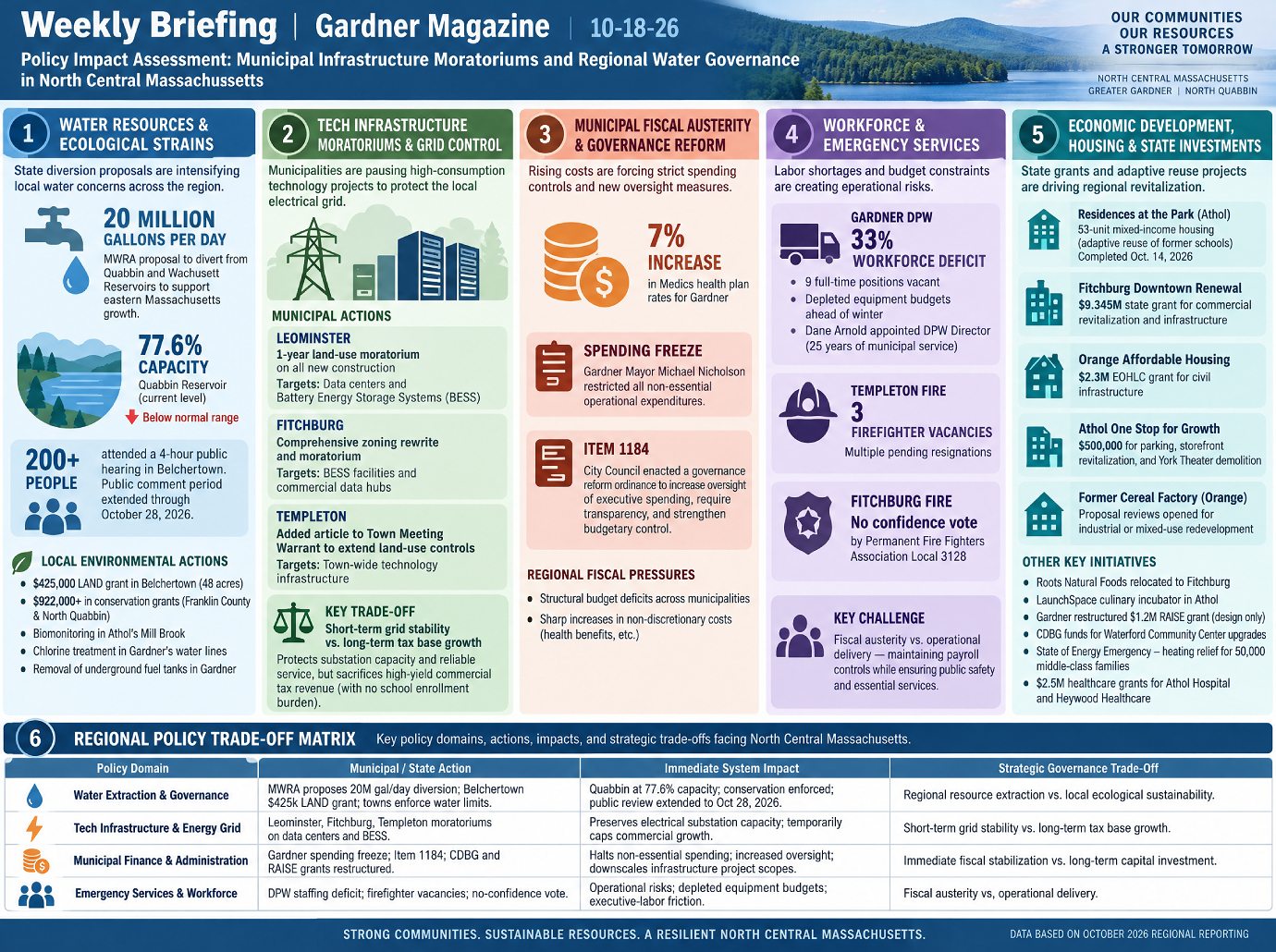
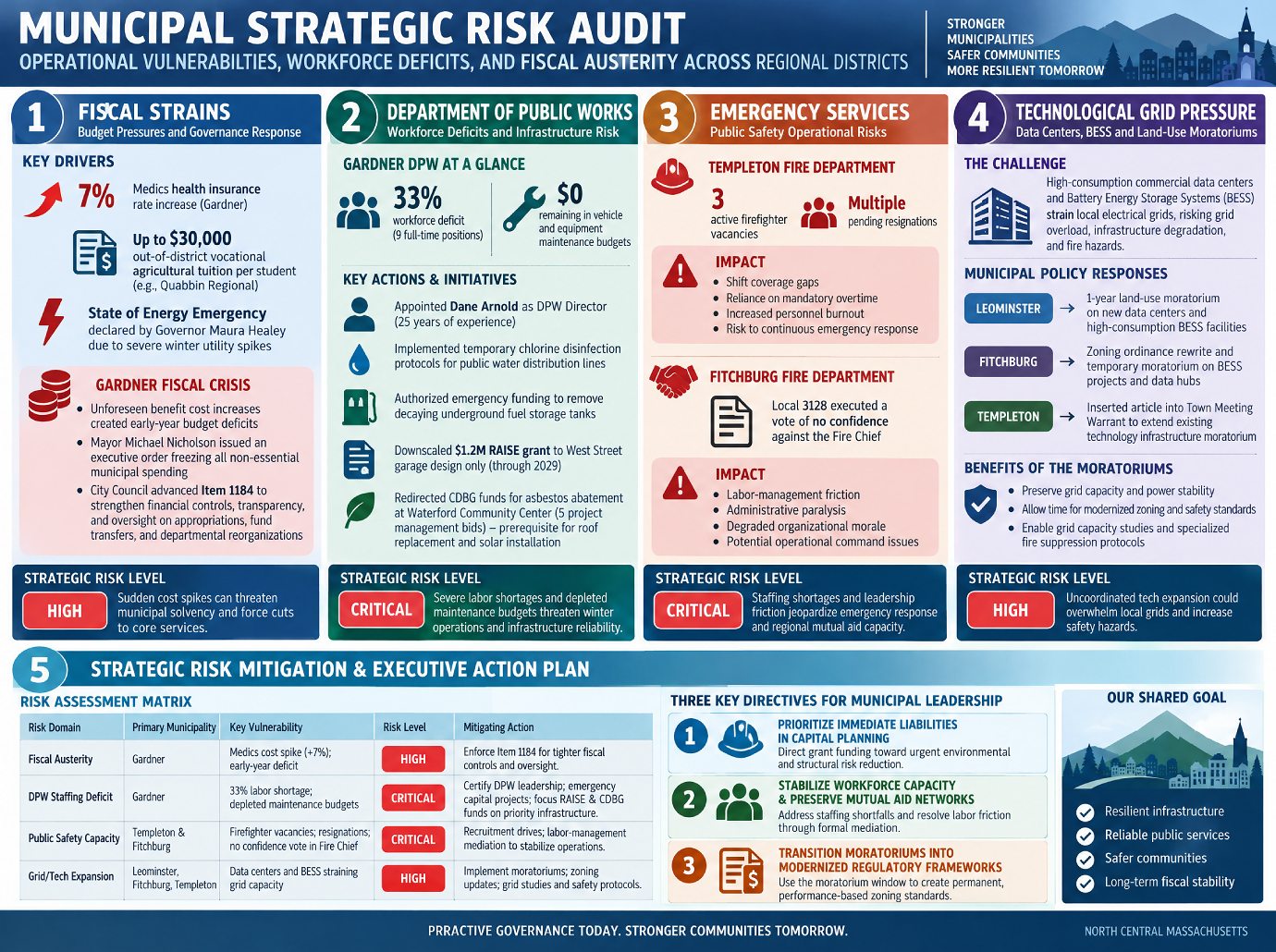
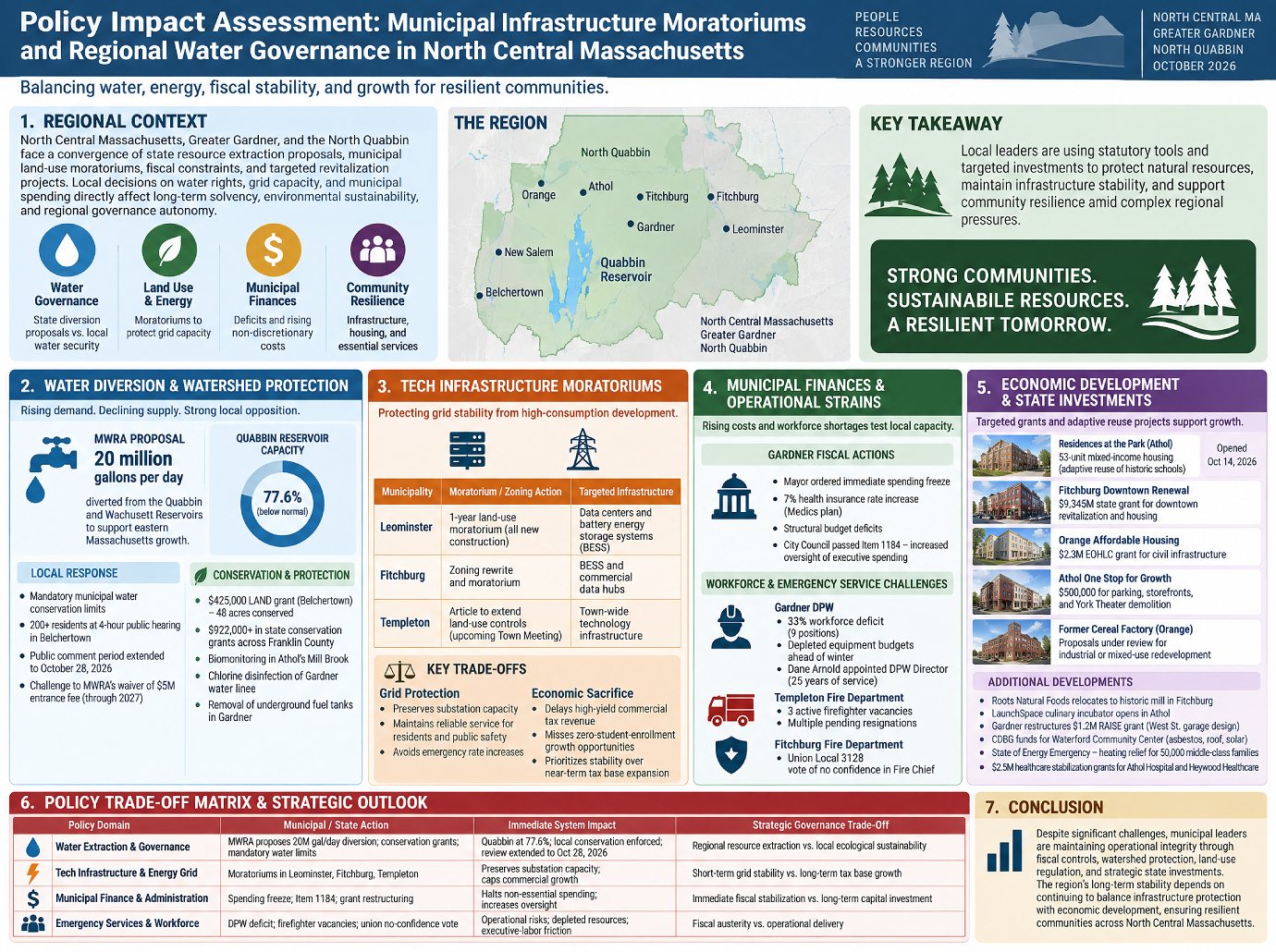
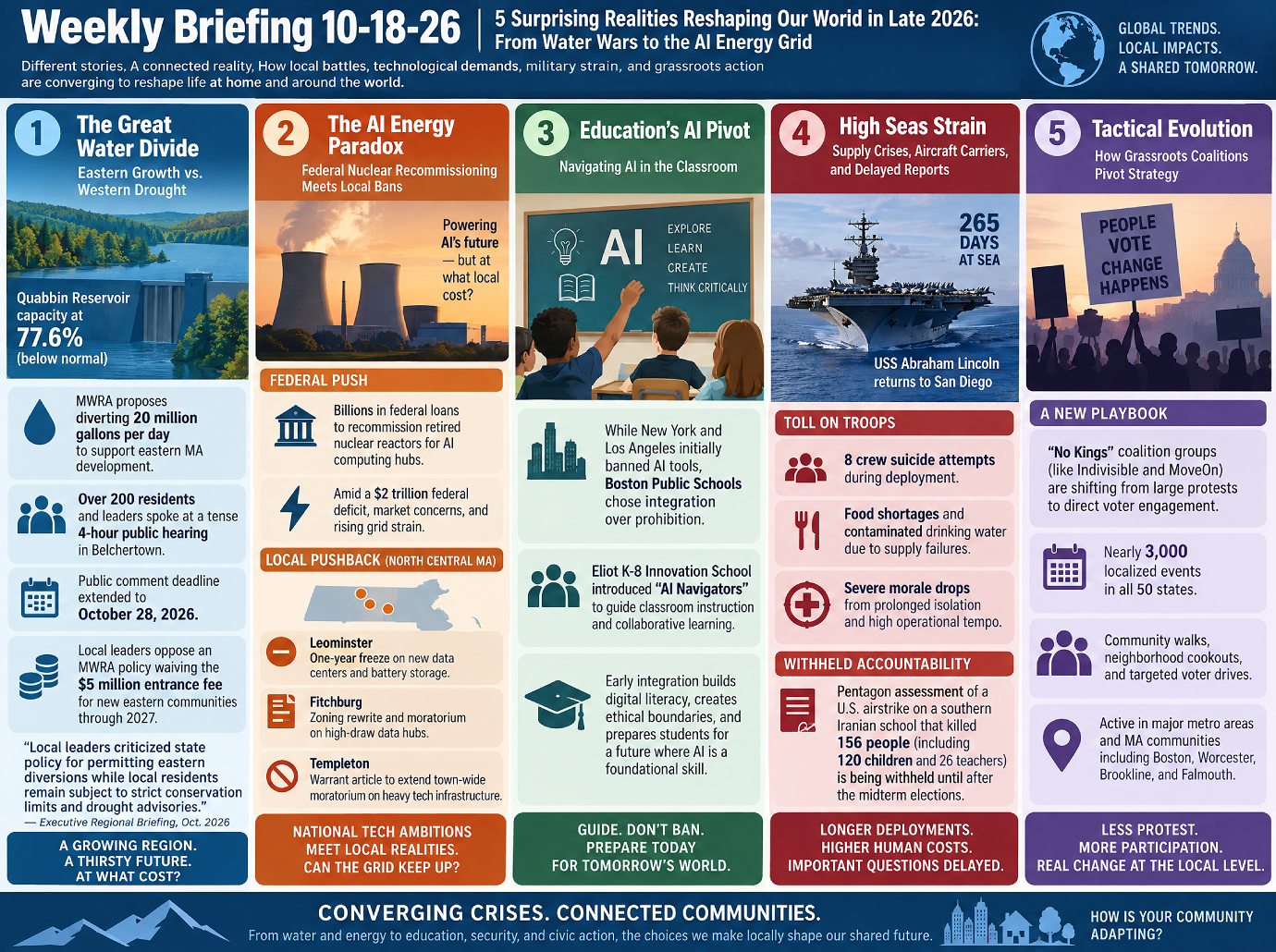
- Hotline Radio 10-17-26

A Mid-October WGAW Hotline Radio Program
Listen to the entire show from October 17, 2026 on any device, CLICK PLAY.
WGAW Hotline Radio 10-17-26 First up on the show was an uplifting song: Yankee Doodle Dandy.
First guest was Gardner Mayor Michael Nicholson. Host Steve Wendell asked the Mayor about the upcoming winter: Gardner’s vehicle fleet is in good shape, but Gardner is still looking for some more on-call plowing contractors. Other matters discussed included the retirement of the Sealer of Weights and Measures Steve Hirons whose son is the new appointee, a discussion of various matters involving Gardner Public Schools. The Annunciation Parish and Holy Family Bazaar is taking place this weekend. Grandma K’s Daycare is having a ribbon cutting today.
Other Show topics: School Biz Commentary with Werner Poegel – about the various issues raised during the last School Committee meeting.Steve Wendell spoke with Chris Turcotte about the ongoing Mason Pumpkin Sale on Elm Street near the Big Chair.
An interview with State Senator Peter Durant: The Senator is working on the issue homeowners are having with concrete. Some homes built in the 80s and 90s have a mineral in the concrete which causes the concrete to disintegrate decades later. The Senator spoke about State funding for repairs.
The Final Debate between Governor Maura Healey and Challenger Michael Minogue
- Westminster Town Crier Episode 35

Westminster Town Crier Episode 35 with Town Administrator Stephanie Lahtinen
Listen to the podcast on any device, CLICK PLAY.
Westminster Town Crier – Episode 35 Episode 35 of the Westminster Town Crier, hosted by Town Administrator Stephanie Latin on October 6 (broadcast October 8).
The primary operational focus for the Town of Westminster enters a busy fall season characterized by election preparations, budget planning for Fiscal Year 2028, preliminary scheduling for the May 2027 Annual Town Meeting, and the upcoming November 17 Special Town Meeting. Key governance highlights include the Select Board’s formal request for state intervention regarding ongoing PFAS contamination at Bean Porch Hill, the approval of infrastructure projects at Crocker Pond, key municipal appointments across emergency and public services, and extensive updates regarding the November 3 State Election from newly appointed Town Clerk Jane Devolio.
Special Town Meeting Warrant Overview (November 17): The Special Town Meeting is scheduled for Tuesday, November 17, at 6:30 p.m. at the Westminster Elementary School. The warrant officially closed at noon on Friday, October 9, and will be publicly posted on November 2.
- Financial & Capital Reallocations:
- Reallocation of $200,000 in capital funding toward bidding and design phase for the Public Safety Building.
- Transfer of $35,340 from ambulance receipts to support advanced paramedic training.
- Standard financial placeholders, free cash transfers to Stabilization Accounts, and funding for the Other Post-Employment Benefits (OPEB) Trust.
- Adjustment to Emergency Home Heating Assistance funding to accommodate rising fuel, oil, and gas costs.
- Strategic Staffing Plan (5-Year Plan):
- Three separate articles authorizing new personnel starting January 1: one Fire Captain, one Police Patrolman, and one Police Sergeant.
- Bylaw & Zoning Proposals:
- Historical Commission Bylaw: Article to formally create a town Historical Commission bylaw.
- MBTA Bylaw Amendment: A minor clerical correction to the MBTA zoning bylaw passed in the prior year.
- Data Center Prohibition: A comprehensive, town-wide zoning amendment submitted by the Planning Board proposing a total ban on data centers across all zoning districts.
Community Events and Local Program Calendar
11th Annual Westminster Cracker Festival
- Date & Time: Saturday, October 17, 10:00 a.m. – 5:00 p.m. (Rain or Shine).
- Location: Westminster Village Center (Organized by the all-volunteer Westminster Village Foundation).
- Key Activities:
- Cracker Festival 5K Road Race begins at 9:00 a.m.
- Annual local restaurant Chili Contest.
- Live music stage schedule featuring Mr. Strickland, Freddy and the Freeloaders, and The Tribe.
- Temporary live entertainment license running 10:00 a.m. to 5:00 p.m.
- Municipal and non-profit booths including Neighbors Helping Neighbors, Community Services Department, Fire Department, and Council on Aging.
- Logistics: Free admission. Free public parking with dedicated shuttle services operating from outer lots, including the VFW field.
Halloween & Fall Community Operations
- Agricultural Commission Farmers Market: Final day of the season is Friday, October 16, from 3:00 p.m. to 6:00 p.m. on Academy Hill.
- Cultural Council Grant Applications: Accepting local arts and cultural project grant proposals through October 15 via the town portal.
- Forbush Memorial Library Events:
- Book Sale: October 17 (concurrent with Cracker Festival).
- Special Evening Programming: October 18.
- Haunted Library Event: October 31.
- Council on Aging (COA) Programming:
- Boo Bingo: October 13 at 10:00 a.m.
- Meadowbrook Orchards Trip: October 16.
- Senior Halloween Party: October 22 from 1:00 p.m. to 3:00 p.m. (Registration: 978-874-7402).
- Official Town Trick-or-Treating:
- Schedule: Saturday, October 31, from 5:00 p.m. to 7:00 p.m.
- Street Closures: Bacon Street, Pleasant Street, and Elliot Street will be closed to vehicular traffic by the Westminster Police and Fire Departments.
- Annual Bonfire: Hosted by the Westminster Fire Department at 7:00 p.m. at the VFW field immediately following neighborhood trick-or-treating.
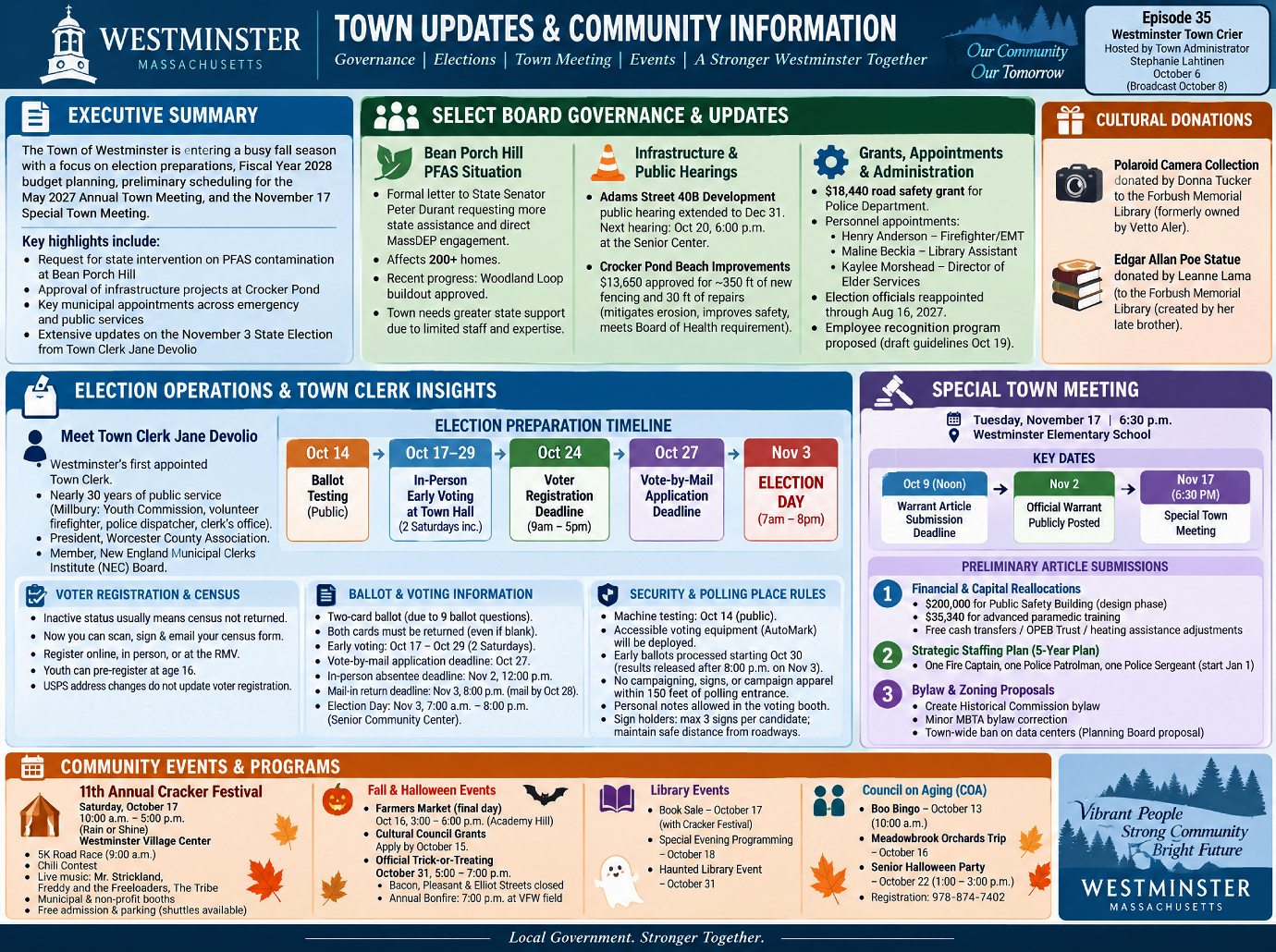
- Financial & Capital Reallocations:
- MWCC CCAMPIS
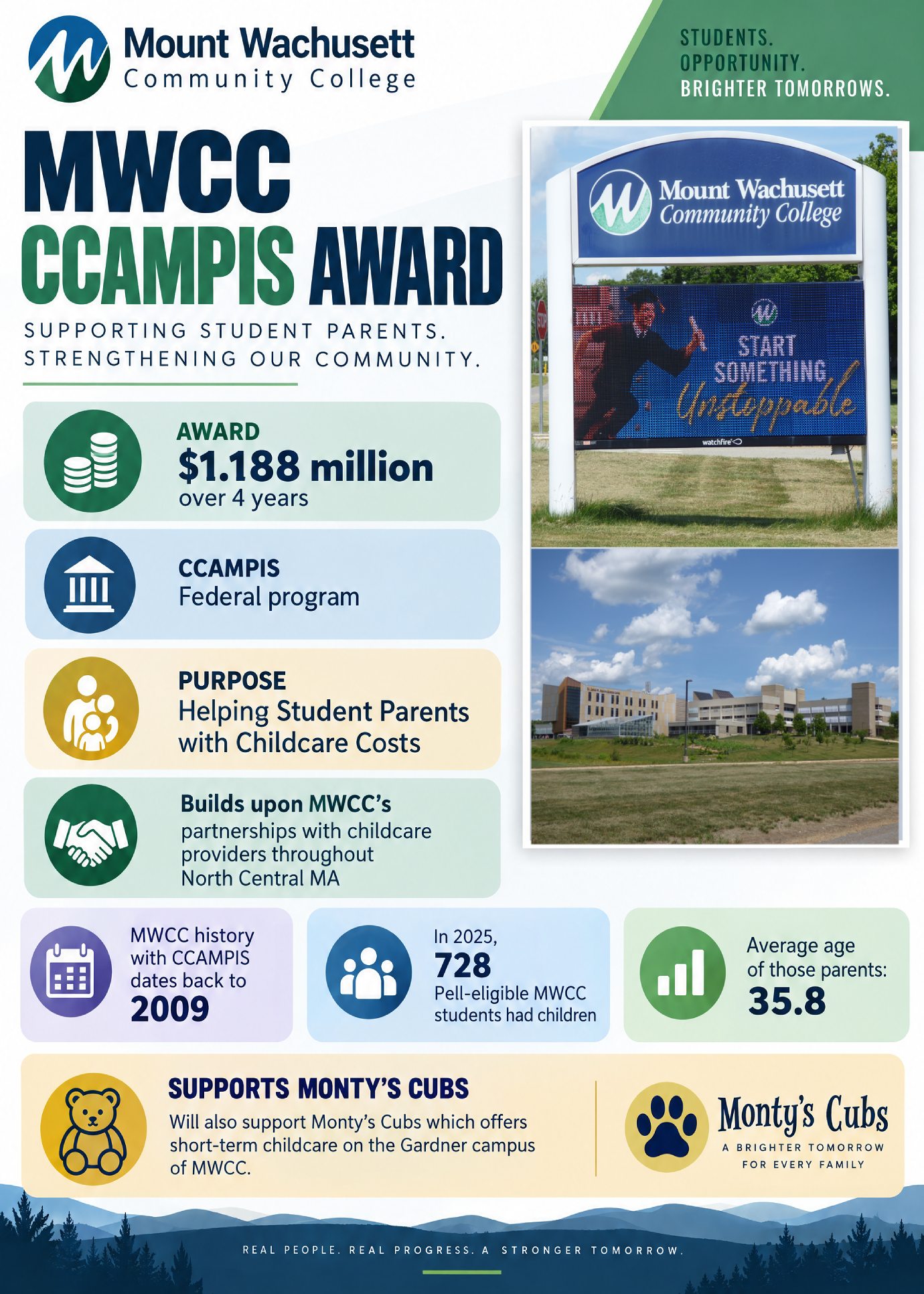
For more information about Mount Wachusett Community College, please visit their website, CLICK HERE.
MWCC Childcare Support Gets Boost with CCAMPIS award
From Mount Wachusett Community College: “Mount Wachusett Community College (MWCC) has been awarded $1.188 million over four years through the federal Child Care Access Means Parents in School (CCAMPIS) program, significantly expanding the college’s ability to help student parents access affordable, reliable childcare while pursuing their education.
The award provides MWCC with $297,000 annually for four years. In the first year alone, nearly $230,000 is designated for childcare subsidies, with at least 50 student parents expected to benefit annually. Subsidies will cover between 40 and 80 percent of eligible childcare costs based on student need, with maximum annual assistance of $10,000 for one child and $20,000 for families with two or more children.
“For nearly two decades, CCAMPIS has helped student parents at the Mount continue their education while caring for their families,” said MWCC President James Vander Hooven. “We are especially grateful to see that commitment continue and grow. This significant investment will allow us to help more student parents access the childcare and support they need to remain in college and achieve their academic and career goals.”
MWCC’s history with CCAMPIS dates to 2009, when the college first received a multi-year grant to increase college participation and success among low-income student parents by helping them pay for childcare. The original program provided childcare subsidies to 24 full- and part-time students receiving Pell Grants, with subsidies covering 20, 40, or 60 percent of childcare costs. Participating parents could choose from among 75 pre-screened, licensed childcare providers serving infants through school-age children near MWCC’s campuses.
Seventeen years later, the new award significantly expands that work. Under the new CCAMPIS program, students will be able to select licensed childcare providers and before and after school programs that meet their families’ needs, with subsidies covering as much as 80 percent of costs. The program is designed to provide at least 50 childcare subsidies annually.
At MWCC, the need for childcare assistance has grown along with the population of adult and parenting students. In 2025, 728 Pell-eligible MWCC students had children, representing more than one-quarter of the college’s Pell-eligible students. The average age of those student parents was 35.8.
A recent survey of MWCC student parents further demonstrated the challenges they face while pursuing a college education. Among Pell-eligible student parents responding to the survey, 82 percent said family responsibilities prevented them from having enough time to study, 67 percent reported difficulty finding affordable childcare, and 56 percent said they had missed class because a child was sick.
In addition to childcare subsidies, the new CCAMPIS program will connect participating students with academic advising and individualized support, parent support activities, financial literacy and other workshops, referrals to campus and community resources, and Monty’s Cubs Child Watch. The program uses a two-generation approach designed to support both student parents and their children while helping parents persist in college, graduate, or transfer.
Monty’s Cubs provides short-term childcare on the Gardner Campus so student parents can attend class, meet with an advisor, access tutoring, study or take care of other college-related responsibilities. It also serves as an option when a student unexpectedly loses access to their regular childcare, although it is not intended to replace stable, ongoing care.
“Monty’s Cubs has also served as a bridge for student parents,” notes Ann Reynolds, Director of Student Parent Supports at MWCC. “Many who utilize the service do so because they have no other childcare for their young child, or their child has never stayed with anyone other than the parent. When student parents see their children blossom in the space, and as they advance in their college journey, they are more likely to consider finding regular sustainable childcare. The CCAMPIS Program helps them do just that.”
Through the new CCAMPIS award, MWCC aims for at least 65 percent of participating students who have not graduated or transferred to remain enrolled at the end of each academic year, and for 55 percent of participants to graduate or transfer within three years.
The grant will also build upon MWCC’s partnerships with childcare providers throughout North Central Massachusetts, allowing student parents greater flexibility in finding care that works for their families, schedules and educational goals.
- Festival of Trees 10-16-26
Festival of Trees Begins November 11th at the Gardner Museum in Gardner MA
The Gardner Museum Festival of Trees is November 11, 2026 through December 5, 2026. Museum Hours during the festival: Wednesdays and Thursdays 1 to 4pm, Fridays 1-7pm, Saturdays and Sundays 10am to 4pm . (On the last day, December 5th, hours are until 2pm to allow for the drawing.) Location: the e Gardner Museum on Pearl Street in Gardner. Donations of a tree, basket, or other item for the festival will be accepted through October 31st (to give time for the setup on November 2nd)
Here’s how the Festival of Trees works: The Annual Festival of Trees is a fundraising event with visitors purchasing sheets of raffle tickets for $5 each. Each sheet contains 26 chances. Each one of those 26 chances on a sheet can be placed in a container near one of the expected more than 120 raffle items and one can be used to take a chance to win one of the weekly door prizes drawn each Saturday to include Christmas décor, scratch tickets, and cash.
Those who wish to donate a tree, basket, or other item can call the Gardner Museum at (978) 632-3277 or send an email to info@gardnermuseuminc.com. Museum Coordinator Marion Knoll will then forward the info to Janet Stankaitis and her team of about 100 volunteers.
- Relay for Life 10-16-26
Relay for Life – Greater Gardner – to be Huge 1 Day Event in 2027
The Greater Gardner Relay for Life will be a HUGE 1 day event this coming year. Date is Saturday June 12, 2027 from 10am to 10pm. Location is the same at 444 Green Street Gardner (MWCC). This year’s theme is “Garden of Hope” and the fundraising goal is $170,000.
Visit: RelayforLifeGG.org for more information including a Team Captain Guide, a Participant Guide, and a link to download a fundraising app. You can also see the top teams, top participants, and top companies involved in the Greater Gardner Relay for Life.
While the focus often turns to the relay event itself, the Relay for Life, Greater Gardner is a year-long fundraising effort working towards a world without cancer. It’s purpose: Grow Hope, Celebrate Survivors, and Remember Loved Ones.
Would you like to promote your team? Simply email News@GardnerMagazine.com and provide us with the info.
Every Dollar Makes a Difference: At Relay For Life no donation is too small, each and every dollar counts. Donations help fund groundbreaking cancer research, patient care programs, and can make a difference in the Greater Gardner area. With every donation, you are helping the American Cancer Society save lives.
At Relay For Life events, no one faces cancer alone. People come together every year at events around the country to support and celebrate survivors and caregivers.
Each Relay has special events and activities (many throughout the year) just for survivors and their caregivers, so they can connect with others and know there is a strong support system available to them.For more information about the Greater Gardner Relay for Life, visit RelayforLifeGG.org.
- NOAA – Winter 26-27
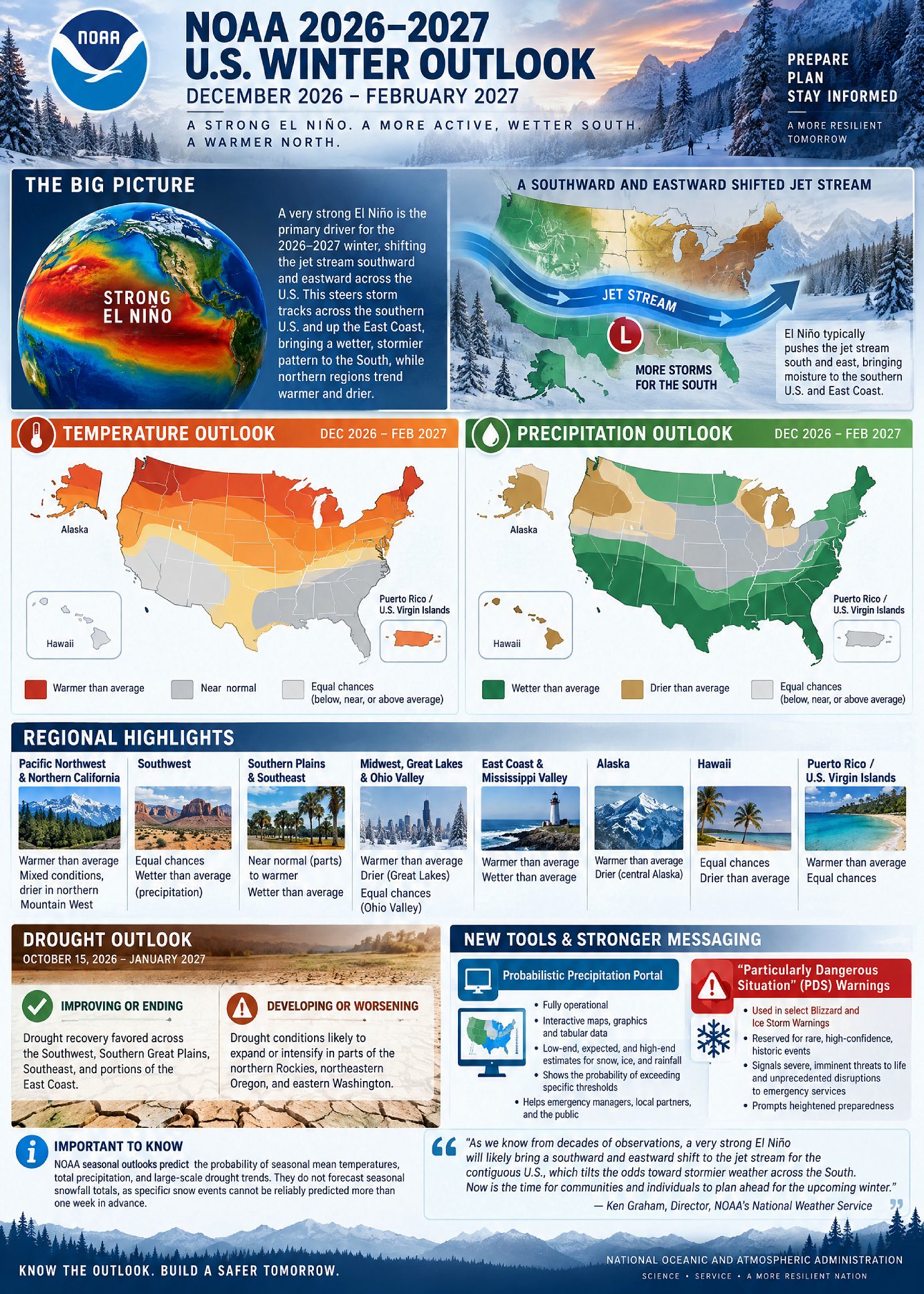
NOAA – Winter Outlook – 2026-2027
Listen to this podcast on any device, CLICK PLAY.
DEEP DIVE – NOAA Winter Outlook 2026-27 On October 15, 2026, the National Oceanic and Atmospheric Administration (NOAA) released its U.S. Winter Outlook for the period spanning December 2026 through February 2027.
The primary atmospheric driver for the upcoming season is a very strong El Niño, which is anticipated to shift the jet stream southward and eastward across the contiguous United States.
Here’s what the outlook looks like:
Temperature: Warmer-than-average conditions are favored across the northern U.S., Alaska, and U.S. territories, while near-normal temperatures are expected in parts of the Southeast.
Precipitation: Wetter-than-average conditions are expected across the southern tier of the country and along the Eastern Seaboard. Conversely, drier conditions are anticipated in the northern Rockies, Great Lakes, and parts of Alaska.
- Drought Relief vs. Hazards: While increased precipitation is projected to end or improve drought conditions in the Southwest, Southern Great Plains, Southeast, and East Coast, heavy rainfall on dry terrain introduces heightened risks of flash flooding and mudslides. Drought is predicted to worsen in parts of the Pacific Northwest and northern Rockies.
- Tool & Messaging Upgrades: NOAA’s National Weather Service (NWS) has introduced the operational Probabilistic Precipitation Portal and will now utilize “Particularly Dangerous Situation” (PDS) wording in select Blizzard and Ice Storm Warnings for historic, high-confidence events.
Primary Climate Driver: El Niño and Jet Stream Shift
The 2026–2027 winter weather pattern is heavily governed by a strong El Niño climate pattern. According to Ken Graham, Director of NOAA’s National Weather Service:
“As we know from decades of observations, a very strong El Nino will likely bring a southward and eastward shift to the jet stream for the contiguous U.S., which tilts the odds toward stormier weather across the South. While higher chances of rain and snow may bring relief to drought-afflicted areas, too much precipitation on dry soil can fuel destructive flash floods and mudslides. Now is the time for communities and individuals to plan ahead for the upcoming winter.”
This shifting jet stream acts as the primary mechanism redirecting storm tracks, steering moisture across the southern half of the country and up the East Coast, while leaving northern regions warmer and selectively drier.
Seasonal Temperature and Precipitation Forecasts
Temperature Outlook (December 2026 – February 2027)
- Warmer-than-Average: Favored for the Pacific Northwest, northern California, northern Rockies, Midwest, Mississippi Valley, much of the East Coast, Alaska, and Puerto Rico / U.S. Virgin Islands.
- Near-Normal: Most likely for parts of the Southeast, including Florida.
- Equal Chances (Below-, Near-, or Above-Average): Hawaii and much of the Southwest exhibit equal likelihoods across all temperature categories.
Precipitation Outlook (December 2026 – February 2027)
- Wetter-than-Average: Most likely across the southern tier of the U.S. (extending from California through the Southwest to the Southeast) and along the East Coast.
- Drier-than-Average: Elevated odds for the northern Mountain West/northern Rockies, some areas in the Great Lakes, central Alaska, Hawaii, and the western Pacific Islands.
- Equal Chances (Below-, Near-, or Above-Average): Intermountain West, northern Plains, Ohio Valley, and Puerto Rico / U.S. Virgin Islands.
Drought Expectations (October 15, 2026 – January 2027)
The anticipated shift in precipitation patterns substantially alters the national drought footprint:
- Improving or Ending Drought: Strong probabilities of drought recovery across the Southwest, Southern Great Plains, Southeast, and portions of the East Coast.
- Developing or Worsening Drought: Drought conditions are favored to expand or intensify across parts of the northern Rockies, as well as northeastern Oregon and eastern Washington.
Operational Upgrades and Forecasting Innovations
NOAA’s National Weather Service has deployed two major updates for the 2026–2027 winter season to enhance decision support and hazard communication:
- Probabilistic Precipitation Portal
- Status: Fully operational.
- Capabilities: Provides interactive graphics, maps, and tabular data detailing low-end, expected, and high-end estimates for snow, ice, and rainfall accumulations.
- Purpose: Assists emergency managers, local partners, and the public by mapping the probability of precipitation exceeding specific operational thresholds.
- “Particularly Dangerous Situation” (PDS) Warning Language
- Implementation: Integrated into select Blizzard Warnings and Ice Storm Warnings.
- Trigger: Reserved for rare, high-confidence winter storms of historic severity.
- Objective: Clearly communicate severe, imminent threats to life and unprecedented disruptions to emergency services, prompting heightened preparedness.
Programmatic Constraints and Future Updates
- Predictability Limits: NOAA seasonal outlooks project the probability of seasonal mean temperatures and total precipitation amounts, as well as large-scale drought trends. They do not forecast seasonal snowfall totals, as specific snow events cannot be reliably predicted more than one week in advance.
- Update Schedule: The Climate Prediction Center / Weather Prediction Center updates the three-month outlook monthly. The next official update following this release is scheduled for November 19, 2026.
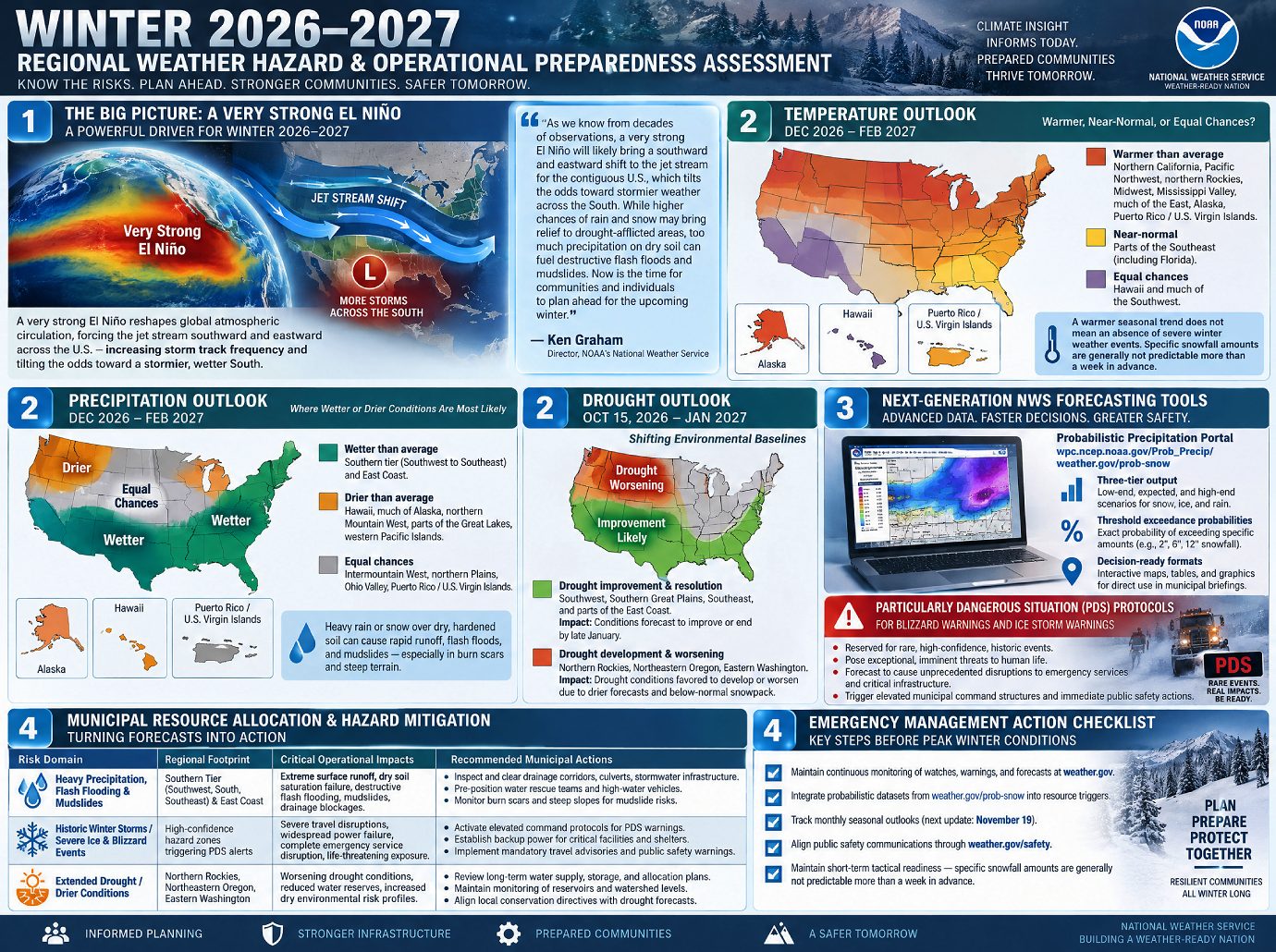
Winter 2026-2027 Preparedness Summary 
El Nino Takes Center Stage
- Governor Debate 10-15-26
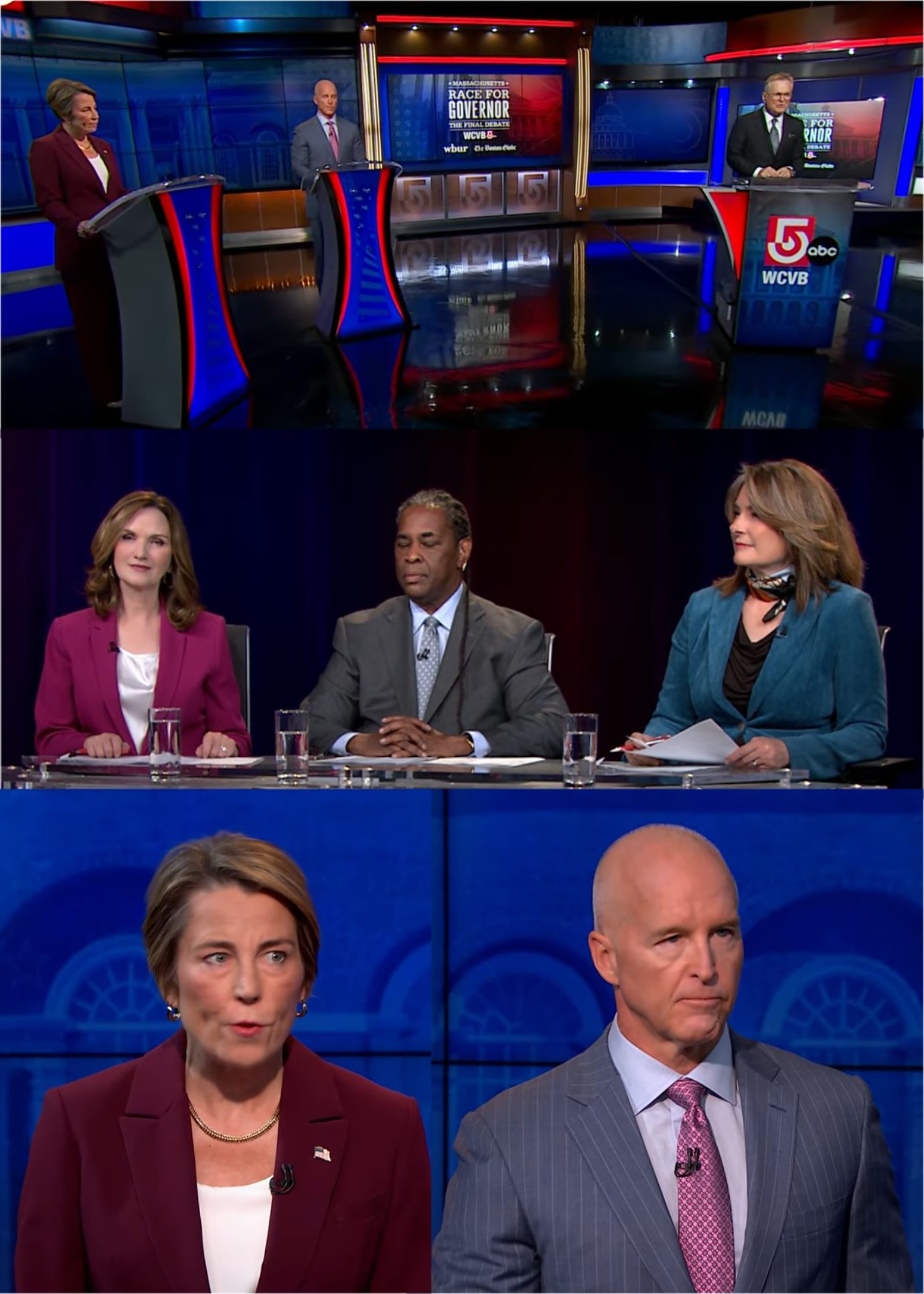
Last Debate for MA Governor – October 15, 2026 – FULL COVERAGE
Listen to the debate on any device, CLICK PLAY.
Healey-Minogue Debate 10-15-26 The final Massachusetts gubernatorial debate between incumbent Democratic Governor Maura Healey and Republican challenger Mike Manogue.
The debate centered on acute economic pressures facing Massachusetts residents—including high housing, energy, and living costs—alongside contrasting visions for state governance, public safety, law enforcement oversight, energy policy, and reproductive rights.
Gardner Magazine has coverage of the key takeaways from the debate and detailed candidate positions on the various issues.
- Economy & Cost of Living: Both candidates acknowledge severe affordability pressures (food prices up 35% since 2020, median listing prices near $800,000, gas at $4.30/gallon). Governor Healey highlights her tax cuts for seniors, parents, and small businesses, alongside a 4th-in-the-nation GDP growth rate. Challenger Mike Manugg advocates for immediate gas tax cuts, eliminating a third of state utility fees, and opting into federal scholarship tax credits ($10,000–$20,000 back to families).
- Housing & Migration: Manugg highlights out-migration statistics (>33,000 people in a single year, 60% aged 25–44) and blames restrictive stretch codes and slow local permitting (1.5+ years). Healey points to state-level permitting reform (slashed from 1 year to 30 days), accessory dwelling unit (ADU) legislation, and 100,000 homes permitted or under development.
- Ethics, Law Enforcement & Oversight: Manugg sharply criticizes the Healey administration over state police misconduct scandals, the arrest of former administration staffer Lamar Cook (involving 18 lbs of delivered cocaine, SNAP fraud, and a $22,000 vacation payout), and a 12.5% SNAP error rate that risks a $300 million taxpayer penalty. Healey defends her zero-tolerance policy, stating Cook was fired immediately before arraignment, and points to the appointment of Colonel Jeffrey Noble to oversee State Police reform.
- Energy & Climate Policy: Manugg claims Healey’s past opposition to natural gas pipelines as Attorney General drove utility bills up, forcing the state to import European LNG at six times the cost. Healey defends an “all-of-the-above” strategy (wind, solar, hydro, geothermal, and expanded gas capacity in existing pipelines), arguing that tariffs and federal policies are driving up regional energy costs.
- Immigration & Federal Authorities: Healey signed the Protect Act and calls ICE a “public safety threat” that pulls taxpaying parents from communities. Manugg emphasizes local, state, and federal law enforcement coordination to remove violent criminals while protecting law-abiding undocumented workers.
Candidate Comparative Summary
Topic Area Governor Maura Healey (D) Challenger Mike Manugg (R) Tax Relief & Cost of Living Proposes temporary gas tax suspension targeting drivers; highlights earlier tax cuts for seniors, parents, and small businesses. Calls for immediate gas tax elimination, cutting 1/3 of utility fees, and adopting federal scholarship tax credits. Housing & Permitting Reduced state permitting from 1 year to 30 days; created ADU build-by-right policies; target to build/permit 200,000 homes. Targets 45-day local permitting; advocates eliminating strict stretch codes; opposes state lawsuits against towns over condo mandates. Education & Wealth Gap Expanded vocational seats by 25,000; implemented free community college; offered $25,000 for first-time homebuyers. Focuses on literacy (60% non-proficient); supports school choice via federal scholarship tax credits; advocates vocational training. Law Enforcement & ICE Signed Protect Act; opposes non-criminal ICE deportations; appointed Colonel Jeffrey Noble to lead State Police reforms. Calls for law enforcement cooperation across local/state/federal levels; prioritizes removing violent criminals and drug dealers. Energy Policy Promotes “all-of-the-above” approach; supports expanding flow in existing gas pipelines alongside wind, solar, hydro, and geothermal. Advocates new natural gas pipelines and nuclear energy; calls for suspending the 1/3 utility fee labeled a “climate tax.” Ethics & State Oversight Claims zero tolerance; fired Lamar Cook day of arrest; referred fraud cases to state/federal prosecutors. Cites $298B in bond debt, 12.5% SNAP error rate ($300M taxpayer risk), state house drug deliveries, and demands an independent state audit. Reproductive Rights Stockpiled mifepristone; signed healthcare shield law; made prenatal vitamins free. Pledges to uphold state abortion laws and separation of church and state; calls stockpiling unnecessary fearmongering.
Detailed Examination of Debate Themes
1. Economy, Cost of Living, and Taxation
Massachusetts faces severe macroeconomic headwinds, including food prices rising nearly 35% nationwide since 2020, median home listing prices approaching $800,000, and regular gas averaging $4.30 per gallon.
Cost of Living Context (Massachusetts): ├── Food Prices: +35% (since 2020) ├── Gas Prices: $4.30 / gallon average └── Housing: Listing closing prices approaching $800,000- Governor Healey’s Position:
- Highlights being the first Massachusetts governor in 20 years to enact tax cuts, focusing relief on seniors, parents, young people, and small businesses rather than the wealthy.
- Supports a limited, temporary gas tax suspension designed to ensure oil companies do not profit at the expense of drivers.
- Attributes broad inflation and energy price spikes to foreign wars and federal tariffs.
- Emphasizes that Massachusetts maintains the 4th fastest-growing state economy in the U.S., driven by strong healthcare, innovation, and education sectors.
- Mike Manogue’s Position:
- References Healey’s past statement that “Massachusetts is a great place to live if you can afford it,” arguing that working families cannot afford current state policies.
- Demands an immediate suspension of the gas tax to provide direct relief.
- Advocates cutting one-third of utility bill fees, describing non-energy fees as a “climate tax.”
- Proposes opting into the Federal Scholarship Tax Credit to return $10,000 to $20,000 directly into parents’ pockets.
2. Housing Production, Permitting, and Out-Migration
Concerns were raised regarding domestic out-migration, with Greater Boston Chamber of Commerce data showing over 33,000 people leaving the state in a single year—60% of whom are between the ages of 25 and 44.
- Mike Manogue’s Analysis & Proposals:
- Cites an exodus of young professionals fleeing high rents to cities like Austin, Texas, where housing costs are a fraction of Boston’s.
- Asserts Massachusetts ranks last in the nation in building permits per capita due to excessive bureaucracy, local permitting delays (1.5+ years for single-family homes; 3+ years for commercial properties), and unrealistic building stretch codes regarding ventilation and hookups.
- Proposes incentivizing municipalities with state funds to adopt a universal stretch code and streamline local permitting down to 45 days, rather than suing municipalities that resist building large condo developments.
- Criticizes the Healey administration for putting $298 billion on bond debt over four years—nearly double former Governor Charlie Baker’s first term—while expanding state employee payrolls.
- Governor Healey’s Analysis & Proposals:
- Rejects claims of stalled development, noting that her housing legislation cut state-level permitting times from 1 year down to 30 days.
- Enacted policies making Accessory Dwelling Units (ADUs) allowed by right, released surplus state land for development, and offered tax credits to developers.
- Reports that 100,000 homes have been permitted, built, or placed under development during her term, with a goal to double that figure in a second term.
- Points to job growth (15,000 jobs created last year) and corporate expansions by Takeda, Whoop, and Gillette as proof of economic vitality.
3. Education and the Racial Wealth Gap
A Federal Reserve Bank of Boston study highlighted that the median Black family in Massachusetts holds less than 2% of the wealth of the median white family.
Racial Wealth Gap Context: Median Black Family Wealth < 2% of Median White Family Wealth (Federal Reserve Bank of Boston)- Healey’s Initiatives:
- Homeownership & Housing: Created a first-time homebuyer program offering $25,000 in direct assistance to close the historical racial wealth gap driven by homeownership barriers; eliminated real estate broker fees for renters.
- Higher Education & Workforce: Made community college free across the state; doubled public funding for K-12 students; expanded vocational and career-technical education seats by 25,000.
- Manogue’s Counterarguments:
- Argues that free community college fails to solve underlying systemic issues when 60% of high school and elementary students cannot read or write at a proficient level—a decline from 2019 levels.
- Claims urban core achievement gaps are among the worst in the nation despite high state spending.
- Demands the state opt into the Federal Scholarship Tax Credit (school vouchers) to give low-income families options outside their zip codes, alongside expanded support for vocational facilities like Essex Tech.
4. Law Enforcement, Governance Ethics, and Administrative Oversight
State Police Culture
Following an internal affairs investigation into a trooper who allowed a friend to stay at the Martha’s Vineyard barracks—resulting in an alleged sexual assault of a woman by a civilian—both candidates addressed law enforcement accountability.
- Manogue: Condemns Healey’s response that “sometimes things happen,” arguing that true leadership requires zero tolerance, strict accountability, and high integrity standards. Opposes special union deals and promises regular ride-alongs.
- Healey: Defends State Police leadership under Colonel Jeffrey Noble (hired from outside the agency in New Jersey). Highlights state police achievements, including locating a lost 4-year-old boy in the woods and supporting fallen officers via the Blue Star plate program.
Lamar Cook & DTA SNAP Fraud Scandal
- Manogue’s Allegations:
- Claims administration staffer Lamar Cook had 18 lbs of cocaine delivered directly to the State House, received $22,000 in unused vacation pay upon termination, and subsequently received SNAP benefits.
- Accuses the administration of failing to cooperate with U.S. Attorney Leah Foley or provide recipient identification data to federal oversight bodies.
- States the Department of Transitional Assistance (DTA) SNAP error rate spiked to 12.5% (compared to 4.5% under Governor Baker). Because states pay penalties for error rates exceeding 6%, Manugg asserts this will cost Massachusetts taxpayers $300 million in new taxes and jeopardize $3 billion in federal funding.
- Healey’s Defense:
- Clarifies that Cook was fired immediately on the day of his arrest, before he was even arraigned, and that the state worked with prosecutors to recoup funds.
- Reaffirms zero tolerance for public trust breaches, noting she routinely refers fraud cases to the U.S. Attorney, Attorney General, State Auditor, and Inspector General.
- Explains that broad SNAP administrative actions were necessary after federal disruptions cut off SNAP benefits for 900,000 Massachusetts residents.
SNAP Program Error Rate Comparison:
├── Baker Administration Error Rate: 4.5%
├── Current Healey Administration Error Rate: 12.5%
├── Federal Penalty Threshold: 6.0%
└── Estimated Taxpayer Penalty Exposure: $300 Million
Federal Immigration Enforcement (ICE) & Public Safety
- Healey: Signed the Protect Act to restrict state involvement with ICE, calling current ICE operations an “out-of-control rogue agency” and a “public safety threat” that detains taxpaying parents (e.g., recent fish plant raids in New Bedford). Distinguishes non-criminal families from violent criminals, highlighting joint state/federal task force operations that seized 20 kilograms of fentanyl and cocaine in September.
- Manogue: Argues that refusing to cooperate with federal detainer requests for violent criminals and drug dealers places immigrant communities in danger. Advocates for coordinated operations between local, state, and federal authorities to target violent offenders while protecting law-abiding undocumented workers.
5. Energy Policy, Climate Objectives, and Public Works
Energy Grid and Utility Bills
- Mike Manogue:
- Attributes high regional electricity costs to Healey’s actions as Attorney General in 2015, when she opposed natural gas pipeline expansion into Massachusetts.
- Notes that because domestic pipeline capacity was blocked, Massachusetts imports Liquefied Natural Gas (LNG) from Europe at six times the domestic cost.
- Points out that wind and solar provide under 6% of the state’s energy despite billions in investments, while nuclear energy (Seabrook facility) provides 20%.
- Advocates building natural gas pipelines, exploring nuclear expansion, and removing non-usage climate charges from utility bills.
- Governor Healey:
- Promotes an “all-of-the-above” strategy including wind, solar, geothermal, hydro (via Canadian interconnections), and natural gas.
- Notes she petitioned federal regulators to increase gas flow volume through existing regional pipelines.
- Recalls that her 2015 pipeline legal challenge protected consumers because the developer wanted ratepayers—rather than company shareholders—to shoulder the construction risk.
- Filed legislation aimed at reforming regional energy markets to save ratepayers an estimated $13 billion.
Climate Goals
- Healey: Opposes rolling back state climate goals, emphasizing operational progress in siting, permitting, and clean energy development to lower long-term costs.
- Manogue: Accuses the administration of delaying penalty fee implementations until after the election. Warns that attempting to run state infrastructure solely on intermittent renewables will cost taxpayers $300 billion and disrupt industrial operations.
Infrastructure Disputes (Springfield Courthouse)
- Manogue: Criticizes a proposed $2 billion, 40-year lease agreement for a new Springfield courthouse, noting local sheriff and community opposition regarding safety and lack of on-site parking.
- Healey: Defends the procurement process, stating a judge verified the process was flawless. Replaces a contaminated “sick building” to protect worker health while creating 1,000 local jobs and 550 housing units in Springfield.
6. Reproductive Rights and Legislative Oversight
Abortion Access & Shield Laws
- Mike Manogue: Reiterates his personal pro-life views but pledges absolute adherence to state law, the state constitution, and the separation of church and state. Argues that FDA-approved Mifepristone remains legally available through standard supply chains, rendering state-funded stockpiles an unnecessary use of taxpayer funds.
- Governor Maura Healey: Highlights her proactive stockpiling of Mifepristone and passage of the nation’s strongest healthcare shield law following the overturning of Roe v. Wade. Emphasizes that her administration expanded free prenatal care and maternal health investments, arguing that government should not interfere in private medical decisions.
Legislative Performance & State Transparency
When asked to evaluate the Massachusetts Legislature—frequently ranked among the least productive in the nation—the candidates offered starkly different assessments:
- Monogue (Grade: F): Cites the Legislature’s failure to audit state operations, refusal to address gas tax proposals, and efforts to block Ballot Question 1 (designed to mandate legislative transparency). Promises to hire an independent financial auditing firm and increase funding for the State Auditor to investigate the MBTA and energy authorities.
- Healey (Grade: Incomplete): Notes that key bills, including her $13 billion energy reform measure, remain pending before the Legislature. Highlights her willingness to utilize executive actions to bypass legislative gridlock when necessary to deliver economic relief.
- 3 Generations – Weights and Measures
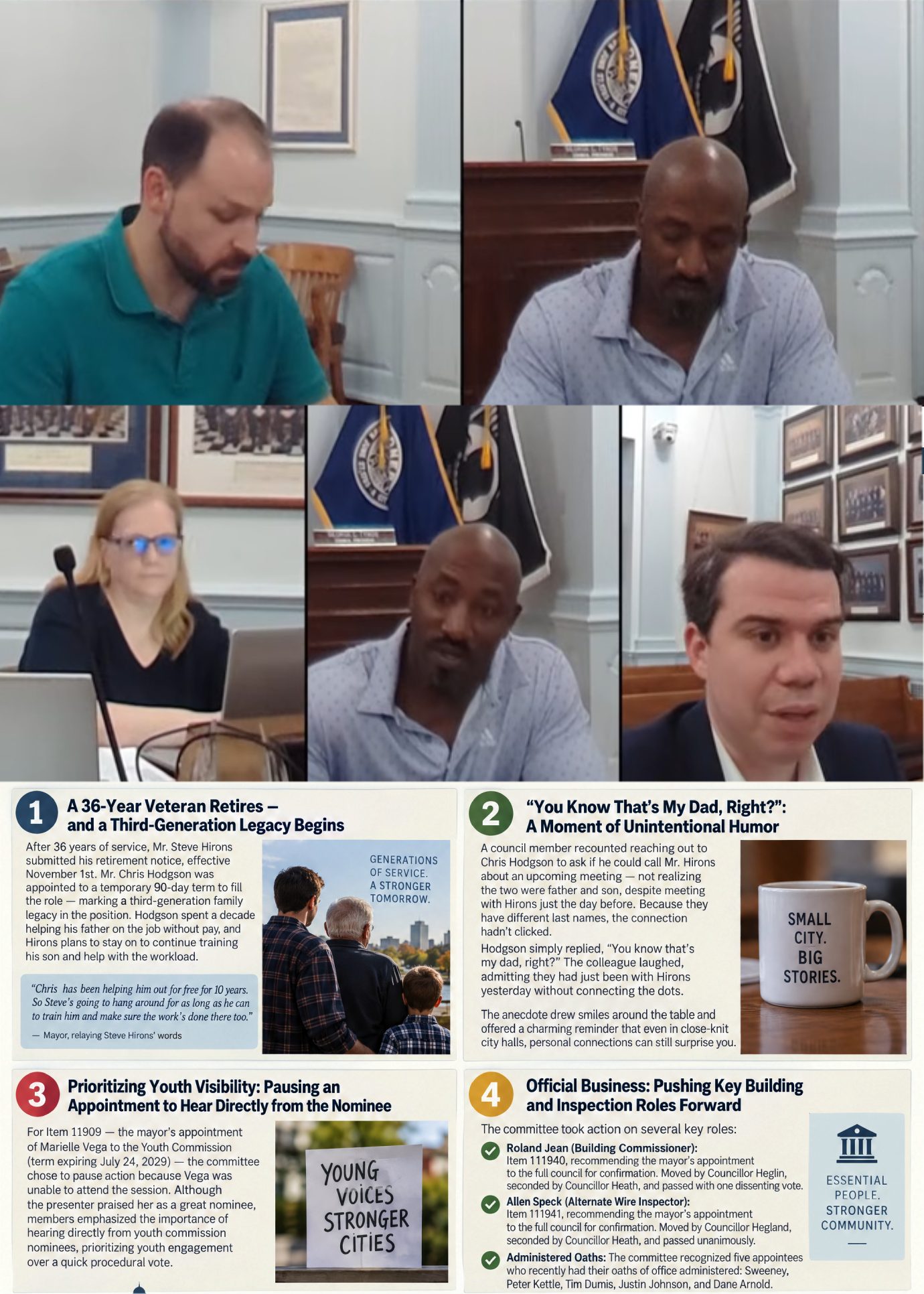
Appointments Committee – a 36 Year Veteran Retires and a 3rd Generation Legacy Begins
The Gardner Appointments Committee met on October 14, 2026. Listen on any device, CLICK PLAY.
Appointments Committee 10-14-26 After 36 years in the role of the Sealer of Weights and Measures for the City of Gardner, Stephen Hirons has submitted his request for retirement effective November 1st. At an Appointments Committee meeting of October 14, 2026, Gardner Mayor Nicholson announced that he has given Hirons’ son a temporary 90 day appointment to the role. making him the 3rd generation in the job. This transition marks the arrival of a third-generation family legacy in the position, with Hodgson stepping into the exact footsteps previously walked by both his father and his grandfather.
What makes this passing of the torch even more extraordinary is Hodgson’s extensive, quiet preparation. As shared during the meeting, Hodgson spent a decade helping his father on the job entirely without pay. To ensure a seamless transition, Hirens plans to stay nearby to continue training his son and assist with the workload. As the mayor recounted during the meeting, relaying Hirens’ own words:
“Chris has been helping him out for free for 10 years. So Steve’s going to hang around for as long as he can to train him and make sure the work’s done there too.”
“You Know That’s My Dad, Right?”: A Moment of Unintentional Humor – A council member recounted an earlier attempt to get in touch with Mr. Hirons regarding an upcoming meeting. The member reached out to Chris Hodgson, asking if he could call Hirons and tell him he was needed. At the time, the council member had no idea the two men were father and son—despite having spent time meeting with Hirons just the day before. Because the two men carry different last names, the connection hadn’t clicked.
Hodgson simply replied, “You know that’s my dad, right?” To which the astonished colleague could only laugh, admitting they had just been with Hirens yesterday without connecting the dots.
The responsibilities of the Sealer of Weights and Measures is an important position with the following responsibilities: Inspecting and certifying commercial weighing and measuring devices, Maintaining accuracy for gas and oil dispensing equipment, scales, and retail devices, Enforcing Massachusetts General Laws regarding commercial integrity and consumer protection.
- Assessors 10-15-26
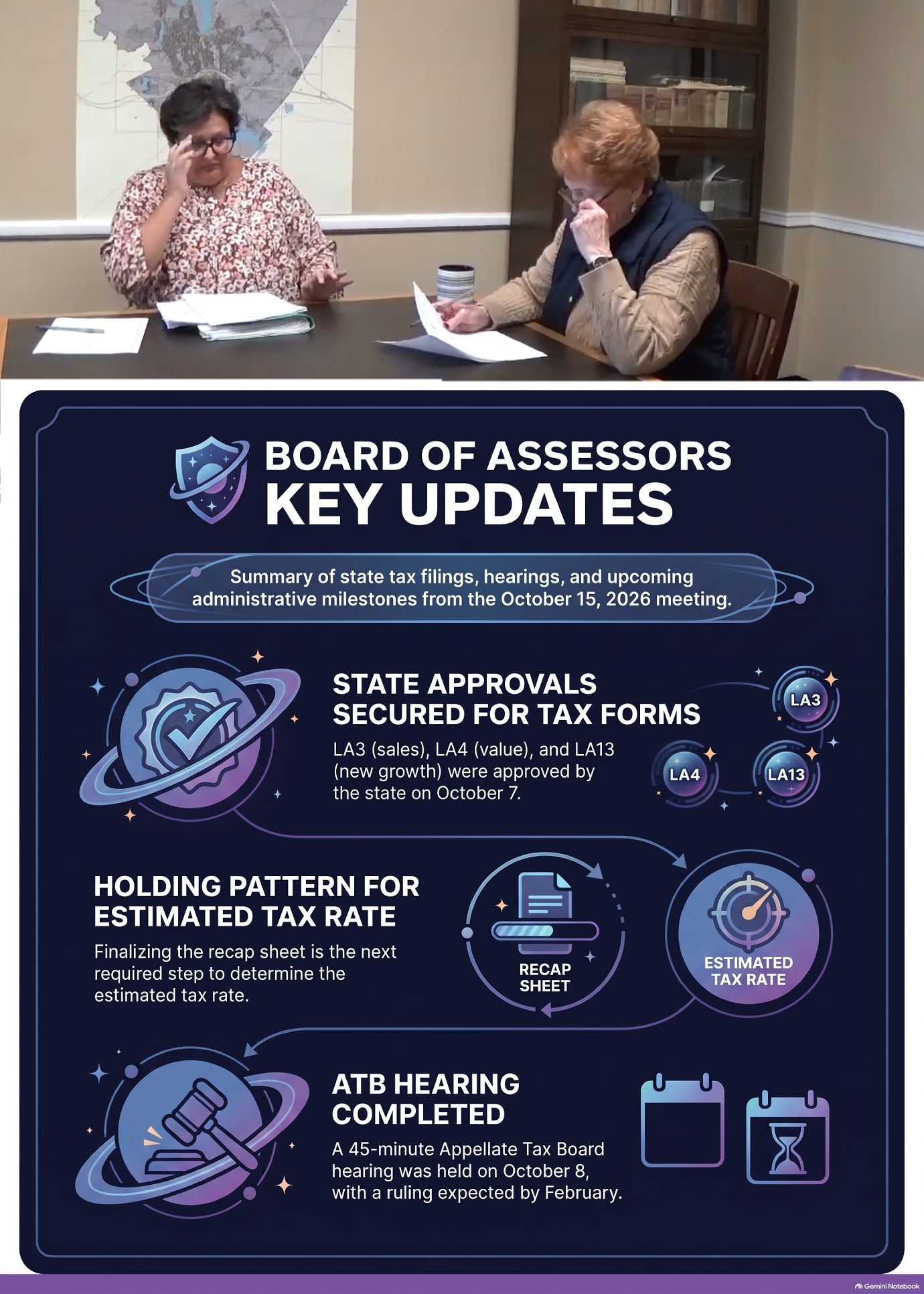
Inside the Board of Assessors: Lessons from this 3-Minute Meeting
On Thursday, October 15, 2026, at precisely 9:01 AM, Assessor Christine Kumar and Member Paulette Burns convened in an empty room. There were no packed public benches, no grand speeches, and no heated debates. , the Board of Assessors meeting wrapped up in just minutes. Yet behind this brief, unassuming gathering lies the unseen machinery of local government—the precise administrative mechanisms that establish community property tax rates and defend local assessments in state legal proceedings.
For municipal observers and local taxpayers, a close look at this micro-meeting reveals surprising lessons about local tax administration, legal procedural rigor, and the deliberate pacing of civic governance.
Major Pre-Tax Hurdles Are Cleared (Now Comes the “Holding Pattern”): Before a municipality can determine its local tax rate, it must satisfy a rigorous gauntlet of state-level reporting requirements. During the October 15 meeting, the board received an essential status update: three foundational filings had officially crossed the finish line on October 7, 2026. LA3 (Sales): The official compilation and reporting of local real estate sales data, establishing baseline market transactions. LA4 (Value): The comprehensive catalog of property valuations calculated across the entire community. LA13 (New Growth): The specific valuation figures attributed to new construction, physical developments, and parcel improvements.
Together, these three forms form the structural bedrock of municipal tax assessment. Until state authorities review and approve this triad, local assessors are legally constrained—the municipality literally cannot complete its official recap sheet or finalize the local tax rate. With all three forms signed, submitted, and approved by the state on October 7th, the assessment office successfully cleared its largest regulatory hurdles. However, clearing these hurdles does not lead to immediate public action; instead, it triggers a mandatory administrative “holding pattern.” The board must now wait while the final recap sheet is assembled to establish an estimated tax rate. For local taxpayers and municipal observers, this transition illustrates the inherent rhythm of assessment work: intense periods of data gathering and state submission followed by necessary, patient pauses while formal calculations align.
The 5-Minute Word Count in a 45-Minute Appeal: While setting the municipal tax rate requires navigating state approvals internally, defending those property valuations externally presents an entirely different administrative test.
During the meeting, the assessor briefed the board on an Appellate Tax Board (ATB) hearing held the previous week, on Thursday, October 8, 2026. The report offered a vivid look into modern municipal tax adjudication, highlighting both the hybrid format of present-day hearings and the multi-month lag built into municipal justice.
The hearing took place via Zoom, featuring a distinct technological split: the ATB commissioner and the clerk were visible on video, while the appealing property owner participated strictly via a telephone call. Despite the formal 45-minute block allotted for the hearing, the town’s active testimony was surprisingly brief. The assessor noted speaking for “all of about five minutes in total” while presenting the municipality’s case.
“I spoke for all of about five minutes in total. So I I think it went well. Uh, we should last year for the same. I believe we did not get the determination until February. So, it’ll it’ll be a while before we know, but I I think we’re in pretty good shape.”
- Ashburnham Incident 10-14-26

Incident in Ashburnham 10-14-26 – FULL REPORT
The Ashburnham Police Department issued 2 Press Releases, one from the Department, CLICK HERE, and a thank you from Chief Conrad, CLICK HERE.
Ashburnham Police Operation and Suspect Apprehension: On the morning of October 14, 2026, the Ashburnham Police Department, in coordination with multiple regional and state public safety partners, responded to a disturbance at the All Town Convenience Store in South Ashburnham. Upon police arrival, the suspect fled into a nearby wooded area, initiating an extensive multi-agency search operation utilizing advanced tracking assets, aerial drones, and state police aircraft.
The operation resulted in the successful apprehension of the suspect, identified as Jacob Comeau-Karlon, age 35, of Ashburnham. Criminal charges are being filed through the Gardner District Court. As a precautionary measure during search and extraction operations, three local schools briefly kept students and staff indoors. The Ashburnham Police Department confirmed that at no time was there a direct threat to any school campus.
Incident Overview and Timeline
- Date: October 14, 2026
- Initial Incident: Reported disturbance at the All Town Convenience Store in South Ashburnham.
- Initial Action: Upon the arrival of law enforcement, an individual fled the scene into a contiguous wooded area.
- Operation: A multi-agency search and tracking operation was immediately deployed to locate and extract the individual safely.
- Resolution: The individual was successfully apprehended in the woods, with extraction operations centered near the rear parking lot of Oakmont Regional High School.
Law Enforcement Response and Resource Deployment: The operation required rapid coordination among local municipal departments and state law enforcement agencies. Participating Agencies and Partners included Ashburnham Police Department (Lead agency), Westminster Police Department, Winchendon Police Department, Massachusetts State Police, Cushing Academy (Acknowledged public safety partner), and the Ashburnham-Westminster Regional School District
Deployed Specialized Assets included: K-9 Tracking Teams: Local Ashburnham and regional K-9 units.Unmanned Aerial Systems (UAS): Drones deployed for aerial search coverage. Massachusetts State Police Air Wing: Helicopters providing high-altitude tracking and search support.
School Campus Safety and Operational Impact: Out of an abundance of caution, specific public safety measures were implemented for nearby educational facilities while search operations were conducted in adjacent wooded areas: Safety Measures implemented included those at John R. Briggs Elementary School directed to remain inside building for a brief period, those at Oakmont Regional High School directed to remain inside building while the rear parking lot was use temporarily for staging and extraction, and those at Overlook Middle School were directed to remain inside building for a brief period. There was no direct threat to those inside the schools.
Official Statements and Contact Information: Police Chief Chris W. Conrad stated: “Their communication, coordination, and professionalism were critical to achieving a safe and successful resolution.” “This incident highlights the strength of regional partnerships and the rapid coordinated response capabilities of our local and state public safety agencies. We appreciate the cooperation and patience of the school district, students, staff, parents, and community members during today’s operation.”
Department Contact Information
- Department Address: Ashburnham Police Department, 99 Central Street, Ashburnham, MA 01430
- Main Telephone: (978) 827-4110
- Fax: (978) 827-5703
- Website: www.ashburnhampd.org
- Media Line: (978) 827-4413
- Designated Media Contacts: Chief Chris W. Conrad, Lt. John Boucher
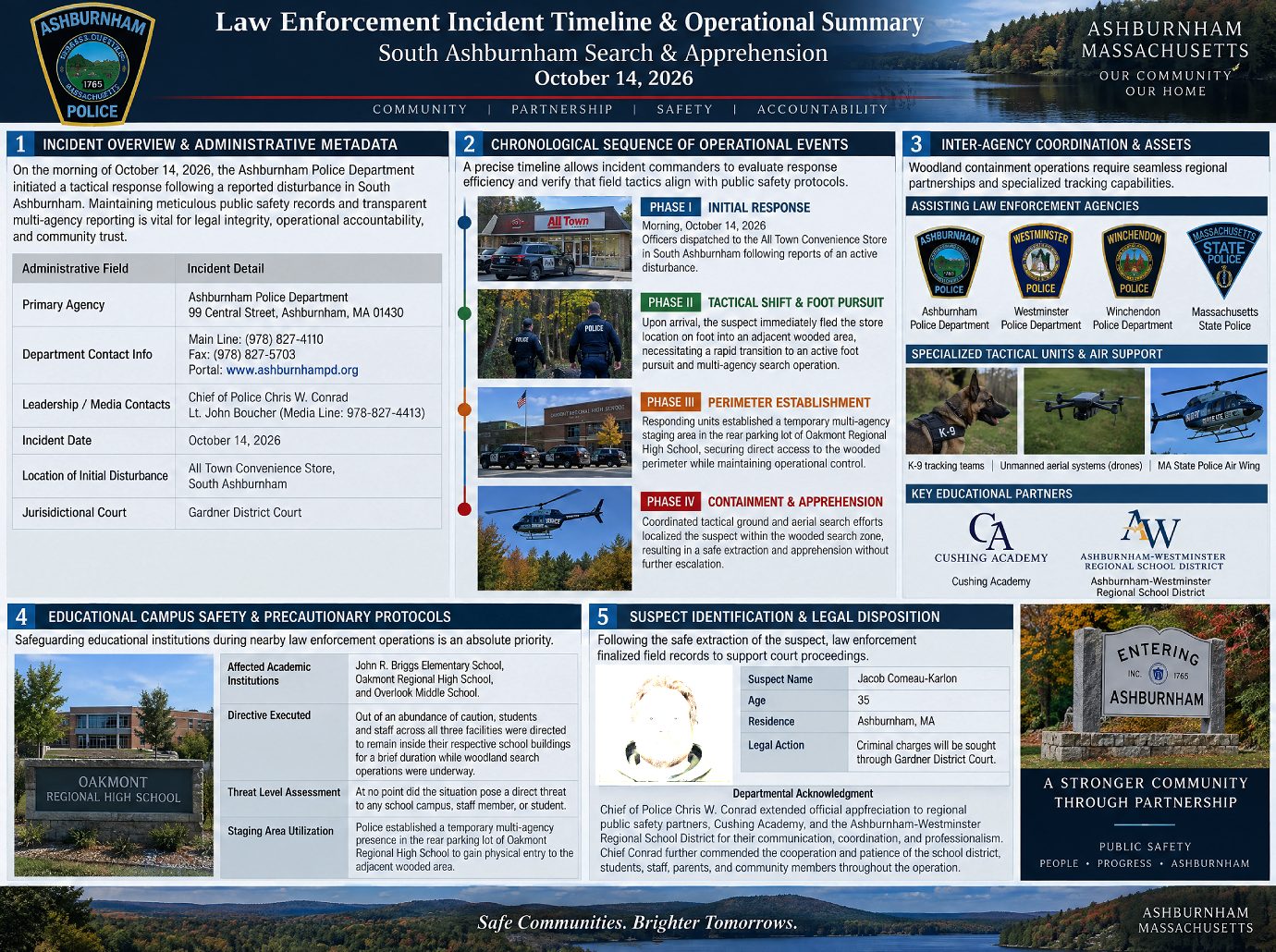
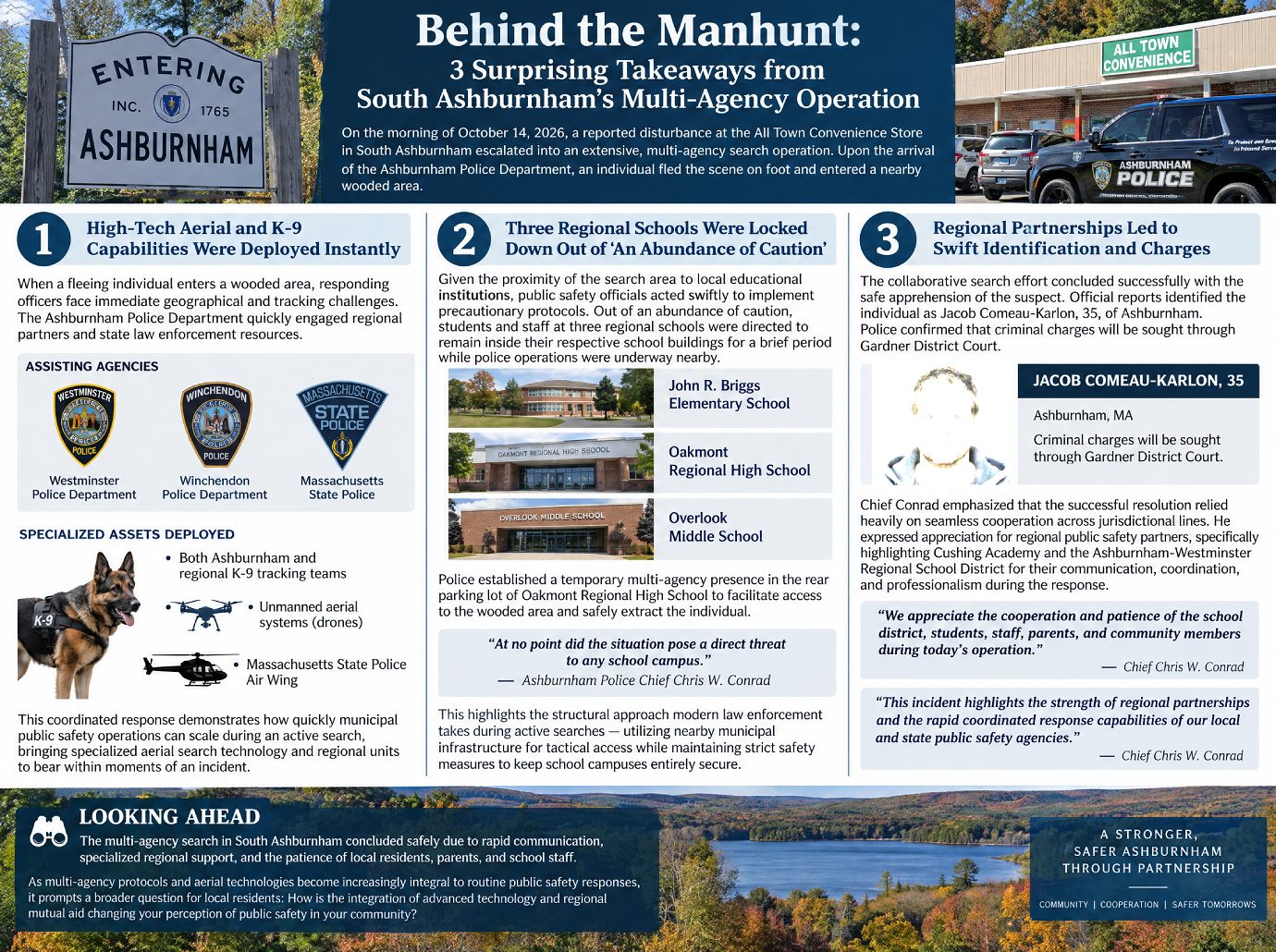
- School Committee 10-13-26
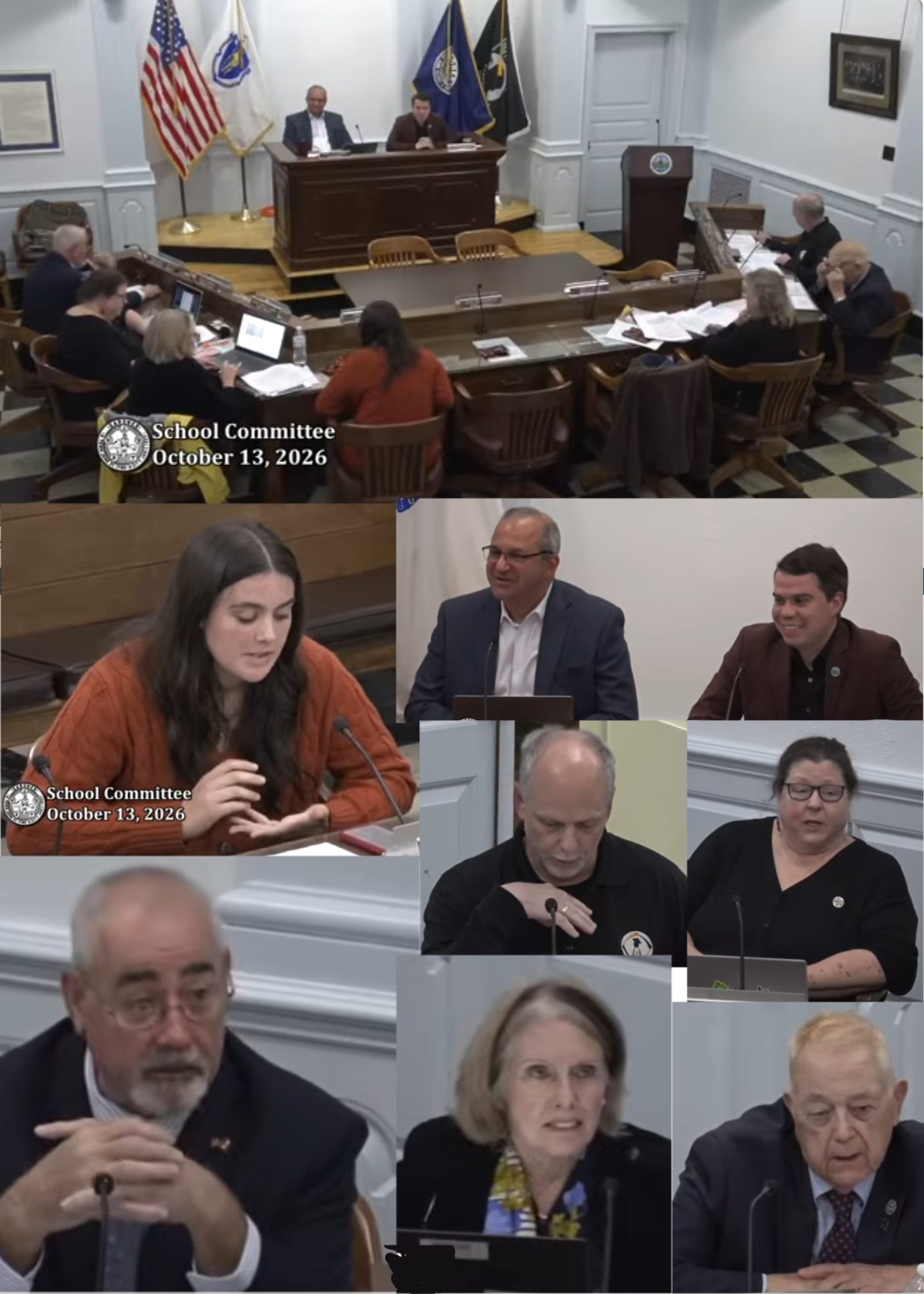
Consequential School Committee Meeting
Listen to the entire meeting on any device, CLICK PLAY.
School Committee 10-13-26 The October 15, 2026, regular meeting of the Gardner School Committee addressed major municipal governance disputes, capital facility updates, district administrative policy changes, and student achievements.
The central governance issue involved a proposed City Council ordinance concerning Section 40 of the City Charter. The ordinance seeks to establish strict oversight procedures for school capital projects and alterations. Superintendent Dr. Pellegrino and committee members discussed the balance of power between the School Committee’s exclusive budget authority under Massachusetts General Law and the City Council’s oversight.
School Committee Action: While the School Committee granted retroactive approval for the Gardner High School (GHS) C-Wing locker room project, it voted to grant additional time to review the broader Section 40 capital projects classification list following member requests for clarification.
Key administrative and financial disclosures included an operational update on relocating the School Department’s central offices from the second floor to the first floor of the Elm Street facility. The move yields an estimated annual operational savings of $12,000 to $15,000, achieving a full return on investment within 1.5 to 2 years. Additionally, the Committee approved the District Improvement Plan, the Superintendent’s Goals, and annual Student Activity Account authorizations, while initiating a first reading for a mandated civil law enforcement interaction policy (Protect Act).
Governance & Jurisdictional Debate: City Charter Section 40 vs. State Law: Overview of the Section 40 Controversy
The Finance Subcommittee and the full committee engaged in an extensive debate regarding a proposed City Council ordinance amending procedures under Section 40 of the City Charter. Under Massachusetts General Law, once the City Council appropriates a total budget sum to the school district, the School Committee maintains exclusive authority over how those funds are expended. Section 40 of the City Charter requires joint School Committee voting and Mayor approval specifically for: Purchasing land; Constructing new school buildings; and/or Executing “major alterations” of existing school facilities. Superintendent Dr. Pellegrino presented a legal and structural analysis highlighting ambiguity around the definition of an “alteration.”
Statutory Definitions & Legal Guidance
- MGL Chapter 143, Section 1 Definition: Defines an alteration as any change or addition to a building that reduces exit means, reduces fire resistance, or changes structural support, use, or occupancy. Under this definition, projects like the GHS C-Wing locker room expansion qualify under Section 40 due to moving walls and changing room occupancy.
- Concerns over City Council Overreach: Dr. Pellegrino expressed concern regarding “Item 5” of the City Council’s proposed procedure. This clause would mandate that the School Committee explicitly justify why any non-alteration capital project funded out of the school department’s general budget is not a Section 40 project. Dr. Pellegrino emphasized that requiring justifications for ordinary repairs funded within the school department’s existing budget oversteps City Council authority and infringes on the School Committee’s statutory purview.
- City Council President Communication: A September newsletter from City Council President George Tyros stated that the School Committee has “inconsistently” received updates and that requests for appropriations from the school department arrive at the “last possible hour.” Dr. Pellegrino refuted the characterization of an “out-of-control school department,” maintaining that the administration operates strictly within the parameters delegated by the School Committee.
Committee Debate & Perspectives
- Superintendent Dr. Pellegrino: Warned that without a clear, codified definition of “alteration,” the district faces a operational landmine where routine maintenance could be misconstrued as unapproved alterations.
- Mrs. Veronica Guay: Urged positive communication with the City Council, stating the intent of the ordinance is “fiscal soundness for the city of Gardner” rather than taking away School Committee power. She advocated for a comprehensive urban plan coordinating municipal and educational facilities.
- Mrs. Hurst: Questioned why the committee was re-examining the issue before the Council took a final vote, expressing that the committee should allow the process to play out without creating friction.
- Mr. Swartz: Recommended that the Facilities Committee be involved earlier in the development phase of concepts and projects to ensure cost transparency before bills arrive. He supported drafting a formal School Department legal interpretation of Section 40 requirements.
- Mr. Cormier & Mayor Nicholson: Affirmed support for the Superintendent’s administrative authority while noting that communications between the bodies ultimately flow through the Mayor and School Committee leadership.
Capital Improvement Projects & Facility Operations
The Finance Subcommittee report and district updates provided status reports on multiple capital and maintenance projects:
Project Location Description Estimated / Actual Cost Status / Financial Notes GHS C-Wing Locker room renovation & expansion $3.4 Million (originally estimated at $2M, then $3M) In demolition phase. Funded via unexpended bond funds. A $2,000 change order for floor leveling (tile removal) is under review by Tyng Bond. Retroactively approved under Item 3810. GHS Second Floor Bathroom reconstruction ~$100,000 (Plumbing quotes) + ~$50,000 (Stalls & fixtures) Two quotes received under $100k for plumbing. Committee directed administration to seek additional quotes before proceeding. Gardner Middle School Roof replacement project N/A Near substantial completion as of the week ending Sept 26, despite a multi-day delay caused by a Nor’easter. Gardner Middle School Sidewalk replacement $225,000 Form submitted for Capital Improvement Plan. Cost calculated via square footage estimates. Endorsed by subcommittee as ordinary maintenance. GMS Air Handlers Rooftop unit repairs ~$100,000 Active repair project funded through internal general/revolving funds. GHS Garage Addition Facility addition N/A Classified via committee amendment as a Section 40 project rather than ordinary maintenance. District Elevators Maintenance & refresh N/A History of unsatisfactory service from Otis Elevator Company (“Yotus”). Administration is actively pursuing service upgrades to maintain accessibility compliance. Elm Street Central Office Relocation Details: Dr. Pellegrino clarified the operational logic behind moving administrative offices from the second floor to the first floor at the Elm Street facility:
- Operational Rationale: Resolves severe public confusion regarding building entry points, corrects accessibility issues, and consolidates staff. The rear exterior ramp has been fully repaired, rendering the entire first floor accessible.
- Financial Return on Investment (ROI): Heating and cleaning the expansive second-floor hallways for only a few personnel created substantial waste. Moving downstairs reduces operational costs by $12,000 to $15,000 annually, achieving a full ROI within 1.5 to 2 years.
- Carpet Tile Expenditure: The district purchased 800 square yards of uniform carpet tiles for $16,500.
- 459 square yards (~$9,500) were utilized for the Elm Street central offices.
- The remaining tiles were allocated to Gardner Middle School for ongoing maintenance (following a $25,000 carpeting project at GMS the previous year).
- Cost Minimization: Central Office staff physically moved all personal items, whiteboards, and small equipment. Paid movers were retained strictly by the hour to move heavy desks, large conference tables, and fireproof filing cabinets.
Policy Actions & Administrative Approvals
Votes & Action Items: Item 3808 (District Improvement Plan): Adopted unanimously as presented. Item 3809 (Superintendent Goals): Adopted unanimously as presented. Item 3810 (CIP Request – GHS C-Wing Locker Rooms): Retroactive capital plan approval granted for ongoing renovations. Item 3811 (Capital Improvement Plan Projects List): Mrs. Guay requested additional time to review the unmerged, comprehensive Section 40 categorization list. Granted without objection. Item 3812 (Annual Student Activity Account Authorizations): Approved at recommended maximum balance levels under Policy JJA.
Policy Revisions (First Readings – Item 3807) —Policy BHE: Use of Electronic Messaging by School Committee Members (Amendment). Policy EH AAA: District Security Relating to Technology (Amendment). Policy EHB: Data and Records Retention (Amendment). Policy AC (New Adoption): Interacting with Law Enforcement Officers Engaged in Civil Enforcement. Context: Implements the state’s newly passed Protect Act, based on guidance from the Massachusetts Association of School Committees (MASC). Operational Protocol: Principals (or the Athletic Director on athletic fields) serve as immediate contacts if ICE/civil enforcement officers arrive. Staff must immediately contact the Central Office. Staff are prohibited from releasing student information without parental consent or obstructing officers. Central administration and legal counsel will verify whether incoming officers possess a valid judicial warrant versus an administrative warrant.
Special Education Parent Advisory Council (SEPAC / CPAC) Update: During review of the Special Education report (Item 3816), Ms. Hurst expressed concern that SEPAC/CPAC lacks active parent members and urged the administration not to advertise general events under the CPAC label until a formal parent membership is established. Recommendations to recruit members included leveraging the Gardner Disability Commission, placing notices in IEP meetings, and utilizing MASC/Federation training resources.
Student Advisory Board & District Recognition: Student Representative Elizabeth Pawlowski presented the GHS and Gardner Academy updates: Student Recognitions & Programs – GHS September Wildcat Winners: Serena Longton, James Ramos, Lucas Goodwin. Gardner Academy September Student of the Month: Tyler Doucette (recognized for core values: Community, Appreciation, Responsibility, Excellence). Montachusett Regional Vocational Technical School (Monte) MVP Partnership: 25 GHS students enrolled in vocational tracks covering Electrical, Carpentry, and Plumbing (newly added). Safety Assemblies: Conducted Sept 16 in partnership with Gardner Police, training students on “Run, Hide, Fight” protocols in preparation for upcoming district-wide safety drills. Athletic Highlights: Homecoming victories across field hockey, soccer, and football. GHS Field Hockey Coach Meg Lhuillier was named Telegram & Gazette Coach of the Year.
District-Wide Music Program Metrics: Mayor Michael Nicholson provided enrollment metrics highlighting the district’s music programs following the All-City Band Night on September 25 (which hosted over 200 performing students): Elementary School Band: ~195 participating students. Middle School Band: Just over 225 participating students. High School Band: 36 participating students (including 18 freshmen).
Executive Updates: Former School Building Dispositions: Mayor Nicholson submitted an official report detailing the finalized sales and market-rate housing conversion plans for decommissioned school properties: Statutory Proceeds Restriction: State law mandates that proceeds from the sale of municipal school properties are restricted to the city’s municipal property sale account. Funds may strictly be utilized to pay down city debt schedules or fund specific capital projects. Perry Auditorium Status: Final contractor walkthrough scheduled for Thursday; municipal cleaning scheduled for Friday. The auditorium reopens Saturday evening to host the Athletic Association Ball.
Public Comment – Werner Poegel praised Superintendent Dr. Pellegrino and the committee for raising district reading scores and expanding dual-enrollment college degree opportunities for high school students. Poegel also commended the superintendent for creating a new advance notification system for winter school closings that simultaneously alerts local media (WGAW, Gardner Magazine, Gardner News), the Gardner Senior Center, and local public safety agencies.
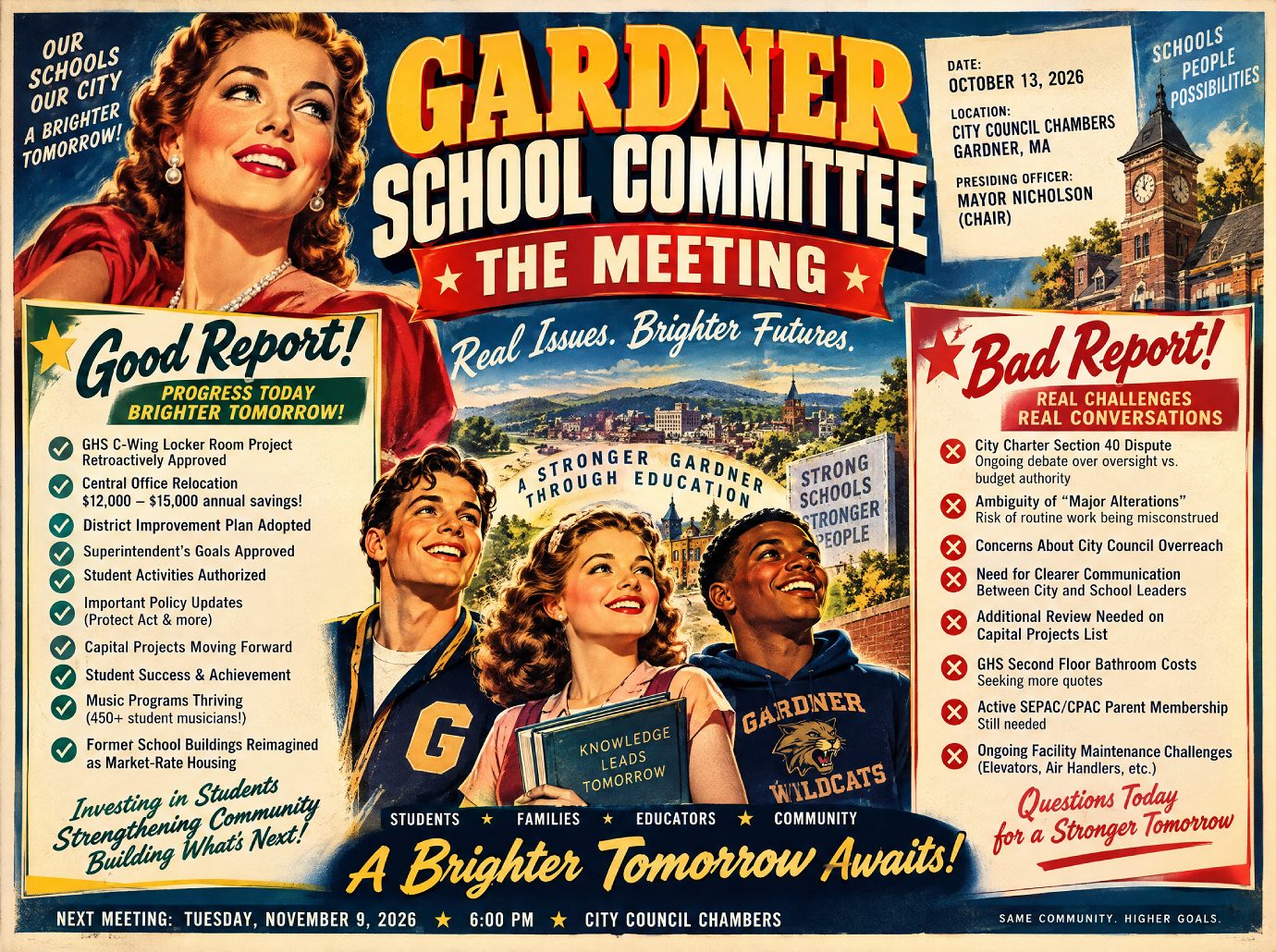
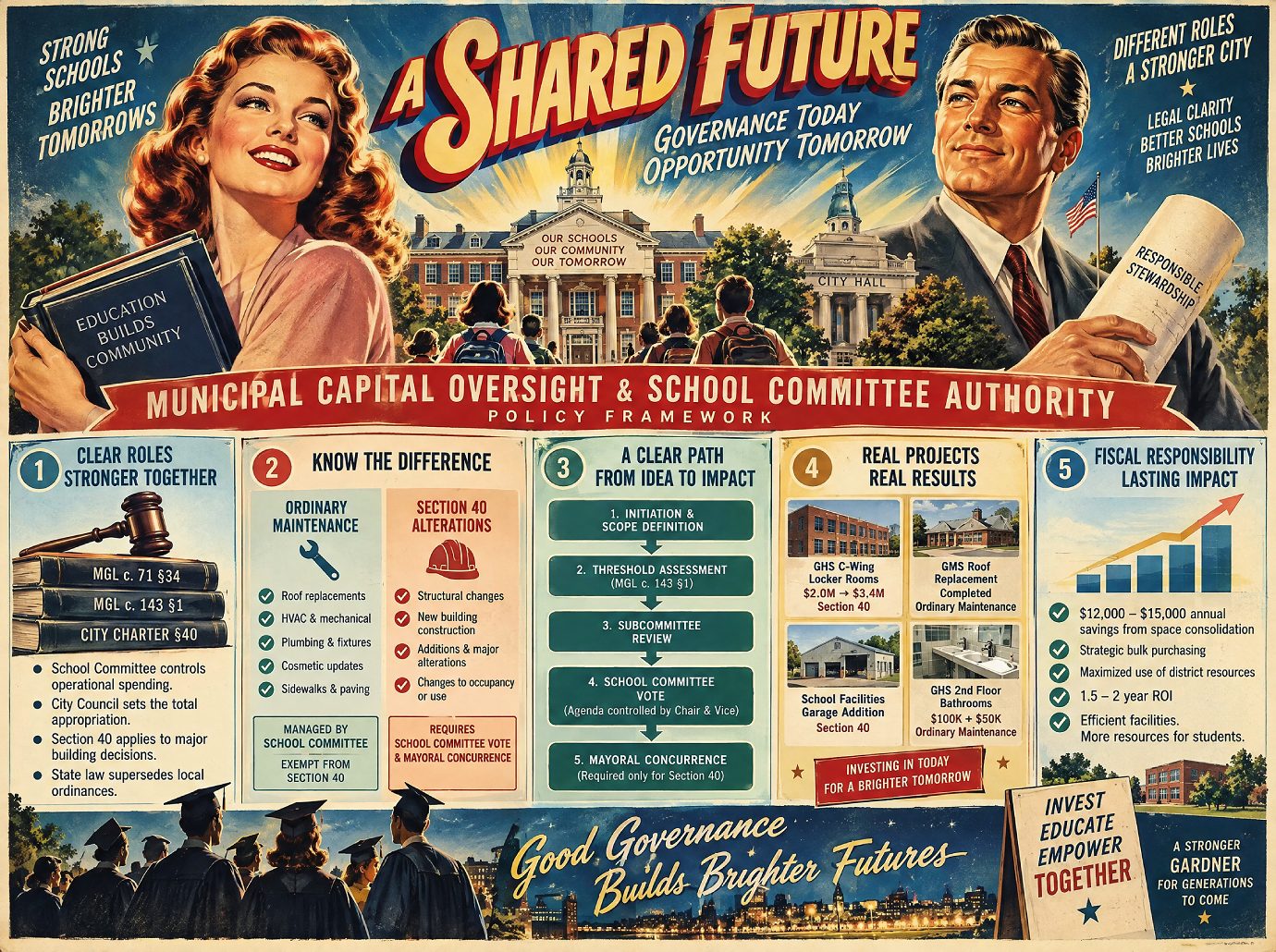

Gardner Magazine also has the following infographics for additional information on the subjects from this meeting. 1. A general overview of agenda topics. 2. Understanding local budgeting and municipal governance. 3. Policy Evaluation – Proposed Charter Amendment. 4. When Transparency Trigger Gridlock CLICK an IMAGE for a larger view.
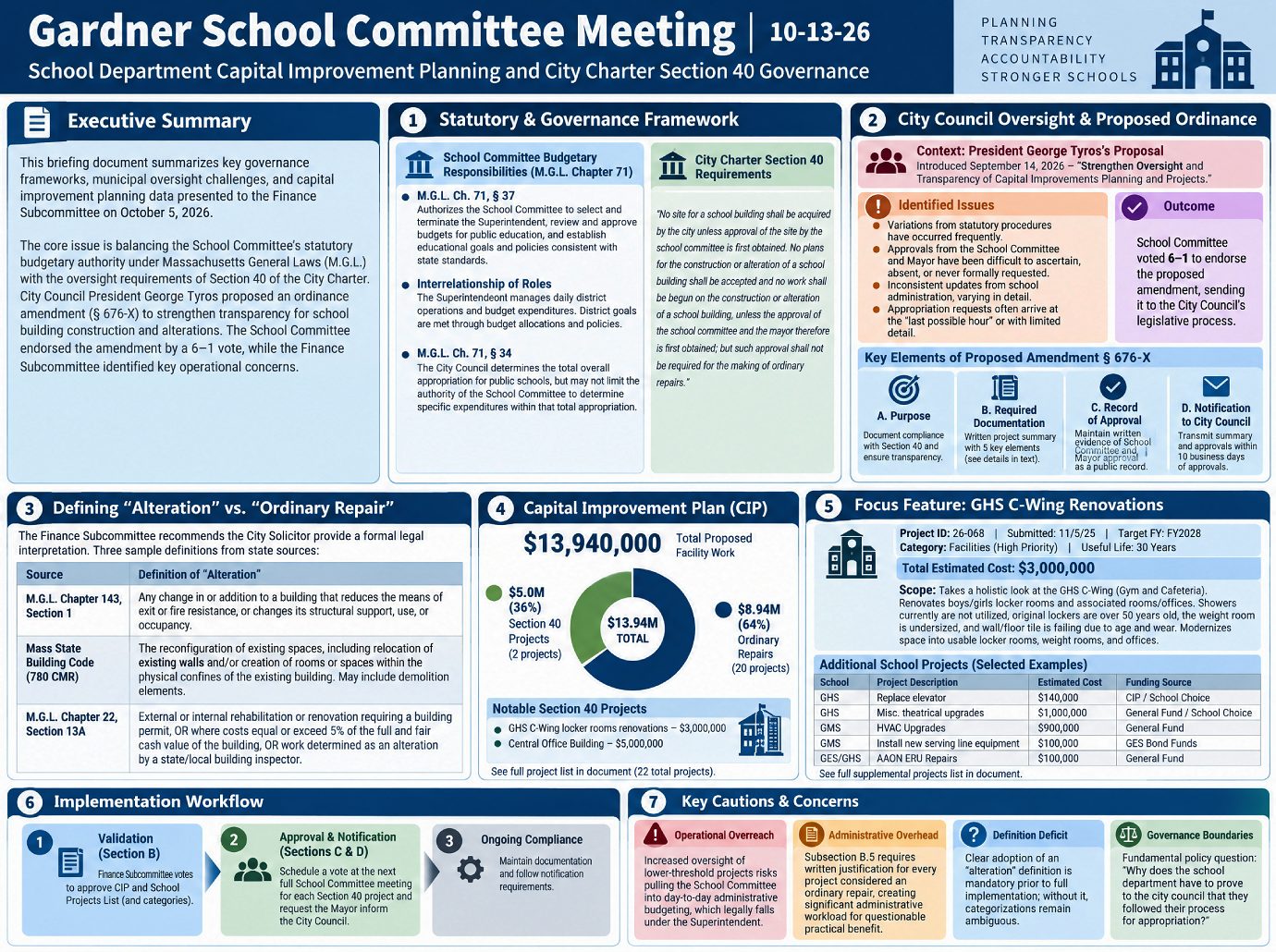
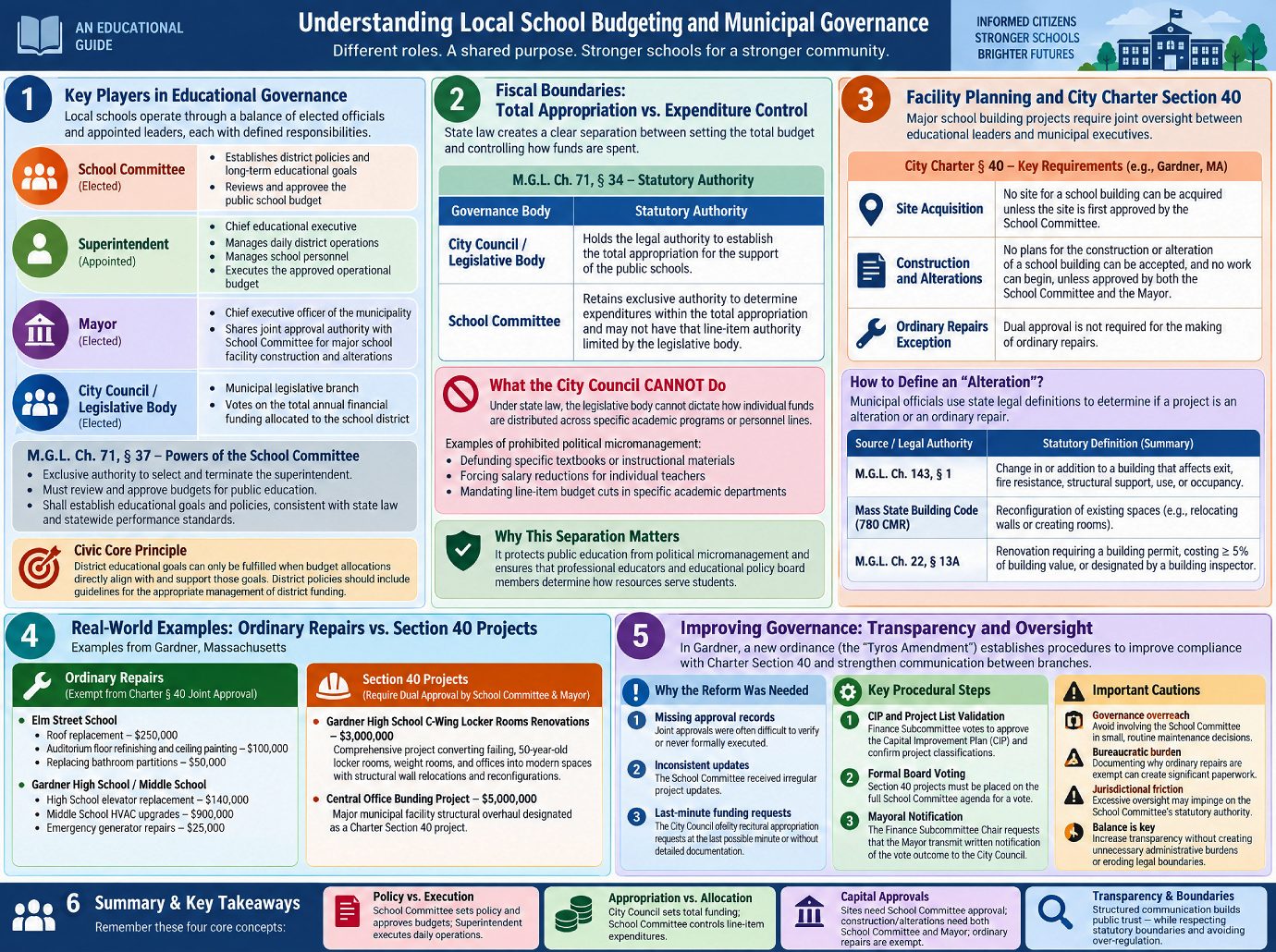
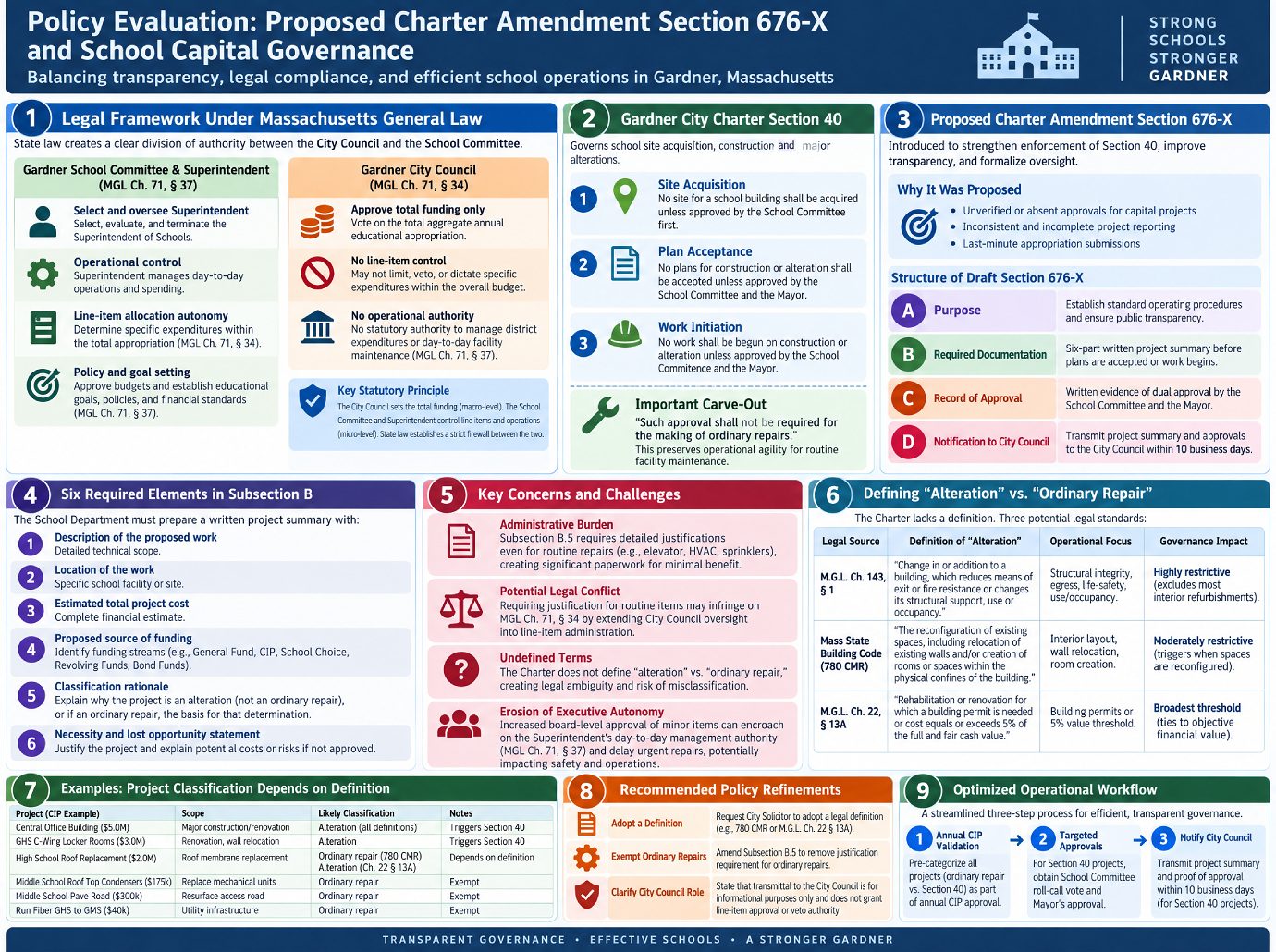
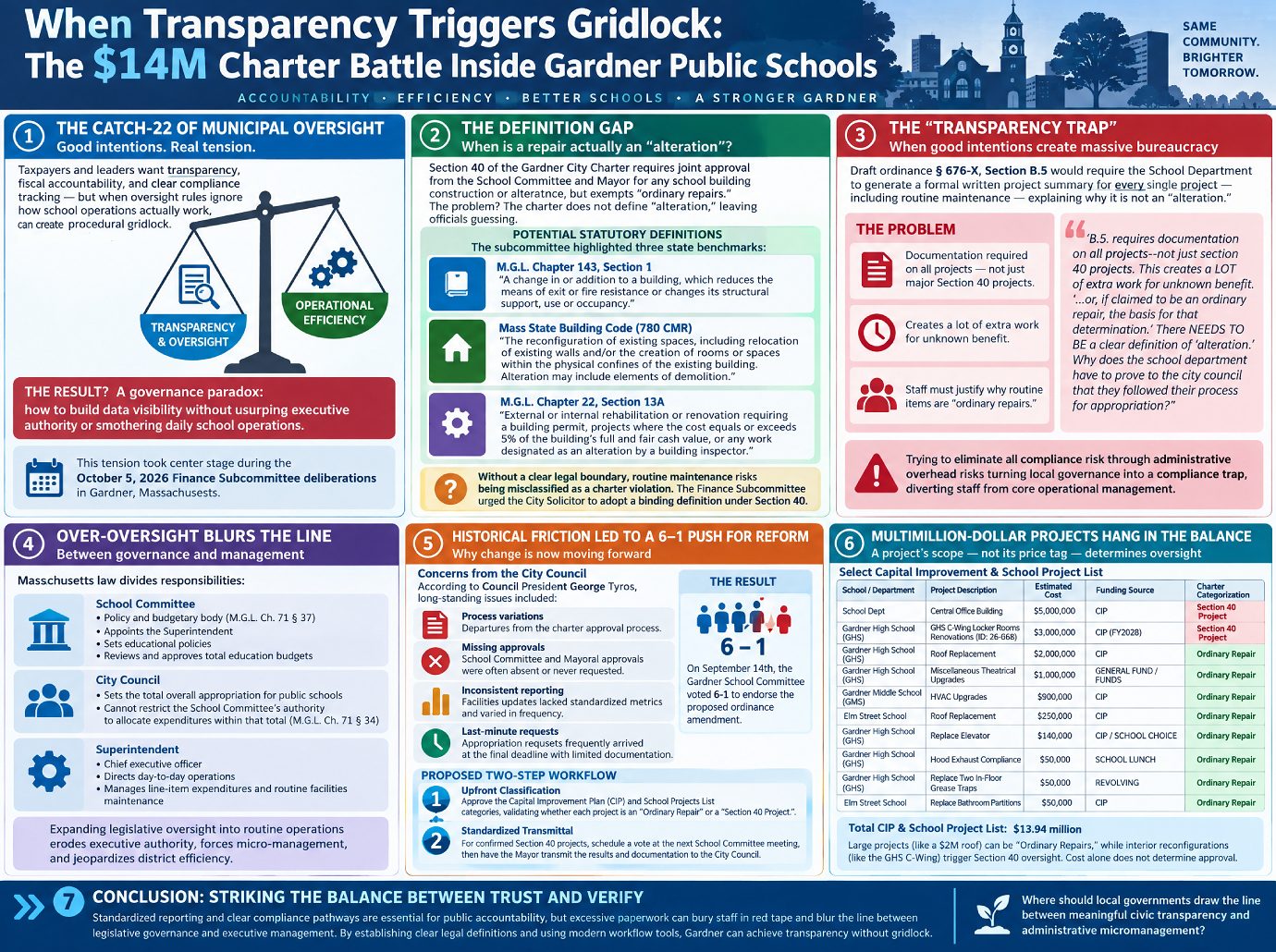
- Annunciation Fall Bazaar 2026

Popular Annunciation Parish Fall Bazaar is October 16 to October 18, 2026 in Gardner MA – FULL COVERAGE
Listen to this podcast about the event on any device, CLICK PLAY.
Annunciation Parish and Holy Family Academy – Annual Fall Bazaar 2026 Crafting the Perfect Fall Tradition: Highlights from the 2026 Annunciation Parish & Holy Family Academy Bazaar
Is there anything quite as enchanting as the crisp, golden days of autumn when a community comes together in warmth and celebration? As the New England foliage peaks, local gatherings offer far more than just a weekend outing—they create cherished traditions that bring neighbors together across generations.
This fall, the Annual Fall Bazaar, co-hosted by Annunciation Parish and Holy Family Academy, invites families and friends to gather, celebrate, and give back. Taking place from October 16–18, 2026, at Holy Rosary Hall (135 Nichols Street, Gardner, MA), this vibrant three-day festival blends delicious home-style dining, purposeful local shopping, and joyful entertainment for all ages.
Take the Daily Culinary Journey (Food That Tells a Story)
Nothing captures the cozy spirit of fall like warm, home-cooked comfort food. The Annual Fall Bazaar turns dining into an irresistible weekend-long journey by featuring a distinct, mouthwatering culinary theme every single day.
On Friday, October 16, the hall opens its doors from 10:00 AM to 4:00 PM with a hearty Full Menu packed with satisfying classic lunch and dinner options. On Saturday, October 17, from 10:00 AM to 3:00 PM, the kitchen celebrates Polish Food Day, filling the air with the aroma of savory, authentic dishes like steaming pierogies. The culinary weekend concludes on Sunday, October 18, from 10:00 AM to 3:00 PM with a grand Turkey Dinner served with all the classic trimmings.
Throughout all three days, visitors can also satisfy their sweet tooth with continuous everyday staples, including homemade favorites, delicious desserts, and freshly baked goods prepared by parish and school volunteers.
“From authentic Polish classics to a heartwarming Sunday turkey feast, every day at Holy Rosary Hall offers a brand-new reason to pull up a chair and share a meal with friends.”
Shop with Purpose — “Shop & Support” Marketplace
Beyond the wonderful aromas drifting from the kitchen, the hall transforms into a lively treasure hunt at the “Shop & Support” marketplace. Browsing the aisles provides a wonderful opportunity to discover unique gifts, seasonal decor, and handcrafted items while directly supporting the educational programs at Holy Family Academy and the ongoing mission of Annunciation Parish.
The marketplace offers a wide variety of themed booths and specialty displays:
- Raffles
- Gift Baskets
- Plants
- Jewelry
- Handmade Goods
- Knitting
- Attic Treasures
- Vendor Booths
Whether you are seeking cozy hand-knitted scarves, potted autumn greens, themed gift baskets, or hidden vintage gems in the Attic Treasures section, every single purchase helps invest back into local parish life and student education.
The Family Fun Zone is Designed for All Generations
A truly memorable community festival offers something delightful for every age group, from energetic young children to grandparents. The Annual Fall Bazaar achieves this with a dedicated entertainment space designed to keep kids smiling while parents browse the marketplace or enjoy a quiet meal.
The Family Fun Zone includes:
- Kids Zone
- Bounce House
- Games
By pairing adult-friendly shopping and dining with exciting, interactive children’s play areas, the event creates an inviting, stress-free environment for the entire family. Children can jump, play, and make memories, turning a simple community fundraiser into a beloved autumn family outing.
The Bazaar is a Model of Educational & Spiritual Partnership
At its core, the bazaar highlights a vibrant collaboration between two foundational community institutions. The event unites Annunciation Parish, guided by its spiritual commitment (“Fiat”), alongside Holy Family Academy, anchored by its tradition of academic and character development (“Wisdom, Grace & Strength”).
By bringing together parishioners, teachers, students, and local residents under one roof, the event showcases the incredible impact of shared community goals. This collective spirit shines through in the bazaar’s main banner banner call to action:
“SUPPORT OUR SCHOOL & PARISH!”
Event At-A-Glance
Category Details Event Name Annual Fall Bazaar (2026) Hosts Annunciation Parish & Holy Family Academy Location Holy Rosary Hall, 135 Nichols Street, Gardner, MA Friday Hours 10:00 AM – 4:00 PM (Full Menu) Saturday Hours 10:00 AM – 3:00 PM (Polish Food Day) Sunday Hours 10:00 AM – 3:00 PM (Turkey Dinner)
Looking Ahead: Strengthening Community Traditions
As autumn approaches, gatherings like the Annual Fall Bazaar remind us of the lasting value of local traditions. By combining heartwarming meals, purposeful local shopping, and joyful family activities, Annunciation Parish and Holy Family Academy offer a wonderful venue for neighbors to connect, celebrate, and support one another.

- Beacon Connect Begins

If you need assistance with the app, Beacon Connect support email is support@gobeacon.com or you can call GPS at (978) 632-1000, ext. 4570.
Gardner Public Schools Launches “Beacon Connect” on Tuesday, October 13th
Parents of Gardner Public School students will be able to stay connected to their child’s Gardner Public Schools bus route in real time, starting Tuesday, October 13th via an app on their smartphones. Here is the Gardner Public Schools Transportation page, CLICK HERE.
Here is the “Beacon Connect” Setup Guide on PDF, CLICK HERE. The School District advises to make sure to “Allow Notifications” for the most accurate information. There’s also a setup instruction video which we have embedded below.
- Drug Bust 10-12-26

Gardner Police Department Announces Columbus Day Drug Bust
The following is the Press Release from the Gardner Police Department: “This morning, 10/12/2026, members of Gardner PD and the North Worcester County Drug Task Force executed a search warrant at 242 Pine St #2 in Gardner. As a result of the investigation and the execution of the search warrant, Emmanuel Gray (26) was arrested and charged with: Possession with Intent to Distribute a Class B Substance (Cocaine)
Possession of a Large Capacity Firearm
Possession of a Firearm without an FID card
Possession of a Large Capacity Feeding Device
Possession of Ammunition without an FID card
An amount of cash (US currency) and other items associated with drug distribution were seized as well.“
- Winchendon Fall Festival 2026

Winchendon Fall Festival 2026 a Big Success – Date Planned for Next Year
The Winchendon Fall Festival was held on October 10, 2026 was a huge success. Hundreds of people attended the event which had many vendors.
Organizer Nicole Roberts has already posted next year’s date as October 9, 2027.
Nicole Roberts posted on behalf of the Winchendon Fall Festival: “ Thank you for another amazing Winchendon Fall Festival! What a great day! We couldn’t have asked for better weather, and I’m so thankful to everyone who came out and spent the day with us. Thank you to our community for showing up, supporting our local businesses, and making the festival what it is. And to all the local businesses, vendors, and organizations who took part, thank you for being there and helping make this event so special!
A huge thank-you to our Police, Fire, and DPW departments. I truly couldn’t do this without you, and I appreciate all the time and help you put into making this day happen! Thank you to RanDom Band for putting together such a great lineup and helping make this year’s Winchendon Fall Festival so much fun! We appreciate you being part of it and helping make the day such a success!
A special thank-you to the Robinson Broadhurst Foundation for funding this event year after year. Because of your continued support, we’re able to offer free activities for the kiddos, and that means so much!
I’m so grateful to everyone who helps make this festival happen. It takes a lot of people working together, and I appreciate every one of you!”
- Weekly News Briefing 10-11-26
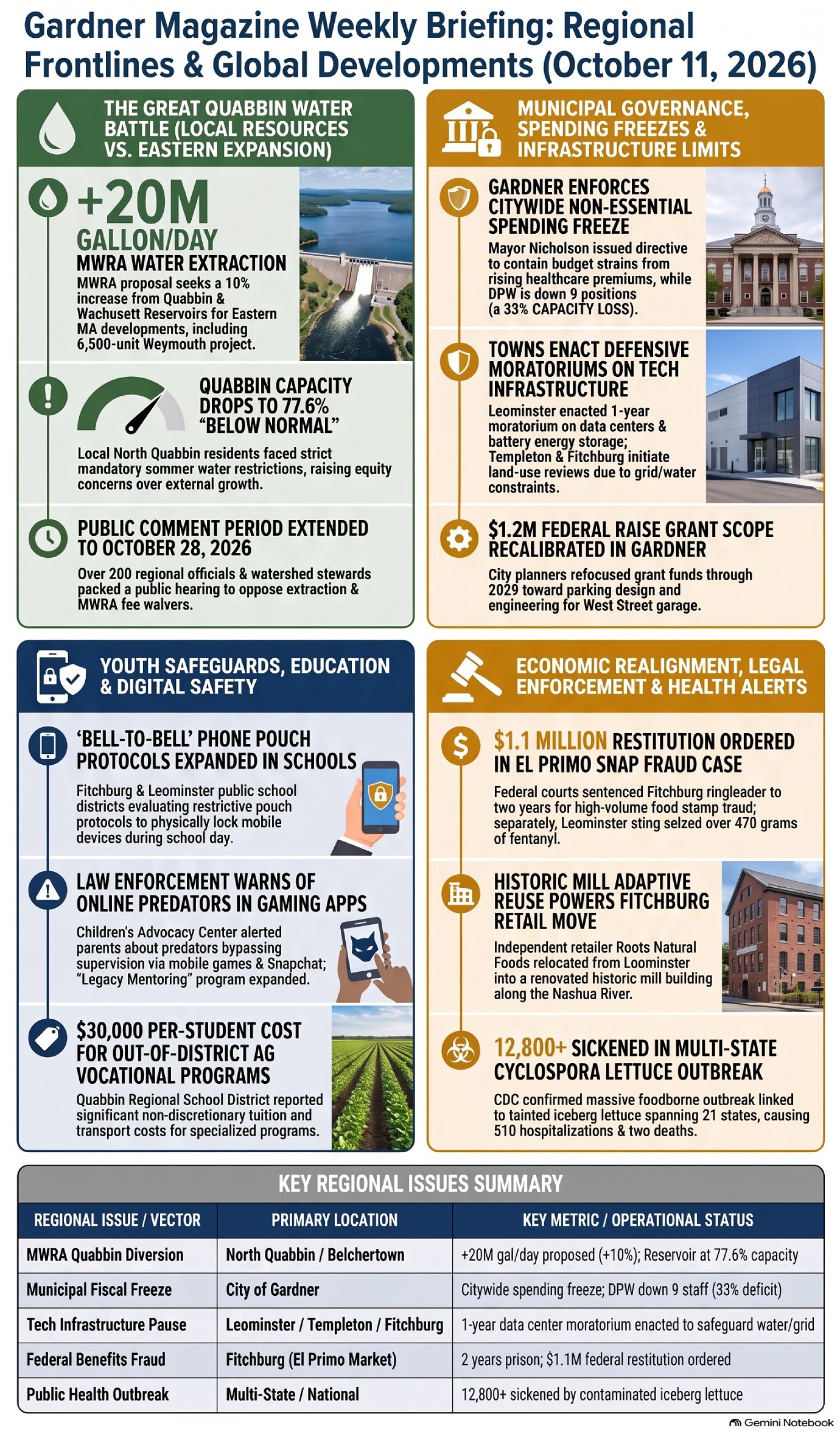
Want even more detail? We have individual comprehensive Weekly News Briefings on North Central MA, Massachusetts, National News and World News. Each has a separate podcast, narrative, and infographics for your perusal.
Gardner Magazine Weekly News Briefing for the Week of October 11, 2026
Listen to the Weekly News Briefing on any device, CLICK PLAY.
Weekly News Briefing 10-11-26 Bonus Podcast This Week – A Debate including Quabbin Water. CLICK PLAY.
DEBATE – Battle for North Quabbin Water As of October 11, 2026, the international, national, state, and regional landscapes are defined by an interconnected series of natural resource disputes, fiscal constraints, geopolitical conflicts, public health management actions, and domestic policy shifts.
At the regional focus area—North Central Massachusetts, Greater Gardner, and the North Quabbin Region—the central policy conflict concerns the Massachusetts Water Resources Authority (MWRA) Quabbin and Wachusett Reservoir Diversion Proposal. The plan to draw an additional 20 million gallons of water daily for Eastern Massachusetts development has drawn intense opposition from local officials, environmental stewards, and watershed communities that are currently managing localized drought conditions and municipal water restrictions. Concurrently, regional administrations are navigating severe financial pressures. Municipalities such as Gardner are enforcing strict spending freezes due to non-discretionary cost spikes, while cities and towns including Leominster, Fitchburg, and Templeton are instituting land-use moratoria on high-consumption infrastructure like data centers and battery energy storage facilities. Public safety across the region is defined by significant federal law enforcement operations targeting fentanyl distribution networks and SNAP benefit fraud, alongside municipal public safety labor friction and emergency response deficits.
At the State Level in Massachusetts, political attention is focused on the November 3, 2026 midterm elections, featuring high-profile debates in the gubernatorial and U.S. Senate races, alongside a record nine statewide ballot initiatives—most notably Question 1 concerning public records transparency for executive and legislative offices. Governor Maura Healey has declared a State of Energy Emergency to address heating oil costs affecting over 200,000 households, while federal and state law enforcement agencies have executed sweeping regional operations netting nearly 200 arrests.
At the U.S. National Level, domestic politics are heightened ahead of the midterms. The administration faces intense bipartisan scrutiny over regulatory crackdowns on technology sector immigration (including freezing Microsoft’s PERM green card program and imposing $100,000 fees on new H-1B visas) and controversial criminal justice proposals. The nation is also navigating high national diesel fuel costs, major corporate consolidation—such as Paramount Skydance’s $111 billion acquisition of Warner Bros. Discovery—and severe weather disruptions caused by Hurricane Isaias and public health outbreaks.
At the Global Level, escalation in the Middle East involving the U.S., Israel, Iran, and Houthi forces has severely impacted maritime commercial routes through the Strait of Hormuz. Projectile attacks and naval mines have reduced global fertilizer production capacity by nearly 40%, threatening an international food crisis. Concurrently, heavy Russian missile bombardments across Ukraine coincide with a controversial U.S.-Russia agreement to temporarily import Russian diesel, while international health authorities monitor a fatal pneumonic plague incident linked to a laboratory breach in Siberia.
Region / Scope Primary Event / Catalyst Key Metrics, Direct Impacts, & Status Primary Entities & Stakeholders Involved North Central MA / North Quabbin MWRA Quabbin & Wachusett Water Diversion Proposal +20M gal/day proposed diversion; Quabbin at 77.6% capacity; public comment extended to Oct 28, 2026 MWRA, Water Resources Commission, Municipalities of Athol, Orange, New Salem, Belchertown Greater Gardner / Regional Municipalities Municipal Spending Freezes & Tech Infrastructure Moratoria Gardner DPW down 9 positions (33%); Leominster 1-year data center moratorium; Item 1184 council oversight City of Gardner, City of Leominster, City of Fitchburg, Town of Templeton Regional Public Safety & Enforcement Federal Drug & Fraud Indictments >470g fentanyl seized in Leominster; $1.1M SNAP fraud restitution (El Primo Market); Fitchburg Fire Union No-Confidence vote U.S. District Court, FBI, Homeland Security Task Force, Local Police & Fire Unions State of Massachusetts State Energy Emergency & November Ballot Referendums State of Emergency declared for 206k households; 9 statewide ballot questions (Question 1 transparency focus) Governor Maura Healey, Mike Minogue, Senator Ed Markey, John Deaton, MA Legislature U.S. National Tech Visa Crackdowns & Midterm Election Offensives Microsoft PERM program suspended; $100k H-1B petition fee; S&P 500 record high; $111B Skydance takeover U.S. Dept of Labor, Microsoft, Paramount Skydance, Warner Bros. Discovery, White House Middle East / Global Energy Airport Projectile Attacks & Strait of Hormuz Naval Mining 3 to 12 dead / 36 to 309 wounded in airport strikes; fertilizer capacity down ~40%; projected grain prices +80% U.S. Military, IRGC, Houthi Rebels, Saudi Arabia, ICC, UKMTO Eastern Europe Russian Aerial Assaults & U.S.-Russia Energy Agreement 78 civilian deaths in 48 hrs; U.S. importing 300k–1M metric tons of Russian diesel Russia, Ukraine, U.S. Executive Branch, United Kingdom Public Health & Environment Siberian Bio-Lab Incident & Extreme Weather Events Pneumonic plague lab fatality in Siberia; Cat 2 Hurricane Isaias (9-ft surge); 12,800+ Cyclospora cases WHO, U.S. CDC, Russian Health Authorities, FEMA
Regional Examination: North Central Massachusetts, Greater Gardner, and North Quabbin
Water Resources, Environmental Governance, and Infrastructure
MWRA Quabbin Reservoir Diversion Controversy
A central environmental and regulatory conflict in the region is the proposal by the Massachusetts Water Resources Authority (MWRA) to expand daily water extractions from the Quabbin and Wachusett Reservoir systems by 20 million gallons per day. This represents a 10% increase in regional water transfers aimed at supporting urban expansion in Eastern Massachusetts, including a proposed 6,500-unit residential development at the former Weymouth naval base.
- Public Mobilization & Administrative Extension: Over 200 local officials, watershed stewards, and residents from Athol, Orange, New Salem, Belchertown, and surrounding communities attended a four-hour public hearing convened by the Water Resources Commission in Belchertown. Following sharp pushback, state regulators extended the public comment deadline from October 7 to October 28, 2026.
- Hydrological Deficits & Resource Inequity: Regional representatives emphasized that the Quabbin Reservoir is currently operating at 77.6% capacity, categorizing it as “below normal” on the MWRA drought index. Local leaders highlighted the policy contradiction of requiring North Quabbin residents to adhere to strict mandatory summer water conservation protocols while state authorities plan extractions to supply commercial growth elsewhere.
- Entrance Fee Waivers Contested: Regional stakeholders criticized the MWRA’s policy of waiving its standard $5 million entrance fee for new member municipalities through 2027, arguing that the financial incentive encourages Eastern communities to draw water from Western and Central Massachusetts reservoirs rather than investing in local conservation.
[Local Mandatory Summer Water Restrictions]
       │
       ├──> Quabbin Reservoir Capacity: 77.6% ("Below Normal")
       ├──> MWRA Proposed Daily Extraction: +20 Million Gallons (+10%)
       └──> Extended State Public Comment Deadline: October 28, 2026
Regional Environmental and Infrastructure Upgrades
- Drought Protocols & Water Treatment: Following below-average late-summer precipitation, Central and North Central Massachusetts municipalities continue to manage local water restrictions. To maintain drinking water compliance during line maintenance, the City of Gardner implemented temporary chlorine treatment protocols across its municipal distribution network.
- Wastewater & Storage Infrastructure: The Gardner Finance Committee reviewed borrowing frameworks and State Revolving Fund financing for major capital overhauls at the city’s wastewater treatment facility. Concurrently, funds were authorized to execute the decommissioning and removal of aged underground fuel storage tanks on municipal property.
- Watershed Conservation: The Town of Belchertown secured a $425,000 state LAND grant to acquire the Metacomet Hills Conservation Area, permanently protecting 48 acres of continuous forest land directly connected to the Quabbin Watershed Reservation.
- Biomonitoring: Environmental researchers and regional partners initiated biological sampling along Athol’s Mill Brook watershed to monitor baseline water quality and ecological health.
Municipal Governance, Fiscal Management, and Land Use
Municipal Budget Adjustments and Staffing Deficits
- Gardner Non-Essential Spending Freeze: Citing sudden spikes in municipal health insurance premiums and early-fiscal-year budget constraints, Gardner Mayor Michael Nicholson issued an executive order enforcing a strict freeze on non-essential municipal spending.
- DPW Workforce Shortages: The Gardner Department of Public Works (DPW) is operating under a 33% personnel reduction (losing nine full-time positions), compounded by high early-season fleet repair expenditures.
- Governance Reform (Item 1184): The Gardner City Council advanced Item 1184, an administrative reform measure intended to enhance municipal oversight, regulatory compliance, and fiscal transparency.
- Administrative Realignments:
- The Gardner Council on Aging amended its operational bylaws to conform with the revised City Charter, eliminating associate member seats and shifting its annual meeting mandate from May to January.
- Mayor Nicholson appointed Peter Kettle to the Gardner Airport Commission for a term extending through July 2029.
- Municipal finance leaders established tracking mechanisms for reimbursement plans to replenish the Salt Shed Stabilization Account following emergency capital outlays.
High-Consumption Tech Infrastructure Moratoria
- Leominster One-Year Moratorium: Municipal leadership in Leominster enacted a mandatory one-year moratorium on all proposed data centers and commercial battery energy storage sites, citing risks to local water supplies and heavy loads on the local electrical grid.
- Fitchburg & Templeton Regulatory Reviews: Fitchburg municipal officials initiated a formal land-use zoning review targeted at high-consumption technology facilities. Templeton included an article on its Fall Town Meeting Warrant at Narragansett Regional Middle School to extend its existing moratorium on data center construction.
Capital Improvement and Facilities Projects
- RAISE Grant Rescoping: City planners recalibrated the scope of a $1.2 million federal RAISE grant in Gardner, reallocating resources through 2029 toward engineering and parking design for the West Street garage.
- Waterford Community Center: Gardner received five Owner’s Project Manager (OPM) qualification bids to supervise asbestos abatement in the senior center wing of the Waterford Community Center. Final utility permitting with National Grid is underway for a full roof replacement and commercial solar array.
- Paving and Accessibility Infrastructure:
- Athol Main Street: MassDOT and the Town of Athol announced resurfacing along Main Street from Raymond Place to Athol High School, funded via the Municipal Pavement Program.
- Fish Park Playground: Athol dedicated a $249,000 ADA-compliant playground at Fish Park, featuring rubberized safety surfacing and American-made “Miracle Recreation” equipment installed by Site Specifics.
- Barre Road Modernization: Barre utilized a $500,000 MassDOT grant to perform full-depth reclamation, stabilization, and repaving on Town Farm Road and Williamsville Road.
Public Safety, Law Enforcement, and Judicial Proceedings
Federal Indictments and Task Force Enforcement
- Leominster Undercover Fentanyl Bust: Federal prosecutors charged two Leominster residents and one Worcester resident following an undercover law enforcement operation outside a Leominster residence, seizing over 470 grams of fentanyl and 60 grams of cocaine.
- Fitchburg Federal CSAM Conviction: A Fitchburg resident entered a guilty plea in U.S. District Court in Worcester to federal charges concerning child sexual abuse material (CSAM).
- El Primo Market SNAP Fraud Sentencing: U.S. District Court Judge sentenced Raul Fernandez Vicioso of Fitchburg to two years in federal prison and ordered over $1.1 million in restitution for operating a widespread Supplemental Nutrition Assistance Program (SNAP) fraud network out of El Primo Market.
- Multi-Jurisdictional Task Force Operations: A Homeland Security Task Force operation involving police departments in Leominster, Fitchburg, Gardner, and Clinton resulted in federal indictments charging multiple individuals with illegal firearms violations and narcotics distribution conspiracy.
Local Investigations and Emergency Services
- Park Street Animal Cruelty Case: Gardner Police and Animal Control opened a criminal investigation after discovering multiple deceased animals and one severely neglected surviving animal inside an abandoned residential property on Park Street.
- Winchendon Self-Storage Burglaries: Winchendon Police arrested two individuals connected to a series of forced break-ins and burglaries at the Winchendon Self Storage facility on Gardner Road.
- Public Safety Labor and Staffing Strains:
- Fitchburg Fire Union: The Fitchburg Permanent Fire Fighters Association Local 3128 conducted a formal vote of no confidence against the city’s fire chief.
- Templeton Fire Vacancies: Templeton town administrators reported operational coverage challenges resulting from three active personnel vacancies and additional pending resignations in the fire department.
- Homeless Encampment Bylaw Proposal: Orange Police Chief James Sullivan requested authorization from the Selectboard to draft municipal bylaws regulating homeless encampments on town-owned land and public parks.
Economic Development, Commercial Real Estate, and Housing
Commercial Footprint Shifts
- Roots Natural Foods Relocation: Independent retailer Roots Natural Foods completed its commercial move from Leominster to a larger, renovated historic mill complex along the Nashua River in Fitchburg.
- 1-2-3 Grow Child Center Construction: Rebuilding efforts advanced on West Street in Gardner for the new 1-2-3 Grow Child Center facility, replacing the structure destroyed in a prior fire.
- Waterford Center Co-Location: Non-profit agricultural agency Growing Places established its regional headquarters inside two former classrooms at the Waterford Community Center in Gardner. The facility is also building out a commercial kitchen, expanded studio facilities for Gardner Educational Television (GETV), and designated office space for the Gardner Disability Commission.
- Cannabis Retail Expansion: The Gardner Planning Board approved special permit modifications allowing on-site adult-use retail operations at the existing HeadyCo cultivation facility.
- LaunchSpace Commercial Kitchen: Orange-based makerspace LaunchSpace continued onboarding local food entrepreneurs as it prepares to open its shared commercial kitchen at the former Pleasant Street School in Athol.
Roots Natural Foods  ──> Relocated from Leominster to Historic Mill (Fitchburg)
HeadyCo Cultivation  ──> Planning Board Approval for On-Site Retail (Gardner)
Growing Places HQ    ──> Established Regional Office at Waterford Center (Gardner)
LaunchSpace Kitchen  ──> Shared Kitchen Deployment at Pleasant St School (Athol)
Housing Policy and State Capital
- Single-Family Zoning Reform Debates: Town selectboards across Greater Gardner analyzed state-level legislative proposals designed to relax multi-family zoning restrictions to address regional housing supply shortages.
- State Infrastructure Grants: The Executive Office of Housing and Livable Communities announced a $2.3 million grant allocated to support municipal infrastructure for housing projects in Orange.
Education, Youth Protection, and Regional Health
Academic Protocols and Financial Dynamics
- Mobile Device Restrictions: Public school districts in Fitchburg and Leominster continued evaluating newly deployed “bell-to-bell” pouch protocols designed to physically enclose student cell phones during instruction.
- Quabbin Regional Financial Strain: The Quabbin Regional School District reported that 60 students opted to “school choice” into the district this academic year. However, the School Committee noted that students enrolling out-of-district in specialized Vocational Agricultural programs cost the district $30,000 per student in tuition, plus mandatory state-required transportation expenses.
- Vocational Apprenticeships: Montachusett Regional Vocational Technical School (Monty Tech) expanded student apprenticeship programs with local advanced manufacturing firms.
Youth Protection and Public Wellness
- Digital Exploitation Warnings: At an annual seminar hosted at Greenfield Community College, the Children’s Advocacy Center (CAC) of Franklin County and North Quabbin warned that online predators are increasingly targeting local youth through gaming applications and Snapchat. The CAC highlighted the growth of its survivor-led Legacy Mentoring Program.
- West Nile Virus Detection: The Gardner Health Department and state health officials confirmed the region’s first positive West Nile virus (WNV) mosquito sample of the late season; overall public risk is categorized as low.
- Healthcare Restructuring:
- Heywood Hospital: The Gardner healthcare facility continues operational stabilization following its emergence from Chapter 11 bankruptcy restructuring.
- CHD Primary Care: The Center for Human Development introduced integrated primary medical care at its Orange facility alongside existing behavioral health services.
- UMass Memorial Layoffs: Regional healthcare staff were impacted by workforce reductions across the UMass Memorial system.
Regional Culture, Community Events, and Local Memorials
- Phillipston Giant Pumpkin Contest: Phillipston hosted its annual Autumn Fair and Giant Pumpkin Weigh-Off on October 11 on the Town Common.
- Quabbin Days Festival: Spanning October 9–12 across 12 towns, the second annual Quabbin Days festival promoted regional business and historical tourism.
- Gardner Oktoberfest & Civic Events: Downtown Gardner hosted concerts and vendor contests for the 21st Annual Oktoberfest, though weather logistics forced the postponement of the street chair luge. The Chamber of Commerce finalized plans for the annual Downtown Halloween Stroll.
- Athol Scary Story Writing Contest: The Athol Public Library opened submissions for its seasonal Scary Story Writing Contest across three age brackets, setting a deadline of midnight on October 25.
- Athletic Rivalries: In regional high school football, the Mahar Regional Senators ended a multi-year loss streak against the Athol Bears, securing a 21–12 victory.
- Notable Regional Obituaries:
- Judith “Judy” Rathburn (83): Longtime resident of Orange and Petersham, passed away October 6, 2026.
- Dr. Danielle Girard: Athol native, graduate of Narragansett Regional High School (2010) and Mount Wachusett Community College, passed away in Lancaster, England.
Strategic Operational Review & Recommendations for Municipal Governance
Analysis of Municipal Fiscal Pressures: Local governments across North Central Massachusetts are facing a challenging operating environment where revenue caps collide with non-discretionary cost spikes. Municipal administrations must balance rising fixed costs—such as health insurance and specialized tuition—against the mandate to deliver essential services.
Municipality / Entity | Fiscal Strain Driver & Administrative Response |
+————————————+———————————————————————————–+
| City of Gardner | Executive spending freeze issued by Mayor Nicholson due to health insurance costs;|
| | tracking reimbursement plans to replenish the Salt Shed Stabilization Account. |
| Town of Athol | Mid-year FY operating budget reductions requiring Special Town Meeting realignments.|
| Town of Templeton | Emergency safety service gaps addressed via supplemental budget warrant articles. |
| Quabbin Regional District | Absorption of mandatory $30,000/student specialized Voke-Ag tuition + transit. |
| Regional Healthcare Sector | Chapter 11 emergence at Heywood Hospital; layoffs across UMass Memorial system. |Deferred Liabilities of Spending Bans
While non-essential spending freezes provide short-term cash flow stabilization, prolonged reliance on them creates compounding operational risks. Postponing routine maintenance, equipment servicing, and administrative functions leads to accelerated physical asset decay. This can turn manageable ongoing operational costs into sudden capital expenditures that strain local tax bases.
Departmental Operations and Human Capital Constraints
Systemic workforce shortages across public works and emergency services jeopardize regulatory compliance and expand municipal risk profiles.
┌──────────────────────────────────────────┐ │ Non-Essential Hiring Freezes & Budget │ │ Vacancy Controls │ └────────────────────┬─────────────────────┘ │ ▼ ┌──────────────────────────────────────────┐ │ Overburdened Remaining Personnel & │ │ Escalating Mandatory Emergency Overtime │ └────────────────────┬─────────────────────┘ │ ▼ ┌──────────────────────────────────────────┐ │ Deferred Asset Maintenance & Compromised │ │ Infrastructure Lifespans / Response Times│ └──────────────────────────────────────────┘- Gardner DPW Staffing Deficit: Operating with nine vacant positions (a 33% reduction), the department faces backlogs in municipal facility repairs, road maintenance, and utility upkeep, exacerbated by early-season fleet repairs.
- Templeton Fire Department Shortages: Three active personnel vacancies combined with impending resignations create coverage vulnerabilities, raising emergency response risks.
- Inspectional Services Absences: Key personnel leaves, such as the extended injury absence of Gardner Electrical Inspector Daryl Sweeney, require temp coverage plans to prevent delays in commercial and residential building permitting.
Capital Grant Execution and Asset Management
With local operating budgets constrained, municipal reliance on state and federal grants is critical for infrastructure maintenance. However, strict administrative milestones create performance risks.
- Gardner Facilities & Clean Energy: The city is managing $750,000 in clean energy grid modernization grants for EV charging stations, alongside state electrical grants for City Hall upgrades. At the Waterford Center, five OPM bids were received for asbestos abatement, while commercial solar arrays pending National Grid permits will support co-located entities like Growing Places, GETV, and the Disability Commission.
- Airport Navigation Easements: Following the confirmation of Commissioner Peter Kettle to the Gardner Airport Commission through July 2029, the body must execute navigation contract easements to secure over $139,000 in FAA and Bipartisan Infrastructure Law (BIL) funds before their FY27 expiration.
- RAISE Grant Rescoping: Adjustments to a $1.2 million federal RAISE grant shifted focus through 2029 toward West Street garage parking optimizations.
- Defensive Zoning Moratoria: Land-use freezes enacted in Leominster, Fitchburg, and Templeton regarding data centers protect immediate utility and water capacities, but they also pause prospective commercial and industrial property tax base expansion.
Directives for Municipal Leadership
To navigate structural inflation, labor tightropes, and resource pressures, city councils, selectboards, and town managers across North Central Massachusetts should consider the following policy adjustments:
- Formalize Multi-Year Capital Replenishment Accounts: Establish dedicated financial mechanisms to insulate operating budgets from sudden asset failures. Municipalities should enact policies requiring structured replenishment of drawn stabilization reserves (modeled on Gardner’s Salt Shed account) and fund dedicated fleet maintenance reserves through fixed annual contributions.
- Centralize Grant Tracking Protocols: Create centralized administrative oversight to monitor performance deadlines across expiring FAA/BIL aviation funds, federal RAISE engineering phases, MassDOT paving grants, and state ADA funds, ensuring utility permitting and OPM selections occur within required funding windows.
- Deploy Dynamic Vacancy Prioritization Matrices: Shift away from broad non-essential hiring freezes toward objective vacancy frameworks. Positions should be evaluated and filled based on revenue impact, infrastructure degradation risk, and regulatory compliance, while navigating civil service classifications, collective bargaining agreements, and public safety staffing minimums.
- Form an Inter-Municipal Resource Protection Coalition: Formalize a multi-town advocacy coalition across North Central and North Quabbin communities. This group should establish unified legal and policy frameworks to oppose uncompensated water diversions via the MWRA, advocate for eliminating fee waivers that incentivize resource transfers, and harmonize regional land-use guidelines for high-consumption technology infrastructure.
Commonwealth of Massachusetts State Developments
Political, Legislative, and Ballot Initiatives
- Gubernatorial Campaign Clashes: Incumbent Governor Maura Healey and Republican challenger Mike Minogue intensified campaign appearances ahead of the November 3 election. In a televised debate on WBZ, Minogue targeted Healey on economic performance, high childcare costs, and a proposed $2 billion Springfield courthouse project. Healey defended her record, emphasizing state anti-corruption prosecutions and corporate accountability measures.
- Campaign Finance Scrutiny: Public records showed executives and lobbyists associated with utility provider Eversource contributed thousands of dollars to Governor Healey’s campaign shortly before she publicly advocated for expedited state departmental reviews of a regional natural gas pipeline expansion.
- U.S. Senate Contest: U.S. Senator Ed Markey and Republican challenger John Deaton finalized preparations for a statewide televised debate. Neighboring political activity in New Hampshire’s Senate race (Sununu vs. Pappas) also generated cross-border financial contributions and media activity in Massachusetts.
- Record Nine Statewide Ballot Questions:
- Question 1: Directs significant public attention toward subjecting the financial contracts, administrative operations, and internal records of the State Legislature and the Governor’s Office to state public records laws.
- Additional Questions: Address state tax revenue caps, public defender unionization rights, and legislative oversight parameters.
- Stalled Energy and Spending Legislation: The State Legislature remains at an impasse regarding a major spending and clean energy bill, leaving future clean energy initiatives and funding frameworks for Mass Save unresolved.
Judicial, Criminal Investigations, and Public Safety
Case / Enforcement Action | Legal Focus, Scope, & Current Operational Status |
+————————————+———————————————————————————–+
| Matthew Farwell Murder Trial | Federal trial underway for former officer accused in 2021 death of Sandra Birchmore.|
| FBI “Operation Summer Heat 2.0” | Regional violent crime sweep netting 176 arrests across MA, ME, NH, and RI. |
| FBI “Operation Pinky Promise” | Multi-agency federal/state takedown targeting illicit regional networks in MA. |
| Springfield PPP Fraud Settlement | Local firm agreed to $1.2M federal settlement regarding loan fraud allegations. |- Local Officer-Involved and Fatal Incidents:
- Stoughton Incident: Norfolk District Attorney’s Office and state police opened an investigation into an early-morning shooting outside a Monk Street pub in Stoughton that left one person dead.
- Reading Homicide: A murder suspect waived extradition in Vermont and was returned to Massachusetts to face formal charges in connection with his mother’s death inside their Reading home.
- Hyde Park Gas Station Shooting: An 18-year-old suspect surrendered to Boston Police following a fatal shooting inside a Hyde Park gas station.
- Boston Machete Assault: A suspect was arraigned on felony charges following a triple stabbing incident involving a machete in Boston.
- Smith Academy Case: A former instructor at Smith Academy faces child sexual assault charges in Western Massachusetts.
Healthcare, Energy Emergency, and Transit Infrastructure
- Brigham and Women’s Labor Dispute: Thousands of nurses at Brigham and Women’s Hospital prepared for an indefinite strike over alleged unfair labor practices. Governor Healey intervened to assist in labor negotiations.
- Top Health Ranking: Massachusetts was named the No. 1 state in the nation for women’s and children’s health for the 10th consecutive year by America’s Health Rankings.
- Assisted-Living Enforcement Action: State regulators took formal enforcement action against a Hopkinton assisted-living facility following the death of a resident inside a room where temperatures reached 99 degrees.
- State of Energy Emergency: Governor Healey issued an executive order declaring a State of Energy Emergency to provide financial relief to approximately 206,000 low- and middle-income households facing four-year record highs in heating oil costs.
- Heat Pump Utility Rate Cuts: State regulators confirmed that reduced electric utility rates designed to encourage residential heat pump adoption will take effect November 1.
- Traffic Enforcement (“Operation Wicked Safe”): Massachusetts State Police, coordinating with five neighboring states, launched a multi-state traffic enforcement campaign targeting aggressive driving along interstate corridors from October 13–15.
- Braintree Structural Crash: An unoccupied tractor-trailer ran off the road into the Brewery building in Braintree, destroying 30 barrels of craft beer and causing major structural damage; no injuries were reported.
U.S. National News Briefing
The 2026 Midterm Election Landscape & Executive Branch Policy
With less than four weeks remaining before the November 3, 2026 midterm elections, national political campaigns have reached peak activity across key swing states and secure districts.
- Presidential Campaign Focus: President Donald Trump conducted targeted campaign tours, featuring rallies in Texas and Syracuse, New York. His platform focuses on preserving Republican congressional majorities, lowering domestic diesel prices, cutting federal regulations, and critiquing international institutions. Asked by reporters, President Trump stated he would accept the 2026 election results provided there is “no cheating.”
- Democratic “Trump Country” Offensive: National Democratic organizations initiated campaign spending inside historically safe Republican districts. The strategy aims to compel the GOP to expend capital defending secure seats, reducing resources available for pivotal toss-up districts.
- OSCE Election Observers Excluded: The administration announced that international observers from the Organization for Security and Co-operation in Europe (OSCE) will not be permitted to monitor the 2026 midterm elections, drawing pushback from election-integrity organizations.
- DOJ Voter Roll Purge Enjoined: A federal judge issued an injunction blocking a Department of Justice (DOJ) directive that matched state voter rolls against federal immigration databases to purge non-citizens, ruling the measure violated established federal voting statutes.
Legal, Federal Enforcement, and Judicial Controversies
- Proposal for Live-Streamed Execution: A White House plan to publicly live-stream the upcoming federal execution of Fort Hood shooter Nidal Hasan by firing squad triggered strong bipartisan opposition, pushback from Vice President J.D. Vance, and formal statements of condemnation from Pope Leo emphasizing human dignity.
- Tennessee Execution Failure Inquiry: Following a botched execution attempt in Tennessee, death row inmate Christa Pike was hospitalized, discharged, and returned to state custody. Her legal counsel confirmed she is conscious. Tennessee Governor Bill Lee suspended all scheduled executions pending an independent investigation.
- Violent Mass Incidents:
- Erie, Pennsylvania: Joint federal and state law enforcement agencies opened an investigation into a mass shooting that left nine people dead.
- Douglas, Georgia: Local authorities launched a homicide investigation after a targeted residential shooting resulted in five fatalities.
- ICE Enforcement Demonstrations: Protests broke out in Marble Hill, northern Manhattan, after an ICE agent shot and wounded Oscar Belgal during an operational arrest conducted in front of his five-year-old child.
- CIA Espionage Guilty Plea: A former active CIA officer arrested with physical gold bars formally pled guilty in federal court to exposing classified foreign intelligence assets to a foreign government official.
Macroeconomics, Technology Crackdowns, and Business Mergers
- PERM Program Freeze & Visa Fees: The administration escalated regulatory pressure on technology companies by freezing PERM green card application processing for Microsoft and seven major IT outsourcing firms over allegations of labor fraud. Additionally, executive mandates established a $100,000 fee on new H-1B visa petitions, while federal labor investigators opened 200 compliance audits under “Project Firewall.”
- Skydance Acquisition of WBD: Paramount Skydance finalized its $111 billion takeover of Warner Bros. Discovery. Led by CEO David Ellison, the combined corporate entity—operating as Skydance—unifies major film studios, streaming services, and news platforms including CNN and CBS News.
- Financial Markets & Diesel Costs: The S&P 500 reached an all-time high, driven by market momentum in the semiconductor sector as Nvidia approached a $6 trillion valuation. However, high national diesel fuel costs continue to elevate shipping expenses across commercial supply chains.
Severe Weather, Public Health, and Recalls
Hazard / Health Incident | Total Scope & Measured Operational Impact |
+———————————–+———————————————————————————–+
| Hurricane Isaias | Cat 2 landfall (FL Panhandle/AL); 80-105 mph winds; 9-ft surge; 2 fatalities. |
| Cyclospora Outbreak | Contaminated iceberg lettuce; 12,800+ sickened across 21 states; 570 hospitalized. |
| New York Measles Emergency | State of emergency declared following rapid case increases in multiple counties. |
| Semi-Synthetic Kratom Deaths | Utah health regulators issued urgent warnings after products were linked to 4 deaths.|
Global Developments & Strategic Insights
Middle East Conflict and Energy Infrastructure Security
[Riyadh Airport Strikes / Hormuz Mining] │ ├──> Casualties: 3–12 fatalities / 36–309 wounded ├──> Naval Impact: Supertanker hits mine in Strait of Hormuz ├──> Supply Disruption: Global fertilizer production capacity down ~40% └──> Economic Projection: Global grain prices projected to rise up to 80%- Riyadh Airport Attacks: Houthi forces launched coordinated projectile strikes targeting King Khalid International Airport in Riyadh and a secondary facility in Saudi Arabia. Initial casualty reports range from 3 to 12 fatalities and 36 to 309 injuries. The Houthis stated the strikes were an enforcement measure aimed at restricting airspace strictly to pre-approved humanitarian flights.
- Strait of Hormuz Naval Disruptions: The Iranian Islamic Revolutionary Guard Corps (IRGC) reported that a supertanker struck a naval mine while transiting an “illegal” route through the Strait of Hormuz. Additionally, UK Maritime Trade Operations (UKMTO) launched an investigation into projectile strikes on a commercial tanker north of Qatar. The International Chamber of Commerce (ICC) warned that these blockades have caused global fertilizer production capacity to plummet by nearly 40%, projecting that global grain prices could surge up to 80%.
- U.S. Military Operations & Damage Disclosures: Former military officials reported that U.S. installations in the Middle East sustained up to $200 billion in structural damage from Iranian missile and drone strikes, with footage confirming heavy destruction at Camp Buehring in Kuwait. Concurrently, the U.S. military formally concluded its mission in Iraq.
Eastern European Front & International Energy Realignment
- Russian Aerial Assualts: Marking President Vladimir Putin’s birthday week, Russian military forces conducted heavy missile and aerial attacks across Ukraine. A missile strike on a residential building in Prylucky killed 22 people, including five children, while a bomb attack hit two civilian buses in Kramatorsk, bringing the 48-hour civilian death toll across Ukraine to 78.
- U.S.-Russia Diesel Agreement: President Trump temporarily lifted select energy sanctions to import Russian diesel into domestic and global markets. Under the agreement, Russia will supply an initial 300,000 metric tons of diesel to the U.S., scaling up to 1 million metric tons monthly. Ukrainian President Volodymyr Zelenskyy criticized the deal, stating it directly finances Moscow’s military operations.
- European Energy Imports: Financial reporting revealed that despite public commitments to phase out Russian fossil fuels, European Union member states paid €7.9 billion for Russian Arctic Liquefied Natural Gas (LNG) over the recent trading cycle.
International Law, Civil Unrest, and Bio-Safety Incidents
Global Energy & Strategic Vectors ├── U.S.-Russia Diesel Deal: 300k to 1M metric tons imported to U.S. ├── EU-Russia LNG Trade: €7.9B paid for Russian Arctic LNG ├── China-South America Trade: 67% tariff wall on Brazilian beef ├── Siberian Bio-Lab Incident: Researcher fatality via pneumonic plague; 3 regional hospitals quarantined └── Human Rights & Sanctions: U.S. sanctions ICC; 2026 Nobel Peace Prize awarded to Navi Pillay- 2026 Nobel Peace Prize & ICC Sanctions: Jurist Navi Pillay of South Africa was awarded the 2026 Nobel Peace Prize for her contributions to international law across tribunals for Rwanda, the ICC, and the International Court of Justice. Shortly thereafter, the Trump administration imposed economic sanctions on the ICC over alleged political bias against U.S. and Israeli personnel, a move condemned by the European Union.
- Siberian Pneumonic Plague Lab Leak: The World Health Organization (WHO) and the U.S. CDC issued requests for transparency after a researcher at a specialized anti-plague laboratory in Siberia died from pneumonic plague following an accidental vial breach. Three regional hospitals remain under quarantine, and the U.S. State Department submitted a formal diplomatic inquiry to Moscow regarding the incident.
- European Civil Unrest:
- Spain: Unrest erupted following the death of an 87-year-old woman during a forced eviction in Barcelona. Emergency housing decrees were enacted to cap residential rents and freeze evictions, while parliament was dissolved with snap national elections set for November 29.
- France: Over 250,000 demonstrators rallied across 40 cities to protest public education staffing shortages, prompting the French government to ban police use of tactical stun grenades following clashes.
- Peruvian Local Election Result: In the Andean district of Queropalca, Peru, businessman Hitler Mussolini Simeon Flores won the municipal mayoral election.

- WGAW Hotline 10-10-26

WGAW Radio Columbus Day Weekend Hotline Radio Show
On the Columbus Day Weekend Hotline Radio Show on WGAW which aired on October 10, 2026, Gardner Mayor Nicholson provided an extensive update, Werner Poegel provided a commentary and report on Columbus Day, and the audience heard the entire Healey-Minogue Debate. Listen to the show on any device, CLICK PLAY.
WGAW Hotline Radio 10-10-26 Host Steve Wendell opened the program with a reflection on the changing Fall weather and an encouragement for everyone to get out and have a great time in the U.S. and Worcester County. The audience was then treated to a beautiful rendition of the Star Spangled Banner.
Gardner Mayor Michael Nicholson was interviewed. The Mayor spoke about the City Council Food Drive taking place on November 14th. See our other article, CLICK HERE.
The Mayor spoke about the City’s hiring freeze and its impact on the hiring of a Conservation Agent, the rising costs of insurance including the City’s health insurance, improvements to the Wastewater Treatment Plan, a number of grants received in the past week, the Mayor’s continued support of a single tax rate, the heating assistance program for middle income families, reasons for signing up for Code Red, and politics.
Werner Poegel had an extensive commentary and report on Columbus Day.
Host Steve Wendell spoke with Chris Turcotte on the Masons’ Pumpkin Sale taking place in front of the Big Chair on Elm Street in Gardner.
The 2nd Hour of the program featured the October 8, 2026 debate between Maura Healey and Challenger Mike Minogue.
- City Council November Food Drive

Gardner City Council Organizes Food Drive
The Gardner City Council is sponsoring a community food drive scheduled for Saturday, November 14, from 9:00 AM to 11:30 AM. The objective of the drive is to stock the food pantries of the Massachusetts Veterans Outreach Center, Inc. (MVOC) and the Gardner Community Action Committee (CAC) in preparation for the holiday season. Listen to this short statement from Gardner City Councilor Judy Mack. CLICK PLAY.
Councilor Judy Mack re November 14th Food Drive Donations will be collected directly outside four local commercial grocery and retail locations and delivered to the recipient pantries on the same day. The initiative requests specific non-perishable food staples, holiday cooking ingredients, gluten-free items, and financial contributions (cash or gift cards).
Organizational Framework & Key Stakeholders: Sponsor: Gardner City Council – Beneficiary Organizations: Massachusetts Veterans Outreach Center, Inc. (MVOC): An organization dedicated to serving all veterans and Gardner Community Action Committee (CAC): A local community action committee operating a regional pantry. Primary Objective: Mobilize community donations to fully restock local pantries ahead of the holiday season.
Schedule & Delivery: Date: Saturday, November 14 – Collection Hours: 9:00 AM – 11:30 AM – Distribution Logistics: All items collected outside designated drop-off points during the morning window will be transported directly to the MVOC and CAC pantries that same day.
Designated Drop-off Locations: – Donations will be accepted outside the entrance of the following four retail sites: Price Chopper, Aldi, Walmart, and Hannaford.
Requested Donation Inventory: The event organizers have outlined specific pantry needs, categorized by general items, special dietary requirements, and non-food monetary assistance. Suggested Food Items include the following: Canned & Jarred Goods: Canned fruit, canned vegetables, applesauce, jelly/jam, pudding cups, spaghetti sauce, soups (pop-top and ramen), cranberry sauce. Grains, Dry Staples & Baking: Pasta, rice, instant mashed potatoes, baking mixes (cookies, muffins, cornbread), gravy mixes, crackers. Proteins & Oils: Peanut butter, spices, cooking oils. Snacks & Beverages: Granola bars, fruit snacks, juice boxes.
Special Considerations & Financial Support” Gluten-Free Items: Highlighted as a continuous high-priority need (“always needed”). Monetary Contributions: Cash and gift cards are explicitly requested and noted as “always appreciated.”
- Hubbardston Fall 2026 Town Meeting
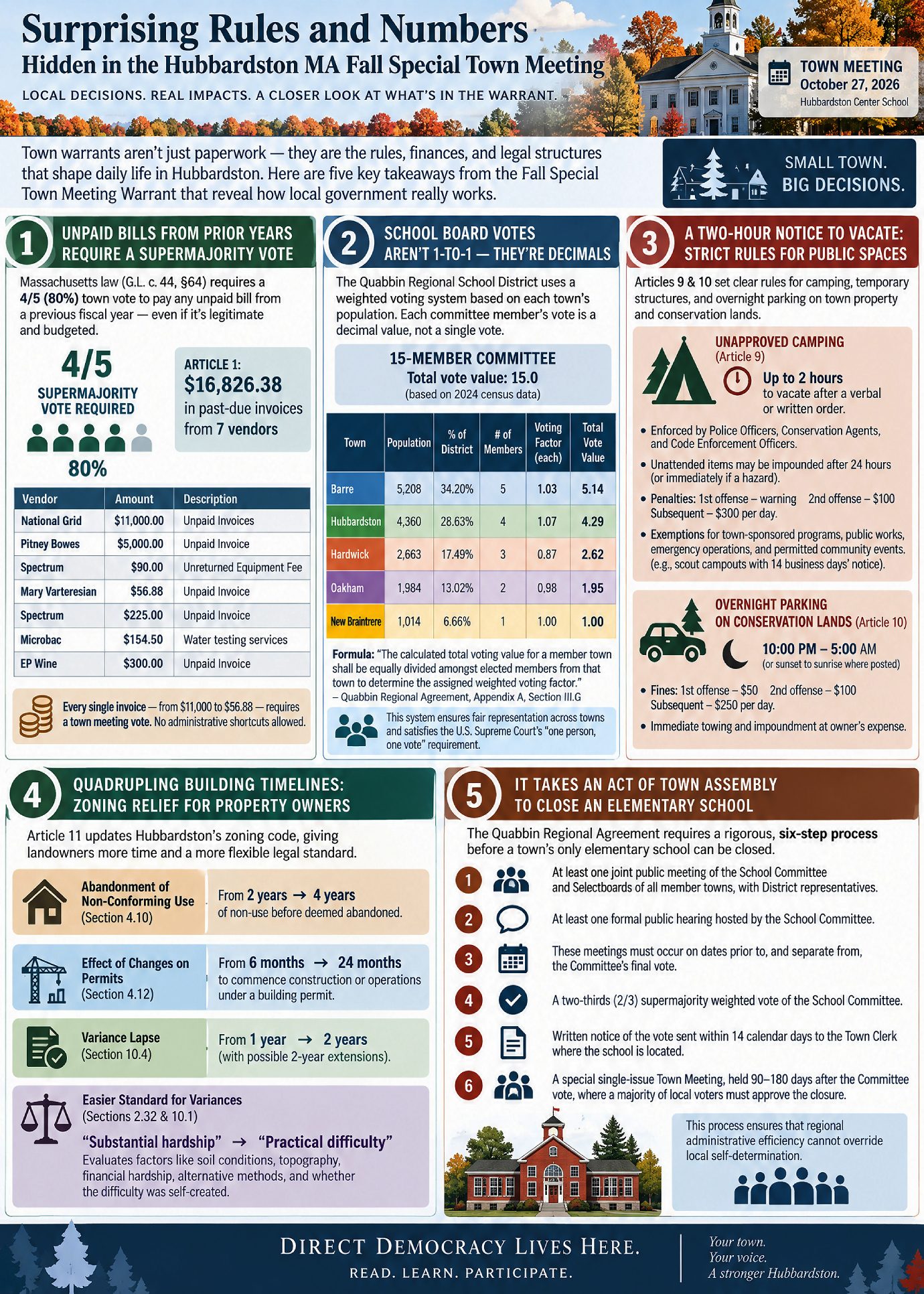
Hubbardston Fall 2026 Special Town Meeting
Town of Hubbardston’s Special Fall Town Meeting, scheduled for Tuesday, October 27, 2026, at 7:00 PM at the Hubbardston Center School.
The warrant addresses eleven primary articles, covering municipal financial adjustments, historic preservation grants, regulatory general bylaws, comprehensive zoning updates to match Massachusetts General Law (M.G.L. c. 40A), and an updated regional agreement for the Quabbin Regional School District. Key highlights include:
- Financial Adjustments: Transferring $16,826.38** from Certified Free Cash to clear prior year invoices, appropriating **$50,000 for an emergency utility fund, allocating $7,000** for emergency trailer repairs, and adjusting the Fiscal Year 2027 municipal budget to **$4,011,673.00 for operational costs and $520,934.00 for unclassified expenses.
- Historic Preservation: Allocating $41,500 from Community Preservation undesignated reserves for historic structure and structural engineering reports on the town’s First Meeting House.
- General Bylaw Additions: Establishing formal prohibitions, exemptions, and non-criminal penalties for unapproved camping/temporary structures on municipal property and overnight parking on conservation land.
- Zoning Bylaw Compliance: Updating multiple zoning sections—including variance standards, non-conforming use protections (“grandfathering”), abandonment limits, and permit expiration terms—to align with state zoning statute revisions under M.G.L. c. 40A.
- Quabbin Regional School District Agreement: A revised PreK–12 Regional Agreement establishing updated committee structures, weighted voting rules, cost allocation formulas, student reassignment constraints, and strict, multi-step procedures for potential elementary school closures.
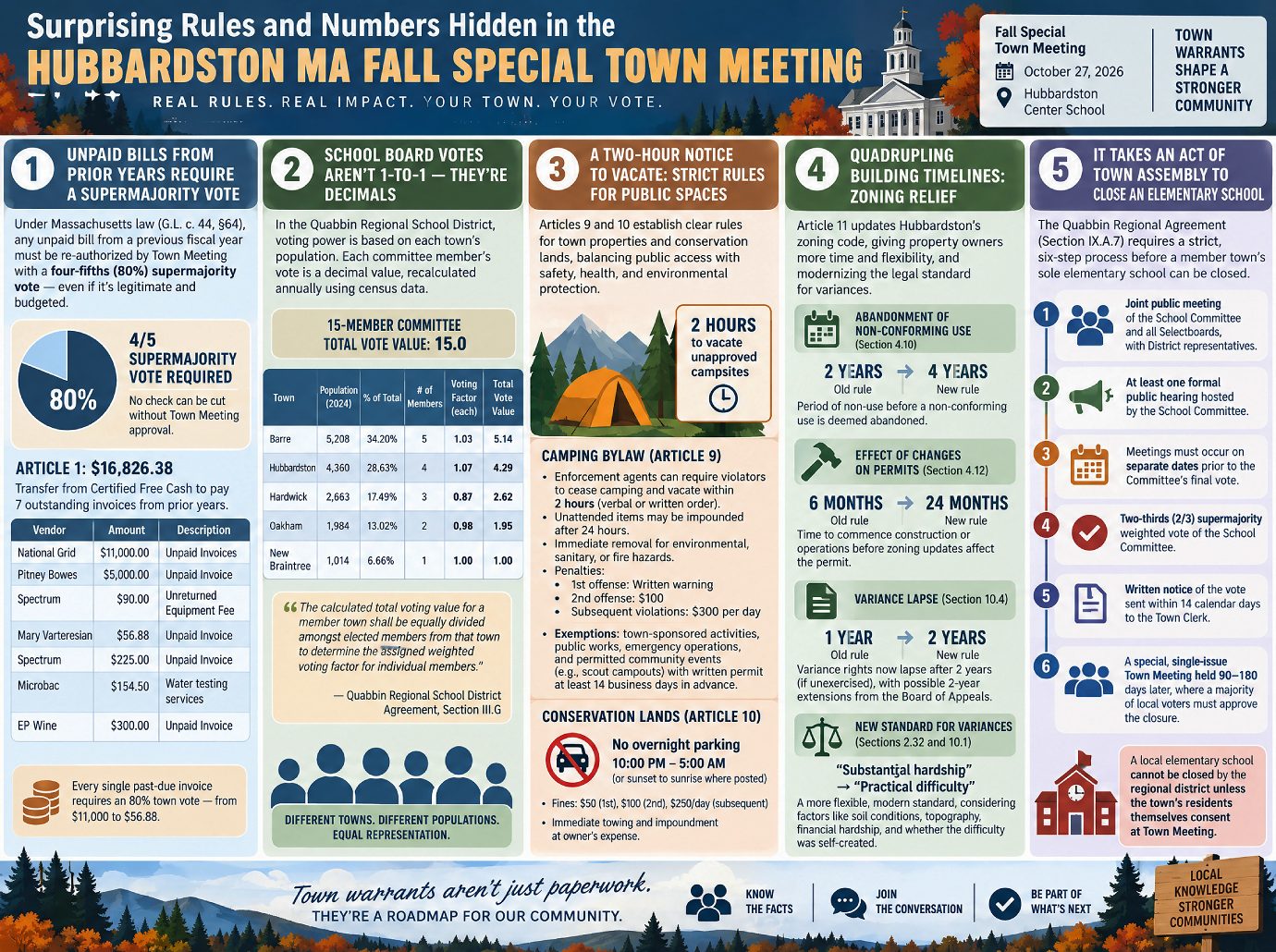
- FBI 10-7-26
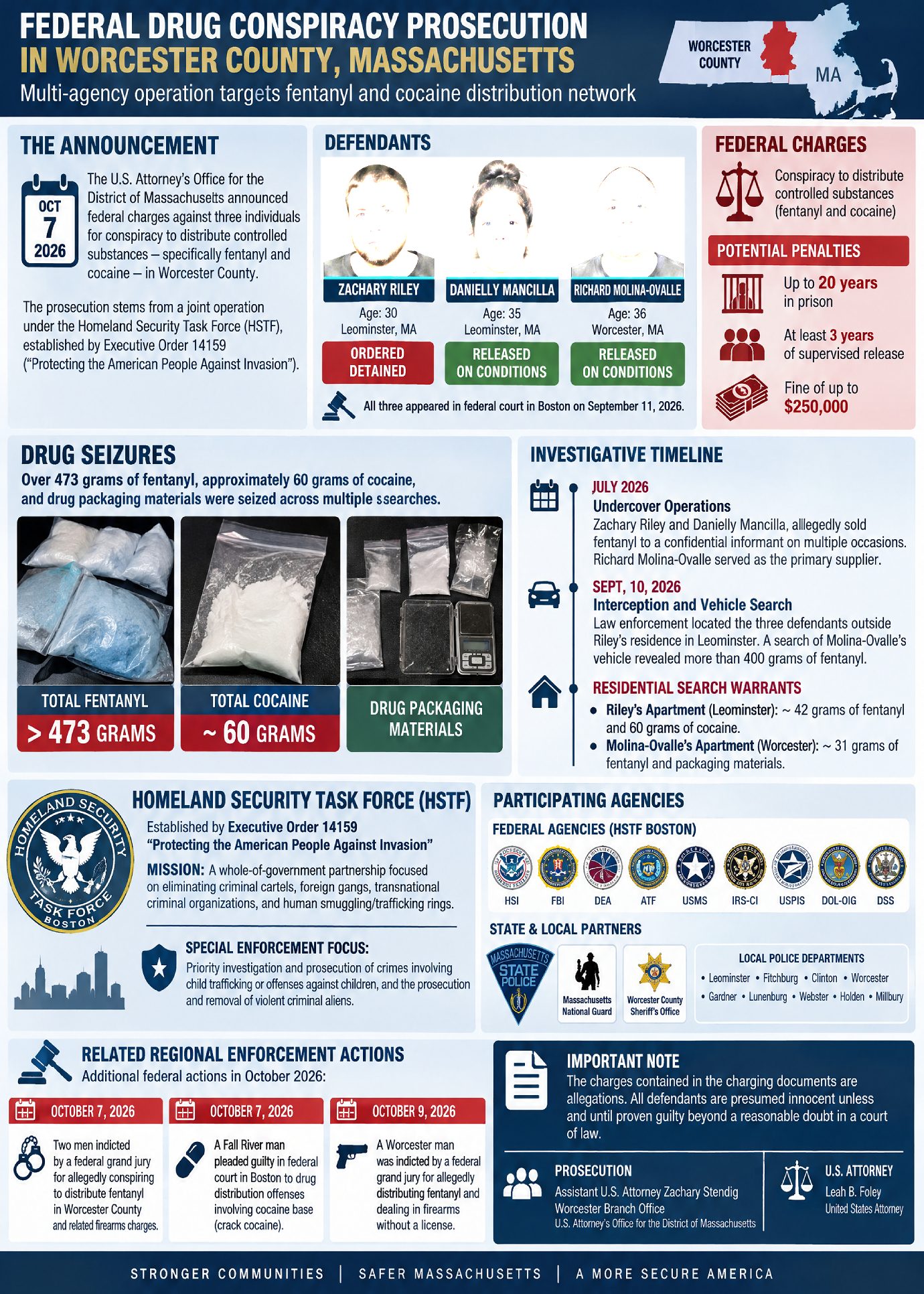
Enforcement action was a collaborative effort with extensive interagency involvement: Led by the U.S. Attorney’s Office, DEA, FBI, IRS-CI, and Massachusetts State Police, supported the Massachusetts National Guard, the Worcester County Sheriff’s Office, and by nine local police departments including Leominster, Fitchburg, Clinton, Worcester, Gardner, Lunenburg, Webster, Holden, and Millbury.
Federal Drug Conspiracy Prosecution by FBI in Worcester County Massachusetts
Read the official Press Release from the FBI, CLICK HERE.
On October 7, 2026, the United States Attorney’s Office for the District of Massachusetts announced federal charges against three individuals for conspiracy to distribute controlled substances—specifically fentanyl and cocaine—in Worcester County. The prosecution stems from a joint operation involving federal, state, and local law enforcement under the umbrella of the Homeland Security Task Force (HSTF), an initiative established pursuant to Executive Order 14159 (“Protecting the American People Against Invasion”).
Key highlights of the enforcement action include:
- Defendants Charged: Zachary Riley (30, Leominster) -ordered detained after September court appearance, Danielly Mancilla (35, Leominster) – released on conditions, and Richard Molina-Ovalle (36, Worcester) – released on conditions.
- Controlled Substances Seized: Over 473 grams of fentanyl, approximately 60 grams of cocaine, and drug packaging materials across multiple searches.
- Potential Statutory Penalties: Up to 20 years in prison, at least three years of supervised release, and a fine of up to $250,000 for conspiracy to distribute controlled substances.
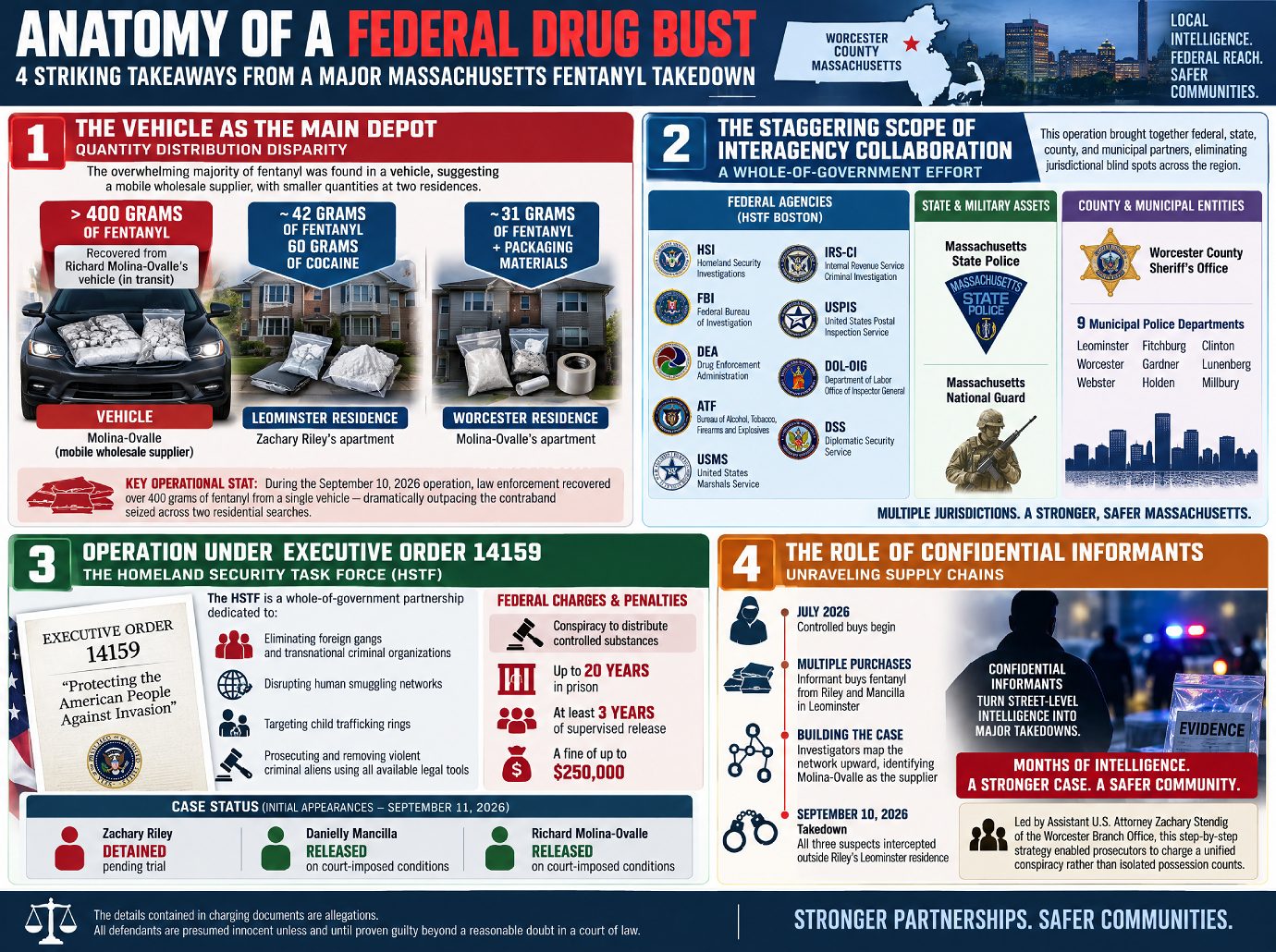
- Finance Committee 10-9-26
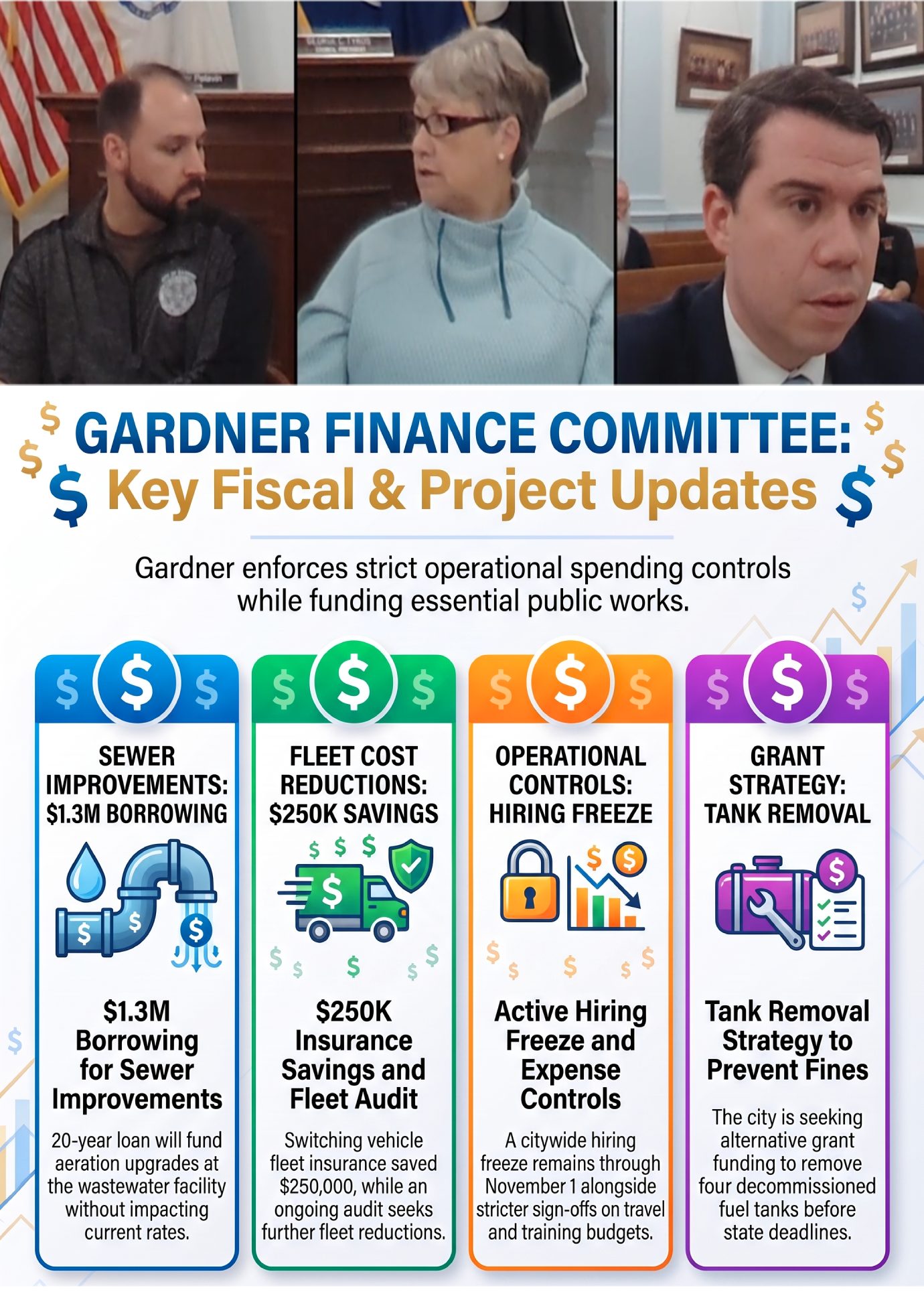
2 additional infographics are featured below.
Borrowing – Savings – Hiring Freeze – Strategies – Topics of Gardner Finance Committee
The Gardner Finance Committee met on October 9, 2026. Listen to the meeting on any device, CLICK PLAY.
Finance Committee 10-9-26 The Gardner Finance Committee convened on October 9, 2026, to address key municipal operational expenditures, infrastructure updates, fleet management, and long-term fiscal strategies. Key topics included underground storage tank removal funding, the city vehicle fleet review, and updates on a wastewater treatment facility upgrade loan. Additionally, participants examined the city’s health insurance trust fund, stabilization accounts, and upcoming tax rate settings. The committee also reviewed ongoing administrative policies, such as professional development spending and hiring restrictions, aimed at maintaining fiscal responsibility.
Critical Items from the Meeting
- Unfunded Infrastructure Mandates: The city faces an impending five-year deadline to remove decommissioned underground fuel storage tanks at the DPW. Because Gardner proactively decommissioned the non-leaking tanks to prevent environmental contamination, the city currently fails to qualify for state Department of Environmental Protection (DEP) removal grants reserved for active leaks, leaving the project unfunded.
- Fleet Optimization and Insurance Savings: The administration is conducting individual department assessments to reduce the municipal vehicle fleet. Switching the city’s aggregate fleet insurance provider to Hub Insurance saved approximately $250,000 in a single year. Further cost controls are being evaluated around vehicle take-home policies and gas card rebate usage (WEX program).
- Major Sewer Enterprise Borrowing: The committee reviewed a proposed $1,300,000 borrowing order for aeration improvements at the wastewater treatment facility. The 20-year loan will be serviced strictly by the Sewer Enterprise Fund without anticipated rate increases for residents.
- Fiscal Controls & Financial Outlook: To manage budget pressures ahead of setting the tax rate in November, the Mayor confirmed an ongoing hiring freeze through at least November 1, 2026. Additionally, stricter expenditure controls have been implemented, including a mandatory rewrite of the city’s Professional Development (PD) policy to scrutinize “wants versus needs.”
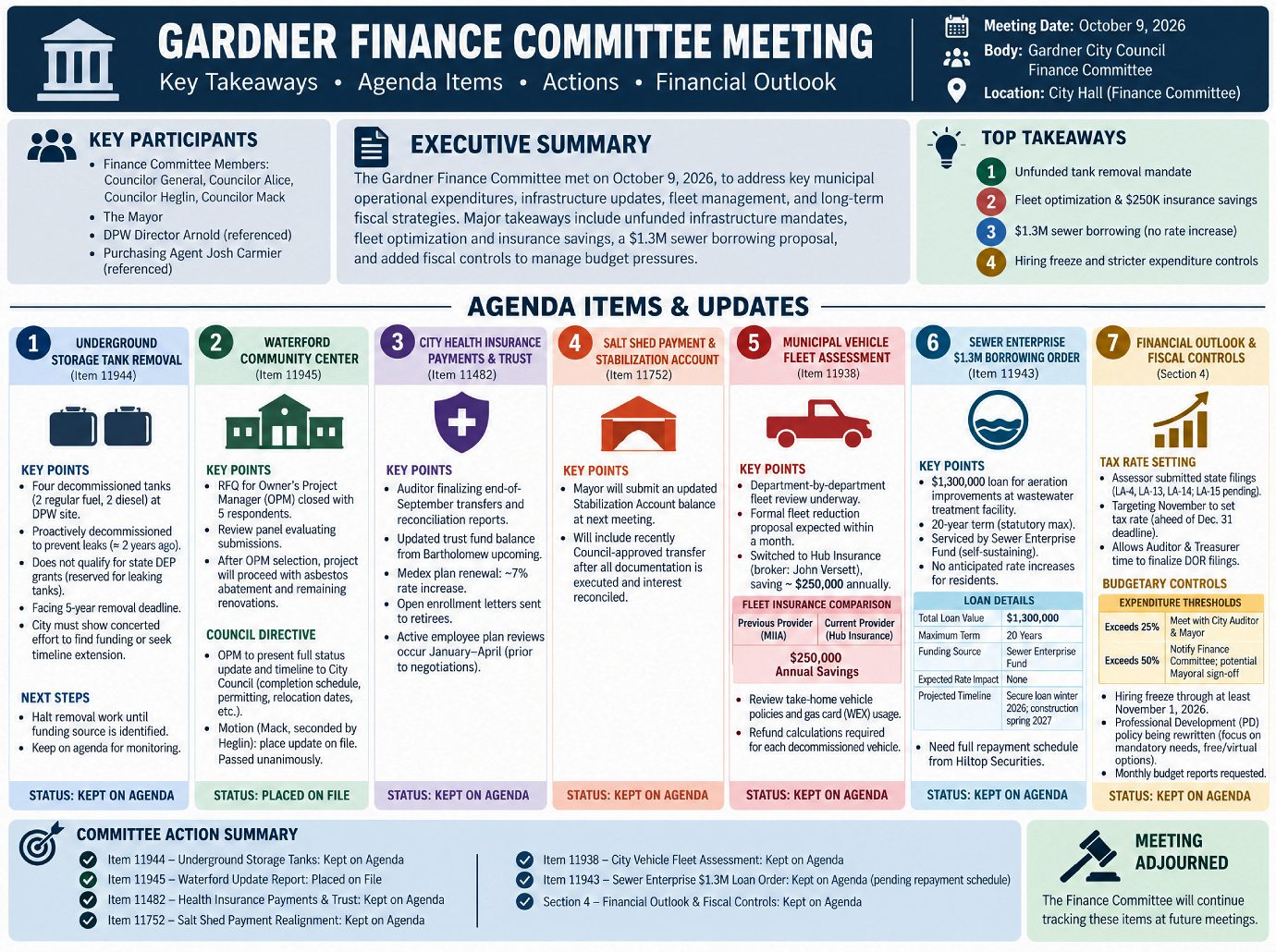
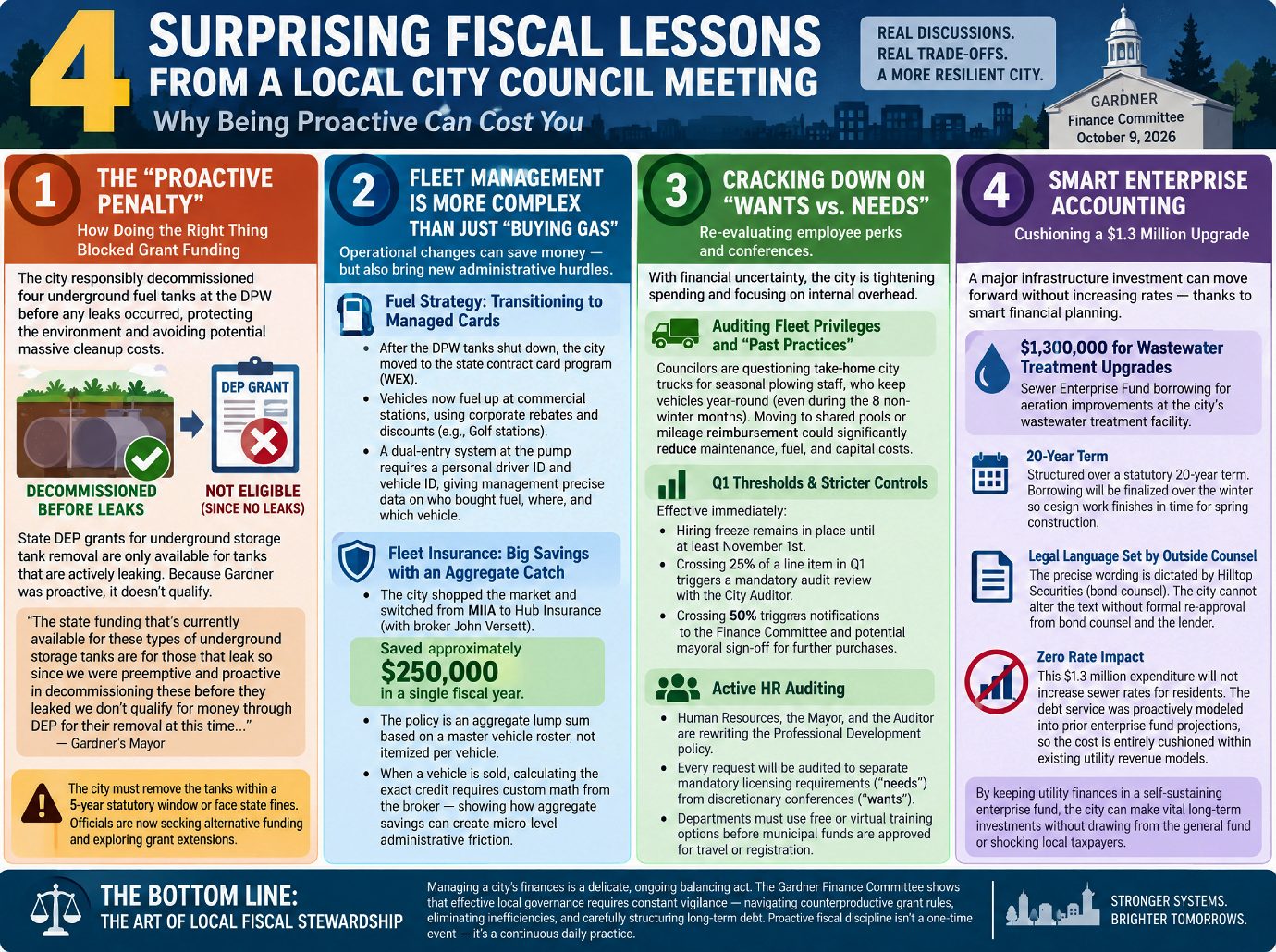
- Nicholson the Candidate
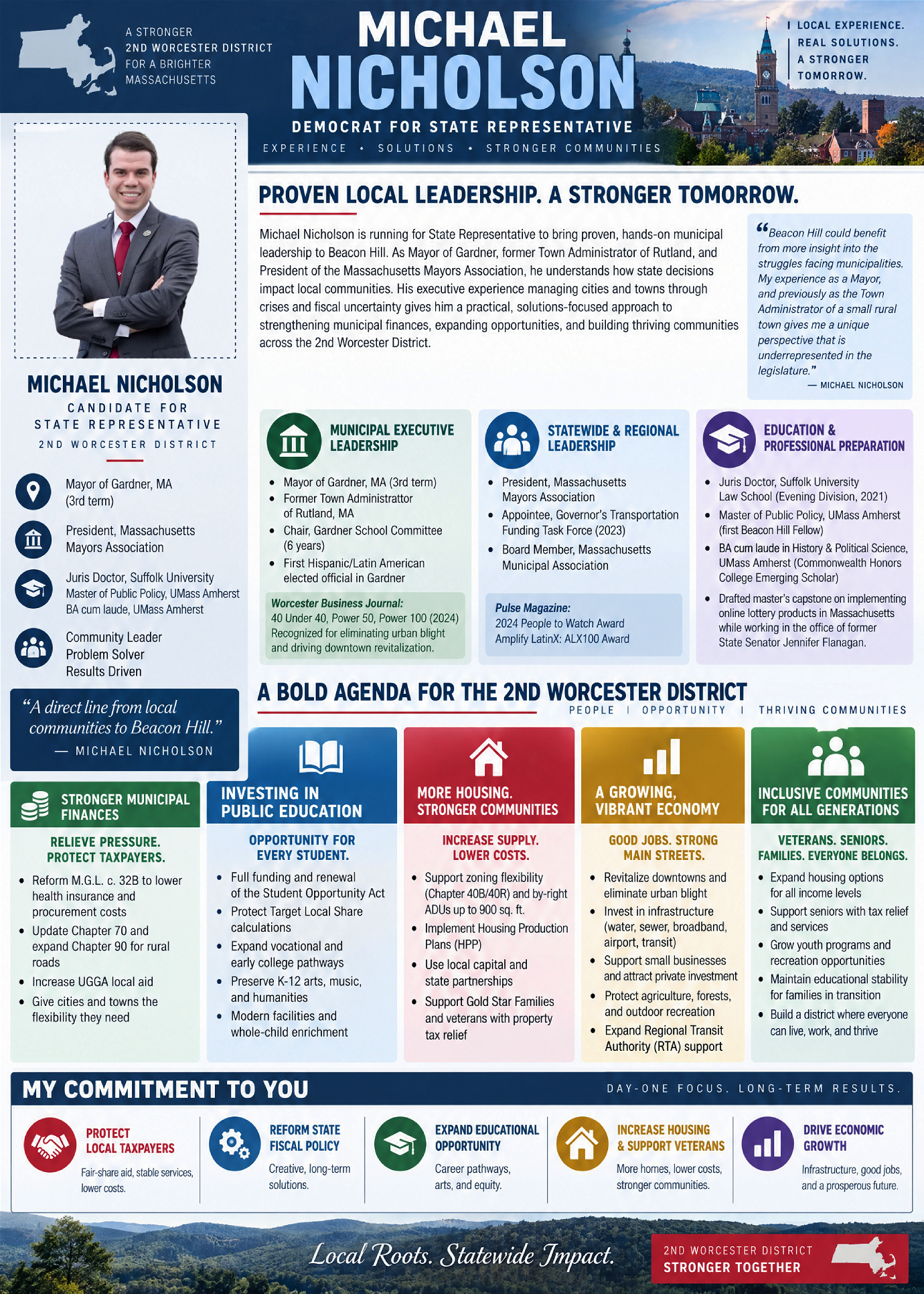
For more information about Mike Nicholson and the various issues affecting the 2nd Worcester District, visit the candidate’s website, CLICK HERE.
Michael Nicholson the Candidate – From Drum Major to Mayor and Beyond
Listen to the Chair Man and the Chair Lady speaking about the candidate and reviewing the various issues. Learn the details. CLICK PLAY.
DEEP DIVE – The Nicholson Candidacy
The political and economic landscape across Massachusetts municipalities is defined by severe budgetary strain, escalating fixed operational costs, and increasing pressures on local tax bases. In this environment, the 2nd Worcester District requires legislative leadership that extends beyond theoretical policy craft. Michael Nicholson’s candidacy for State Representative is built upon a foundation of proven, executive municipal management. Having successfully managed local government operations through global health crises and fiscal uncertainty, Mayor Nicholson brings a grounded, pragmatic approach to Beacon Hill. His transition from a city executive to a state lawmaker offers the Commonwealth’s legislature a direct line to the operational realities facing cities and towns, ensuring state policy directly reinforces local fiscal sustainability. Election is November 3rd.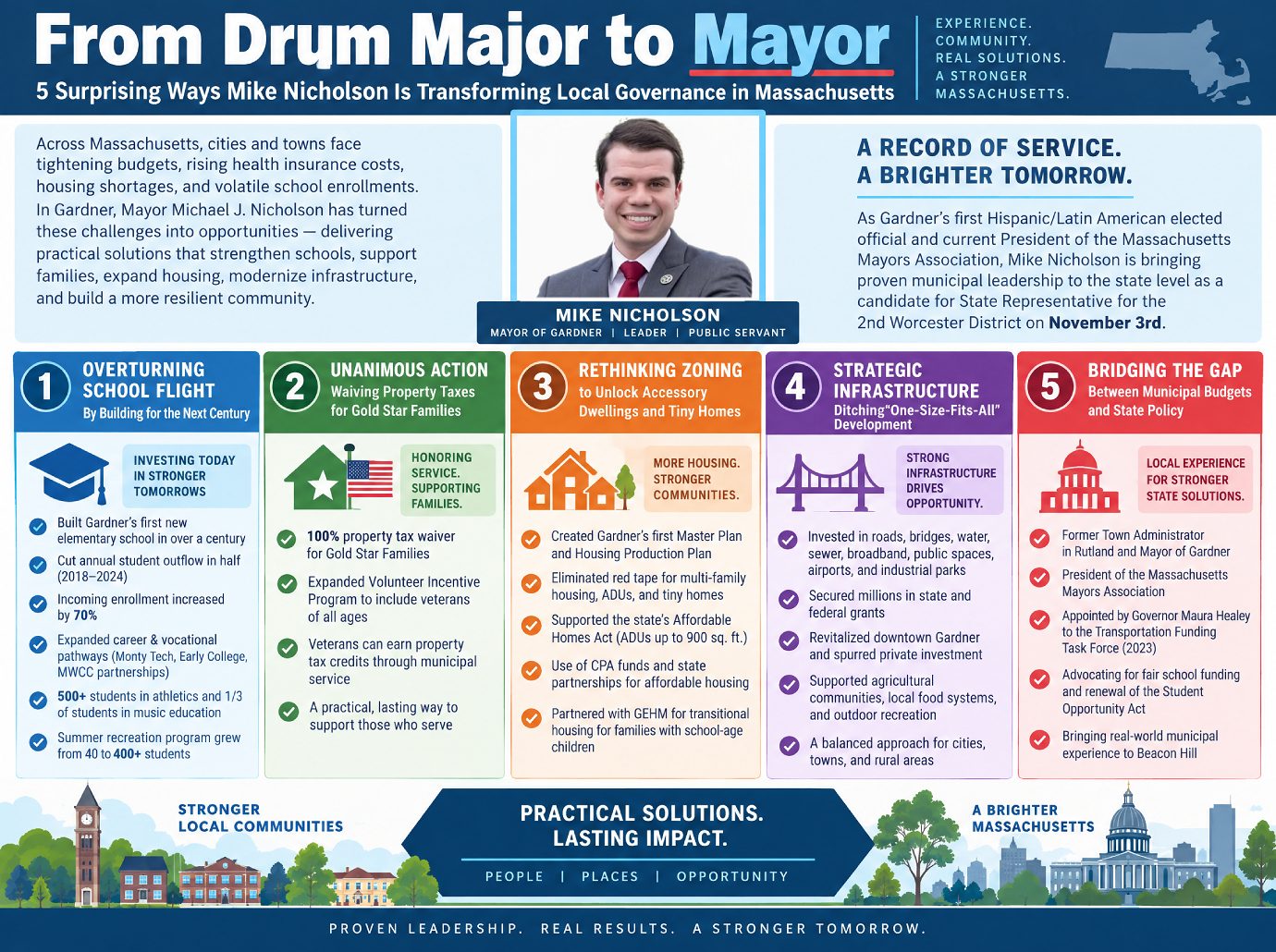
- Templeton Fall Town Meeting 2026
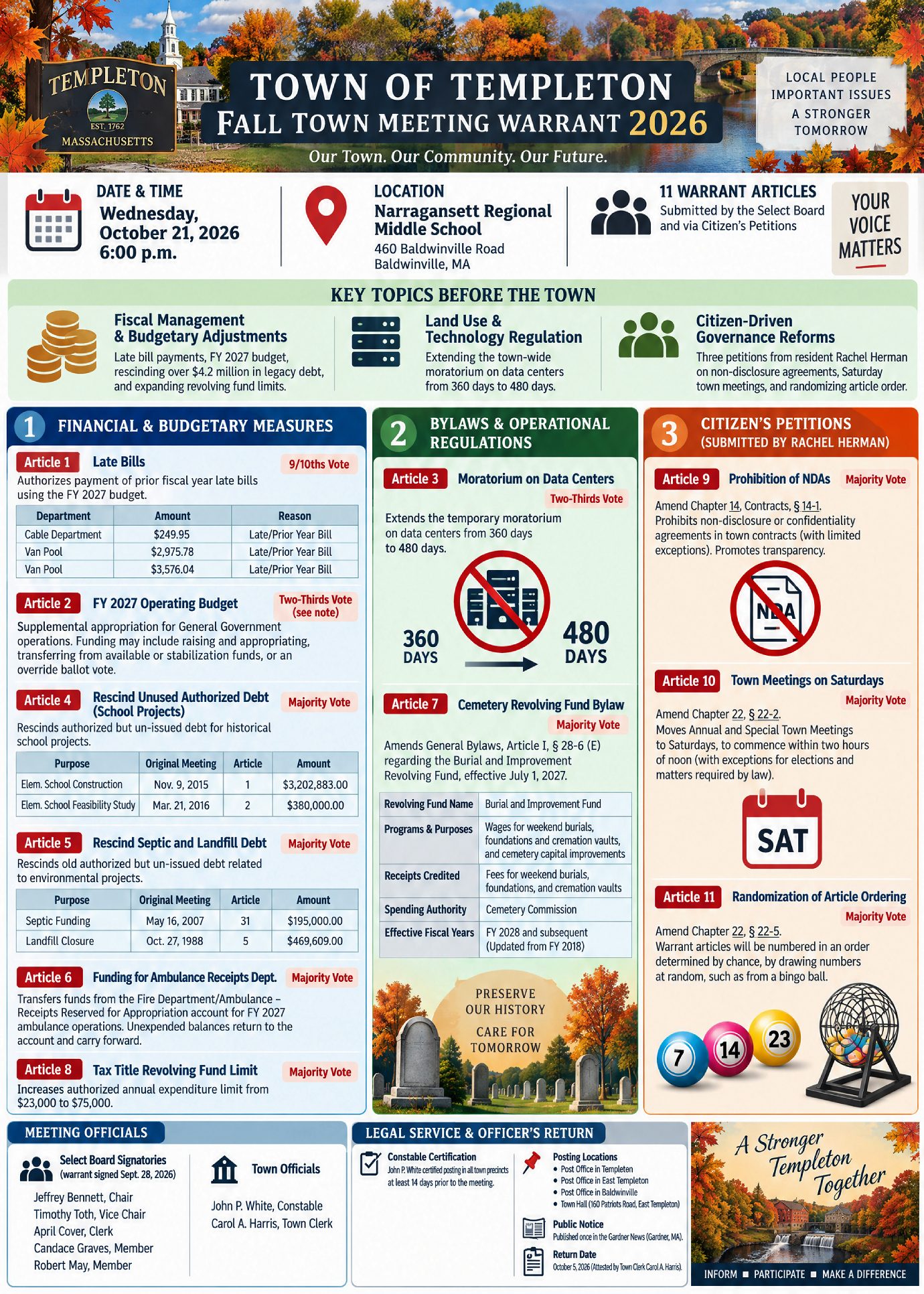
Download a printable version of this graphic, CLICK HERE. Following a failed override vote in September, Templeton voters will make critical decisions at this Town Meeting which will impact Public Safety and other positions in the town. A printable version of the article graphic is available (CLICK HERE) A printable version of the Citizen Guide is available (CLICK HERE) View PDF of actual warrant, CLICK HERE.
A Guide to the Town of Templeton Fall 2026 Town Meeting Warrant
The Templeton MA Fall Town Meeting will be Wednesday, October 21, 2026 at 6pm at the Narragansett Regional Middle School. There are 11 Warrant Articles.
Key topics on the agenda include approving late fiscal year bills, setting the operating budget, extending a data center moratorium, and canceling unused financial debt. Additionally, the assembly will consider bylaw updates regarding local funds, alongside several citizen petitions proposing changes to town contracting transparency, meeting scheduling, and agenda ordering procedures. View PDF of actual warrant, CLICK HERE.
Article 2: Fiscal Year 2027 Operating Budget – A critical article
- Purpose: Supplemental appropriation for General Government operations for Fiscal Year 2027. Funding sources may include raising and appropriating, transferring from available funds, transferring from stabilization funds, or utilizing an override ballot vote.
- Submitted By: Select Board
- Voting Threshold Required: Two-Thirds Vote Required (Majority Vote Required if no general purpose stabilization funds are used).
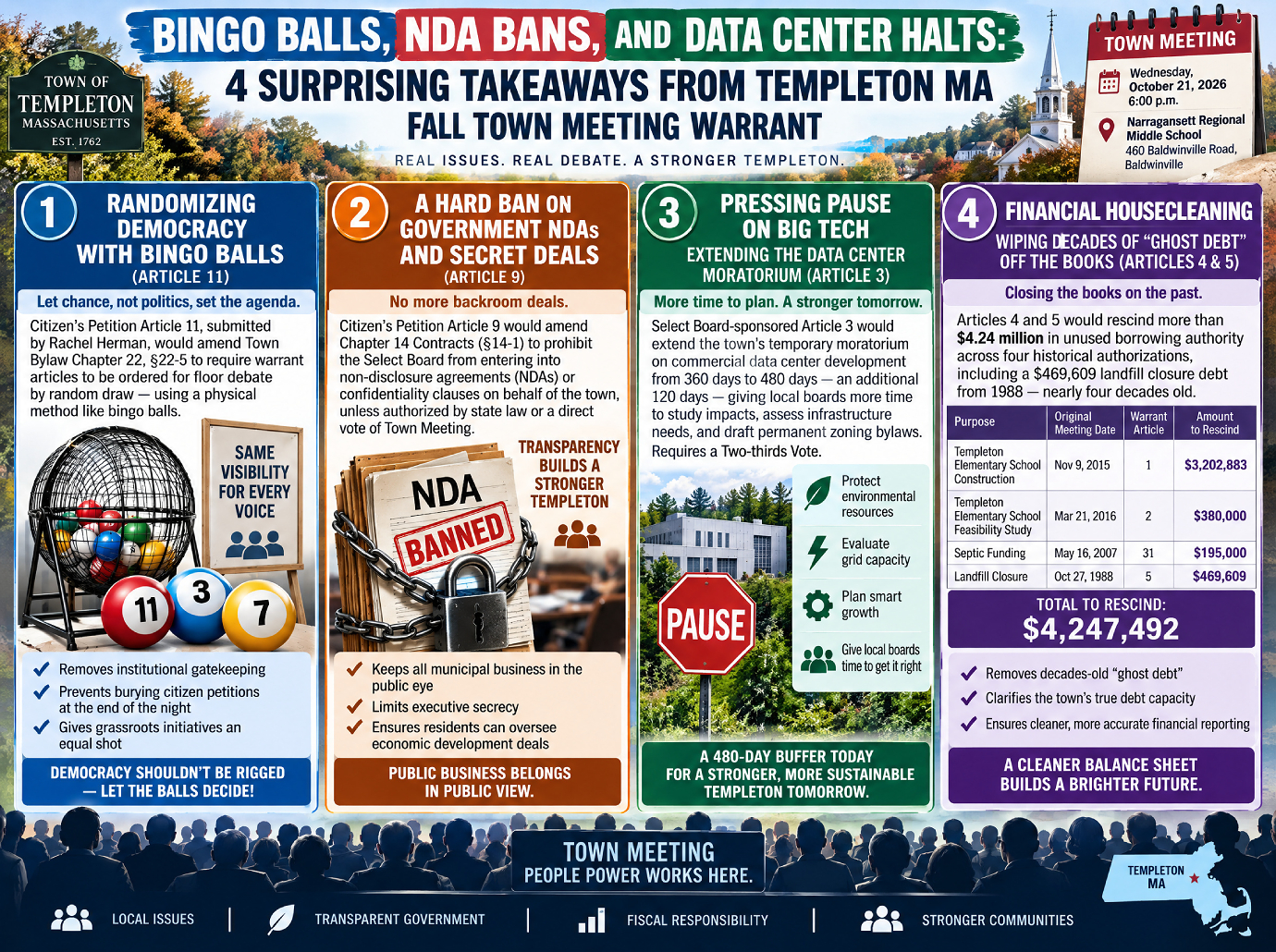
Surprising Takeaways 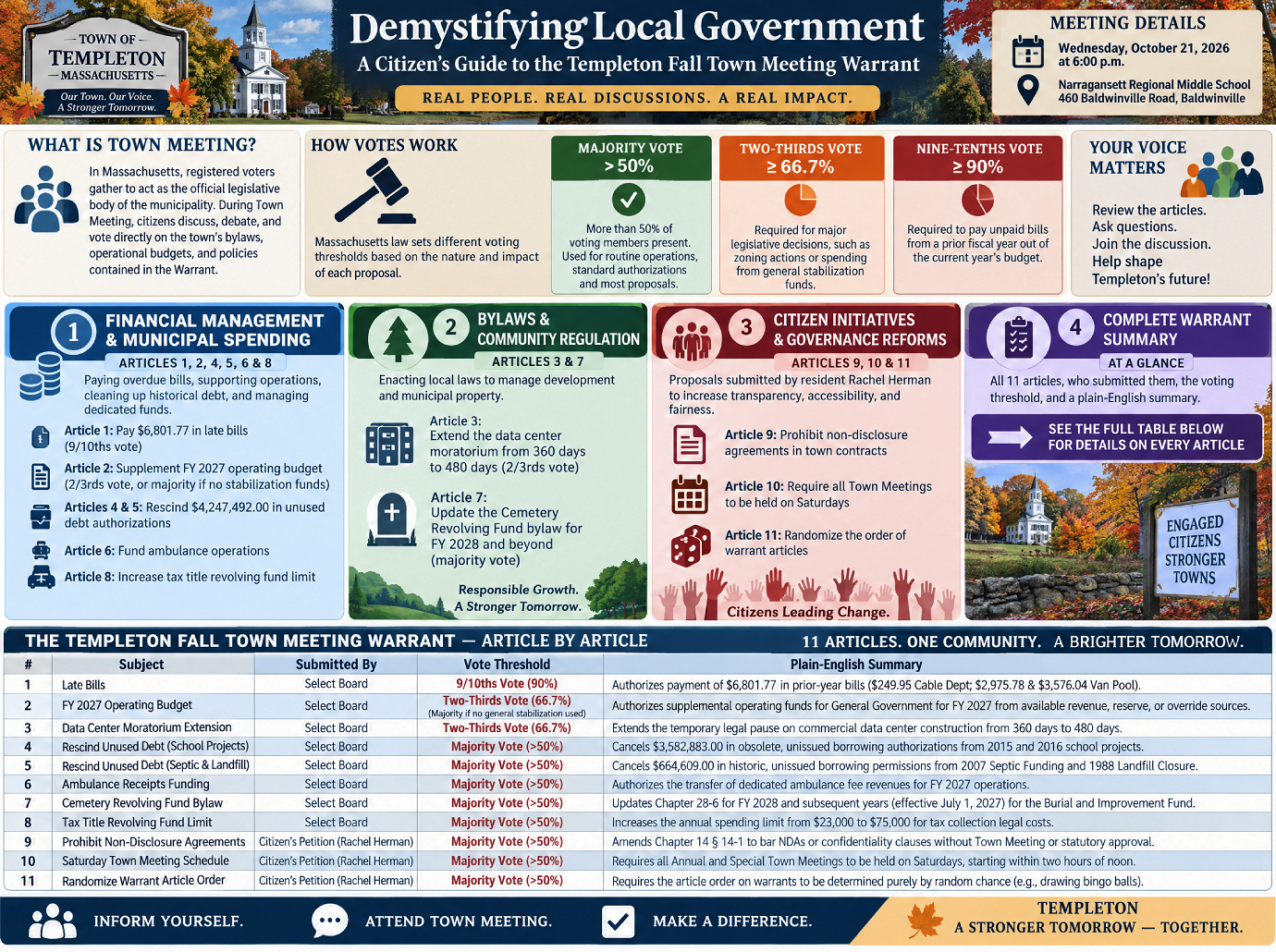
Download a portrait-oriented printable version, CLICK HERE – Citizen Guide - MA Oil Bill Help

One of the infographics below shows the eligibility table by household size and income.
Massachusetts Announces the Middle Income Heating Oil Relief Program
Listen to this podcast on any device, CLICK PLAY.
DEEP DIVE – MA Middle Income Heating Oil Program
To address the rising cost of home heating oil, Governor Healey has made additional Massachusetts state funds available to create a supplemental energy assistance program. Administered by the Executive Office of Housing and Livable Communities, the Middle-Income Heating Oil Relief initiative provides a one-time emergency benefit of up to $680 to thousands of middle-income households. The program specifically targets residents who rely on #2 home heating oil and whose income levels disqualify them from the standard Home Energy Assistance Program (HEAP). Applications for the program are set to open in December 2026. Details on this page, CLICK HERE.For details on the Heating System Repair and Replacement Program, CLICK HERE.
For the main home energy assistance page including the program for low-income earners, CLICK HERE.

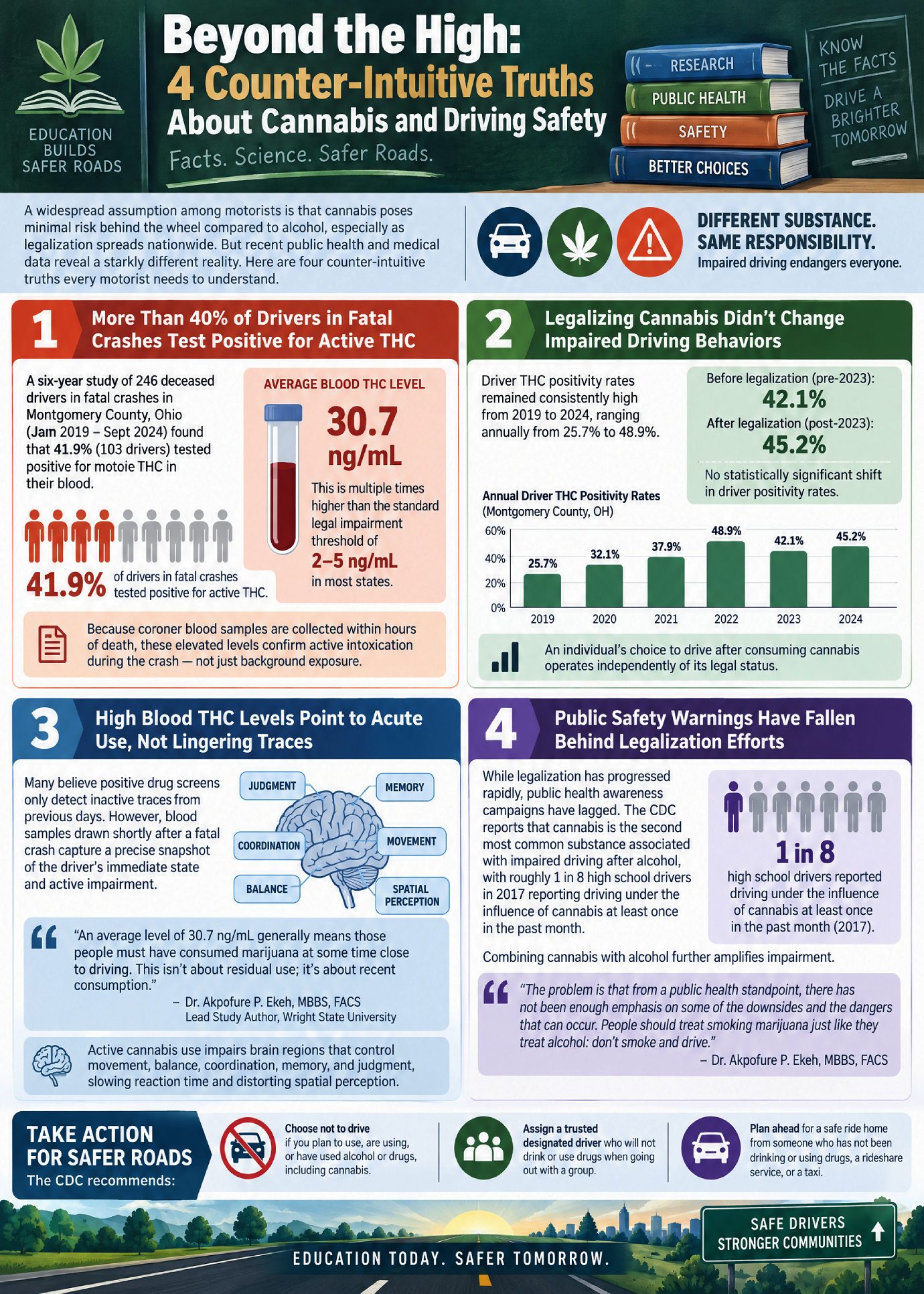
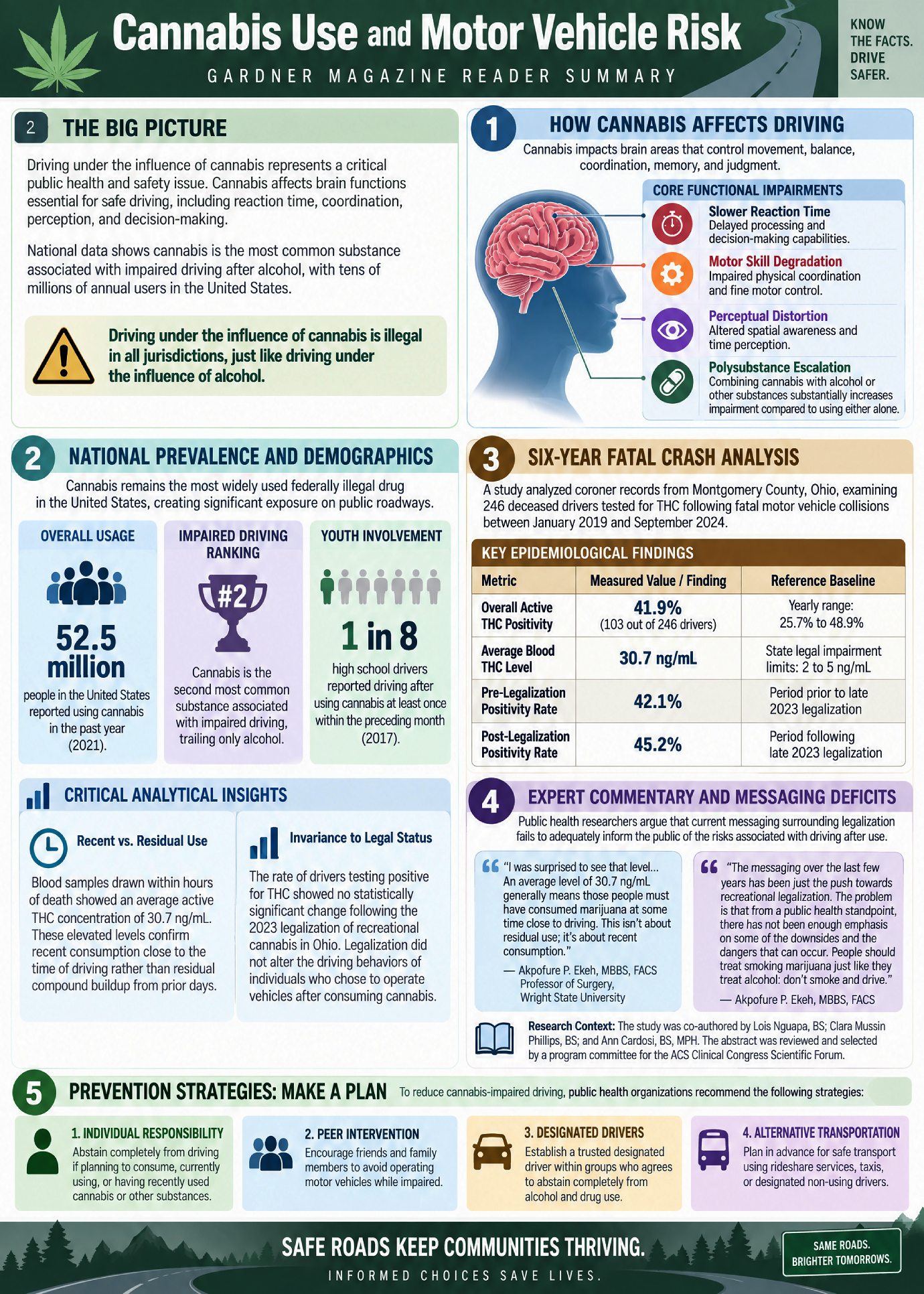



- Events 2026
Get your event on this 2026 Events calendar. Email News@GardnerMagazine.com or leave a voicemail at (978) 632-6324. We will provide a link to your details such as a website, image, PDF etc. (Whatever helps promote your event.) Government, Non-Profits, and businesses welcome. FREE exposure to 30,000+ unique households monthly.
Month 2026 Events at a Glance January Gardner Relay for Life First Lap. Visit Gardner Relay for Life page. Relay for Life 2025 is Friday June 12, 2026 February 16th – Presidents Day – City Hall and various town offices are closed
16th – Random Act of Kindness WeekMarch – Gardner Museum opens for the season, Website.
31st – Dog License Registration closes in Gardner. Register dog before this date. License pageApril 1st: Higher prices go in to effect on April 1 for Flower pot sponsorships in Gardner – only $150 until then.
5th – Projected opening day for Rietta Flea Market (weather permitting) WebsiteMay – first monthly Farmers Market for 2025 at Waterford Community Center. Website June 12th/13th – Greater Gardner Relay for Life at MWCC.
19th: JuneteenthOngoing Music Concerts at Monument Park, The Lithuanian Beach Club, and the Polish American Citizens Club July July 11th – Gardner MA 9th Annual Food Truck Festival August August 6th – National Night Out – 5:30-8pm – at Gardner High School September 26th – Fabulous Fall Festival and Oktoberfest – Downtown Gardner October 31st: Halloween November 26th: Thanksgiving – Annual Lighting of the Tree at Monument Park, Carriage Rides and more… December 25th: Christmas Day Add Event Email: News@GardnerMagazine.com - Event List 2025
Month 2025 Events at a Glance January 11th – Gardner Relay for Life First Lap. Visit Gardner Relay for Life page. Relay for Life 2025 is Friday June 13, 2025 February 17th – Presidents Day – City Hall and various town offices are closed
17th – Random Act of Kindness Week
23rd – PACC Polish Drive Thru 11am to 2pm – Meals are 15 dollars
24th – Planned snow removal in Downtown Gardner with Parking Ban 7am to 3:30pmMarch 5th – Gardner Museum opens for the season, Website.
30th – Higher prices go in to effect on April 1 for Flower pot sponsorships in Gardner – only $150 until then.
31st – Dog License Registration closes in Gardner. Register dog before this date. License pageApril 6th – Projected opening day for Rietta Flea Market (weather permitting) Website
23rd – Earth Day Expo: Growing Business, Nurturing Fixtures Gardner PACC open to public 6-7:30pm – More details — all Chamber listed events
24th – Greater Gardner Health and Wellness Fair 5-7pm at Perry Auditorium in Gardner City Hall
26th – Saturday – Purple Paws Fundraiser 9:30am-noon at Pulaski Dog Park, Gardner Flyer, CLICK HERE.May 17th – first monthly Farmers Market for 2025 at Waterford Community Center. Website
31st – Saturday – Gardner City-Wide Yard Sale Article Email to submit addresses is: shopportunity5@yahoo.comJune 13th/14th – Greater Gardner Relay for Life at MWCC. Complete Schedule.
19th: Juneteenth
21st – Small Business Saturday and Happy Birthday Gardner Festival. Website.
21st – Farmers Market at Waterford Community Center. Website
21st – Fireworks at PACC . Bands at PACC and Lithuanian Beach Club.Ongoing Music Summer Concert Schedules: Monument Park – PACC – Lithuanian Beach Club July 11th – GAAMHA 4th Annual Golf Tournament
12th – 2025 Gardner Food Truck FestivalAugust 6th: National Night Out September 27th – Fabulous Fall Festival and Oktoberfest – Downtown Gardner October 16th – Earth Day Expo: Growing Business, Nurturing Fixtures Gardner PACC open to public 6-7:30pm – More details — all Chamber listed events
31st: HalloweenNovember 27th: Thanksgiving December 25th: Christmas Day Add Event Email: News@GardnerMagazine.com