
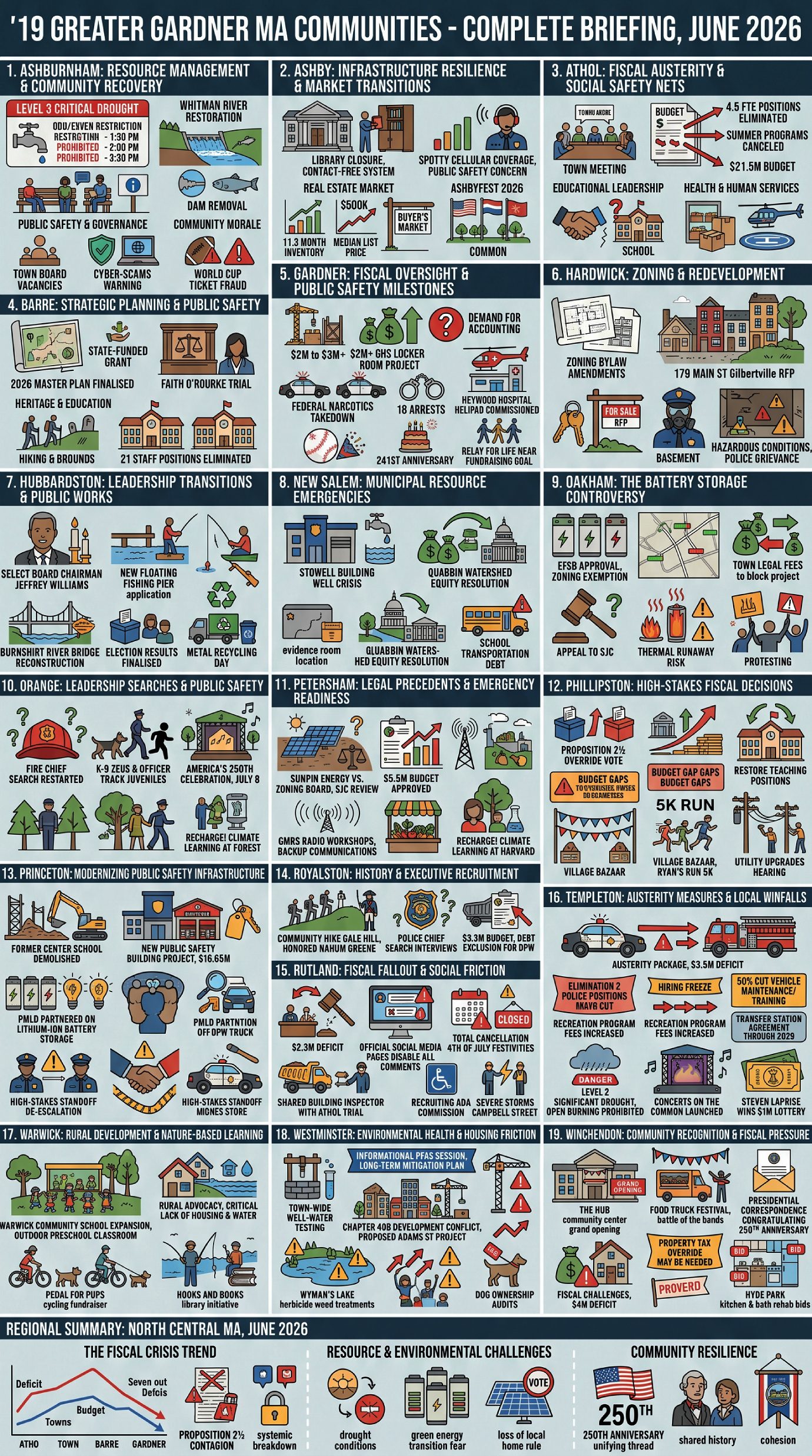
Complete Briefing 19 Communities – June 2026
In June 2026, the Greater Gardner MA Massachusetts region faced a complex landscape defined by severe municipal fiscal constraints, regional environmental crises, and significant infrastructure transitions. A recurring theme across several municipalities—most notably Rutland, Templeton, and Athol—was the immediate fallout from failed tax overrides and budget deficits, leading to staff layoffs, reduced municipal hours, and the cancellation of landmark community events.
Environmental pressures were equally prominent. A regional drought triggered mandatory water conservation measures in multiple towns, while the state-level approval of a massive battery energy storage facility in Oakham sparked a legal and civic battle over local control. Conversely, the region saw major infrastructure milestones, including the commencement of a $16.65 million Public Safety Building in Princeton and the expansion of emergency medical transport networks in Athol and Gardner.
Despite these challenges, community life was punctuated by high-profile celebrations of the 250th anniversary of American independence and a significant regional triumph in youth sports by the Ashburnham/Westminster (Ash/West) baseball team.
For all of our June 2026, home page news stories, CLICK HERE.
A complete narrative of each of the 19 communities covered on Gardner Magazine follows.
Here is the podcast covering all 19 communities for June 2026: Listen on any device, CLICK PLAY.

1. Ashburnham: Resource Management and Community Recovery
In June 2026, Ashburnham finds itself at a precarious crossroads, attempting to balance long-term ecological restoration with the immediate constraints of a strained municipal budget and a regional climate emergency. While the town celebrates milestones in river restoration, the reality of a Level 3 Critical Drought has forced a pivot toward strict resource management that now dictates the rhythm of residential life.
Environmental Policy and Water Conservation
Following the 2025 Water Quality Report, which provided a transparent look at the town’s supply infrastructure, Ashburnham has moved into a high-alert phase. The current Level 3 Critical Drought in the Millers Basin has triggered mandatory odd/even water restrictions. Under this logic, non-essential outdoor water use is restricted based on street addresses and is strictly prohibited between 9:00 a.m. and 5:00 p.m. through the end of September. This is no longer a suggestion but a municipal necessity to prevent a total depletion of local reservoirs.
Infrastructure and Ecological Milestones
The Whitman River restoration project has achieved a major milestone following the removal of the Whitney Pond Dam. A year into the effort to restore the coldwater fishery, the Whitney Pond Dam Conservation Area has been formally established as a public asset. The site now features educational signage, trails, and benches, offering residents a front-row seat to the river’s ecological recovery and the return of native species.
Public Safety and Municipal Governance
On the governance front, the Select Board is grappling with persistent vacancies across multiple town boards and committees, signaling a need for renewed civic engagement. Meanwhile, the Ashburnham Police Department has issued a high-priority warning regarding sophisticated cyber-scams. With the 2026 World Cup approaching, federal authorities have tracked spoofing attacks against FIFA-related sites where malicious actors use fake ticket sales to harvest personally identifiable information (PII).
Community and Youth Sports
Local morale received a significant boost from the Ash/West 12U Cal Ripken all-star team. In a stunning regional upset, the team captured the championship title by defeating the previously undefeated Montachusett co-op team—a regional powerhouse comprising players from Fitchburg and Lunenburg.
Municipal Schedule and Events:
- Firefighter Sunday: Observed on June 14 at the Central Street station to honor the service of fallen members.
- Independence Day Observance: Town Hall will close on Thursday, July 2; all other administrative offices close Friday, July 3.
- Transfer Station: Closed Saturday, July 4; revised hours on Monday, July 6 (1:00 p.m. to 5:00 p.m.).
The ecological and resource-heavy focus in Ashburnham stands in stark contrast to Ashby, where physical infrastructure damage and a cooling real estate market are the primary drivers of municipal concern.
2. Ashby: Infrastructure Resilience and Market Transitions
Ashby is currently navigating a period of physical vulnerability and economic correction. The town is managing the fallout of severe storm damage to public assets while witnessing a fundamental shift in its local housing economy, moving away from the post-pandemic frenzy toward a more stagnant, buyer-friendly environment.
Public Infrastructure and Utility Challenges
The Ashby Free Public Library has been forced into an indefinite indoor closure after severe storms destroyed its fire alarm panel. Because state law mandates a functional fire system for public occupancy, the library has pivoted to a “contact-free” system: patrons now retrieve book holds alphabetically from a black filing cabinet placed outside the facility. Beyond the library, the Select Board is facing pressure regarding the town’s “spotty” cellular coverage. Residents argue that weak signals are undermining the regional dispatch system, leading to dropped calls and static during emergency transmissions—a critical failure point for rural public safety.
Real Estate and Market Dynamics
June 2026 housing data indicates a definitive cooling of the local market. The town has reached an 11.3-month supply of inventory with a median list price of $500,000. The “So What?”: With an average market time of 95 days, Ashby has officially transitioned into a buyer’s market. This represents a significant loss of leverage for sellers, as the high volume of active listings allows buyers to be more selective and negotiate more aggressively than at any point in the last five years.
Community Heritage
On June 13, the town celebrated AshbyFest 2026 on the Town Common. While a celebration of local culture, the event carried a weightier significance this year, serving as a formal kickoff for the 250th anniversary of the Declaration of Independence. The Ashby Historical Society curated specific exhibitions linking the town’s colonial history to the upcoming national milestone.
While Ashby navigates these market and utility shifts, the fiscal contagion in Athol has forced a much sharper set of survival-based municipal decisions.
3. Athol: Fiscal Austerity and Social Safety Nets
Athol is defined this month by a strategic tension: the town is aggressively cutting municipal staff to balance a failing budget while simultaneously watching its social safety nets expand to meet a surge in community need.
Municipal Budget and Labor Reductions
Voters at the Annual Town Meeting approved a $21.5 million budget for FY27, a move aimed at closing a $1.7 million deficit. To achieve this, the town has authorized home rule petitions to expand liquor licenses—a clear attempt to use economic development as a revenue tool. However, the immediate cost remains high.
| Category | Specific Impact |
|---|---|
| Personnel (Cuts) | 4.5 full-time equivalent (FTE) positions eliminated |
| Personnel (Vacancies) | 4 positions to remain permanently unfilled |
| Program Eliminations | Total cancellation of summer beach and recreation programs |
| Budget Total | $21.5 million (FY27) |
Educational Leadership Instability
The Athol-Royalston School Committee is in a state of upheaval following a 5-4 vote to extend Superintendent Matthew Ehrenworth’s contract. The narrow margin and the timing of the vote—conducted while Ehrenworth was a finalist for another position—triggered the immediate resignation of multiple committee members, leaving a leadership vacuum during a critical transition period.
Health and Human Services
In contrast to the municipal contraction, the Athol Area YMCA food pantry is expanding. Bolstered by monthly pledges from local manufacturer Whipps, Inc., the pantry is increasing its footprint to address rising food insecurity. The “So What?”: This expansion, coupled with the commissioning of the new Heywood Healthcare helipad, provides a vital regional security layer. As municipal services recede, these private and healthcare-sector developments are becoming the primary stabilizers for the region’s vulnerable populations.
As Athol attempts to stabilize its fiscal base, Barre is focusing on the long-term via a state-funded roadmap for neighborhood revitalization.
4. Barre: Strategic Planning and Public Safety
Barre is prioritizing structural roadmaps and the resolution of high-profile legal matters, seeking to close old chapters while planning for a decade of managed growth.
The 2026 Master Plan and Neighborhood Revitalization
The town has officially finalized the Barre 2026 Master Plan, a comprehensive document funded by a $50,000 state grant and developed in collaboration with the Central Massachusetts Regional Planning Commission (CMRPC). A key component of this forward-looking strategy is the South Barre Neighborhood Property & Infrastructure Assessment, which focuses on auditing structural integrity and housing density to prepare the neighborhood for state-backed revitalization grants.
Legal and Judicial Updates
The community remains focused on the trial of Faith O’Rourke, 20, who faces charges of manslaughter and motor vehicle homicide following a fatal Route 62 crash in 2025. O’Rourke has pleaded not guilty to operating under the influence in the incident that claimed the lives of two passengers.
Heritage and Education
Barre continues to preserve its complex history, recently hosting a guided hike to the Prince Walker Burial Ground, a rare 18th-century African American site in the Ware River Watershed. However, this preservation of the past contrasts with a reduction in future investments; the Quabbin Regional School District has approved a budget that eliminates 21 staff positions, resulting in significant cuts to reading specialists and physical education classes.
The strategic planning seen in Barre finds a more friction-filled expression in Gardner, where infrastructure “scope creep” is fueling a budget crisis.
5. Gardner: Fiscal Oversight and Public Safety Milestones
Gardner is currently characterized by a struggle over project transparency and a series of major public safety successes that highlight the city’s role as a regional healthcare and enforcement hub.
Infrastructure Friction and Budget Inflation
The Gardner High School locker room project has become a symbol of municipal “scope creep.” Initially estimated at $2 million, the project has ballooned by 50%, now exceeding $3 million. While Mayor Michael Nicholson has defended the cost increases as necessary adjustments, the City Council and School Committee have demanded a full accounting of why these costs were not disclosed earlier, creating a significant rift in city governance.
Public Safety and Health
Gardner saw two major milestones this month. Law enforcement concluded a federal narcotics and money laundering takedown targeting a local trade business, resulting in 18 arrests across seven states. On the healthcare front, Heywood Hospital officially commissioned its new Life Flight helipad. Located steps from the emergency department, this facility significantly reduces transport times for critical trauma patients.
Civic Anniversary and Events
The city celebrated its 241st anniversary on June 27, marking its 1785 incorporation. Community spirit remains high despite budget tensions, as the Greater Gardner Relay for Life moved within $20,000 of its $170,000 fundraising goal.
While Gardner audits its ballooning infrastructure costs, Hardwick is focused on turning dormant town-owned assets into tax-generating properties.
6. Hardwick: Zoning and Redevelopment
Hardwick is moving aggressively to modernize its regulatory framework and repurpose municipal liabilities into community assets.
Annual Town Meeting Outcomes
The June 6 Annual Town Meeting saw the finalization of the FY2027 budget and the passage of several zoning bylaw amendments. These changes, proposed by the Planning Board, are designed to align Hardwick with modern land-use standards and provide more flexibility for small-business development in residential zones.
Asset Redevelopment
The town has issued a formal Request for Proposals (RFP) for 179 Main Street in Gilbertville. By seeking private buyers for this town-owned property, Hardwick is signaling a strategic shift toward property management that prioritizes private investment and community revitalization over holding dormant assets.
Public Health and Facilities
Internal municipal relations are strained following a grievance filed by the police department. Officers have documented hazardous conditions in the municipal building basement, including mold and exposed asbestos, and are demanding immediate remediation or relocation.
Hardwick’s focus on infrastructure health mirrors the challenges in Hubbardston, where the town is also managing a significant transition in leadership.
7. Hubbardston: Leadership Transitions and Public Works
Hubbardston is entering a period of reflection following the loss of a key municipal figure, even as it maintains the continuity of its essential public works projects.
The Legacy of Jeffrey Williams
The town is mourning the passing of Select Board Chairman Jeffrey L. Williams, who died on June 2 at age 83. A career educator and long-term public servant, Williams was the architect of Hubbardston’s recent era of stability. His passing leaves a significant void in the town’s executive leadership just as it enters a new fiscal cycle.
Infrastructure and Public Access
Public works projects remain on track despite the loss of leadership. The town is seeking public comment on a Chapter 91 application for a new floating fishing pier at the Comet Pond boat ramp. Meanwhile, the Burnshirt River Bridge reconstruction continues to necessitate detours on Route 68, representing a critical long-term investment in the town’s transit capacity.
Municipal Logistics
The Annual Town Election results have been finalized, providing a new cohort of leaders to carry forward Williams’ legacy. Additionally, the town’s “Metal Recycling Day” was a successful environmental initiative, held in conjunction with the town-wide yard sale to divert tons of scrap metal from the waste stream.
As Hubbardston transitions its leadership, the neighboring town of New Salem is facing a more immediate crisis in its basic municipal utilities.
8. New Salem: Municipal Resource Emergencies
New Salem is currently managing a critical infrastructure failure that threatens the operational viability of its primary administrative and safety hub.
The Stowell Building Well Crisis
The Stowell Building, which serves as the headquarters for the Police Department, Selectboard, and Town Coordinator, is in the midst of a water emergency. The shallow, hand-dug well—absurdly located inside the Police Department’s evidence room—consistently runs dry. Town officials are weighing a $1 million overhaul against smaller bids from local contractors. The “evidence room well” has become a potent symbol of the decaying infrastructure facing small, rural Massachusetts communities.
Regional Equity and Education
New Salem has formally backed the Quabbin Watershed Equity Resolution, seeking fair financial compensation from the state for the town’s role in protecting Boston’s water supply. Simultaneously, the town is grappling with regional school transportation debt, as state reimbursements continue to fall short of mandated levels, placing a heavier burden on local taxpayers.
New Salem’s struggle for water access is echoed in Oakham, where the town is battling a different kind of utility: massive battery storage.
9. Oakham: The Battery Storage Controversy
Oakham has become a flashpoint for the tension between state-level green energy mandates and local municipal control.
EFSB Approval and Town Response
In a unanimous 9-0 vote, the Massachusetts Energy Facilities Siting Board (EFSB) approved a zoning exemption for a 180-megawatt battery storage facility on Coldbrook Road. The “So What?”: This decision represents a total loss of local home rule. Despite the town spending $150,000 on legal fees to block the project, state regulators pushed it through. Oakham has authorized another $75,000 to appeal this decision to the Supreme Judicial Court (SJC), arguing that the state is overriding rural safety for urban energy needs.
Public Safety Concerns
Residents remain vocal about the risk of “thermal runaway”—an uncontrollable self-heating cycle in lithium-ion batteries. Other cited fears include toxic emissions and noise pollution, which residents argue will permanently alter the character of their rural community.
While Oakham fights the state in court, Orange is resetting its search for the leadership needed to handle its own public safety challenges.
10. Orange: Leadership Searches and Public Safety
Orange is hitting the “reset” button on its fire department leadership while touting the efficacy of its local law enforcement and community policing.
The Fire Chief Search
The Orange Selectboard has withdrawn all current job offers and restarted the search committee process for a permanent Fire Chief. This decision reflects a desire for a candidate who can provide long-term stability rather than a stop-gap solution for the department currently led by Interim Chief James Young Jr.
Public Safety Successes
Local law enforcement achieved a significant win following a series of vehicle break-ins. Three juveniles were arrested after being tracked through the woods by K-9 Zeus and Officer Kyle Johnson. The operation resulted in the recovery of stolen property from at least 12 vehicles, highlighting the success of the department’s K-9 unit.
Community Celebrations
The town is moving forward with plans for a major America’s 250th Anniversary celebration on July 8 at Butterfield Park. The event will feature the Orange Community Band and a public reading of the Declaration of Independence, serving as a unifying community event.
As Orange plans its festivities, Petersham is awaiting an SJC ruling that could fundamentally change rural zoning across the Commonwealth.
11. Petersham: Legal Precedents and Emergency Readiness
Petersham is currently the epicenter of a landmark legal case regarding rural land use while simultaneously building a localized communication network to survive the ongoing drought.
Sunpin Energy vs. Zoning Board
The SJC is currently reviewing Petersham’s case against Sunpin Energy’s proposed 12,000-panel solar array. The case centers on whether the town can block the clear-cutting of 14 acres of woodland for green energy. The ruling will set a statewide precedent for the “green-on-green” conflict—balancing renewable energy goals against forest conservation.
Municipal Finance
Voters unanimously approved a $5.5 million budget. This includes a $700,000 debt exclusion specifically for the purchase of a new fire department tanker and a highway department pickup truck, ensuring the town’s fleet remains viable.
Emergency Communications and Community
The MVP Committee is hosting GMRS radio workshops to create a backup communication grid in response to drought-related fire risks. On a lighter note, the Friday Market continues to thrive with performances by Brie Green, and residents are preparing for the “Recharge! A Day of Climate Learning” at the Harvard Forest.
While Petersham waits on the court, Phillipston residents are facing a high-stakes fiscal vote that will determine the fate of their local schools.
12. Phillipston: High-Stakes Fiscal Decisions
Phillipston is at a fiscal crossroads, with the future of the Narragansett Regional School District hanging on a single Proposition 2½ override vote.
The School Budget Override
On June 30, voters will decide on a $208,000 budget increase. For the average homeowner, this represents a $220 property tax increase. Passing the override would restore several teaching positions, though 13 district staff positions remain on the chopping block regardless of the outcome. A failure would trigger a mandatory joint district-wide meeting with Templeton to resolve the budget gap.
Community Traditions
The town recently held the annual Village Bazaar and “Ryan’s Run 5K,” drawing over 100 participants in honor of Ryan Twohey. These events remain critical for local scholarship funding and community cohesion during a period of intense fiscal debate.
Infrastructure Hearings
The Board of Selectmen has scheduled a July 8 hearing for utility upgrades on Blake Corner Road. National Grid and Verizon are seeking to install new poles and underground cables to stabilize the local power grid ahead of expected summer storm seasons.
While Phillipston votes on its budget, Princeton is witnessing the physical transformation of its town center as it builds for the future.
13. Princeton: Modernizing Public Safety Infrastructure
Princeton is in the midst of a physical metamorphosis, clearing the way for a modern safety facility while embracing new energy storage partnerships.
The Public Safety Building Project
The demolition of the former Center School building is now complete, marking the end of the site preparation phase. The project has transitioned into the $16.65 million construction phase, with heavy equipment and trailers now arriving on-site. This joint police and fire facility represents the largest capital investment in the town’s recent history.
Green Energy Initiatives
The Princeton Municipal Light Department (PMLD) has partnered with Lightshift Energy to construct a lithium-ion battery storage facility. This project is part of a regional effort to stabilize the grid and reduce peak-demand costs for local ratepayers.
Public Safety Incidents
The town’s current emergency response capabilities were tested on June 20 during a high-stakes standoff on Hickory Drive. Princeton officers, with mutual aid from state and local police, successfully de-escalated a situation involving an intoxicated individual firing a handgun. The suspect was taken into custody without injury.
As Princeton builds its new headquarters, Royalston is celebrating its Revolutionary roots while searching for its own next chief of police.
14. Royalston: History and Executive Recruitment
Royalston is balancing the commemoration of its 18th-century heritage with the modern demands of executive recruitment and shared municipal services.
Historical Commemoration
To kick off the 250th-anniversary celebrations, the town hosted a community hike up Gale Hill. The event honored local Revolutionary War participants, specifically Nahum Greene, and served to educate residents on Royalston’s early contributions to the American cause.
Police Chief Search
The search for a permanent Chief of Police is accelerating. The Preliminary Screening Committee is conducting executive session interviews to narrow a pool of candidates, seeking a leader who can provide the department with long-term stability.
Budget and Shared Services
Voters approved a $3.3 million budget, which includes a $350,000 debt exclusion for a new DPW dump truck. Notably, June 30 marks the end of a trial period for a shared building inspector with Athol; town leaders are now evaluating whether to formalize the arrangement or seek independent services.
While Royalston looks back at history, Rutland is dealing with a contemporary crisis that has shuttered its digital public square.
15. Rutland: Fiscal Fallout and Social Friction
Rutland is currently the region’s most stark example of what happens when civic discourse collapses alongside municipal funding. Following a failed tax override, the town has moved into a state of unprecedented austerity.
Communication and Social Media Lockdown
In a move that signals a total failure of civic infrastructure, the Town of Rutland has disabled all comments on its official social media pages. Officials cited staffing shortages and a spike in “derogatory language” as the cause. This digital lockdown reflects a community fractured by the $2.3 million budget deficit and a breakdown in the democratic process between residents and leadership.
Cancellations and Austerity
The deficit has forced the total cancellation of all 4th of July festivities, including the parade and fireworks, due to an inability to staff police and fire details. Furthermore, starting July 1, Town Hall will operate on a reduced schedule and will remain closed on Fridays as a direct result of staff layoffs.
Environmental and ADA Initiatives
Despite the crisis, the town is recruiting for a new ADA Commission and managing the aftermath of severe storms that brought down power lines on Campbell Street. However, these efforts are overshadowed by the broader municipal contraction.
As Rutland implements its lockdown, Templeton is balancing its own austerity measures with a rare stroke of local luck.
16. Templeton: Austerity Measures and Local Windfalls
Templeton is navigating a “financial stress test” after the rejection of two major overrides, forcing the town to choose between essential services and fiscal solvency.
Austerity and Public Safety
The town has implemented a severe austerity package to address a $3.5 million deficit:
- Police/Fire: Elimination of two full-time police positions, a total hiring freeze, and a 50% cut to fire vehicle maintenance and training.
- Recreation: Seasonal maintenance staff have been eliminated, and program fees have been increased by up to 65%.
Infrastructure and Environment
The town has secured a critical intermunicipal agreement with Winchendon, ensuring residents can access the Winchendon Transfer Station through 2029 for a $95 fee. Environmentally, the town remains under a Level 2 Significant Drought status, with open burning strictly prohibited.
Community Events and Luck
Providing a rare moment of levity, the “Concerts on the Common” launched this month. Additionally, resident Steven Laprise won a $1 million grand prize in the “Extreme Cash” lottery game, a high-profile win that provided a brief distraction from the town’s fiscal woes.
While Templeton manages its cuts, Warwick is doubling down on its identity as a hub for specialized, nature-based education.
17. Warwick: Rural Development and Nature-Based Learning
Warwick is focusing on specialized education as a survival strategy, attempting to attract young families to a town currently hindered by a lack of basic infrastructure.
Warwick Community School Expansion
The town is moving forward with a four-phase plan for an outdoor preschool classroom. The “So What?”: In a rural town facing a lack of water and housing infrastructure, this nature-focused pedagogical model is more than an educational perk; it is a critical marketing tool designed to draw families to a community that otherwise lacks the amenities of larger neighboring towns.
Regional Rural Advocacy
State Senator Joanne Comerford has been working with local leaders to address the “infrastructure desert” in Franklin County. The focus remains on the critical lack of housing and water systems that prevent Warwick and its neighbors from achieving sustainable growth.
Community Recreation
The town hosted the “Pedal for Pups” cycling fundraiser and launched the “Hooks and Books” initiative, which allows library patrons to check out fishing kits, further cementing the town’s focus on outdoor-centric living.
Warwick’s outdoor focus is a contrast to Westminster, where the community is currently preoccupied with the safety of its groundwater.
18. Westminster: Environmental Health and Housing Friction
Westminster is defined this month by a high level of community vigilance regarding long-term environmental health and the preservation of its small-town character.
PFAS Mitigation and Water Safety
Following a high-attendance Informational PFAS Session, the town is continuing town-wide well-water testing. Residents remain highly engaged with the Board of Health as they seek clarity on current health standards and the long-term plan for water mitigation in affected neighborhoods.
Chapter 40B Development Conflict
The proposed Adams Street affordable housing project has sparked intense pushback. The conflict highlights the central tension in North Central Massachusetts: the desperate need for regional growth versus the desire to protect the historic, low-density character of small towns. Residents are currently organizing to limit the scale of the Chapter 40B project.
Municipal Regulation
Wyman’s Lake was temporarily closed for herbicide weed treatments, and the town has initiated dog ownership audits, issuing violation notices to residents to ensure compliance with local licensing ordinances.
As Westminster battles over housing density, Winchendon is celebrating its role as a statewide model for community health while facing its own $4 million shortfall.
19. Winchendon: Community Recognition and Fiscal Pressure
Winchendon is experiencing a period of profound recognition for its social capital, even as it stares down a looming multi-million dollar deficit.
Public Health and Social Capital
“The HUB” community center received statewide acclaim from Commissioner for Public Health Dr. Robbie Goldstein, who lauded the facility as a premier model for building healthy communities. This recognition was celebrated with the grand opening of the new HUB Patio, a space dedicated to local social programming and community gathering.
Community Festivals
The town saw massive turnout for the 30th Annual Summer Solstice Celebration and the Winchendon Food Truck Festival. The latter featured 16 food trucks, a Battle of the Bands, and new midway games, serving as a major economic and social driver for the downtown area.
Presidential Correspondence
The town received a formal letter from the White House, signed by President Donald Trump and First Lady Melania Trump. The letter congratulated Winchendon on its upcoming 250th Anniversary and commended the town’s historical role in the founding of the nation.
Fiscal Challenges
Despite the accolades, the town faces a $4 million deficit for FY26. While the Housing Authority is moving forward with $150,000 in kitchen and bath rehab bids for Hyde Park, town leaders are warning that a property tax override may be the only way to maintain the very programs that have recently brought the town statewide fame.
20. Regional Summary: Greater Gardner MA Massachusetts in June 2026
At the close of June 2026, Greater Gardner and North Central Massachusetts is a region defined by a stark contrast between community pride and municipal insolvency.
The Fiscal Crisis Trend
The defining trend of the month is the “Proposition 2½ contagion.” From Rutland’s $2.3 million deficit to Winchendon’s $4 million gap, the region is seeing a systemic breakdown in the traditional funding model. This has led to the cancellation of 4th of July traditions, staffing freezes, and a notable erosion of civic discourse in towns like Rutland.
Resource and Environmental Challenges
The Level 2 and Level 3 droughts have turned water from a utility into a precious commodity, dictating residential behavior through mandatory restrictions. Simultaneously, the region is struggling with its role in the state’s green energy transition. The 9-0 override in Oakham regarding battery storage and the Sunpin solar battle in Petersham highlight a regional fear that local home rule is being sacrificed to meet state climate goals.
Community Resilience
The upcoming 250th Anniversary of American Independence remains the primary unifying thread. Across the region, from the White House correspondence in Winchendon to the historical hikes in Royalston and Barre, these communities are leaning into their shared history as a way to maintain cohesion in the face of significant fiscal and environmental stress.