
Westminster MA – History and Profile
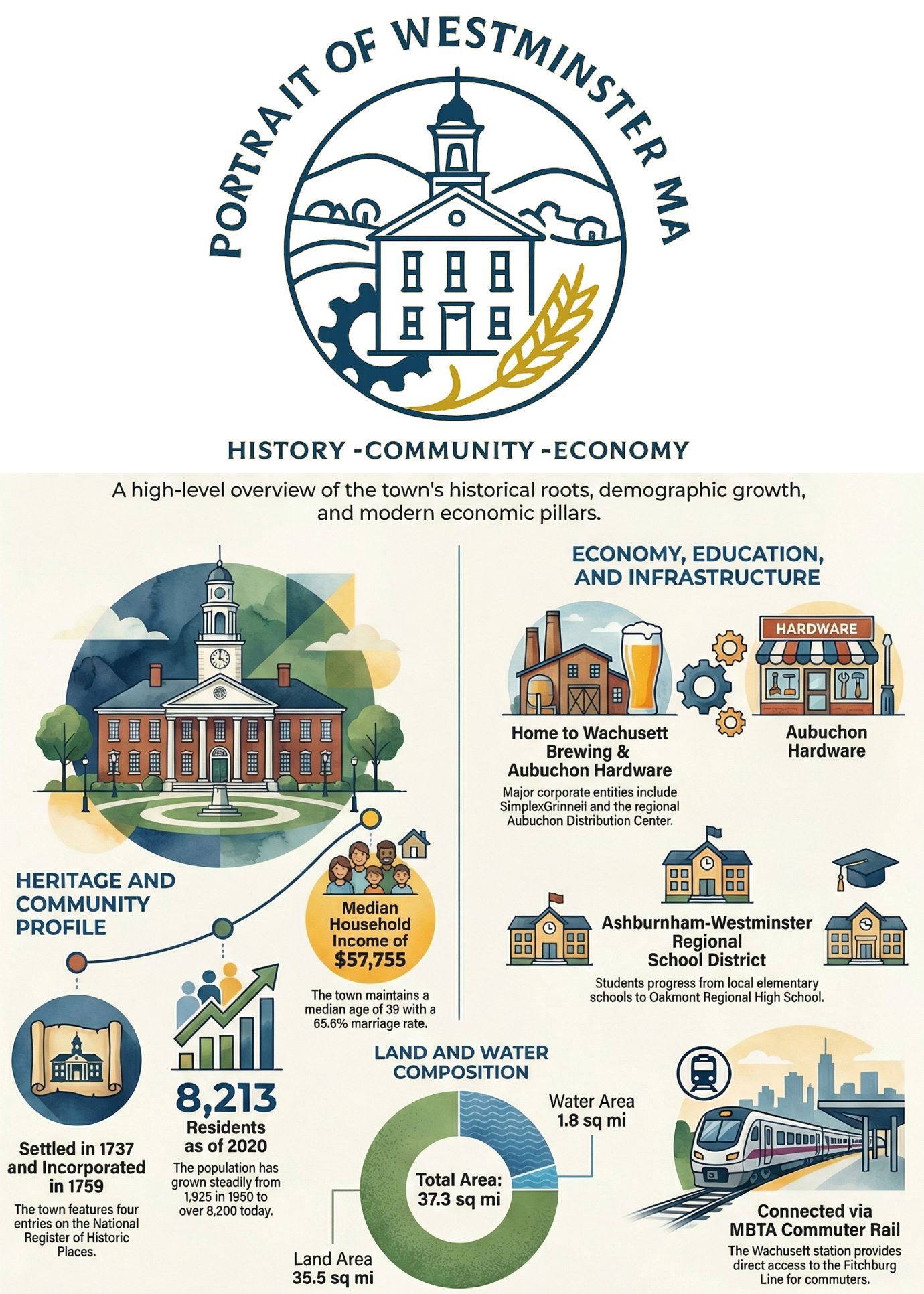
The History and Portrait of Westminster, Massachusetts
Listen to a “Deep Dive” podcast on Westminster MA on any device, CLICK PLAY.
Historical Brief – Westminster MA
Community Profile: Westminster, Massachusetts
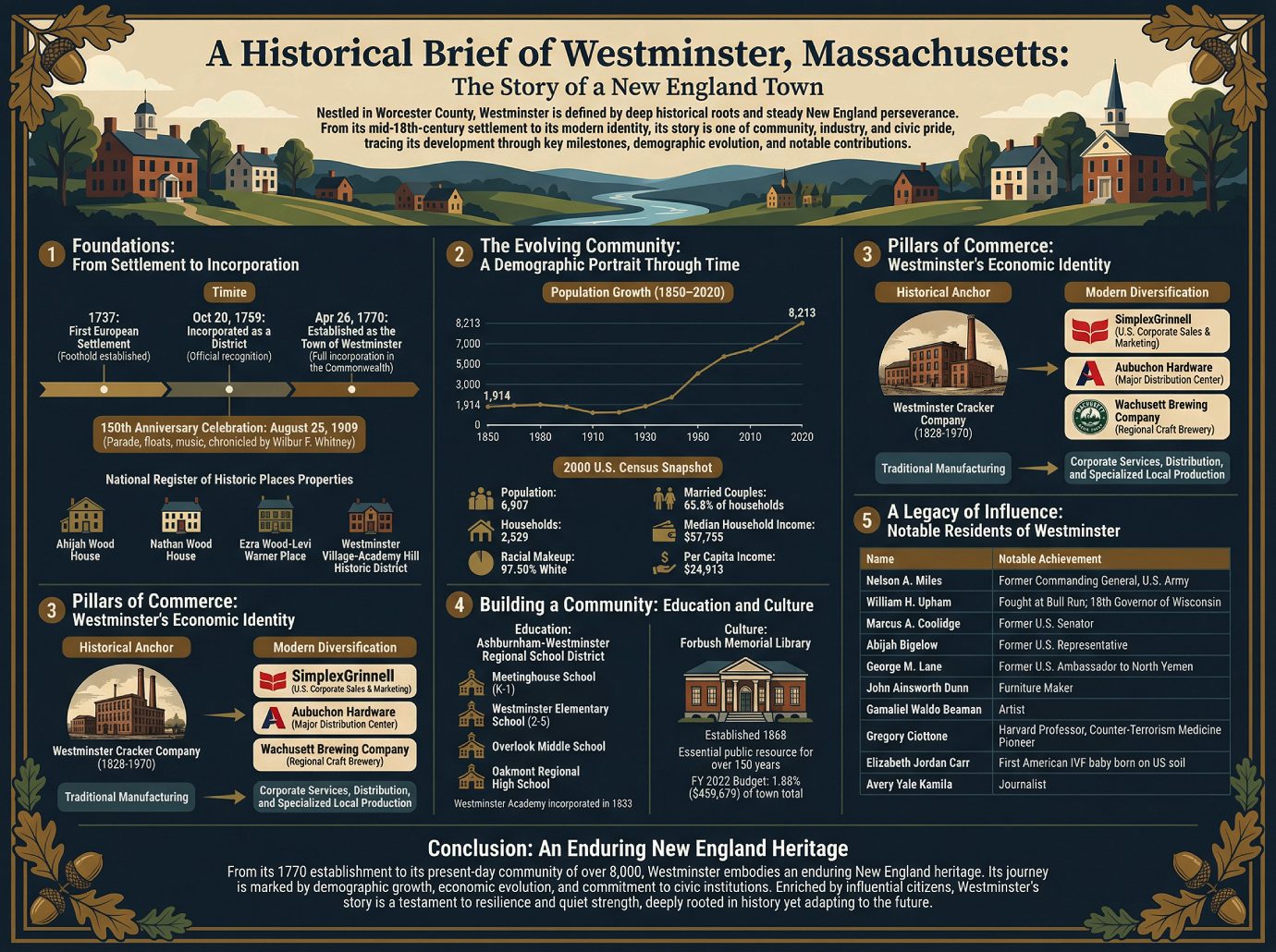
A Historical Brief of Westminster, Massachusetts
A Historical Brief of Westminster, Massachusetts
Introduction: The Story of a New England Town
Nestled in the rolling landscape of Worcester County, Westminster, Massachusetts, is a town defined by its deep historical roots and a legacy of steady New England perseverance. From its origins as a mid-18th-century settlement to its modern identity, the town’s story is one of community, industry, and civic pride. This brief provides a narrative account of Westminster’s history, tracing its development and enduring character through key historical milestones, demographic evolution, and the notable contributions of its citizens.
1. Foundations: From Settlement to Incorporation
The character of a New England town is often forged in its earliest years of settlement and incorporation. For Westminster, this period established a foundation of civic governance and identity that would guide its trajectory for the next two centuries.
Westminster’s formal establishment was a deliberate, multi-decade progression from a frontier outpost to a recognized Massachusetts town. The journey began in 1737 with the first European settlement, a foothold that grew for over twenty years before achieving its next milestone on October 20, 1759, with its official incorporation as a district. The final step in this civic evolution occurred on April 26, 1770, when the community was fully established as the town of Westminster, cementing its place in the Commonwealth.
This deep sense of history was proudly displayed during the town’s 150th anniversary celebration on August 25, 1909. The event, which featured a large parade with floats and music, was meticulously chronicled by Wilbur F. Whitney, preserving a moment of profound civic pride for future generations. Today, tangible links to this past are preserved in the four properties and districts listed on the National Register of Historic Places:
• Ahijah Wood House
• Nathan Wood House
• Ezra Wood-Levi Warner Place
• Westminster Village-Academy Hill Historic District
From these foundational milestones emerged the story of the people who have called Westminster home, shaping its evolution over the subsequent centuries.
2. The Evolving Community: A Demographic Portrait Through Time
The demographic arc of a New England town often tells a story of its economic fortunes. For Westminster, population data reveals a history not of simple growth, but of resilience through periods of struggle followed by dramatic mid-century expansion.
While Westminster’s population grew from 1,914 in 1850 to 8,213 in 2020, its path was not one of uninterrupted expansion. The town experienced several decades of population decline in the late 19th and early 20th centuries, a pattern reflecting broader economic shifts in the region. However, beginning in the 1930s, Westminster entered a period of significant and sustained growth that would continue for the rest of the century, transforming it into the thriving modern community it is today.
A snapshot from the 2000 U.S. Census provides a detailed look at the community at the turn of the century. At that time, Westminster had a population of 6,907 people living in 2,529 households. The town’s racial makeup was predominantly White, at 97.50%. The data reflects a strong family-oriented community, with married couples constituting 65.8% of all households. Economically, the median household income stood at $57,755, and the per capita income for the town was $24,913, indicating a stable, middle-class profile.
This growing and evolving population was supported by an economic base that has shifted from traditional manufacturing to a diverse mix of modern commerce.
3. Pillars of Commerce: Westminster’s Economic Identity
The economic identity of many New England towns is defined by a transition from a singular, dominant industry to a more diversified modern portfolio. Westminster’s commercial history is a textbook example of this evolution, charting a course from a manufacturing past to a contemporary role in corporate services and regional distribution.
For nearly 150 years, the town’s primary economic anchor was the Westminster Cracker Company, a local institution that operated from 1828 to 1970. This long-standing enterprise was a cornerstone of the local economy for generations.
In the contemporary era, Westminster’s economic profile has diversified. The town is now home to several significant businesses that contribute to its modern identity and provide crucial employment opportunities for its residents. Key among these are:
• SimplexGrinnell, which houses its U.S. Corporate Sales & Marketing division in the town.
• Aubuchon Hardware, which operates a major Distribution Center in Westminster.
• Wachusett Brewing Company, a well-known regional craft brewery.
This economic evolution reflects a broader regional trend away from a single manufacturing anchor toward a diversified base of corporate services, distribution, and specialized local production. This blend of corporate presence and local entrepreneurship has provided a stable foundation, allowing the town to invest in the civic and cultural institutions that enrich community life.
4. Building a Community: Education and Culture
A community’s investment in its public institutions, particularly in education and libraries, is a hallmark of the New England civic tradition. Westminster’s history demonstrates a consistent dedication to these pillars, viewing them as essential for nurturing an informed and engaged citizenry.
The town’s dedication to education dates back to its early history, with the incorporation of Westminster Academy in 1833. This commitment continues today through its participation in the Ashburnham-Westminster Regional School District. The district provides a comprehensive public education system serving the town’s students at the following institutions:
• Meetinghouse School (Grades K–1)
• Westminster Elementary School (Grades 2–5)
• Overlook Middle School
• Oakmont Regional High School
A cornerstone of local culture and learning is the Forbush Memorial Library. Established in 1868, the library has served as an essential public resource for over 150 years. The town’s enduring support is evident in its modern budget; in fiscal year 2022, Westminster dedicated 1.88% ($459,679) of its total budget to the library. This commitment to public knowledge, established with the founding of Westminster Academy in 1833, is a civic value that persists today, as evidenced by the town’s significant modern investment in its Forbush Memorial Library.
Ultimately, a town’s character is not only reflected in its institutions but also in the notable individuals it nurtures and produces.
5. A Legacy of Influence: Notable Residents of Westminster
Beyond its own borders, a town’s history is also written through the lives of its people. Westminster has been the proving ground for individuals whose influence has been felt in the highest echelons of the military, federal government, the arts, and scientific innovation, weaving the town’s story into the larger American narrative.
The following table highlights some of Westminster’s most distinguished residents and their accomplishments:
| Name | Notable Achievement |
|---|---|
| Nelson A. Miles | Former Commanding General of the United States Army. |
| William H. Upham | Fought at the Battle of Bull Run; 18th Governor of Wisconsin. |
| Marcus A. Coolidge | Former U.S. Senator. |
| Abijah Bigelow | Former U.S. Representative. |
| George M. Lane | Former U.S. ambassador to North Yemen. |
| John Ainsworth Dunn | Furniture maker. |
| Gamaliel Waldo Beaman | Artist. |
| Gregory Ciottone | Harvard professor, White House Consultant, and pioneering physician in Counter-Terrorism Medicine. |
| Elizabeth Jordan Carr | First American child conceived through IVF to be born on US soil. |
| Avery Yale Kamila | Journalist. |
The diverse accomplishments of these individuals contribute to the rich and multifaceted history of Westminster.
Conclusion: An Enduring New England Heritage
From its formal establishment as a town in 1770 to its present-day standing as a thriving community of over 8,000 residents, Westminster, Massachusetts, embodies an enduring New England heritage. Its journey is marked by significant demographic growth, an economic evolution from traditional industry to modern commerce, and a steadfast commitment to foundational civic institutions like its schools and library. The town’s legacy is further enriched by the influential citizens it has produced, whose contributions resonate far beyond its borders. Westminster’s story is a testament to the resilience and quiet strength of a community deeply rooted in its history yet continually adapting to the future.
——————
Community Profile: Westminster, Massachusetts

Community Profile: Westminster, Massachusetts
1.0 Introduction and Executive Overview
This document provides a comprehensive community profile of Westminster, Massachusetts. It is intended to serve as a foundational resource for strategic planning, economic development initiatives, and grant applications by synthesizing key data points related to the town’s history, geography, demographics, economy, and infrastructure. This profile offers a detailed snapshot of the community’s core attributes, providing essential context for informed decision-making.
The following core identifiers define the town of Westminster:
• County: Worcester
• Government Type: Open town meeting
• Total Area: 37.3 sq mi (96.7 km2)
• 2020 Population: 8,213
• Key Historical Dates: Settled in 1737, Incorporated as a district in 1759
This overview begins by examining the historical foundations that have shaped the town’s character and development.
2.0 Historical Context and Development
This section analyzes the key milestones and historical designations that have fundamentally shaped Westminster’s development trajectory. An understanding of this history is essential for modern planning, as past events inform present-day identity, land use patterns, and civic values.
The town’s official establishment occurred in distinct stages over a 33-year period in the mid-18th century:
• 1737: First European settlement established.
• 1759: Officially incorporated as a district on October 20.
• 1770: Incorporated as a town on April 26.
Westminster demonstrated an early commitment to education with the incorporation of the Westminster Academy in 1833. This legacy is preserved through several historic properties and districts recognized for their significance. Four sites in Westminster are listed on the National Register of Historic Places:
• Ahijah Wood House
• Nathan Wood House
• Ezra Wood-Levi Warner Place
• Westminster Village-Academy Hill Historic District
The town’s long history is intrinsically linked to its physical landscape and strategic location within the region.
3.0 Geography and Regional Setting
Westminster’s geography is a critical factor in land use planning, infrastructure development, and regional economic cooperation. Its significant land area is complemented by substantial water resources, which constitute nearly 5% of its total area, influencing both conservation priorities and development potential. Situated in northern Worcester County, Westminster holds a strategic position bordering several key communities.
Key geographical statistics for the town are as follows:
• Total Area: 37.3 square miles (96.7 km²)
• Land Area: 35.5 square miles (92.0 km²)
• Water Area: 1.8 square miles (4.7 km²), making up 4.90% of the total area.
• Elevation: 1,079 ft (329 m)
Westminster’s location makes it a nexus point in the region, sharing borders with a diverse set of municipalities:
• North: Ashburnham
• East: Fitchburg and Leominster
• South: Princeton
• Southwest: Hubbardston
• West: Gardner
This physical environment provides the setting for the community whose demographic profile is detailed below.
4.0 Demographic Analysis
Demographic data is the cornerstone of effective community planning, directly influencing decisions related to housing, public services, and economic development strategies. This section analyzes Westminster’s population trends and provides a detailed snapshot of its community characteristics.
Population Trends
The historical population data reveals distinct phases of growth, including a period of decline in the late 19th century followed by steady and often rapid growth throughout the 20th and early 21st centuries.
Historical Population of Westminster, 1850–2023
| Year | Population |
|---|---|
| 1850 | 1,914 |
| 1860 | 1,840 |
| 1870 | 1,770 |
| 1880 | 1,652 |
| 1890 | 1,688 |
| 1900 | 1,327 |
| 1910 | 1,353 |
| 1920 | 1,343 |
| 1930 | 1,925 |
| 1940 | 2,126 |
| 1950 | 2,768 |
| 1960 | 4,022 |
| 1970 | 4,273 |
| 1980 | 5,139 |
| 1990 | 6,191 |
| 2000 | 6,907 |
| 2010 | 7,277 |
| 2020 | 8,213 |
| 2023* | 8,377 |
| * = population estimate |
Analysis of the data reveals a period of transformative growth following World War II; the town’s population more than doubled between 1950 and 1990, a key trend indicating its transition into a modern suburban community. The most recent trend shows continued growth, with a 12.9% increase between the 2010 and 2020 censuses and an additional estimated 2.0% increase by 2023.
Community Snapshot (2000 Census Data)
The following detailed demographic data is from the 2000 U.S. Census. It is crucial to note that this 20-year-old data serves as a historical baseline; for any formal planning, grant applications, or strategic initiatives, sourcing more current information from the U.S. Census Bureau’s American Community Survey (ACS) is strongly recommended.
• Racial and Ethnic Composition: The town’s population was predominantly White (97.50%). The Hispanic or Latino population of any race was 1.11%.
• Ancestry: The top five reported ancestries were French (17.6%), Irish (15.0%), French Canadian (13.2%), English (9.0%), and Italian (9.0%).
• Household & Family Structure: The town contained 2,529 households and 1,954 families. Of these households, 36.9% had children under the age of 18, and 65.8% were comprised of married couples living together.
• Age Distribution: The median age was 39 years. The population was distributed with 26.8% under the age of 18, 28.9% between 25 and 44, and 10.9% aged 65 or older.
• Economic Indicators: The median household income was $57,755, and the median family income was $61,835. The per capita income for the town was $24,913. Approximately 3.0% of families and 3.1% of the population lived below the poverty line, including 1.5% of those under age 18 and 5.1% of those age 65 or over.
These demographic and economic characteristics provide a foundation for understanding the town’s economic base.
5.0 Economic Landscape
The economic landscape of a community is a key driver of its vitality and a central focus for development efforts. The town’s economic base must support the steadily growing population identified in the demographic analysis, making the attraction and retention of key employers a strategic priority. This section examines Westminster’s economic identity, acknowledging its industrial history and identifying the major corporate entities that contribute to its current economic base.
For nearly 150 years, the town was known for its industrial heritage as the home of the Westminster Cracker Company, which operated from 1828 until 1970. Today, the town’s documented economic base includes major corporate sales offices and regional distribution centers, highlighting its strategic location within the region.
Key businesses located in Westminster include:
• SimplexGrinnell: The U.S. Corporate Sales & Marketing division.
• Aubuchon Hardware: The company’s primary Distribution Center.
• Wachusett Brewing Company: A prominent regional brewery.
These private enterprises are supported by a framework of public services and infrastructure that serves the broader community.
6.0 Community Infrastructure and Services
The quality of public infrastructure and community services is fundamental to residents’ quality of life and serves as a key factor in attracting new families and businesses. Westminster provides a range of essential services in education, public enrichment, and transportation.
Education System
Westminster is a member of the Ashburnham-Westminster Regional School District.
• Public schools serving the town include:
◦ Meetinghouse School (Grades K–1)
◦ Westminster Elementary School (Grades 2–5)
◦ Overlook Middle School (Grades 6–8)
◦ Oakmont Regional High School (Grades 9–12)
• Vocational and technical education is available to students at the Montachusett Regional Vocational Technical School in nearby Fitchburg.
Public Services
The Forbush Memorial Library stands as a central cultural and educational asset for the community. Established in 1868, the library is a long-standing public institution. In fiscal year 2022, the town demonstrated its commitment to this service by allocating $459,679, or 1.88% of its total budget, to library expenditures.
Transportation Infrastructure
Westminster residents have access to regional public transportation networks for local and commuter travel.
• Local bus service is provided by the Montachusett Regional Transit Authority (MART).
• Regional commuter rail access is available via the MBTA Commuter Rail’s Fitchburg Line, whose western terminus is the Wachusett station located in West Fitchburg.
The town’s physical and social infrastructure is managed and overseen by its system of local and representative governance.
7.0 Governance and Civic Representation
A clear understanding of a municipality’s governance structure and its representatives at the state and federal levels is essential for effective civic engagement and inter-governmental relations. Westminster utilizes a traditional New England form of local government and is represented by officials at the state and federal levels.
Westminster operates under an Open town meeting form of government.
State-Level Representation
• State Representatives: Kimberly Ferguson (R), Jonathan Zlotnik (D)
• State Senator: John J. Cronin (D)
• Governor’s Councilor: Paul DePalo (D)
Federal-Level Representation
• U.S. Representative: Lori Trahan
• U.S. Senators: Elizabeth Warren (D), Ed Markey (D)
This profile provides a data-driven baseline essential for evaluating future development proposals, shaping policy, and pursuing strategic initiatives for the Town of Westminster. ——————
Understanding Westminster, MA: A Demographic Story
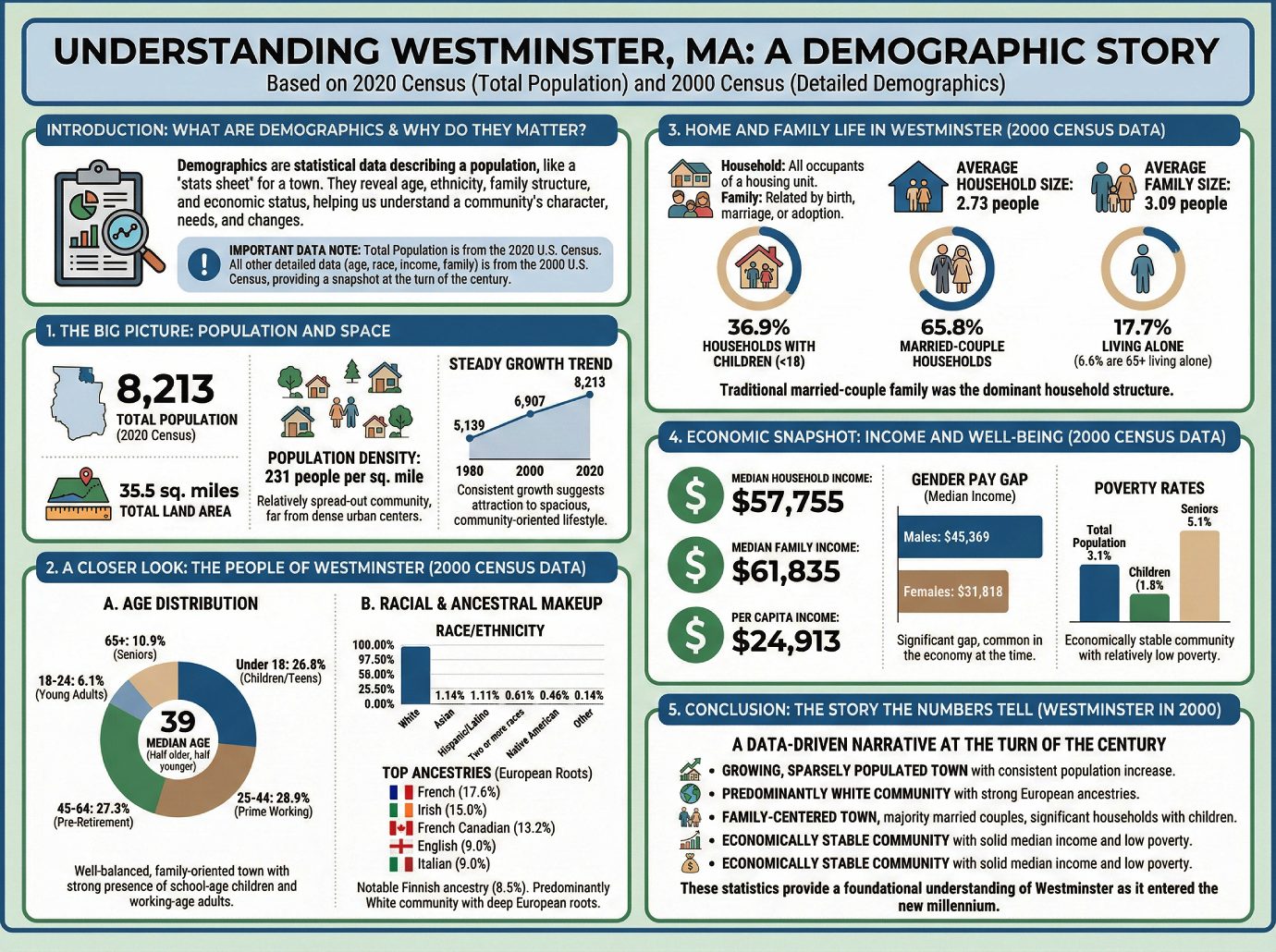
Understanding Westminster, MA: A Demographic Story
Introduction: What are Demographics and Why Do They Matter?
Demographics are the statistical data that describe a population. Think of them as a “stats sheet” for a town, telling us about the people who live there—their age, ethnic background, family structures, and economic status. By studying this data, we can understand the character of a community, identify its needs, and see how it has changed over time. This document explores the demographic data for Westminster, Massachusetts, to paint a clear picture of the people who call it home.
Important Note on Data Sources: The most recent total population figure is from the 2020 U.S. Census. All other detailed demographic data in this report—including age, race, income, and family life—is from the 2000 U.S. Census. This provides a detailed snapshot of the community at the turn of the century.
——————————————————————————–
1. The Big Picture: Population and Space
The most fundamental demographic fact about any place is how many people live there. According to the 2020 census, the total population of Westminster was 8,213.
This population lives across a total land area of 35.5 square miles, resulting in a population density of 231 people per square mile. This number tells us that Westminster is a relatively spread-out community, far from the crowded feel of a dense urban center.
The data also shows a clear trend of steady growth over the last several decades.
| Year | Total Population |
|---|---|
| 1980 | 5,139 |
| 2000 | 6,907 |
| 2020 | 8,213 |
This consistent growth, combined with a low population density, suggests Westminster has long attracted residents seeking a more spacious, community-oriented lifestyle compared to denser urban areas. Now that we know the size of the population, let’s look closer at who these residents are.
——————————————————————————–
2. A Closer Look: The People of Westminster
The following data provides a detailed portrait of the residents of Westminster based on the 2000 Census.
A. Age Distribution
The age breakdown of a community reveals its life cycle, from its youngest members to its seniors. In 2000, Westminster’s population was distributed as follows:
• Under 18: 26.8% (Children and teenagers)
• 18 to 24: 6.1% (Young adults, college age)
• 25 to 44: 28.9% (Prime working years)
• 45 to 64: 27.3% (Experienced workers, pre-retirement)
• 65 and older: 10.9% (Seniors and retirees)
The median age was 39 years. “Median age” is the midpoint of the population’s age range—half the residents were older than 39, and half were younger. This figure, combined with the strong presence of both school-age children and working-age adults, suggests Westminster was a well-balanced, family-oriented town in 2000.
B. Racial and Ancestral Makeup
This data provides a snapshot of the town’s ethnic and racial diversity at the turn of the century.
| Race/Ethnicity | Percentage of Population |
|---|---|
| White | 97.50% |
| Asian | 1.14% |
| Hispanic or Latino | 1.11% |
| Two or more races | 0.61% |
| African American | 0.46% |
| Native American | 0.14% |
| Other races | 0.14% |
In addition to racial identity, residents reported their ancestry, revealing the historical roots of the community. The top five ancestries reported were:
• French (17.6%)
• Irish (15.0%)
• French Canadian (13.2%)
• English (9.0%)
• Italian (9.0%)
Notably, 8.5% of residents also reported Finnish ancestry, pointing to another distinct strand in the town’s historical makeup. Taken together, these numbers indicate that Westminster in 2000 was a predominantly White community with deep and identifiable European roots.
This profile of individual residents naturally leads to the question of how they structured their home lives, from households to family units.
——————————————————————————–
3. Home and Family Life in Westminster
Based on 2000 Census data, we can understand the typical living arrangements in the town. It’s helpful to know the difference between a “household” (all people who occupy a housing unit) and a “family” (a group of people related by birth, marriage, or adoption).
• Typical Household Size: The average household had 2.73 people, and the average family had 3.09 people.
• Households with Children: 36.9% of all households had children under the age of 18 living with them, highlighting a significant family presence.
• Married Couples: 65.8% of all households were married couples living together.
• Living Alone: 17.7% of all households were made up of individuals, and 6.6% of all households consisted of someone 65 or older living alone.
These statistics paint a picture of a community where the traditional married-couple family was the dominant household structure in 2000. The well-being of these households, of course, is closely tied to their economic stability.
——————————————————————————–
4. Economic Snapshot: Income and Well-being
This section examines the financial health of the community using 2000 Census data. “Median income” is a key metric; it represents the midpoint income, meaning half of the group earned more, and half earned less.
• Median Household Income: $57,755
• Median Family Income: $61,835
• Per Capita Income: $24,913 (This is the average income per person).
The data also showed a notable gap in median income between genders, with males earning a median of 45,369∗∗versus∗∗31,818 for females, revealing a significant gender pay gap that was a common feature of the American economy at the time.
Regarding poverty, about 3.1% of the total population was below the poverty line. This rate was lower for children under 18 (1.5%) and slightly higher for seniors age 65 and over (5.1%). Overall, these figures suggest Westminster was an economically stable community with a relatively low level of poverty.
Having reviewed the population, people, families, and finances, we can now pull these threads together to see the complete story.
——————————————————————————–
5. Conclusion: The Story the Numbers Tell
Demographic data is more than just a list of numbers; it tells a story about a place and its people at a specific moment in time. The census data reveals a clear and consistent profile of Westminster at the beginning of the 21st century.
Based on the provided data, this is what Westminster looked like in 2000:
• A growing, sparsely populated town, showing a pattern of consistent population increase over several decades.
• A community with a predominantly White population and strong European roots, particularly French, Irish, and English ancestries.
• A town centered around families, with a majority of households consisting of married couples and a significant percentage of homes having children under 18.
• An economically stable community with a solid median household income and a low overall poverty rate.
Ultimately, these statistics provide a valuable, data-driven narrative, offering a foundational understanding of the community of Westminster as it entered the new millennium. ——————
Welcome to Westminster, Massachusetts: A Quick Guide for New Students
Welcome to Westminster! We’re thrilled to have you join our community and hope this quick guide helps you get acquainted with your new hometown.
Westminster at a Glance – Quick Guide for New Students of History
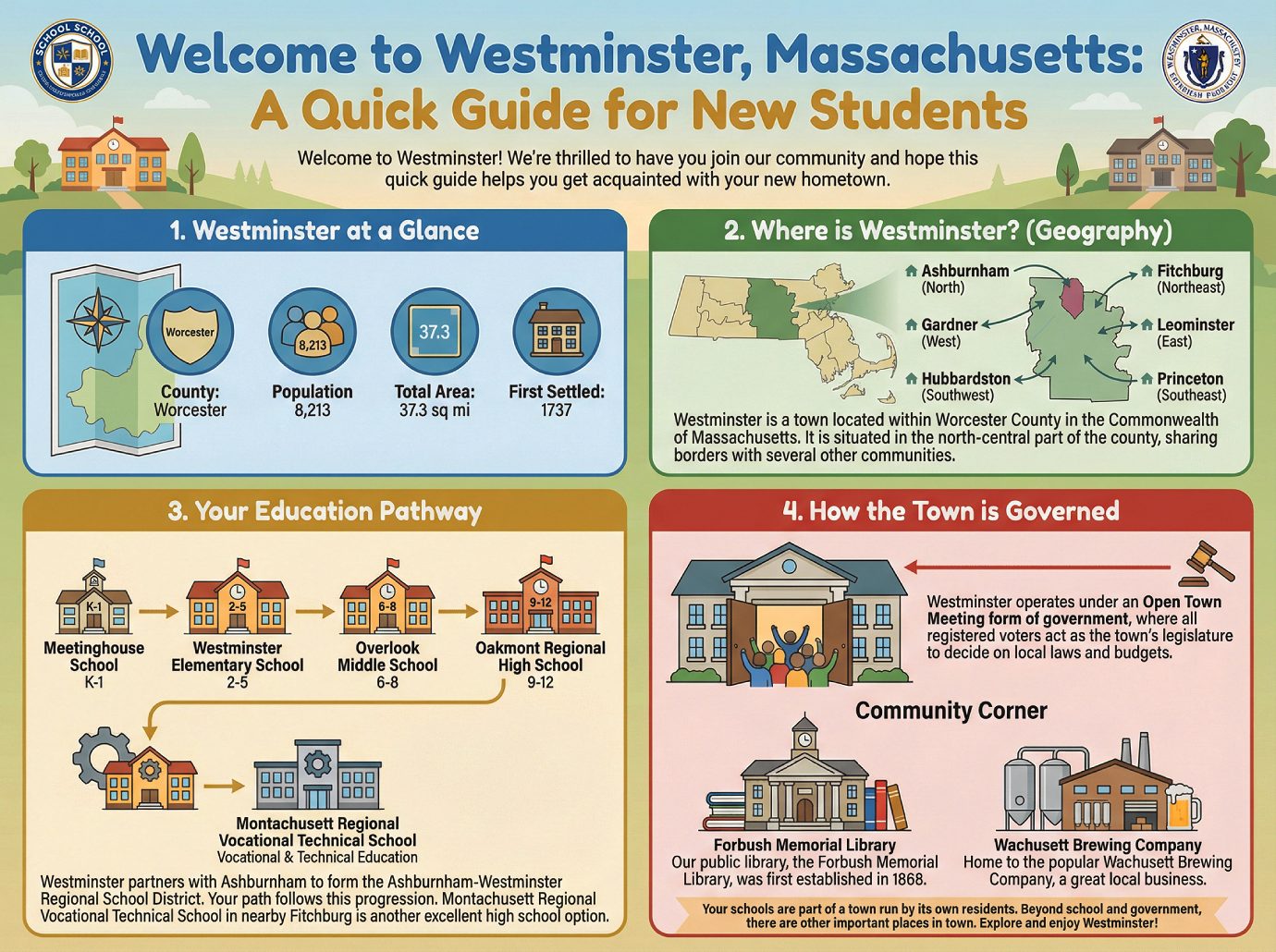
Westminster at a Glance – Quick Guide for New Students of History
County: Worcester Population (2020): 8,213 Total Area: 37.3 sq mi First Settled: 1737
Where is Westminster? (Geography)
Westminster is a town located within Worcester County in the Commonwealth of Massachusetts. It is situated in the north-central part of the county, sharing borders with several other communities.
Neighboring Towns:
• Ashburnham
• Gardner
• Hubbardston
• Princeton
• Leominster
• Fitchburg
Now that you know where Westminster is, let’s look at the schools you’ll be attending.
Your Education Pathway
Westminster partners with the neighboring town of Ashburnham to form the Ashburnham-Westminster Regional School District. Your path through our local schools will follow this progression:
1. Meetinghouse School: Serves students in grades K-1.
2. Westminster Elementary School: Serves students in grades 2-5.
3. Overlook Middle School: Serves students in grades 6-8.
4. Oakmont Regional High School: Serves students in grades 9-12.
For students interested in a vocational and technical education, the Montachusett Regional Vocational Technical School in nearby Fitchburg, one of our neighboring towns to the east, is another excellent high school option.
Your schools are part of a town run by its own residents.
How the Town is Governed
Westminster operates under an Open Town Meeting form of government, where all registered voters act as the town’s legislature to decide on local laws and budgets.
Beyond school and government, there are other important places in town.
Community Corner
Westminster has a vibrant community with many places to explore. Here are a couple of local highlights to get you started:
• Forbush Memorial Library: Our public library, the Forbush Memorial Library, was first established in 1868.
• Wachusett Brewing Company: Home to the popular Wachusett Brewing Company, a great local business. ———————-