
Gardner Businesses – Evidence of a “Model City for America” – Gardner MA – Various Reports

Jump to various reports on this page, CLICK a LINK.
Strategic Economic Assessment and Growth Blueprint: Gardner, MA Business Sector —— Beyond the Chair City: Gardner’s 2026 Registry Data Reveals an Entrepreneurial Renaissance —— Gardner, MA: Commercial Density and Business Corridor Analysis Report (2024-2026) —–Gardner Economic Development Strategy: 2026 Industry Diversity & Sectoral Profile —-Business Anatomy: Deconstructing the Municipal Business Register —–Analyzing the Pulse of Gardner: A Chronological Guide to Business Growth —–
Listen to an interesting discussion with the Chair Man and the Chair Lady documenting why the Gardner Business List evidences Gardner as the “Model City for America.”
Listen to a very interesting Debate on the Gardner Business Landscape with Max and Maxine Rogers on any device, CLICK PLAY.
View this Video on the Gardner Massachusetts Business Landscape.
Strategic Economic Assessment and Growth Blueprint: Gardner, MA Business Sector
Strategic Economic Assessment and Growth Blueprint: Gardner, MA Business Sector
1. Executive Analysis of the Gardner Business Landscape
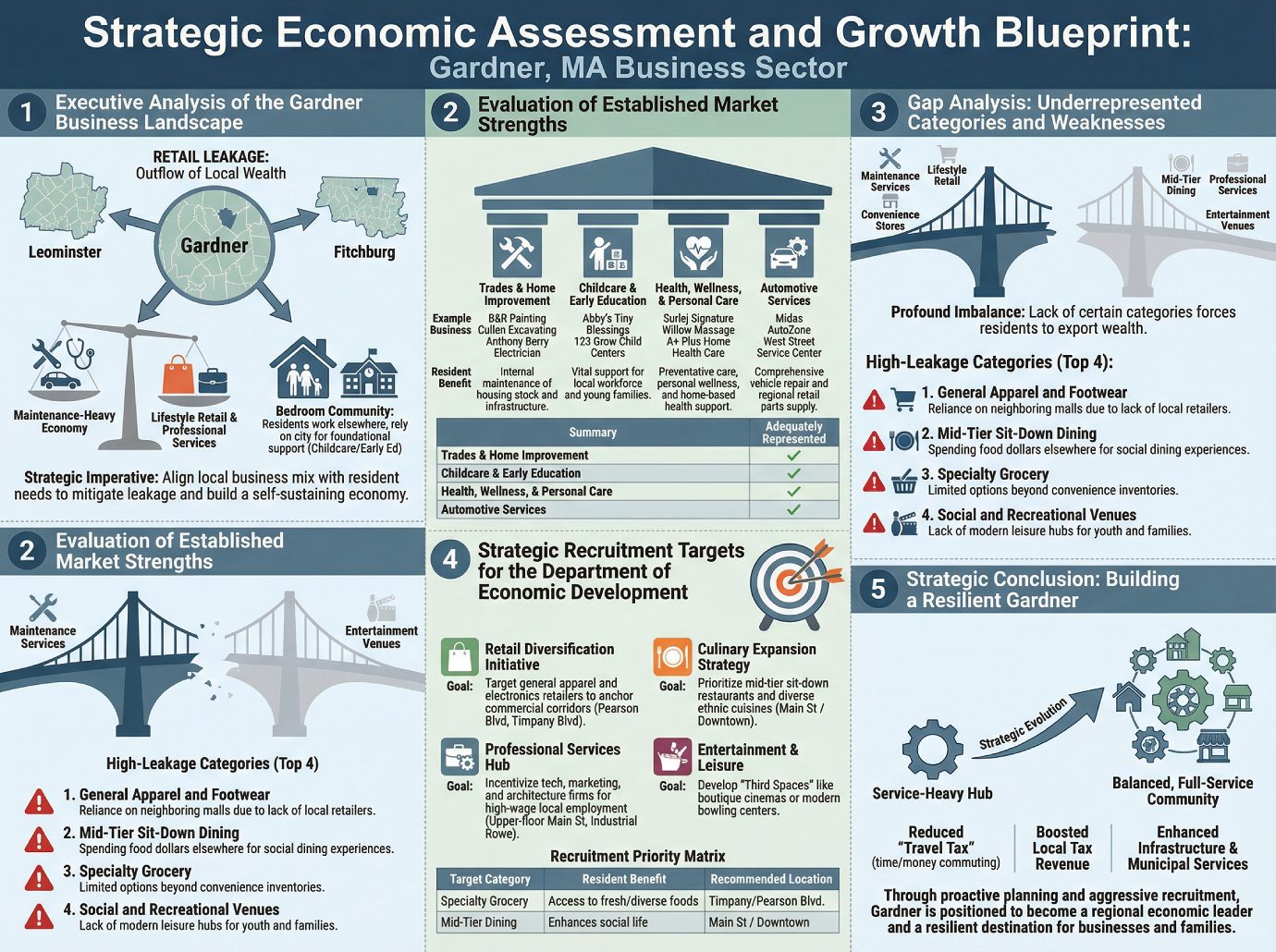
A municipality’s economic health is determined by its ability to capture the spending power of its residents. For Gardner, Massachusetts, the strategic imperative is to align the local business mix with the actual needs of the population to mitigate “retail leakage”—the systemic outflow of local wealth to neighboring commercial hubs like Leominster and Fitchburg. Reducing this leakage is not merely about convenience; it is a critical requirement for building a self-sustaining economy that stabilizes the tax base and funds essential city services.
A thematic analysis of the current business registry confirms a distinct economic identity centered on maintenance and essential support. Gardner currently functions as a “maintenance-heavy” economy, dominated by dense clusters in the Service/Trades, Health/Wellness, and Automotive sectors. Furthermore, a significant cluster of Childcare and Early Education providers indicates that Gardner serves as a “bedroom community,” where residents work elsewhere but rely on the city for foundational family support. The current registry suggests a surplus of blue-collar service firms but a stark deficit in lifestyle-oriented retail and professional corporate services.
This assessment evaluates these established strengths and provides a blueprint for addressing the structural gaps that currently force Gardner’s disposable income outside city limits.
2. Evaluation of Established Market Strengths
Identifying established clusters is the foundation for stabilizing Gardner’s economic floor. These strengths ensure that the city can maintain its physical assets and support its human capital internally, providing a resilient base for future diversification.
Trades and Home Improvement
Gardner possesses an exceptionally deep Trades and Home Improvement cluster. The data confirms a high density of both specialized and general contractors, including B&R Painting, Cullen Excavating, and MJ Blueboard & Plastering. Crucially, the cluster extends “inside the home” with essential licensed services like Anthony Berry Electrician and Miner Leaks Plumbing. This density allows Gardner to maintain its housing stock and commercial properties locally, retaining wealth that would otherwise go to external regional contractors.
Childcare and Early Education
A vital but often overlooked strength in Gardner’s economy is the Childcare and Early Education sector. The registry lists numerous providers, such as Abby’s Tiny Blessings, 123 Grow Child Centers, Gardner Early Learning Center, and Happy Times Daycare. This cluster serves as the backbone for the city’s workforce, supporting its identity as a family-centric community and ensuring that parents can participate in the regional labor market.
Health, Wellness, and Personal Care
The personal care sector is a primary pillar of the local service economy. There is a high frequency of specialized wellness entities, particularly in massage therapy (e.g., Surlej Signature, Willow Massage, Keli Reeves d/b/a Quiet Waters Massage Therapy) and esthetics (e.g., Complexion Perfection, Estética Skin Studio). Additionally, the presence of A+ Plus Home Health Care provides a vital community health infrastructure for the city’s aging population.
Automotive Services
The Automotive sector is a clear regional differentiator. National retailers and service centers like Midas, Meineke, AutoZone, and NAPA operate alongside specialized local firms such as West Street Service Center and Brian’s Auto Body. This concentration transforms Gardner into a regional automotive hub, drawing consumers from smaller surrounding towns for parts and repair.
Summary of Adequately Represented Categories
| Category | Primary Business Entities | Resident Need Fulfilled |
|---|---|---|
| Trades & Construction | B&R Painting, Cullen Excavating, Anthony Berry Electrician, Miner Leaks Plumbing, MJ Blueboard & Plastering | Internal maintenance of housing stock and infrastructure. |
| Childcare & Education | Abby’s Tiny Blessings, 123 Grow Child Centers, Gardner Early Learning Center, Happy Times Daycare | Vital support for the local workforce and young families. |
| Health & Wellness | Surlej Signature, Willow Massage, Complexion Perfection, A+ Plus Home Health Care | Preventative care, personal wellness, and home-based health support. |
| Automotive Services | Midas, Meineke, AutoZone, NAPA, West Street Service Center | Comprehensive vehicle repair and regional retail parts supply. |
| Cleaning & Maintenance | Dragon Fly Cleaning, Blue Summit Cleaning, Zoom Cleaning Service, Purecare Cleaning Services | Professional upkeep of residential and commercial environments. |
The strength of these sectors provides the necessary stability to pivot toward aggressive recruitment of underrepresented industries.
3. Gap Analysis: Underrepresented Categories and Weaknesses
The current lack of certain business categories forces residents to export their wealth to neighboring municipalities. This leakage represents a failure to capture local demand, resulting in lost tax revenue and a diminished quality of life.
Category Representation Analysis
There is a profound imbalance between “maintenance services” and “lifestyle retail.” While the city is well-served by convenience-oriented outlets like A-1 Mart and South Gardner Minimart, there is almost no presence of general apparel or electronics. Currently, clothing is limited to niche players like Aleksa Fashion and Legionary Gearz. Furthermore, Gardner’s dining landscape is over-saturated with fast food and pizza (e.g., West Broadway Pizza, Crown Fried Chicken, Friendly’s), leaving a significant void for mid-tier, sit-down, or diverse international cuisines.
Professional and Technical Services
While Gardner is not entirely devoid of professional services—hosting firms such as Tobia Law Offices, LaRoche Law, Padgett Business Services, and Edward D Jones & Co—the sector lacks diversification. The city suffers from a lack of high-wage “creative class” or corporate services, specifically in the realms of marketing, technology, architecture, and engineering. This forces local businesses and residents to seek high-level consulting outside the city.
Entertainment and Leisure
The data reveals a critical absence of “Third Spaces”—locations other than home or work where residents can socialize. While wellness centers and fitness studios are present, the only notable recreational venue is Fun Never Ends, Inc. The city lacks evening and weekend social anchors, such as boutique cinemas, modern bowling centers, or indoor social-recreational spaces, which are essential for keeping “night-out” spending within Gardner.
High-Leakage Categories (Top 4)
1. General Apparel and Footwear: Near-total reliance on neighboring malls/outlets due to a lack of local retailers.
2. Mid-Tier Sit-Down Dining: Residents spend food dollars elsewhere for non-fast-food social dining experiences.
3. Specialty Grocery: Limited options beyond standard convenience/minimart inventories.
4. Social and Recreational Venues: Lack of modern leisure hubs for youth and families.
The transition to a balanced economy requires converting these spending exports into local growth through active recruitment.
4. Strategic Recruitment Targets for the Department of Economic Development
The Department of Economic Development and Planning must move beyond a role of passive registration. The city’s mandate is to actively prioritize the acquisition of businesses that fill identified gaps.
Retail Diversification Initiative
The Department must target general apparel and electronics retailers to anchor the commercial corridors. Leveraging the high traffic of the Pearson Blvd and Timpany Blvd corridors is essential for attracting brand-name or high-quality independent clothing stores.
Culinary Expansion Strategy
Recruitment must prioritize mid-tier sit-down restaurants and diverse ethnic cuisines (e.g., Mexican, Thai, or Mediterranean) to balance the current pizza-heavy landscape. Transforming the Main St / Downtown area into a dining destination will generate the foot traffic necessary for a vibrant nighttime economy.
Professional Services Hub
Gardner should incentivize the location of tech, marketing, and architecture firms. By promoting the city’s lower overhead and central location, Gardner can offer high-wage local employment, reducing the commute for residents and providing a professional support network for local small businesses.
Recruitment Priority Matrix
| Target Category | Resident Benefit | Recommended Location Type |
|---|---|---|
| Specialty Grocery | Access to fresh/diverse foods; keeps high-frequency spend local. | Timpany Blvd or Pearson Blvd (high visibility). |
| Mid-Tier Sit-Down Dining | Enhances social life; drives evening foot traffic and sales tax. | Main St / Downtown (pedestrian accessible). |
| Apparel & Specialty Retail | Reduces travel time for goods; diversifies retail tax base. | Pearson Blvd Corridor (retail synergy). |
| Professional/Tech Services | High-wage job creation; provides corporate support locally. | Upper-floor Main St or Industrial Rowe. |
Targeted recruitment will transform Gardner from a city people leave to shop, into a destination people visit to stay.
5. Strategic Conclusion: Building a Resilient Gardner
The strategic evolution of Gardner requires a deliberate shift from a service-heavy hub to a balanced, full-service community. The city’s current dominance in trades, automotive, and childcare provides a strong economic floor; however, the growth ceiling is limited by the current retail and professional gaps.
Filling these voids will directly improve the quality of life for residents by reducing the “travel tax”—the time and money spent commuting to neighboring cities for basic lifestyle needs. Furthermore, recapturing this leakage will boost local tax revenue, providing the city with the capital needed to enhance infrastructure and municipal services.
Gardner possesses the foundational infrastructure and a robust service-based business core. Through proactive, data-driven planning and aggressive recruitment of retail and professional entities, Gardner is well-positioned to become a regional economic leader and a resilient, premier destination for both businesses and families.
——————————
Beyond the Chair City: Gardner’s 2026 Registry Data Reveals an Entrepreneurial Renaissance
Beyond the Chair City: Gardner’s 2026 Registry Data Reveals an Entrepreneurial Renaissance
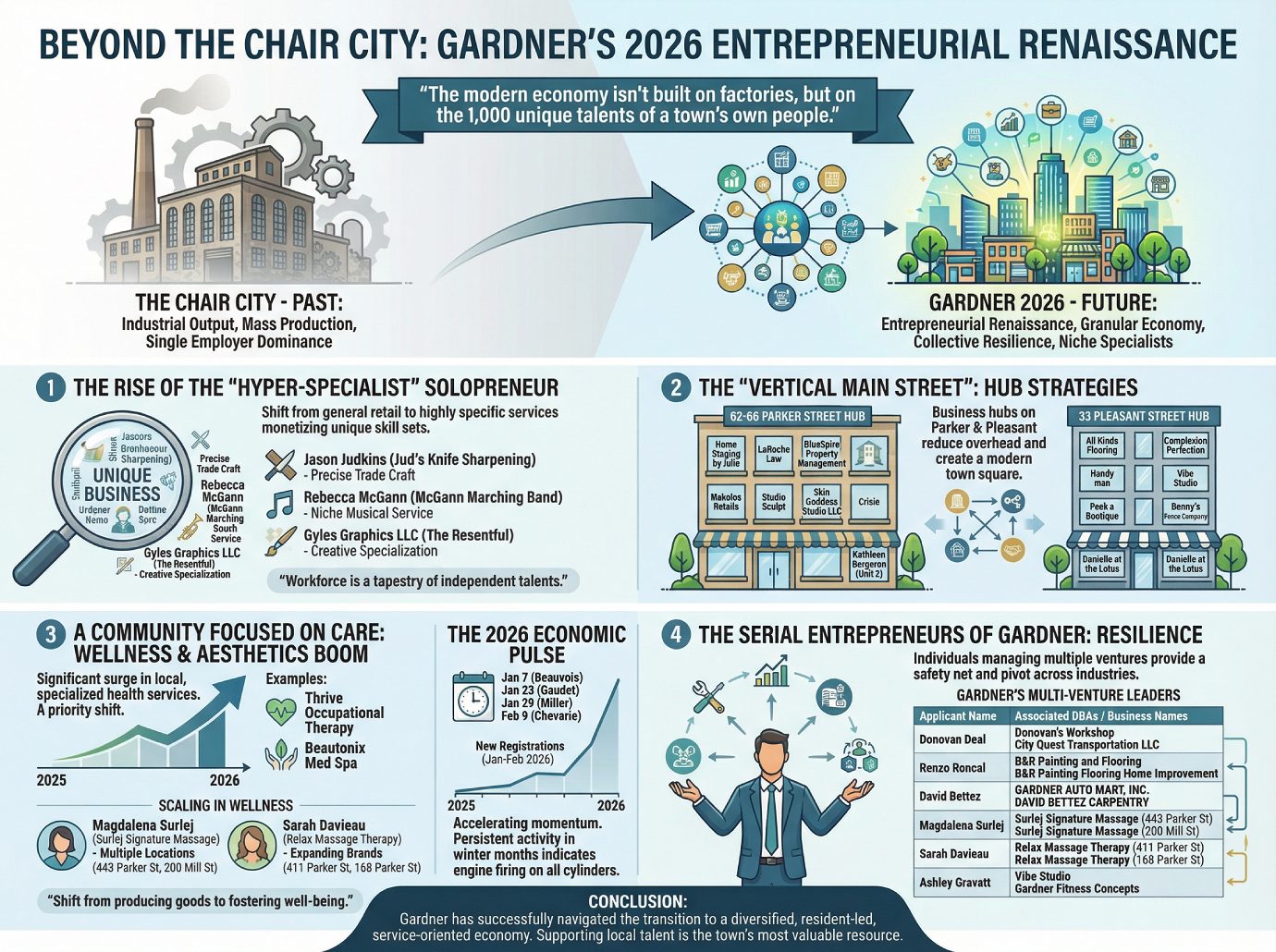
For generations, the economic identity of Gardner, Massachusetts, was inextricably linked to its factory floors. As the “Chair City,” its pulse was measured by industrial output and large-scale manufacturing. In the traditional narrative of New England mill towns, the sunset of such industries often marks the beginning of a long period of stagnation. However, looking at the city’s latest data, that narrative is being rewritten by a wave of residents who aren’t waiting for a new factory to open—they are opening their own doors instead.
The “Gardner MA – Registered Businesses” registry, current through February 2026, acts as a crystal ball for the community’s future. In the first two months of 2026 alone, the city has seen a steady stream of new filings, suggesting an economy that has pivoted from mass production to personal enterprise. We are seeing the birth of a “Granular Economy,” where the strength of the city is found not in one massive employer, but in the collective resilience of hundreds of niche specialists.
This transformation represents a fundamental shift in how small towns survive in the 2020s. By moving from the production of physical chairs to the provision of sophisticated human services, Gardner is evolving into a self-sustaining ecosystem. It is a town in a state of “constant beginning,” where the entrepreneurial spirit has become the primary driver of growth.
The Rise of the “Hyper-Specialist” Solopreneur
The most striking trend in the 2026 data is the emergence of the hyper-specialist. The registry shows a departure from general retail toward highly specific services that monetize unique skill sets. This transition suggests a more sophisticated local marketplace where residents are identifying and filling precise gaps.
Key examples of this trend include Jason Judkins (Jud’s Knife Sharpening) on Washington Street, providing a precise trade craft, and Rebecca McGann (McGann Marching Band) on Lynde Street, showcasing a highly niche musical service. We even see creative specialization in entries like Gyles Graphics LLC (Dominic Gyles-Carter), doing business as the provocatively named “The Resentful.” This granularity indicates that Gardner’s workforce is no longer a monolith of labor, but a tapestry of independent talents.
“The modern economy isn’t built on factories, but on the 1,000 unique talents of a town’s own people.”
The “Vertical Main Street”: Hub Strategies on Parker and Pleasant
Traditional storefronts are being supplemented by a new geographic strategy: the business hub. The registry highlights 62-66 Parker Street and 33 Pleasant Street as primary engines of this growth. These addresses act as “Vertical Main Streets” or incubators, allowing diverse businesses to cluster together, reducing overhead and creating a modern version of the town square.
At the 62-66 Parker Street hub, the variety of commerce is a testament to the city’s diversity:
• Home Staging by Julie (Julia Millar)
• LaRoche Law (Paul A. LaRoche)
• BlueSpire Property Management (Jeremy Haber)
• Makolos Retails (Madeline McLaughlin)
• Studio Sculpt (Chase Hamel)
• Skin Goddess Studio LLC (Christie Rodriguez)
• Crisie (Crisie Marois)
• Kathleen Bergeron (Unit 2)
A similar phenomenon is occurring at 33 Pleasant Street, which has become a vital center for trades and personal care:
• All Kinds Flooring (Colleen MacDonald)
• Complexion Perfection (Cody Franklin)
• Handy man (Ken Griest)
• Vibe Studio (Ashley Gravatt)
• Peek a Bootique (Michael Campbell)
• Benny’s Fence Company (Kris Bennett)
• Danielle at the Lotus (Danielle Faucher)
A Community Focused on Care: The Wellness & Aesthetics Boom
The registry data from 2025 and 2026 reveals a significant surge in health, beauty, and wellness services. This is not merely a trend; it is a priority shift. Residents are increasingly seeking out local, specialized health services like Thrive Occupational Therapy (Kaleigh Ritter) and Beautonix Med Spa (Lauren Gomez).
What is most impressive is the evidence of “scaling” within this sector. Entrepreneurs like Magdalena Surlej (Surlej Signature Massage) and Sarah Davieau (Relax Massage Therapy) are no longer just running single-location shops; they are expanding their brands across multiple locations, such as 443 Parker Street and 200 Mill Street. This suggests that the wellness economy in Gardner has moved beyond the “startup” phase and into a period of established growth.
“The proliferation of wellness services marks a shift in Gardner’s identity—from a town that produces goods to a community that fosters well-being.”
The Serial Entrepreneurs of Gardner
Resilience in a local economy is often built by individuals who manage multiple ventures. The “Multi-Hustle” culture is alive and well in Gardner, with several names appearing repeatedly across the registry. These serial entrepreneurs provide a safety net for the local economy, as they are capable of pivoting between different industries and service models.
Gardner’s Multi-Venture Leaders
| Applicant Name | Associated DBAs / Business Names |
|---|---|
| Donovan Deal | Donovan’s Workshop; City Quest Transportation LLC |
| Renzo Roncal | B&R Painting and Flooring; B&R Painting Flooring Home Improvement |
| David Bettez | GARDNER AUTO MART, INC.; DAVID BETTEZ CARPENTRY |
| Magdalena Surlej | Surlej Signature Massage (443 Parker St); Surlej Signature Massage (200 Mill St) |
| Sarah Davieau | Relax Massage Therapy (411 Parker St); Relax Massage Therapy (168 Parker St) |
| Ashley Gravatt | Vibe Studio; Gardner Fitness Concepts |
The 2026 Economic Pulse
The registry is far from a static historical record; the “Date Submitted” column confirms a state of accelerating momentum. While the list contains legacy businesses, the flurry of activity in early 2026 is impossible to ignore. New registrations from Bryan Chevarie (Feb 9, 2026), Lori Miller (Jan 29, 2026), Shawn Gaudet (Jan 23, 2026), and Ederson Beauvois (Jan 7, 2026) show that the new year has brought a fresh wave of confidence to the local market. This persistent activity, even in the typically slow winter months, indicates that Gardner’s entrepreneurial engine is firing on all cylinders.
Conclusion: Beyond the Registry
The February 2026 data presents a portrait of a Gardner that has successfully navigated the transition from an industrial past to a diversified, service-oriented future. By supporting the person behind the DBA—whether they are a massage therapist, a legal professional, or a property manager—the city has created a resident-led model for growth that is more resilient than any single factory could ever be.
The question for other “secondary cities” in New England is whether they can foster the same organic growth. Gardner’s success serves as a reminder that the most valuable resource a town has is the unique talent of its own people. Supporting a local DBA is more than a transaction; it is an investment in the town’s continued renaissance. —————————————-
Gardner, MA: Commercial Density and Business Corridor Analysis Report (2024-2026)
Gardner, MA: Commercial Density and Business Corridor Analysis Report (2024-2026)
1. Spatial Overview of the Gardner Commercial Landscape
Gardner’s business environment, as evidenced by registration data extending through early 2026, reveals a resilient and diversifying municipal economy. For city planners, investors, and commercial real estate developers, understanding business density is not merely a statistical exercise; it is a prerequisite for strategic infrastructure planning, targeted zoning adjustments, and identifying gaps in the local market. By analyzing the geographic clustering of active registrations, stakeholders can pinpoint where commercial gravity is shifting and where municipal support can be most effectively deployed to sustain growth.
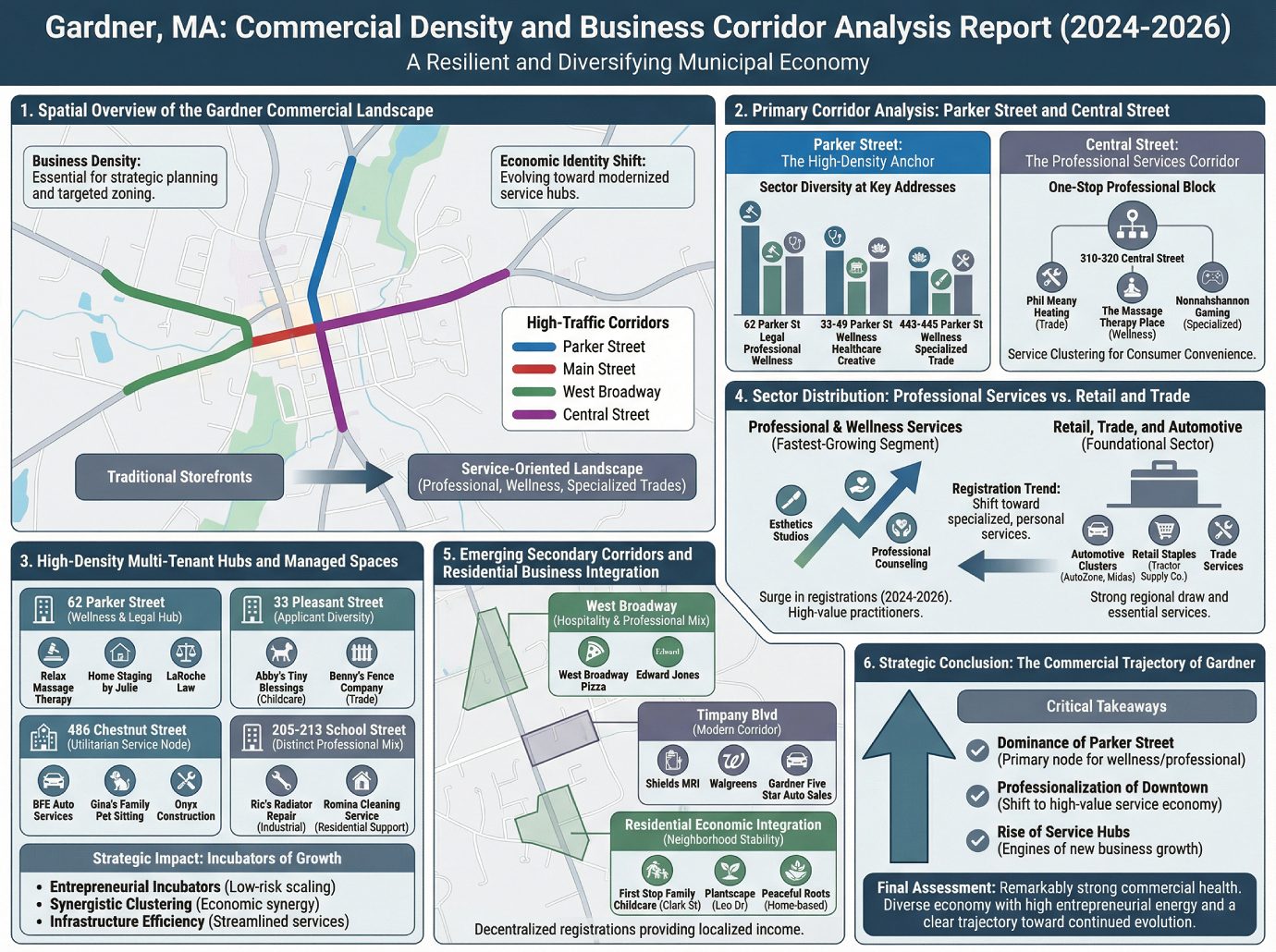
The city’s commercial reach is anchored by several primary arteries that facilitate the bulk of its economic activity. A synthesis of the business registry identifies Parker Street, Main Street, West Broadway, and Central Street as the high-traffic corridors with the highest frequency of registrations. These streets serve as the functional heart of the city, connecting residential zones to essential commercial and professional services.
This spatial distribution reflects a significant transition in Gardner’s economic identity. While traditional storefronts remain vital to the city’s character, the data indicates a pronounced evolution toward modernized service hubs. Gardner is increasingly moving toward a “service-oriented” landscape, where professional practitioners, wellness experts, and specialized trades utilize shared spaces to maximize visibility and operational efficiency in a post-retail era.
2. Primary Corridor Analysis: Parker Street and Central Street
Parker Street and Central Street represent the backbone of Gardner’s professional and retail activity. Their strategic central location makes them ideal for businesses requiring high visibility and accessibility for both local residents and regional visitors.
Parker Street: The High-Density Anchor
Parker Street demonstrates the highest level of commercial density in the city. Addresses such as 62 Parker Street and 33-49 Parker Street serve as multifaceted business nodes, housing a high volume of independent practitioners. The following table highlights the sector diversity at these key addresses:
| Address | Business Name | Sector/Industry |
|---|---|---|
| 62 Parker Street | LaRoche Law, Home Staging by Julie, Relax Massage Therapy, Studio Sculpt | Legal, Professional, Wellness |
| 33-49 Parker Street | Beauty of the Divine, A+ Home Health Care, DOT LINE CURVE CREATIONS | Wellness, Healthcare, Creative |
| 443-445 Parker Street | Surlej Signature Massage, Enviro Contracting Solutions, AMCO Power Washing | Wellness, Specialized Trade |
Central Street: The Professional Services Corridor
Central Street has emerged as a specialized corridor for professional and trade-based services, essentially functioning as a “One-Stop Professional Block.” The complex at 310-320 Central Street is the primary example of this trend. This location acts as a hub for diverse services, including Phil Meany Heating, The Massage Therapy Place (Charlene Shaver), and Nonnahshannon Gaming. The concentration of these diverse providers indicates a movement toward “service clustering,” allowing consumers to fulfill multiple professional and personal needs within a single, centralized location.
Together, these corridors serve as the primary gravity centers for Gardner’s local economy, providing the density required to sustain a vibrant downtown atmosphere while supporting a transition into more sophisticated, service-driven models.
3. High-Density Multi-Tenant Hubs and Managed Spaces
The economic efficiency of multi-tenant hubs is a defining feature of Gardner’s current commercial trajectory. By providing shared infrastructure, these locations lower the barrier to entry for small businesses and independent practitioners, allowing them to establish a commercial presence without the overhead of standalone real estate.
Analysis of Major Multi-Tenant Locations
• 62 Parker Street: This location serves as the city’s premier wellness and legal hub. The data shows a high prevalence of beauty and wellness services (Relax Massage Therapy, Home Staging by Julie) co-existing with established professional firms like LaRoche Law (Paul LaRoche).
• 33 Pleasant Street: This hub demonstrates significant applicant diversity, acting as a home for both specialized childcare, such as Abby’s Tiny Blessings, and trade services like Benny’s Fence Company (Kris Bennett).
• 486 Chestnut Street: This address acts as a “utilitarian service node,” catering to practical residential needs through a unique mix of BFE Auto Services (Meineke Car Care), Gina’s Family Pet Sitting, and specialized contracting like Onyx Construction.
• 205-213 School Street: This location supports a distinct professional mix, housing both industrial services like Ric’s Radiator Repair and residential support services like Romina Cleaning Service.
Strategic Impact: Incubators of Growth
• Entrepreneurial Incubators: These hubs act as vital starting points for Gardner’s entrepreneurial class, offering a low-risk environment for new businesses to scale.
• Synergistic Clustering: The proximity of diverse businesses—such as legal services situated near wellness therapy—encourages local economic synergy and consumer convenience.
• Infrastructure Efficiency: Clustering businesses allows the city to streamline essential services, including waste management, parking, and utility delivery.
4. Sector Distribution: Professional Services vs. Retail and Trade
A resilient municipal economy relies on a balance between physical trade and professional services. Gardner’s registry suggests a robust interplay between these sectors, though the data reflects a clear pivot toward specialized, personal services.
Professional & Wellness Services The “Creative and Professional Class” is the fastest-growing segment of the Gardner registry. Registration dates indicate a surge in this sector between 2024 and 2026, evidenced by Magdalena Surlej’s expansion at 443 Parker Street in early 2025 and Relax Massage Therapy’s registration in late 2024. This sector includes a high volume of esthetics studios (e.g., Complexion Perfection, Skin Goddess Studio) and professional counseling (e.g., Melanie Parker, LMHC). These practitioners gravitate toward shared addresses to benefit from professional environments that match their service profiles.
Retail, Trade, and Automotive The “Physical Goods” and trade sector remains foundational. Gardner maintains strong automotive clusters, including national anchors like AutoZone and Midas alongside local mainstays like Gardner Auto Mart and Brian’s Auto Sales. Retail staples such as Tractor Supply Co. and Aubuchon Ace Hardware provide essential regional draws, while trade services like Phil Meany Heating and Benny’s Fence Company ensure the city remains a hub for regional labor and expertise.
Registration Trends A review of submission timelines reveals that the Professional & Wellness sector is currently showing more frequent new registrations than traditional retail. This trend suggests Gardner is successfully attracting independent, high-value practitioners who view the city as a viable hub for professional growth.
5. Emerging Secondary Corridors and Residential Business Integration
While the downtown arteries remain dominant, Gardner is experiencing a decentralization of its business landscape. Secondary corridors and residential business integration provide essential geographic coverage and neighborhood-level economic stability.
• West Broadway: This corridor features a strategic mix of hospitality and professional services. West Broadway Pizza serves as a food service anchor, while the presence of Edward Jones (Nersida Hodzic) at 696 W Broadway highlights the street’s growing professional appeal.
• Timpany Blvd: This area serves as a modern corridor for large-scale retail and essential healthcare. Key registrations include Shields MRI at Heywood, Chair City Pharmacy, and Walgreens, alongside automotive services like Gardner Five Star Auto Sales.
• Residential Economic Integration: A significant number of registrations are decentralized across residential streets, providing neighborhood stability. These include First Stop Family Childcare on Clark Street, Plantscape (Janet Herrera) on Leo Drive, and Missy Cote on Marquette Street.
Other home-based entities, such as Peaceful Roots (Carlee Mills) on Clark Street, provide critical services directly within neighborhoods. This integration reduces cross-city travel and provides stable, localized income for residents.
6. Strategic Conclusion: The Commercial Trajectory of Gardner
The commercial landscape of Gardner is defined by a successful transition into a service-oriented economy anchored by high-density professional hubs. The high volume of active registrations indicates a city that is maintaining its traditional trade roots while becoming a destination of choice for professional and wellness practitioners.
Critical Takeaways
1. The Dominance of Parker Street: This corridor remains the undisputed center of Gardner’s commercial density, particularly as the primary node for the burgeoning wellness and professional sectors.
2. The Professionalization of Downtown: The concentration of law firms, healthcare providers, and specialized therapy clinics in central corridors indicates a clear shift toward a higher-value service economy.
3. The Rise of Service Hubs: Multi-tenant buildings like 62 Parker Street and 486 Chestnut Street are the engines of new business growth, acting as successful incubators for the city’s independent workforce.
Final Assessment The commercial health of Gardner is remarkably strong. The diversity of industries represented—from industrial radiator repair and fence installation to med-spas and legal services—suggests a balanced economy well-insulated against sector-specific downturns. The high density of active registrations through 2026 points toward a city with high entrepreneurial energy and a clear trajectory toward continued commercial evolution. ————————————
Gardner Economic Development Strategy: 2026 Industry Diversity & Sectoral Profile
Gardner Economic Development Strategy: 2026 Industry Diversity & Sectoral Profile
1. Strategic Economic Overview
Analyzing the distribution of “Doing Business As” (DBA) registrations and registered entities in Gardner provides a vital, “ground-level” view of the city’s entrepreneurial ecosystem. This data serves as a leading indicator of economic health, revealing where local human capital is being deployed and identifying the organic development of industry clusters. For urban planners and city leadership, this granular review is essential for zoning optimization and resource allocation, allowing the city to transition from reactive administration to proactive, data-driven sectoral support.
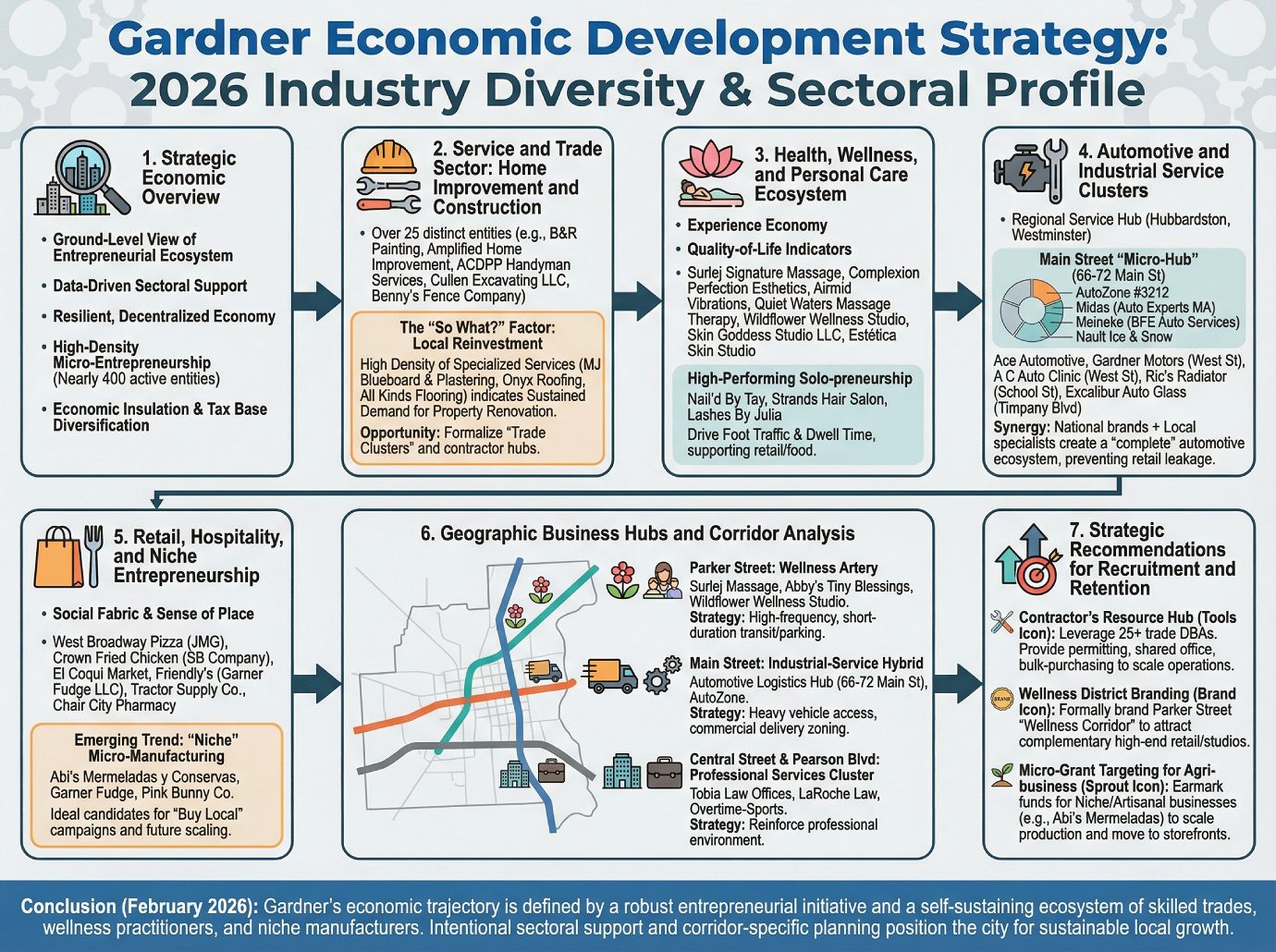
A synthesis of the February 2026 business registry, which encompasses nearly 400 active entities, reveals a resilient, decentralized economy defined by high-density micro-entrepreneurship. This volume of individual proprietors suggests Gardner has successfully cultivated an entrepreneurial pipeline that provides economic insulation against the fluctuations of larger industrial employers. By fostering a diverse web of self-starters, the city is building a robust foundation for tax base diversification. The following sections evaluate the functional pillars that define Gardner’s commercial identity and suggest strategies for future recruitment.
2. The Service and Trade Sector: Home Improvement and Construction
A robust trade sector is a primary indicator of local reinvestment. When a municipality maintains a high density of construction and maintenance businesses, it signifies that property owners are actively preserving and enhancing the city’s housing stock. This sector is a strategic asset for Gardner, supporting a healthy local labor market and ensuring the physical integrity of the city’s infrastructure.
The Gardner registry currently features over 25 distinct entities dedicated to specialized trades and home maintenance. Notable players in this sector include:
• B&R Painting Flooring Home Improvement
• Amplified Home Improvement
• ACDPP Handyman Services
• Cullen Excavating LLC
• Benny’s Fence Company
The “So What?” factor for city leadership lies in the density of specialized services—from MJ Blueboard & Plastering and Onyx Roofing to All Kinds Flooring and KB H20 Systems. This concentration indicates a sustained, high-volume demand for property renovation within the city limits. This presents a clear opportunity for Gardner to formalize these “Trade Clusters” by developing supply-chain support or centralized contractor hubs. Strategic support for these small contractors will ensure that the capital generated by Gardner’s property improvements remains within the local economy.
3. Health, Wellness, and Personal Care Ecosystem
The growth of localized wellness services is a key hallmark of the “Experience Economy.” As a community’s discretionary spending power matures, there is a corresponding rise in specialized health, beauty, and wellness services. These businesses serve as critical quality-of-life indicators, making the city increasingly attractive to young professionals and families.
Gardner’s wellness ecosystem has achieved significant sectoral density, as evidenced by the following variety of practitioners:
• Surlej Signature Massage
• Complexion Perfection Esthetics
• Airmid Vibrations
• Quiet Waters Massage Therapy
• Wildflower Wellness Studio
• Skin Goddess Studio LLC
• Estética Skin Studio
The registry also highlights a trend of high-performing “Solo-preneurship” in the beauty space, including Nail’d By Tay, Strands Hair Salon, and Lashes By Julia. These businesses are vital drivers of foot traffic in commercial corridors such as Parker Street and Main Street. By facilitating “dwell time” through recurring appointments, these wellness professionals provide an indirect subsidy to neighboring retail and food establishments. This personal care infrastructure is the human-centric counterpart to the city’s more industrial service segments.
4. Automotive and Industrial Service Clusters
In a regional hub economy, the automotive sector functions as a strategic infrastructure asset. Gardner serves as the primary service center for surrounding municipalities—such as Hubbardston and Westminster—that lack this concentration of specialized repair and logistics.
The geographic clustering of these services is most evident on Main Street, which has developed into a high-density “Micro-Hub” for automotive logistics.
| Business Entity | Address / Geographic Cluster |
|---|---|
| AutoZone #3212 | 66-72 Main Street |
| Midas (Auto Experts MA) | 66-72 Main Street |
| Meineke Car Care (BFE Auto Services) | 66-72 Main Street |
| Nault Ice & Snow (Joey Nault) | 66-72 Main Street |
| Ace Automotive Service Center | Main Street |
| Gardner Motors LLC (Vilson Auto Sales) | West Street |
| A C Auto Clinic | West Street |
| Ric’s Radiator Repair | School Street |
| Excalibur Auto Glass | Timpany Blvd |
The synergy between national brands and local specialists like Ric’s Radiator Repair or Boyer’s Buggy Bath creates a “complete” automotive ecosystem. This prevents retail leakage by providing residents and regional commuters with every necessary tier of vehicle maintenance in one centralized location. This logistical foundation is essential for supporting the delivery and supply-chain requirements of the city’s retail and food sectors.
5. Retail, Hospitality, and Niche Entrepreneurship
Retail and hospitality businesses serve as the social fabric of Gardner, defining the city’s character and its aesthetic appeal to visitors. Beyond basic commerce, these entities create the communal spaces that foster a distinct sense of place.
Key food and retail entities currently anchoring Gardner include:
• West Broadway Pizza and Seafood (JMG Pizzeria)
• Crown Fried Chicken (SB Company LLC)
• El Coqui Market
• Friendly’s Restaurant (Operated by Garner Fudge LLC)
• Tractor Supply Co.
• Chair City Pharmacy
An emerging trend of note is the rise of “Niche” entrepreneurs such as Abi’s Mermeladas y Conservas, Garner Fudge, and Pink Bunny Co. These entities represent a burgeoning “Micro-Manufacturing” and “Agri-business” segment. From a development standpoint, these artisanal producers are ideal candidates for “Buy Local” marketing campaigns. They represent the high-potential start of a commercial pipeline that could eventually transition from home-based DBAs into larger, permanent food processing or boutique manufacturing facilities.
6. Geographic Business Hubs and Corridor Analysis
Strategic urban planning requires an understanding of how business density shifts across the city’s geography. In Gardner, specific corridors have developed unique economic identities based on their sectoral concentrations.
• Parker Street: This corridor has evolved into the city’s “Service and Wellness” artery. Hosting entities such as Surlej Signature Massage, Abby’s Tiny Blessings, and Wildflower Wellness Studio, it requires transit and parking strategies that accommodate high-frequency, short-duration visits typical of personal care services.
• Main Street: Serving as the industrial-service hybrid heart of the city, Main Street is dominated by the automotive logistics hub at 66-72 Main St and anchors like AutoZone. This corridor requires zoning that supports heavy vehicle access and commercial delivery logistics.
• Central Street & Pearson Blvd: This area is emerging as a “Professional Services Cluster.” In addition to health and sports-related entities like Overtime-Sports, the corridor is home to a legal and administrative hub including Tobia Law Offices and LaRoche Law.
Strategic Interpretation: These geographic identities should guide future zoning. By reinforcing the “Wellness Hub” on Parker Street and the “Professional Cluster” on Pearson Blvd, the city can create a more navigable and attractive environment for complementary business recruitment.
7. Strategic Recommendations for Recruitment and Retention
To maximize Gardner’s economic trajectory, city leadership should shift from passive business registration to an active recruitment and retention model.
1. Contractor’s Resource Hub: Utilizing the high volume of over 25 home improvement and trade DBAs, the city should establish a resource hub. This platform would provide small tradespeople with permitting assistance, shared office infrastructure, and bulk-purchasing cooperatives to help them scale their operations into larger commercial tax-paying entities.
2. Wellness District Branding: Gardner should pursue a formal branding strategy for the Parker Street “Wellness Corridor.” Marketing this area as a regional destination for health and self-care will attract complementary high-end retail, such as health food boutiques or yoga studios, to fill vacant storefronts.
3. Micro-Grant Targeting for Agri-business: Propose targeted micro-grants for the “Niche/Artisanal” businesses identified, such as Abi’s Mermeladas. These funds should be specifically earmarked for scaling production capacity and assisting these micro-manufacturers in moving from residential operations to permanent storefronts within the city’s commercial districts.
As of February 2026, Gardner’s economic trajectory is defined by a robust entrepreneurial initiative. The city has transitioned into a self-sustaining ecosystem of skilled trades, wellness practitioners, and niche manufacturers. Through intentional sectoral support and corridor-specific planning, Gardner is well-positioned for sustainable local growth. ————————————————————————————-
Business Anatomy: Deconstructing the Municipal Business Register
Business Anatomy: Deconstructing the Municipal Business Register
1. Introduction: The Anatomy of a Business Entry
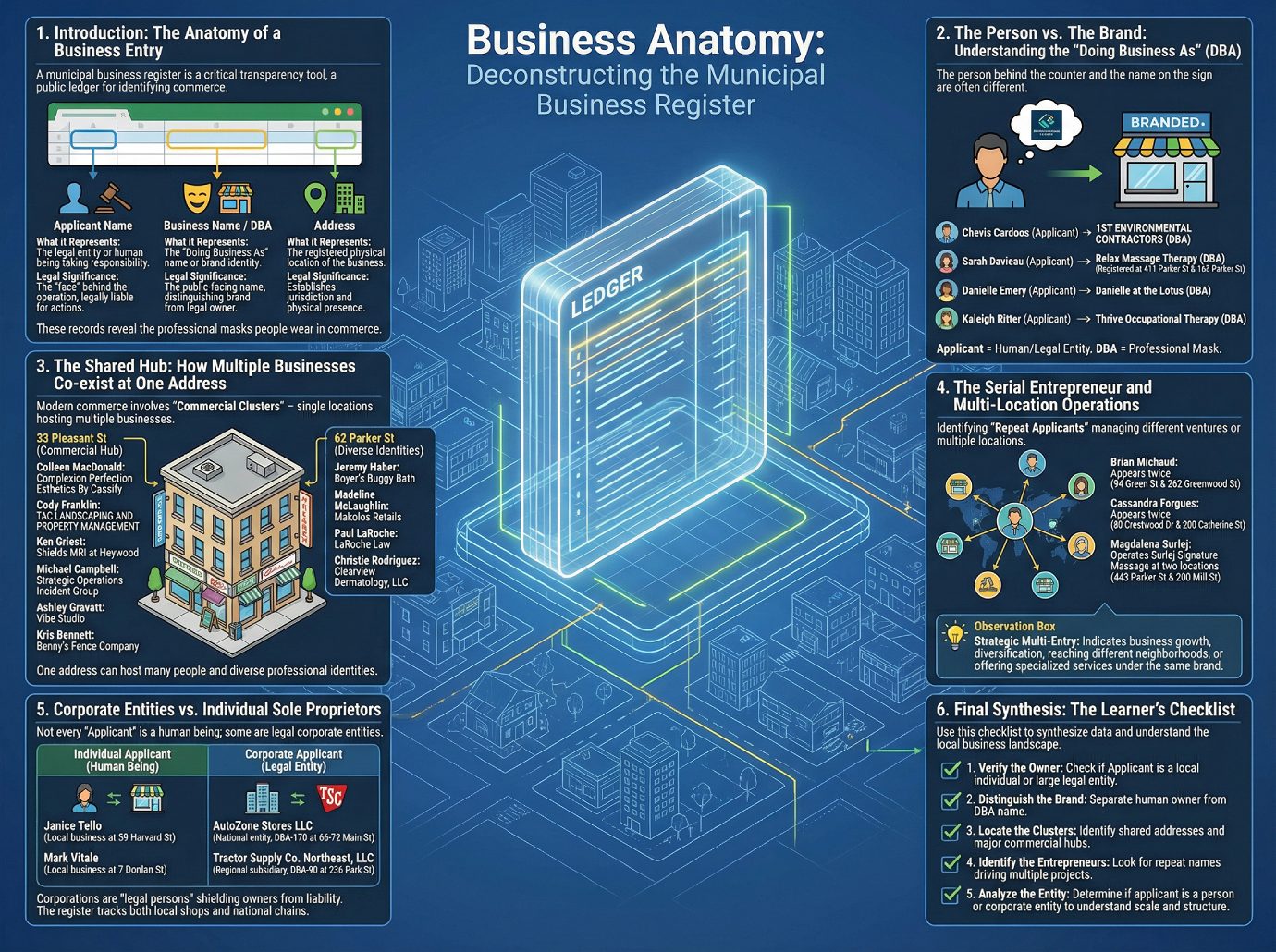
A municipal business register serves as a critical transparency tool for any community. It functions as a public ledger, allowing residents, consumers, and regulators to identify exactly who is conducting commerce within city limits. By maintaining these records, a municipality ensures that businesses are not anonymous entities but are instead accountable to the public.
To understand these records, a student must look at the three core components found in the Gardner business register. While a single line in a spreadsheet might seem mundane, it actually represents a complex legal and professional structure.
The Anatomy Parts
| Component | What it Represents | Legal Significance |
|---|---|---|
| Applicant Name | The legal entity or human being taking responsibility for the business. | This is the “face” behind the operation, identifying who is legally liable for the business’s actions. |
| Business Name / DBA | The “Doing Business As” name or the brand identity used in the marketplace. | This is the public-facing name. It distinguishes the professional brand from the legal owner. |
| Address | The registered physical location where the business is conducted or managed. | This establishes the business’s jurisdiction and physical presence within the community. |
While these records look like simple lists, they reveal the professional masks people wear in commerce, allowing a single individual to present a specific “brand” to the public while remaining the legal foundation of the operation.
——————————————————————————–
2. The Person vs. The Brand: Understanding the ‘Doing Business As’ (DBA)
In the world of business, the person behind the counter and the name on the sign are often different. This is the concept of the DBA (Doing Business As). It allows an individual (the Applicant) to operate under a professional identity that describes their service or creates a specific brand image.
By examining the Gardner register, we can see how individuals use DBAs to transition from their private identity to their professional persona. Note that some individuals, such as Sarah Davieau, use the same brand across multiple registrations to maintain consistency:
• Chevis Cardoos (Applicant) operates as 1ST ENVIRONMENTAL CONTRACTORS.
• Sarah Davieau (Applicant) operates as Relax Massage Therapy (registered at both 411 Parker St and 168 Parker St).
• Danielle Emery (Applicant) operates as Danielle at the Lotus.
• Kaleigh Ritter (Applicant) operates as Thrive Occupational Therapy.
This distinction is vital for learners: the “Applicant” is the human being or legal entity, while the “DBA” is the professional mask they wear to engage with customers.
As we move from who is doing business, we must also look at where that business is physically located, which reveals even more about the city’s economic structure.
——————————————————————————–
3. The Shared Hub: How Multiple Businesses Co-exist at One Address
A common misconception is that one address equals one business. In reality, modern commerce often involves “Commercial Clusters.” These are single physical locations—such as office buildings, retail plazas, or salon suites—that serve as hubs for multiple distinct businesses.
The Gardner records highlight several high-density addresses where diverse applicants and brands co-exist:
This address serves as a primary commercial hub in Gardner, hosting a wide variety of professional services managed by different individuals:
• Colleen MacDonald: Operating as Complexion Perfection Esthetics By Cassify.
• Cody Franklin: Operating as TAC LANDSCAPING AND PROPERTY MANAGEMENT.
• Ken Griest: Operating as Shields MRI at Heywood.
• Michael Campbell: Operating as Strategic Operations Incident Group.
• Ashley Gravatt: Operating as Vibe Studio.
• Kris Bennett: Operating as Benny’s Fence Company.
Another significant hub, this location demonstrates the diversity of professional identities housed within a single structure:
• Jeremy Haber: Operating as Boyer’s Buggy Bath.
• Madeline McLaughlin: Operating as Makolos Retails.
• Paul LaRoche: Operating as LaRoche Law.
• Christie Rodriguez: Operating as Clearview Dermatology, LLC.
Just as one address can host many people, the register also reveals that one person can sometimes be found in many different places.
——————————————————————————–
4. The Serial Entrepreneur and Multi-Location Operations
The municipal register is an excellent tool for identifying “Repeat Applicants.” These are individuals who appear multiple times in the records, usually because they are “Serial Entrepreneurs” managing different types of ventures or because they operate the same business across multiple locations.
Specific examples of operational complexity in Gardner include:
• Brian Michaud: Appears twice, operating at both 94 Green St and 262 Greenwood St.
• Cassandra Forgues: Appears twice, with registrations at 80 Crestwood Dr and 200 Catherine St.
• Magdalena Surlej: Operates Surlej Signature Massage at two distinct locations: 443 Parker St and 200 Mill St.
Observation Box: Strategic Multi-Entry Having multiple entries for a single owner often indicates business growth or diversification. It allows the owner to reach different geographic neighborhoods or offer specialized services under the same brand umbrella at different sites. By registering each location, the entrepreneur ensures each branch is legally recognized by the municipality.
While many entries represent local individual owners, the register also includes large-scale corporate entities that operate on a much broader scale.
——————————————————————————–
5. Corporate Entities vs. Individual Sole Proprietors
Not every “Applicant” is a human being. In many cases, the applicant is a legal corporate entity. While a sole proprietor uses their own name, a corporation is a “legal person” created to conduct business, often shielding the individual owners from direct liability.
The Gardner register clearly distinguishes between these two types of commercial actors:
| Individual Applicant | Corporate Applicant |
|---|---|
| Janice Tello (A human being operating a local business at 59 Harvard St) | AutoZone Stores LLC (A national legal entity, Applicant for DBA-170 at 66-72 Main St) |
| Mark Vitale (A human being operating a local business at 7 Donlan St) | Tractor Supply Co. Northeast, LLC (A regional corporate subsidiary, Applicant for DBA-90 at 236 Park St) |
In the case of corporations, the “Applicant” is the company itself, demonstrating that the municipal register tracks both the smallest local shops and the largest national chains.
——————————————————————————–
6. Final Synthesis: The Learner’s Checklist
When reading a municipal business register, use this checklist to synthesize the data and understand the local business landscape:
1. Verify the Owner: Look at the “Applicant” name to see if the business is run by a local individual (sole proprietor) or a large legal entity (LLC or Corporation).
2. Distinguish the Brand: Separate the human owner from the “DBA” name to understand the professional identity they use to market themselves to the community.
3. Locate the Clusters: Check for shared addresses (like 33 Pleasant St or 62 Parker St) to identify the major commercial hubs and shared professional spaces in the city.
4. Identify the Entrepreneurs: Look for repeat names to find the serial entrepreneurs who are driving multiple projects or expanding a single brand across multiple neighborhoods.
5. Analyze the Entity: Determine if the applicant is a person or a corporate entity to understand the scale and legal structure of the businesses operating in the town. ——————————————————–
Analyzing the Pulse of Gardner: A Chronological Guide to Business Growth
Analyzing the Pulse of Gardner: A Chronological Guide to Business Growth
1. Introduction: From Raw Data to Community Narrative
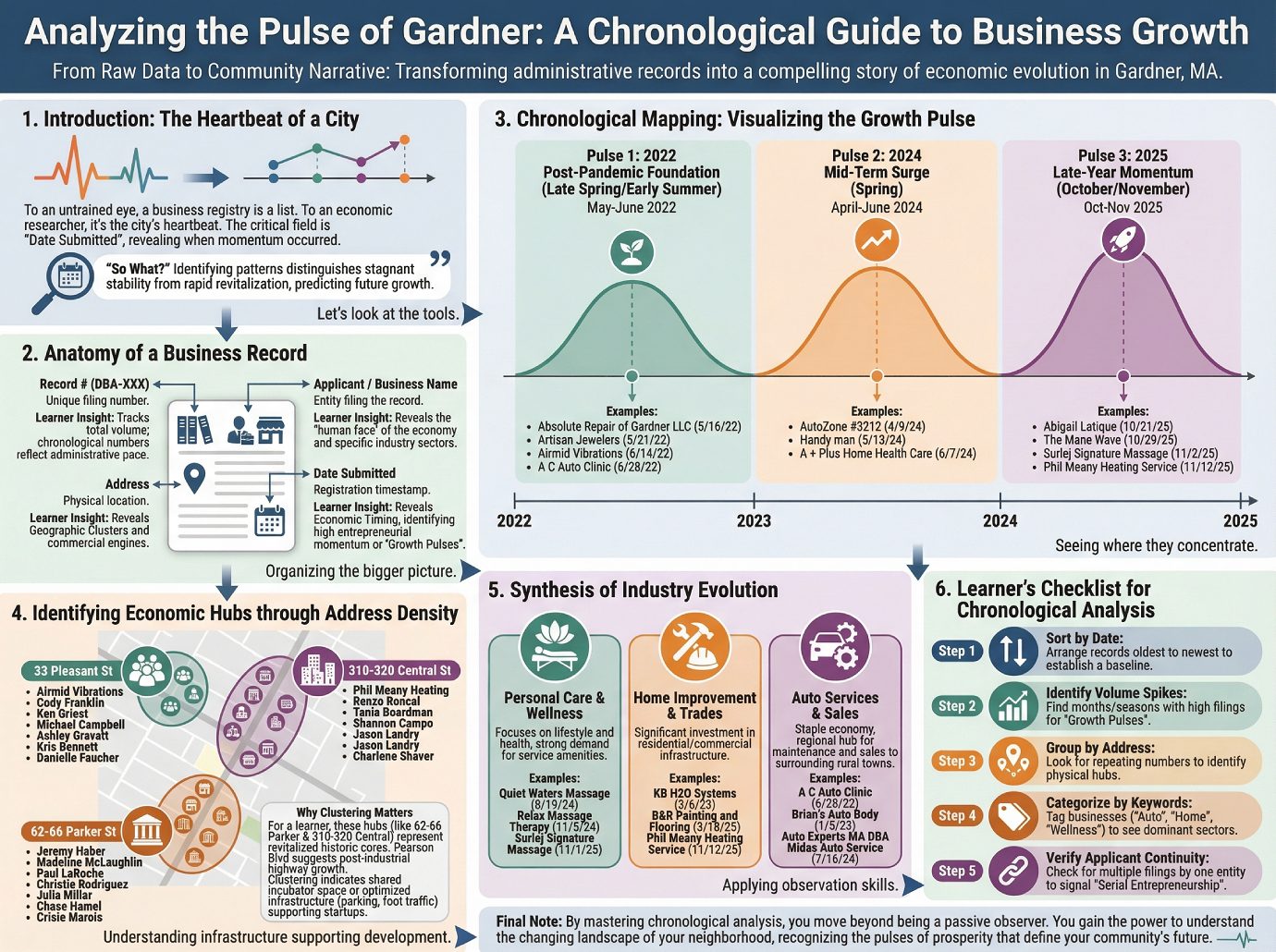
To an untrained eye, a business registry is merely a list of names and numbers. However, for an economic development researcher, these records serve as the “heartbeat” of a city. This guide is designed to help you transform administrative data from Gardner, MA, into a compelling story of economic evolution.
The most critical field in this transformation is the Date Submitted. While a business name tells us who is moving in, the date tells us when the community gained momentum. By interpreting these dates, a learner can identify periods of prosperity, the arrival of new industries, and the density of development. The “So What?” is clear: identifying these patterns allows us to see whether a community is in a state of stagnant stability or rapid revitalization, providing the evidence needed to predict future growth.
Transitional Sentence: Now that we understand why timing matters, let’s look at the specific tools we find within these records.
2. Anatomy of a Business Record
Before we can map the timeline, we must understand the individual data points that make up a business record. Each piece of information offers a unique window into Gardner’s development.
| Record Component | Description | Learner Insight |
|---|---|---|
| Record # (DBA-XXX) | The unique filing number assigned to the business registration. | Helps track the total volume of new businesses; chronological filing numbers reflect the pace of administrative activity. |
| Applicant / Business Name | The name of the individual or entity filing the record. | Reveals the “human face” of the economy and identifies specific industry sectors (e.g., Wellness, Trades, or Retail). |
| Address | The physical location where the business is registered. | Reveals Geographic Clusters, showing which streets or buildings are becoming the city’s commercial engines. |
| Date Submitted | The specific timestamp of the registration. | Reveals Economic Timing, allowing us to identify periods of high entrepreneurial momentum or “Growth Pulses.” |
Transitional Sentence: With the components of the records clear, we can begin organizing them to see the bigger picture.
3. Chronological Mapping: Visualizing the Growth Pulse
By synthesizing the registration data, we can identify three significant “Growth Pulses” between 2022 and 2025. These windows represent periods where Gardner’s economic engine was firing at its highest capacity.
• Pulse 1: The 2022 Post-Pandemic Foundation (Late Spring/Early Summer 2022)
◦ Absolute Repair of Gardner LLC (Record DBA-356) – Registered 5/16/2022
◦ Artisan Jewelers (Record DBA-21) – Registered 5/21/2022
◦ Airmid Vibrations (Record DBA-351) – Registered 6/14/2022
◦ A C Auto Clinic (Associated with Record DBA-371 timing) – Registered 6/28/2022
• Pulse 2: The 2024 Mid-Term Surge (Spring 2024)
◦ AutoZone #3212 (Record DBA-170) – Registered 4/9/2024
◦ Handy man (Record DBA-235) – Registered 5/13/2024
◦ A + Plus Home Health Care (Record DBA-374) – Registered 6/7/2024
• Pulse 3: The 2025 Late-Year Momentum (October/November 2025)
◦ Abigail Latique / Abi’s Mermeladas (Record DBA-349) – Registered 10/21/2025
◦ The Mane Wave (Record DBA-347) – Registered 10/29/2025
◦ Surlej Signature Massage (Record DBA-369) – Registered 11/2/2025
◦ Phil Meany Heating Service (Record DBA-341) – Registered 11/12/2025
Transitional Sentence: Tracking when businesses open is vital, but seeing where they concentrate reveals the community’s “Growth Hubs.”
4. Identifying Economic Hubs through Address Density
In Gardner, business growth is not just a matter of time; it is a matter of place. Certain addresses act as “Growth Hubs,” where multiple businesses cluster together.
| Address | Associated Businesses |
|---|---|
| 33 Pleasant St | Airmid Vibrations (DBA-351), Cody Franklin (DBA-314), Ken Griest (DBA-244), Michael Campbell (DBA-157), Ashley Gravatt (DBA-140), Kris Bennett (DBA-116), Danielle Faucher (DBA-117) |
| 310-320 Central St | Phil Meany Heating (DBA-341), Renzo Roncal (DBA-308), Tania Boardman (DBA-275), Shannon Campo (DBA-205), Jason Landry (DBA-59), Charlene Shaver (DBA-19) |
| 62-66 Parker St | Jeremy Haber (DBA-332), Madeline McLaughlin (DBA-284), Paul LaRoche (DBA-212), Christie Rodriguez (DBA-171), Julia Millar (DBA-50), Chase Hamel (DBA-31), Crisie Marois (DBA-7) |
Why Clustering Matters: For a learner, identifying these hubs is crucial. Addresses like 62-66 Parker St and 310-320 Central St represent the historic commercial core being revitalized through modern occupancy. Conversely, development appearing on Pearson Blvd signals post-industrial highway commercial growth, targeting high-traffic commuters. Clustering indicates a shared business incubator space or a multi-unit commercial center where infrastructure—such as parking and foot traffic—is already optimized to support several small startups simultaneously.
Transitional Sentence: Recognizing these physical clusters helps us understand the infrastructure supporting Gardner’s development.
5. Synthesis of Industry Evolution
As we examine the business names within the timeline, three dominant industry themes emerge. These sectors represent the primary drivers of Gardner’s local economy.
Personal Care & Wellness
This sector focuses on lifestyle and health, indicating a community with a strong demand for service-based amenities.
• Quiet Waters Massage Therapy (Keli Reeves, DBA-69) – Registered 8/19/2024
• Relax Massage Therapy (Sarah Davieau, DBA-373) – Registered 11/5/2024
• Surlej Signature Massage (Magdalena Surlej, DBA-369) – Registered 11/2/2025
Home Improvement & Trades
The volume of specialized contractors suggests significant investment in Gardner’s residential and commercial infrastructure.
• KB H2O Systems (Kyle Banville, DBA-77) – Registered 3/6/2023
• B&R Painting and Flooring (Renzo Roncal, DBA-308) – Registered 3/18/2025
• Phil Meany Heating Service (DBA-341) – Registered 11/12/2025
Auto Services & Sales
Auto services remain a staple of Gardner’s economy. This sector thrives because the city serves as a regional hub, providing essential maintenance and vehicle sales to residents of surrounding rural towns like Templeton and Westminster.
• A C Auto Clinic – Registered 6/28/2022
• Brian’s Auto Body (Associated with DBA-192) – Registered 1/5/2023
• Auto Experts MA DBA Midas Auto Service – Registered 7/16/2024
Transitional Sentence: Having identified the types of businesses fueling the economy, we can now apply these observation skills to any administrative dataset.
6. Learner’s Checklist for Chronological Analysis
To conduct your own analysis of community growth, follow this five-step action plan:
1. Sort by Date: Arrange records from oldest to newest to establish a baseline of when development activity began.
2. Identify Volume Spikes: Look for months or seasons with a high number of filings to pinpoint “Growth Pulses.”
3. Group by Address: Look for repeating street numbers to identify the physical hubs and commercial centers of the local economy.
4. Categorize by Keywords: Tag businesses with terms like “Auto,” “Home,” or “Wellness” to see which industry is dominant.
5. Verify Applicant Continuity: Check if the same individual or entity is filing multiple DBA records, which signals “Serial Entrepreneurship” in the district.
——————————————————————————–
Final Note: By mastering chronological analysis, you move beyond being a passive observer of your city. You gain the power to understand the changing landscape of your neighborhood, recognizing the pulses of prosperity that define your community’s future.