
Historical Figures – Reports by Gardner Magazine
Analysis of History: Historical Figures
Jump to a specific report on this page, CLICK a LINK:
Legacy & Life: Portraits of the People Who Built Our World —–Global and National Influence: A Synthesis of Historically Significant Figures —–Leadership Archetype Analysis: A Strategic Framework of Historical Impact —–From Gears to Wings: The Technological Architects of the Modern Age —–Beyond the History Books: 5 Surprising Truths About the World’s Most Influential Figures —–
Listen to a “Deep Dive” podcast on Historical Figures on any device, CLICK PLAY.
Watch This Video:
Legacy & Life: Portraits of the People Who Built Our World
Legacy & Life: Portraits of the People Who Built Our World
1. Introduction: The Power of Individual Impact
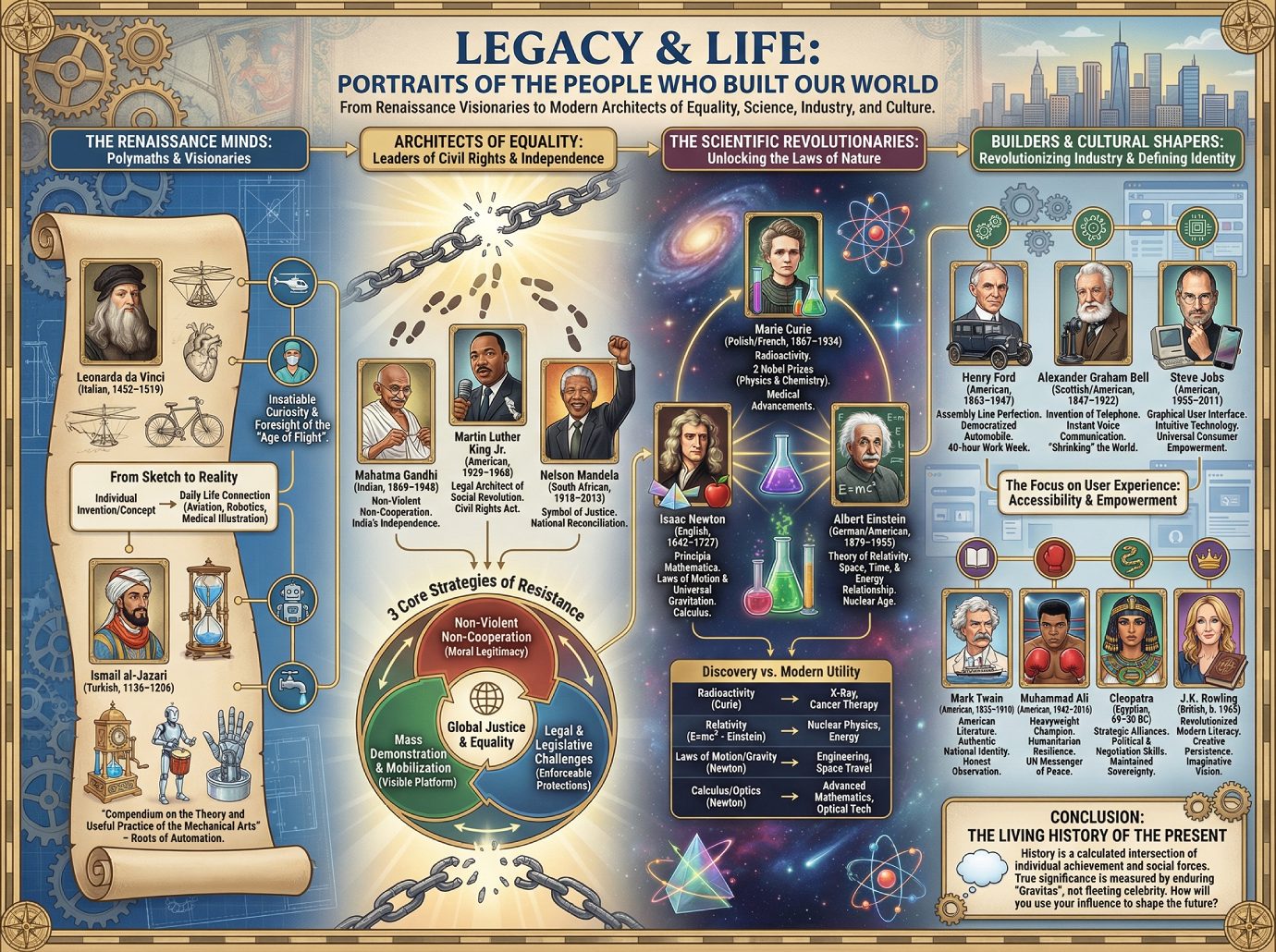
Historical significance is not a matter of random chance; it is a calculated intersection where individual achievement meets social forces and the enduring gravity of memory. To the modern observer, those who rank highest in our collective consciousness are figures whose specific actions directly shaped the daily experience—from the way we labor to the very tools with which we communicate. However, the study of history remains divided by a fundamental philosophical tension: is history driven by “Great Men,” or are individuals merely the convenient faces of inevitable societal shifts?
“The history of the world is the biography of great men,” declared the Scottish historian Thomas Babington Carlyle. Ralph Waldo Emerson, a leading American writer of the nineteenth century, echoed this, claiming that “all history is biography.” This “Great Man” theory suggests that unique individuals are the primary drivers of historical change. Conversely, structuralist historians argue that major events would have occurred regardless of the specific actors involved, viewing individuals as symbols of larger forces.
Whether these figures were truly indispensable or simply the most effective catalysts for change, the common thread linking them all is “influence.” We must ask: does the individual create the moment, or does the moment find the individual? This question finds its first practical answer in the polymaths of the Renaissance, whose mechanical and artistic innovations bridged the gap between abstract genius and the tangible world.
——————————————————————————–
2. The Renaissance Minds: Polymaths and Visionaries
The Renaissance was defined by individuals who refused to be confined to a single discipline. These visionaries combined art, science, and mechanics to foresee technologies centuries before they became reality.
• Leonardo da Vinci: Often cited as the smartest man to have ever lived, Leonardo was the quintessential “Renaissance Man.” His paintings like the Mona Lisa redefined art, but his true genius lay in his foresight of the “age of flight.” Four hundred years before the Wright Brothers took flight at Kitty Hawk, Leonardo’s notebooks were filled with sketches for helicopters and flying wings. His insatiable curiosity extended to human anatomy, fundamentally changing how we understand the biological machine.
• Ismail al-Jazari: A Turkish genius of mechanics, al-Jazari authored the groundbreaking “Compendium on the Theory and Useful Practice of the Mechanical Arts.” His work provided instructions so clear and beautifully illustrated that they have been easily recreated by engineers in this century. During the Crusades, al-Jazari’s work traveled to Medieval Europe, where it is believed he influenced the sketches of Leonardo da Vinci himself. His legacy includes early versions of the alarm clock and humanoid robots, proving that the roots of modern automation reach back to the twelfth century.
From Sketch to Reality
| Individual | Invention / Concept | Daily Life Connection |
|---|---|---|
| Leonardo da Vinci | Helicopter, flying wings, and bicycle sketches | Modern aviation and personal transportation |
| Ismail al-Jazari | Humanoid robots and automated devices | Modern robotics and consumer automation |
| Ismail al-Jazari | Mechanical alarm clocks and hand-washing devices | Daily scheduling and modern hygiene automation |
| Leonardo da Vinci | Detailed anatomical studies | Foundation of modern medical illustration and surgery |
As these early masters unlocked the mechanical potential of humanity, the narrative of history shifted toward the moral and social struggle to ensure that the dignity of the individual was as respected as their ingenuity.
——————————————————————————–
3. Architects of Equality: Leaders of Civil Rights and Independence
The modern landscape of human rights was built by leaders who utilized the power of non-violent resistance to dismantle systems of oppression.
• Martin Luther King Jr.: As a key leader in the American civil rights movement, King acted as the “legal architect” of a social revolution. By organizing marches and leading demonstrations, he secured landmark legislation like the Civil Rights Act. His commitment to non-violent resistance pricked the nation’s conscience, moving the needle toward a world where character outranks color.
• Mahatma Gandhi: Before leading the Indian National Congress, Gandhi spent 21 years in South Africa fighting racial discrimination. This experience forged his “non-violent non-cooperation” approach. By leading India to independence from British colonial rule, he became the primary source of inspiration for global movements, proving that justice could be achieved without taking up arms.
• Nelson Mandela: Mandela’s 27-year resistance against South African apartheid made him a global symbol of justice. Upon his release, he transitioned from prisoner to president, famously fostering national reconciliation in a deeply divided country and proving that the end of oppression is not revenge, but unity.
3 Core Strategies of Resistance
• Non-Violent Non-Cooperation: Refusing to comply with unjust laws through peaceful protest and civil disobedience.
◦ Modern Benefit: Establishes the moral legitimacy required for citizens to challenge authority without resorting to force.
• Mass Demonstration and Mobilization: Using the power of collective presence to demand political change.
◦ Modern Benefit: Ensures the fundamental right to assemble and provides a visible platform for marginalized voices.
• Legal and Legislative Challenges: Combining public activism with high-level legal strategies to overturn discriminatory laws.
◦ Modern Benefit: Results in permanent, enforceable protections for equality and voting rights.
The struggle for social freedom was matched by a parallel revolution in the scientific understanding of the physical world, unlocking the very laws of nature.
——————————————————————————–
4. The Scientific Revolutionaries: Unlocking the Laws of Nature
These individuals transformed our understanding of existence, from the gravity that holds us to the Earth to the subatomic energy that defines our modern era.
• Marie Curie: A pioneer in radioactivity and the first woman to win a Nobel Prize, Curie remains the only person to win them in two different scientific fields (Physics and Chemistry). Her discovery of polonium and radium revolutionized our understanding of atomic structure and directly led to life-saving medical advancements.
• Albert Einstein: Named “Person of the Century,” Einstein’s theory of relativity and the equation E=mc2 fundamentally changed our understanding of space, time, and gravity. His work revealed the relationship between mass and energy, paving the way for the nuclear age.
• Isaac Newton: The author of Principia Mathematica, Newton established the laws of motion and universal gravitation. His work formed the basis of classical mechanics and introduced calculus, the essential tool for analyzing change in the physical world.
Discovery vs. Modern Utility
| Discovery | Individual | Modern Utility |
|---|---|---|
| Radioactivity | Marie Curie | The X-ray and radiation therapy for cancer treatment |
| Relativity (E=mc2) | Albert Einstein | Advancements in nuclear physics and energy |
| Laws of Motion / Gravity | Isaac Newton | Engineering, space travel, and classical mechanics |
| Calculus / Optics | Isaac Newton | Advanced mathematics and optical technology |
The laws of motion that Newton calculated in the seventeenth century would eventually become the assembly lines of the twentieth. In America, this transition was stark: the nation moved from a country where 90% of the population lived as farmers to an industrial giant where only 2% remained on the land, a shift driven by the “Builders and Titans.”
——————————————————————————–
5. Builders and Titans: Revolutionizing Industry and Communication
The titans of industry did more than create products; they pioneered a “User Experience” that changed how the global population lives, works, and interacts.
• Henry Ford: By perfecting the assembly line for the Model T, Ford democratized the automobile. Beyond transportation, he revolutionized labor by popularizing the 40-hour, five-day work week, proving that industrial efficiency could also improve the worker’s quality of life.
• Steve Jobs: A visionary who insisted on the “mouse and graphical user interface,” Jobs made computing accessible to the masses. Through the Macintosh, iPhone, and iTunes, he ensured that technology was navigated through intuition rather than complex code.
• Alexander Graham Bell: The invention of the telephone allowed for instant voice communication across vast distances, effectively “shrinking” the world and laying the foundation for the global telecommunications age.
The Focus on User Experience
The common trait shared by these titans was a relentless focus on the “User Experience.” Whether it was Ford making cars affordable and easy to operate, or Jobs ensuring that a computer could be navigated with simple icons, these leaders understood that technology only changes the world when it is accessible. This approach shifted the global economy from specialized utility to universal consumer empowerment, forever altering the global market.
——————————————————————————–
6. Cultural Shapers: Icons of Literature, Sport, and Social Change
Culture provides the lens through which we view our collective identity. These figures redefined resilience and the power of individual voice.
• Mark Twain: As the “most unsentimental observer of our national life,” Twain defined American literature. His novels like Adventures of Huckleberry Finn captured authentic national identity, influencing generations of writers to observe their world with honesty.
• Muhammad Ali: A heavyweight champion who transcended the ring, Ali served as a “UN messenger of peace.” His activism extended to delivering medical supplies and helping to secure the release of hostages, proving that a professional platform can serve as a conduit for global justice.
• Cleopatra: Ruling Egypt for nearly 30 years, Cleopatra utilized strategic alliances with both Julius Caesar and Marc Antony to maintain her nation’s sovereignty. Her political and negotiation skills proved that women could succeed in the highest levels of male-dominated power structures.
• J.K. Rowling: A role model for creativity and persistence, Rowling’s Harry Potter series captured the world’s heart and revolutionized modern literacy, demonstrating that a single imaginative vision can shape the cultural identity of an entire generation.
The “So What?” for the Aspiring Learner
• Mark Twain: His “unsentimental” style teaches the importance of honest observation as a foundation for cultural influence.
• Muhammad Ali: His humanitarian resilience shows that professional success is most significant when used to advocate for human rights.
• Cleopatra: Her strategic negotiation serves as a foundational lesson in maintaining power through diplomacy and alliance.
• J.K. Rowling: Her creative journey serves as a primary introduction to how persistence can transform a personal vision into a global phenomenon.
——————————————————————————–
7. Conclusion: The Living History of the Present
The figures profiled here prove that history is not a dry ledger of dates, but a living tapestry of people who possessed the courage to stand up for their beliefs. However, in our digital age, we must distinguish between “Internet Memes”—contemporary figures with high name recognition but fleeting impact—and true “Gravitas.”
As historians Steven Skiena and Charles B. Ward suggest, historical significance is an algorithmic measure of how well a reputation is destined to endure despite the “decay” of mindshare over time. While a contemporary star like Justin Bieber may hold immense contemporary fame, he currently lacks the “gravitas” of a figure like Chester A. Arthur, a “forgotten” president who nevertheless remains more historically significant due to the permanent stability of his impact on the American governance structure. Significance is the measure of a reputation that remains stable long after the initial celebrity has faded.
As you reflect on these portraits, consider the challenges of our own era. History is a collection of stories still being written. Like those who came before you, how will you use your influence to shape the future? ———————————
Global and National Influence: A Synthesis of Historically Significant Figures
Global and National Influence: A Synthesis of Historically Significant Figures
Executive Summary
This document provides a comprehensive analysis of the individuals who have most profoundly shaped world history and American society. Synthesizing data from historical rankings, algorithmic analyses, and public sentiment polls, this briefing identifies the core drivers of historical significance across various disciplines.
Critical takeaways include:
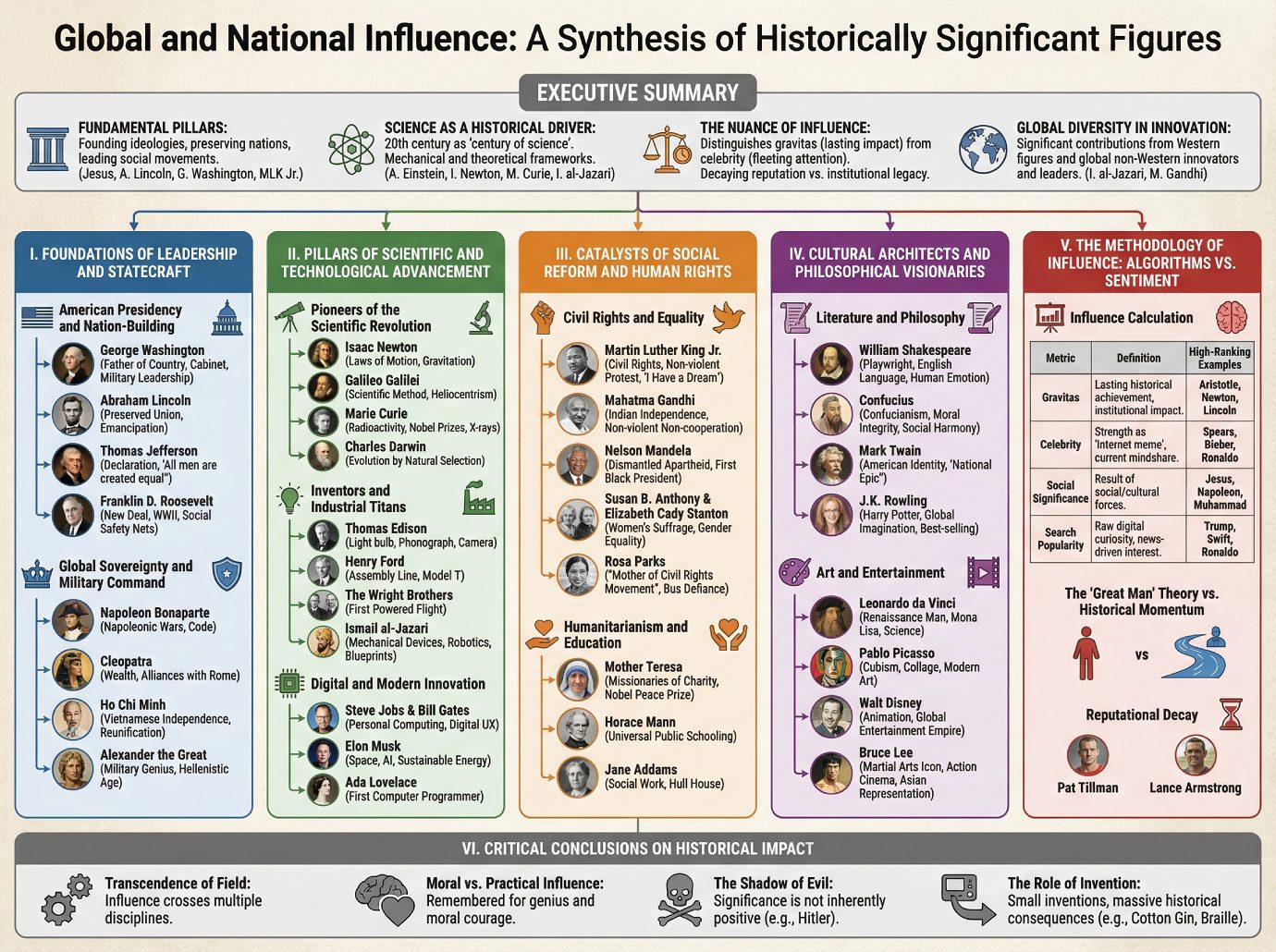
• Fundamental Pillars: Figures such as Jesus, Abraham Lincoln, George Washington, and Martin Luther King Jr. consistently rank at the apex of historical significance due to their roles in founding ideologies, preserving nations, or leading transformative social movements.
• Science as a Historical Driver: The 20th century is characterized as a “century of science,” with Albert Einstein recognized as its preeminent figure. Key contributors like Isaac Newton, Marie Curie, and Ismail al-Jazari provided the mechanical and theoretical frameworks for modern technology.
• The Nuance of Influence: Modern analysis distinguishes between “gravitas” (lasting historical impact) and “celebrity” (fleeting public attention). While figures like Elvis Presley and Donald Trump command massive contemporary “mindshare” or search volume, historical significance is ultimately measured by the long-term “decay” of reputation and the permanence of an individual’s institutional or cultural legacy.
• Global Diversity in Innovation: While Western figures dominate many English-language lists, significant global contributions range from the mechanical inventions of the 12th-century polymath Ismail al-Jazari to the non-violent resistance strategies of Mahatma Gandhi.
——————————————————————————–
I. Foundations of Leadership and Statecraft
The sources emphasize that political leaders are often the primary architects of national identity and global order. Their influence is categorized by their ability to navigate crises, establish legal frameworks, and lead military efforts.
The American Presidency and Nation-Building
• George Washington: Recognized as the “Father of His Country,” Washington is credited with making the United States possible through military leadership and the precedent of declining monarchical power. He established the executive branch and the Cabinet of Advisors.
• Abraham Lincoln: Frequently ranked as the most significant American, Lincoln is lauded for preserving the Union during the Civil War and ending slavery through the Emancipation Proclamation.
• Thomas Jefferson: As the primary author of the Declaration of Independence, Jefferson’s assertion that “all men are created equal” serves as the foundational “five words” of American history.
• Franklin D. Roosevelt (FDR): Led the U.S. through the Great Depression with the New Deal and through World War II, establishing modern social safety nets like Medicare and Medicaid.
Global Sovereignty and Military Command
• Napoleon Bonaparte: A pivotal figure who changed Europe through the Napoleonic Wars and established the Napoleonic Code, which set firm laws for property and individual rights.
• Cleopatra: A female leader who navigated a male-dominated society to make Egypt wealthier and more powerful through strategic alliances with Rome.
• Ho Chi Minh: A transformative leader who fought for Vietnamese independence and successfully reunited the country under communist rule.
• Alexander the Great: A military genius whose conquests brought European influence as far as India, initiating the Hellenistic Age.
——————————————————————————–
II. Pillars of Scientific and Technological Advancement
The progress of human civilization is inextricably linked to individuals who shifted the paradigm of understanding in mathematics, physics, and engineering.
Pioneers of the Scientific Revolution
• Isaac Newton: Established the laws of motion and universal gravitation, forming the basis for classical mechanics.
• Galileo Galilei: The “Father of Modern Science,” who pioneered the scientific method and challenged geocentric views of the universe.
• Marie Curie: The only person to win Nobel Prizes in two different scientific fields (physics and chemistry); her work in radioactivity led to breakthroughs in cancer treatment and x-rays.
• Charles Darwin: Revolutionized the understanding of life through the theory of evolution by natural selection.
Inventors and Industrial Titans
• Thomas Edison: The “Wizard of Menlo Park,” credited with the incandescent light bulb, the phonograph, and the motion picture camera.
• Henry Ford: Transformed transportation and labor through the assembly line and the Model T, making automobiles accessible to the average consumer.
• The Wright Brothers: Successfully achieved the first powered air flight in 1903, ushering in the age of global travel.
• Ismail al-Jazari: A 12th-century polymath whose “Book of Knowledge of Ingenious Mechanical Devices” provided the blueprints for alarm clocks, humanoid robots, and hand-washing devices.
Digital and Modern Innovation
• Steve Jobs and Bill Gates: Co-founders of Apple and Microsoft, respectively, who revolutionized personal computing and the digital user experience.
• Elon Musk: Identified as a modern entrepreneur pushing the boundaries of space travel, artificial intelligence, and sustainable energy.
• Ada Lovelace: Recognized as the world’s first computer programmer for her work on early mechanical computer algorithms.
——————————————————————————–
III. Catalysts of Social Reform and Human Rights
The sources highlight individuals who challenged institutional oppression and advocated for equality, often through non-violent resistance.
Civil Rights and Equality
• Martin Luther King Jr.: The preeminent leader of the American Civil Rights Movement, whose “I Have a Dream” speech and non-violent protests led to the Civil Rights Act of 1964.
• Mahatma Gandhi: Led India to independence from British rule using non-violent non-cooperation, serving as a global inspiration for civil rights movements.
• Nelson Mandela: A global icon for peace who dismantled apartheid in South Africa and became the nation’s first Black president after 27 years of imprisonment.
• Susan B. Anthony & Elizabeth Cady Stanton: Key leaders in the women’s suffrage movement who fought for gender equality and the right to vote.
• Rosa Parks: Often called the “Mother of the Civil Rights Movement” for her defiance of bus segregation in Montgomery, Alabama.
Humanitarianism and Education
• Mother Teresa: A Roman Catholic nun who founded the Missionaries of Charity to serve the “poorest of the poor,” awarded the Nobel Peace Prize for her selfless service.
• Horace Mann: Known as the “Father of American Education” for his tireless advocacy of universal public schooling.
• Jane Addams: A social advocate who co-founded Hull House and pioneered the field of social work.
——————————————————————————–
IV. Cultural Architects and Philosophical Visionaries
Cultural influence is measured by the ability to shape language, narrative, and the collective imagination of society.
Literature and Philosophy
• William Shakespeare: Widely considered the greatest playwright in history; he transformed the English language and explored the full range of human emotion.
• Confucius: An influential philosopher whose teachings on moral integrity, family respect, and social harmony (Confucianism) continue to shape Asian culture.
• Mark Twain: The “author of our national epic,” whose work defined the American identity and influenced generations of writers.
• J.K. Rowling: A modern role model for creativity whose Harry Potter series has captured the global imagination and become one of the best-selling fiction series of all time.
Art and Entertainment
• Leonardo da Vinci: The quintessential “Renaissance Man” whose achievements spanned art (the Mona Lisa), science, and early designs for flying machines.
• Pablo Picasso: A pioneer of Cubism and inventor of collage, recognized as one of the most important figures in 20th-century art.
• Walt Disney: A pioneer of animation and creator of iconic characters; he built a global entertainment empire that wields unmatched influence over childhood.
• Bruce Lee: A martial arts icon and philosopher who revolutionized action cinema and changed the presentation of Asians in American film.
——————————————————————————–
V. The Methodology of Influence: Algorithms vs. Sentiment
A recurring theme in the sources is the debate over how “greatness” or “influence” is calculated.
| Metric | Definition | High-Ranking Examples |
|---|---|---|
| Gravitas | Lasting historical achievement and institutional impact. | Aristotle, Isaac Newton, Abraham Lincoln |
| Celebrity | Strength as an “Internet meme” or current public mindshare. | Britney Spears, Justin Bieber, Cristiano Ronaldo |
| Social Significance | The result of social and cultural forces acting on achievement. | Jesus, Napoleon, Muhammad |
| Search Popularity | Raw digital curiosity or news-driven interest (e.g., Google Search). | Donald Trump, Taylor Swift, Cristiano Ronaldo |
The “Great Man” Theory vs. Historical Momentum
• The “Great Man” Theory: Suggests history is determined by unique, indispensable individuals.
• Event-Driven History: Questions whether events would have unfolded similarly without these specific figures.
• Reputational Decay: Sources note that significance is not just what an individual did, but how well others remember and value them for it over centuries. For instance, while Pat Tillman or Lance Armstrong were highly admired in 2005, their historical standing changed due to scandal or the fading of a specific cultural moment.
——————————————————————————–
VI. Critical Conclusions on Historical Impact
The analysis of these sources suggests that true historical significance requires a combination of high achievement and a lasting “statistical trace” in the collective memory.
1. Transcendence of Field: The most influential people (e.g., Da Vinci, Franklin) often cross multiple disciplines, such as art, science, and politics.
2. Moral vs. Practical Influence: Individuals are remembered both for their genius (e.g., Einstein) and for their moral courage (e.g., MLK Jr.).
3. The Shadow of Evil: Significance is not inherently positive; figures like Adolf Hitler are ranked highly in significance due to the massive—albeit catastrophic—scale of their impact on the 20th century.
4. The Role of Invention: Small inventions can have massive historical consequences; Eli Whitney’s cotton gin is noted for sustaining the empire of slavery, while Louis Braille’s writing system transformed education for the visually impaired. ——————————————
Leadership Archetype Analysis: A Strategic Framework of Historical Impact
Leadership Archetype Analysis: A Strategic Framework of Historical Impact
1. Executive Framework: Defining Historical Leadership Archetypes
Strategic Context
In the contemporary landscape of high-stakes governance and corporate competition, the study of leadership often falters by prioritizing individual personality traits over functional impact. To move beyond biographical summary and into the mechanics of systemic change, modern professionals must analyze historical figures through the lens of archetypes. This framework allows for a diagnostic evaluation of how specific methodologies of influence are deployed against institutional inertia. By categorizing leadership into distinct strategic pillars, we can decode the “So What?” of historical influence—identifying how different models of authority are leveraged to overcome existential challenges or to achieve market-altering disruption within a society or organization.
The Framework Methodology
Synthesizing global historical data reveals three primary pillars of leadership that serve as the engines of systemic transformation:
• Negotiation and Statecraft: The optimization of survival and prosperity through strategic alliances and resource leveraging within established power corridors.
• Political and Military Revolution: The total structural replacement of a defunct regime through long-term ideological persistence and military or legislative innovation.
• Social Activism: The mobilization of moral capital and non-violent resistance to dismantle systemic civil rights barriers.
Archetype Definition Table
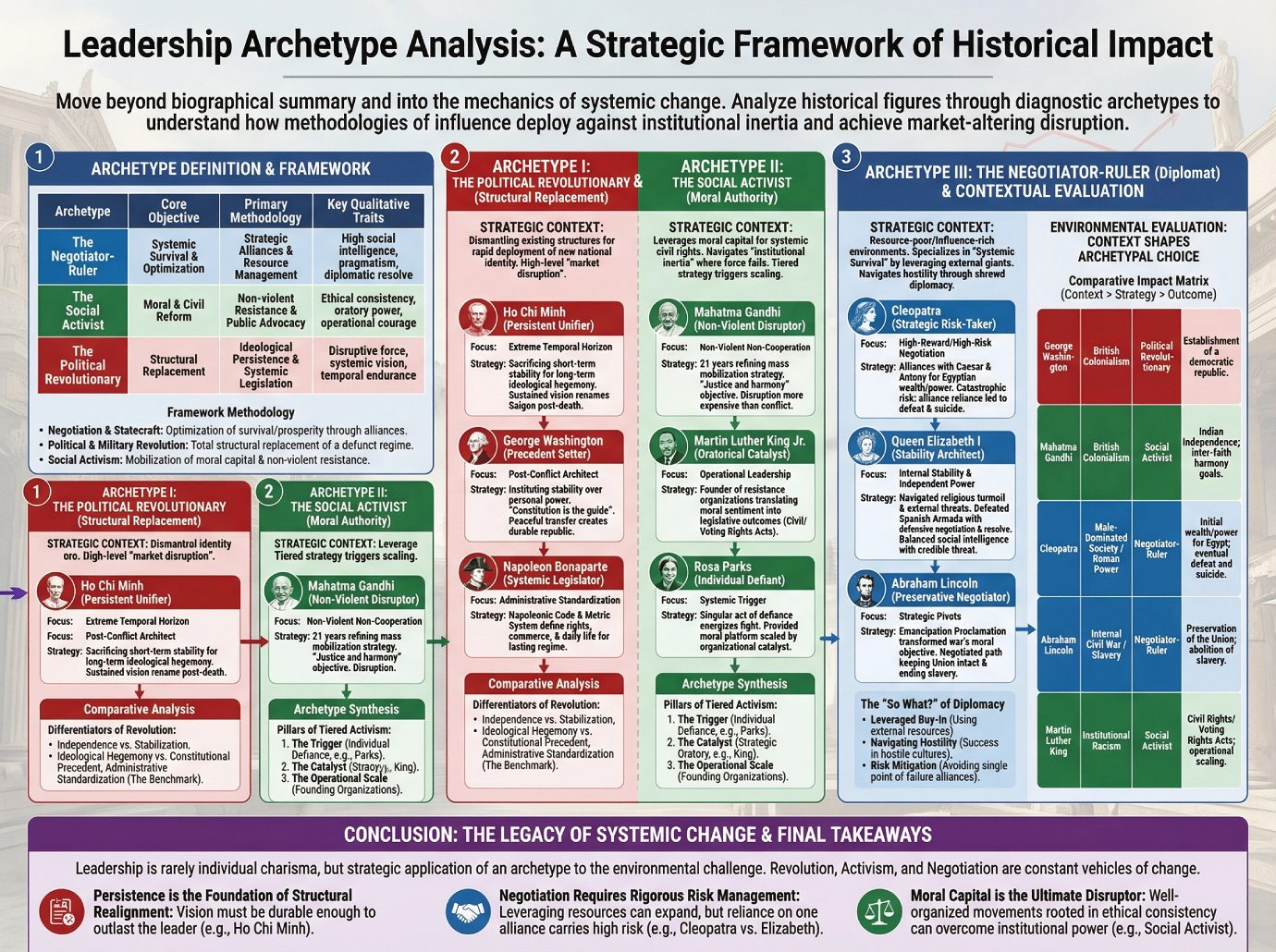
| Archetype | Core Objective | Primary Methodology | Key Qualitative Traits |
|---|---|---|---|
| The Negotiator-Ruler | Systemic Survival & Optimization | Strategic Alliances & Resource Management | High social intelligence, pragmatism, diplomatic resolve. |
| The Social Activist | Moral & Civil Reform | Non-violent Resistance & Public Advocacy | Ethical consistency, oratory power, operational courage. |
| The Political Revolutionary | Structural Replacement | Ideological Persistence & Systemic Legislation | Disruptive force, systemic vision, temporal endurance. |
While these archetypes are theoretically distinct, they often function as a strategic sequence. The transition from theoretical framework to practical application begins with the architects of total structural replacement.
——————————————————————————–
2. Archetype I: The Political Revolutionary and State Architect
Strategic Context
The ‘Political Revolutionary’ is a diagnostic model for leaders who operate when the cost of maintaining the status quo exceeds the projected cost of total systemic collapse. Their strategic mandate is twofold: first, the dismantling of existing power structures; and second, the rapid deployment of a new national identity. For the executive strategist, this archetype represents “market disruption” at the highest level of human organization.
Case Study: Ho Chi Minh (The Persistent Unifier)
Ho Chi Minh’s strategic profile is characterized by an extreme temporal horizon—sacrificing short-term stability for long-term ideological hegemony. His determination to reunite Vietnam under communist rule was sustained through successive conflicts against the Japanese, the French, and the Americans. Though he passed away in 1969, six years prior to the fall of Saigon, his persistence provided the structural momentum that allowed his forces to rename the city in his honor and achieve total independence in 1975. This validates the revolutionary’s reliance on a vision that survives the leader.
Case Study: George Washington (The Precedent Setter)
Washington represents the “Post-Conflict Architect” who prioritizes institutional stability over personal power. His leadership as Commander-in-Chief and the nation’s first president was defined by what he refused to accept: monarchical authority. By declaring that “the Constitution is the guide” and establishing the peaceful transfer of power, he transformed a military victory into a durable democratic republic. Washington understood that for a new system to scale, it must be rooted in precedent rather than the singular will of a victor.
Case Study: Napoleon Bonaparte (The Systemic Legislator)
Napoleon’s impact exemplifies the “Systemic Legislator” who follows military disruption with administrative standardization. Beyond his innovations in warfare, his enduring legacy rests on the Napoleonic Code, which established the first firm laws for property, families, and individual rights in post-revolution France. Furthermore, his creation of the metric system demonstrates how a revolutionary can cement influence by standardizing the very language of commerce and daily life, ensuring the new regime becomes an inescapable reality.
Comparative Analysis: Differentiators of Revolution
• External Independence vs. Internal Stabilization: Ho Chi Minh and Washington focused on expelling colonial powers to achieve autonomy, whereas Napoleon focused on consolidating an internal revolution to prevent a return to chaos.
• Ideological Hegemony vs. Constitutional Precedent: Ho Chi Minh utilized ideological persistence as a unifying force, while Washington used self-restraint to create institutional buy-in.
• Administrative Standardization: Napoleon is the benchmark for using legislative tools (the Code and Metric System) to stabilize a disrupted environment.
——————————————————————————–
3. Archetype II: The Social Activist and Moral Authority
Strategic Context
The ‘Social Activist’ archetype leverages moral capital to achieve systemic civil rights advancements. This model is essential for navigating environments of “institutional inertia,” where raw force is either unavailable or counterproductive. Success here is achieved not through institutional office, but through a tiered strategy where individual defiance triggers a catalyst for operational scaling.
Case Study: Mahatma Gandhi (The Non-Violent Disruptor)
Gandhi’s “non-violent non-cooperation approach” was a calculated diagnostic tool developed over 21 years of fighting racial discrimination in South Africa. This tenure allowed him to refine a strategy of mass mobilization for the Indian National Congress. Gandhi’s objective was not merely political independence from British colonial rule, but the deeper systemic goal of achieving “justice and harmony between people of all faiths.” His model proves that non-violent disruption can be more strategically expensive for an occupier than armed conflict.
Case Study: Martin Luther King Jr. (The Oratorical Catalyst)
While King is often celebrated for his “powerful oratory,” a strategist must also recognize his operational leadership. He was not merely a speaker but a founder of resistance organizations that translated moral sentiment into legislative outcomes. His advocacy was the engine behind the Civil Rights Act of 1964 and the Voting Rights Act of 1965, demonstrating that the Activist archetype is most potent when it marries public sentiment with institutional policy-making.
Case Study: Rosa Parks (The Individual Defiant)
Parks serves as the “Systemic Trigger.” Her refusal to yield her seat on a Montgomery bus was a singular act of defiance that “energized the fight for civil rights.” However, her significance is best understood within a systemic sequence: her individual act provided the moral platform, which was then scaled through King’s organizational catalyst and oratorical reach.
Archetype Synthesis: The Pillars of Tiered Activism
1. The Trigger (Individual Defiance): A singular, symbolic act that exposes the ethical bankruptcy of the status quo (e.g., Parks).
2. The Catalyst (Strategic Oratory): Articulating a vision that resonates with universal values to capture public attention (e.g., King).
3. The Operational Scale (Founding Organizations): Establishing the infrastructure to maintain pressure through boycotts and legal challenges.
——————————————————————————–
4. Archetype III: The Negotiator-Ruler and Diplomat
Strategic Context
The ‘Negotiator-Ruler’ thrives in resource-poor but influence-rich environments. These leaders specialize in “Systemic Survival/Optimization” by leveraging alliances with external giants to achieve internal longevity. This is the model for the leader navigating a male-dominated or hostile landscape through shrewd resource management and high-risk diplomacy.
Case Study: Cleopatra (The Strategic Risk-Taker)
Cleopatra’s leadership is a post-mortem on high-reward/high-risk negotiation. By utilizing “political, social, and negotiation skills,” she formed alliances with Julius Caesar and Mark Antony to make Egypt “wealthier and more powerful through Rome’s resources.” However, a balanced critique must acknowledge the catastrophic strategic risk inherent in this archetype: her reliance on Mark Antony ended in a severe defeat by Octavian, leading to her suicide and the loss of Egyptian sovereignty. She remains a study in the limits of resource-leveraging against a more powerful, aggressive competitor.
Case Study: Queen Elizabeth I (The Stability Architect)
As a “determined female ruler” in a male-dominated era, Elizabeth I navigated internal religious turmoil and external threats to bring prosperity to England. Her defeat of the Spanish Armada in 1588 was a demonstration of defensive negotiation backed by military resolve. Unlike Cleopatra, Elizabeth focused on internal stability and independent power, proving that a Negotiator-Ruler can achieve longevity by balancing social intelligence with a credible threat of force.
Case Study: Abraham Lincoln (The Preservative Negotiator)
Lincoln’s role in “preserving the Union” during the Civil War was achieved through a masterclass in strategic pivots. The Emancipation Proclamation was his most potent tool; it was a military and diplomatic document that transformed the purpose of the war. By changing the conflict’s moral objective, Lincoln successfully negotiated a path that kept the Union intact and ended legal slavery, ensuring the survival of the American system during its most acute internal crisis.
The “So What?” of Diplomacy
• Leveraged Buy-In: Utilizing the resources of a larger entity (Rome) to subsidize internal growth (Egypt).
• Navigating Hostility: Succeeding in cultures that seek to diminish the leader’s agency through intellectual and interpersonal excellence.
• Risk Mitigation: The leader must recognize when an alliance becomes a single point of failure (Cleopatra vs. Elizabeth).
——————————————————————————–
5. Environmental Evaluation: How Context Shapes Archetypal Choice
Strategic Context
The “Absolute Grounding” principle dictates that a leader’s archetype is a direct response to the specific pressures of their era. No leadership choice is made in a vacuum; rather, it is a diagnostic reaction to environmental challenges.
Comparative Impact Matrix
| Leader | Environmental Challenge | Archetypal Strategy Used | Systemic Outcome |
|---|---|---|---|
| George Washington | British Colonialism | Political Revolutionary | Establishment of a democratic republic. |
| Mahatma Gandhi | British Colonialism | Social Activist | Indian Independence; inter-faith harmony goals. |
| Cleopatra | Male-Dominated Society / Roman Power | Negotiator-Ruler | Initial wealth/power for Egypt; eventual defeat and suicide. |
| Abraham Lincoln | Internal Civil War / Slavery | Negotiator-Ruler | Preservation of the Union; abolition of slavery. |
| Martin Luther King | Institutional Racism | Social Activist | Civil Rights/Voting Rights Acts; operational scaling. |
The Evolution of Influence
Historical models of influence provide the blueprint for contemporary leadership. From Washington’s insistence that “the Constitution is the guide” to Gandhi’s refined “non-violent approach,” these archetypes demonstrate that the vehicles of change—revolution, activism, and negotiation—are constant. Whether in the context of statecraft or the modern corporate boardroom, these models represent the only verified methods for overcoming systemic inertia and achieving structural realignment.
——————————————————————————–
6. Conclusion: The Legacy of Systemic Change
The collective impact of these historical archetypes is the foundation of modern civilization. These figures demonstrate that effective leadership is rarely about individual charisma and almost always about the strategic application of an archetype that fits the environmental challenge. Whether through the persistent vision of the Revolutionary, the tiered moral authority of the Activist, or the high-stakes diplomacy of the Negotiator, these leaders proved that systemic change is a deliberate, functional process.
Final Takeaways for Modern Leaders:
1. Persistence is the Foundation of Structural Realignment: As evidenced by Ho Chi Minh, a strategic vision must be durable enough to outlast the leader and adapt to successive challenges.
2. Negotiation Requires Rigorous Risk Management: While leveraging external resources can lead to rapid expansion, as seen with Cleopatra, it carries the risk of total failure if the primary alliance collapses.
3. Moral Capital is the Ultimate Disruptor: The systemic sequence of the Social Activist proves that a well-organized movement rooted in ethical consistency can overcome institutional power that raw force cannot touch. —————————–
From Gears to Wings: The Technological Architects of the Modern Age
From Gears to Wings: The Technological Architects of the Modern Age
1. Introduction: The Great Transition
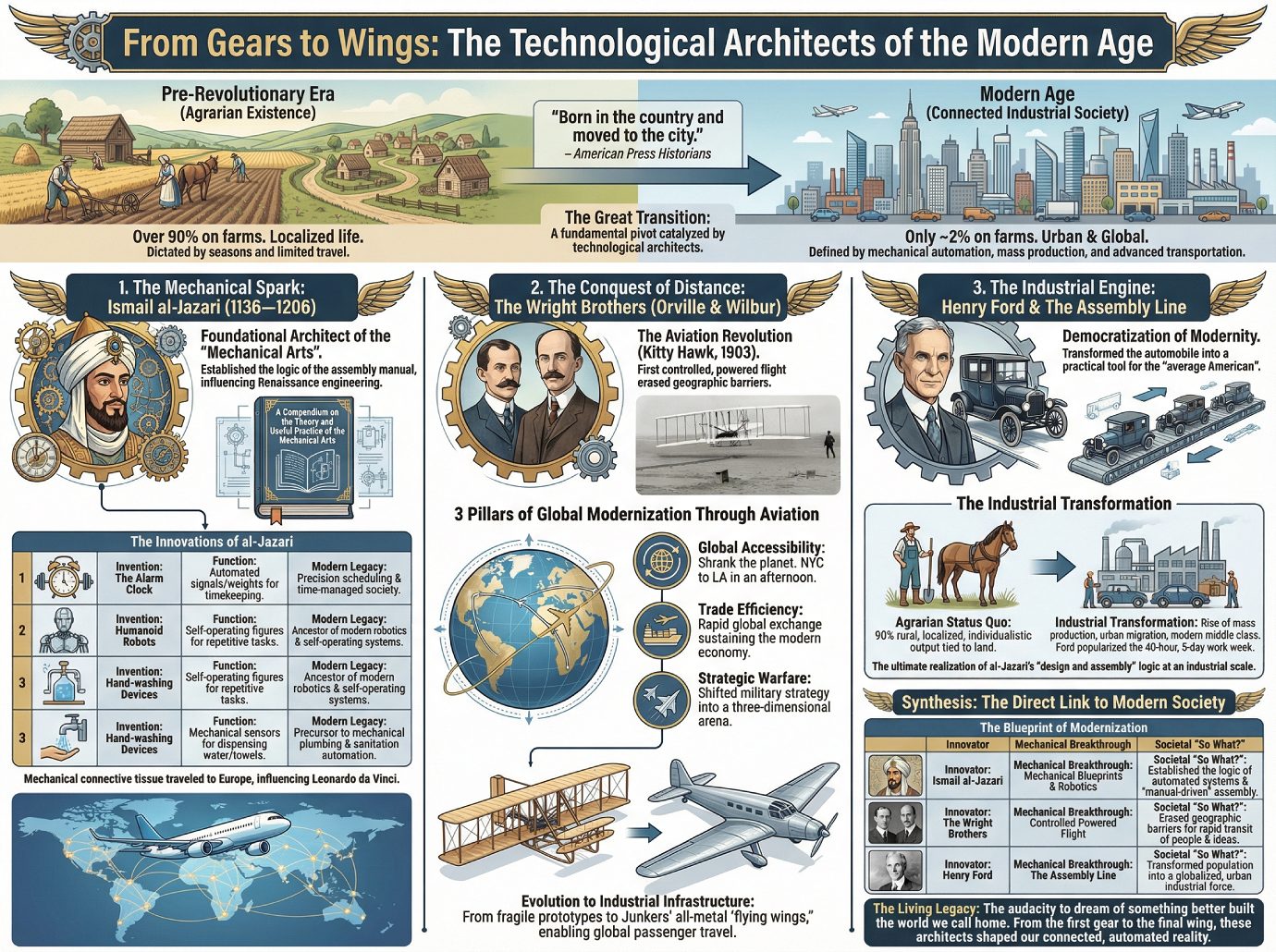
The history of human civilization is marked by a “Great Transition,” a fundamental pivot from a localized, agrarian existence to a connected, industrial global society. As noted by historians at American Press, the United States was “born in the country and moved to the city.” In the pre-Revolutionary era, over 90% of the population lived as farmers, rarely venturing more than a few miles from their birthplaces. Today, that reality has been inverted; the nation has become an industrial giant where only about 2% of the population remains on farms.
This “Modern Age” is defined by mechanical automation, mass production, and advanced transportation systems that have fundamentally redefined human capability. This evolution was catalyzed by specific “technological architects”—visionaries who possessed the audacity to dream of a more efficient reality. To trace the lineage of our automated world, we must look to three distinct milestones: the foundational robotics of Ismail al-Jazari, the aerial conquest of the Wright Brothers, and the industrial democratization of Henry Ford.
To understand our automated world, we must first look back nearly a millennium to a Turkish polymath who turned sketches into self-operating reality.
——————————————————————————–
2. The Mechanical Spark: Ismail al-Jazari and the Birth of Automation
Ismail al-Jazari (1136–1206) was the foundational architect of the “Mechanical Arts.” His seminal work, A Compendium on the Theory and Useful Practice of the Mechanical Arts, was more than a list of inventions; it was a groundbreaking manual that established the logic of the assembly manual. By providing “clear and beautiful” instructions on design, manufacture, and assembly, al-Jazari ensured his mechanical logic could be replicated across centuries—a fact proven by 21st-century engineers who have successfully recreated his machines using only his original blueprints.
His mastery of technical components—such as cams, shafts, and automated signals for timekeeping—provided the mechanical “connective tissue” that eventually traveled to Medieval Europe. This transfer of knowledge heavily influenced the Renaissance, specifically the sketches of Leonardo da Vinci, who drew upon al-Jazari’s logic of automated systems to envision his own mechanical wonders.
The Innovations of al-Jazari
| Invention | Function | Modern Legacy |
|---|---|---|
| The Alarm Clock | A device utilizing automated signals and weights to track time. | Established the logic of precision scheduling and the time-managed structures of modern society. |
| Humanoid Robots | Self-operating mechanical figures designed to perform repetitive tasks. | The direct ancestor of modern robotics and the fundamental logic of self-operating systems. |
| Hand-washing Devices | Automated systems that used mechanical sensors to dispense water and towels. | The precursor to modern mechanical plumbing and the automation of global sanitation infrastructure. |
While al-Jazari mastered the movement of machines on the ground, the next great leap required breaking the bounds of gravity itself.
——————————————————————————–
3. The Conquest of Distance: The Wright Brothers and the Aviation Revolution
The modern era of global connectivity was born at Kitty Hawk, North Carolina, in 1903. Orville and Wilbur Wright were the first to successfully fly a controlled, powered machine heavier than air. This was a revolutionary pivot point for trade and warfare, effectively erasing the geographic barriers that had dictated human movement for millennia.
However, the industry’s rapid evolution required a transition from experimentation to industrial infrastructure. While the Wrights’ initial craft was a “controlled machine” of wood and fabric, the next phase was led by pioneers like Germany’s Hugo Junkers. Junkers transformed aviation into a global transport utility by pioneering all-metal planes and “flying wings,” creating the world’s first passenger aircraft. This shift from the Wrights’ fragile prototypes to Junkers’ robust metal engineering is what eventually enabled the “95 nationalities” of the modern world to bridge continents.
3 Pillars of Global Modernization Through Aviation
• Global Accessibility: Aviation shrank the planet, making it possible for a modern citizen to fly from New York City to Los Angeles in a single afternoon.
• Trade Efficiency: The industry revolutionized the movement of goods, moving beyond slow maritime routes to a system of rapid, global exchange that sustains the modern economy.
• Strategic Warfare: The ability to dominate the skies shifted military strategy into a three-dimensional arena, fundamentally changing the nature of international conflict.
Flight made the world smaller, but it was the efficiency of the factory floor that made the tools of progress accessible to every citizen.
——————————————————————————–
4. The Industrial Engine: Henry Ford and the Democratization of Modernity
If the Wright Brothers gave the world wings, Henry Ford provided the engine for the average citizen. By founding the Ford Motor Company and developing the Model T, Ford transformed the automobile from a luxury for the elite into a practical tool for the “average American.” His true architectural contribution, however, was the Assembly Line. This was the ultimate realization of the “design and assembly” logic first proposed by al-Jazari 700 years earlier, applied to a high-speed industrial scale.
The assembly line triggered a tectonic shift in the structure of human society, facilitating the transition from rural isolation to urban interconnectedness.
The Agrarian Status Quo
Prior to this transformation, 90% of Americans lived in a localized, farmer-based society. Life was dictated by the seasons and the limited distance a horse could travel. Economic output was individualistic, slow, and tied strictly to the land.
The Industrial Transformation
With the rise of mass production, the population migrated to urban centers. This created the template for the modern, urban middle class, supported by advanced transportation and mass communication. Ford solidified this social contract by popularizing the 40-hour, 5-day work week, defining the modern work-life balance.
——————————————————————————–
5. Synthesis: The Direct Link to Modern Society
The society we inhabit today—one defined by speed, automation, and urban density—is the direct result of these three technological architects. They provided the blueprint for a world that has largely conquered both distance and labor.
The Blueprint of Modernization
| Innovator | Mechanical Breakthrough | Societal “So What?” |
|---|---|---|
| Ismail al-Jazari | Mechanical Blueprints & Robotics | Established the logic of automated systems and the “manual-driven” assembly method. |
| The Wright Brothers | Controlled Powered Flight | Erased geographic barriers, allowing for the rapid transit of people and ideas. |
| Henry Ford | The Assembly Line | Transformed the population from rural farmers into a globalized, urban industrial force. |
These individuals succeeded because they had the “audacity to dream of something better.” The fact that a modern reader can board a plane in New York and arrive in Los Angeles by sunset is the living legacy of their ingenuity. From the first gear to the final wing, these architects built the world we now call home. ———————
Beyond the History Books: 5 Surprising Truths About the World’s Most Influential Figures
Beyond the History Books: 5 Surprising Truths About the World’s Most Influential Figures
1. Introduction: The Ever-Shifting Mirror of History
We tend to view history as a gallery of static portraits—faces etched into marble or printed on currency, frozen in a moment of peak importance. Yet, the reality of influence is far more fluid. History is not a fixed ledger but a living algorithm, reshaped by modern data and shifting cultural values. Why is it that George Washington remains a titan of our collective consciousness, while other figures, once equally revered by their contemporaries, have vanished into the footnotes of textbooks?
In an era defined by big data, the way we measure “greatness” is evolving. Influence is no longer merely a tally of deeds; it is a measure of how effectively a name survives the relentless friction of time. By looking through the lens of algorithmic analysis and narrative decay, we can uncover surprising truths about who actually holds power over our imagination—and why.
2. Takeaway 1: History is Becoming an Algorithmic “Meme”
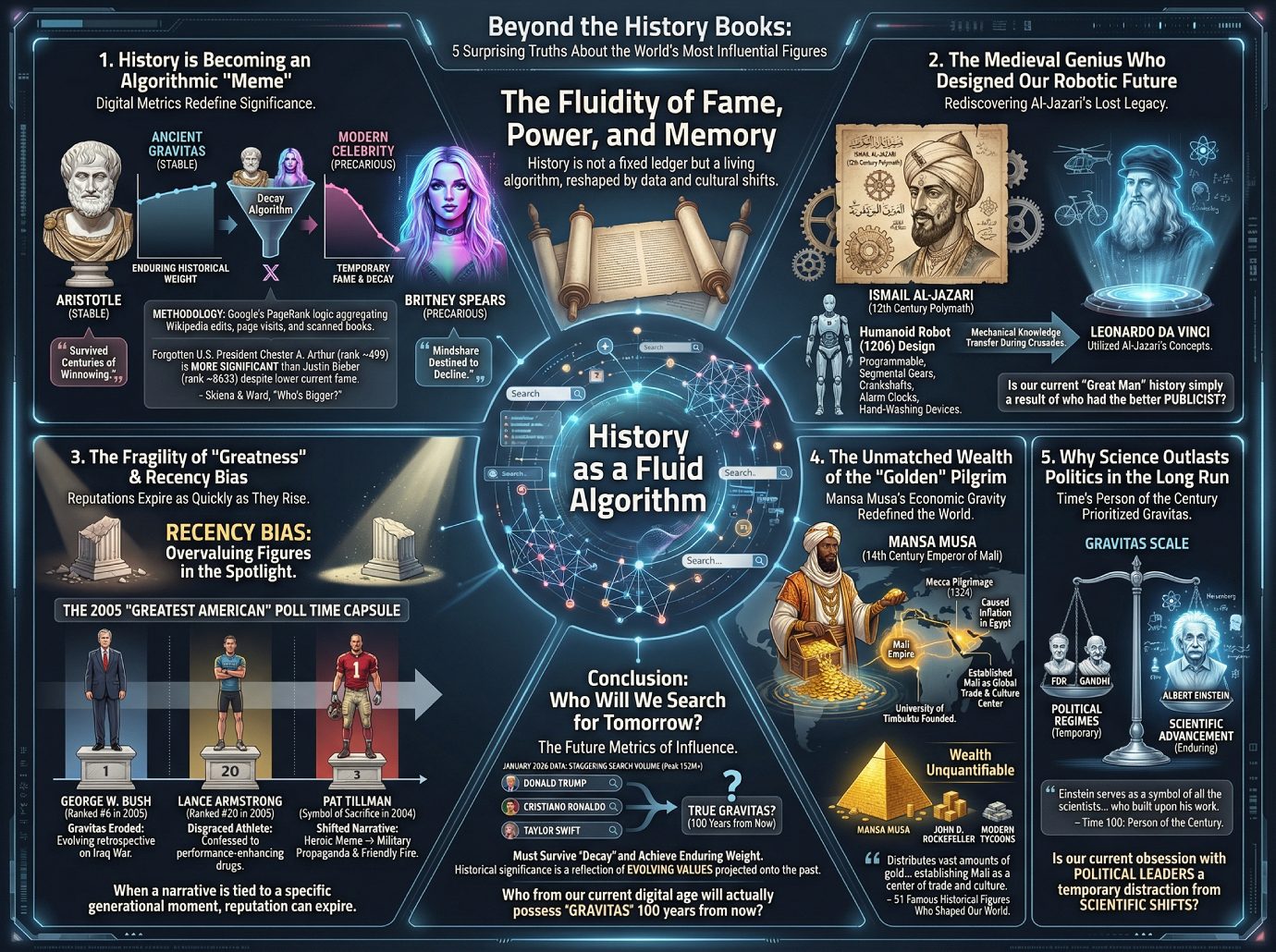
In the digital age, historical significance is being re-evaluated through quantitative metrics. Researchers Steven Skiena and Charles B. Ward have developed a methodology to rank historical figures using a logic similar to Google’s PageRank: by aggregating millions of data points from Wikipedia edits, page visits, and scanned books.
They distinguish between two critical types of reputation: Gravitas (enduring historical weight) and Celebrity (temporary contemporary fame). To bridge the gap between an ancient philosopher and a modern pop star, they use a “decay” algorithm. This logic suggests that an ancient reputation, such as Aristotle’s, is inherently stable because it has already survived the winnowing process of centuries. Conversely, the significance of a modern icon like Britney Spears is precarious; her “mindshare” is destined to decline as the generation that grew up with her music is replaced. Historical significance, then, is increasingly measured by a figure’s strength as an “Internet meme”—their ability to continue triggering digital activity across generations.
“Forgotten U.S. President Chester A. Arthur (who we rank as the 499th most significant person in history) is more historically significant than young pop singer Justin Bieber (currently ranked 8633), even though he may have a less devoted following and lower contemporary name recognition.” — Skiena and Ward, “Who’s Bigger?”
3. Takeaway 2: The Medieval Genius Who Designed Our Robotic Future
While data analysis helps us rank the famous, it also serves as a tool for “narrative architecture,” rediscovering geniuses long ignored by the Western canon. While Leonardo da Vinci is often hailed as the ultimate Renaissance visionary, the blueprints for our robotic future were drafted nearly three centuries before his birth by Ismail al-Jazari, a 12th-century polymath.
Al-Jazari authored the groundbreaking work, A Compendium on the Theory and Useful Practice of the Mechanical Arts. His instructions were so precise that modern engineers have successfully recreated his machines using only his original texts.
The Humanoid Robot of 1206
Al-Jazari’s inventions were startlingly prescient. He is credited with designing the first practical alarm clocks, sophisticated hand-washing devices, and even programmable humanoid robots. These were not merely toys but complex mechanical systems that utilized the first segmental gears and crankshafts.
The Da Vinci Connection
The lineage of engineering leads directly from the Muslim world into Medieval Europe. During the Crusades, Al-Jazari’s work was the primary vector for mechanical knowledge transfer. It is widely believed that Leonardo da Vinci utilized Al-Jazari’s mechanical concepts to develop his own sketches of bicycles and helicopters. Da Vinci was the “leading man” of the Renaissance, but he was standing on the shoulders of a 12th-century giant.
Is our current “Great Man” history simply a result of who had the better publicist in the centuries that followed?
4. Takeaway 3: The Fragility of “Greatness” and the Role of Recency Bias
Public perception of “greatness” is remarkably fragile, often propped up by “recency bias”—the tendency to overvalue figures who are currently in the spotlight. When a figure’s narrative is tied to a specific generational moment, their reputation can expire as quickly as it rose.
The 2005 “Greatest American” poll serves as a time capsule of this fragility. At the time, George W. Bush was ranked the 6th greatest American, and Lance Armstrong held the 20th spot. Since then, both have seen their “gravitas” eroded—Armstrong through a doping scandal that stripped him of his titles, and Bush through the evolving retrospective on the Iraq War.
Even more poignant is the case of Pat Tillman. In 2004, Tillman was a symbol of patriotic sacrifice, a professional athlete who died in Afghanistan. In the years following, that narrative shifted into a dark retrospect involving military propaganda and the revelation that he was killed by friendly fire. His story moved from a “heroic meme” to a cautionary tale about the manipulation of historical imagery.
Figures Whose Ranking Aged Poorly:
• Lance Armstrong: Ranked #20 in 2005; later became one of history’s most disgraced athletes after confessing to performance-enhancing drug use.
• Audie Murphy: A WWII hero who won every available medal; he was a titan to an older generation but faded as that generation lost its cultural influence.
• Pat Tillman: Initially celebrated as a martyr of the War on Terror; his legacy is now inextricably linked to military cover-ups and the “dark” side of recency bias.
5. Takeaway 4: The Unmatched Wealth of the “Golden” Pilgrim
Influence is not always a product of political conquest; sometimes, it is a product of pure economic gravity. Mansa Musa, the 14th-century emperor of the Mali Empire, remains one of history’s most counter-intuitive examples of global impact. Though often overshadowed in Western education by industrial tycoons like John D. Rockefeller, Musa’s wealth was so vast it remains essentially unquantifiable.
In 1324, he embarked on a pilgrimage to Mecca that would redefine the Mediterranean economy. His distribution of gold was so massive that it caused inflation in Egypt and established Mali as a global center of trade and culture, eventually leading to the founding of the University of Timbuktu.
“Musa is best known for his legendary pilgrimage to Mecca in 1324, during which he reportedly distributed vast amounts of gold, demonstrating his immense wealth and establishing Mali as a center of trade and culture.” — 51 Famous Historical Figures Who Shaped Our World
6. Takeaway 5: Why Science Outlasts Politics in the Long Run
When Time Magazine selected its “Person of the Century” at the end of the 1900s, it made a decision that prioritized “gravitas” over “celebrity.” It bypassed two monumental political runners-up—Franklin D. Roosevelt and Mahatma Gandhi—in favor of Albert Einstein.
The editors argued that the 20th century would be remembered primarily for its scientific and technological advancements rather than the rise and fall of political regimes. Einstein was chosen not just for his individual genius, but because he serves as a symbol for all the scientists whose work built the foundation of the modern world.
“Einstein serves as a symbol of all the scientists—such as Fermi, Heisenberg, Bohr, Richard Feynman… who built upon his work.” — Time 100: Person of the Century
Is our current obsession with political leaders a temporary distraction from the scientific shifts that will actually define our century?
7. Conclusion: Who Will We Search for Tomorrow?
As we look toward the future, the metrics of influence have shifted definitively toward digital visibility. Data from January 2026 reveals a staggering volume of search queries for modern figures. Donald Trump led the digital landscape with a monthly peak of over 152 million searches, followed by global sport icon Cristiano Ronaldo and pop culture pillar Taylor Swift.
However, high search volume is only the beginning of the “Internet meme” phase. For these figures to achieve true “gravitas” a century from now, they must survive the “decay” that claims so many contemporary icons. Historical significance is the result of social and cultural forces acting on achievement; it is a reflection of the evolving values of the present projected onto the past.
Who from our current digital age will actually possess “gravitas” 100 years from now, and who is merely a passenger in the recency bias of today?