
Housing in Massachusetts – Gardner Magazine Analysis and Report
Housing In Massachusetts – Jump to a section by clicking on a link below:
An Analysis of Massachusetts’ Housing Production Initiatives Under the Healey Administration
Building a Future: How Massachusetts is Tackling Its Housing Challenge
Briefing on Massachusetts Housing Initiatives and Production
Gardner Magazine has prepared a debate on the topic between Max and Maxine Rogers. Listen on any device.
We have a video on the topic which explains the progress on housing in Massachusetts.
We have 4 different podcasts about this topic approached from different perspectives. Listen on any device, CLICK PLAY.
An Analysis of Massachusetts’ Housing Production Initiatives Under the Healey Administration
An Analysis of Massachusetts’ Housing Production Initiatives Under the Healey Administration
1.0 Executive Overview: The Housing Deficit and the Commonwealth’s Response
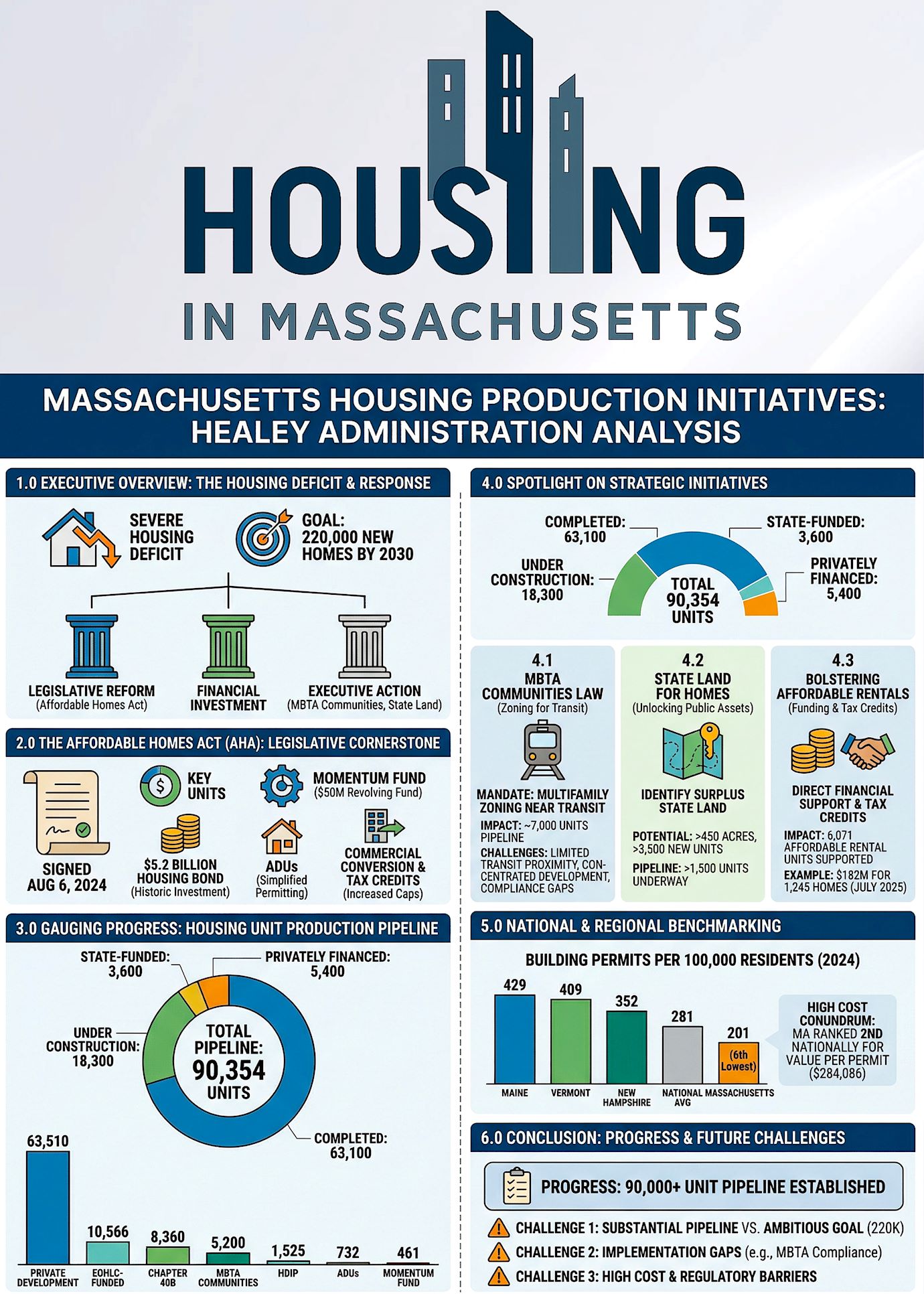
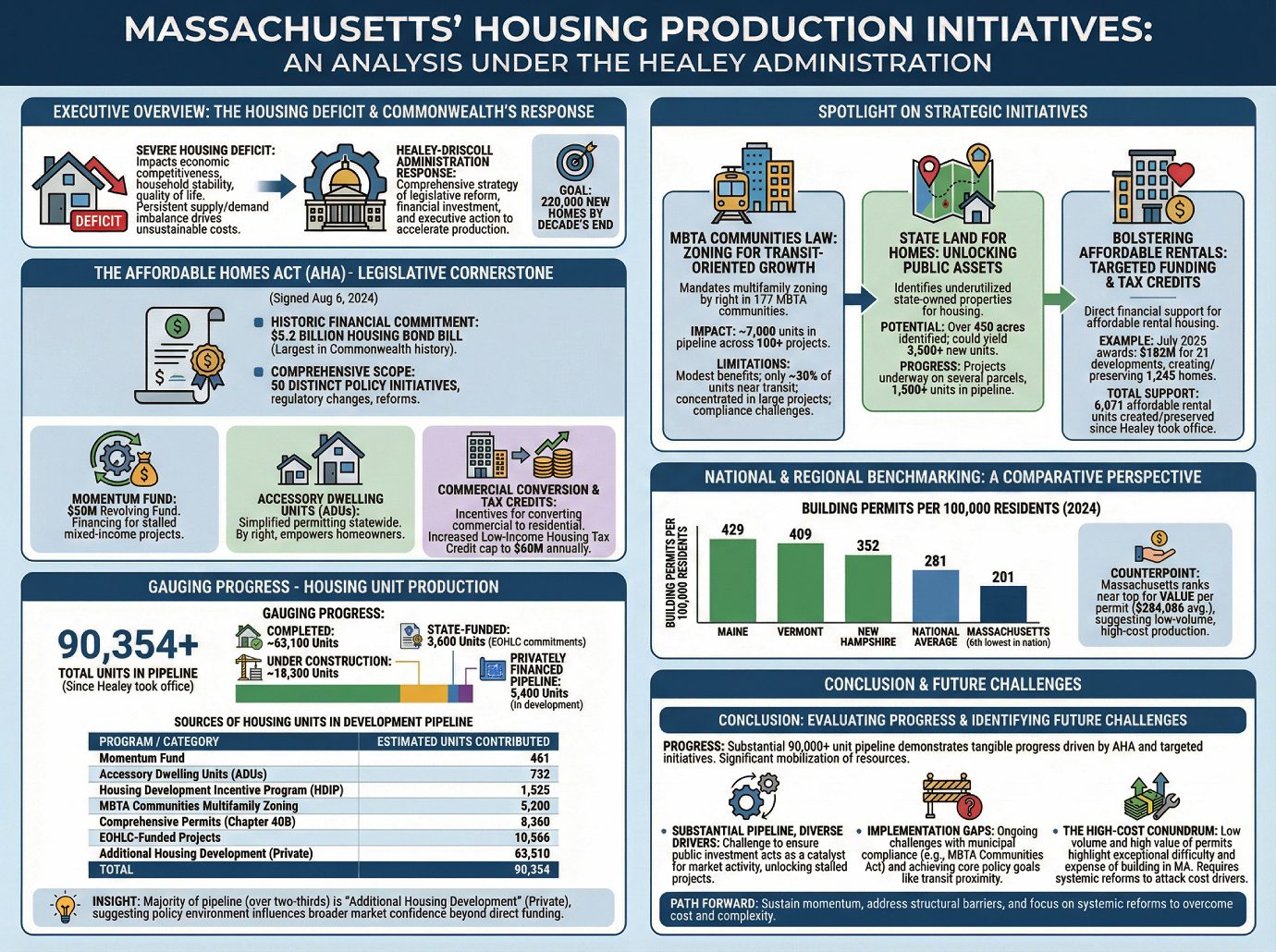
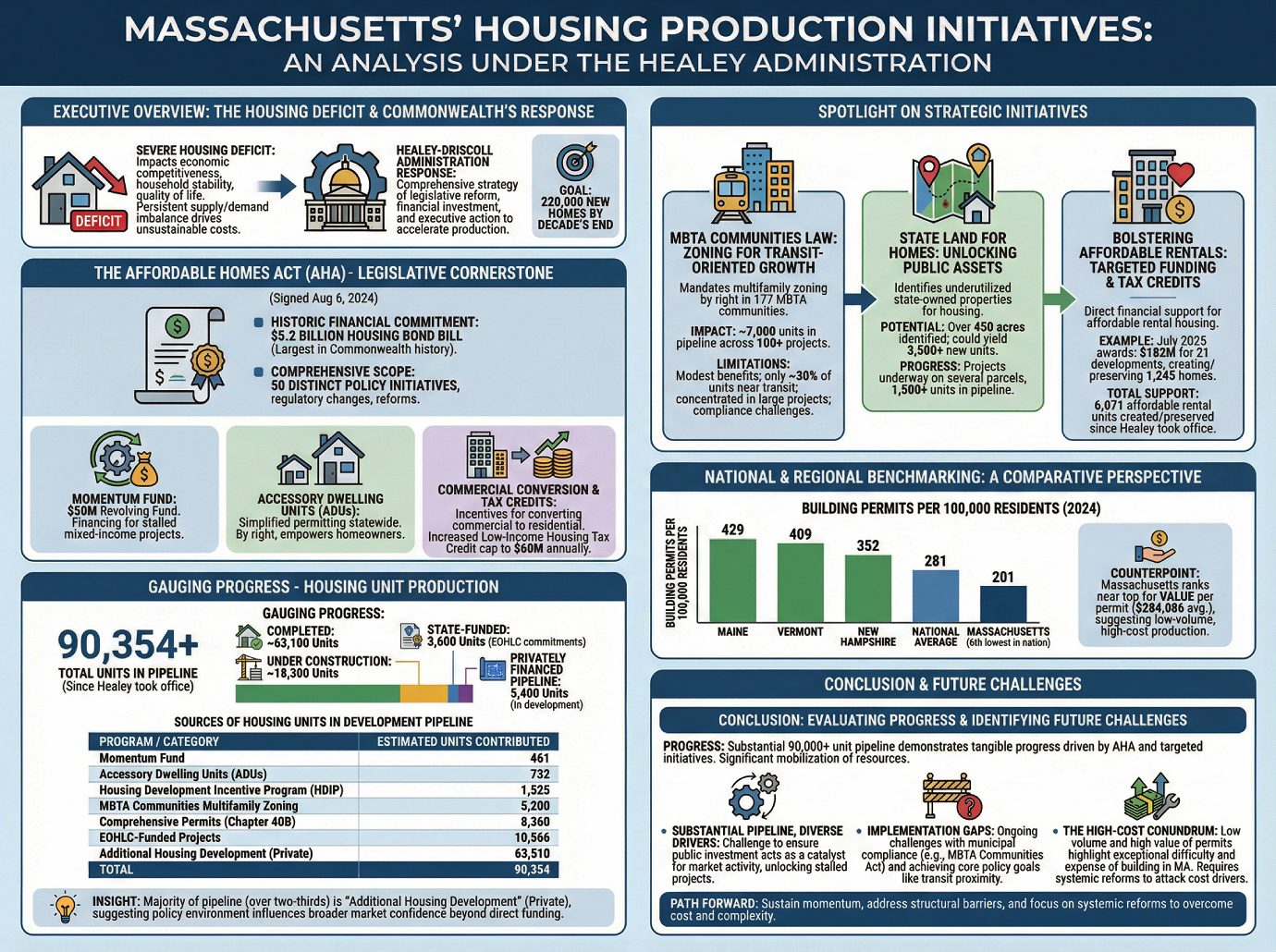
Massachusetts is confronting a severe housing deficit that impacts economic competitiveness, household stability, and overall quality of life. The strategic context is defined by a persistent imbalance between housing supply and demand, which has driven costs to unsustainable levels for many residents. In response, the Healey-Driscoll Administration has implemented a comprehensive strategy of legislative reform, financial investment, and executive action aimed at accelerating housing production across the Commonwealth. This analysis will evaluate the effectiveness of this response by examining key initiatives, synthesizing available production data, and benchmarking the state’s progress against regional and national trends.
The scale of the state’s housing challenge is significant, with an estimated need for 220,000 new homes by the end of the decade to address the current shortage. To meet this goal, the administration is leveraging a combination of legislative action, executive authority, and targeted financial incentives. The core strategies under review in this document include the landmark Affordable Homes Act (AHA), the transit-oriented zoning reforms mandated by the MBTA Communities law, and the innovative State Land for Homes initiative. This analysis will begin with a detailed examination of the primary legislative vehicle driving this agenda, the Affordable Homes Act.
——————————————————————————–
2.0 The Legislative Cornerstone: The Affordable Homes Act (AHA)
The Affordable Homes Act (AHA) serves as the foundational legislative framework for the administration’s housing agenda. Signed into law on August 6, 2024, it represents a comprehensive and ambitious effort to provide the financial resources and regulatory tools necessary to overcome long-standing barriers to housing development. The act is designed not as a single solution but as a broad toolkit to stimulate production across various housing types and income levels.
The core tenets of the Affordable Homes Act underscore its scale and scope:
• Historic Financial Commitment: The Act authorizes a $5.2 billion housing bond bill, representing the largest single investment in housing in the Commonwealth’s history.
• Comprehensive Scope: The legislation encompasses 50 distinct policy initiatives, regulatory changes, and reforms aimed at speeding up housing production.
The AHA enables a diverse set of programs and policy changes, creating multiple pathways to increase housing supply. Key among these are:
• Momentum Fund: A first-in-the-nation revolving fund established with an initial $50 million to provide critical financing for stalled mixed-income housing projects, helping them move from planning to construction.
• Accessory Dwelling Units (ADUs): The law simplified the permitting process for ADUs statewide, allowing them by right and empowering homeowners to create new, smaller-scale housing options on their properties.
• Commercial Conversion Tax Credit: This initiative provides a financial incentive for developers to transform vacant or underutilized commercial buildings into residential housing, adapting to post-pandemic real estate trends.
• Increased Tax Credits: The act raised the state’s Low-Income Housing Tax Credit cap to $60 million annually—a $20 million increase—providing a more powerful tool to finance the creation and preservation of affordable rental homes, the direct results of which are quantified in the state’s recent funding announcements.
By combining significant capital investment with crucial regulatory reforms, the Affordable Homes Act created a comprehensive toolkit of financial and regulatory mechanisms. This framework sets the stage for the production numbers and specific program outcomes that will be analyzed next.
——————————————————————————–
3.0 Gauging Progress: An Analysis of Housing Unit Production
Quantifying housing production is the primary metric for measuring the real-world impact of any housing policy. To assess the effectiveness of the Healey-Driscoll Administration’s initiatives, it is essential to deconstruct the reported progress and understand the sources contributing to the housing pipeline. This section analyzes the administration’s headline production figures and breaks down the specific programs driving these numbers.
Since Governor Healey took office, over 90,000 housing units (specifically, 90,354) have been completed or have entered the development pipeline. This figure encompasses projects at various stages of completion, providing a comprehensive view of current and near-term housing supply additions. The pipeline can be broken down as follows:
• Completed: Approximately 63,100 units have been built and added to the state’s housing supply.
• Under Construction: An additional 18,300 units are currently being built.
• State-Funded: 3,600 units have secured funding commitments from the Executive Office of Housing and Livable Communities (EOHLC).
• Privately Financed Pipeline: 5,400 units represent privately financed proposals that have not yet broken ground but are in development.
To understand the specific drivers of this activity, the following table details the contribution of various state-directed programs and other development to the total 90,354-unit figure.
Sources of Housing Units in the Development Pipeline
| Program / Category | Estimated Units Contributed |
|---|---|
| Momentum Fund | 461 |
| Accessory Dwelling Units (ADUs) | 732 |
| Housing Development Incentive Program (HDIP) | 1,525 |
| MBTA Communities Multifamily Zoning | 5,200 |
| Comprehensive Permits (Chapter 40B) | 8,360 |
| EOHLC-Funded Projects | 10,566 |
| Additional Housing Development (Private) | 63,510 |
| Total | 90,354 |
An analysis of this data reveals a crucial insight: while state-directed programs and older statutes like Chapter 40B are responsible for nearly 30,000 units, the majority of the pipeline—over two-thirds, or 63,510 units—falls under the broad category of “Additional housing development.” This suggests that the administration’s strategy has a dual effect. Beyond direct programmatic funding, the overarching policy environment—characterized by zoning reforms, new financing tools, and a clear executive focus on housing—is likely influencing broader market confidence and private investment. Therefore, a deeper examination of the specific state-led initiatives is required to assess their direct contribution and catalytic effect on the broader market.
——————————————————————————–
4.0 Spotlight on Strategic Initiatives
To understand the mechanics of the Commonwealth’s strategy, it is crucial to analyze the specific design and impact of its flagship initiatives. These programs target distinct barriers to housing production, from restrictive local zoning to the lack of available land and project financing. By examining each in detail, we can better assess their individual contributions and their collective potential to address the state’s housing deficit.
4.1 The MBTA Communities Law: Zoning for Transit-Oriented Growth
The 2021 MBTA Communities Act is a landmark zoning reform law that mandates the 177 municipalities served by the Massachusetts Bay Transportation Authority (MBTA) to create districts where multifamily housing is permitted by right. This policy aims to increase housing density in areas with existing public transit infrastructure, promoting smart growth and reducing car dependency.
To date, the law has had a measurable impact, with zoning changes directly linked to a pipeline of nearly 7,000 housing units across more than 100 projects. However, a recent analysis by Boston Indicators, authored by Senior Fellow Amy Dain, offers a more nuanced evaluation of the law’s effectiveness, highlighting several key limitations:
• Modest Benefits: The report characterizes the law’s initial impact as “real but modest” when measured against the region’s total housing need.
• Limited Transit Proximity: A central goal of the law is to encourage transit-oriented development, yet only about 30% of the pipeline units are located within a half-mile of a train station, partly because state guidelines provide communities with flexibility to site their districts elsewhere when land availability near stations is constrained.
• Concentrated Development: The production is not evenly distributed. Approximately 75% of the new housing is concentrated in just 19 large-scale projects, suggesting that the law has been more effective at enabling large developments than fostering smaller, “missing middle” housing.
Taken together, these findings suggest the law is currently more effective at enabling large, centrally planned developments than fostering the kind of distributed, smaller-scale ‘missing middle’ housing that could broadly increase supply across communities. Implementation also remains an ongoing challenge. As of early January 2026, 12 of the 177 communities remained out of compliance with the law’s deadlines and faced the prospect of legal action from the Attorney General’s office.
4.2 State Land for Homes: Unlocking Public Assets for Housing
The “State Land for Homes Initiative” is a proactive strategy to address one of the primary constraints on development: the high cost and limited availability of land. This initiative identifies underutilized, state-owned properties and makes them available for housing development.
The scale and potential of this initiative are substantial, with a comprehensive inventory identifying significant opportunities for new housing across the Commonwealth.
• Total Acreage Identified: Over 450 acres of surplus state land have been deemed suitable for housing.
• Potential New Units: Development on this land could yield over 3,500 new housing units.
• Units Already in Pipeline: Projects are already underway on several state parcels, accounting for more than 1,500 units already in the development pipeline.
Concrete examples of this strategy in action include the redevelopment of the former Boston State Hospital campus in Mattapan and the former Veterans Home at Chelsea, which will collectively create hundreds of new rental and homeownership units, many of which will be deed-restricted as affordable.
4.3 Bolstering Affordable Rentals: Targeted Funding and Tax Credits
In addition to regulatory reform and land disposition, the administration has deployed direct financial support to create and preserve affordable rental housing. Through the Executive Office of Housing and Livable Communities (EOHLC), the state provides a combination of subsidies and tax credits to make complex affordable housing projects financially viable.
A clear example of this is the July 2025 announcement of $182 million in awards for 21 rental developments across Massachusetts. This single funding round will create or preserve 1,245 homes, with the financing composed of:
• $32.2 million in federal Low-Income Housing Tax Credits
• $31.6 million in state Low-Income Housing Tax Credits
• $118.2 million in direct subsidies from EOHLC
In total, since Governor Healey took office, the administration has supported the creation or preservation of 6,071 affordable rental units. These direct investments are critical for serving low- and moderate-income households, but the broader question remains of how Massachusetts’ overall production volume compares on a national scale.
——————————————————————————–
5.0 National and Regional Benchmarking: A Comparative Perspective
To fully contextualize Massachusetts’ housing production efforts, a comparative analysis is essential. Benchmarking the Commonwealth’s performance against national averages and neighboring states provides critical perspective on whether the current pace of development is sufficient to address its acute housing shortage. This section places the state’s housing permit data in a broader geographic context.
Despite progress in building a development pipeline, Massachusetts continues to lag much of the country in the rate of new housing production. In 2024, the state issued 14,338 building permits, which translates to a rate of 201 permits per 100,000 residents. This rate was the sixth-lowest in the nation and fell significantly below the national average of 281 permits per 100,000 residents.
The state’s production rate also trails its northern New England neighbors, which are permitting new homes at a much faster per-capita pace.
| State | Building Permits per 100,000 Residents (2024) |
|---|---|
| Maine | 429 |
| Vermont | 409 |
| New Hampshire | 352 |
| Massachusetts | 201 |
However, an analysis by U.S. Data Labs introduces a critical counterpoint. While Massachusetts produces a low volume of units, it ranks near the top nationally for the value of those units. The average estimated value per permit in the Commonwealth was $284,086, second only to Hawaii.
This dynamic of low-volume, high-value production suggests that development in Massachusetts is characterized by more expensive and potentially more complex projects. While the state is building, it is doing so at a slower pace and higher cost than most of the country, a finding that frames the central challenges ahead.
——————————————————————————–
6.0 Conclusion: Evaluating Progress and Identifying Future Challenges
The Healey-Driscoll Administration has successfully marshaled a comprehensive, multi-faceted policy approach to combat the state’s housing crisis. The establishment of a development pipeline exceeding 90,000 housing units demonstrates tangible progress, propelled by the landmark Affordable Homes Act and a suite of targeted initiatives. This represents a significant mobilization of public resources and political will to address a decades-in-the-making challenge.
However, a holistic evaluation reveals a more complex picture. While the pipeline is substantial, it must be measured against the ambitious goal of producing 220,000 new units by the end of the decade. Furthermore, the state’s lagging per-capita production rate compared to national and regional benchmarks indicates that significant structural barriers to development persist. The path forward requires not only sustaining the current momentum but also addressing the underlying challenges that constrain growth.
Key takeaways and future challenges from this analysis include:
1. Substantial Pipeline, Diverse Drivers: The current pipeline is a product of both new state programs and ongoing private market activity. While state incentives are contributing thousands of units, the fact that the majority of the pipeline is privately financed highlights a complex interplay between policy and market dynamics. The key challenge for policymakers is to ensure public investment acts as a catalyst for market activity—unlocking stalled projects and de-risking development—rather than merely subsidizing projects that would have proceeded anyway.
2. Implementation Gaps: The passage of ambitious laws like the MBTA Communities Act is only the first step. Ongoing challenges with municipal compliance and achieving core policy goals, such as concentrating development near transit, highlight that effective implementation and enforcement are as critical as legislative design.
3. The High-Cost Conundrum: The state’s low volume of permits combined with the high average value of each project points to a central truth: it is exceptionally difficult and expensive to build in Massachusetts. Overcoming the cost and complexity barriers—from land acquisition and labor to lengthy permitting processes—remains the fundamental challenge. Future policy must therefore focus not only on funding but on systemic reforms that attack the underlying drivers of cost, from regulatory streamlining and modernizing construction practices to innovative strategies for land acquisition.
———————–
Building a Future: How Massachusetts is Tackling Its Housing Challenge
Building a Future: How Massachusetts is Tackling Its Housing Challenge
1. Introduction: Why Is It So Hard to Find a Home in Massachusetts?
Think about the town you grew up in. Will you be able to afford your first apartment here? Can your favorite teacher or firefighter afford to live in the community they serve? These aren’t just personal questions; they’re at the heart of Massachusetts’ housing challenge. For families, workers, and young people looking to build a life here, finding an affordable place to live has become incredibly difficult.
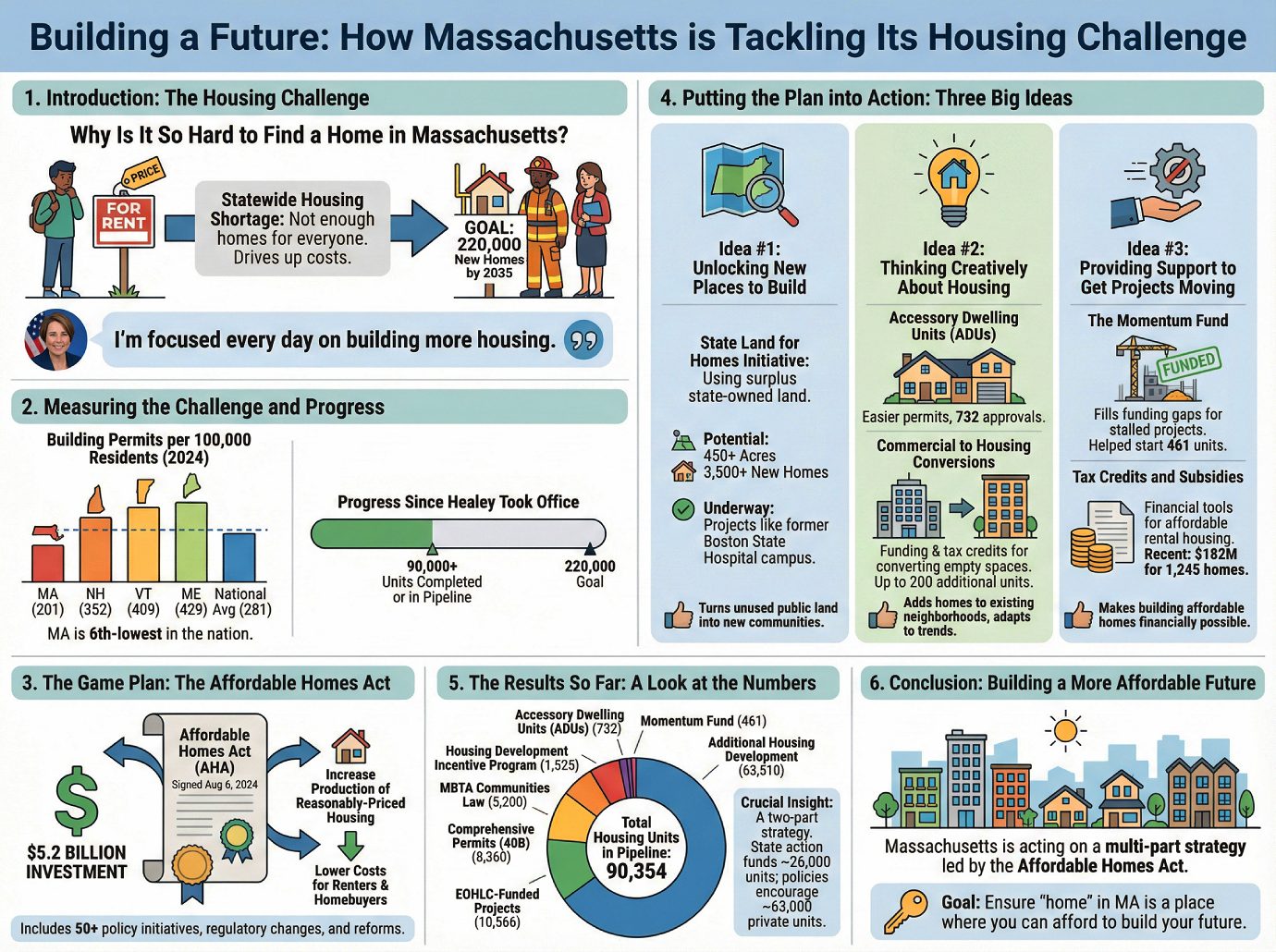
This is the result of a statewide housing shortage, which means there simply aren’t enough homes for everyone who needs one. In fact, Massachusetts has an estimated need for 220,000 new homes by 2035. This imbalance between supply and demand is what drives up costs for everyone.
To address this challenge, the state government, led by Governor Maura Healey’s administration, has developed a comprehensive plan to build more housing and make it more affordable. As Governor Healey stated, “I’m focused every day on building more housing.” The goal is to create a future where everyone can afford to call Massachusetts home.
To understand how the state is tackling this challenge, let’s first look at the numbers.
2. Measuring the Challenge and the Progress
One of the key reasons for our state’s housing problem is that we’ve been building new homes at a slower pace than the rest of the country. A look at the data on building permits—the official approvals needed to start construction—makes this clear.
• Massachusetts: Issued just 201 building permits per 100,000 residents in 2024, which is the sixth-lowest rate in the entire nation.
• Neighboring States: Fell behind Maine (429), Vermont (409), and New Hampshire (352).
• National Average: Issued 281 building permits per 100,000 residents during the same period.
Despite this gap, the state is making significant strides. Since Governor Healey took office, more than 90,000 new housing units have been completed or have entered the development pipeline, chipping away at the 220,000-unit goal.
This progress is guided by a major piece of legislation designed to be the centerpiece of the state’s housing strategy.
3. The Game Plan: The Affordable Homes Act
On August 6, 2024, the Affordable Homes Act (AHA) was signed into law. It is a $5.2 billion plan that represents the “state’s most ambitious investment in housing in history.”
The primary goal of the Affordable Homes Act is simple but powerful: to increase the production of reasonably-priced housing and lower costs across the state for renters and homebuyers. It’s not just a funding bill; the Act includes 50 different policy initiatives, regulatory changes, and reforms designed to speed up housing production across the state.
But a plan is only as good as its execution, so let’s explore the key initiatives that are turning this act into action.
4. Putting the Plan into Action: Three Big Ideas
The state’s strategy isn’t just one single action, but a combination of using public assets, encouraging innovation, and providing financial incentives. Let’s look at how each of these policy tools works.
4.1. Idea #1: Unlocking New Places to Build
One of the biggest hurdles to building new homes is finding a place to put them. The State Land for Homes Initiative is a common-sense plan to solve this by identifying surplus, underutilized land that the state already owns and making it available for housing development.
Here’s a snapshot of its potential:
• Total Potential: Over 450 acres of state-owned land have been identified that could be used for more than 3,500 new homes.
• Already Underway: Projects are already in the pipeline on sites like the former Boston State Hospital campus.
The main benefit of this strategy is that it turns public land that isn’t being used into new communities, without having to compete for expensive private land.
4.2. Idea #2: Thinking Creatively About Housing
Solving the housing crisis also requires new ways of thinking about what a “home” can be. The state is encouraging two creative approaches:
• Accessory Dwelling Units (ADUs): These are small, independent apartments located on the same property as a single-family home, such as a unit over a garage or a small cottage in a backyard. The Affordable Homes Act made it easier for homeowners to get permits for ADUs, leading to 732 approvals or permits.
• Commercial to Housing Conversions: With the rise of remote work, many office buildings are now underused. The state is providing funding and tax credits to encourage developers to convert these empty commercial spaces into new apartments. A new Commercial Conversion Tax Credit is expected to support the creation of up to 200 additional units.
The benefit of these approaches is that they add new homes to existing, developed neighborhoods and smartly adapt our communities to changing economic trends.
4.3. Idea #3: Providing Support to Get Projects Moving
Sometimes, a promising housing project can get “stuck” due to a small funding gap. The state has created programs to provide the final push needed to get shovels in the ground.
• The Momentum Fund: This is a special fund designed to help stalled mixed-income housing projects get the last bit of financing they need. It has already helped start construction on 461 units.
• Tax Credits and Subsidies: These are financial tools the state uses to make it more attractive for developers to build affordable rental housing. In one recent announcement, the state provided $182 million to create or preserve 1,245 homes.
The benefit of these support systems is that they make it financially possible for developers to build the types of homes—especially affordable ones—that Massachusetts needs most.
With all these different initiatives working together, we can see a clear picture of the progress being made.
5. The Results So Far: A Look at the Numbers
The total of 90,354 housing units in the pipeline comes from a wide variety of state-directed programs and other forms of development. The new housing units come from a mix of new initiatives and long-standing state laws. For instance, the MBTA Communities Law requires towns with public transit to allow more multi-family housing, while Comprehensive Permits (Chapter 40B) is an older law that helps developers build affordable housing in towns that lack it. The table below breaks down where these new homes are coming from.
| Program or Source | Estimated Housing Units |
|---|---|
| Momentum Fund | 461 |
| Accessory Dwelling Units (ADUs) | 732 |
| Housing Development Incentive Program | 1,525 |
| MBTA Communities Law | 5,200 |
| Comprehensive Permits (40B) | 8,360 |
| EOHLC-Funded Projects | 10,566 |
| Additional Housing Development | 63,510 |
| Total | 90,354 |
This data reveals a crucial insight: while state-sponsored programs and laws are directly responsible for over 26,000 new homes, the majority of development (over 63,000 units) still comes from other private projects. This shows the importance of a two-part strategy: direct government action to fund and support projects, combined with policies that encourage private investment in housing across the Commonwealth.
These numbers represent real progress, but what does it all mean for the future of Massachusetts?
6. Conclusion: Building a More Affordable Future
Massachusetts faces a significant housing shortage, but the state is not standing still. The government is using a multi-part strategy, led by the historic Affordable Homes Act, to create more housing for everyone. By unlocking unused state land, providing critical funding to get projects moving, and encouraging creative solutions like ADUs and office conversions, the state is making clear progress toward its goal.
For you and other young people thinking about your future, these efforts are incredibly important. The goal of these programs is to ensure that ‘home’ in Massachusetts isn’t just a place you come from, but a place where you can afford to build your future—whether that means renting your first apartment after graduation or, one day, buying a house of your own.
————————
90,000 New Homes, But Still Falling Behind: 4 Surprising Truths About the Massachusetts Housing Crisis
90,000 New Homes, But Still Falling Behind: 4 Surprising Truths About the Massachusetts Housing Crisis
Anyone living in Massachusetts is likely familiar with the state’s housing affordability crisis. The high cost of rent and homeownership is a constant topic of conversation, a source of financial strain for families, and a major challenge for the state’s economy. It’s a problem that feels deeply entrenched and difficult to solve.
Against this backdrop, the Healey administration recently announced an impressive headline number: since the governor took office, more than 90,000 new housing units have either been completed or are now in the development pipeline. This figure suggests significant momentum and a concerted effort to tackle the housing shortage head-on. It’s a sign of progress in a state that desperately needs it.
However, this big number doesn’t tell the whole story. When you dig into the data, the reality of the state’s housing push is filled with surprising details and counter-intuitive facts. From our ranking against other states to where new homes are actually coming from, the situation is far more complex than a single number can convey. Here are four surprising takeaways that reveal the true nature of the Massachusetts housing challenge.
1. The 90,000-Unit Paradox: Big Numbers, Slow Pace
The figure of more than 90,000 housing units being developed is a clear indicator of activity and investment. It represents tangible progress toward the state’s estimated need for 220,000 new homes by the end of the decade. But a closer look at the state’s production rate reveals a startling paradox.
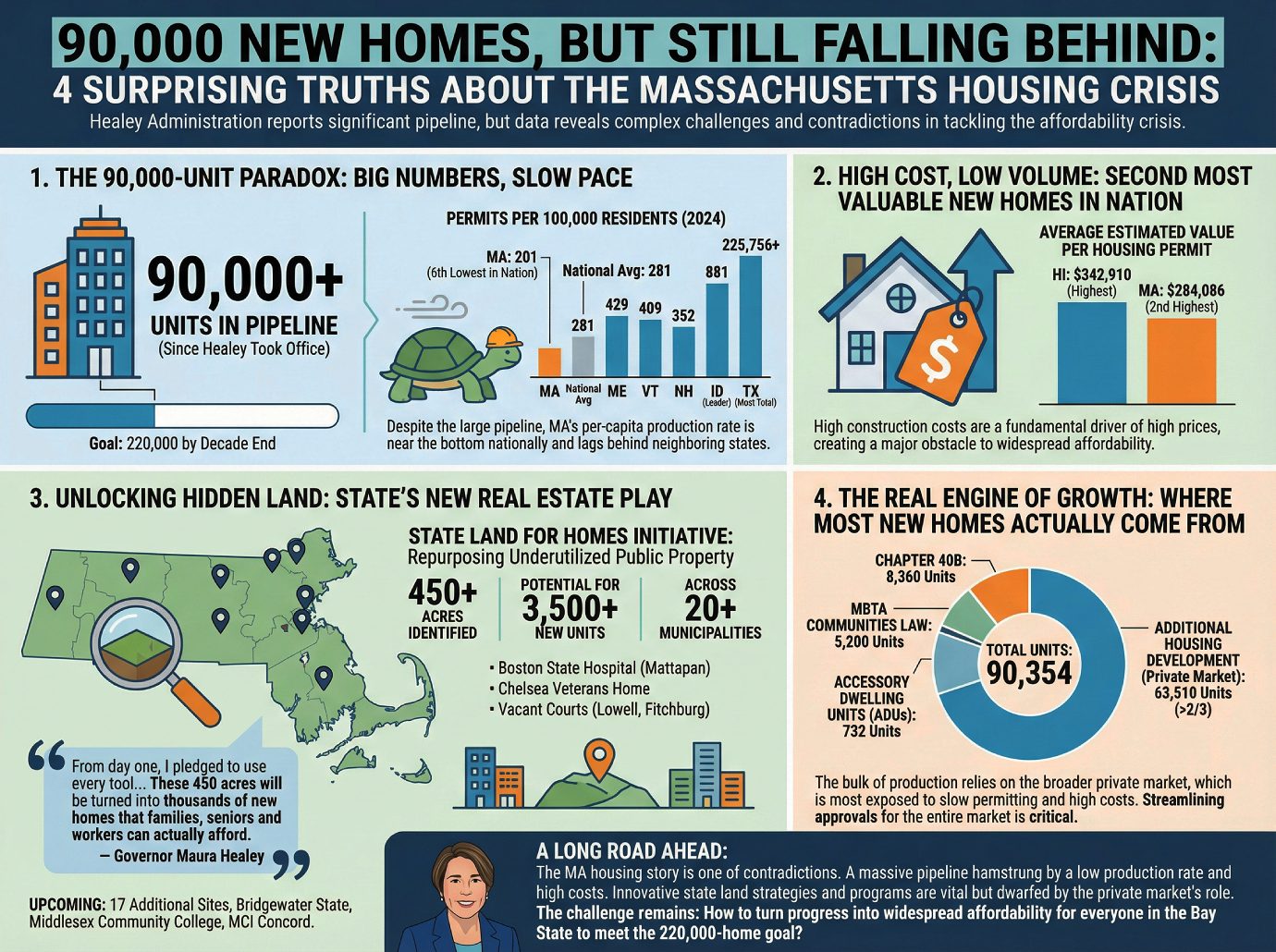
According to an analysis by U.S. Data Labs, Massachusetts is falling behind much of the country. In 2024, the state issued only 201 building permits per 100,000 residents, the sixth-lowest rate in the entire nation. This is significantly below the national average of 281 permits per 100,000 people. For context, national leaders show what’s possible: Idaho led with about 881 permits per 100,000 people, while Texas authorized the most permits overall at more than 225,756. Perhaps more surprisingly, neighboring states are building much faster on a per-capita basis. Maine (429), Vermont (409), and New Hampshire (352) all outpaced Massachusetts.
This contrast is one of the most surprising truths about the state’s housing situation. Despite a major government push and a large raw number of units in the pipeline, Massachusetts’ actual production rate remains near the bottom nationally and is not competitive even within its own region.
2. High Cost, Low Volume: Our New Homes Are the Second Most Valuable in the Nation
While Massachusetts may be building a low quantity of new homes per capita, the homes that are getting permitted are exceptionally expensive to build. This finding adds another critical layer to the affordability crisis.
The U.S. Data Labs report revealed that the average estimated value per housing permit in Massachusetts was $284,086. This figure was the second-highest in the United States, surpassed only by Hawaii, where the average value was $342,910.
This data point offers a key insight into the state’s housing challenges. It’s not just that the supply of new homes is limited; the cost of constructing those new units is among the highest in the country. This high cost of development is a fundamental driver of the high prices that homebuyers and renters ultimately face, creating a major obstacle in the push for widespread affordability.
3. Unlocking Hidden Land: The State’s New Real Estate Play
In the search for creative solutions, the Healey-Driscoll administration has launched the “State Land for Homes Initiative”—a strategy to repurpose underutilized public property for housing. This effort is turning a hidden state asset into a direct tool for boosting supply.
The administration has identified more than 450 acres of surplus state-owned land that is viable for development. This inventory of properties has the potential to support the creation of over 3,500 new housing units across more than 20 municipalities. Concrete examples of this strategy are already underway, with sites being repurposed including the former Boston State Hospital Campus in Mattapan, the former Veterans Home at Chelsea, and vacant court buildings in Lowell and Fitchburg.
This initiative is an active, ongoing program. The administration expects to make 17 additional sites available to developers in the next year, with upcoming projects including the redevelopment of properties at Bridgewater State University and Middlesex Community College, as well as planning for sites like the former MCI Concord. By turning these underused parcels into living communities, the state is leveraging its own real estate portfolio to directly address the housing shortage.
“From day one, I pledged to use every tool to build more housing and lower costs across the state. That’s why I directed our team to find state properties that could be turned into housing. These 450 acres will be turned into thousands of new homes that families, seniors and workers can actually afford.”
— Governor Maura Healey
4. The Real Engine of Growth: Where Most New Homes Actually Come From
When the state announces new housing programs, it’s easy to assume that these initiatives are the primary drivers of new construction. However, a breakdown of the 90,354-unit total reveals a different story about where the vast majority of new homes originate.
While state-run programs make important contributions—for instance, the MBTA Communities law accounts for 5,200 units, Chapter 40B for 8,360, and Accessory Dwelling Units for 732—they are only part of the picture. The most significant data point is that more than two-thirds of the total, or 63,510 units, fall under the category of “additional housing development.” This category represents projects outside of these specific state-directed programs.
This is a crucial takeaway. While new government initiatives generate headlines and provide critical support, the bulk of housing production still relies on the broader private development market. This underscores a critical vulnerability in the state’s strategy: the primary engine of housing production is the one most exposed to the systemic drags of slow permitting and the nation’s second-highest building costs. Therefore, policies that streamline approvals and address construction costs for the entire market are just as, if not more, important than the targeted state funds that get the most attention.
A Long Road Ahead
The Massachusetts housing story is one of profound contradictions: a massive pipeline of units hamstrung by a near-last-place production rate; a low volume of permits offset by the second-highest construction value in the nation; an innovative strategy to unlock state land that is still just a fraction of the total need; and headline-grabbing state programs that are dwarfed by the private market engine they are meant to support.
These surprising truths behind the numbers serve as a critical reality check. The state’s low per-capita building rate and the exceptionally high cost of construction highlight the scale of the challenge that remains. Massachusetts still needs an estimated 220,000 new homes by the end of the decade to meet demand. With tens of thousands of homes in the pipeline but a building rate near the bottom of the nation, what will it truly take to turn progress into widespread affordability for everyone in the Bay State?
Briefing on Massachusetts Housing Initiatives and Production
Briefing on Massachusetts Housing Initiatives and Production
Summary
Since taking office, the Healey-Driscoll Administration has initiated a comprehensive and aggressive strategy to address the Massachusetts housing crisis, resulting in over 90,000 new housing units being completed, permitted, or entering the development pipeline. This multi-pronged approach is anchored by the landmark Affordable Homes Act (AHA), a historic investment signed in August 2024, which has been rapidly implemented to increase housing production and lower costs.
Key initiatives include the creation of the Momentum Fund for stalled projects, the “State Land for Homes” initiative to repurpose over 450 acres of surplus public land, expanded tax credits for developers, and zoning reforms like the MBTA Communities Law. This law alone is credited with spurring nearly 7,000 new housing units. Recent direct state investments include a July 2025 award of $182 million for 1,245 new and preserved rental homes.
Despite these significant efforts, Massachusetts continues to face a substantial housing deficit, estimated at 220,000 units needed by the end of the decade. Data from 2024 shows the state’s per-capita housing production rate of 201 permits per 100,000 residents is the sixth-lowest in the nation and trails the national average of 281. The administration’s policies have garnered broad support from business, real estate, and housing advocacy groups, who view them as critical to the state’s economic competitiveness and the well-being of its residents.
Housing Production Progress and Targets
Over 90,000 Units in the Development Pipeline
The Healey-Driscoll Administration reports that 90,400 housing units have been completed or have entered development since Governor Maura Healey took office. This figure represents significant progress toward the state’s estimated need for 220,000 new homes by the end of the decade. Governor Healey has expressed confidence in this progress, stating in January 2026, “Experts said that we had to build about 220,000 homes by 2035. I’m telling you right now, we’re not just going to meet that, we’re going to beat it.”
The status of the 90,400 units is as follows:
• Completed: Approximately 63,100 units have been built and added to the state’s supply.
• Under Construction: 18,300 units are currently under construction.
• State Funded: 3,600 units have secured funding through the Executive Office of Housing and Livable Communities (EOHLC).
• Privately Financed Pipeline: 5,400 units are in privately financed proposals.
Sources of New Housing Units
The total of 90,354 units is attributed to a combination of state-led programs, zoning mandates, and broader market development. While state initiatives have spurred thousands of units, more than two-thirds of the total comes from development outside of these specific programs.
| Program / Category | Estimated Total Units* |
|---|---|
| Momentum Fund | 461 |
| Accessory Dwelling Units (permits & approvals) | 732 |
| Housing Development Incentive Program (HDIP) | 1,525 |
| MBTA Communities Multifamily Zoning Pipeline | 5,200 |
| Comprehensive Permits (Chapter 40B) | 8,360 |
| EOHLC-Funded Projects | 10,566 |
| Additional Housing Development | 63,510 |
| Total | 90,354 |
| Represents units completed, permitted, awarded funds or in the development pipeline. |
Comparative Analysis: Massachusetts vs. National Trends
An analysis by U.S. Data Labs highlights a critical challenge: despite state-level progress, Massachusetts lags much of the nation in housing production on a per-capita basis.
• Lagging Permit Rate: In 2024, Massachusetts issued an estimated 14,338 building permits, a rate of 201 per 100,000 residents. This was the sixth-lowest rate in the United States and significantly below the national average of 281 per 100,000.
• Regional Comparison: Several New England neighbors outpaced Massachusetts in 2024. Maine issued permits at a rate of 429 per 100,000 residents, Vermont at 409, and New Hampshire at 352.
• High Value of Construction: Conversely, Massachusetts ranks near the top for the value of new housing. The average estimated value per permit was 284,086,secondonlytoHawaii(342,910). This indicates that while fewer units are being permitted, the projects themselves are high-cost.
Core Strategies and Initiatives
The administration’s housing agenda is built on a framework of legislative action, executive initiatives, and targeted funding to stimulate development across the state.
The Affordable Homes Act (AHA)
Signed into law on August 6, 2024, the Affordable Homes Act is described as the state’s “most ambitious investment in housing in history.” This $5.16 billion housing bond bill is the centerpiece of the administration’s strategy.
• Key Provisions:
◦ Mandated that cities and towns allow Accessory Dwelling Units (ADUs) by right.
◦ Established a $50 million “Momentum Fund,” a first-in-the-nation revolving fund to support stalled mixed-income projects.
◦ Expanded financing tools for affordable and moderate-income housing.
◦ Created the state’s first Office of Fair Housing.
◦ Established commissions to study and report on housing needs for seniors, individuals with extremely low incomes, and accessible housing.
• Implementation: As of August 2025, one year after its signing, nearly 80% of the law’s 50 policy initiatives and reforms have been implemented, with full implementation expected by the end of 2025.
State Land for Homes Initiative
In June 2025, the administration launched this initiative to unlock underutilized state-owned property for housing development.
• Inventory: A comprehensive review identified over 450 acres of surplus state-owned land suitable for housing.
• Potential Impact: This land could support the development of over 3,500 new housing units. More than 1,500 units are already in the pipeline on these properties.
• Upcoming Actions: 17 additional sites are expected to become available to developers within the next year, with RFPs for 10 sites and an auction for another seven in September 2025.
• Key Sites: Notable projects are planned for the former Boston State Hospital campus, the former Veterans Home at Chelsea, and the South Campus at Salem State University, which is expected to yield over 350 units.
The MBTA Communities Law
Passed in 2021, this law requires 177 municipalities served by the MBTA to create zoning districts that allow for multifamily housing by right. A January 2026 report from Boston Indicators assessed its initial impact.
• Results: The law is directly responsible for nearly 7,000 housing units across over 100 projects in 34 communities that are now in the permitting, construction, or occupancy pipeline.
• Analysis:
◦ The impact is described as “real but modest” relative to the region’s total housing need.
◦ Only about 30% of the new units are located within a half-mile of a train station.
◦ Production is heavily concentrated, with just 19 large projects (over 100 units each) accounting for 75% of the total units.
• Enforcement: As of early January 2026, 12 of the 177 communities remained out of compliance. Attorney General Andrea Campbell stated her office was “prepared to bring an enforcement suit” against non-compliant communities by the end of the month.
Funding and Financial Tools
The administration has leveraged new and expanded financial programs to create and preserve affordable housing.
• Direct Subsidies: In July 2025, the administration announced $182 million in subsidies and tax credits for 21 rental housing developments. This funding will create or preserve 1,245 homes, with 1,143 being affordable to households earning less than 80% of the area median income (AMI) and nearly 420 for those below 30% AMI. These state investments are projected to leverage nearly $450 million in private equity.
• Tax Credits: Governor Healey’s tax cuts package raised the state’s annual Low-Income Housing Tax Credit cap by $20 million to a total of $60 million. A new Commercial Conversion Tax Credit was also established to support turning vacant office buildings into housing.
• Capital Investment Plan (FY2026-FY2030): This plan funds programs authorized by the AHA, including:
◦ $657 million for Public Housing investments
◦ $622 million for HousingWorks
◦ $334 million for the Affordable Housing Trust Fund
◦ $50 million for the Momentum Fund
Key Statements and Stakeholder Support
Administration Officials
• Governor Maura Healey: “I’m focused every day on building more housing… Through tax credits for developers, changes to the law to make accessory dwelling units available by right, mill-to-housing conversions, office-to-housing conversions, and surplus state land, we’re making real progress.”
• Lieutenant Governor Kim Driscoll: “The projects we’re supporting today reflect what’s possible when government, developers and community partners work together to build the housing we need.”
• Housing and Livable Communities Secretary Ed Augustus: “The housing shortage takes away people’s power to choose where they want to live, which is why we’ve acted urgently to implement the Affordable Homes Act, build more housing and give choice back to renters and homebuyers.”
Stakeholder Perspectives
The administration’s housing agenda has received widespread support from various sectors who see it as essential for Massachusetts’ future.
• Business Community: Groups like the Associated Industries of Massachusetts and the Massachusetts Business Roundtable have endorsed the AHA, arguing that the high cost of housing negatively impacts their ability to recruit and retain talent, making it a critical “cost of doing business issue.”
• Housing Advocates: Organizations such as Citizens’ Housing and Planning Association (CHAPA) and Abundant Housing Massachusetts praise the AHA as a landmark investment that provides a comprehensive range of solutions for people across incomes and sets the state on a path to address its housing needs.
• Real Estate and Development: NAIOP Massachusetts and the Greater Boston Real Estate Board applaud the administration for championing policies like the AHA and ADU reform, noting that new tools like the Momentum Fund are critical to getting projects built in an uncertain economic climate.
—————————————–