
Top Movies of the Last 100 Years – Reports by Gardner Magazine
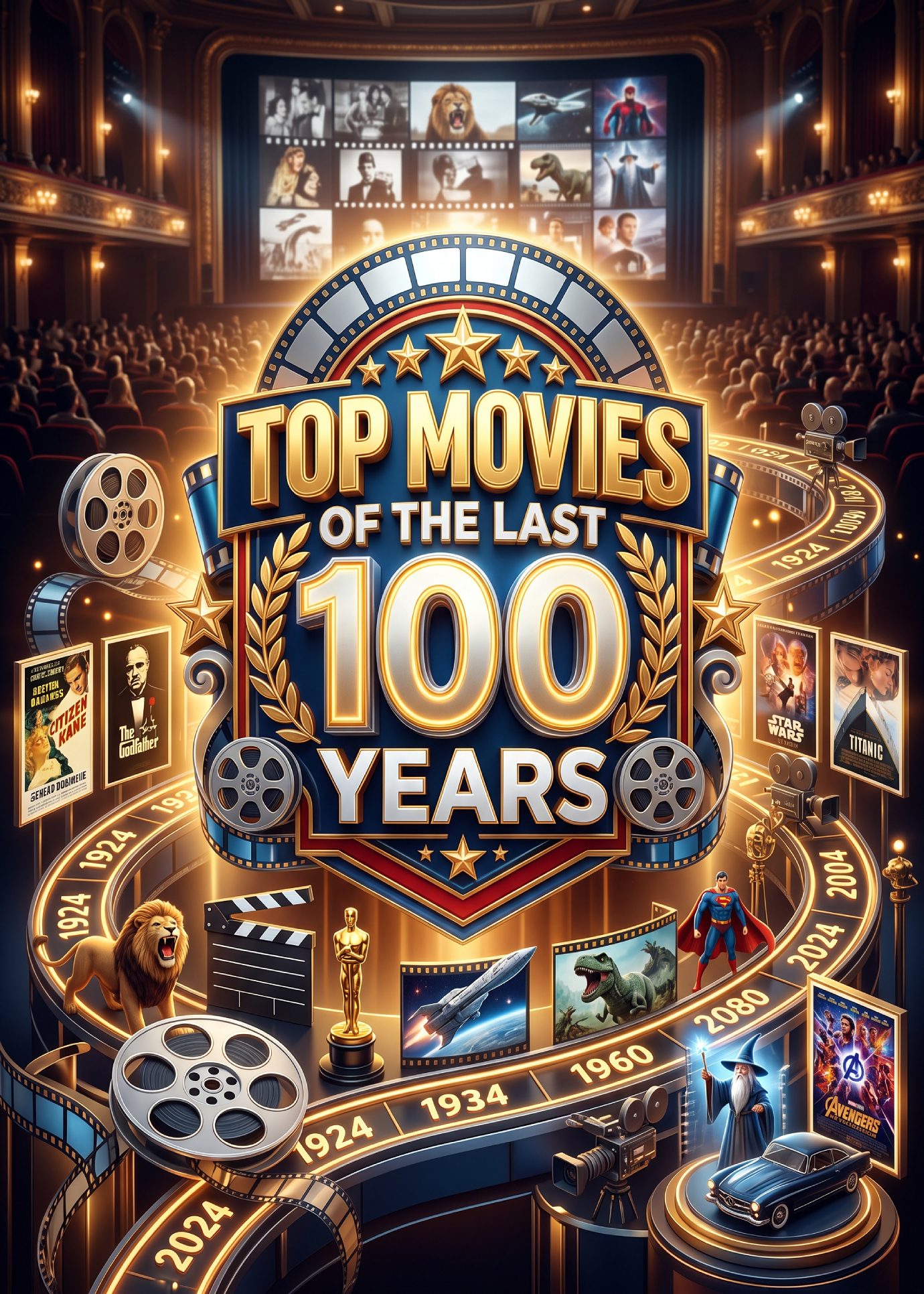
From the age of Silent Films to the age of Artificial Intelligence, movie making has evolved over the last 100 years. Gardner Magazine explores the Top Movies of the Last 100 Years.
Jump to 1 of 3 sections on this page: A Comprehensive Analysis of Cinematic Landmarks: From Silent Era Foundations to 21st-Century Classics — More Than Just Movies: 7 Surprising Truths That Defined Cinema History —-A Century of Cinema: A Decadal Analysis of Genre Evolution and Commercial Success (1920–2020)
Listen to this “Deep Dive” podcast on any device.
Listen to this “Debate” on any device.
Watch this excellent short video on the subject of choosing an era to match viewing interest.
A Comprehensive Analysis of Cinematic Landmarks: From Silent Era Foundations to 21st-Century Classics
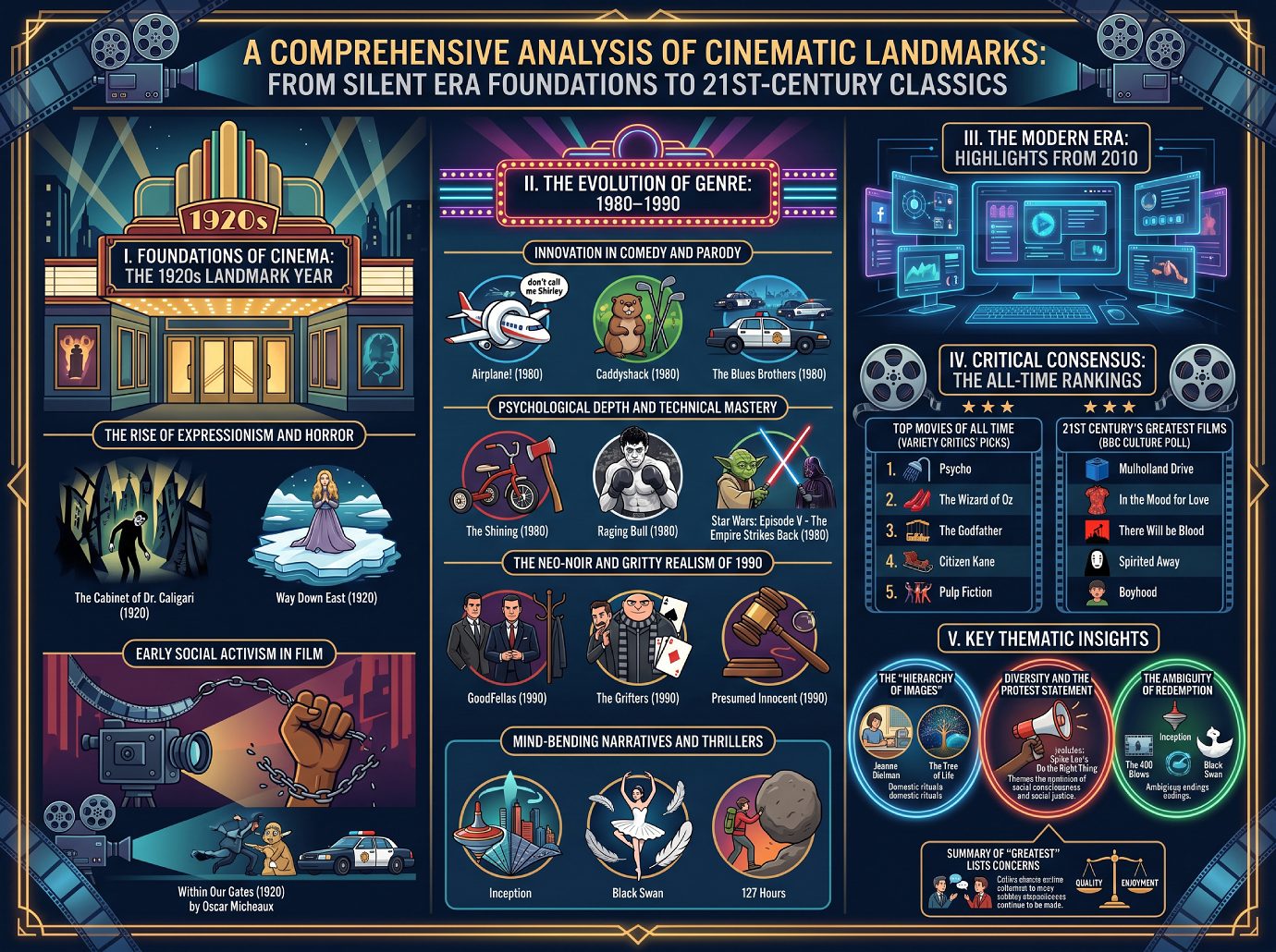
A Comprehensive Analysis of Cinematic Landmarks: From Silent Era Foundations to 21st-Century Classics
The history of cinema is a dynamic evolution of narrative style, technical innovation, and cultural reflection. Spanning over a century, the medium has transitioned from the silent Expressionism of the 1920s to the high-concept, computer-animated blockbusters of the 2010s. Critical consensus, as reflected in various historical retrospectives and “best-of” lists, identifies several pivotal shifts in the industry:
- Genre Refinement: The establishment of horror conventions in the 1920s (The Cabinet of Dr. Caligari), the rise of the “ZAZ” parody style in the 1980s (Airplane!), and the saturation of the “Neo-Noir” in the 1990s.
- Technical Transformation: The shift from hand-drawn animation to CGI dominance, led by Pixar’s Toy Story franchise, and the use of groundbreaking cinematography in psychological thrillers like The Shining and Inception.
- Social and Political Commentary: The enduring power of films that challenge racial and class structures, from Oscar Micheaux’s Within Our Gates (1920) to Spike Lee’s Do the Right Thing (1989) and Bong Joon Ho’s Parasite (2019).
- The “New Classics”: Critics now recognize a “golden age” in the 21st century, where diverse global voices and high-budget spectacles coexist with intimate indie dramas.
This briefing provides a detailed examination of these themes, summarizing key films and critical insights that have shaped the global cinematic landscape.
I. Foundations of Cinema: The 1920s Landmark Year
The 1920s served as a crucible for film language, establishing genres and social rebuttals that resonate today.
The Rise of Expressionism and Horror
- The Cabinet of Dr. Caligari (1920): A German silent landmark that introduced Expressionistic style to the screen. Characterized by “shadowy, disturbing, distorted” studio-shot cityscapes, it introduced many standard horror conventions and influenced Hollywood’s 1930s horror cycle.
- Way Down East (1920): Directed by D.W. Griffith, this powerful melodrama utilized the “ice floe” sequence to push the limits of cinematic suspense and starred silent film legend Lillian Gish.
Early Social Activism in Film
- Within Our Gates (1920): Directed by Oscar Micheaux, this is the earliest surviving film by an African-American filmmaker. It served as a direct rebuttal to Griffith’s The Birth of a Nation (1915), addressing “man’s inhumanity to man” through themes of lynching, rape, and white-supremacist attitudes.
II. The Evolution of Genre: 1980–1990
These decades saw the perfection of the blockbuster, the revitalization of the comedy, and the darkening of the American thriller.
Innovation in Comedy and Parody
- Airplane! (1980): Created by the Zucker, Abrahams, and Zucker (ZAZ) team, this film revolutionized comedy through “slapstick gutbusters” and verbal literalism (e.g., “Surely you can’t be serious.” “I am serious, and don’t call me Shirley”).
- Caddyshack (1980): A “snobs vs. slobs” cult favorite that became a staple of the VCR and cable era, defined by the improvisational styles of Bill Murray, Chevy Chase, and Rodney Dangerfield.
- The Blues Brothers (1980): An anarchic fusion of musical, action, and comedy, notable for its “mission from God” and a record-breaking number of car crashes.
Psychological Depth and Technical Mastery
- The Shining (1980): Stanley Kubrick used groundbreaking Steadicam work and a disturbing soundtrack to transform the horror genre into a slow-burn study of “a man going mad.”
- Raging Bull (1980): Martin Scorsese’s “visceral, vivid” black-and-white biopic of Jake LaMotta is frequently cited by critics as the best film of the 1980s.
- Star Wars: Episode V – The Empire Strikes Back (1980): Regarded by many as the best in the original trilogy, it introduced emotional depth (the Vader paternity reveal) and legendary characters like Yoda.
The Neo-Noir and Gritty Realism of 1990
- GoodFellas (1990): Scorsese’s definitive gangster film, using a non-fiction basis to chronicle three decades of the mob life with “slick, no-apologies” realism.
- The Grifters (1990): A British-directed take on the American “short con,” exploring themes of “gamesmanship, treachery, and double-crosses.”
- Presumed Innocent (1990): A high-profile crime mystery that popularized the legal thriller with a series of “plot surprises and twists.”
III. The Modern Era: Highlights from 2010
The year 2010 demonstrated the artistic viability of animated franchises and the continued strength of the “prestige” biopic.
The Peak of Computer Animation
- Toy Story 3: A narrative conclusion to the original trilogy, dealing with themes of abandonment and the transition to adulthood.
- Despicable Me: Introduced the character Gru and the “Minions,” launching a long-running, multi-billion dollar franchise.
- How to Train Your Dragon: A coming-of-age story that subverted the “dragon slayer” trope to focus on human-animal harmony.
Biopics and Historical Dramas
- The Social Network: David Fincher’s analysis of the founding of Facebook, exploring how “success in revolutionizing communication was achieved at the expense of both chaotic personal and legal complications.”
- The King’s Speech: A Best Picture-winner focusing on King George VI’s struggle with stammering on the eve of World War II.
- The Fighter: A “true-life story” of sibling rivalry and redemption in the boxing ring.
Mind-Bending Narratives and Thrillers
- Inception: Christopher Nolan’s complex “sci-fi heist thriller” involving dream-within-a-dream architecture.
- Black Swan: A psychological horror-drama about the “masochistic self-destruction” of a ballerina pursuing perfection.
- 127 Hours: A survival docu-drama based on Aron Ralston’s ordeal in a Utah canyon, noted for its “extraordinarily brave” central performance.
——————————————————————————–
IV. Critical Consensus: The All-Time Rankings
International critics and publications consistently return to a core group of films when defining the greatest of all time.
Top Movies of All Time (Variety Critics’ Picks)
Critics emphasize that movies are a young medium (just over 100 years old), and while lists are subjective, certain titles are “soul-nourishing” landmarks.
| Rank | Film | Director | Year | Key Insight |
|---|---|---|---|---|
| 1 | Psycho | Alfred Hitchcock | 1960 | “The shower scene rips the 20th century in half.” |
| 2 | The Wizard of Oz | Victor Fleming | 1939 | The “gold standard” for cinematic enchantment. |
| 3 | The Godfather | F.F. Coppola | 1972 | The greatest film since the fadeout of the studio system. |
| 4 | Citizen Kane | Orson Welles | 1941 | Established the “visionary excitement” of indie filmmaking. |
| 5 | Pulp Fiction | Quentin Tarantino | 1994 | Remixed B-movie obsessions into a “monumental homage.” |
21st Century’s Greatest Films (BBC Culture Poll)
Surveying 177 critics, the BBC identified that cinema is not dying but “evolving,” with a surge in Asian masterpieces and innovative indie voices.
- Mulholland Drive (David Lynch, 2001)
- In the Mood for Love (Wong Kar-wai, 2000)
- There Will Be Blood (Paul Thomas Anderson, 2007)
- Spirited Away (Hayao Miyazaki, 2001)
- Boyhood (Richard Linklater, 2014)
——————————————————————————–
V. Key Thematic Insights
The “Hierarchy of Images”
Critics like Chantal Akerman (Jeanne Dielman) challenged the cinematic status quo by focusing on “mundane domestic rituals” typically overlooked by major studios. Similarly, Terrence Malick’s The Tree of Life used DP Emmanuel Lubezki’s “gravity-defying camera” to explore metaphysical questions over traditional plot.
Diversity and the Protest Statement
The evolution from the silent films of Oscar Micheaux to Spike Lee’s Do the Right Thing (1989) shows the industry’s slow shift toward racial consciousness. Lee’s work, which “anticipated the contemporary wave of demonstrations against police brutality,” is cited as a vital moment where Hollywood began to make room for Black voices.
The Ambiguity of Redemption
A recurring theme in modern prestige cinema is the “ambiguous ending.” Whether it is the spinning top in Inception, the final freeze-frame in The 400 Blows, or the “shattering climax” of Black Swan, great films often leave the final judgment to the audience.
Summary of “Greatest” Lists Concerns
Modern critics have expressed skepticism regarding some “Best of” lists (e.g., the New York Times list), arguing they can be “pretentious” or weighted by political representation rather than purely “quality” or “cheeseburger-like” enjoyment. However, lists from Variety and the BBC are lauded for recognizing that cinematic masterpieces continue to be made regardless of budget or medium.
More Than Just Movies: 7 Surprising Truths That Defined Cinema History
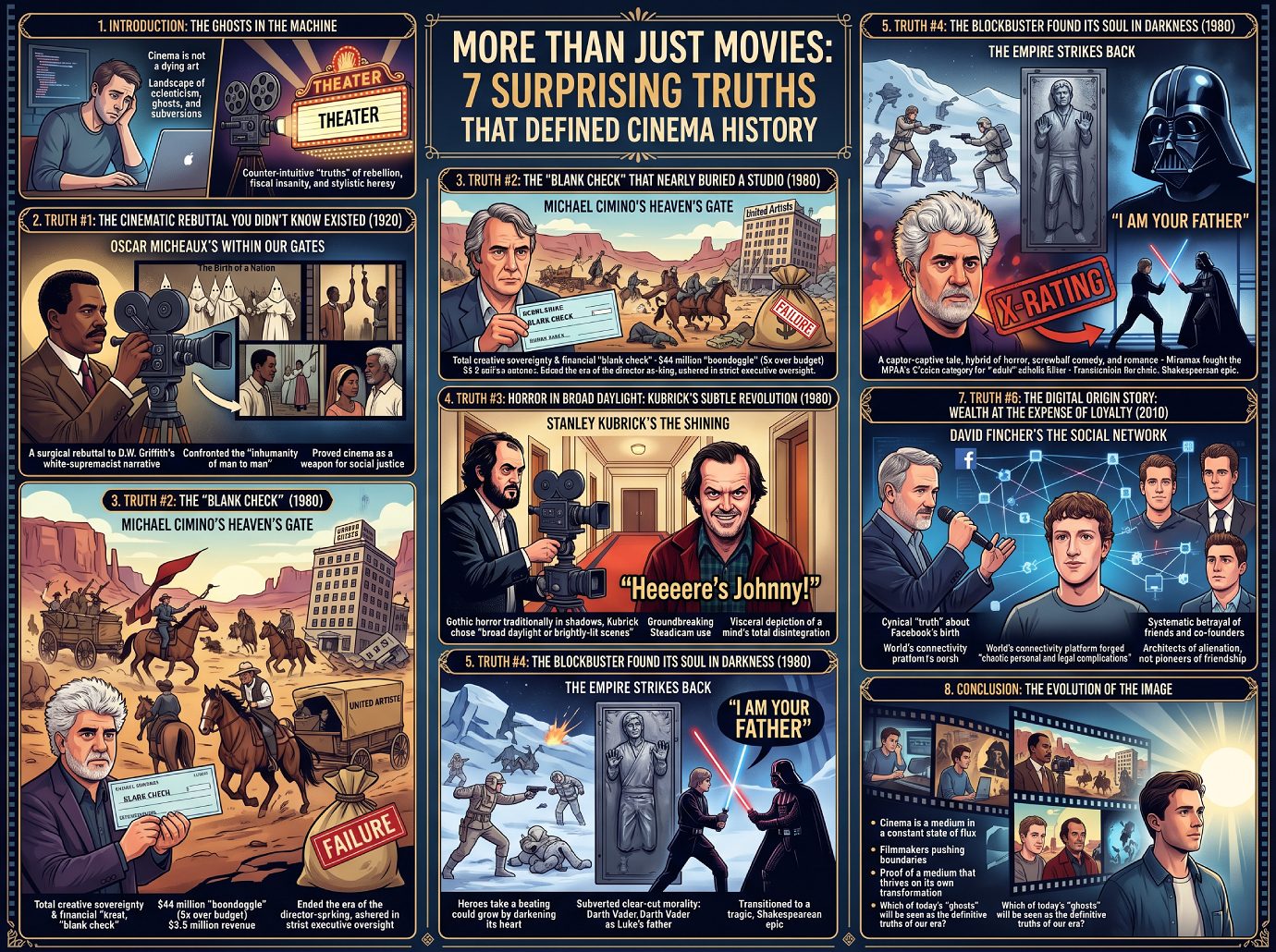
More Than Just Movies: 7 Surprising Truths That Defined Cinema History
1. Introduction: The Ghosts in the Machine
“They don’t make ’em like they used to.” It is a weary refrain, often sighed by those who believe the silver screen has lost its luster in an age of digital saturation and caped crusaders. To some, cinema is a dying art, gasping its last breath under the weight of video-on-demand. Yet, as a historian of the moving image, I see a different reality. The history of film is not a steady decline into obsolescence; it is a landscape of spine-tingling eclecticism, populated by ghosts and subversions that refuse to stay buried. Behind the marquee names and the billion-dollar franchises lie counter-intuitive “truths”—stories of rebellion, fiscal insanity, and stylistic heresy that remind us why the theater remains a sacred space.
2. Truth #1: The Cinematic Rebuttal You Didn’t Know Existed (1920)
In 1915, D.W. Griffith’s The Birth of a Nation utilized groundbreaking technique to weave a poisonous narrative of white supremacy, effectively inventing the modern film grammar to celebrate the Ku Klux Klan. For years, history books treated Griffith’s work as an unchallenged technical marvel. However, a profound “truth” emerged just five years later in the form of Oscar Micheaux’s Within Our Gates (1920).
Micheaux, the earliest known African-American filmmaker of such surviving directorial effort, did not merely make a movie; he crafted a surgical rebuttal. Where Griffith portrayed Black men as predators, Micheaux depicted the harrowing reality of white-supremacist violence, including graphic sequences of lynching and murder. In a plot point so provocative it was frequently hacked away by regional censors, Micheaux revealed that the man attempting to rape the protagonist, Sylvia Landry, was actually her own father—a white man. By confronting the “inhumanity of man to man” with a primarily African-American cast, Micheaux proved that cinema could be a weapon for social justice long before the medium was even a quarter-century old.
3. Truth #2: The “Blank Check” That Nearly Buried a Studio (1980)
The year 1980 stands as a seismic fault line in Hollywood history, a moment of profound friction where the era of the “New Hollywood” auteur met its spectacular, ruinous end. No film embodies this collapse more than Michael Cimino’s Heaven’s Gate. Fresh off five Academy Awards for The Deer Hunter, Cimino was granted a financial “blank check” and total creative sovereignty. In the high-stakes gamble of the 1980s, the line between visionary genius and fiscal ruin was drawn in the dust of a Wyoming set.
What followed was a $44 million “boondoggle” that redefined the word failure. Cimino’s revisionist Western, detailing the 1890s Johnson County Wars, spiraled five times over its original budget. The “truth” of its impact was felt in the ledger: the film generated a measly $3.5 million in revenue. This single project brought the venerable United Artists studio to the precipice of bankruptcy and effectively ended the age of the director-as-king, ushering in the era of strict executive oversight.
4. Truth #3: Horror in Broad Daylight: Kubrick’s Subtle Revolution (1980)
While Cimino was breaking the bank, Stanley Kubrick was busy breaking the rules of the horror genre. In his 1980 adaptation of The Shining, Kubrick performed a stylistic heresy. Gothic horror traditionally breathes in the shadows, yet Kubrick chose to bathe the Overlook Hotel in “broad daylight or brightly-lit scenes.”
This choice created a mounting, inescapable rage that felt more paranormal than any darkened hallway could achieve. Utilizing the Steadicam in groundbreaking fashion, Kubrick followed the Torrance family through the hotel’s labyrinthine corridors with an eerie, clinical fluidity. While the film took such liberties with the source material that Stephen King famously dismissed it, the “truth” of Kubrick’s vision lies in the visceral depiction of a mind’s total disintegration.
“Heeeere’s Johnny!”
The iconic line, delivered with Jack Nicholson’s demonically-insane sneer, signaled a shift: horror was no longer about what was hiding in the dark, but about the madness staring at you in the high noon of a hotel lobby.
5. Truth #4: The Blockbuster Found Its Soul in Darkness (1980)
The third pillar of 1980’s revolutionary trio was The Empire Strikes Back. In a medium where sequels were often viewed as pale imitations, Empire proved that a franchise could grow by darkening its heart. It is a rare blockbuster where “the heroes really take a beating”—from the crushing defeat on the icy plains of Hoth to the narrative cliffhanger of Han Solo being frozen in carbonite.
The film’s most enduring “truth,” however, was its subversion of the clear-cut morality established in the original Star Wars. By delivering the most impactful spoiler in galactic history—the reveal of Darth Vader as Luke Skywalker’s father—the film transitioned from a simple space-age fairy tale into a tragic, Shakespearean epic. It proved that audiences were not just looking for escapism; they were hungry for high-stakes emotional investment.
6. Truth #5: The X-Rating That Sparked a Legal Rebirth (1990)
By 1990, the boundaries of taste and legality were again under fire, this time through Pedro Almodóvar’s Tie Me Up! Tie Me Down!. The film was a “surprising” hybrid: a captor-captive tale that played as a “horror film and a screwball comedy crossed with a romantic love story.” Its tagline captured this bizarre duality perfectly:
“A love story…with strings attached!”
When the MPAA slapped the film with an X-rating—a label then synonymous with pornography—Miramax fought back. While the legal challenge failed and the film was released unrated, the resulting controversy forced a fundamental change in American cinema. The industry created the NC-17 category specifically to accommodate “adult” artistic films that were not pornographic. Though the rating first appeared on this film’s home video edition, its birth was a theatrical revolution, acknowledging that cinema’s “landscape of eclecticism” required a space for stories that were both dark and romantic.
7. Truth #6: The Digital Origin Story: Wealth at the Expense of Loyalty (2010)
David Fincher’s The Social Network (2010) stripped the digital revolution of its utopian veneer, presenting a cynical “truth” about the birth of Facebook. Long before it was a global utility, it was “Facemash,” a petty Harvard website designed by Mark Zuckerberg to rank female students.
Fincher’s analysis centered on a bitter irony: the world’s most successful platform for connectivity was forged through “chaotic personal and legal complications” and the systematic betrayal of those closest to its founder. From the legal onslaught of the Winklevoss twins to the phasing out of best friend and co-founder Eduardo Saverin, the film depicts the “Accidental Billionaires” not as pioneers of friendship, but as architects of alienation. It remains a haunting reminder that in the digital age, communication is often achieved through the wreckage of personal loyalty.
8. Conclusion: The Evolution of the Image
Cinema is not a static monolith; it is a medium in a constant state of flux. From the silent, righteous fury of Micheaux to the stylistic subversions of Kubrick and the digital betrayals of Fincher, filmmakers have spent a century pushing the boundaries of what a story can be. The “diverse landscape of eclecticism” we see today is not a sign of the end, but proof of a medium that thrives on its own transformation. As we look forward, one must wonder: in another hundred years, which of today’s “ghosts” will be seen as the definitive truths of our era?
How will a future historian judge the shadows we are casting in the light of the 21st century?
A Century of Cinema: A Decadal Analysis of Genre Evolution and Commercial Success (1920–2020)
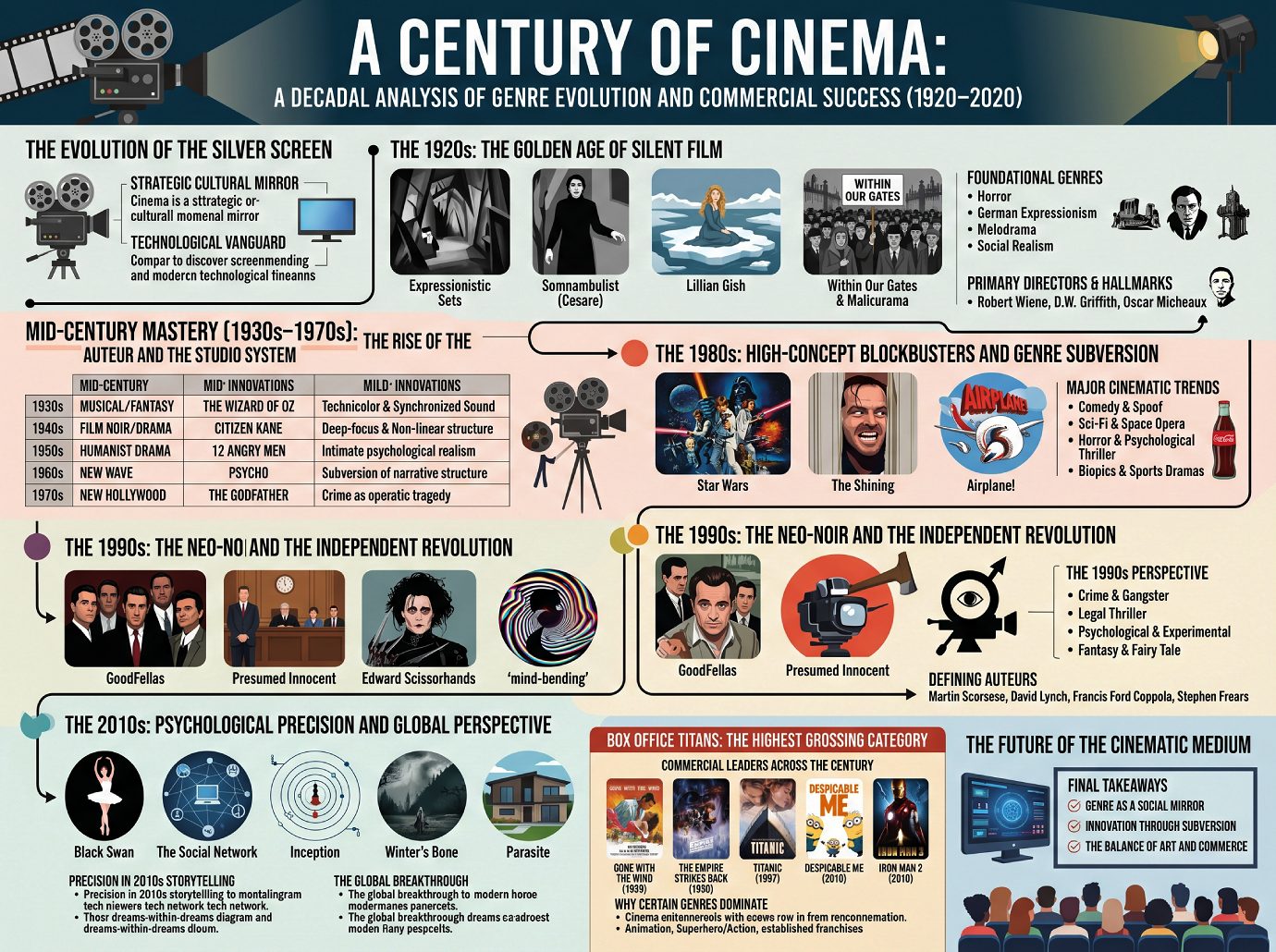
A Century of Cinema: A Decadal Analysis of Genre Evolution and Commercial Success (1920–2020)
1. Introduction: The Evolution of the Silver Screen
Cinema serves as both a strategic cultural mirror and a technological vanguard, capturing the shifting aspirations and anxieties of society for over a hundred years. As a medium, it is remarkably young, yet its journey from the silent, shadows-heavy expressionism of the early 20th century to the sophisticated digital blockbusters of the modern era reflects profound global transitions. Throughout this century, the silver screen has functioned as an “impossibly wide-ranging, ever-shifting glory,” evolving from a niche curiosity into a dominant global art form. This analysis seeks to synthesize these decades of storytelling, tracking how specific genres rose to prominence to define their respective eras. We begin with the foundational 1920s, an era where this “young medium” first mastered its complex and archaic visual grammar.
2. The 1920s: Expressionism, Melodrama, and Social Commentary
The 1920s represent the “Golden Age of Silent Film,” a decade where directors relied on light, shadow, and physical performance to push the boundaries of visual expression without the aid of synchronized dialogue. This era established foundational cinematic languages—a mastery of visual storytelling that reached its peak before the arrival of sound.
Foundational Genres of the 1920s
- Horror and German Expressionism: Robert Wiene’s The Cabinet of Dr. Caligari (1920) remains a landmark of stylistic filmmaking, characterized by a macabre atmosphere. By utilizing distorted, dream-nightmarish sets—twisted alleyways, crooked buildings, and skewed cityscapes—the film introduced many standard horror conventions. Central to its dread is the figure of Cesare, the “pale-skinned, lanky, black leotard-wearing” somnambulist whose hypnotic presence influenced a century of cinematic monsters.
- Melodrama: The emotional weight of the decade was exemplified by D.W. Griffith’s Way Down East (1920). Starring the “silent film immortal” Lillian Gish, the film utilized high-stakes physical action, most notably a climactic rescue on a floating ice floe heading toward a waterfall, to amplify its narrative of a wronged, innocent country girl.
- Social Realism: A pivotal moment in cinematic history occurred with Oscar Micheaux’s Within Our Gates (1920). As the earliest surviving directorial effort of an African-American filmmaker, it served as a courageous and direct rebuttal to the racial narratives of D.W. Griffith’s The Birth of a Nation (1915). By confronting themes of lynching, murder, and systemic white-supremacist attitudes, Micheaux established a milestone for historical significance and social resistance.
Primary Directors and Hallmarks
- Robert Wiene: Known for a macabre atmosphere, visual distortion, and high-contrast lighting that defined early horror.
- D.W. Griffith: A master of large-scale melodrama who pushed the boundaries of high-tension physical climaxes.
- Oscar Micheaux: A pioneer of social realism who used the medium as a tool for racial rebuttal and diverse storytelling.
While the silent era reached its zenith through this visual mastery, the eventual mid-century shifts in technology and studio power would soon redefine the medium’s narrative possibilities.
3. The Mid-Century Mastery (1930s–1970s): The Rise of the Auteur and the Studio System
The middle of the 20th century saw the birth of “talkies,” the consolidation of power within the Hollywood Studio System, and eventually, the rebellious rise of the “New Hollywood” auteurs who challenged traditional narrative rules.
Decadal Genre Evolution
- The 1930s (Musical and Fantasy): This decade marked the technical shift to color and synchronized sound. The Wizard of Oz (ranked #2 by Variety critics) remains the gold standard for cinematic enchantment, utilizing Technicolor to signify the transition to fantasy. Simultaneously, Charlie Chaplin’s City Lights proved that silent comedy could achieve romantic brilliance even amidst the rise of sound.
- The 1940s (Film Noir and Drama): The “Golden Age of Noir” emerged with films like Double Indemnity, while Citizen Kane—commonly thought of as the “greatest movie ever made” for decades—revolutionized film structure through its use of deep-focus cinematography and complex, non-linear storytelling.
- The 1950s (Humanist Drama and Epic): Cinema expanded internationally, contrasting the intimate humanism of Yasujirō Ozu’s Tokyo Story and Satyajit Ray’s Pather Panchali with the grand scale of Akira Kurosawa’s Seven Samurai. This era also mastered the “courtroom drama set inside the jury room” with the riveting 12 Angry Men.
- The 1960s (The New Wave and Counterculture): A paradigm shift occurred as traditional rules were broken. Alfred Hitchcock’s Psycho—ranked as the #1 film of all time by Variety—shattered audience expectations by killing its protagonist early. Meanwhile, Jean-Luc Godard’s Breathless introduced the jump cut, and The Graduate became an indelible comedy of alienation.
- The 1970s (The New Hollywood): This decade redefined the crime genre as operatic Greek tragedy. Films like The Godfather and Chinatown treated corruption and family loyalty with a weight previously reserved for classical theater, emphasizing moral decay and narrative complexity.
Summary of Mid-Century Innovations
| Decade | Dominant Category | Defining Film | Key Innovation |
|---|---|---|---|
| 1930s | Musical/Fantasy | The Wizard of Oz | Technicolor and synchronized sound mastery |
| 1940s | Film Noir/Drama | Citizen Kane | Deep-focus cinematography and non-linear structure |
| 1950s | Humanist Drama | 12 Angry Men | Intimate, single-location psychological realism |
| 1960s | New Wave | Psycho | Subversion of narrative structure and God-like oversight |
| 1970s | New Hollywood | The Godfather | Crime as operatic tragedy and the “Auteur” era |
As artistic experimentation peaked in the 70s, the industry began to shift toward a new model of high-concept, mass-market entertainment in the 1980s.
4. The 1980s: High-Concept Blockbusters and Genre Subversion
The 1980s were defined by the emergence of the “Blockbuster” and a fascination with high-concept premises that could be easily summarized and marketed, often blending zany, absurdist humor with technical masterpieces.
Major Cinematic Trends
- Comedy and Spoof: The decade pioneered “ZAZ humor” via Airplane!, which used verbal literalism (e.g., “don’t call me Shirley”) and rapid-fire visual gags. Caddyshack perfected the “Snobs vs. Slobs” trope, becoming a cultural touchstone through its improvisational brilliance.
- Sci-Fi and Space Opera: The Empire Strikes Back elevated the Star Wars franchise, proving that a sequel could introduce high narrative stakes and emotional complexity, ensuring franchise longevity.
- Horror and Psychological Thriller: Stanley Kubrick’s The Shining subverted “haunted house” conventions. Instead of relying on shadows, Kubrick used brightly lit scenes and groundbreaking Steadicam work. This technical precision was punctuated by the “ear-splitting tricycle” audio that heightened the sensation of domestic madness.
- Biopics and Sports Dramas: Visceral realism was the hallmark of the era’s dramas. Martin Scorsese’s Raging Bull offered a gritty, black-and-white character study, while Coal Miner’s Daughter provided a powerful underdog narrative.
The 1980s were also shaped by the rise of the VCR and cable TV, which granted “cult status” to films like The Blues Brothers. A notable example of this was the sleeper hit The Gods Must Be Crazy, a cultural mirror that used a simple Coke bottle as a symbol of “modern civilization” and the “plastic society” that native Africans were unprepared for. This accessibility set the stage for the grit and independent spirit that would define the 1990s.
5. The 1990s: The Neo-Noir and the Independent Revolution
In the 1990s, independent voices and a “neo-noir” sensibility challenged the dominance of mainstream studio productions, favoring fatalistic themes and stylistic violence.
The 1990s Perspective
- Crime and Gangster: Martin Scorsese’s GoodFellas presented the mob life as both seductive and brutally realistic. This fatalism was echoed in neo-noirish “grifter” narratives like The Grifters and After Dark, My Sweet, which leaned heavily on the unreliable narrator and themes of strained, fatalistic loyalty.
- The Legal Thriller: Mystery mechanics were refined in Presumed Innocent and Reversal of Fortune, the latter deconstructing the real-life “Case of Claus von Bülow” with a sense of moral ambiguity and high-society intrigue.
- Psychological and Experimental: Films like Jacob’s Ladder and Total Recall explored “mind-bending” territory, questioning the nature of reality through hallucinations and virtual constructs.
- Fantasy and Fairy Tale: Tim Burton’s Edward Scissorhands used a Gothic “Beauty and the Beast” allegory to deliver a sharp critique of 1950s suburban life, blending the dark with the whimsical.
Defining Auteurs of the 1990s
The decade was shaped by directors with distinct visual and narrative signatures:
- Martin Scorsese: Realistic crime sagas and high-energy editing.
- David Lynch: Surrealism and the dark underbelly of the American dream (Wild at Heart).
- Francis Ford Coppola: Continuing the operatic legacy with The Godfather Part III.
- Stephen Frears: Mastering the tense, deceptive world of the modern con artist.
As independent cinema flourished, the new millennium would bring a focus on digital precision and global narratives.
6. The 2010s: Psychological Precision and Global Perspective
The 2010s focused on psychological interiority and the social shifts brought about by the technological revolution, while global cinema began to break down traditional genre silos.
Precision in 2010s Storytelling
- Psychological Thriller: Darren Aronofsky’s Black Swan provided a study of “tormenting perfection.” Natalie Portman’s performance culminated in the haunting final line, “I felt it. Perfect… It was perfect,” capturing the cost of artistic obsession.
- Biographical and Tech Drama: The Social Network served as a defining narrative of the digital age, deconstructing the personal complications behind the rise of social media.
- Mind-Bending Heist: Christopher Nolan’s Inception added immense complexity to the heist genre, using a “dreams-within-dreams” structure to explore corporate espionage.
- Western Revisionism: The Coen Brothers’ True Grit and the gritty realism of Winter’s Bone offered new takes on survival. In Winter’s Bone, the search for a missing father is described with the vivid metaphor of a “dog digging for a winter’s bone.”
- Animation: The decade saw narrative sophistication in Toy Story 3 and How to Train Your Dragon, balancing technical brilliance with deep emotional resonance.
The Global Breakthrough
A significant milestone of the era was the success of Parasite (2019). As a “breakthrough best picture winner,” it signaled a tipping point in the global conversation, using a sharp thriller format to critique the rigid class system. This era of critical precision was mirrored by a period of unprecedented commercial growth for the “titans” of the box office.
7. Box Office Titans: The Highest Grossing Category
While critical acclaim focuses on artistic innovation, commercial performance is a crucial metric of mass cultural resonance. Throughout the century, “commercial behemoths” have defined the limits of the blockbuster phenomenon.
Commercial Leaders Across the Century
- Gone With the Wind (1939): For a long time, this was the quintessential Hollywood movie, a work of star power and spectacle that set the bar for commercial dominance.
- The Empire Strikes Back (1980): A massive commercial hit that proved the enduring power of science-fiction franchises.
- Titanic (1997): Merged spectacular disaster with a primal love story to achieve jaw-dropping global sales.
- Despicable Me (2010): Launched a dominant computer-animated franchise, highlighting the immense profitability of family-oriented comedy.
- Iron Man 2 (2010): Represented the rising dominance of the superhero genre and the “franchise-series” saturation of the modern market.
Why Certain Genres Dominate
The modern box office is increasingly dominated by Animation and Superhero/Action genres. Successes like Iron Man 2 and the Despicable Me franchise illustrate how cinema has become a dominant global art form. These films rely on established franchises to ensure consistent cultural visibility and massive sales, marking the confluence of mass appeal and technical prowess.
8. Conclusion: The Future of the Cinematic Medium
This decadal study illustrates that cinema has evolved from a “young medium” of silent experiments into a complex, multi-layered art form. Its survival is predicated on constant evolution—adapting to new technologies like sound, color, and CGI while remaining rooted in the fundamental human desire for storytelling.
Final Takeaways
- Genre as a Social Mirror: From the social realism of the 1920s to the class-conscious thrillers of the 2010s, genres evolve to reflect contemporary anxieties.
- Innovation Through Subversion: The medium stays relevant by breaking its own rules, whether through the New Wave of the 60s or the psychological “mind-bending” narratives of today.
- The Balance of Art and Commerce: While critical masterpieces redefine the craft, commercial titans demonstrate the medium’s power to create a shared global experience.
As the industry moves forward, it continues to honor a “landscape of spine-tingling eclecticism.” Cinema remains a young medium, still entirely capable of surprising us as it navigates the ever-shifting glory of the human experience.
