
Gardner MA Sludge Landfill and the National Problem of Sewage Sludge
Jump to a particular section, CLICK LINK:
The Escalating Crisis of PFAS Contamination in Agricultural Sewage Sludge —– From Toilet to Table: The Lifecycle of Waste and Gardner’s Path Forward —– Navigating the Sludge Dilemma: An Environmental Trade-off Summary —–The Biosolids Dilemma: A National Report on the Risks of Sewage Sludge Disposal —– The Dirty Secret in the Soil: Why Your Town’s ‘Daily Flush’ is Sparking a National Crisis —-
Watch this Video explaining the issue in Gardner MA:
Just by chance, each of the following is exactly the same length. But they are different podcasts.
Listen to this “Debate” on the Sludge Landfill Expansion in Gardner MA on any device, CLICK PLAY
Listen to this “Deep Dive” explaining Sewage Sludge on any device, CLICK PLAY.
Gardner Mayor Michael Nicholson Remarks on the Sludge Landfill Expansion made to Gardner City Council: February 17, 2026
Gardner Mayor Michael Nicholson Remarks on the Sludge Landfill Expansion made to Gardner City Council: February 17, 2026
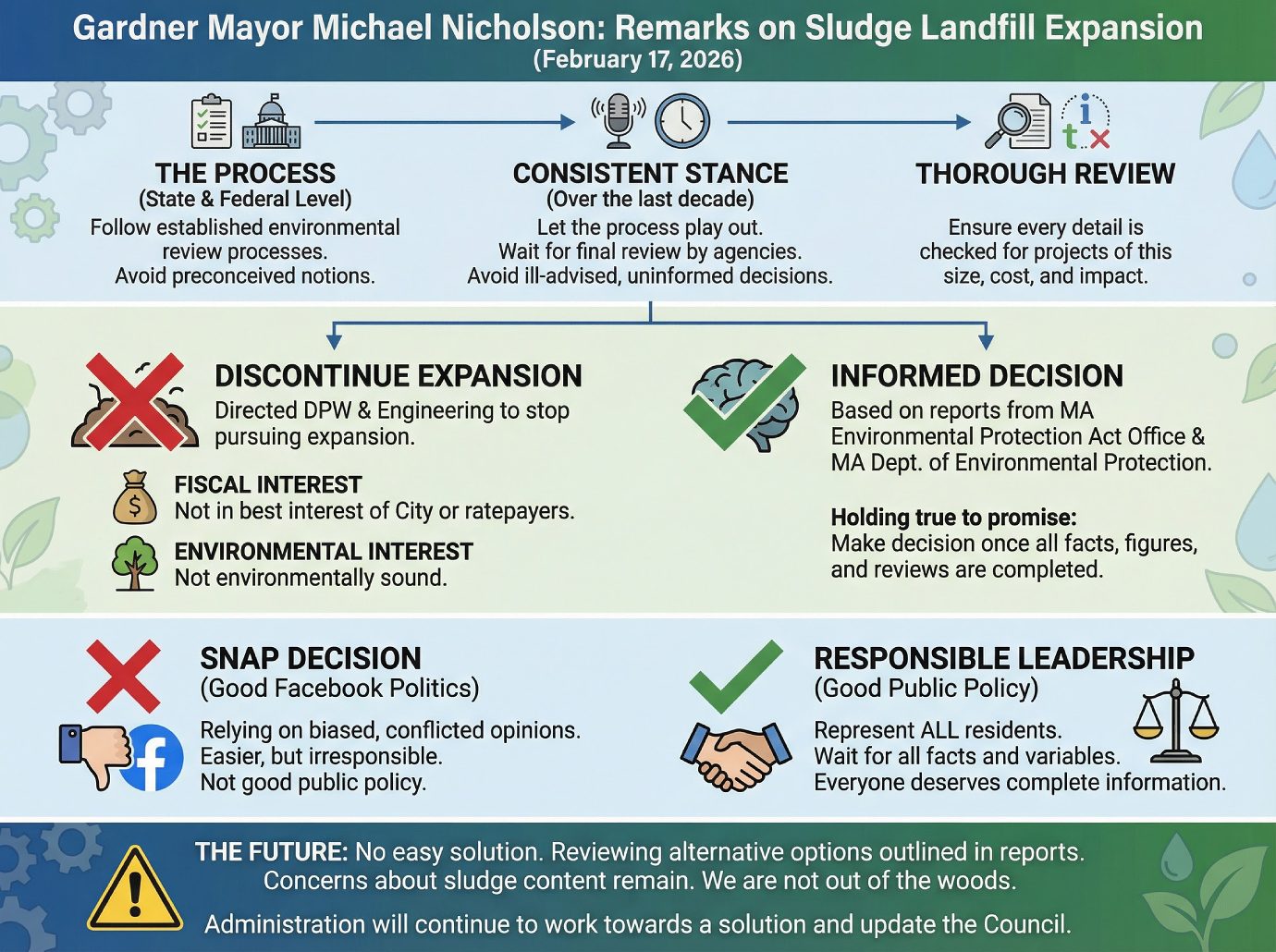
When dealing with projects related to the environment, it’s important we follow the processes that are in place at the state and federal level. The Sludge Landfill has been a topic of discussion in Gardner pretty consistently over the last decade. From the moment I launched my first campaign until now, I have consistently said that we need to let the process play itself out before any preconceived notions are made. Any decisions made before any final review was completed by the various state and federal agencies reviewing the project and its alternatives would be ill advised, uninformed, and amateurish at best. The processes are in place for a reason. We need to make sure every i is dotted and t crossed when dealing with a project of this size, cost, and impact. And that’s exactly what I’ve done.
After reviewing the reports from the Massachusetts Environmental Protection Act Office and the Massachusetts Department of Environmental Protection, I have directed the City’s Department of Public Works and Engineering Department to discontinue pursuing any further expansion of the existing sludge landfill. It is my opinion that any further expansion is not in the best interest of the City or our rate payers, either fiscally, or environmentally. I am holding true to the same promise that was made before on this project- to make an informed decision once all the facts, figures, and reviews were received and completed so that the best outcome could be reached.
It would have been easier for me to torpedo this when I came into office. This was the plan and proposal started by my predecessor. But, making a snap decision, relying on biased, and conflicted opinions to make a decision is not what people in a leadership position should do. It makes for good Facebook politics, but not good public policy.
Until just recently, we didn’t have every fact, there were still variables. I have shared many of the concerns raised by the opponents of this project, but it would have been irresponsible for me, as an elected official, to campaign against this, put a sign on my lawn, before all the facts came in, before all the variables were known to us. We were elected to represent all of the City’s residents, not just a small group of them. Everyone deserves every bit of information before a decision can be made.
In making my decision not to proceed with this project, I do so with every bit of information there is to make this a complete and sound judgement. So that the ratepayers can be assured that the best decision has been made.
I know some of you have strong opinions about this. Some of you expressed to me that you weren’t in favor or would vote against it. I appreciated when those legitimate opinions didn’t turn into political games and theatrics.
Now that I have made this decision, we will only review those alternative options outlined in the reports received from the review of the project. I want to be clear, there is no easy solution to this. Just as we are cautious about expanding our landfill, so are other communities who may be destinations. The concerns raised about what is in the sludge have only become more pronounced over time. So to anyone celebrating this decision, we’re nowhere close to being out of the woods on this issue.
I will update the Council as my administration continues to work towards a solution.
AUDIO of Statement to the Gardner City Council on 2-17-26
The Escalating Crisis of PFAS Contamination in Agricultural Sewage Sludge
The Escalating Crisis of PFAS Contamination in Agricultural Sewage Sludge
Summary
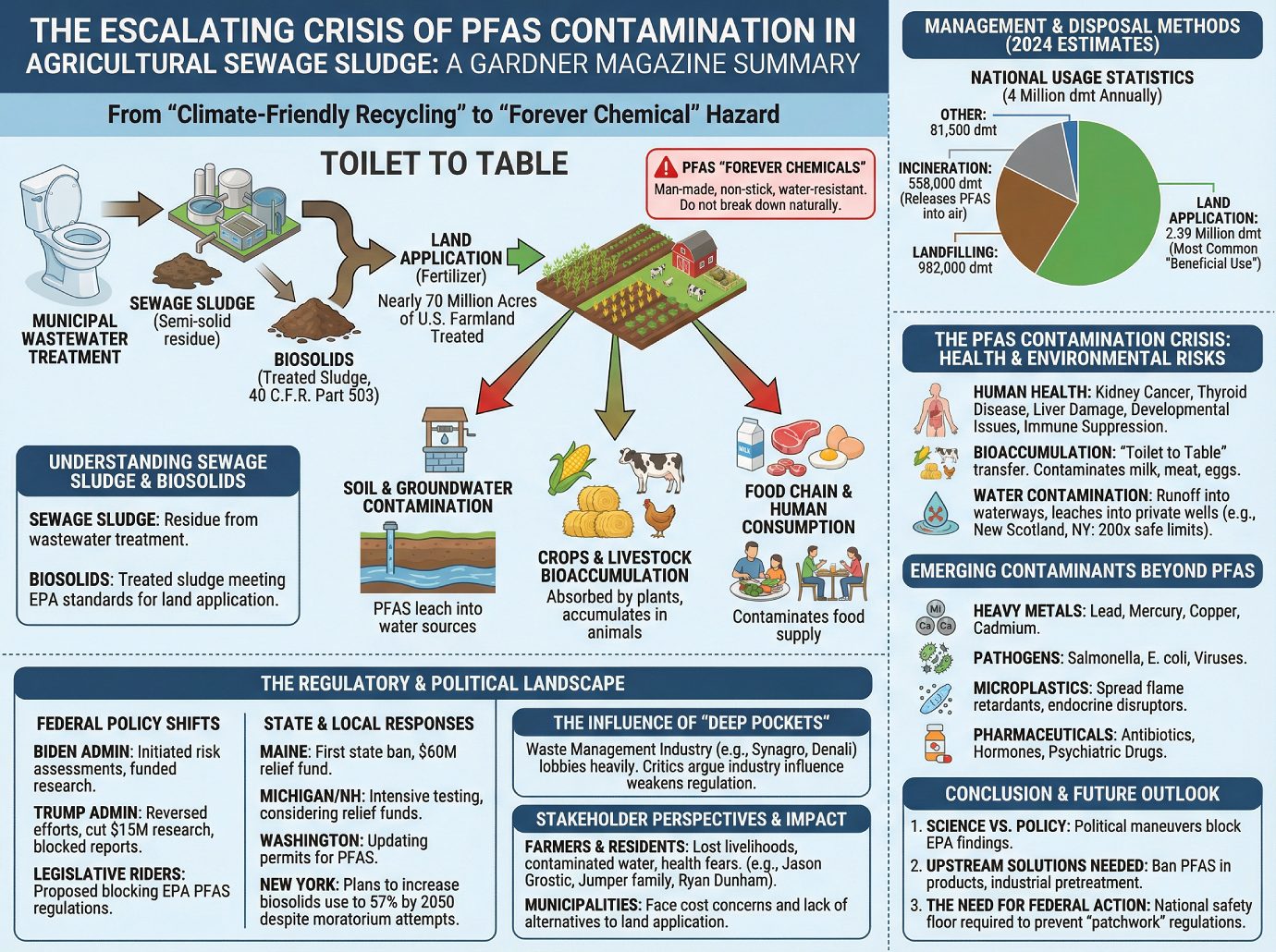
The practice of applying sewage sludge—the byproduct of municipal wastewater treatment—to agricultural land as fertilizer is facing intense scrutiny as evidence of widespread contamination by “forever chemicals” (PFAS) mounts. For decades, the Environmental Protection Agency (EPA) and waste management industries promoted this practice as a climate-friendly, cost-effective recycling method. Today, it is estimated that nearly 70 million acres of U.S. farmland are treated with these biosolids.
Recent findings have connected this practice to significant public health risks, including elevated cancer rates, thyroid disease, and liver damage. PFAS chemicals leach from the sludge into soil, groundwater, and the broader food chain, contaminating crops and livestock. While the Biden administration initiated preliminary risk assessments and funded research into these hazards, the current Trump administration has moved to reverse these efforts, cutting nearly $15 million in research funding and attempting to block the finalization of critical health risk reports. This federal retreat has created a “regulatory patchwork,” leaving states like Maine to implement total bans while others, such as New York, struggle to pass moratoriums amidst heavy industry lobbying.
Understanding Sewage Sludge and Biosolids
Sewage sludge is the semi-solid, nutrient-rich residue remaining after wastewater treatment plants separate liquids from solids in domestic and industrial sewage. The terms are often used interchangeably, but the EPA specifically defines biosolids as sewage sludge that has been treated to meet regulatory standards (40 C.F.R. Part 503) for land application as a soil conditioner or fertilizer.
Management and Disposal Methods
There are three primary methods for managing sewage sludge in the United States:
• Land Application: The most common “beneficial use” method, involving spreading, spraying, or injecting sludge onto agricultural land, forests, and reclamation sites.
• Landfilling: Disposal in municipal solid waste landfills or dedicated sewage sludge monofills.
• Incineration: Combustion at high temperatures, which reduces volume but can release PFAS into the air.
National Usage Statistics (2024 Estimates)
The EPA estimates that approximately four million dry metric tons (dmt) of sewage sludge are generated annually. The following table illustrates the distribution of management practices:
| Management Practice | Estimated Amount (dmt) |
|---|---|
| Land Application | 2.39 million |
| Landfilling | 982,000 |
| Incineration | 558,000 |
| Other (Deep well injection, storage, etc.) | 81,500 |
The PFAS Contamination Crisis
Per- and polyfluoroalkyl substances (PFAS) are a class of thousands of man-made chemicals used in consumer products for their non-stick and water-resistant properties. Because they do not break down naturally, they accumulate in the environment and the human body.
Health and Environmental Risks
The EPA confirmed in early 2025 that even extremely low levels of PFOA and PFOS in sewage sludge applied to farmland result in an elevated risk of cancer and non-cancer health effects.
• Human Health: Linked to kidney cancer, thyroid disease, liver damage, developmental issues in infants, and immune system suppression.
• Bioaccumulation: PFAS travel from “toilet to table.” They are absorbed by edible crops (corn, hay) and bioaccumulate in livestock, contaminating milk, meat, and eggs.
• Water Contamination: Runoff from sludge-treated fields carries chemicals into waterways and leaches into private wells. In New Scotland, NY, some wells tested 200 times above safe limits for contaminants following nearby sludge application.
Emerging Contaminants Beyond PFAS
Beyond PFAS, sewage sludge is known to contain a “biological cocktail” and chemical mishmash including:
• Heavy Metals: Lead, mercury, copper, and cadmium.
• Pathogens: Salmonella, E. coli O157:H7, and various viruses (Adenovirus, Rotavirus).
• Microplastics: Found to spread flame retardants and endocrine disruptors.
• Pharmaceuticals: Residues from antibiotics, hormones, and psychiatric drugs.
The Regulatory and Political Landscape
The regulation of biosolids is currently a battleground between public health advocates and industry-backed political interests.
Federal Policy Shifts
• The Biden Administration: Released the first-ever preliminary evaluation of human health risks associated with PFAS in biosolids and funded landmark research at 11 universities.
• The Trump Administration: Has moved to slash environmental funding and research. In July 2025, the administration cut nearly $15 million in farm-related PFAS research.
• Legislative Riders: Congressional Republicans proposed a permanent provision in a House appropriations bill to prevent the EPA from finalizing its PFAS risk assessment or using its findings to create new regulations.
The Influence of “Deep Pockets”
Advocates point to the immense influence of the waste management industry. Companies like Synagro Technologies Inc. and Denali Water Technology (WeCare Denali) hold multimillion-dollar contracts with local governments.
• Lobbying: In New York, a five-year moratorium bill passed four committees but stalled on the Assembly floor. Legislators suspect this “last-minute flip” resulted from lobbying by Denali, which is owned by the $19 billion private equity firm TPG.
• Industry Influence: Industry trade groups meet with the EPA to “ensure validated science” is used, which critics argue is a euphemism for weakening regulation.
State and Local Responses
In the absence of consistent federal oversight, a patchwork of state-level regulations has emerged:
• Maine: The national leader in biosolid regulation. In 2022, it became the first state to ban sewage sludge application and established a $60 million relief fund for farmers whose land and livelihoods were destroyed by contamination.
• Michigan and New Hampshire: Have begun intensive testing and are considering financial safety nets for farmers. New Hampshire is evaluating House Bill 1275, which proposes an Agricultural PFAS Relief Fund.
• Washington State: The Pollution Control Hearings Board ruled that biosolids permits must be updated to address PFAS, PBDEs, and microplastics to comply with environmental laws.
• New York: Despite being a top-five state for biosolid use, its Department of Environmental Conservation plans to increase the use of biosolids from 22% to 57% by 2050, characterizing them as “nutrient-rich.”
Stakeholder Perspectives and Impact
Impact on Farmers and Residents
The human cost of contamination is profound. Farmers like Jason Grostic in Michigan and the Jumper family in Maine lost multi-generational dairy and cattle operations overnight after testing revealed toxic PFAS levels.
• Resident Experience: Ryan Dunham of New Scotland, NY, discovered his children were showering in water that smelled of “decay, rot, and death” because sludge from a neighbor’s farm had seeped into his well.
• Public Health Concerns: “Whenever my daughter’s taking a shower and singing… I wonder what chemicals she is ingesting,” Dunham stated.
Challenges for Municipalities
Wastewater treatment professionals argue that sludge is an unavoidable byproduct.
• Cost Concerns: Banning land application forces municipalities to use more expensive disposal methods like landfilling or long-distance trucking (sometimes to Canada), which would raise rates for sewer users.
• Lack of Alternatives: “I do want you to really think long and hard about where your daily flush is going to go,” warned Shelagh Connelly of Resource Management Inc.
Conclusion and Future Outlook
The conflict over sewage sludge highlights a fundamental tension between waste disposal logistics and public health. While land application is an efficient disposal method for municipalities, the “forever” nature of PFAS means that current practices may be poisoning the U.S. food supply and water resources for generations.
Key Conclusions:
1. Science vs. Policy: While EPA scientists have confirmed cancer risks, political maneuvers are currently preventing these findings from becoming enforceable regulations.
2. Upstream Solutions Needed: Advocates argue the only long-term solution is to prevent PFAS from entering the waste stream initially by banning their use in consumer products and requiring industrial pretreatment.
3. The Need for Federal Action: State bans, while effective locally, create a “patchwork” that allows contaminated waste to be shipped to less-regulated regions. A federal “floor” of safety is required to protect the national food system. ———————————————–
The Dirty Secret in the Soil: Why Your Town’s ‘Daily Flush’ is Sparking a National Crisis
Every year, the average person generates approximately 37 pounds of wastewater sludge. It is the unavoidable byproduct of modern life—the solid residue filtered out after every toilet flush and shower.
In New Scotland, New York, Ryan Dunham discovered the reality of this “daily flush” when his eleven-year-old daughter screamed in the shower. The water ran brown, smelling of “decay, rot, and death.”
The source was human waste spreading across a neighbor’s farm. This material, often rebranded as “nutrient-rich biosolids,” had seeped into the local groundwater, leaving Dunham’s children to bathe in the concentrated remnants of the community’s sewers.
The ‘Forever Chemical’ Pipeline
Wastewater treatment plants are remarkable at separating liquids from solids, but they were never designed to destroy per- and polyfluoroalkyl substances (PFAS). These “forever chemicals” now hitch a ride from industrial drains and household sinks directly into the sludge.
The irony is a policy failure of marketing versus medicine. For decades, the EPA promoted biosolids as a “nutrient-rich” recycling win. Today, the agency confirms that even low levels of PFAS in this sludge pose an elevated cancer risk.
In towns like Bethlehem, New York, investigators have identified PFBA—a specific PFAS not currently regulated by the EPA—in water supplies near sludge-applied fields. In New Scotland, samples showed E. coli and coliform levels 200 times above safe limits.
“PFAS doesn’t care if you live in Massachusetts or Connecticut. They don’t care if you’re in New Jersey or New York. These chemicals spread and they bioaccumulate in living organisms, from plants, to beef cattle, to ourselves.” — Clare Walsh Winsler, Environmental Advocates New York.
The Death of the ‘Green’ Fertilizer Narrative
What was once marketed as a climate-friendly “soil amendment” is now being reclassified by agricultural experts as a “major hazard.” Industry surveys suggest that sludge is currently spread across nearly 70 million acres of U.S. farmland.
The transition from recycling success to environmental nightmare has been swift. Contaminants in the soil are absorbed by crops and livestock, moving the chemicals from the muck to the dinner table.
Maine became the first state to shatter the narrative, issuing a first-in-the-nation ban on land-applied sludge. This pivot occurred after widespread contamination forced multi-generational dairy farms to shutter overnight when their milk was found to be tainted.
The Disposal Trap: Landfilling vs. Incineration vs. The Air
As land application outlets disappear, municipalities are falling into a “disposal trap.” There is no perfect exit strategy, and every choice involves a trade-off between the soil, the water, and the air.
• Landfilling: Approximately 982,000 dry metric tons of sludge were landfilled in 2024. This method has the highest impact on global warming due to methane and photochemical oxidation.
• Incineration: About 558,000 dry metric tons were burned in 2024. While it offers energy recovery, it can release PFAS into the air and leaves behind toxic ash that requires specialized disposal.
A Life Cycle Assessment (LCA) of Italian waste strategies reveals the complexity: land spreading has the lowest global warming values but the highest terrestrial ecotoxicity. Incineration may reduce human toxicity, but only if there is “effective recovery of solid residues.” Without it, the benefits vanish.
The Regulatory Vacuum and Private Interests
The U.S. currently operates under a confusing patchwork of regulations as federal oversight undergoes a systematic retreat. A “smoking gun” for this vacuum is a recent House appropriations bill rider designed to prevent the EPA from finalizing PFAS risk assessments.
The federal government has also moved to slash nearly $15 million in PFAS research, effectively closing critical studies at 11 universities across the country. This leaves the door open for private waste management firms with deep pockets to dictate the terms of disposal.
Firms like TPG, a private equity firm valued at $19 million, operate through divisions like WeCare Denali, which holds contracts such as a $2 million deal with Rockland County. Lobbying from these entities is often credited for stalling state-level moratoriums that would otherwise restrict sludge spreading.
The Merrimack Dilemma: Necessity vs. Safety
The crisis is reaching a breaking point in towns like Merrimack, New Hampshire. Assistant Director of Public Works Leo Gaudette has cautioned that as “outlets” for sludge disappear, the financial burden on local residents becomes unsustainable.
Merrimack, like many other communities, faces a choice between environmental safety and skyrocketing sewer rates. If land application is banned without a federal standard, the cost of trucking waste long distances—sometimes to Canada—will fall directly on the ratepayers.
Local officials must now weigh three critical factors:
• Cost Stability: Land application remains the cheapest disposal route; alternatives can double or triple municipal budgets.
• Public Health Liability: Failing to act on PFAS risks billions in long-term remediation and health costs.
• Long-term Environmental Impact: Decision-makers must choose between contaminating local soil or contributing to air pollution and climate change.
A Forward-Looking Ponder
Sludge is the one environmental problem we cannot stop producing. As long as humans eat and wash, the “daily flush” will continue to concentrate the chemicals of our modern existence into a toxic slurry.
If our soil has become too contaminated to serve as a filter and our air is at risk from incineration, we are reaching the limits of our disposal capacity. As Shelagh Connelly of Resource Management Inc. warned: “Think long and hard about where your daily flush is going to go.”
Are we prepared for the skyrocketing costs of maintaining a clean environment, or will we continue to hide our dirty secrets in the soil?
————————–
From Toilet to Table: The Lifecycle of Waste and Gardner’s Path Forward
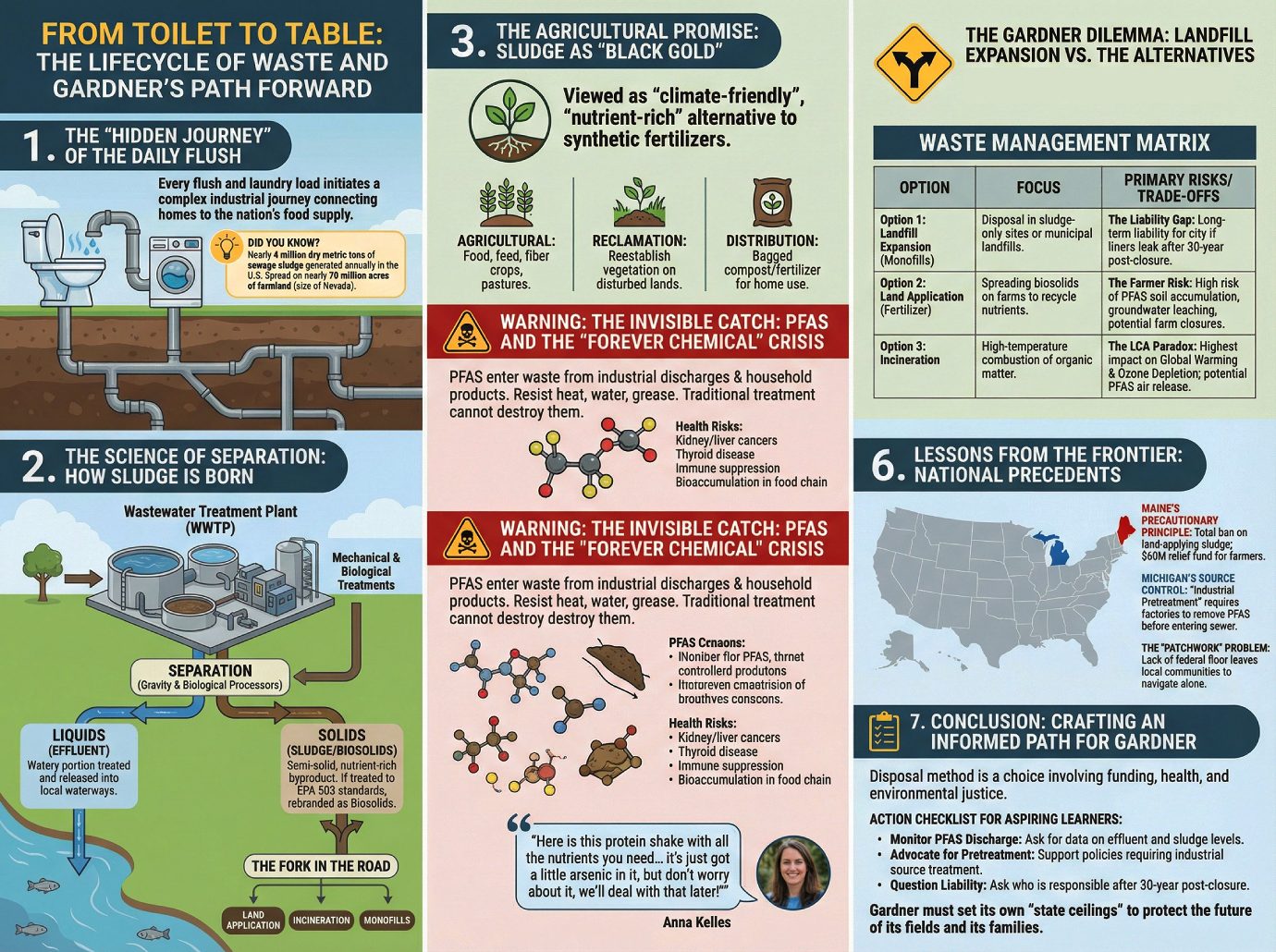
From Toilet to Table: The Lifecycle of Waste and Gardner’s Path Forward
1. The “Hidden Journey” of the Daily Flush
Every time you flush a toilet or wash a load of laundry, you are initiating a complex industrial journey that connects your home to our nation’s food supply. This “daily flush” is the start of a conceptual process narrative: a story of how human and industrial waste is transformed from a municipal burden into a potential agricultural resource. On a national scale, this transformation is massive, with nearly 4 million dry metric tons of sewage sludge generated annually in the United States.
Did You Know? According to estimates from the National Biosolids Data Project, based on industry surveys, the reach of sludge application is vast. It is currently spread on nearly 70 million acres of U.S. farmland—an area roughly the size of the state of Nevada.
While this system has functioned behind the scenes for decades, it is now at the center of a high-stakes debate over safety and sustainability. To understand the choices facing Gardner, we must follow the waste from the bathroom drain to the city’s Wastewater Treatment Plant (WWTP).
——————————————————————————–
2. The Science of Separation: How Sludge is Born
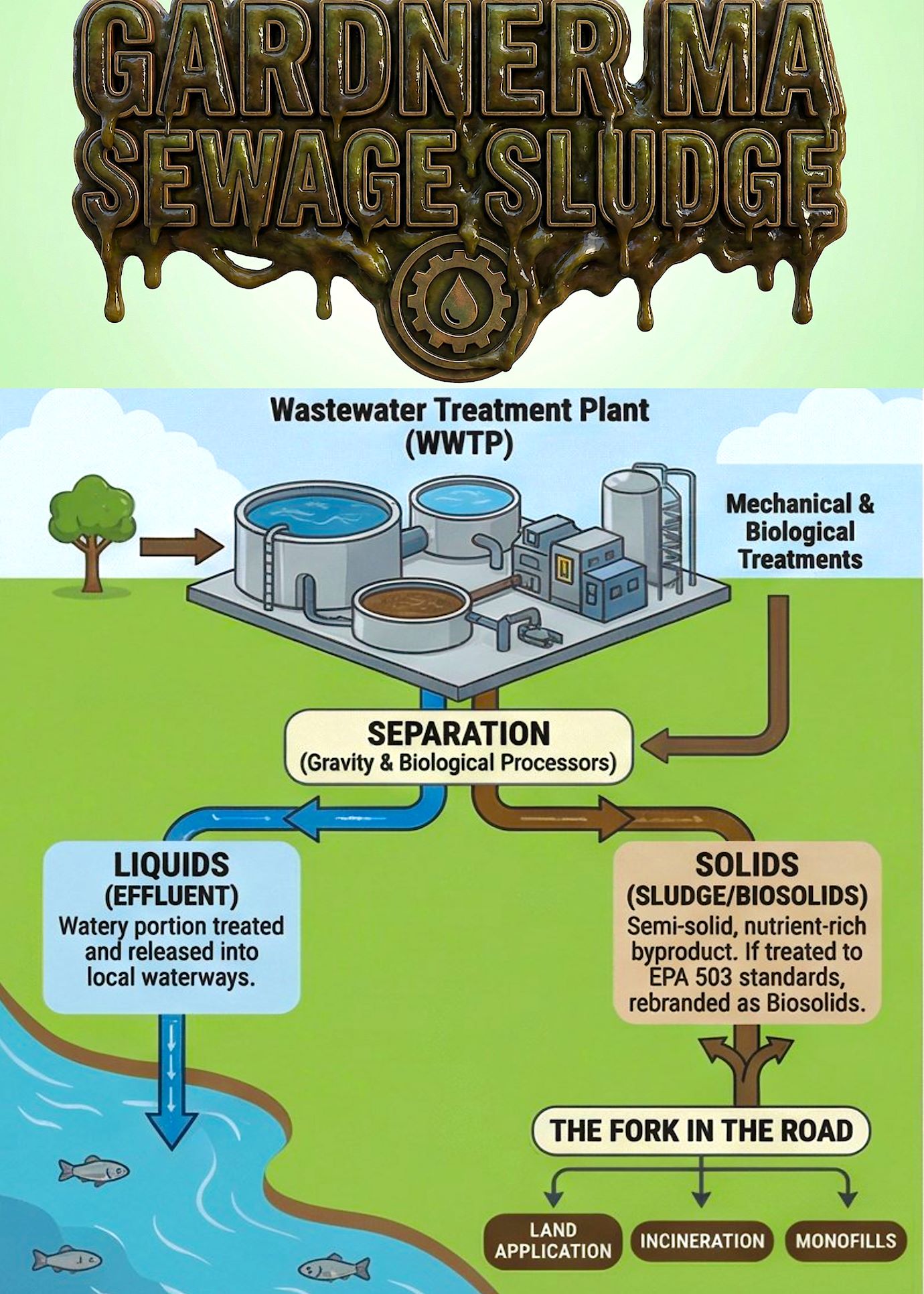
When waste arrives at a WWTP, it undergoes a series of mechanical and biological treatments designed to purify water before it returns to our environment. The core of this technology is separation: using gravity and biological processors to divide the “daily flush” into two distinct streams.
This separation creates a semi-solid, nutrient-rich byproduct known as Sewage Sludge. Under the EPA’s 40 C.F.R. Part 503 standards, if this sludge is further treated to meet specific pathogen and pollutant requirements for land application, it is rebranded as Biosolids.
The Fork in the Road
| Liquids (Effluent) | Solids (Sludge/Biosolids) |
|---|---|
| The watery portion of waste that is treated and released into local waterways. | Semi-solid, nutrient-rich material that remains for further management. |
| Primarily released back into rivers and streams. | Must be managed via land application, incineration, or disposal in specialized monofills. |
Once these solids are separated, the city must decide where they go next—a choice that carries long-term environmental and financial consequences.
——————————————————————————–
3. The Agricultural Promise: Sludge as “Black Gold”
For years, sludge has been viewed as a “climate-friendly” and “nutrient-rich” alternative to synthetic fertilizers. For Gardner’s farmers, this material can be an inexpensive tool to condition the soil and provide three primary nutrients vital for crop health: Carbon, Nitrogen, and Phosphorus.
The Three Pillars of Sludge Utility
• Agricultural: Applied to land to grow food, feed, and fiber crops, or to nourish pastures for animal grazing.
• Reclamation: Used to reestablish vegetation on significantly disturbed lands, such as closed mines or construction sites.
• Distribution: Processed into bagged compost or fertilizer sold to the public for home lawns and gardens.
However, the scientific reality of modern waste is complicated. We are now facing the “arsenic in the protein shake” dilemma—the reality that hidden, indestructible chemicals are lurking within these valuable nutrients.
——————————————————————————–
# WARNING: The Invisible Catch: PFAS and the “Forever Chemical” Crisis
The same processes that concentrate nutrients in sludge also concentrate per- and polyfluoroalkyl substances (PFAS). These “forever chemicals” enter Gardner’s waste stream from industrial discharges and common household products. Because they are designed to resist heat, water, and grease, traditional wastewater treatment cannot destroy them.
As an educator, I must note a critical nuance: current testing standards often focus on the “total content” of chemicals, but scientific research indicates this is not always a reliable indicator of toxicity. Even at low levels, PFAS pose significant health risks, including:
• Kidney and liver cancers.
• Thyroid disease and immune system suppression.
• Bioaccumulation in the food chain (moving from soil to crops, and then into milk, meat, and eggs).
“Here is this protein shake with all the nutrients you need… it’s just got a little arsenic in it, but don’t worry about it, we’ll deal with that later!” — New York State Assemblywoman Anna Kelles, PhD
This chemical reality moves us from a simple story of recycling to a difficult municipal management dilemma.
——————————————————————————–
5. The Gardner Dilemma: Landfill Expansion vs. The Alternatives
Disposing of sludge is unavoidable, but Gardner must choose a path that balances cost with long-term liability. Every disposal method involves a scientific trade-off.
The Waste Management Matrix
| Option | Focus | Primary Risks/Trade-offs |
|---|---|---|
| Option 1: Landfill Expansion (Monofills) | Disposal in sludge-only sites or municipal landfills. | The Liability Gap: Requires leachate collection, but current regulations often let industry “off the hook” after a 30-year post-closure period, leaving the city with long-term liability if liners eventually leak. |
| Option 2: Land Application (Fertilizer) | Spreading biosolids on farms to recycle nutrients. | The Farmer Risk: High risk of PFAS soil accumulation and groundwater leaching; potential to shutter local farms if contamination is discovered in the food supply. |
| Option 3: Incineration | High-temperature combustion of organic matter. | The LCA Paradox: While it reduces human toxicity and acidification, Life Cycle Assessments (LCA) show it has the highest impact on Global Warming and Ozone Depletion while potentially releasing PFAS into the air. |
As Gardner weighs the necessity of disposal against the risks of environmental leaching, we can look to other states that are already navigating these identical choices.
——————————————————————————–
6. Lessons from the Frontier: National Precedents
Across the country, the lack of a “federal floor” for PFAS has led to a patchwork of “Ban vs. Promote” strategies.
Lessons for Gardner:
1. Maine’s Precautionary Principle: In response to shuttered farms, Maine enacted a total ban on land-applying sludge and established a $60 million relief fund for impacted farmers.
2. Michigan’s Source Control: Michigan has pioneered “Industrial Pretreatment.” This works by requiring factories to treat their waste at the source to remove PFAS before it ever hits the municipal sewer system, significantly cleaning the resulting sludge.
3. The “Patchwork” Problem: Without federal oversight, local communities like Gardner are left to navigate the legal and environmental influence of the waste management industry on their own.
For Gardner residents, the “So What?” is clear: the safety of your local food and water depends on how we handle the solids left behind.
——————————————————————————–
7. Conclusion: Crafting an Informed Path for Gardner
While waste is unavoidable (“The Daily Flush”), the method of disposal is a choice involving funding, health, and environmental justice. The journey from toilet to table requires active oversight and a commitment to keeping our food chain safe.
Action Checklist for Aspiring Learners:
• Monitor PFAS Discharge: Ask local officials for data on PFAS levels. Be specific: ask about the levels in both the effluent (liquid) and the sludge (solids), as chemicals often distribute into both.
• Advocate for Pretreatment: Support policies that require industrial users to treat waste at the source. This is the most effective way to protect municipal infrastructure.
• Question Liability: In discussions about landfill expansion, ask who is responsible for monitoring and remediation after the initial 30-year post-closure period expires.
Ultimately, while we wait for “federal floors” to set national safety standards, Gardner must set its own “state ceilings” to protect the future of its fields and its families. ——————-
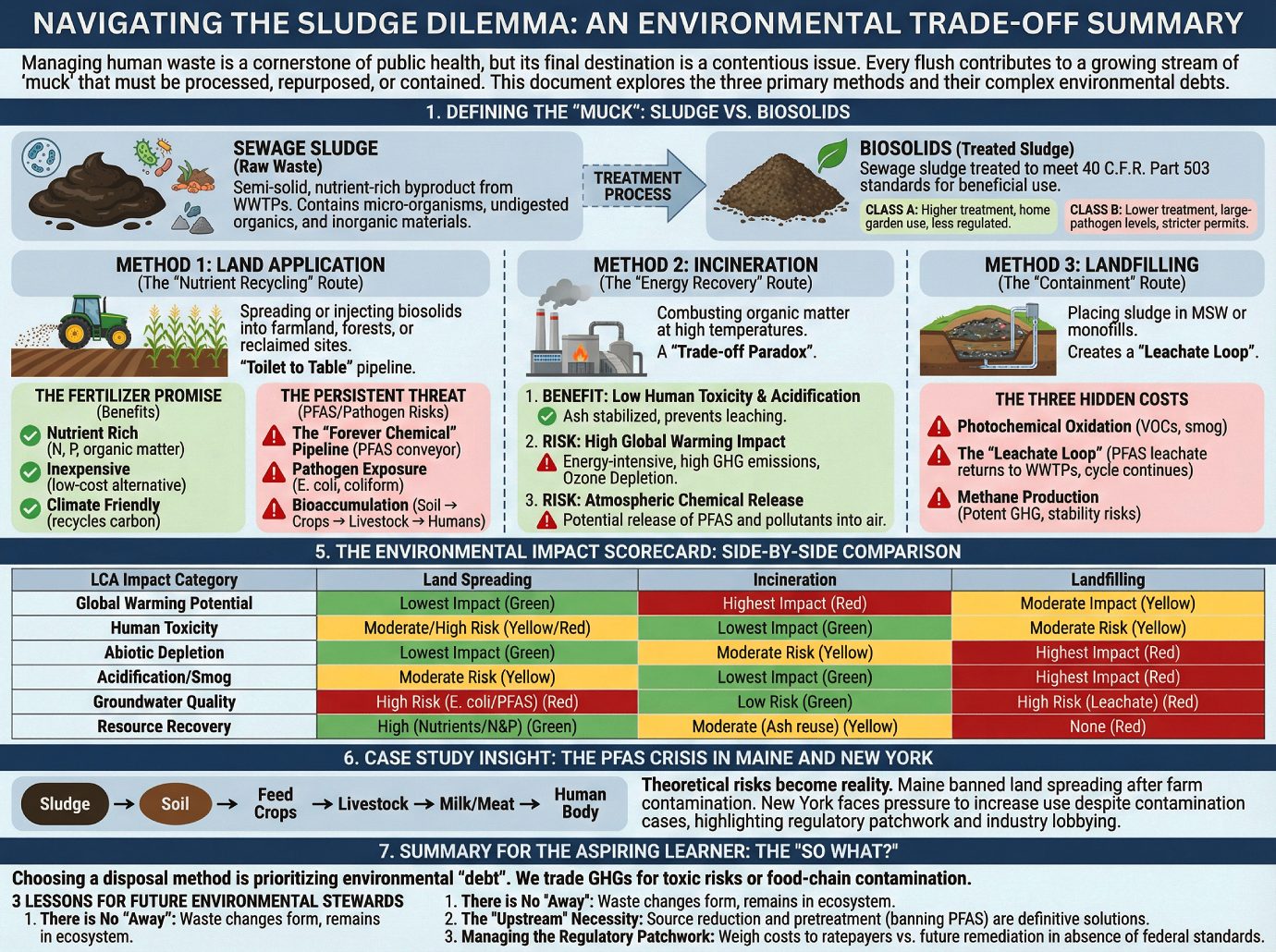
Navigating the Sludge Dilemma: An Environmental Trade-off Summary
Managing human waste is a cornerstone of public health, yet the final destination of that waste remains one of the most contentious issues in modern environmental science and policy. Every time we flush, we contribute to a growing stream of “muck” that must be processed, repurposed, or contained. As a society, we face a regulatory patchwork where the necessity of disposal often clashes with the reality of contamination. This document explores the three primary methods used to handle this waste and the complex environmental debts we incur with each choice.
1. Defining the “Muck”: Sludge vs. Biosolids
To navigate this dilemma, we must first distinguish between raw waste and the products created from it. The U.S. Environmental Protection Agency (EPA) and wastewater treatment plants (WWTPs) use specific terminology to describe these materials, though their meanings carry significant regulatory weight.
——————————————————————————–
Key Definitions
• Sewage Sludge: The semi-solid, nutrient-rich byproduct created during the treatment of domestic sewage at a WWTP. It is the solid mass separated from liquid waste, containing a “cocktail” of micro-organisms, undigested organics, and inorganic materials.
• Biosolids: This term refers specifically to sewage sludge that has been treated to meet the standards of 40 C.F.R. Part 503. These are intended for beneficial use as soil conditioners or fertilizers.
◦ Class A: Treated to a higher standard, often sold for home garden use and less regulated for tracking.
◦ Class B: Frequently used in large-scale agriculture; these have higher allowable levels of pathogens and require stricter permits for application.
——————————————————————————–
While these terms are often used interchangeably, the label “biosolids” is frequently a point of marketing by industry groups to promote the beneficial reuse of waste. Regardless of the label, the sheer volume of material generated daily makes finding a disposal method an urgent necessity.
2. Method 1: Land Application (The “Nutrient Recycling” Route)
Land application involves spreading or injecting biosolids into farmland, forests, or reclaimed mining sites. This method is promoted as a way to “close the loop” on the waste cycle through what critics and advocates alike call the “Toilet to Table” pipeline. Currently, sludge is spread on nearly 70 million acres of U.S. farmland—roughly the size of Nevada—primarily using Class B biosolids.
| The Fertilizer Promise (Benefits) | The Persistent Threat (PFAS/Pathogen Risks) |
|---|---|
| Nutrient Rich: Recycles nitrogen (N), phosphorus (P), and organic matter to improve soil health and crop yields. | The “Forever Chemical” Pipeline: Sludge acts as a conveyor for PFAS. The EPA confirms that even at low levels, PFOA and PFOS in sludge pose significant cancer risks. |
| Inexpensive: Offers a low-cost alternative to synthetic fertilizers, supporting the economic viability of small-scale farming. | Pathogen Exposure: In New Scotland, NY, sludge application led to well water testing nearly 200 times above the safe limit for E. coli and coliform. |
| Climate Friendly: Seen as more sustainable than energy-intensive synthetic fertilizers by recycling existing carbon. | Bioaccumulation: Chemicals travel from soil to feed crops, then to livestock, and ultimately into the human body via milk, meat, and eggs. |
While land application offers immediate agricultural benefits, it simultaneously acts as a primary vector for persistent toxins that current wastewater treatment processes are not designed to destroy. This transition from soil enrichment to environmental contamination forces us to consider the atmospheric consequences of alternative disposal methods.
3. Method 2: Incineration (The “Energy Recovery” Route)
Incineration uses high temperatures to combust the organic matter within sewage sludge. Based on Life Cycle Assessment (LCA) data (such as the Lombardi et al. study), this method presents a unique “Trade-off Paradox.”
The Three Critical Trade-offs of Combustion
1. Benefit: Low Human Toxicity & Acidification: Incineration often yields the lowest values for human toxicity. This is primarily because solid residues (ash) are recovered and stabilized, preventing the leaching of heavy metals or chemicals into groundwater that occurs in land spreading.
2. Risk: High Global Warming Impact: The process of burning waste is energy-intensive and generates significant greenhouse gas emissions, resulting in the highest scores for Global Warming Potential and Ozone Layer Depletion.
3. Risk: Atmospheric Chemical Release: While combustion reduces waste volume by 90%, it risks releasing PFAS and other persistent pollutants into the air if not managed with advanced scrubbers, potentially spreading “forever chemicals” through the atmosphere.
If air quality and global warming are the primary concerns, the final alternative—containment—must be examined for its long-term stability.
4. Method 3: Landfilling (The “Containment” Route)
Landfilling involves placing sludge in either municipal solid waste (MSW) landfills or dedicated monofills (sewage-sludge-only landfills). While this appears to “hide” the waste, it creates a “Leachate Loop” that perpetuates the very contamination it seeks to contain.
The Three Hidden Costs of Landfilling
• Photochemical Oxidation: Landfilling performs worst in this category due to the release of volatile organic compounds (VOCs) that contribute to ground-level ozone and smog.
• The “Leachate Loop”: As rainwater filters through a landfill, it creates “leachate” concentrated with PFAS. This liquid is typically sent back to WWTPs. Since these plants cannot destroy PFAS, the chemicals are either released in treated water or concentrated back into new sludge, creating a never-ending cycle of pollution.
• Methane Production: Anaerobic decay produces methane, a potent greenhouse gas. Strategically, some operators keep landfills “wet” to increase methane for energy capture, but this increases moisture levels by up to 300%, undermining site stability and increasing the risk of toxic leaks.
To understand the full scope of these choices, we must view them side-by-side through the lens of technical impact categories.
5. The Environmental Impact Scorecard: Side-by-Side Comparison
No disposal method is without an environmental “debt.” The following table synthesizes LCA data to show the trade-offs across different environmental stresses.
| LCA Impact Category | Land Spreading | Incineration | Landfilling |
|---|---|---|---|
| Global Warming Potential | Lowest Impact | Highest Impact | Moderate Impact |
| Human Toxicity | Moderate/High Risk | Lowest Impact | Moderate Risk |
| Abiotic Depletion | Lowest Impact | Moderate Risk | Highest Impact |
| Acidification/Smog | Moderate Risk | Lowest Impact | Highest Impact |
| Groundwater Quality | High Risk (E. coli/PFAS) | Low Risk | High Risk (Leachate) |
| Resource Recovery | High (Nutrients/N&P) | Moderate (Ash reuse) | None |
This data provides the technical framework, but the true cost of these trade-offs is best understood through the lived experiences of those at the front lines of the contamination crisis.
6. Case Study Insight: The PFAS Crisis in Maine and New York
The theoretical risks of sludge disposal have become a grim reality for families in the Northeast, highlighting a regulatory patchwork influenced by industry lobbying.
The “Forever Chemical” Bioaccumulation Chain
In Maine, the Jumper family, owners of a four-generation dairy farm, were forced out of business “overnight” after discovering their soil and milk were contaminated by historic sludge applications. In New Scotland, NY, the Dunham family discovered their children were showering in brown water that smelled of “decay and death”—the result of a neighbor spreading sludge that leached into their well.
The Chain: Sludge → Soil → Feed Crops → Livestock → Milk/Meat → Human Body.
While Maine enacted a historic ban on land spreading in 2022, other states face intense pressure from “deep pockets” in the waste industry. For example, the New York Department of Environmental Conservation plans to increase sludge use on land from 22% to 57% by 2050. This push continues even as legislative efforts for a moratorium stall, often due to lobbying from firms like WeCare Denali, which holds lucrative contracts (such as a $2 million deal in Rockland County). This highlights the tension between affordable municipal waste management and the long-term protection of the food supply.
7. Summary for the Aspiring Learner: The “So What?”
Choosing a sewage disposal method is a matter of prioritizing which environmental “debt” we are willing to pay. We are currently trading greenhouse gases (incineration) for potential toxic containment failures (landfilling) or direct food-chain contamination (land application). As future stewards, you must look beyond the “daily flush” and consider the systemic influences of industry and regulation.
3 Lessons for Future Environmental Stewards
1. There is No “Away”: When we flush, the waste simply changes form. Whether it becomes smoke, fertilizer, or landfill leachate, it remains a permanent part of our ecosystem.
2. The “Upstream” Necessity: We cannot “treat” our way out of this crisis. The only definitive solution is source reduction and pretreatment—banning PFAS in consumer products (like food packaging and ski wax) and requiring industries to clean their waste before it enters the municipal stream.
3. Managing the Regulatory Patchwork: In the absence of federal standards for PFAS in biosolids, responsibility falls to state and local leaders. As a strategist, you must weigh the cost to sewer district ratepayers against the multi-billion-dollar cost of future environmental remediation. ———————-
The Biosolids Dilemma: A National Report on the Risks of Sewage Sludge Disposal
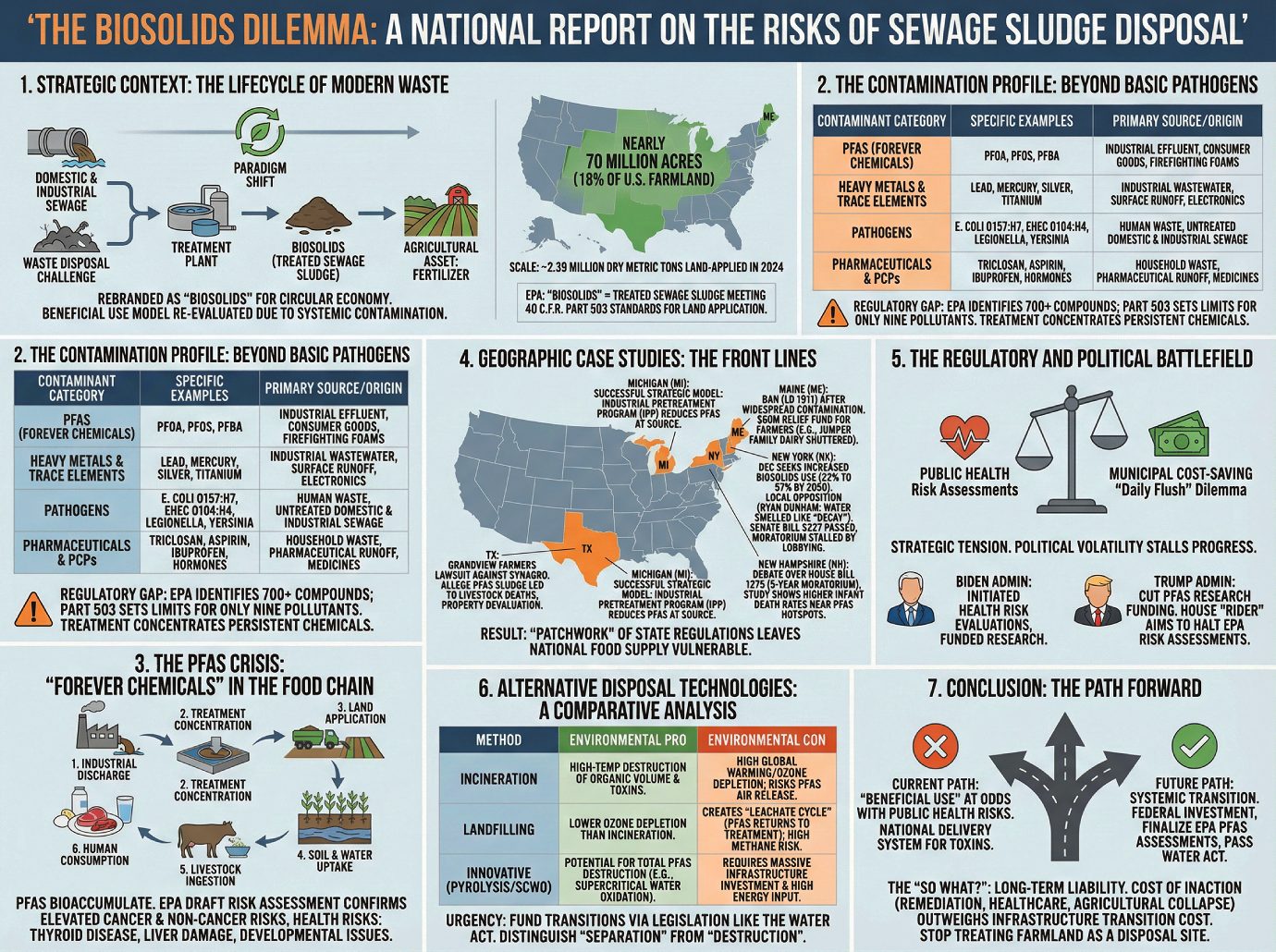
The Biosolids Dilemma: A National Report on the Risks of Sewage Sludge Disposal
1. Strategic Context: The Lifecycle of Modern Waste
The management of wastewater residuals has reached a critical strategic juncture. For decades, the byproduct of domestic and industrial sewage treatment was viewed strictly as a waste disposal challenge. However, a significant paradigm shift occurred as municipalities and waste management firms rebranded “sewage sludge” as “biosolids”—a nutrient-rich agricultural asset marketed as an inexpensive, climate-friendly fertilizer. This transformation was intended to create a circular economy where public waste provides direct value to the food system. Yet, as our understanding of chemical persistence evolves, this “beneficial use” model is being re-evaluated against a backdrop of systemic environmental contamination.
The distinction between raw waste and treated residuals is governed by specific federal standards. The Environmental Protection Agency (EPA) provides the following regulatory context:
“The terms ‘biosolids’ and ‘sewage sludge’ are often used interchangeably by the public; however, the U.S. Environmental Protection Agency typically uses the term ‘biosolids’ to mean sewage sludge that has been treated to meet the requirements in the EPA’s regulation entitled, ‘Standards for the Use or Disposal of Sewage Sludge,’ promulgated at 40 C.F.R. Part 503, and intended to be applied to land as a soil conditioner or fertilizer.”
The scale of this practice is immense. According to the National Biosolids Data Project and Environmental Working Group (EWG) estimates, nearly 70 million acres of U.S. farmland—approximately 18% of all agricultural land—may be treated with these residuals, a footprint roughly the size of the state of Nevada. In 2024 alone, facilities reported that approximately 2.39 million dry metric tons of sewage sludge were land-applied across the United States. While this was once hailed as a triumph of recycling, emerging evidence suggests that this national pipeline may be delivering more than just nutrients to our soil.
2. The Contamination Profile: Beyond Basic Pathogens
In the 21st century, traditional testing protocols that focus primarily on heavy metals and basic bacterial indicators are no longer sufficient to ensure public safety. Modern sewage is a complex “biological cocktail” reflecting the full spectrum of industrial and domestic chemistry. Current treatment processes are designed to reduce common bacteria, but they often fail to address—and can actually concentrate—persistent chemical compounds and emerging virulent pathogens.
The following table categorizes the primary threats identified in modern residuals:
| Contaminant Category | Specific Examples | Primary Source/Origin |
|---|---|---|
| PFAS (Forever Chemicals) | PFOA, PFOS, PFBA | Industrial effluent, consumer goods, firefighting foams |
| Heavy Metals & Trace Elements | Lead, Mercury, Silver, Titanium | Industrial wastewater, surface runoff, electronics |
| Pathogens | E. coli O157:H7, EHEC O104:H4, Legionella, Yersinia | Human waste, untreated domestic and industrial sewage |
| Pharmaceuticals & PCPs | Triclosan, Aspirin, Ibuprofen, Hormones | Household waste, pharmaceutical runoff, medicines |
A significant regulatory gap exists: while the EPA identifies over 700 compounds in sludge, current federal regulations under Part 503 only set limits for nine pollutants. Wastewater treatment plants function as collection hubs where these substances are sequestered into solids. Because many of these chemicals, particularly pharmaceuticals and PFAS, are resistant to biodegradation, they exit the treatment facility unchanged and highly concentrated, exiting the plant to enter the environment upon land application.
3. The PFAS Crisis: “Forever Chemicals” in the Food Chain
The presence of per- and polyfluoroalkyl substances (PFAS) represents a strategic threat to the “circular economy” model of waste recycling. Known as “forever chemicals” due to their inability to break down, PFAS pose a unique hazard because they bioaccumulate within living organisms. The January EPA Draft Risk Assessment confirmed that even at extremely low levels, the application of sludge to farmland can result in an elevated risk of cancer and non-cancer effects that exceed acceptable safety thresholds.
Livestock grazing on treated land or consuming feed like corn and hay grown in contaminated soil act as conduits for these toxins. The EPA and the National Association of State Departments of Agriculture (NASDA) have identified severe health risks associated with PFAS exposure, including thyroid disease, liver damage, and developmental issues.
The PFAS Bioaccumulation Cycle follows a clear, hazardous path:
1. Industrial Discharge: Factories release PFAS-laden waste into the municipal sewer system.
2. Treatment Concentration: Wastewater plants separate liquids from solids, concentrating PFAS into the resulting sludge.
3. Land Application: Sludge is spread on agricultural fields as fertilizer.
4. Soil and Water Uptake: PFAS leach into groundwater and are absorbed by crops and feed.
5. Livestock Ingestion: Animals consume contaminated feed and water; PFAS accumulate in milk, eggs, and meat.
6. Human Consumption: Contaminated animal products and water reach the dinner table, leading to systemic human exposure.
While the science of bioaccumulation is a national concern, the devastating impact of this cycle is increasingly felt through specific local crises.
4. Geographic Case Studies: The Front Lines of Sludge Debates
Due to federal regulatory stagnation, state-level action has become the primary battleground for biosolid safety.
• Maine: In 2022, Maine passed a landmark ban (LD 1911) on the land application of sewage sludge after discovering widespread contamination. The state established a $60 million relief fund for farmers like Adam Nordell and the Jumper family, whose four-generation dairy farm was shuttered overnight when high levels of PFAS were discovered in their cattle and blood.
• New York: The Department of Environmental Conservation (DEC) currently seeks to increase biosolids use from 22% to 57% by 2050, despite visceral local opposition. In New Scotland, Ryan Dunham discovered his family was showering in water that smelled like “decay, rot, and death” after a neighbor applied sludge to nearby fields. Dunham’s haunting realization—that his daughter was ingesting human sewage while “singing Taylor Swift in the shower”—highlights the human cost. Legislatively, Senate Bill S227 (industrial discharge testing) passed the Senate 62-0 but died in the Assembly. Simultaneously, a statewide five-year moratorium bill stalled on the Assembly floor due to intense lobbying by “deep pockets” like WeCare Denali (owned by TPG).
• Texas: In Grandview, farmers have filed a lawsuit against Synagro Technologies Inc. in Baltimore County. The plaintiffs allege that PFAS-contaminated sludge led to livestock deaths, property devaluation, and the rendering of their land worthless.
• Michigan: Michigan’s “Industrial Pretreatment Program” (IPP) serves as a successful strategic model. By addressing the problem “upstream”—requiring industrial facilities to remove PFOS and PFOA before they reach the municipal plant—the state has successfully reduced concentrations at the source.
• New Hampshire: The debate over House Bill 1275 continues, proposing a five-year moratorium. Advocates cite a December study showing infant death rates near New Hampshire PFAS hotspots are three times higher than in non-contaminated areas.
The result of these varying state responses is a “patchwork” of regulations that leaves the national food supply vulnerable.
5. The Regulatory and Political Battlefield
The regulation of biosolids is trapped in a strategic tension between public health and municipal cost-saving. For many sewer districts, land application is the cheapest disposal route; removing it would significantly increase costs for ratepayers. Merrimack public works official Leo Gaudette highlights the practical dilemma: the “daily flush” of a community must go somewhere.
Political volatility has stalled progress. While the Biden administration initiated health risk evaluations and funded research at 11 universities, the Trump administration moved to cut nearly $15 million in PFAS research and environmental protection funding. Furthermore, a permanent “rider” in a House appropriations bill—described by advocates as a “gift to the industry”—aims to prevent the EPA from finalizing its PFAS risk assessments, effectively halting the science necessary for national safety standards.
6. Alternative Disposal Technologies: A Comparative Analysis
To break the cycle of PFAS contamination, the transition to “destructive” disposal methods is essential. This requires distinguishing between “separation” (moving chemicals to another medium) and “destruction” (breaking the chemical bonds).
Innovative strategies include Granular Activated Carbon (GAC) and Anion Exchange (AIX) for initial separation. However, true destruction requires the high temperatures found in advanced thermal processes.
| Method | Environmental Pro | Environmental Con |
|---|---|---|
| Incineration | High-temp destruction of organic volume and toxins. | High global warming/ozone depletion; risks PFAS air release. |
| Landfilling | Lower ozone depletion than incineration. | Creates a “leachate cycle” where PFAS returns to treatment plants; high methane risk. |
| Innovative (Pyrolysis/SCWO) | Potential for total PFAS destruction (e.g., Supercritical Water Oxidation). | Requires massive infrastructure investment and high energy input. |
The urgency of funding these transitions through legislation like the WATER Act cannot be overstated. Without federal investment, municipalities remain tied to outdated, hazardous disposal models.
7. Conclusion: The Path Forward
The evidence is clear: the “beneficial use” of biosolids is currently at odds with documented public health risks. While land application was marketed as a sustainable recycling mechanism, it has become a national delivery system for persistent toxins.
The “So What?” for policymakers is a matter of long-term liability. The cost of inaction—remediation of groundwater, healthcare for impacted families, and the collapse of agricultural livelihoods—far outweighs the cost of a systemic transition in infrastructure. The federal government must finalize the EPA PFAS risk assessments and pass the WATER Act to provide a “safety floor” for all states. We can no longer afford to treat our farmland as a disposal site for a chemical cocktail that eventually finds its way to our dinner tables. ———————
Executive Summary
The practice of applying sewage sludge—the byproduct of municipal wastewater treatment—to agricultural land as fertilizer is facing intense scrutiny as evidence of widespread contamination by “forever chemicals” (PFAS) mounts. For decades, the Environmental Protection Agency (EPA) and waste management industries promoted this practice as a climate-friendly, cost-effective recycling method. Today, it is estimated that nearly 70 million acres of U.S. farmland are treated with these biosolids.
Recent findings have connected this practice to significant public health risks, including elevated cancer rates, thyroid disease, and liver damage. PFAS chemicals leach from the sludge into soil, groundwater, and the broader food chain, contaminating crops and livestock. While the Biden administration initiated preliminary risk assessments and funded research into these hazards, the current Trump administration has moved to reverse these efforts, cutting nearly $15 million in research funding and attempting to block the finalization of critical health risk reports. This federal retreat has created a “regulatory patchwork,” leaving states like Maine to implement total bans while others, such as New York, struggle to pass moratoriums amidst heavy industry lobbying.
Understanding Sewage Sludge and Biosolids
Sewage sludge is the semi-solid, nutrient-rich residue remaining after wastewater treatment plants separate liquids from solids in domestic and industrial sewage. The terms are often used interchangeably, but the EPA specifically defines biosolids as sewage sludge that has been treated to meet regulatory standards (40 C.F.R. Part 503) for land application as a soil conditioner or fertilizer.
Management and Disposal Methods
There are three primary methods for managing sewage sludge in the United States:
• Land Application: The most common “beneficial use” method, involving spreading, spraying, or injecting sludge onto agricultural land, forests, and reclamation sites.
• Landfilling: Disposal in municipal solid waste landfills or dedicated sewage sludge monofills.
• Incineration: Combustion at high temperatures, which reduces volume but can release PFAS into the air.
National Usage Statistics (2024 Estimates)
The EPA estimates that approximately four million dry metric tons (dmt) of sewage sludge are generated annually. The following table illustrates the distribution of management practices:
| Management Practice | Estimated Amount (dmt) |
|---|---|
| Land Application | 2.39 million |
| Landfilling | 982,000 |
| Incineration | 558,000 |
| Other (Deep well injection, storage, etc.) | 81,500 |
The PFAS Contamination Crisis
Per- and polyfluoroalkyl substances (PFAS) are a class of thousands of man-made chemicals used in consumer products for their non-stick and water-resistant properties. Because they do not break down naturally, they accumulate in the environment and the human body.
Health and Environmental Risks
The EPA confirmed in early 2025 that even extremely low levels of PFOA and PFOS in sewage sludge applied to farmland result in an elevated risk of cancer and non-cancer health effects.
• Human Health: Linked to kidney cancer, thyroid disease, liver damage, developmental issues in infants, and immune system suppression.
• Bioaccumulation: PFAS travel from “toilet to table.” They are absorbed by edible crops (corn, hay) and bioaccumulate in livestock, contaminating milk, meat, and eggs.
• Water Contamination: Runoff from sludge-treated fields carries chemicals into waterways and leaches into private wells. In New Scotland, NY, some wells tested 200 times above safe limits for contaminants following nearby sludge application.
Emerging Contaminants Beyond PFAS
Beyond PFAS, sewage sludge is known to contain a “biological cocktail” and chemical mishmash including:
• Heavy Metals: Lead, mercury, copper, and cadmium.
• Pathogens: Salmonella, E. coli O157:H7, and various viruses (Adenovirus, Rotavirus).
• Microplastics: Found to spread flame retardants and endocrine disruptors.
• Pharmaceuticals: Residues from antibiotics, hormones, and psychiatric drugs.
The Regulatory and Political Landscape
The regulation of biosolids is currently a battleground between public health advocates and industry-backed political interests.
Federal Policy Shifts
• The Biden Administration: Released the first-ever preliminary evaluation of human health risks associated with PFAS in biosolids and funded landmark research at 11 universities.
• The Trump Administration: Has moved to slash environmental funding and research. In July 2025, the administration cut nearly $15 million in farm-related PFAS research.
• Legislative Riders: Congressional Republicans proposed a permanent provision in a House appropriations bill to prevent the EPA from finalizing its PFAS risk assessment or using its findings to create new regulations.
The Influence of “Deep Pockets”
Advocates point to the immense influence of the waste management industry. Companies like Synagro Technologies Inc. and Denali Water Technology (WeCare Denali) hold multimillion-dollar contracts with local governments.
• Lobbying: In New York, a five-year moratorium bill passed four committees but stalled on the Assembly floor. Legislators suspect this “last-minute flip” resulted from lobbying by Denali, which is owned by the $19 billion private equity firm TPG.
• Industry Influence: Industry trade groups meet with the EPA to “ensure validated science” is used, which critics argue is a euphemism for weakening regulation.
State and Local Responses
In the absence of consistent federal oversight, a patchwork of state-level regulations has emerged:
• Maine: The national leader in biosolid regulation. In 2022, it became the first state to ban sewage sludge application and established a $60 million relief fund for farmers whose land and livelihoods were destroyed by contamination.
• Michigan and New Hampshire: Have begun intensive testing and are considering financial safety nets for farmers. New Hampshire is evaluating House Bill 1275, which proposes an Agricultural PFAS Relief Fund.
• Washington State: The Pollution Control Hearings Board ruled that biosolids permits must be updated to address PFAS, PBDEs, and microplastics to comply with environmental laws.
• New York: Despite being a top-five state for biosolid use, its Department of Environmental Conservation plans to increase the use of biosolids from 22% to 57% by 2050, characterizing them as “nutrient-rich.”
Stakeholder Perspectives and Impact
Impact on Farmers and Residents
The human cost of contamination is profound. Farmers like Jason Grostic in Michigan and the Jumper family in Maine lost multi-generational dairy and cattle operations overnight after testing revealed toxic PFAS levels.
• Resident Experience: Ryan Dunham of New Scotland, NY, discovered his children were showering in water that smelled of “decay, rot, and death” because sludge from a neighbor’s farm had seeped into his well.
• Public Health Concerns: “Whenever my daughter’s taking a shower and singing… I wonder what chemicals she is ingesting,” Dunham stated.
Challenges for Municipalities
Wastewater treatment professionals argue that sludge is an unavoidable byproduct.
• Cost Concerns: Banning land application forces municipalities to use more expensive disposal methods like landfilling or long-distance trucking (sometimes to Canada), which would raise rates for sewer users.
• Lack of Alternatives: “I do want you to really think long and hard about where your daily flush is going to go,” warned Shelagh Connelly of Resource Management Inc.
Conclusion and Future Outlook
The conflict over sewage sludge highlights a fundamental tension between waste disposal logistics and public health. While land application is an efficient disposal method for municipalities, the “forever” nature of PFAS means that current practices may be poisoning the U.S. food supply and water resources for generations.
Key Conclusions:
1. Science vs. Policy: While EPA scientists have confirmed cancer risks, political maneuvers are currently preventing these findings from becoming enforceable regulations.
2. Upstream Solutions Needed: Advocates argue the only long-term solution is to prevent PFAS from entering the waste stream initially by banning their use in consumer products and requiring industrial pretreatment.
3. The Need for Federal Action: State bans, while effective locally, create a “patchwork” that allows contaminated waste to be shipped to less-regulated regions. A federal “floor” of safety is required to protect the national food system. ———————————————–
The Dirty Secret in the Soil: Why Your Town’s ‘Daily Flush’ is Sparking a National Crisis
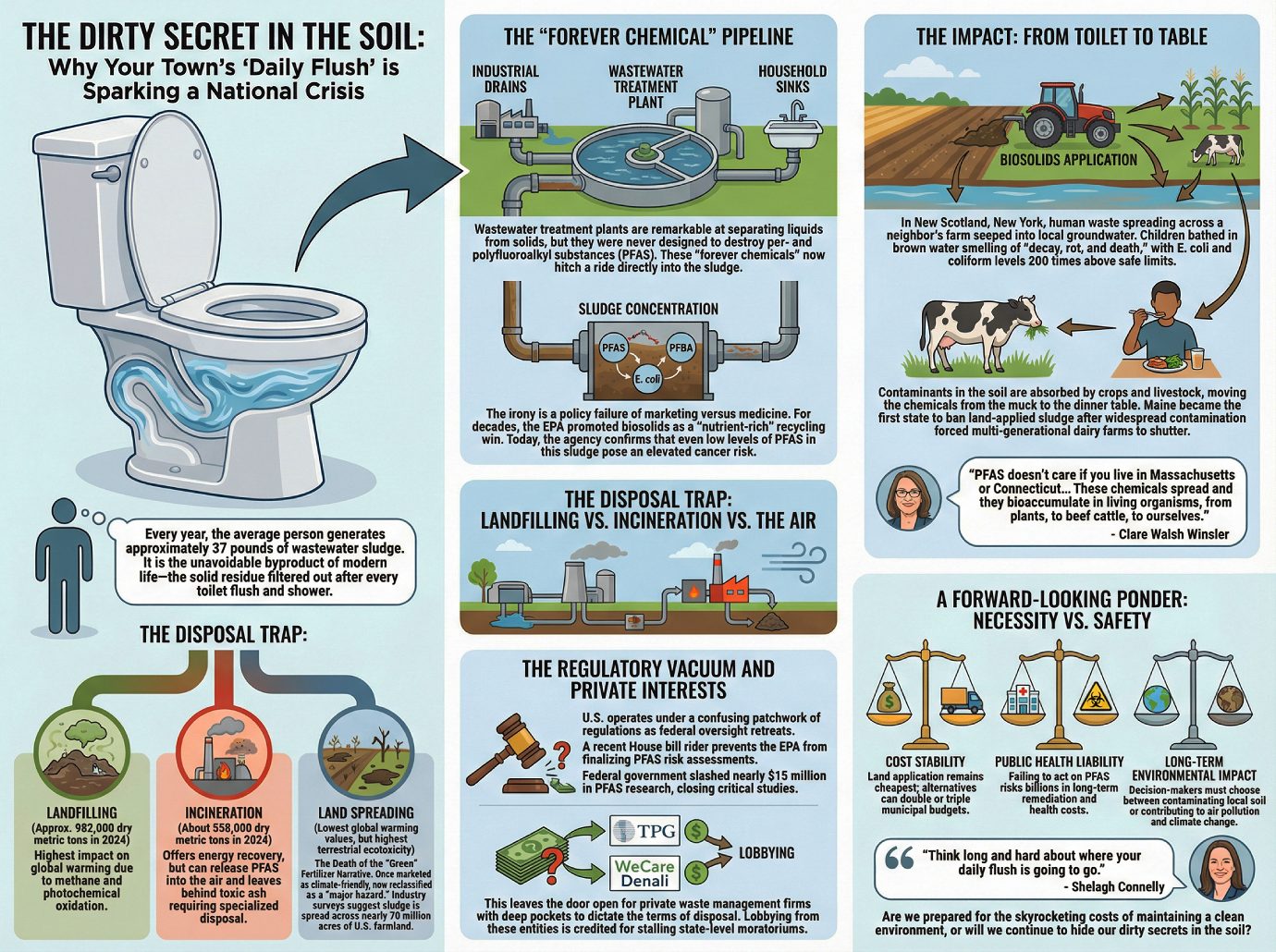
The Dirty Secret in the Soil: Why Your Town’s ‘Daily Flush’ is Sparking a National Crisis
Every year, the average person generates approximately 37 pounds of wastewater sludge. It is the unavoidable byproduct of modern life—the solid residue filtered out after every toilet flush and shower.
In New Scotland, New York, Ryan Dunham discovered the reality of this “daily flush” when his eleven-year-old daughter screamed in the shower. The water ran brown, smelling of “decay, rot, and death.”
The source was human waste spreading across a neighbor’s farm. This material, often rebranded as “nutrient-rich biosolids,” had seeped into the local groundwater, leaving Dunham’s children to bathe in the concentrated remnants of the community’s sewers.
The ‘Forever Chemical’ Pipeline
Wastewater treatment plants are remarkable at separating liquids from solids, but they were never designed to destroy per- and polyfluoroalkyl substances (PFAS). These “forever chemicals” now hitch a ride from industrial drains and household sinks directly into the sludge.
The irony is a policy failure of marketing versus medicine. For decades, the EPA promoted biosolids as a “nutrient-rich” recycling win. Today, the agency confirms that even low levels of PFAS in this sludge pose an elevated cancer risk.
In towns like Bethlehem, New York, investigators have identified PFBA—a specific PFAS not currently regulated by the EPA—in water supplies near sludge-applied fields. In New Scotland, samples showed E. coli and coliform levels 200 times above safe limits.
“PFAS doesn’t care if you live in Massachusetts or Connecticut. They don’t care if you’re in New Jersey or New York. These chemicals spread and they bioaccumulate in living organisms, from plants, to beef cattle, to ourselves.” — Clare Walsh Winsler, Environmental Advocates New York.
The Death of the ‘Green’ Fertilizer Narrative
What was once marketed as a climate-friendly “soil amendment” is now being reclassified by agricultural experts as a “major hazard.” Industry surveys suggest that sludge is currently spread across nearly 70 million acres of U.S. farmland.
The transition from recycling success to environmental nightmare has been swift. Contaminants in the soil are absorbed by crops and livestock, moving the chemicals from the muck to the dinner table.
Maine became the first state to shatter the narrative, issuing a first-in-the-nation ban on land-applied sludge. This pivot occurred after widespread contamination forced multi-generational dairy farms to shutter overnight when their milk was found to be tainted.
The Disposal Trap: Landfilling vs. Incineration vs. The Air
As land application outlets disappear, municipalities are falling into a “disposal trap.” There is no perfect exit strategy, and every choice involves a trade-off between the soil, the water, and the air.
• Landfilling: Approximately 982,000 dry metric tons of sludge were landfilled in 2024. This method has the highest impact on global warming due to methane and photochemical oxidation.
• Incineration: About 558,000 dry metric tons were burned in 2024. While it offers energy recovery, it can release PFAS into the air and leaves behind toxic ash that requires specialized disposal.
A Life Cycle Assessment (LCA) of Italian waste strategies reveals the complexity: land spreading has the lowest global warming values but the highest terrestrial ecotoxicity. Incineration may reduce human toxicity, but only if there is “effective recovery of solid residues.” Without it, the benefits vanish.
The Regulatory Vacuum and Private Interests
The U.S. currently operates under a confusing patchwork of regulations as federal oversight undergoes a systematic retreat. A “smoking gun” for this vacuum is a recent House appropriations bill rider designed to prevent the EPA from finalizing PFAS risk assessments.
The federal government has also moved to slash nearly $15 million in PFAS research, effectively closing critical studies at 11 universities across the country. This leaves the door open for private waste management firms with deep pockets to dictate the terms of disposal.
Firms like TPG, a private equity firm valued at $19 million, operate through divisions like WeCare Denali, which holds contracts such as a $2 million deal with Rockland County. Lobbying from these entities is often credited for stalling state-level moratoriums that would otherwise restrict sludge spreading.
The Merrimack Dilemma: Necessity vs. Safety
The crisis is reaching a breaking point in towns like Merrimack, New Hampshire. Assistant Director of Public Works Leo Gaudette has cautioned that as “outlets” for sludge disappear, the financial burden on local residents becomes unsustainable.
Merrimack, like many other communities, faces a choice between environmental safety and skyrocketing sewer rates. If land application is banned without a federal standard, the cost of trucking waste long distances—sometimes to Canada—will fall directly on the ratepayers.
Local officials must now weigh three critical factors:
• Cost Stability: Land application remains the cheapest disposal route; alternatives can double or triple municipal budgets.
• Public Health Liability: Failing to act on PFAS risks billions in long-term remediation and health costs.
• Long-term Environmental Impact: Decision-makers must choose between contaminating local soil or contributing to air pollution and climate change.
A Forward-Looking Ponder
Sludge is the one environmental problem we cannot stop producing. As long as humans eat and wash, the “daily flush” will continue to concentrate the chemicals of our modern existence into a toxic slurry.
If our soil has become too contaminated to serve as a filter and our air is at risk from incineration, we are reaching the limits of our disposal capacity. As Shelagh Connelly of Resource Management Inc. warned: “Think long and hard about where your daily flush is going to go.”
Are we prepared for the skyrocketing costs of maintaining a clean environment, or will we continue to hide our dirty secrets in the soil?
————————–
From Toilet to Table: The Lifecycle of Waste and Gardner’s Path Forward
From Toilet to Table: The Lifecycle of Waste and Gardner’s Path Forward
1. The “Hidden Journey” of the Daily Flush
Every time you flush a toilet or wash a load of laundry, you are initiating a complex industrial journey that connects your home to our nation’s food supply. This “daily flush” is the start of a conceptual process narrative: a story of how human and industrial waste is transformed from a municipal burden into a potential agricultural resource. On a national scale, this transformation is massive, with nearly 4 million dry metric tons of sewage sludge generated annually in the United States.
Did You Know? According to estimates from the National Biosolids Data Project, based on industry surveys, the reach of sludge application is vast. It is currently spread on nearly 70 million acres of U.S. farmland—an area roughly the size of the state of Nevada.
While this system has functioned behind the scenes for decades, it is now at the center of a high-stakes debate over safety and sustainability. To understand the choices facing Gardner, we must follow the waste from the bathroom drain to the city’s Wastewater Treatment Plant (WWTP).
——————————————————————————–
2. The Science of Separation: How Sludge is Born
When waste arrives at a WWTP, it undergoes a series of mechanical and biological treatments designed to purify water before it returns to our environment. The core of this technology is separation: using gravity and biological processors to divide the “daily flush” into two distinct streams.
This separation creates a semi-solid, nutrient-rich byproduct known as Sewage Sludge. Under the EPA’s 40 C.F.R. Part 503 standards, if this sludge is further treated to meet specific pathogen and pollutant requirements for land application, it is rebranded as Biosolids.
The Fork in the Road
| Liquids (Effluent) | Solids (Sludge/Biosolids) |
|---|---|
| The watery portion of waste that is treated and released into local waterways. | Semi-solid, nutrient-rich material that remains for further management. |
| Primarily released back into rivers and streams. | Must be managed via land application, incineration, or disposal in specialized monofills. |
Once these solids are separated, the city must decide where they go next—a choice that carries long-term environmental and financial consequences.
——————————————————————————–
3. The Agricultural Promise: Sludge as “Black Gold”
For years, sludge has been viewed as a “climate-friendly” and “nutrient-rich” alternative to synthetic fertilizers. For Gardner’s farmers, this material can be an inexpensive tool to condition the soil and provide three primary nutrients vital for crop health: Carbon, Nitrogen, and Phosphorus.
The Three Pillars of Sludge Utility
• Agricultural: Applied to land to grow food, feed, and fiber crops, or to nourish pastures for animal grazing.
• Reclamation: Used to reestablish vegetation on significantly disturbed lands, such as closed mines or construction sites.
• Distribution: Processed into bagged compost or fertilizer sold to the public for home lawns and gardens.
However, the scientific reality of modern waste is complicated. We are now facing the “arsenic in the protein shake” dilemma—the reality that hidden, indestructible chemicals are lurking within these valuable nutrients.
——————————————————————————–
# WARNING: The Invisible Catch: PFAS and the “Forever Chemical” Crisis
The same processes that concentrate nutrients in sludge also concentrate per- and polyfluoroalkyl substances (PFAS). These “forever chemicals” enter Gardner’s waste stream from industrial discharges and common household products. Because they are designed to resist heat, water, and grease, traditional wastewater treatment cannot destroy them.
As an educator, I must note a critical nuance: current testing standards often focus on the “total content” of chemicals, but scientific research indicates this is not always a reliable indicator of toxicity. Even at low levels, PFAS pose significant health risks, including:
• Kidney and liver cancers.
• Thyroid disease and immune system suppression.
• Bioaccumulation in the food chain (moving from soil to crops, and then into milk, meat, and eggs).
“Here is this protein shake with all the nutrients you need… it’s just got a little arsenic in it, but don’t worry about it, we’ll deal with that later!” — New York State Assemblywoman Anna Kelles, PhD
This chemical reality moves us from a simple story of recycling to a difficult municipal management dilemma.
——————————————————————————–
5. The Gardner Dilemma: Landfill Expansion vs. The Alternatives
Disposing of sludge is unavoidable, but Gardner must choose a path that balances cost with long-term liability. Every disposal method involves a scientific trade-off.
The Waste Management Matrix
| Option | Focus | Primary Risks/Trade-offs |
|---|---|---|
| Option 1: Landfill Expansion (Monofills) | Disposal in sludge-only sites or municipal landfills. | The Liability Gap: Requires leachate collection, but current regulations often let industry “off the hook” after a 30-year post-closure period, leaving the city with long-term liability if liners eventually leak. |
| Option 2: Land Application (Fertilizer) | Spreading biosolids on farms to recycle nutrients. | The Farmer Risk: High risk of PFAS soil accumulation and groundwater leaching; potential to shutter local farms if contamination is discovered in the food supply. |
| Option 3: Incineration | High-temperature combustion of organic matter. | The LCA Paradox: While it reduces human toxicity and acidification, Life Cycle Assessments (LCA) show it has the highest impact on Global Warming and Ozone Depletion while potentially releasing PFAS into the air. |
As Gardner weighs the necessity of disposal against the risks of environmental leaching, we can look to other states that are already navigating these identical choices.
——————————————————————————–
6. Lessons from the Frontier: National Precedents
Across the country, the lack of a “federal floor” for PFAS has led to a patchwork of “Ban vs. Promote” strategies.
Lessons for Gardner:
1. Maine’s Precautionary Principle: In response to shuttered farms, Maine enacted a total ban on land-applying sludge and established a $60 million relief fund for impacted farmers.
2. Michigan’s Source Control: Michigan has pioneered “Industrial Pretreatment.” This works by requiring factories to treat their waste at the source to remove PFAS before it ever hits the municipal sewer system, significantly cleaning the resulting sludge.
3. The “Patchwork” Problem: Without federal oversight, local communities like Gardner are left to navigate the legal and environmental influence of the waste management industry on their own.
For Gardner residents, the “So What?” is clear: the safety of your local food and water depends on how we handle the solids left behind.
——————————————————————————–
7. Conclusion: Crafting an Informed Path for Gardner
While waste is unavoidable (“The Daily Flush”), the method of disposal is a choice involving funding, health, and environmental justice. The journey from toilet to table requires active oversight and a commitment to keeping our food chain safe.
Action Checklist for Aspiring Learners:
• Monitor PFAS Discharge: Ask local officials for data on PFAS levels. Be specific: ask about the levels in both the effluent (liquid) and the sludge (solids), as chemicals often distribute into both.
• Advocate for Pretreatment: Support policies that require industrial users to treat waste at the source. This is the most effective way to protect municipal infrastructure.
• Question Liability: In discussions about landfill expansion, ask who is responsible for monitoring and remediation after the initial 30-year post-closure period expires.
Ultimately, while we wait for “federal floors” to set national safety standards, Gardner must set its own “state ceilings” to protect the future of its fields and its families. ——————-
Navigating the Sludge Dilemma: An Environmental Trade-off Summary
Managing human waste is a cornerstone of public health, yet the final destination of that waste remains one of the most contentious issues in modern environmental science and policy. Every time we flush, we contribute to a growing stream of “muck” that must be processed, repurposed, or contained. As a society, we face a regulatory patchwork where the necessity of disposal often clashes with the reality of contamination. This document explores the three primary methods used to handle this waste and the complex environmental debts we incur with each choice.
1. Defining the “Muck”: Sludge vs. Biosolids
To navigate this dilemma, we must first distinguish between raw waste and the products created from it. The U.S. Environmental Protection Agency (EPA) and wastewater treatment plants (WWTPs) use specific terminology to describe these materials, though their meanings carry significant regulatory weight.
——————————————————————————–
Key Definitions
• Sewage Sludge: The semi-solid, nutrient-rich byproduct created during the treatment of domestic sewage at a WWTP. It is the solid mass separated from liquid waste, containing a “cocktail” of micro-organisms, undigested organics, and inorganic materials.
• Biosolids: This term refers specifically to sewage sludge that has been treated to meet the standards of 40 C.F.R. Part 503. These are intended for beneficial use as soil conditioners or fertilizers.
◦ Class A: Treated to a higher standard, often sold for home garden use and less regulated for tracking.
◦ Class B: Frequently used in large-scale agriculture; these have higher allowable levels of pathogens and require stricter permits for application.
——————————————————————————–
While these terms are often used interchangeably, the label “biosolids” is frequently a point of marketing by industry groups to promote the beneficial reuse of waste. Regardless of the label, the sheer volume of material generated daily makes finding a disposal method an urgent necessity.
2. Method 1: Land Application (The “Nutrient Recycling” Route)
Land application involves spreading or injecting biosolids into farmland, forests, or reclaimed mining sites. This method is promoted as a way to “close the loop” on the waste cycle through what critics and advocates alike call the “Toilet to Table” pipeline. Currently, sludge is spread on nearly 70 million acres of U.S. farmland—roughly the size of Nevada—primarily using Class B biosolids.
| The Fertilizer Promise (Benefits) | The Persistent Threat (PFAS/Pathogen Risks) |
|---|---|
| Nutrient Rich: Recycles nitrogen (N), phosphorus (P), and organic matter to improve soil health and crop yields. | The “Forever Chemical” Pipeline: Sludge acts as a conveyor for PFAS. The EPA confirms that even at low levels, PFOA and PFOS in sludge pose significant cancer risks. |
| Inexpensive: Offers a low-cost alternative to synthetic fertilizers, supporting the economic viability of small-scale farming. | Pathogen Exposure: In New Scotland, NY, sludge application led to well water testing nearly 200 times above the safe limit for E. coli and coliform. |
| Climate Friendly: Seen as more sustainable than energy-intensive synthetic fertilizers by recycling existing carbon. | Bioaccumulation: Chemicals travel from soil to feed crops, then to livestock, and ultimately into the human body via milk, meat, and eggs. |
While land application offers immediate agricultural benefits, it simultaneously acts as a primary vector for persistent toxins that current wastewater treatment processes are not designed to destroy. This transition from soil enrichment to environmental contamination forces us to consider the atmospheric consequences of alternative disposal methods.
3. Method 2: Incineration (The “Energy Recovery” Route)
Incineration uses high temperatures to combust the organic matter within sewage sludge. Based on Life Cycle Assessment (LCA) data (such as the Lombardi et al. study), this method presents a unique “Trade-off Paradox.”
The Three Critical Trade-offs of Combustion
1. Benefit: Low Human Toxicity & Acidification: Incineration often yields the lowest values for human toxicity. This is primarily because solid residues (ash) are recovered and stabilized, preventing the leaching of heavy metals or chemicals into groundwater that occurs in land spreading.
2. Risk: High Global Warming Impact: The process of burning waste is energy-intensive and generates significant greenhouse gas emissions, resulting in the highest scores for Global Warming Potential and Ozone Layer Depletion.
3. Risk: Atmospheric Chemical Release: While combustion reduces waste volume by 90%, it risks releasing PFAS and other persistent pollutants into the air if not managed with advanced scrubbers, potentially spreading “forever chemicals” through the atmosphere.
If air quality and global warming are the primary concerns, the final alternative—containment—must be examined for its long-term stability.
4. Method 3: Landfilling (The “Containment” Route)
Landfilling involves placing sludge in either municipal solid waste (MSW) landfills or dedicated monofills (sewage-sludge-only landfills). While this appears to “hide” the waste, it creates a “Leachate Loop” that perpetuates the very contamination it seeks to contain.
The Three Hidden Costs of Landfilling
• Photochemical Oxidation: Landfilling performs worst in this category due to the release of volatile organic compounds (VOCs) that contribute to ground-level ozone and smog.
• The “Leachate Loop”: As rainwater filters through a landfill, it creates “leachate” concentrated with PFAS. This liquid is typically sent back to WWTPs. Since these plants cannot destroy PFAS, the chemicals are either released in treated water or concentrated back into new sludge, creating a never-ending cycle of pollution.
• Methane Production: Anaerobic decay produces methane, a potent greenhouse gas. Strategically, some operators keep landfills “wet” to increase methane for energy capture, but this increases moisture levels by up to 300%, undermining site stability and increasing the risk of toxic leaks.
To understand the full scope of these choices, we must view them side-by-side through the lens of technical impact categories.
5. The Environmental Impact Scorecard: Side-by-Side Comparison
No disposal method is without an environmental “debt.” The following table synthesizes LCA data to show the trade-offs across different environmental stresses.
| LCA Impact Category | Land Spreading | Incineration | Landfilling |
|---|---|---|---|
| Global Warming Potential | Lowest Impact | Highest Impact | Moderate Impact |
| Human Toxicity | Moderate/High Risk | Lowest Impact | Moderate Risk |
| Abiotic Depletion | Lowest Impact | Moderate Risk | Highest Impact |
| Acidification/Smog | Moderate Risk | Lowest Impact | Highest Impact |
| Groundwater Quality | High Risk (E. coli/PFAS) | Low Risk | High Risk (Leachate) |
| Resource Recovery | High (Nutrients/N&P) | Moderate (Ash reuse) | None |
This data provides the technical framework, but the true cost of these trade-offs is best understood through the lived experiences of those at the front lines of the contamination crisis.
6. Case Study Insight: The PFAS Crisis in Maine and New York
The theoretical risks of sludge disposal have become a grim reality for families in the Northeast, highlighting a regulatory patchwork influenced by industry lobbying.
The “Forever Chemical” Bioaccumulation Chain
In Maine, the Jumper family, owners of a four-generation dairy farm, were forced out of business “overnight” after discovering their soil and milk were contaminated by historic sludge applications. In New Scotland, NY, the Dunham family discovered their children were showering in brown water that smelled of “decay and death”—the result of a neighbor spreading sludge that leached into their well.
The Chain: Sludge → Soil → Feed Crops → Livestock → Milk/Meat → Human Body.
While Maine enacted a historic ban on land spreading in 2022, other states face intense pressure from “deep pockets” in the waste industry. For example, the New York Department of Environmental Conservation plans to increase sludge use on land from 22% to 57% by 2050. This push continues even as legislative efforts for a moratorium stall, often due to lobbying from firms like WeCare Denali, which holds lucrative contracts (such as a $2 million deal in Rockland County). This highlights the tension between affordable municipal waste management and the long-term protection of the food supply.
7. Summary for the Aspiring Learner: The “So What?”
Choosing a sewage disposal method is a matter of prioritizing which environmental “debt” we are willing to pay. We are currently trading greenhouse gases (incineration) for potential toxic containment failures (landfilling) or direct food-chain contamination (land application). As future stewards, you must look beyond the “daily flush” and consider the systemic influences of industry and regulation.
3 Lessons for Future Environmental Stewards
1. There is No “Away”: When we flush, the waste simply changes form. Whether it becomes smoke, fertilizer, or landfill leachate, it remains a permanent part of our ecosystem.
2. The “Upstream” Necessity: We cannot “treat” our way out of this crisis. The only definitive solution is source reduction and pretreatment—banning PFAS in consumer products (like food packaging and ski wax) and requiring industries to clean their waste before it enters the municipal stream.
3. Managing the Regulatory Patchwork: In the absence of federal standards for PFAS in biosolids, responsibility falls to state and local leaders. As a strategist, you must weigh the cost to sewer district ratepayers against the multi-billion-dollar cost of future environmental remediation. ———————-
The Biosolids Dilemma: A National Report on the Risks of Sewage Sludge Disposal
The Biosolids Dilemma: A National Report on the Risks of Sewage Sludge Disposal
1. Strategic Context: The Lifecycle of Modern Waste
The management of wastewater residuals has reached a critical strategic juncture. For decades, the byproduct of domestic and industrial sewage treatment was viewed strictly as a waste disposal challenge. However, a significant paradigm shift occurred as municipalities and waste management firms rebranded “sewage sludge” as “biosolids”—a nutrient-rich agricultural asset marketed as an inexpensive, climate-friendly fertilizer. This transformation was intended to create a circular economy where public waste provides direct value to the food system. Yet, as our understanding of chemical persistence evolves, this “beneficial use” model is being re-evaluated against a backdrop of systemic environmental contamination.
The distinction between raw waste and treated residuals is governed by specific federal standards. The Environmental Protection Agency (EPA) provides the following regulatory context:
“The terms ‘biosolids’ and ‘sewage sludge’ are often used interchangeably by the public; however, the U.S. Environmental Protection Agency typically uses the term ‘biosolids’ to mean sewage sludge that has been treated to meet the requirements in the EPA’s regulation entitled, ‘Standards for the Use or Disposal of Sewage Sludge,’ promulgated at 40 C.F.R. Part 503, and intended to be applied to land as a soil conditioner or fertilizer.”
The scale of this practice is immense. According to the National Biosolids Data Project and Environmental Working Group (EWG) estimates, nearly 70 million acres of U.S. farmland—approximately 18% of all agricultural land—may be treated with these residuals, a footprint roughly the size of the state of Nevada. In 2024 alone, facilities reported that approximately 2.39 million dry metric tons of sewage sludge were land-applied across the United States. While this was once hailed as a triumph of recycling, emerging evidence suggests that this national pipeline may be delivering more than just nutrients to our soil.
2. The Contamination Profile: Beyond Basic Pathogens
In the 21st century, traditional testing protocols that focus primarily on heavy metals and basic bacterial indicators are no longer sufficient to ensure public safety. Modern sewage is a complex “biological cocktail” reflecting the full spectrum of industrial and domestic chemistry. Current treatment processes are designed to reduce common bacteria, but they often fail to address—and can actually concentrate—persistent chemical compounds and emerging virulent pathogens.
The following table categorizes the primary threats identified in modern residuals:
| Contaminant Category | Specific Examples | Primary Source/Origin |
|---|---|---|
| PFAS (Forever Chemicals) | PFOA, PFOS, PFBA | Industrial effluent, consumer goods, firefighting foams |
| Heavy Metals & Trace Elements | Lead, Mercury, Silver, Titanium | Industrial wastewater, surface runoff, electronics |
| Pathogens | E. coli O157:H7, EHEC O104:H4, Legionella, Yersinia | Human waste, untreated domestic and industrial sewage |
| Pharmaceuticals & PCPs | Triclosan, Aspirin, Ibuprofen, Hormones | Household waste, pharmaceutical runoff, medicines |
A significant regulatory gap exists: while the EPA identifies over 700 compounds in sludge, current federal regulations under Part 503 only set limits for nine pollutants. Wastewater treatment plants function as collection hubs where these substances are sequestered into solids. Because many of these chemicals, particularly pharmaceuticals and PFAS, are resistant to biodegradation, they exit the treatment facility unchanged and highly concentrated, exiting the plant to enter the environment upon land application.
3. The PFAS Crisis: “Forever Chemicals” in the Food Chain
The presence of per- and polyfluoroalkyl substances (PFAS) represents a strategic threat to the “circular economy” model of waste recycling. Known as “forever chemicals” due to their inability to break down, PFAS pose a unique hazard because they bioaccumulate within living organisms. The January EPA Draft Risk Assessment confirmed that even at extremely low levels, the application of sludge to farmland can result in an elevated risk of cancer and non-cancer effects that exceed acceptable safety thresholds.
Livestock grazing on treated land or consuming feed like corn and hay grown in contaminated soil act as conduits for these toxins. The EPA and the National Association of State Departments of Agriculture (NASDA) have identified severe health risks associated with PFAS exposure, including thyroid disease, liver damage, and developmental issues.
The PFAS Bioaccumulation Cycle follows a clear, hazardous path:
1. Industrial Discharge: Factories release PFAS-laden waste into the municipal sewer system.
2. Treatment Concentration: Wastewater plants separate liquids from solids, concentrating PFAS into the resulting sludge.
3. Land Application: Sludge is spread on agricultural fields as fertilizer.
4. Soil and Water Uptake: PFAS leach into groundwater and are absorbed by crops and feed.
5. Livestock Ingestion: Animals consume contaminated feed and water; PFAS accumulate in milk, eggs, and meat.
6. Human Consumption: Contaminated animal products and water reach the dinner table, leading to systemic human exposure.
While the science of bioaccumulation is a national concern, the devastating impact of this cycle is increasingly felt through specific local crises.
4. Geographic Case Studies: The Front Lines of Sludge Debates
Due to federal regulatory stagnation, state-level action has become the primary battleground for biosolid safety.
• Maine: In 2022, Maine passed a landmark ban (LD 1911) on the land application of sewage sludge after discovering widespread contamination. The state established a $60 million relief fund for farmers like Adam Nordell and the Jumper family, whose four-generation dairy farm was shuttered overnight when high levels of PFAS were discovered in their cattle and blood.
• New York: The Department of Environmental Conservation (DEC) currently seeks to increase biosolids use from 22% to 57% by 2050, despite visceral local opposition. In New Scotland, Ryan Dunham discovered his family was showering in water that smelled like “decay, rot, and death” after a neighbor applied sludge to nearby fields. Dunham’s haunting realization—that his daughter was ingesting human sewage while “singing Taylor Swift in the shower”—highlights the human cost. Legislatively, Senate Bill S227 (industrial discharge testing) passed the Senate 62-0 but died in the Assembly. Simultaneously, a statewide five-year moratorium bill stalled on the Assembly floor due to intense lobbying by “deep pockets” like WeCare Denali (owned by TPG).
• Texas: In Grandview, farmers have filed a lawsuit against Synagro Technologies Inc. in Baltimore County. The plaintiffs allege that PFAS-contaminated sludge led to livestock deaths, property devaluation, and the rendering of their land worthless.
• Michigan: Michigan’s “Industrial Pretreatment Program” (IPP) serves as a successful strategic model. By addressing the problem “upstream”—requiring industrial facilities to remove PFOS and PFOA before they reach the municipal plant—the state has successfully reduced concentrations at the source.
• New Hampshire: The debate over House Bill 1275 continues, proposing a five-year moratorium. Advocates cite a December study showing infant death rates near New Hampshire PFAS hotspots are three times higher than in non-contaminated areas.
The result of these varying state responses is a “patchwork” of regulations that leaves the national food supply vulnerable.
5. The Regulatory and Political Battlefield
The regulation of biosolids is trapped in a strategic tension between public health and municipal cost-saving. For many sewer districts, land application is the cheapest disposal route; removing it would significantly increase costs for ratepayers. Merrimack public works official Leo Gaudette highlights the practical dilemma: the “daily flush” of a community must go somewhere.
Political volatility has stalled progress. While the Biden administration initiated health risk evaluations and funded research at 11 universities, the Trump administration moved to cut nearly $15 million in PFAS research and environmental protection funding. Furthermore, a permanent “rider” in a House appropriations bill—described by advocates as a “gift to the industry”—aims to prevent the EPA from finalizing its PFAS risk assessments, effectively halting the science necessary for national safety standards.
6. Alternative Disposal Technologies: A Comparative Analysis
To break the cycle of PFAS contamination, the transition to “destructive” disposal methods is essential. This requires distinguishing between “separation” (moving chemicals to another medium) and “destruction” (breaking the chemical bonds).
Innovative strategies include Granular Activated Carbon (GAC) and Anion Exchange (AIX) for initial separation. However, true destruction requires the high temperatures found in advanced thermal processes.
| Method | Environmental Pro | Environmental Con |
|---|---|---|
| Incineration | High-temp destruction of organic volume and toxins. | High global warming/ozone depletion; risks PFAS air release. |
| Landfilling | Lower ozone depletion than incineration. | Creates a “leachate cycle” where PFAS returns to treatment plants; high methane risk. |
| Innovative (Pyrolysis/SCWO) | Potential for total PFAS destruction (e.g., Supercritical Water Oxidation). | Requires massive infrastructure investment and high energy input. |
The urgency of funding these transitions through legislation like the WATER Act cannot be overstated. Without federal investment, municipalities remain tied to outdated, hazardous disposal models.
7. Conclusion: The Path Forward
The evidence is clear: the “beneficial use” of biosolids is currently at odds with documented public health risks. While land application was marketed as a sustainable recycling mechanism, it has become a national delivery system for persistent toxins.
The “So What?” for policymakers is a matter of long-term liability. The cost of inaction—remediation of groundwater, healthcare for impacted families, and the collapse of agricultural livelihoods—far outweighs the cost of a systemic transition in infrastructure. The federal government must finalize the EPA PFAS risk assessments and pass the WATER Act to provide a “safety floor” for all states. We can no longer afford to treat our farmland as a disposal site for a chemical cocktail that eventually finds its way to our dinner tables.