
Templeton MA History and Profile
The History and Profile of Templeton Massachusetts
Listen to a “Deep Dive” about Templeton, MA on any device, CLICK PLAY.
Comprehensive Templeton Community Profile
Notable Figures of Templeton MA
Town of Templeton, Massachusetts: A Comprehensive Community Profile

Town of Templeton, Massachusetts: A Comprehensive Community Profile
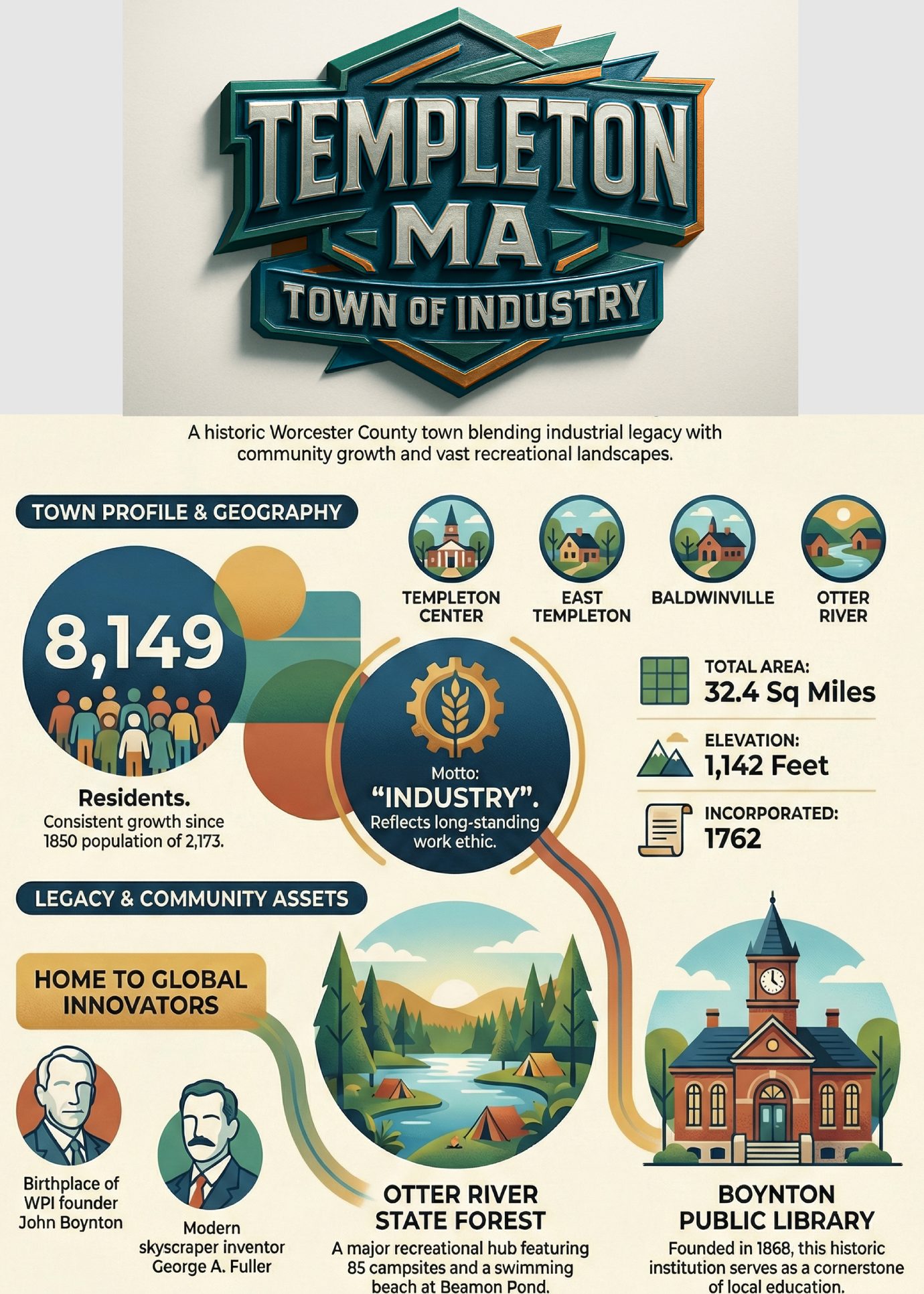
This profile synthesizes key data on the Town of Templeton to provide a holistic overview for strategic planning, community development, and grant application purposes. Located in northern Worcester County, Templeton’s core identity is shaped by its four main villages—Templeton Center, East Templeton, Baldwinville, and Otter River—which together form a community with a rich history and distinct rural character. This document examines the town’s foundational characteristics, demographic trends, governance structure, and community assets to create a comprehensive baseline for informed decision-making.
1.0 Foundational Characteristics
Understanding a town’s foundational data—its history, geography, and location—is the first step in any strategic analysis. These elements provide the physical and historical canvas upon which the community is built, influencing land use, regional relationships, and civic identity.
1.1 Overview and Key Identifiers
The following table summarizes Templeton’s core administrative and identifying information.
| Identifier | Details |
|---|---|
| County | Worcester |
| Year Settled | 1751 |
| Year Incorporated | 1762 |
| Town Motto | “Industry” |
| Primary Villages | Templeton Center, East Templeton, Baldwinville, Otter River |
| ZIP Codes | 01468 (Templeton), 01436 (Baldwinville), 01438 (East Templeton), with some areas also served by 01440 (Gardner) |
| Area Codes | 351 / 978 |
| Official Website | www.templetonma.gov |
1.2 Geography and Regional Context
Templeton encompasses a total area of 32.4 square miles (83.9 km²), with 32.0 square miles (83.0 km²) of land and 0.39 square miles (1.0 km²) of water. The town sits at an elevation of 1,142 feet (348 m), contributing to its rural New England landscape.
Its regional position is defined by its five direct municipal neighbors:
• Royalston (north)
• Winchendon (north)
• Gardner (east)
• Hubbardston (southeast)
• Phillipston (west)
The town’s significant land area relative to its population density suggests opportunities for managed growth and conservation, while its adjacency to five other municipalities underscores the importance of regional planning for infrastructure, emergency services, and economic development corridors.
This physical landscape provides the setting for Templeton’s human landscape, which is best understood through a detailed demographic analysis.
2.0 Demographic Analysis
Demographic data is critical for effective municipal planning. Statistics on population trends, household composition, and economic health are essential for forecasting service needs, identifying key community characteristics, and guiding evidence-based development strategies. While recent population estimates are available, the most comprehensive socioeconomic data for Templeton remains the 2000 U.S. Census. This profile utilizes that data as a critical historical baseline for understanding the town’s social and economic structure, against which future census data can be compared.
2.1 Population Trends and Distribution
As of the 2020 U.S. Census, the Town of Templeton had a total population of 8,149, with a population density of 254 people per square mile (98.2/km²). A 2023 estimate placed the population slightly higher at 8,261. An examination of historical data reveals a long trend of steady growth, with a particularly significant increase in the first decade of the 21st century.
Historical Population Growth (1850-2023)
| Year | Population | % Change |
|---|---|---|
| 1850 | 2,173 | — |
| 1860 | 2,816 | +29.6% |
| 1870 | 2,802 | -0.5% |
| 1880 | 2,789 | -0.5% |
| 1890 | 2,999 | +7.5% |
| 1900 | 3,489 | +16.3% |
| 1910 | 3,756 | +7.7% |
| 1920 | 4,019 | +7.0% |
| 1930 | 4,159 | +3.5% |
| 1940 | 4,601 | +10.6% |
| 1950 | 4,757 | +3.4% |
| 1960 | 5,371 | +12.9% |
| 1970 | 5,863 | +9.2% |
| 1980 | 6,070 | +3.5% |
| 1990 | 6,438 | +6.1% |
| 2000 | 6,799 | +5.6% |
| 2010 | 8,013 | +17.9% |
| 2020 | 8,149 | +1.7% |
| 2023 (est.) | 8,261 | +1.4% |
The data highlights a period of accelerated growth between 2000 and 2010, when the population increased by 17.9%. Since 2010, growth has moderated to a more modest pace.
2.2 Household and Social Composition (2000 Census)
Based on the 2000 Census, the social fabric of Templeton was characterized by the following:
• Racial and Ethnic Makeup: The population was predominantly White (98.15%), with small representations of African American (0.35%), Native American (0.22%), Asian (0.28%), and other racial groups. Individuals identifying as Hispanic or Latino of any race constituted 1.44% of the population.
• Reported Ancestries: The most common reported ancestries included French (19.2%), French Canadian (13.3%), Irish (12.8%), Italian (10.1%), English (9.6%), Polish (8.0%), and Finnish (5.4%).
• Household Characteristics: Of the 2,411 households, 35.3% had children under the age of 18. Married couples living together represented 60.5% of households. The average household size was 2.71 people, and the average family size was 3.09 people.
2.3 Age Demographics (2000 Census)
The age distribution of Templeton’s population in 2000 suggests a balanced community profile. The median age was 38 years.
• Under 18: 26.1%
• 18 to 24: 6.0%
• 25 to 44: 31.1%
• 45 to 64: 23.9%
• 65 and over: 12.9%
This age structure indicates a strong, prime working-age core (31.1% aged 25-44), which forms the town’s primary tax base and drives demand for family-oriented services and school capacity. Concurrently, the significant 12.9% of residents aged 65 and older necessitates strategic planning for senior services, healthcare access, and accessible housing.
2.4 Socioeconomic Profile (2000 Census)
The economic landscape in 2000 provides a baseline for understanding the financial health of Templeton’s households.
• The median household income was $48,482.
• The median family income was $52,936.
• The per capita income for the town was $21,994.
• A notable disparity existed between the median incomes for males (38,088)andfemales(26,993). The significant disparity between male and female median incomes points to potential inequities in the local labor market that could be a focus for future economic development programs.
• Approximately 9.1% of the population and 7.4% of families were below the poverty line.
• Poverty rates were higher for specific age groups, with 10.5% of those under age 18 and 13.4% of those age 65 or over living below the poverty line.
These figures reveal critical economic vulnerabilities, particularly among the town’s youth (10.5%) and elderly (13.4%). The high poverty rate among seniors, specifically, indicates a pressing need for targeted support programs, such as property tax relief or enhanced funding for the Council on Aging.
This analysis of who lives in Templeton provides a foundation for understanding the town’s system of governance, which is designed to serve this population.
3.0 Governance and Representation
A town’s governance structure is the framework through which community decisions are made, services are delivered, and residents are represented. This section outlines Templeton’s local government type and its representation at the state and federal levels, which together shape public policy and resource allocation.
3.1 Local Government
Templeton operates under the Open town meeting form of government, a traditional New England model that allows all registered voters to participate directly in legislative decisions. Executive authority is vested in a five-member Select Board.
| Member | Role | Term Expires |
|---|---|---|
| Michael Currie | Chair | 2025 |
| Matthew Rivard | Vice Chair | 2026 |
| Jeffrey Bennett | Clerk | 2027 |
| Theresa Griffis | Member | 2025 |
| Timothy Toth | Member | 2026 |
3.2 State and Federal Representation
Templeton residents are represented by elected officials at the county, state, and federal levels.
| Office | Official (Party) |
|---|---|
| State Representative | Jonathan Zlotnik (D) |
| State Senator | Peter Durant (R) |
| Governor’s Councilor | Paul DePalo (D) |
| U.S. Representative | James P. McGovern (D-2nd District) |
| U.S. Senator | Elizabeth Warren (D) |
| U.S. Senator | Ed Markey (D) |
This system of local and broader representation connects the town to state and federal resources and decision-making processes, overseeing the community services and assets available to residents.
4.0 Community Assets and Public Services
Community assets such as schools, libraries, and recreational areas are essential pillars of a town’s quality of life and attractiveness. These public services and amenities provide educational opportunities, foster community engagement, and support the well-being of residents. This section details the key public assets serving Templeton.
4.1 Public Education System
Public education in Templeton is managed by the Narragansett Regional School District, which also serves the neighboring town of Phillipston. The district operates three schools to serve students from elementary through high school:
• Templeton Elementary School
• Narragansett Regional Middle School
• Narragansett Regional High School
A significant recent change in the district was the consolidation of elementary schools. The Phillipston Memorial Elementary School was closed at the end of the 2019-2020 school year, and its students were relocated to Templeton Elementary School for the 2020-2021 academic year.
4.2 Boynton Public Library
The Boynton Public Library, established in 1868, serves as a key cultural and educational resource for the community. It is named after its benefactor, John Boynton, a prominent manufacturer and philanthropist.
According to fiscal year 2008 data, the Town of Templeton allocated 53,608∗∗tothelibrary,representing∗∗0.496 per person.
4.3 Parks and Recreation
The Otter River State Forest, operated by the Massachusetts Department of Conservation and Recreation, is a major recreational asset for Templeton. Located by Beamon Pond, the state forest offers a range of outdoor amenities for residents and visitors, including:
• 85 campsites
• A swimming beach
• Picnic areas
• A ball field
These community assets reflect the town’s commitment to public enrichment and were shaped over time by its history and the contributions of its notable residents.
5.0 Historical and Cultural Significance
Understanding a town’s history and the contributions of its past residents provides essential context for its present character and legacy. These historical narratives offer insights into the town’s development, cultural heritage, and the values that have shaped the community over generations.
5.1 Notable Figures
Templeton has been home to numerous individuals who have made significant contributions in fields ranging from architecture and invention to politics and the arts.
Notable People Associated with Templeton
| Name | Lifespan | Contribution |
|---|---|---|
| Stephen Pearl Andrews | 1812–1886 | Individualist anarchist |
| John Boynton | N/A | Entrepreneur, philanthropist, founder of Worcester Polytechnic Institute |
| George E. Bryant | 1832–1907 | Wisconsin legislator and general |
| George A. Fuller | 1851–1900 | Architect and inventor of modern skyscrapers and the contracting system |
| William Goodell | 1792-1867 | Missionary, linguist, and first to translate the Bible into Armeno-Turkish |
| Sarah Goodridge | 1788–1853 | Painter |
| Elizabeth Goodridge | 1798–1882 | Miniaturist and sister of Sarah Goodridge |
| Mike Kelley | 1875–1955 | Baseball player |
| Charles Knowlton | 1800–1850 | Physician, atheist, and writer |
| Pliny Norcross | 1838–1915 | Wisconsin legislator and lawyer |
| Sylvanus Sawyer | 1822–1895 | Inventor and businessman |
| Jonathan Baldwin Turner | 1805–1899 | Classical scholar, botanist, and political activist |
| Charlotte Frances Wilder | 1839–1916 | Writer |
In conclusion, this profile presents the Town of Templeton as a community defined by its rural geography and a history of steady growth. While its stable Open Town Meeting governance and strong community assets—from its regional school district to its public recreation areas—provide a solid foundation, the 2000 demographic snapshot reveals underlying challenges. Addressing the economic vulnerabilities of its senior and youth populations, highlighted two decades ago, remains a critical consideration for ensuring equitable and sustainable development in the years to come. ——————
A Legacy of Influence: Notable Figures of Templeton, Massachusetts
A Legacy of Influence: Notable Figures of Templeton, Massachusetts
——————————————————————————–
1.0 Introduction: The Enduring Impact of a New England Town
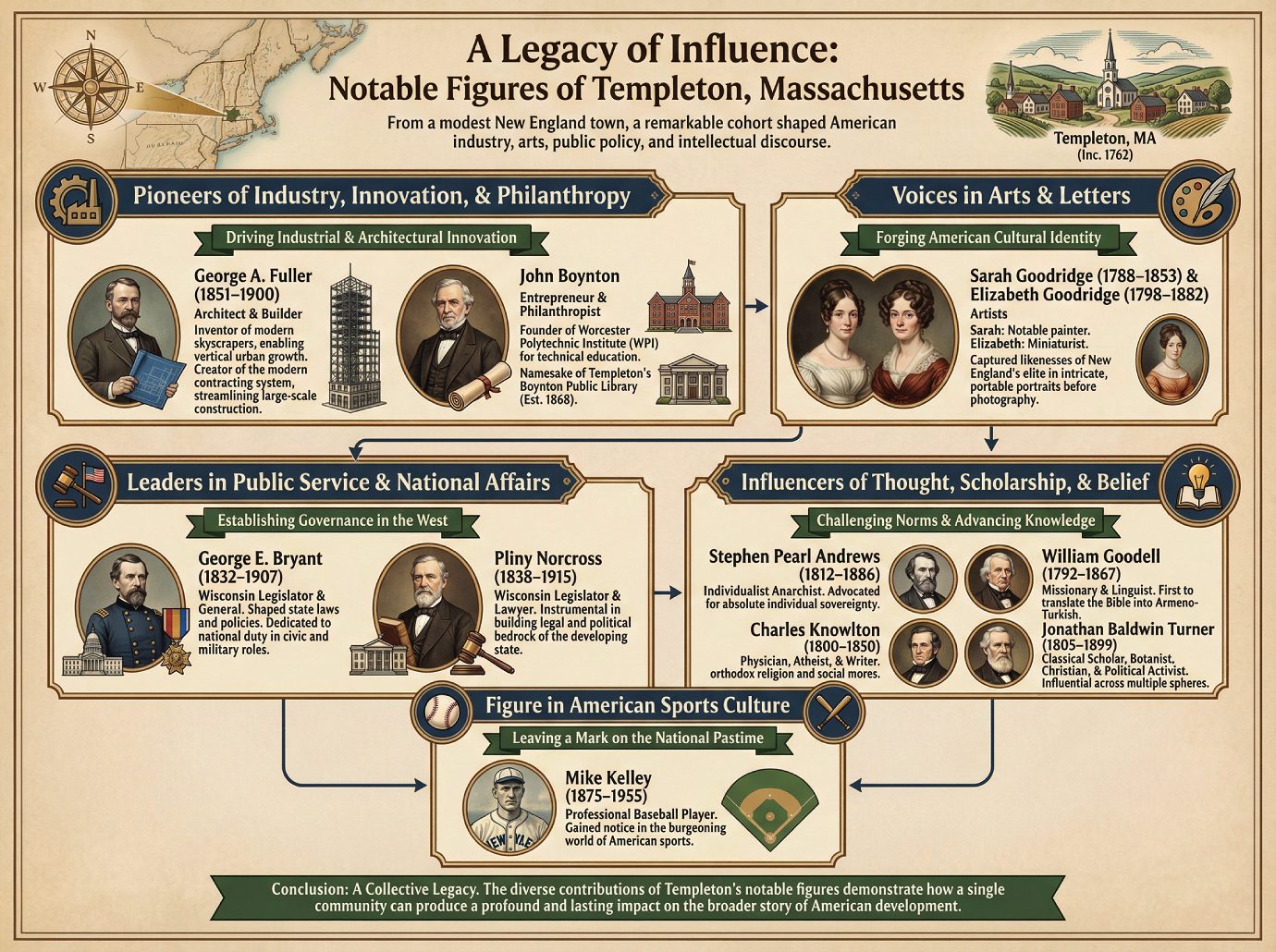
Though a modest New England town since its incorporation in 1762, Templeton, Massachusetts, has produced a remarkable cohort of individuals whose influence radiated far beyond its provincial borders. These figures distinguished themselves through profound innovation, creativity, and leadership, helping to shape the course of American industry, arts, public policy, and intellectual discourse. This brief profiles these notable residents, examining their achievements to illustrate the town’s significant and far-reaching historical footprint. From their origins in this community, these individuals went on to influence the very fabric of the nation, beginning with those who drove industrial and architectural innovation.
2.0 Pioneers of Industry, Innovation, and Philanthropy
The latter half of the 19th century—an era defined by the Second Industrial Revolution and the immense wealth of the Gilded Age—was propelled by visionary individuals from towns like Templeton. This period saw a confluence of invention, entrepreneurship, and a new model of civic duty expressed through large-scale philanthropy. The figures profiled here exemplify this spirit, leveraging their ingenuity to build industries, establish enduring educational institutions, and fundamentally change the American landscape. Among them were inventors and businessmen such as Sylvanus Sawyer, whose careers reflected the era’s focus on commercial ingenuity.
2.1 George A. Fuller (1851–1900)
George A. Fuller’s work as an architect and builder precipitated a revolution in urban development. As the “inventor” of modern skyscrapers, he fundamentally broke with the load-bearing masonry construction that had defined architecture for centuries. This innovation enabled American cities to grow vertically, forever altering their skylines. His creation of the modern contracting system also transformed the business of construction, establishing a framework that streamlined large-scale projects and facilitated the rapid expansion of America’s built environment.
• Title: Architect
• Key Innovation: Inventor of modern skyscrapers
• Business Contribution: Creator of the modern contracting system
2.2 John Boynton
John Boynton’s dual legacy as both a successful entrepreneur and a foundational philanthropist demonstrates how industrial fortunes were converted into public good. His founding of the Worcester Polytechnic Institute established a premier institution for technical education that continues to produce leaders in science and engineering. Locally, his civic-mindedness is immortalized in Templeton’s Boynton Public Library, established in 1868 and named in his honor, ensuring his contributions would enrich both his home community and the wider world.
• Title: Entrepreneur and Philanthropist
• Educational Legacy: Founder of Worcester Polytechnic Institute
• Civic Contribution: Namesake of Templeton’s Boynton Public Library, established in 1868
From the tangible worlds of industry and invention, we now turn to the realm of arts and letters, where other Templeton natives left their imprint on the nation’s cultural identity.
3.0 Voices in Arts and Letters
During the Federalist and Jacksonian eras, a distinct American cultural identity was forged through painting and literature. Artists and writers from communities like Templeton contributed to this evolving narrative, translating their unique perspectives into works that reflected and influenced a young nation. Among these were the Goodridge sisters, whose artistic endeavors enriched the visual culture of their era, and the writer Charlotte Frances Wilder.
3.1 Sarah Goodridge (1788–1853) & Elizabeth Goodridge (1798–1882)
The Goodridge sisters captured the likenesses of New England’s elite in an era before photography democratized portraiture. Sarah Goodridge established herself as a notable painter, while her sister, Elizabeth Goodridge, specialized in miniature portraiture. Elizabeth’s chosen medium was particularly significant; these intricate, personal, and portable works were cherished keepsakes in 19th-century society. Together, their art provides a valuable visual record of their time and stands as a testament to the creative talent nurtured within Templeton.
• Sarah Goodridge: Painter
• Elizabeth Goodridge: Miniaturist and sister of Sarah
The influence of Templeton’s residents extended from the cultural sphere into the demanding arena of public service and political life.
4.0 Leaders in Public Service and National Affairs
The 19th century’s westward expansion was not merely a demographic shift but a projection of political and civic culture, often led by individuals with New England roots. During the post-Civil War settlement boom, these figures were crucial in establishing the governmental and legal structures of the developing Upper Midwest. Two individuals from Templeton exemplify this trend, carrying their principles of leadership to Wisconsin and playing key roles in its statecraft.
4.1 George E. Bryant (1832–1907)
George E. Bryant’s career demonstrates a profound commitment to public service in both civic and military capacities. As a Wisconsin legislator, he helped shape the laws and policies of the growing state at a formative time in its history. His prior service as a general further underscores a life dedicated to national duty, embodying a model of multifaceted leadership that was vital to the nation’s consolidation and growth.
• Primary Roles: Wisconsin legislator and general
4.2 Pliny Norcross (1838–1915)
Pliny Norcross was instrumental in building the legal and political bedrock of his adopted state of Wisconsin. Serving as both a legislator and a lawyer, he applied his New England-honed expertise to the governance and development of the state, showcasing how individuals from established towns like Templeton helped construct the civic institutions of the American frontier.
• Primary Roles: Wisconsin legislator and lawyer
From the practicalities of governance, we shift our focus to the more abstract, yet equally powerful, world of ideas, faith, and social activism.
5.0 Influencers of Thought, Scholarship, and Belief
The 19th century in America was a period of profound intellectual and social ferment, where challenges to traditional norms in philosophy, religion, and science gave rise to new and often radical modes of thought. This environment created a space for independent thinkers to contest the status quo and advocate for new ways of understanding the world. Several individuals from Templeton were prominent in these intellectual currents, contributing to debates that shaped the nation’s ideological landscape.
5.1 Stephen Pearl Andrews (1812–1886)
Stephen Pearl Andrews was a significant voice in 19th-century American political thought, identifying as an individualist anarchist. His philosophical stance, which prioritized absolute individual sovereignty over all forms of external authority, placed him within a radical intellectual tradition that questioned the fundamental structures of state and society.
• Primary Identification: Individualist anarchist
5.2 William Goodell (1792-1867)
William Goodell’s impact was felt at the intersection of faith and rigorous scholarship. His work as a missionary and linguist culminated in a remarkable and historically significant achievement: the first translation of the Bible into Armeno-Turkish. This monumental effort not only served his evangelical mission but also represented a major linguistic undertaking that made the sacred text accessible to an entire culture.
• Primary Roles: Missionary and linguist
• Key Achievement: First to translate the Bible into Armeno-Turkish
5.3 Charles Knowlton (1800–1850)
Charles Knowlton was an embodiment of the era’s radical freethought tradition, openly confronting orthodox religion and social mores. As a physician, atheist, and writer, his combined identities represented a direct challenge to the conventions of his time. His willingness to publicly embrace atheism in a deeply religious society positioned him as a controversial but influential figure who pushed the boundaries of acceptable public discourse.
• Primary Roles: Physician, atheist, and writer
5.4 Jonathan Baldwin Turner (1805–1899)
The career of Jonathan Baldwin Turner exemplifies the intellectual versatility characteristic of many 19th-century public figures. His expertise was exceptionally broad, encompassing work as a classical scholar, botanist, dedicated Christian, and political activist. This diverse range of engagements allowed him to exert influence across the academic, scientific, religious, and political spheres of his day.
• Areas of Influence: Classical scholar, botanist, dedicated Christian, and political activist
Finally, we transition from these intellectual pursuits to recognize a Templeton native who gained notice in the burgeoning world of American popular culture and sports.
6.0 Figure in American Sports Culture
As the 19th century gave way to the 20th, baseball was cementing its status as America’s national pastime, becoming an integral part of the country’s cultural landscape. Professional players were elevated to the status of public figures, and the sport provided a new avenue for national recognition. Templeton’s representative in this arena was Mike Kelley, a professional baseball player who made his mark in the sporting world.
6.1 Mike Kelley (1875–1955)
• Claim to Fame: Baseball player
7.0 Conclusion: A Collective Legacy
The collective biography of Templeton’s notable figures demonstrates that the influence of a small New England town can extend powerfully across a nation. From the architect who reshaped American cities and the philanthropist who founded a major university, to the artists who recorded the faces of a young republic and the legislators who built new states, these individuals left an indelible mark. Their achievements, combined with those of the town’s pioneering thinkers and activists, reveal a diverse and profound legacy. The history of Templeton, Massachusetts, is a compelling reminder of how a single community can produce a remarkable array of accomplished individuals whose contributions resonate through the broader story of American development. ——————-
A Student’s Guide to the Demographics of Templeton, Massachusetts

A Student’s Guide to the Demographics of Templeton, Massachusetts
1. Introduction: What Are Demographics and Why Do They Matter?
Welcome to this guide on the demographics of Templeton, Massachusetts. According to the 2020 U.S. Census, this Worcester County town is home to 8,149 people. But what does that number really tell us? To understand a community, we must look at its demographics.
In demographics, we view these statistics as a community’s report card, revealing key characteristics like its age distribution, ethnic composition, and economic structure. As social scientists, we analyze these numbers to uncover the story of the community, who lives there, and how it has changed. To begin telling Templeton’s story, let’s first look at how its population has evolved over time.
2. The Story of Growth: Templeton’s Population Over Time
A town’s population is never static. It grows and shrinks over the decades in response to economic opportunities, social trends, and other factors. The historical data for Templeton reveals a community that has experienced consistent and sometimes rapid expansion.
| Year | Total Population |
|---|---|
| 1850 | 2,173 |
| 1860 | 2,816 |
| 1870 | 2,802 |
| 1880 | 2,789 |
| 1890 | 2,999 |
| 1900 | 3,489 |
| 1910 | 3,756 |
| 1920 | 4,019 |
| 1930 | 4,159 |
| 1940 | 4,601 |
| 1950 | 4,757 |
| 1960 | 5,371 |
| 1970 | 5,863 |
| 1980 | 6,070 |
| 1990 | 6,438 |
| 2000 | 6,799 |
| 2010 | 8,013 |
| 2020 | 8,149 |
| 2023* | 8,261 |
| *2023 figure is an estimate. |
Analyzing this long-term data reveals two significant trends:
• A Decade of Dramatic Growth: The most significant period of percentage growth occurred between 2000 and 2010, when the population increased by 17.9%. This surge indicates a substantial influx of new residents during that decade, marking it as a key period of expansion for the town.
• A History of Steady Growth: Looking back further, Templeton has shown consistent, steady growth since the 1930s. This long-term trend suggests that the town has been an attractive place to live for many generations.
Contrasting the population boom of 2000-2010 with the much more modest growth of 1.7% between 2010 and 2020 prompts a critical question: What might have caused this rapid expansion to slow down so dramatically?
While this historical view is valuable, the most detailed community data available is from a specific point in time. Let’s take a closer look at the year 2000.
3. A Closer Look: A Snapshot of Templeton in the Year 2000
This section breaks down the detailed community profile of Templeton based on the comprehensive U.S. Census data collected in the year 2000. It is important to remember that this data provides a portrait of the town at that specific time.
3.1. Ethnic and Racial Composition
This data reveals the racial and ancestral heritage of the people who called Templeton home in 2000.
| Race/Ethnicity | Percentage of Population (2000) |
|---|---|
| White | 98.15% |
| Hispanic or Latino | 1.44% |
| Two or More Races | 0.57% |
| Other Races | 0.43% |
| African American | 0.35% |
| Asian | 0.28% |
| Native American | 0.22% |
The key takeaway from this table is that in 2000, Templeton’s population was predominantly White. The census also asked residents about their ancestry, providing a deeper look into the community’s cultural roots.
Most Common Ancestries Reported in 2000
• French
• French Canadian
• Irish
• Italian
• English
3.2. Age and Household Structure
Age and household data tell us about the different generations present in the town and the types of families that live there. The 2000 census data highlights three important characteristics of the Templeton community at that time.
1. A Large Working-Age Population: The single largest age group was adults 25 to 44 years old (31.1%). This suggests Templeton had a strong workforce and a community of active, mid-career adults during that period.
2. Family-Oriented Households: The data shows a community centered on family life. A significant portion of households (35.3%) had children under the age of 18, and a clear majority (60.5%) were married couples living together.
3. A Balanced Community: With a median age of 38 years, the town had a balanced mix of different generations. This included younger families, middle-aged adults, and a notable population of older residents, with 12.9% being 65 years of age or older.
This large, family-oriented workforce in their prime earning years (ages 25-44) directly contributed to the town’s median household income of nearly $50,000, painting a picture of a productive, middle-class community in 2000.
3.3. Income and Economic Well-being
An analysis of income data reveals the economic health and financial standing of a community’s residents in 2000.
Median Income in Templeton (2000)
| Income Metric | Median Income (2000) |
|---|---|
| Median Household Income | $48,482 |
| Median Family Income | $52,936 |
| Male Median Income | $38,088 |
| Female Median Income | $26,993 |
This table reveals a significant income gap between males and females in 2000. This gap reflects common national trends of the time, often attributed to differences in hours worked, occupation segregation, and historical pay scales. The town’s per capita income—the average income per person—was $21,994.
The data also provides insight into economic challenges. In 2000, 9.1% of the total population was living below the poverty line. This data reveals that in 2000, economic hardship in Templeton disproportionately affected the youngest and oldest residents, a crucial insight into the community’s social safety net at the time. The rate for those under 18 was 10.5%, while 13.4% of those age 65 and over fell below the poverty threshold.
These individual data points—from population growth to income levels—combine to paint a comprehensive picture of the Templeton community at the turn of the 21st century.
4. Conclusion: Key Takeaways About Templeton’s Demographics
The demographic data tells a clear story about Templeton, Massachusetts. It is a town defined by its history of growth and, as captured in the year 2000, a community built around working families. Based on this analysis, here are the three most important insights to remember.
1. A Town of Steady Growth: Templeton has a long and consistent history of attracting new residents, growing steadily for nearly a century. This trend accelerated significantly in the early 2000s with a period of remarkable population expansion.
2. A Snapshot of Heritage (2000): The 2000 census revealed a community that was racially homogeneous. At that time, its residents were predominantly White and primarily traced their ancestry to various European nations, with French, French Canadian, Irish, Italian, and English being the most common.
3. A Community of Working Families (2000): The detailed data from 2000 depicts a town centered around a large population of working-age adults and their families. With a balanced age structure and a high percentage of households with children, Templeton was a community of active families.
The Tiny Town Behind the Skyscraper: 4 Surprising Truths About Templeton, Massachusetts
The Tiny Town Behind the Skyscraper: 4 Surprising Truths About Templeton, Massachusetts
Beyond the Quaint Façade
Picture a small New England town. You probably imagine a quiet village green, a white-steepled church, and a history as calm and predictable as the turning of the autumn leaves. It’s an image of peaceful simplicity, a place seemingly disconnected from the grand, chaotic sweep of world events. But what if that quaint façade hides a history of radical contrasts—between rural life and urban skylines, pious conformity and intellectual rebellion, small-town stasis and sudden, dramatic change?
Templeton, Massachusetts, a town of just over 8,000 people in Worcester County, is a perfect case in point. At first glance, it fits the classic New England mold. But dig just beneath the surface, and you’ll find stories of world-changing inventions, radical philosophies, and philanthropic legacies that have shaped the modern world. Templeton’s story is one of profound counter-intuition, a powerful reminder that history’s biggest ideas don’t always come from its biggest cities.
The Modern Skyscraper Has Roots in This Small Town
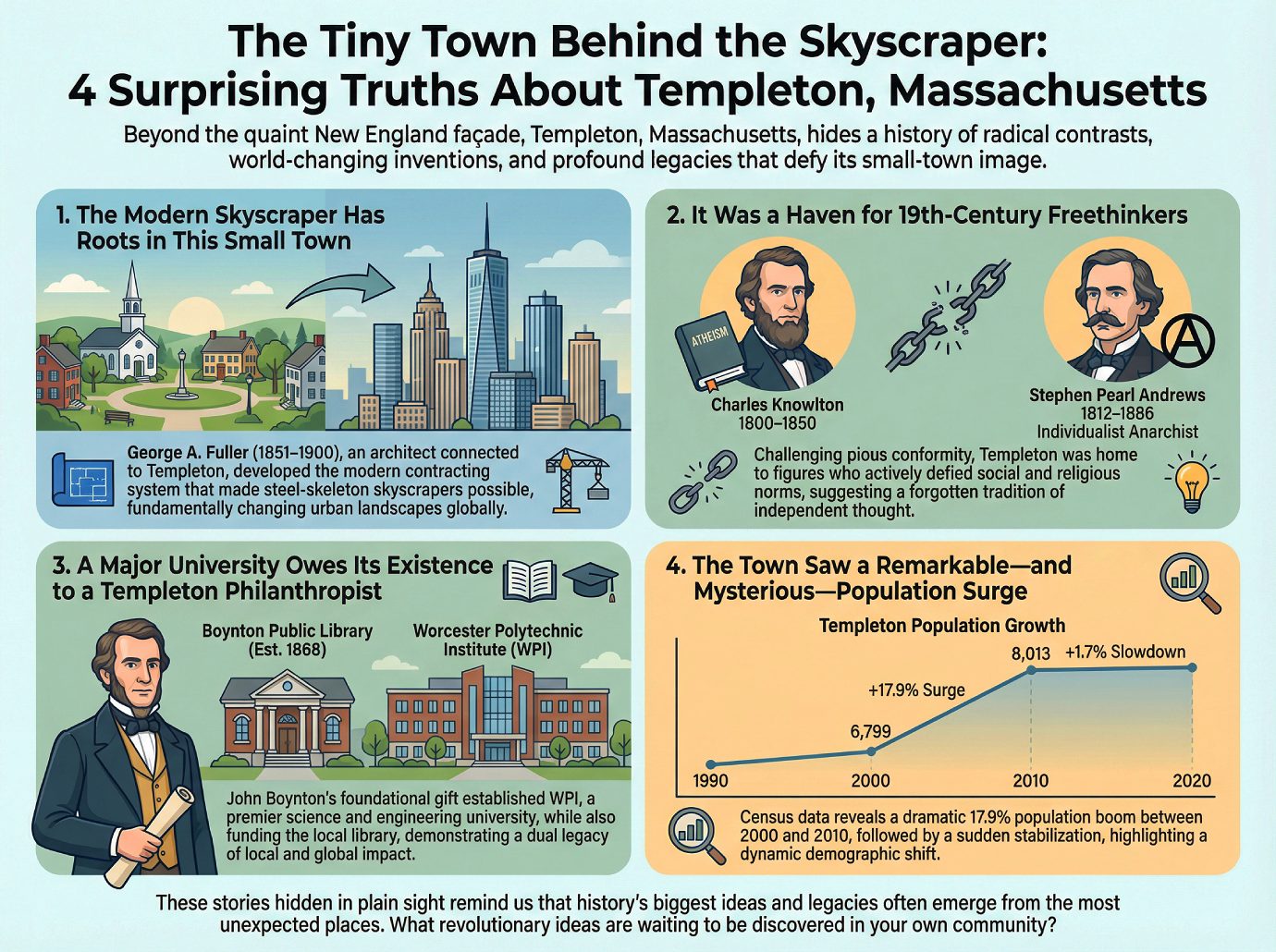
It is a profound and startling irony that the man widely credited as the ‘inventor’ of modern skyscrapers hailed from the small, rural town of Templeton. George A. Fuller (1851–1900), an architect connected to the town, developed the modern contracting system that made the construction of steel-skeleton skyscrapers possible, fundamentally changing the face of the urban world forever.
This fact creates a fascinating contrast. The scale of Fuller’s invention—the towering structures that define skylines from New York to Dubai—stands in stark opposition to the humble scale of his origins. His legacy is a testament to the idea that transformative innovation can emerge from the most unexpected of places, launching the vertical city from the heart of the countryside.
It Was a Haven for 19th-Century Freethinkers
The image of 19th-century New England is often one of pious conformity, yet Templeton’s history includes figures who actively defied the social and religious norms of their day. Rather than being isolated incidents, the presence of two such figures suggests a more complex local culture. The town’s history includes Charles Knowlton (1800–1850), a physician and outspoken atheist, and Stephen Pearl Andrews (1812–1886), a prominent individualist anarchist.
To find both a staunch atheist and a political anarchist connected to the same small Massachusetts town during this period is remarkable. It challenges the stereotype of the monolithic, conservative New England village. What was it about the intellectual climate of Templeton that might have allowed such non-conformist ideas to take root? Perhaps it wasn’t an anomaly, but rather evidence of a forgotten local tradition of independent thought, thriving quietly amidst the rolling hills.
A Major University Owes Its Existence to a Templeton Philanthropist
The impact of those with ties to Templeton has reached far beyond its town lines, shaping the future of technology and education. John Boynton, a successful entrepreneur and philanthropist, provided the foundational gift that established Worcester Polytechnic Institute (WPI), one of the nation’s premier science and engineering universities. His vision and generosity created a lasting legacy of innovation that has educated countless leaders for generations.
Yet Boynton’s philanthropy wasn’t solely focused on the wider world; it was also rooted firmly in his community. The town’s own Boynton Public Library, established in 1868, is named in his honor. This dual legacy is powerful. It shows how a sense of local responsibility can exist alongside a vision for global impact, demonstrating that the seeds of great institutions are often planted in the same soil that nourishes a hometown.
The Town Saw a Remarkable—and Mysterious—Population Surge
While much of Templeton’s surprising history is rooted in the past, its modern story contains unexpected turns revealed in quiet census data. For decades, the town saw modest, predictable growth. Then, something changed. Between 2000 and 2010, the population surged from 6,799 to 8,013—a dramatic 17.9% increase in a single decade.
But the story doesn’t end there. In the following decade, from 2010 to 2020, that explosive growth slowed to just 1.7%. This data tells a story not of simple, sustained growth, but of a specific moment in time when Templeton became a magnet, followed by a period of stabilization. What forces drove that sudden boom? And what does its subsequent leveling-off say about the town’s character today? This demographic mystery provides a modern counterpoint to the historical narratives, showing a community that is not just a repository of history, but a dynamic and evolving place.
The Stories Hidden in Plain Sight
Ordinary places often contain the most extraordinary stories, if we only know where to look. Templeton, Massachusetts, appears to be a typical New England town, but its history is one of radical contrasts—of world-changing urban inventions born from rural roots, of radical ideas flourishing in an unexpected place, and of local philanthropy with a global impact. From the man who gave us the skyscraper to the freethinkers who challenged convention, this small town’s legacy is woven into the fabric of modern America.
These discoveries are a powerful reminder that history isn’t confined to capitals and metropolises. It lives in the quiet streets and local records of towns everywhere. What revolutionary ideas and forgotten legacies are waiting to be discovered in your own community?