
The Gardner Museum – 2026 Season – Complete Report

Click a link to jump to a report:
Unearthing the Chair City: 5 Surprising Reasons the Gardner Museum is This Season’s Must-Visit Hidden Gem —–Gardner Museum 2026: A Season of Heritage and Discovery ——Strategic Programming Overview: Heritage, Education, and Community Engagement for the 2026 Season —–Community Impact Report: The Gardner Museum as a Cultural and Civic Anchor —–
Listen to this “Deep Dive” about the exciting 2026 season at the Gardner Museum on any device, CLICK PLAY.
Watch this short VIDEO about the exciting 2026 Season of the Gardner Museum:
Unearthing the Chair City: 5 Surprising Reasons the Gardner Museum is This Season’s Must-Visit Hidden Gem
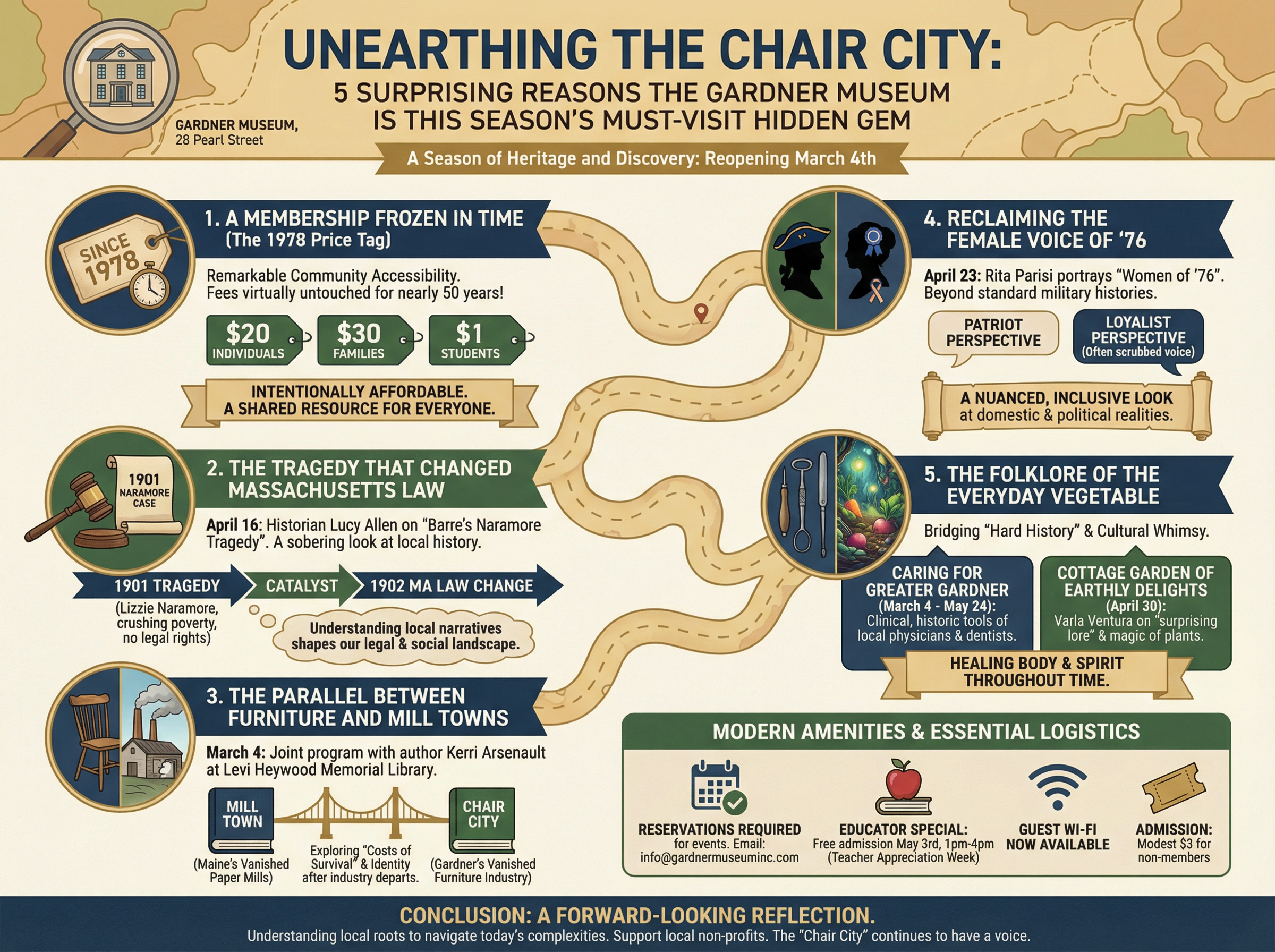
Unearthing the Chair City: 5 Surprising Reasons the Gardner Museum is This Season’s Must-Visit Hidden Gem
As the first buds of spring begin to stir, so too does the narrative of our community. On Wednesday, March 4th, the Gardner Museum at 28 Pearl Street officially reopens its doors, unearthing a season of heritage that promises to be a catalyst for both local pride and intellectual discovery. For those of us who curate the stories of the past, there is a palpable excitement in the air this year. From fresh permanent displays to a lecture series that probes the stark realities of our shared history, the “Chair City” is offering far more than just a walk down memory lane.
Whether you are a lifelong resident or a curious traveler, here are five reasons why the Gardner Museum is the essential cultural destination of the season.
1. A Membership Frozen in Time (The 1978 Price Tag)
In an era where the cost of living seems to climb daily, the Gardner Museum stands as a remarkable testament to community accessibility. Since its founding in 1978, the museum has maintained a membership fee structure that remains virtually untouched for nearly 50 years. At just $20 for Individuals, $30 for Families, and a symbolic $1 for Students, the price of belonging is a throwback to a different age.
This commitment to affordability is a deliberate curatorial choice. It ensures that the stories of our ancestors aren’t locked behind a paywall, but remain a shared resource for everyone.
“Annual membership fees are intentionally kept very affordable… [these contributions] are essential in helping this nonprofit museum continue to serve the community.”
2. The Tragedy That Changed Massachusetts Law
On April 16th, historian Lucy Allen will present one of the most sobering and significant lectures in recent years: “Barre’s Naramore Tragedy.” Local history is not always comfortable; it is often the keeper of “disturbing tragedies” that eventually serve as the foundation for modern civil rights.
The 1901 case of Lizzie Naramore—a mother who took the lives of her six children while trapped in crushing poverty—was a stark reflection of a time when women had no legal rights and were entirely dependent on husbands who failed to provide. This local heartbreak became a statewide catalyst, leading directly to the 1902 change in Massachusetts law. Understanding this tragedy is vital for anyone looking to see how local narratives have historically shaped our state’s legal and social landscape.
3. The Parallel Between Furniture and Mill Towns
On March 4th, the museum co-hosts a poignant joint program that bridges the gap between regional identities. However, take note of the location: this specific event featuring author Kerri Arsenault will be held at the Levi Heywood Memorial Library (55 W Lynde St).
Arsenault will discuss her memoir Mill Town, drawing a haunting parallel between the vanished paper mills of Maine and Gardner’s own legacy as the “Chair City.” For a community defined by its “vanished furniture industry,” this discussion on the “costs of survival” and the search for identity after industry departs is deeply resonant. It is a powerful exploration of what remains of a town when its primary engine of labor stops humming.
4. Reclaiming the Female Voice of ’76
As we approach the semiquincentennial (250th anniversary) of the Declaration of Independence, the museum is moving beyond standard military histories to explore the American Revolution through “unique perspectives.” On April 23rd, performing artist Rita Parisi returns to portray the “Women of ’76.”
This presentation is particularly sophisticated because it does not settle for a one-sided narrative. Parisi brings to life the firsthand accounts of both Patriot and Loyalist women. By including the Loyalist perspective—a voice often scrubbed from traditional American histories—the museum offers a nuanced, inclusive look at the domestic and political realities of the women who witnessed the birth of a nation.
5. The Folklore of the Everyday Vegetable
History is not found solely in ledgers and tools; it lives in our superstitions and the natural world. This season, the museum masterfully bridges the gap between “hard history” and cultural whimsy. From March 4th through May 24th, visitors can explore the “Caring for Greater Gardner” exhibit, featuring the clinical, historic tools of local physicians and dentists.
Contrast this medical reality with Varla Ventura’s presentation on April 30th, “Cottage Garden of Earthly Delights.” Ventura dives into the “surprising lore” and magic associated with common vegetables and enchanted plants. By juxtaposing the physical tools of medicine with the spiritual folklore of nature, the museum tells the complete story of the human experience—how we have sought to heal both the body and the spirit throughout time.
Modern Amenities and Essential Logistics
To ensure your visit is as seamless as it is enlightening, keep these “need-to-know” updates in mind:
• Reservations: Attendance for all lectures and events requires a reservation. The museum strongly prefers contact via email at info@gardnermuseuminc.com.
• Educator Special: In honor of Teacher Appreciation Week, the museum is offering free admission for educators on May 3rd, from 1:00 pm to 4:00 pm, featuring a chance to win door prizes.
• Connectivity: Guest Wi-Fi is now available for all visitors.
• Admission: Regular admission remains a modest $3 for non-members.
• The “Caring” Exhibit: The “Caring for Greater Gardner” medical history display runs from opening day (March 4) through May 24.
Conclusion: A Forward-Looking Reflection
The Gardner Museum’s new season is a “Season of Heritage and Discovery” that asks us to look closer at the world around us. How does understanding a “vanished industry” or a “legal tragedy” from a century ago help us navigate the complexities of today? By supporting local non-profit institutions, we ensure that the “Chair City” continues to have a voice. After all, understanding our local roots is the only way to truly understand where we are going.
——————-
Gardner Museum 2026: A Season of Heritage and Discovery

Gardner Museum 2026: A Season of Heritage and Discovery
Gardner Magazine Reader Summary
The Gardner Museum transitions into its 2026 season on March 4th, offering a robust itinerary of exhibits and programs that bridge local history with broader national narratives. Key highlights of the upcoming season include the “Caring for Greater Gardner” exhibit—a tribute to the region’s medical legacy—and a specialized lecture series covering topics from industrial history and women’s rights to paranormal lore. Notably, the museum is marking the American Revolution’s semiquincentennial with dedicated performances exploring the nation’s founding. As a non-profit institution, the museum continues to maintain accessible membership rates that have remained unchanged since 1978, underscoring its commitment to community service and historical preservation.
——————————————————————————–
Institutional Overview and Visitor Services
Located at 28 Pearl Street, the Gardner Museum reopens to the public on Wednesday, March 4, 2026. The institution has utilized the winter hiatus to curate a spring lineup focused on education and community engagement.
New and Enhanced Amenities
Recent updates to the museum experience include:
• Technological Integration: The introduction of guest Wi-Fi for all visitors.
• Curated Collections: Newly donated artifacts are now integrated into fresh permanent displays.
• Retail: The museum gift shop has been stocked with new items for the 2026 season.
Membership and Support
The museum operates as a non-profit organization, relying on community contributions to sustain its programming. Remarkably, membership rates have remained static since the museum was founded in 1978.
| Membership Type | Annual Fee |
|---|---|
| Individual | $20.00 |
| Family | $30.00 |
| Student | $1.00 |
| General Admission | $3.00 |
Membership benefits include admission to the museum and its various programs.
——————————————————————————–
Seasonal Exhibits
Caring for Greater Gardner
• Duration: March 4 – May 24, 2026
• Scope: This exhibit honors the historical and contemporary contributions of physicians, dentists, and healthcare professionals within the city.
• Contents: The display features a collection of historic medical tools and implements.
• Special Event: An opening event on March 28 at 1:00 PM allows visitors to meet local healthcare professionals and their families; admission is free for this event.
Memories Alive in Images (Summer Photography Exhibit)
• Duration: June 3 – August 30, 2026
• Scope: This is the second annual exhibition featuring photographs taken by museum members.
• Focus: The exhibit highlights special moments, nature, and cherished objects, serving as a “portal to cherished memories.”
——————————————————————————–
Spring 2026 Lecture and Performance Series
The museum’s spring programming features a diverse array of scholars, musicians, and performers. Unless otherwise noted, events are held at the museum and require reservations.
Historical and Social Analysis
• Mill Town: Reckoning with What Remains (March 4): A joint program with the Levi Heywood Memorial Library. Author Kerri Arsenault discusses her investigative memoir regarding the impact of the paper mill industry in Maine, drawing parallels to Gardner’s vanished furniture industry.
• Barre’s Naramore Tragedy (April 16): Historian Lucy Allen examines the 1901 case of Lizzie Naramore. The lecture explores the intersection of poverty and the lack of legal rights for women in marriage, which led to a change in Massachusetts law in 1902.
• Hervey Bowden Essay Contest (May 7): A presentation of winning research essays by 8th-grade and High School students. This event honors Hervey Bowden, a history teacher at Gardner High School for over 40 years.
Cultural and Artistic Performances
• Celtic Songs & Stories (March 19): Musician Jeff Snow performs traditional music from Scotland, Ireland, and England using the guitar, bouzouki, and autoharp.
• Irish Step Dance (March 26): A performance by the Irish-American Step Dancers celebrating traditional Irish dance forms.
• Blooms and Bonnets (May 14): Lynn Hartmann, owner of Hartman’s Herb Farm, explores the history of hat making and the botanical inspirations (herbs and flowers) behind fashion design.
Folklore and Science
• Mysterious MA (April 9): Sarah Hodge-Wetherbe presents an analysis of Massachusetts legends, paranormal reports, and “weird incidental history” as a window into the state’s cultural history.
• Cottage Garden of Earthly Delights (April 30): Author Varla Ventura discusses the surprising folklore and “strange” lore associated with common vegetables.
——————————————————————————–
The 250th Anniversary: Semiquincentennial Programming
The Gardner Museum is commemorating the 250th anniversary of the Declaration of Independence through a two-part series (Spring and Fall) supported by the Gardner Cultural Council and the Massachusetts Cultural Council.
• Women of ’76 (April 23): Rita Parisi of Waterfalls Productions provides a portrayal of women—both Loyalist and Patriot—who witnessed the American Revolution.
• U.S. History in Song (October 22): Jon Waterman returns with a program blending original songs, slideshows, and historical narratives focused on the American experience.
——————————————————————————–
Educational Outreach and Community Events
The museum maintains a strong connection with local educators and students:
• Teacher Appreciation Week (May 3): During regular opening hours (1:00 PM – 4:00 PM), the museum offers free admission and door prizes to educators in recognition of their service.
• Library Collaboration: The museum continues its partnership with the Levi Heywood Memorial Library for the second annual joint program, expanding its reach beyond the 28 Pearl Street location. ——————————
Strategic Programming Overview: Heritage, Education, and Community Engagement for the 2026 Season
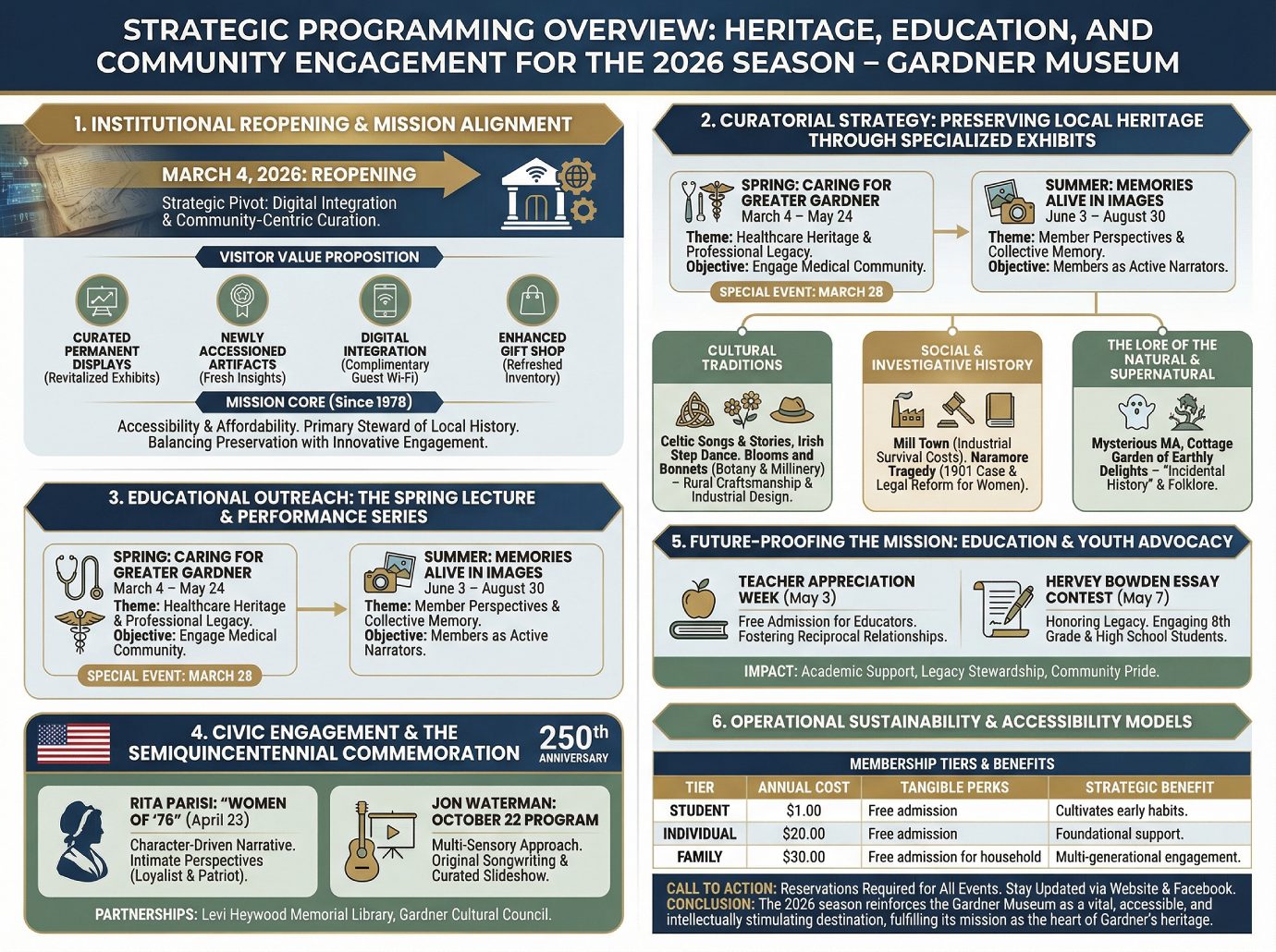
Strategic Programming Overview: Heritage, Education, and Community Engagement for the 2026 Season
1. Institutional Reopening and Mission Alignment
The March 4, 2026, reopening of the Gardner Museum serves as a strategic pivot toward digital integration and community-centric curation. This date marks more than a seasonal return; it represents a comprehensive renewal of our institutional commitment to the Greater Gardner region. By modernizing the visitor experience through amenities such as new guest Wi-Fi, we are not merely offering a perk, but deploying a strategic tool designed to enhance educational delivery and align our historical environment with the expectations of a contemporary audience.
For nearly 50 years, the Gardner Museum has functioned as a vital cultural anchor and a model of nonprofit sustainability. Founded in 1978, the institution has prioritized accessibility and affordability as core tenets of its mission. As we enter the 2026 season, we remain steadfast in our role as the primary steward of local history, balancing the preservation of our collective heritage with the necessity of innovative, forward-facing engagement.
Visitor Value Proposition
• Curated Permanent Displays: Revitalized exhibits offering updated scholarship on Gardner’s industrial and social history.
• Newly Accessioned Artifacts: Recent donations now integrated into the galleries to provide fresh insights into regional material culture.
• Digital Integration: Complimentary guest Wi-Fi to support real-time research and interactive visitor engagement.
• Enhanced Gift Shop: A strategically refreshed inventory of historical literature and locally inspired merchandise.
This institutional evolution provides the necessary framework for a spring season dedicated to specialized curation and the celebration of the individuals who define our community.
2. Curatorial Strategy: Preserving Local Heritage through Specialized Exhibits
Our 2026 curatorial strategy emphasizes industry-specific and member-driven narratives to reinforce local identity and institutional loyalty. By focusing on the professional legacies and personal memories of our constituents, we transform the museum from a passive repository into an active participant in the community’s ongoing story.
The season commences with “Caring for Greater Gardner” (March 4 – May 24). This exhibit honors the healthcare legacy of the region by displaying historic medical and dental tools alongside the narratives of the practitioners who have served the city. By bridging the gap between the historical record and contemporary professional service, the exhibit positions the museum as a relevant partner to Gardner’s modern medical community.
Complementing this professional focus is the “Memories Alive in Images” Summer Photography Exhibit, opening June 3. This initiative empowers our membership to serve as active narrators of our collective history. By exhibiting photographs taken by members that capture cherished moments, nature, and significant objects, the museum facilitates a collaborative storytelling environment that celebrates the lived experiences of our supporters.
Seasonal Exhibit Roadmap
| Exhibit Title | Duration | Core Theme | Strategic Objective |
|---|---|---|---|
| Caring for Greater Gardner | March 4 – May 24 (Special Event: March 28) | Healthcare Heritage and Professional Legacy | To reinforce the museum’s role as a repository for professional history and to engage the local medical community as a key stakeholder demographic. |
| Memories Alive in Images | June 3 – August 30 | Member Perspectives and Collective Memory | To transition members from passive observers into active narrators of local history. |
These foundational exhibits are further enriched by a dynamic schedule of intellectual and cultural programming designed to engage a diverse visitor base.
3. Educational Outreach: The Spring Lecture and Performance Series
The Gardner Museum functions as a “living classroom,” utilizing its programming to analyze complex social, historical, and cultural phenomena. Our Spring 2026 series is meticulously curated to provide the “So What?” factor—the critical link between historical events and their enduring impact on our regional identity.
Thematic Categories of Programming
• Cultural Traditions: Programs such as Celtic Songs & Stories and Irish Step Dance provide essential cultural literacy regarding the region’s ancestral roots. A highlight of this category, Blooms and Bonnets (presented by the owner of Hartman’s Herb Farm in Barre), examines the intersection of botany and millinery. This lecture illustrates how rural craftsmanship and the local agricultural landscape of North Worcester County have historically influenced regional industrial design and fashion.
• Social & Investigative History: This category addresses the weight of historical change through the Mill Town lecture and the Naramore Tragedy presentation. Kerri Arsenault’s Mill Town (a joint event held at the Levi Heywood Memorial Library) draws direct parallels between Maine’s paper mills and Gardner’s vanished furniture industry, examining the human and environmental costs of industrial survival. Similarly, the reexamination of the 1901 Naramore case analyzes the 1902 change in Massachusetts law regarding women’s legal rights within marriage and custody, illustrating how a local tragedy catalyzed statewide legislative reform for women’s autonomy.
• The Lore of the Natural & Supernatural: Through sessions like Mysterious MA and Cottage Garden of Earthly Delights, the museum explores “incidental history”—the legends and botanical folklore that serve as fascinating windows into the state’s broader cultural and psychological identity.
By connecting specific local narratives to larger historical movements, the museum prepares its audience for a broader commemorative focus on our national origins.
4. Civic Engagement and the Semiquincentennial Commemoration
As the nation approaches the 250th anniversary of the Declaration of Independence, the Gardner Museum has positioned itself as a local nexus for the Semiquincentennial. Our programming response to this milestone is strategically designed around visitor demand, featuring the return of two distinguished performing artists who offer contrasting pedagogical approaches to the American Revolution.
Rita Parisi’s portrayal in “Women of ‘76” (April 23) utilizes character-driven narrative to offer an intimate, first-hand perspective of the Revolution from both Loyalist and Patriot women. In contrast, Jon Waterman’s October 22 program employs a multi-sensory approach, blending original songwriting with a curated slideshow to synthesize broader themes of U.S. history. This diversity in format ensures the museum caters to varied learning styles—from the emotive and personal to the analytical and visual.
These large-scale commemorations are fortified by vital institutional partnerships. Our ongoing collaboration with the Levi Heywood Memorial Library and the financial support of the Gardner Cultural Council demonstrate a strategic commitment to extending the museum’s educational reach beyond its physical walls and into the civic heart of the city.
While the Semiquincentennial honors our national origin, our focus on youth advocacy ensures the continuity of this historical consciousness for Gardner’s future leaders.
5. Future-Proofing the Mission: Education and Youth Advocacy
The long-term sustainability of the Gardner Museum depends upon our ability to engage the next generation of historians. Youth advocacy is a strategic necessity, ensuring that the records of our past remain relevant to the leaders of tomorrow.
• Teacher Appreciation Week (May 3): By providing free admission and recognition to regional educators, we foster a reciprocal relationship with the schools that shape our future citizens.
• Hervey Bowden Essay Contest (May 7): Established in 2006 by Ray Fredette (GHS Class of 1942), this contest honors the 40-year legacy of Gardner High School history teacher Hervey Bowden. It remains a cornerstone of our engagement with 8th grade and High School students.
Impact of Educational Initiatives
• Academic Support: Serving as a primary source repository for students meeting regional history and research standards.
• Legacy Stewardship: Maintaining the multi-generational educational traditions established by leaders like Bowden and Fredette.
• Community Pride: Highlighting the intellectual achievements of local youth through public recognition and research awards.
These initiatives lead directly into our broader operational framework, which prioritizes accessibility as a means of ensuring community-wide participation.
6. Operational Sustainability and Accessibility Models
The Gardner Museum maintains a unique economic model predicated on maximum community inclusivity. Our deliberate strategy of price stability—maintaining a $3 general admission and consistent membership rates since our 1978 founding—ensures that financial barriers do not preclude any citizen from accessing our cultural resources.
Membership Tiers and Benefits
| Membership Tier | Annual Cost | Tangible Perks | Strategic Benefit |
|---|---|---|---|
| Student | $1.00 | Free admission to museum and programs | Cultivates early habits of museum attendance and civic stewardship. |
| Individual | $20.00 | Free admission to museum and programs | Provides essential foundational support for nonprofit operations. |
| Family | $30.00 | Free admission for the household | Encourages multi-generational attendance and community-wide engagement. |
Call to Action for Stakeholders
To ensure the high quality of our interactive programming, reservations are required for all events (email preferred). We encourage all stakeholders and visitors to maintain engagement via our website and Facebook page for real-time updates on schedules and seasonal offerings.
Conclusion The 2026 season reinforces the Gardner Museum’s position as a vital, accessible, and intellectually stimulating destination. Through a blend of specialized curation, rigorous educational outreach, and a steadfast commitment to accessibility, we continue to fulfill our mission as the heart of Gardner’s heritage and a beacon for its future. ——————————–
Community Impact Report: The Gardner Museum as a Cultural and Civic Anchor
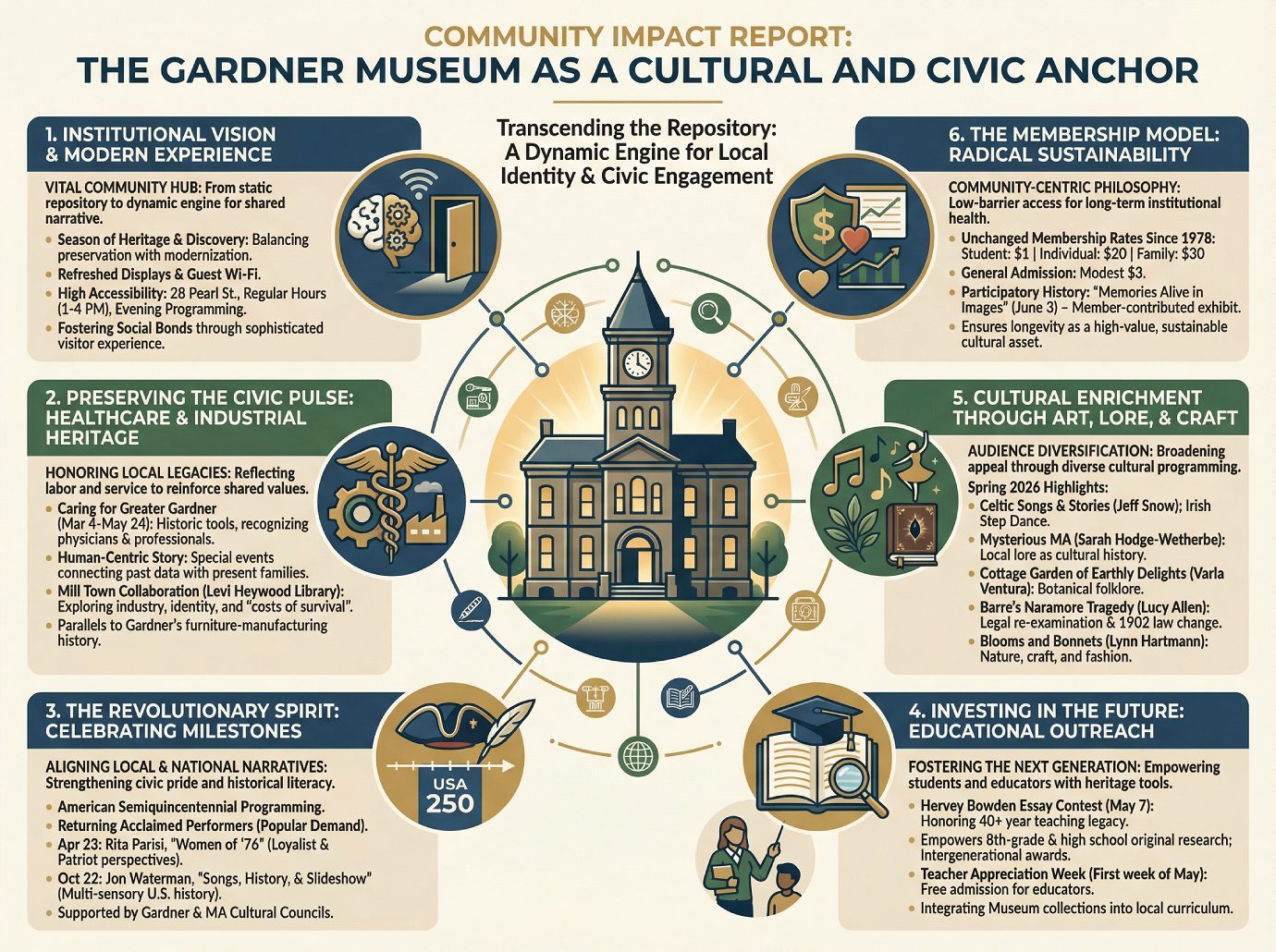
Community Impact Report: The Gardner Museum as a Cultural and Civic Anchor
1. Institutional Vision and the Modern Museum Experience
The Gardner Museum serves as a vital community hub, transcending the traditional role of a repository for artifacts to become a dynamic engine for local identity and civic engagement. By positioning the Museum as a space for shared narrative and cultural dialogue, we ensure that Gardner’s history is not a static memory but a living influence on our collective future. Our strategic focus remains on fostering social bonds through a sophisticated visitor experience that honors the past while embracing the requirements of a modern audience.
Through our “Season of Heritage and Discovery,” the Museum meticulously balances preservation with institutional modernization. We continue to refresh our permanent displays with newly donated artifacts while simultaneously enhancing visitor infrastructure, most notably through the recent introduction of guest Wi-Fi. Located at 28 Pearl Street, the Museum ensures high accessibility, welcoming the public during regular hours (1:00 PM – 4:00 PM) and through a robust schedule of evening programming. This commitment to maintaining a physical and digital presence at the heart of the city serves as the foundation for our broader mission, which is operationalized through specific, community-focused curatorial themes.
2. Preserving the Civic Pulse: Healthcare and Industrial Heritage
Honoring local professional legacies and industrial history is vital for maintaining community social cohesion. When a museum reflects the labor and service of its residents back to them, it reinforces the shared values and resilience that define the region’s character. This recognition transforms technical history into a narrative of collective achievement, ensuring that the foundational pillars of our society are recognized and valued.
The “Caring for Greater Gardner” exhibit (March 4 – May 24) exemplifies this mission. By showcasing “historic tools and implements” alongside the recognition of “past and present physicians, dentists, and health care professionals,” the Museum transforms medical history into a human-centric story of community care. This impact is further deepened through special events, such as the March 28 opening, which invited visitors to meet these professionals and their families, humanizing the data of the past. Furthermore, our “Mill Town” collaboration represents a significant case study in institutional synergy. By hosting author Kerri Arsenault at the Levi Heywood Memorial Library (55 W Lynde St), the Museum moved beyond its walls to explore “industry, identity, and the lasting impact of a vanished hometown industry.” This exploration of the “costs of survival” in a mill town draws direct, poignant parallels to Gardner’s own furniture-manufacturing history. These programmatic efforts collectively anchor the Museum’s role in regional storytelling, leading naturally into our engagement with national historical narratives.
3. The Revolutionary Spirit: Celebrating National and Regional Milestones
As we approach the American semiquincentennial, the Museum recognizes the strategic importance of aligning local programming with national historic milestones. By situating Gardner within the broader narrative of the United States’ founding, we provide residents with a sense of place within the national tapestry, strengthening civic pride and historical literacy.
Our 250th-anniversary programming features the return of two highly acclaimed performers, invited back “due to popular demand” to offer diverse historical interpretations. On April 23, Rita Parisi of Waterfalls Productions presents “Women of ‘76,” a moving portrayal of the loyalist and patriot women who witnessed the Revolution. This is contrasted on October 22 by Jon Waterman, who utilizes a “songs, history, and slideshow” approach to explore the U.S. history narrative through a multi-sensory lens. These high-demand initiatives are made possible through the support of vital external stakeholders, including the Gardner Cultural Council and the Massachusetts Cultural Council. These partnerships ensure that sophisticated historical interpretation remains accessible to the Gardner community, while providing a framework that is increasingly localized through the voices of our youth.
4. Investing in the Future: Educational Outreach and Student Engagement
The Museum views itself as a primary educational partner, tasked with the duty of fostering the next generation of historians and researchers. By providing students and educators with the tools to explore their heritage, we make a strategic investment in the long-term intellectual and civic health of the region.
A cornerstone of this commitment is the Hervey Bowden Essay Contest, which celebrates its winners on May 7. Founded in 2006 by Ray Fredette (GHS Class of 1942), the contest honors the legacy of Mr. Bowden, a history teacher at Gardner High School for over 40 years. This program empowers 8th-grade and high school students to produce original research, with awards presented by members of the Fredette family—a powerful demonstration of intergenerational legacy. Complementing this, our “Teacher Appreciation Week” initiative (the first week of May) grants free admission for educators. This is more than a gesture of gratitude; it is a strategic effort to integrate the Museum into the local curriculum, inviting educators to utilize our collections as an extension of their classrooms. This educational focus serves as a gateway to our broader cultural and artistic engagement offerings for the general public.
5. Cultural Enrichment through Art, Lore, and Traditional Craft
To ensure radical sustainability, the Museum must pursue audience diversification. By offering diverse cultural programming—spanning music, dance, and botanical lore—we broaden our appeal beyond traditional history enthusiasts, attracting a wider donor and member base.
Spring 2026 Cultural Highlights:
• Celtic Songs & Stories (Jeff Snow): Featuring the guitar, bouzouki, and autoharp, this program celebrates heritage through “warmth, humor, and authenticity,” providing a high-value entry point for those seeking cultural connection.
• Irish Step Dance: Performed by the Irish-American Step Dancers, this event utilizes traditional craft to foster community joy and seasonal celebration.
• Mysterious MA (Sarah Hodge-Wetherbe): This program uses “local lore” as a fascinating window into cultural history, proving that even the “weird” aspects of our past offer scholarly insight into the state’s character.
• Cottage Garden of Earthly Delights (Varla Ventura): This presentation on botanical folklore provides a unique intersection of history and plant lore, appealing to garden enthusiasts and researchers alike.
• Barre’s Naramore Tragedy (Lucy Allen): This session provides a vital legal re-examination of the 1901 Naramore case. It illustrates how women were once “legally powerless” within marriage, offering new insight into how this tragedy spurred the 1902 change in Massachusetts law.
• Blooms and Bonnets (Lynn Hartmann): Presented by the owner of Hartman’s Herb Farm, this program analyzes the intersection of natural elements and cultural history, demonstrating how botanical inspiration has shaped traditional craftsmanship and fashion.
These offerings demonstrate that the community itself is a contributor to the Museum’s artistic life, a theme that reaches its peak through our member-focused initiatives.
6. The Membership Model: A Study in Radical Sustainability
The Gardner Museum’s membership model is the bedrock of our nonprofit mission. It reflects a community-centric philosophy that prioritizes low-barrier access as a means of ensuring long-term institutional health. By maintaining an affordable entry point, we ensure that every citizen of Gardner can claim ownership of their history.
The economic significance of our model is best illustrated by our commitment to price stability. While general admission is kept at a modest $3, the following membership rates have remained unchanged since the Museum’s founding in 1978:
• Student Membership: $1
• Individual Membership: $20
• Family Membership: $30
This commitment to affordability is matched by our dedication to participatory history. The “Memories Alive in Images” photography exhibit (opening June 3) empowers members to contribute directly to the Museum’s curated content. By turning members’ “cherished memories” into public history, we ensure that our institution remains a reflection of the people it serves. These essential annual contributions and member-led exhibits ensure the Museum’s longevity as a high-value, sustainable cultural asset that remains a vital anchor for the Greater Gardner community. ————–
The **Gardner Museum** in Massachusetts is launching its new season with a diverse array of **exhibits and educational programs** starting in early March. Visitors can explore a fresh display dedicated to the history of **local healthcare professionals** or attend a collaborative literary event focusing on **industrial history**. To commemorate the **American Revolution’s 250th anniversary**, the museum will host specialized performances in the spring and fall featuring **historical storytelling and music**. Patrons can also enjoy modern upgrades like **guest Wi-Fi** and browse newly acquired artifacts or unique items in the gift shop. To sustain these community offerings, the institution encourages **affordable annual memberships**, which have maintained the same low pricing since the museum was established in **1978**. These initiatives aim to foster a deeper appreciation for **regional heritage** while providing accessible cultural experiences for all residents.
