
Barre MA – Tranquil and Alert
Barre MA – Tranquil and Alert
This entire page is devoted to the Town of Barre, Massachusetts. There’s infographics and narrative on a wide variety of subjects. We also have a “Deep Dive” podcast on the Town of Barre, MA. Listen on any device, CLICK PLAY.
Historical Brief on Barre, Massachusetts
Community Profile of Barre, Massachusetts
Community Profile: Barre, Massachusetts
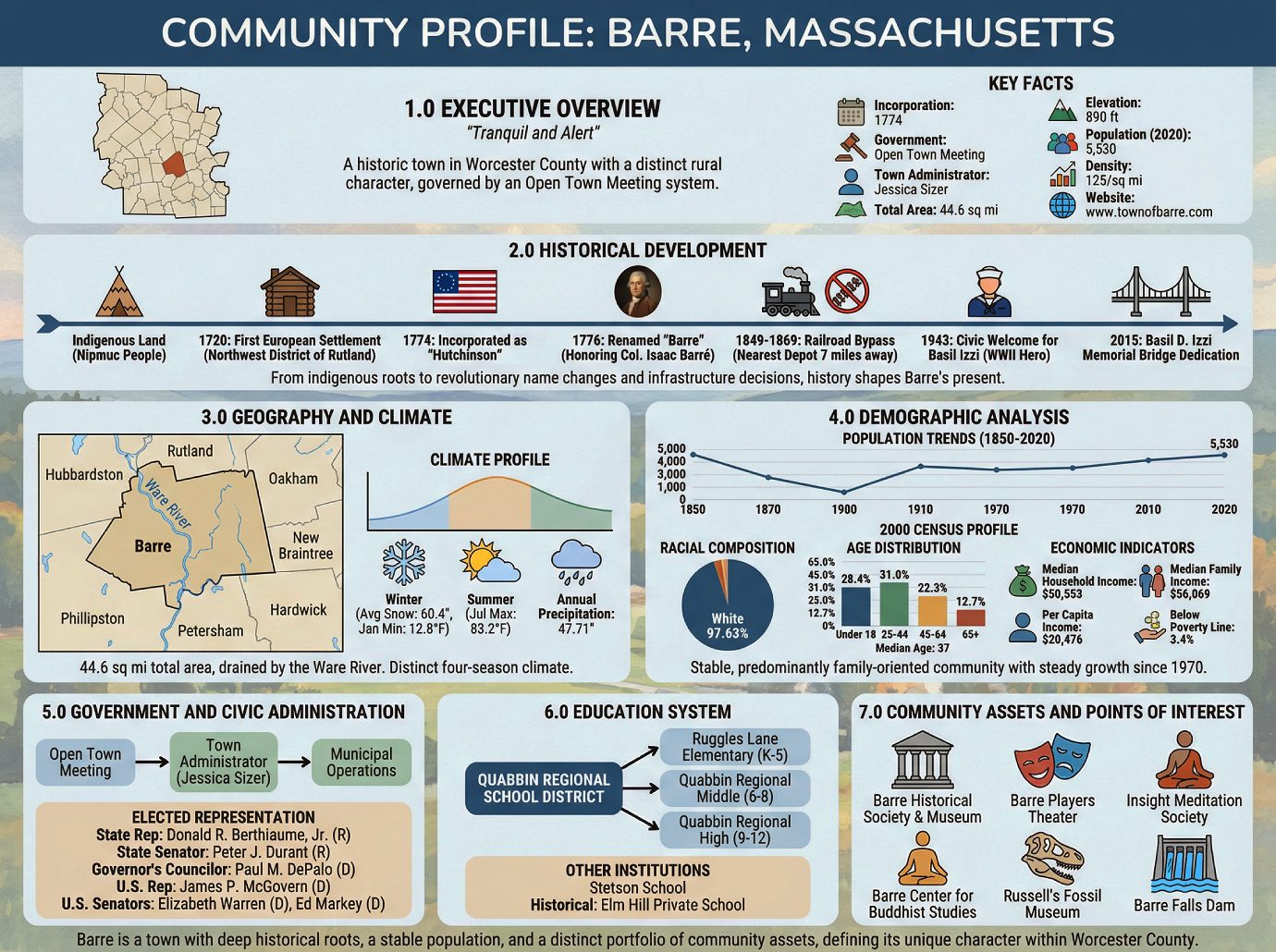
1.0 Overview
Barre, Massachusetts, is a historic town located in Worcester County. Governed by an Open Town Meeting system and with a population of 5,530 as of the 2020 U.S. Census, the town maintains a distinct rural character while being part of a larger regional network. This community profile provides a comprehensive overview of Barre’s key attributes, including its historical development, geographical setting, demographic composition, and civic structure. The data and analysis presented herein are intended to serve as a foundational resource for strategic planning, economic development, and informed decision-making for the town’s future.
Barre, Massachusetts: Key Facts
| Category | Information |
|---|---|
| County | Worcester |
| Motto | “Tranquil and Alert” |
| Date of Incorporation | 1774 |
| Form of Government | Open town meeting |
| Town Administrator | Jessica Sizer |
| Total Area | 44.6 sq mi |
| Elevation | 890 ft |
| Population (2020 Census) | 5,530 |
| Population Density (2020) | 125/sq mi |
| Official Website | www.townofbarre.com |
This high-level overview provides a current snapshot of the town, but its present identity is deeply rooted in a rich historical context that has shaped its development over nearly three centuries.
2.0 Historical Development
Understanding a community’s historical trajectory is essential for effective contemporary planning, as past decisions and events often inform present-day landscapes, infrastructure, and civic identity. This section traces the evolution of Barre from its origins as indigenous land through its incorporation, periods of change, and key moments that have defined its character.
• Early History: The area that is now Barre was originally the ancestral homeland of the Nipmuc people. The first European settlement was established in 1720, and the area was initially designated as the Northwest District of Rutland.
• Incorporation and Renaming: The town was officially incorporated on June 17, 1774, under the name “Hutchinson,” in honor of Thomas Hutchinson, the colonial governor of Massachusetts. However, Hutchinson’s Tory loyalties became deeply unpopular with the town’s patriotic residents. In a clear reflection of the revolutionary sentiment of the era, the town petitioned for a name change. On November 7, 1776, it was renamed “Barre” to honor Colonel Isaac Barré, an Irish-born Member of Parliament who was a vocal supporter of American Independence.
• Infrastructure Development: In the mid-19th century, local ambitions for a direct rail link led to the founding of the Boston, Barre and Gardner Railroad in 1849. Despite its name, the railroad ultimately bypassed the town due to routing changes when the project was revived in 1869. The nearest depot was established 7 miles away in Hubbardston, a development that likely influenced Barre’s subsequent economic and settlement patterns by preserving its more isolated, rural character.
• 20th Century Civic Life: Barre has a strong tradition of honoring its residents. In 1943, the town held a major civic welcome and parade for Basil Izzi, a U.S. Navy hero who survived 83 days adrift in the Atlantic Ocean during World War II. This deep-seated community pride was reaffirmed decades later when, on May 28, 2015, the Route 32 bridge over the Ware River was officially dedicated as the “Seaman 2nd Class Basil D. Izzi Memorial Bridge” in his honor.
The town’s historical settlement patterns were fundamentally shaped by its physical environment, which continues to define its land use and community layout today.
3.0 Geography and Climate
A community’s physical geography and prevailing climate are foundational elements that influence land use patterns, infrastructure requirements, and the overall quality of life for its residents. This section details Barre’s geographical characteristics, including its size, water features, and location relative to neighboring towns, as well as its typical climate patterns.
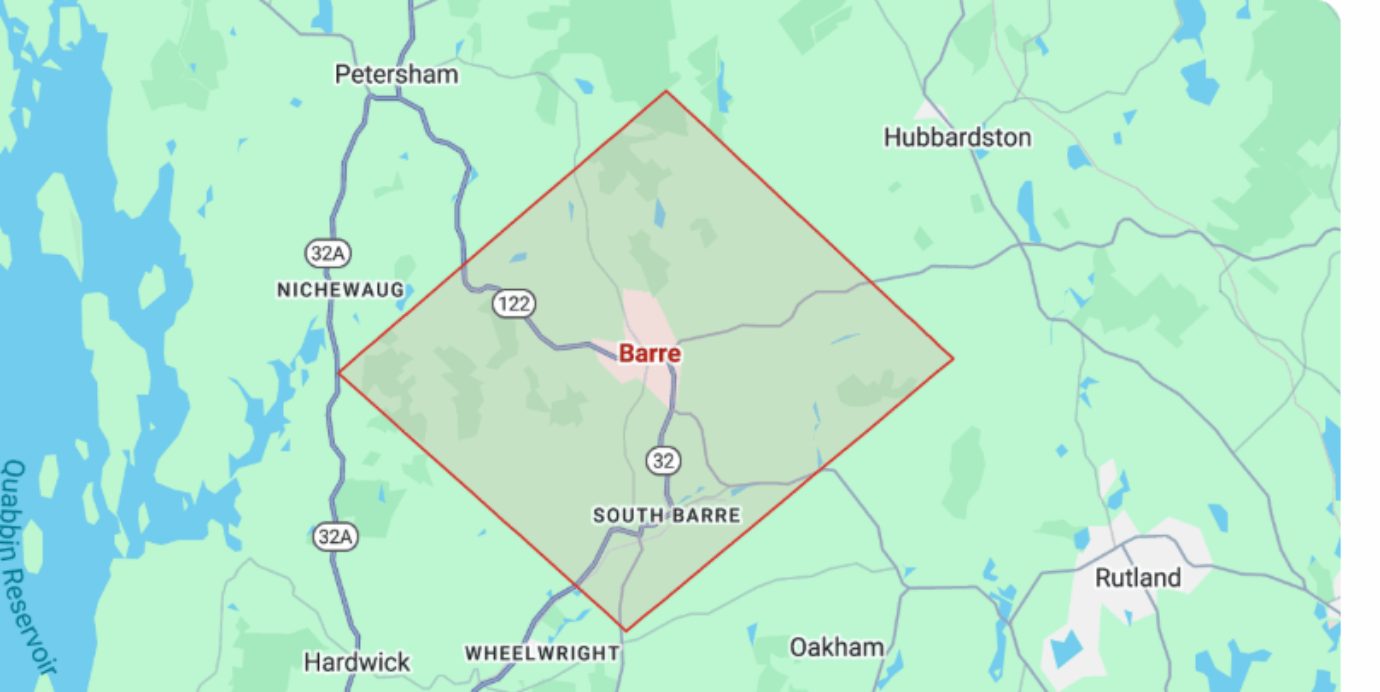
According to the United States Census Bureau, Barre has a total area of 44.6 square miles, of which 44.3 square miles is land and 0.27 square miles is water. The town is drained by the Ware River, a significant local waterway. Barre shares borders with several other communities: Hubbardston to the northeast, Rutland and Oakham to the southeast, New Braintree to the south, Hardwick to the southwest, Petersham to the northwest, and a small portion of Phillipston to the north.
Climate Profile
Barre experiences a distinct four-season climate typical of inland New England. Winters are cold, with an average annual snowfall of 60.4 inches and a mean daily minimum temperature in January of 12.8°F. Summers are warm and humid, with a mean daily maximum temperature in July reaching 83.2°F. The town receives an average of 47.71 inches of precipitation annually, distributed relatively evenly throughout the year. The region’s significant annual snowfall and wide temperature variance necessitate robust municipal planning for snow removal, road maintenance, and emergency services.
This physical and climatic setting provides the backdrop for the community that inhabits it, whose demographic characteristics are examined in the following section.
4.0 Demographic Analysis
A thorough analysis of demographic data is critical for understanding a community’s current composition, identifying its needs, and anticipating its future trajectory. This section examines Barre’s population trends over time and presents a detailed socioeconomic profile based on U.S. Census data.
Historical Population of Barre, 1850–2020
| Year | Population | Change |
|---|---|---|
| 1850 | 2,976 | — |
| 1860 | 2,973 | -0.1% |
| 1870 | 2,572 | -13.5% |
| 1880 | 2,419 | -5.9% |
| 1890 | 2,239 | -7.4% |
| 1900 | 2,059 | -8.0% |
| 1910 | 2,957 | +43.6% |
| 1920 | 3,357 | +13.5% |
| 1930 | 3,510 | +4.6% |
| 1940 | 3,528 | +0.5% |
| 1950 | 3,406 | -3.5% |
| 1960 | 3,479 | +2.1% |
| 1970 | 3,825 | +9.9% |
| 1980 | 4,102 | +7.2% |
| 1990 | 4,546 | +10.8% |
| 2000 | 5,113 | +12.5% |
| 2010 | 5,398 | +5.6% |
| 2020 | 5,530 | +2.4% |
Long-term population data reveals distinct phases in Barre’s development. From 1850 to 1900, the town experienced a 50-year period of sustained population decline, a trend likely influenced by broader industrial shifts and the local impact of being bypassed by the regional railroad. This was followed by a dramatic reversal with a 43.6% growth spurt between 1900 and 1910. Since 1970, the town has settled into a pattern of steady, modest growth, indicating a stable and mature community.
2000 Census Profile
The following detailed data from the 2000 U.S. Census provides a granular snapshot of the town’s composition at the turn of the century.
• Population and Households
◦ Total Population: 5,113
◦ Total Households: 1,889
◦ Total Families: 1,377
◦ Average Household Size: 2.69
◦ Average Family Size: 3.17
• Racial Composition
◦ White: 97.63%
◦ Black or African American: 0.51%
◦ Native American: 0.10%
◦ Asian: 0.33%
◦ From other races: 0.29%
◦ From two or more races: 1.13%
◦ Hispanic or Latino (of any race): 0.80%
• Age Distribution
◦ Under 18: 28.4%
◦ 18 to 24: 5.7%
◦ 25 to 44: 31.0%
◦ 45 to 64: 22.3%
◦ 65 and older: 12.7%
◦ Median Age: 37 years
• Economic Indicators
◦ Median Household Income: $50,553
◦ Median Family Income: $56,069
◦ Per Capita Income: $20,476
◦ Population Below Poverty Line: 3.4%
Barre’s demographic profile reflects a stable, predominantly family-oriented community, an assessment supported by key data points: families constitute over 72% of all households (1,377 of 1,889), the average family size is a robust 3.17, and a significant portion of the population is under the age of 18 (28.4%). The governmental and administrative structures of the town are designed to serve this population.
5.0 Government and Civic Administration
A town’s governance structure is the framework through which community services are delivered, policies are established, and civic life is organized. This section details Barre’s form of local government and lists its elected representatives at the state and federal levels.
Barre operates under an Open town meeting system, a form of direct democratic rule common in New England. The day-to-day municipal operations are managed by the Town Administrator, Jessica Sizer.
Elected Representation
Barre residents are represented by the following officials in state and federal government:
• State Government
◦ State Representative: Donald R. Berthiaume, Jr. (R)
◦ State Senator: Peter J. Durant (R)
◦ Governor’s Councilor: Paul M. DePalo (D)
• Federal Government
◦ U.S. Representative: James P. McGovern (D)
◦ U.S. Senators: Elizabeth Warren (D), Ed Markey (D)
This civic administration oversees the provision of essential public services, including the local education system.
6.0 Education System
A community’s education system is a vital component of its social infrastructure, serving as a cornerstone for families and a key factor in local development. This section outlines the public school system and other educational institutions serving the residents of Barre.
Barre is a member of the Quabbin Regional School District, a collaborative system that also includes the neighboring towns of Hardwick, Hubbardston, New Braintree, and Oakham.
Students from Barre attend the following schools within the district:
• Ruggles Lane Elementary School (Grades K–5)
• Quabbin Regional Middle School (Grades 6–8)
• Quabbin Regional High School (Grades 9–12)
The administrative offices for the Quabbin Regional School District are also located in Barre.
Other Educational Institutions
In addition to its public school system, Barre is home to the Stetson School. Historically, it was also the location of the Elm Hill Private School and Home for the Education of Feeble-Minded Youth, which operated from 1840 into the twentieth century.
Beyond formal education, the town offers a range of cultural and recreational assets that enrich the lives of its residents.
7.0 Community Assets and Points of Interest
Community assets, including cultural institutions, recreational facilities, and historical sites, are essential contributors to a town’s quality of life and unique identity. They provide opportunities for education, leisure, and community engagement.
Cultural, Recreational, and Historical Sites
Barre is home to a diverse array of sites that reflect its historical, cultural, and spiritual character:
• Barre Historical Society & Museum
• Barre Players Theater
• Insight Meditation Society
• Barre Center for Buddhist Studies
• Russell’s Fossil Museum
• Barre Falls Dam
In summary, this profile portrays Barre as a town with deep historical roots, a stable and established population, and a distinct portfolio of community assets. Its rural geography, combined with its participation in regional systems for services like education, defines its unique character within Worcester County.
The Story of Barre, Massachusetts
The Story of Barre, Massachusetts: A Town of Patriots, Heroes, and Surprising Turns
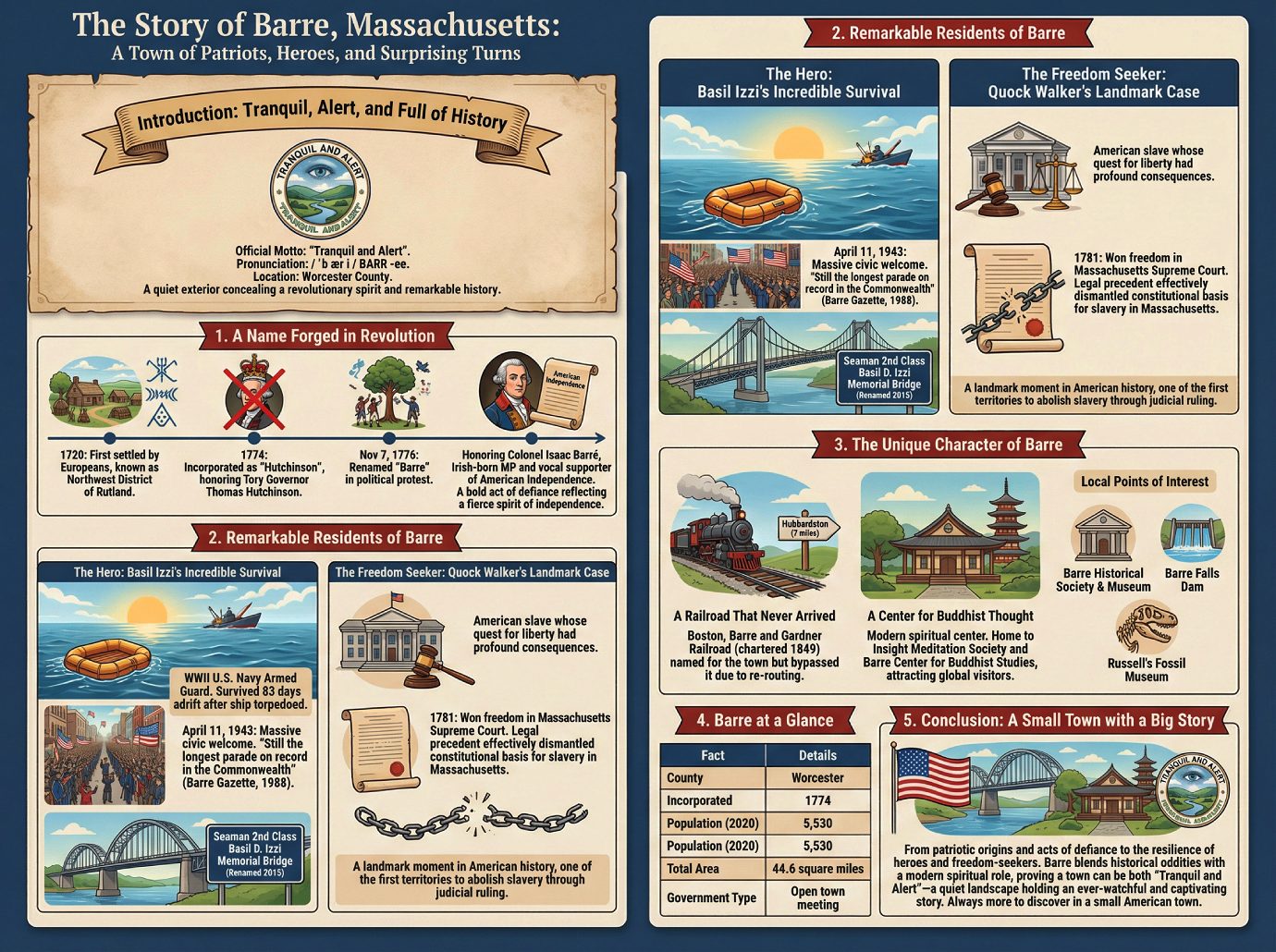
Introduction: Tranquil, Alert, and Full of History
The official motto of Barre, Massachusetts, is “Tranquil and Alert,” a motto that speaks to both its peaceful landscape and the vibrant history hidden within. But beneath this tranquil surface lies a surprisingly alert and fascinating past. For those new to the town, the first lesson is its name, pronounced / ˈ b ær i / BARR -ee. Located in Worcester County, Barre’s quiet exterior conceals a history defined by a revolutionary spirit, the remarkable stories of its residents, and a character all its own. The story of Barre begins, appropriately, with the story of how it earned its name.
1. A Name Forged in Revolution
Barre’s identity is deeply rooted in the American Revolution, an act of defiance reflected in the very evolution of its name. The area, located on the ancestral homeland of the Nipmuc people, was first settled by Europeans in 1720 and known as the Northwest District of Rutland. In 1774, it was first incorporated as the town of “Hutchinson,” named in honor of Thomas Hutchinson, the colonial governor of Massachusetts at the time.
This name, however, would not last. As revolutionary fervor swept the colonies, Governor Hutchinson’s Tory sympathies and loyalty to the British crown made him a deeply unpopular figure. The patriots of the newly formed town grew to “execrate” his name and memory. In a bold act of political protest, on November 7, 1776—just months after the Declaration of Independence—the town was officially renamed “Barre.” The new name honored Colonel Isaac Barré, an Irish-born Member of the British Parliament who was a vocal and powerful supporter of American Independence. This fierce spirit of independence was not merely symbolic; it was a living trait embodied by the very people who called Barre home.
2. Remarkable Residents of Barre
A town’s history is best told through the lives of its people, and Barre is no exception. From heroes of war to pioneers of freedom, its residents have left an indelible mark on the state and the nation.
The Hero: Basil Izzi’s Incredible Survival
During World War II, Barre resident Basil Izzi served as a U.S. Navy Armed Guard. His story of survival is one of the most incredible tales to come out of the war. After his ship, the Zaandam, was torpedoed in the Atlantic, Izzi endured 83 days adrift on a life raft before being rescued.
On April 11, 1943, the town held a massive civic welcome to celebrate its hero’s return. The parade was a legendary event. In 1988, the Barre Gazette claimed it was:
“still the longest parade on record in the Commonwealth”
Izzi’s legacy is now permanently etched into the town’s landscape. In 2015, the bridge that carries Massachusetts Route 32 over the Ware River was officially renamed the “Seaman 2nd Class Basil D. Izzi Memorial Bridge” in his honor.
The Freedom Seeker: Quock Walker’s Landmark Case
Another of Barre’s most significant historical figures is Quock Walker, an American slave whose quest for liberty had profound consequences. In 1781, Walker won his freedom in a case that went before the Massachusetts Supreme Court. This was not just a personal victory; the legal precedent set by the Quock Walker case effectively dismantled the constitutional basis for slavery in Massachusetts, making the Commonwealth one of the first territories in the world to abolish it through a judicial ruling. A landmark moment in American history, sparked by one man’s fight for freedom in Barre.
Beyond these defining human stories, Barre’s character is also etched into its landscape and its charmingly eccentric history.
3. The Unique Character of Barre
Beyond the stories of its people, Barre possesses several unique characteristics—from historical quirks to modern spiritual centers—that contribute to its distinct identity.
• A Railroad That Never Arrived: In a curious twist of history, the Boston, Barre and Gardner Railroad, chartered in 1849, was named for the town but never actually reached it. Due to re-routing, the rail line bypassed Barre entirely, with the nearest depot located 7 miles away in Hubbardston.
• A Center for Buddhist Thought: In modern times, Barre has become an important spiritual center. It is home to two prominent organizations: the Insight Meditation Society and the Barre Center for Buddhist Studies, attracting visitors from around the world.
• Local Points of Interest: The town also features several sites that reflect its historical and natural heritage.
◦ Barre Historical Society & Museum
◦ Barre Falls Dam
◦ Russell’s Fossil Museum
These features, combined with its vital statistics, provide a complete picture of the town.
4. Barre at a Glance
For a quick overview, here are some key facts about the town of Barre.
| Fact | Details |
|---|---|
| County | Worcester |
| Incorporated | 1774 |
| Population (2020) | 5,530 |
| Total Area | 44.6 square miles |
| Government Type | Open town meeting |
5. Conclusion: A Small Town with a Big Story
From its patriotic origins to its modern identity, Barre, Massachusetts, is far more than just another quiet New England town. Its story begins with an act of defiance—a name chosen to reject a Tory governor and honor a champion of liberty. It is a history defined by the incredible resilience of heroes like Basil Izzi and the world-changing courage of freedom-seekers like Quock Walker. With a blend of historical oddities and a modern role as a center for spiritual study, Barre proves that a town can be both “Tranquil and Alert”—its quiet landscape holding an ever-watchful and captivating story. It serves as a powerful reminder that there is always more to discover in the rich history of a small American town.
————————–
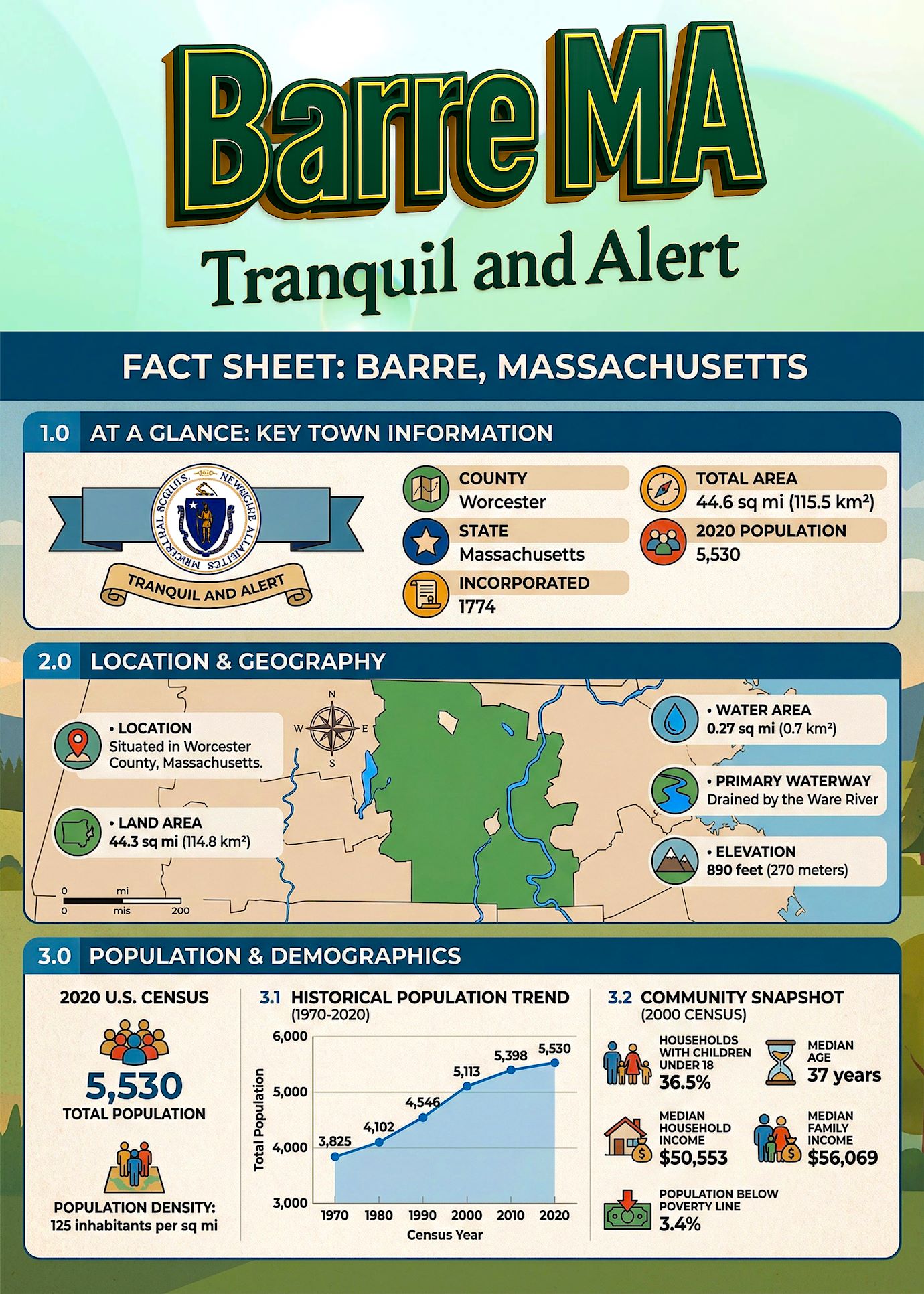
Fact Sheet: Barre, Massachusetts
1.0 At a Glance: Key Town Information
| Category | Details |
|---|---|
| County | Worcester |
| State | Massachusetts |
| Incorporated | 1774 |
| Motto | “Tranquil and Alert” |
| Total Area | 44.6 sq mi (115.5 km²) |
| 2020 Population | 5,530 |
The town’s physical landscape provides additional detail to this overview.
2.0 Location & Geography
• Location: Barre is a town situated in Worcester County, Massachusetts.
• Land Area: The town encompasses 44.3 square miles (114.8 km²) of land.
• Water Area: Water bodies cover a small portion of the town, totaling 0.27 square miles (0.7 km²).
• Primary Waterway: The town is drained by the Ware River.
• Elevation: The town’s elevation is recorded at 890 feet (270 meters).
These geographic features provide the setting for the community detailed in the demographic data below.
3.0 Population & Demographics
As of the 2020 U.S. Census, the total population of Barre was 5,530. This results in a population density of 125 inhabitants per square mile.
3.1 Historical Population Trend
Historical Population (1970-2020)
| Census Year | Total Population |
|---|---|
| 1970 | 3,825 |
| 1980 | 4,102 |
| 1990 | 4,546 |
| 2000 | 5,113 |
| 2010 | 5,398 |
| 2020 | 5,530 |
3.2 Community Snapshot (2000 Census)
The following detailed demographic data is from the 2000 U.S. Census.
• Households with Children Under 18: 36.5%
• Median Age: 37 years
• Median Household Income: $50,553
• Median Family Income: $56,069
• Population Below Poverty Line: 3.4%
Historical Brief on Barre, Massachusetts
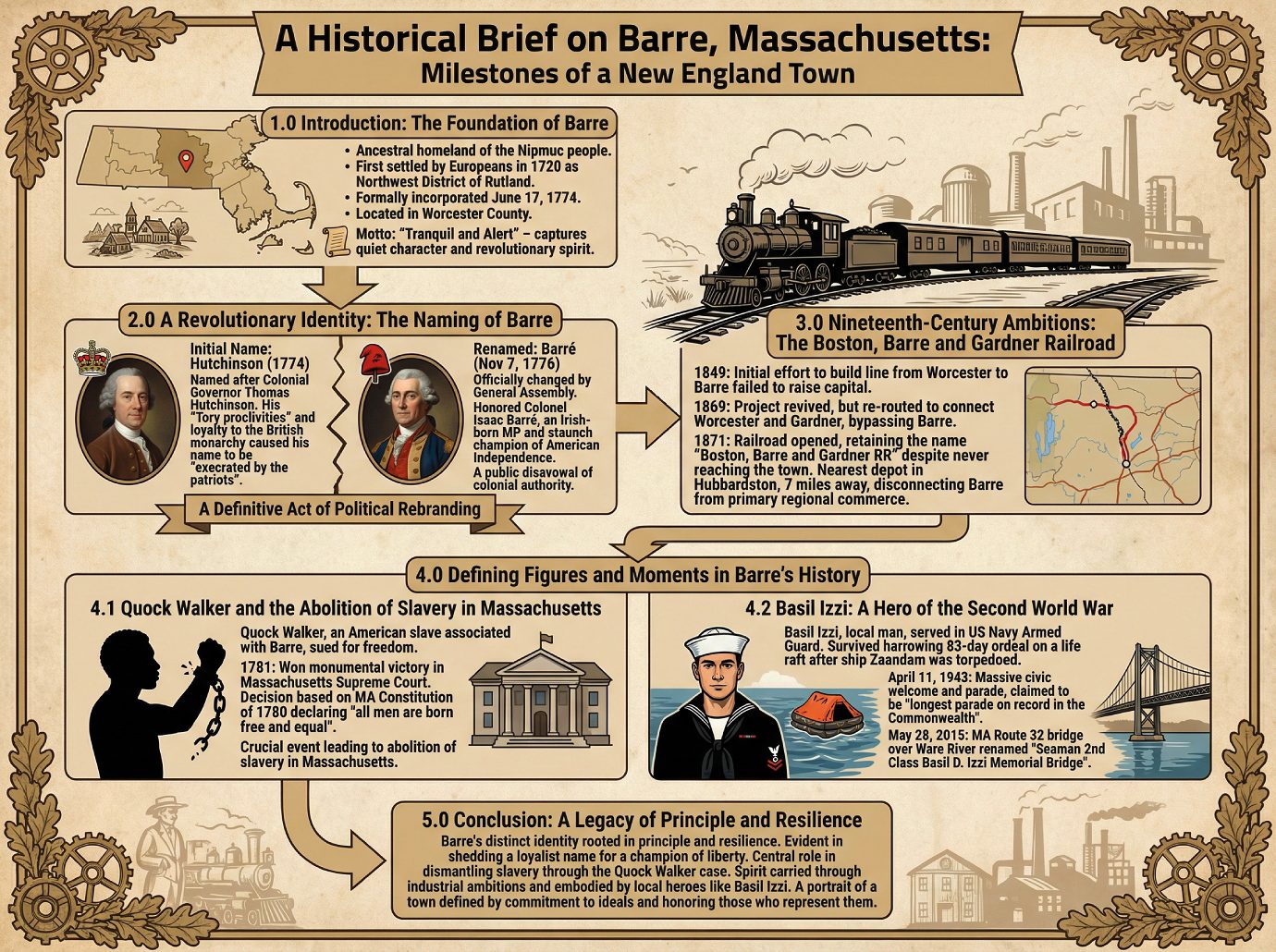
A Historical Brief on Barre, Massachusetts: Milestones of a New England Town
1.0 Introduction: The Foundation of Barre
Located within the ancestral homeland of the Nipmuc people, the area now known as Barre, Massachusetts, was first settled by Europeans in 1720 as part of the broader colonial expansion across the region. Initially established as the Northwest District of Rutland, the town was formally incorporated on June 17, 1774. Situated in Worcester County, Barre operates under the motto “Tranquil and Alert,” a phrase that captures the quiet character and revolutionary spirit of its past. The town’s early history is marked by a profound act of political conviction, reflected in the significant name changes it underwent during the crucible of the American Revolution.
2.0 A Revolutionary Identity: The Naming of Barre
During the American Revolution, the names of towns and landmarks became powerful symbols of political allegiance, capable of demonstrating loyalty to either the Crown or the cause of independence. Barre’s history offers a compelling example of this phenomenon. Upon its incorporation in 1774, the town was named “Hutchinson” in honor of Thomas Hutchinson, the colonial governor of Massachusetts.
This choice of name, however, proved short-lived. As revolutionary sentiment intensified, Governor Hutchinson’s “Tory proclivities” and loyalty to the British monarchy caused his name and memory to be “execrated by the patriots of the township.” This was more than a change of name; it was a public disavowal of colonial authority and a declaration of the town’s allegiance in the burgeoning conflict. In a definitive act of political rebranding, the General Assembly of Massachusetts officially changed the town’s name on November 7, 1776. The new name, “Barré,” was chosen to honor Colonel Isaac Barré, an Irish-born Member of Parliament renowned for being a staunch champion of American Independence. This deliberate renaming cemented the town’s patriotic identity, a spirit of conviction that would continue to shape its character through the industrial developments of the 19th century.
3.0 Nineteenth-Century Ambitions: The Boston, Barre and Gardner Railroad
The 19th century in New England was an era of profound industrial and infrastructural transformation, with the railroad emerging as a critical engine of economic progress. The town of Barre shared in these ambitions, seeking to connect itself to the burgeoning rail network. The initial effort began in 1849 with the founding of the Boston, Barre and Gardner Railroad, a company established to build a line from Worcester to Barre. However, this early venture failed to raise sufficient capital and construction never began.
The project was revived in 1869, but a pivotal decision re-routed the proposed line to connect the more commercially promising hubs of Worcester and Gardner, ultimately bypassing Barre entirely. When the railroad finally opened in 1871, it retained the name “Boston, Barre and Gardner RR” despite never reaching the town for which it was partly named. This decision had a significant practical impact on Barre; the nearest depot on the new line was located in Hubbardston, a full 7 miles away, leaving the town disconnected from the primary artery of regional commerce. This chapter in the town’s infrastructural history gives way to the more personal stories of its most notable figures.
4.0 Defining Figures and Moments in Barre’s History
The history of a community is often best understood not just through its official acts and economic projects, but through the impactful events and influential individuals who have called it home. Barre’s past is illuminated by several such defining stories, two of which stand out for their profound local and national significance.
4.1 Quock Walker and the Abolition of Slavery in Massachusetts
Quock Walker, an American slave associated with Barre, secured a pivotal place in American history by suing for his freedom. The case, which came before the Massachusetts Supreme Court in 1781, resulted in a monumental victory for Walker. This landmark decision was grounded in the newly ratified Massachusetts Constitution of 1780, whose declaration that “all men are born free and equal” was interpreted by the court as being incompatible with the institution of slavery. The ruling was a crucial event that helped lead directly to the abolition of slavery in Massachusetts, establishing a legal precedent that translated revolutionary ideals into binding law.
4.2 Basil Izzi: A Hero of the Second World War
Centuries later, the town celebrated another remarkable individual, Basil Izzi, a local man who served in the United States Navy Armed Guard during the Second World War. After his ship, the Zaandam, was torpedoed, Izzi endured a harrowing 83-day ordeal, surviving on a life raft in the Atlantic Ocean. Upon his return, the town held a massive civic welcome for him on April 11, 1943. A 1988 article in the Barre Gazette claimed that the celebration in his honor was “still the longest parade on record in the Commonwealth.” His legacy was permanently honored on May 28, 2015, when the Massachusetts Route 32 bridge over the Ware River near South Barre was officially renamed the “Seaman 2nd Class Basil D. Izzi Memorial Bridge.” These stories of principle and survival form the core of Barre’s historical identity.
5.0 Conclusion: A Legacy of Principle and Resilience
From its earliest days, Barre has forged a distinct identity rooted in principle and resilience. This character is evident in its revolutionary act of shedding the name of a loyalist governor for that of a champion of American liberty—a symbolic purging of colonial authority. It is demonstrated in its central role in translating revolutionary principle into law through the Quock Walker case, which helped dismantle slavery in the Commonwealth. This spirit of conviction carried through its 19th-century ambitions for industrial connection and is embodied by the local heroes it celebrates, such as World War II survivor Basil Izzi. Together, these milestones paint a portrait of a New England town defined by a profound commitment to its ideals and an enduring capacity to honor the figures who best represent them.
The Wilder History of Barre, Massachusetts
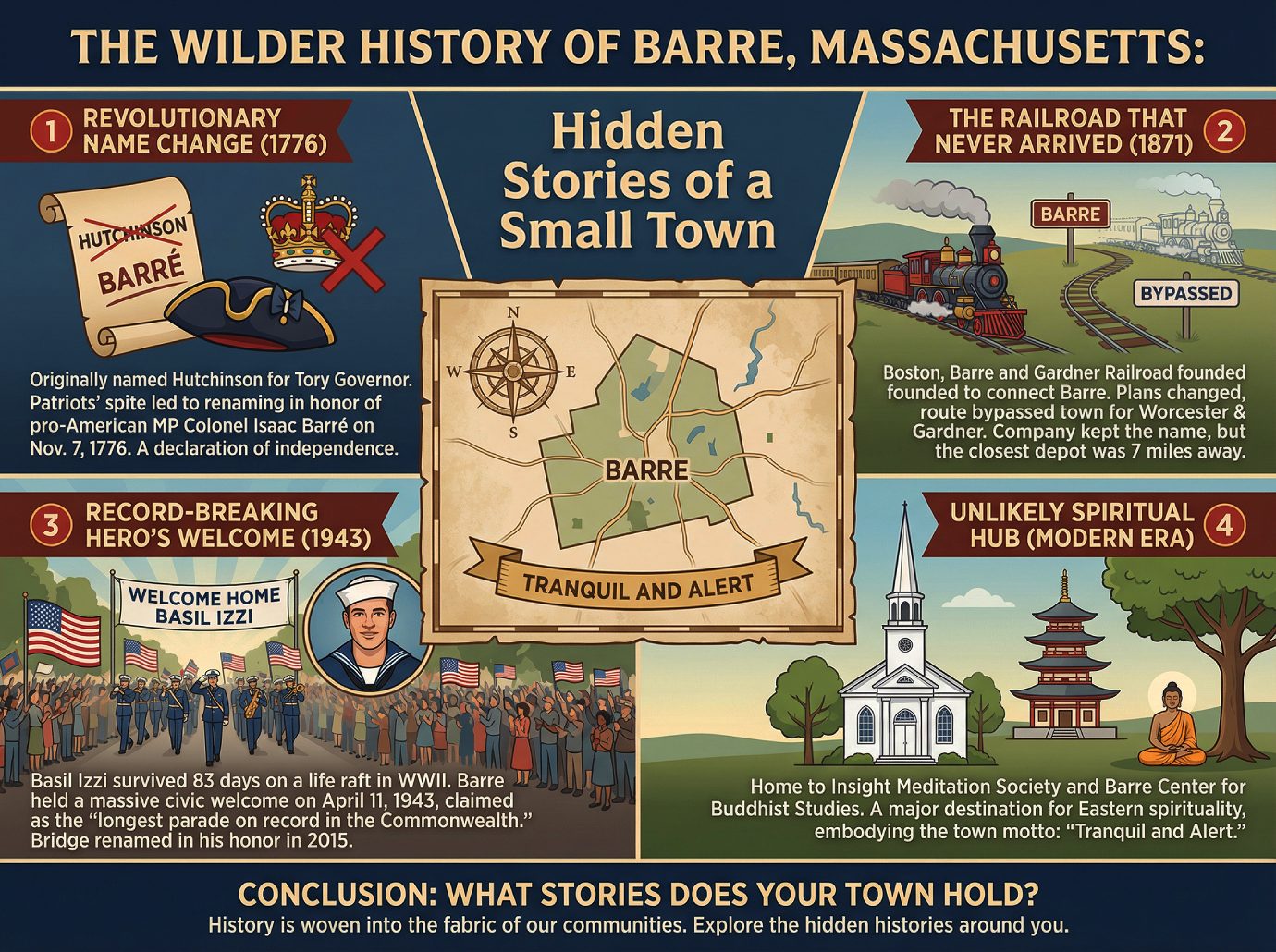
This Tiny Massachusetts Town Has a Wilder History Than You
1.0 Introduction: The Hidden Histories of Small Towns
It’s a familiar feeling: you’re driving through the heart of New England, and a small town flashes by in a blur of white steeples and brick town halls. It’s easy to assume you’ve seen all there is to see, that one quiet village is much like the next. But what if you’re wrong? What if, just beneath that tranquil surface, lies a history of rebellion, heartbreak, and resilience that could rival any city’s?
Barre, Massachusetts, is a perfect case in point. A small town in Worcester County, its placid exterior conceals a past forged in revolutionary fire, shaped by the ghost of a railroad that never was, and defined by moments of profound community spirit. These aren’t just footnotes in a dusty ledger; they are vibrant stories that reveal how a town forges its identity.
This article uncovers some of the most unexpected chapters from Barre’s history. From a name born of political outrage to an unlikely modern identity as a spiritual center, these stories prove that the most fascinating tales are often found where you least expect them.
2.0 A Town’s Name Born from Revolutionary Spite
A town’s name is its most basic identity, but for Barre, it’s a permanent declaration of independence. When the town was first established as the district of Hutchinson in 1774, it was named in honor of Thomas Hutchinson, the colonial governor of Massachusetts. This tribute, however, would be short-lived.
As tensions with Great Britain escalated, Governor Hutchinson’s loyalty to the Crown became undeniable. The local patriots, once willing to honor him, grew to despise the man and everything he represented. Their sentiment was so strong that it was recorded for posterity:
“When, in 1774, on account of his Tory proclivities, Governor Hutchinson resigned his office and went to England, his name and memory were so execrated by the patriots of the township of Hutchinson that, in 1776, the General Assembly of Massachusetts changed the name of the township to ‘Barré.'”
On November 7, 1776, the town officially shed its Tory-affiliated name and was rechristened “Barre.” The new name honored Colonel Isaac Barré, an Irish-born Member of Parliament who was a vocal champion of American Independence. This act of renaming was a powerful statement, capturing the passionate, revolutionary spirit that defined the era.
3.0 The Railroad That Never Arrived
In the 19th century, the arrival of a railroad could make or break a town, promising commerce, growth, and connection to the wider world. So in 1849, residents of Barre had every reason for optimism when the Boston, Barre and Gardner Railroad was founded with the express purpose of building a line straight to their town.
Unfortunately, the initial project stalled. When the effort was revived two decades later in 1869, the plans had changed dramatically. The new route was re-charted to run between the more prominent cities of Worcester and Gardner, completely bypassing Barre.
In a surprising twist of historical irony, the company kept its original name. The Boston, Barre and Gardner Railroad opened in 1871, forever bearing the name of a town it never actually reached. For the residents of Barre, the closest depot was a full 7 miles away in Hubbardston—a permanent reminder of the railroad that got away.
4.0 A Record-Breaking Hero’s Welcome
Every town has its heroes, but few have celebrated one with the sheer scale and passion that Barre did for Basil Izzi. A local man serving in the U.S. Navy Armed Guard during World War II, Izzi became the subject of an almost unbelievable tale of survival. After his ship, the Zaandam, was torpedoed, he survived for an astonishing 83 days on a life raft in the unforgiving Atlantic Ocean.
When Izzi returned home, the town’s reaction was an outpouring of community pride that would go down in local legend. On April 11, 1943, Barre held a massive civic welcome and parade in his honor. The event was so monumental that in 1988, the Barre Gazette made the remarkable claim that it was “still the longest parade on record in the Commonwealth.”
But the town’s tribute didn’t end there. On May 28, 2015, the community ensured his legacy would be permanent by renaming a local bridge carrying Massachusetts Route 32 over the Ware River the “Seaman 2nd Class Basil D. Izzi Memorial Bridge.” It was a powerful modern postscript, transforming a historical anecdote into a living legacy and proving that the town’s respect for his resilience endures to this day.
5.0 An Unlikely Hub for Eastern Spirituality
If you were to guess where one of America’s most significant centers for Buddhist study was located, a traditional New England town might not be the first place that comes to mind. Yet, Barre has cultivated a modern identity that stands in fascinating contrast to its colonial roots.
Today, the town is a major destination for those seeking to study and practice Buddhist meditation. It is home to two renowned institutions that draw people from all over the world: the Insight Meditation Society and the Barre Center for Buddhist Studies. This unlikely role has made Barre a crossroads of culture, where a historic landscape provides a peaceful backdrop for Eastern spiritual traditions. In a surprising twist of fate, this new identity perfectly embodies the town’s long-standing official motto: “Tranquil and Alert.”
6.0 Conclusion: What Stories Does Your Town Hold?
From a name changed in revolutionary anger to a record-breaking parade and a modern-day spiritual sanctuary, the story of Barre, Massachusetts, is one of a community constantly defining and redefining itself. These moments remind us that history isn’t just made in capital cities or on famous battlefields; it’s woven into the very fabric of the places we call home.
The tales of Barre serve as a compelling prompt for us all. Take a closer look at your own community. What hidden histories, forgotten heroes, or surprising twists of fate are waiting just below the surface?