
Infrastructure – Interview with Gardner Mayor Michael Nicholson and Additional Related Reports

Gardner MA Infrastructure: Interview with Gardner Mayor Nicholson and Additional Reports
On February 18, 2026, Gardner Magazine Publisher Werner Poegel spoke with Gardner Mayor Michael Nicholson about Infrastructure in Gardner. We covered all the bases. Listen on any device, CLICK PLAY.
The Interview covered the the extensive infrastructure projects and economic strategies in Gardner, Massachusetts. The discussion highlights significant utility upgrades, including underground electrical work in South Gardner and the installation of a new transformer to revitalize downtown buildings. Mayor Nicholson details the city’s approach to housing development by repurposing former school sites and utilizing state grants to attract diverse new businesses. The overview also covers educational advancements, such as the “multi-tiered system of support” and early college programs that allow students to earn degrees before high school graduation. Additionally, the Mayor addresses facility improvements at City Hall and the police station, while navigating complex challenges like the sludge landfill capacity and potential fire station renovations. Overall, the dialogue emphasizes a proactive vision for the “Chair City” of Gardner through strategic investments in infrastructure and the efficient use of municipal property
Jump to various reports on this page, CLICK LINK: Gardner Infrastructure: Mayor Nicholson’s 2026 Vision —–2026 Gardner Municipal Infrastructure Progress Report: Strategic Modernization & Operational Resilience —– Gardner Open for Business: A Strategic Framework for Sustainable Growth and Investment —– The Pulse of the Chair City: A Citizen’s Guide to Gardner’s Infrastructure —- Gardner’s Blueprint: A Citizen’s Glossary of Municipal Process —-
Watch this short video explaining Infrastructure in Gardner MA
Gardner Infrastructure: Mayor Nicholson’s 2026 Vision
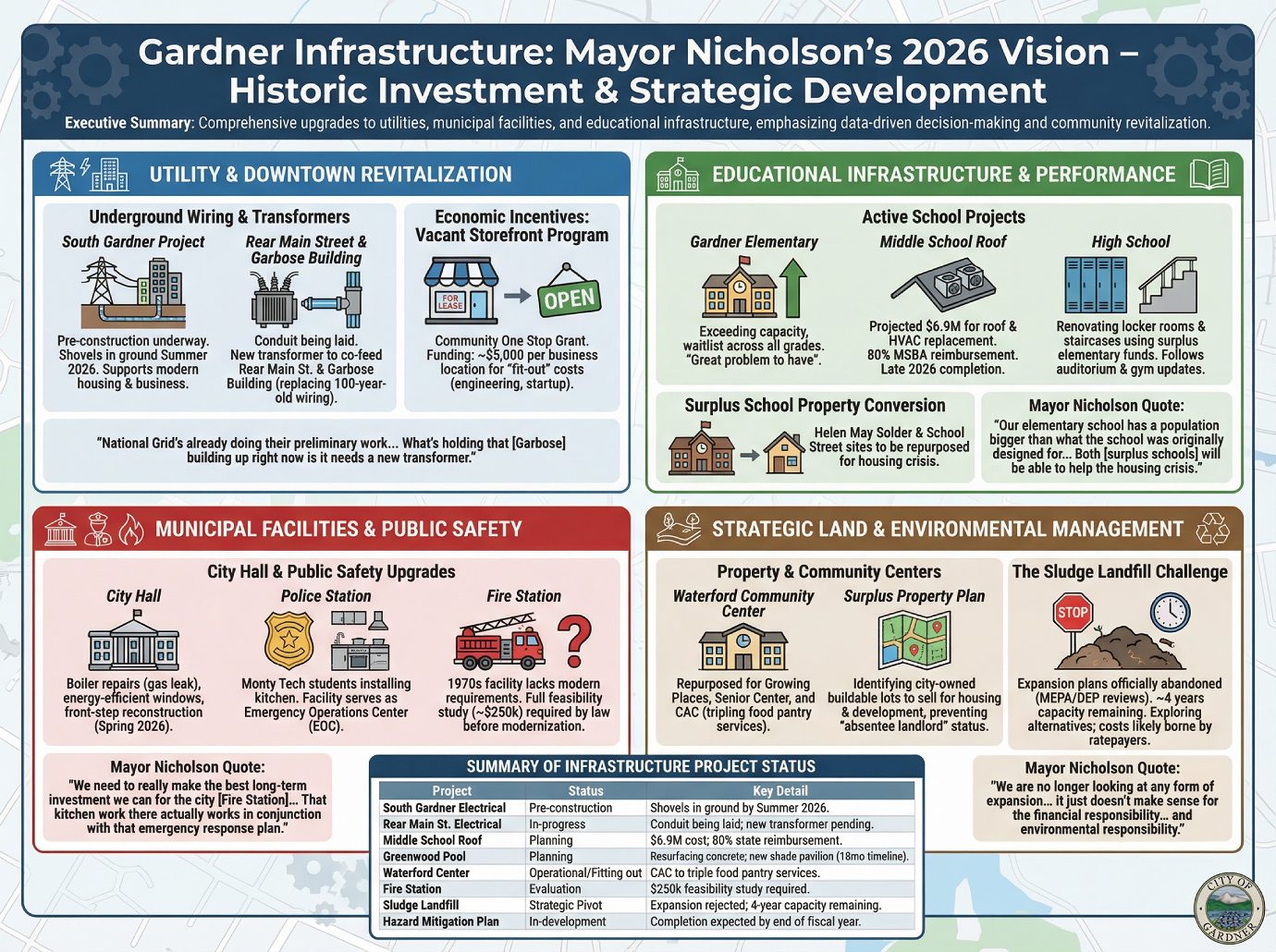
Gardner Infrastructure: Mayor Nicholson’s 2026 Vision
Summary
This briefing document synthesizes the strategic infrastructure and community development initiatives for Gardner, Massachusetts, as outlined by Mayor Michael Nicholson in February 2026. The city is currently undergoing a period of historic investment characterized by comprehensive upgrades to utilities, municipal facilities, and educational infrastructure.
Key priorities include the transition to underground electrical systems in South Gardner and downtown, the revitalization of vacant storefronts through grant incentives, and the conversion of surplus municipal properties into housing. While the city celebrates successes in education—specifically the growth of the Gardner Elementary School and the “Early College” program—it faces critical challenges regarding the modernization of the 1970s-era fire station and the finite capacity of the municipal sludge landfill. The administration maintains a policy of data-driven decision-making, emphasizing the completion of state-mandated reviews and feasibility studies before committing taxpayer funds to large-scale construction.
——————————————————————————–
Utility and Downtown Revitalization
The city is prioritizing the modernization of electrical infrastructure to support both aesthetic improvements and economic expansion. Significant focus is placed on “Rear Main Street” and the South Gardner corridor.
Underground Wiring and Transformers
The transition from overhead wires to underground conduit is a multi-phase effort involving National Grid. These upgrades are not merely cosmetic; they provide the necessary power load to support modern housing and business requirements in historic structures.
• South Gardner Project: Preliminary work is underway to map overhead connections to ensure business and residential continuity. Construction is expected to begin in Summer 2026.
• Rear Main Street: Conduit is currently being laid. This project includes a new transformer that will “co-feed” both Rear Main Street and the Garbose building at 2-10 Parker Street.
• Garbose Building Upgrades: The building currently relies on 100-year-old “knob and tube” wiring, which is insufficient for modern apartments or retail. The new transformer is the primary catalyst for advancing this project.
Economic Incentives: Vacant Storefront Program
To stimulate the downtown and Tony Boulevard corridors, the city utilizes the “Community One Stop” grant from the state.
• Funding: Approximately $5,000 per business location.
• Application: Funds are designated for “fit-out” costs, including engineering and startup expenses, to convert empty spaces into retail or dining establishments.
Mayor Nicholson on Downtown and Utilities
“National Grid’s already doing their preliminary work right now… you have to look at how what’s overhead. And that’s something that a lot of us don’t realize what’s above our head when we’re walking down the street.”
“What’s holding that [Garbose] building up right now is it needs a new transformer… buildings and businesses and apartments are built today a different way than they were built 100 years ago.”
——————————————————————————–
Educational Infrastructure and Performance
Gardner’s schools are experiencing high demand, necessitating both maintenance of existing structures and strategic planning for surplus facilities.
Active School Projects
• Gardner Elementary: Now in its third year, the school is exceeding its original design capacity and maintains a waitlist across all grades.
• Middle School Roof: A projected $6.9 million project to replace the intricate metal roof and HVAC systems. The Massachusetts School Building Authority (MSBA) is covering 80% of the cost. A late 2026 timeline is expected for completion.
• High School: Utilizing surplus funds from the elementary school project, the city is renovating locker rooms and staircases. This follows recently completed renovations to the auditorium and gymnasium.
Surplus School Property Conversion
The city is in the process of closing on the Helen May Solder School and School Street School sites. Both are intended to be repurposed to address the local housing crisis.
Mayor Nicholson on Schools
On Middle School Costs: “You always guess high so you’re not shocked later on, but rather pleasantly surprised.”
On Surplus Schools: “Both will be able to help the housing crisis that we have here in Gardner.”
On the Elementary School: “Our elementary school has a population bigger than what the school was originally designed for, which is a great problem to have.”
——————————————————————————–
Municipal Facilities and Public Safety
Infrastructure maintenance at City Hall and the police and fire stations remains a critical operational focus.
City Hall and Public Safety Upgrades
• City Hall: Recent repairs were necessitated by a gas leak in the boiler system. Ongoing work includes energy-efficient window installations in Perry Auditorium and a second phase of front-step reconstruction set for Spring 2026.
• Police Station: Students from Monty Tech are installing a kitchen in the community room/classrooms. This facility will serve as the city’s Emergency Operations Center during disasters.
• Fire Station: The 1970s facility lacks modern requirements, including facilities for female firefighters. A full feasibility study—costing approximately $250,000—is required by law before a long-term modernization plan can be implemented.
Mayor Nicholson on Municipal Facilities
On the Fire Station: “We can’t just jump at whatever quick fix band-aid that we need to put on that… we need to really make the best long-term investment we can for the city.”
On the Police Station Kitchen: “During an emergency situation… that becomes our emergency operations center. So that kitchen work there actually works in conjunction with that emergency response plan.”
On the Feasibility Study: “It is something that the general laws of the Commonwealth require… otherwise we’re not able to go out for bid for the construction of those projects.”
——————————————————————————–
Strategic Land and Environmental Management
The city is moving toward a more aggressive “municipal surplus property plan” to prevent Gardner from becoming an “absentee landlord.”
Property and Community Centers
• Waterford Community Center: Instead of abandoning the building after the new school was built, the city has repurposed it to house Growing Places, the Senior Center, and the CAC. The CAC expansion will triple its food pantry services.
• Surplus Property Plan: Consultants from Mass Development are identifying buildable lots owned by the city (often via tax title) to sell to abutters or developers, aiming to stimulate housing and development.
The Sludge Landfill Challenge
Following reviews by the Massachusetts Environmental Protection Act (MEPA) office and the Department of Environmental Protection (DEP), the city has officially abandoned plans to expand the existing sludge landfill.
• Current Capacity: Approximately four years of capacity remain.
• Future Action: The executive branch is reviewing alternatives. Costs for any new solution will likely be borne by sewer system ratepayers.
Gardner Mayor Michael Nicholson on Land and Environment
On Surplus Land: “Why are we stunting development by holding land that could be built on and could be housing… just because we took it by either tax title or donation… and now we’re just sitting on it?”
On the Sludge Landfill: “We are no longer looking at any form of expansion… it just doesn’t make sense for the financial responsibility that we have to our ratepayers and the environmental responsibility that we have to the city.”
On the Decision Process: “It would have been absolutely irresponsible… uneducated, irresponsible, and amateur at best if we were to make a decision without having all of the facts in front of us first.”
——————————————————————————–
Summary of Infrastructure Project Status
| Project | Status | Key Detail |
|---|---|---|
| South Gardner Electrical | Pre-construction | Shovels in ground by Summer 2026. |
| Rear Main St. Electrical | In-progress | Conduit being laid; new transformer pending. |
| Middle School Roof | Planning | $6.9M cost; 80% state reimbursement. |
| Greenwood Pool | Planning | Resurfacing concrete; new shade pavilion (18mo timeline). |
| Waterford Center | Operational/Fitting out | CAC to triple food pantry services. |
| Fire Station | Evaluation | $250k feasibility study required. |
| Sludge Landfill | Strategic Pivot | Expansion rejected; 4-year capacity remaining. |
| Hazard Mitigation Plan | In-development | Completion expected by end of fiscal year. |
2026 Gardner Municipal Infrastructure Progress Report: Strategic Modernization & Operational Resilience
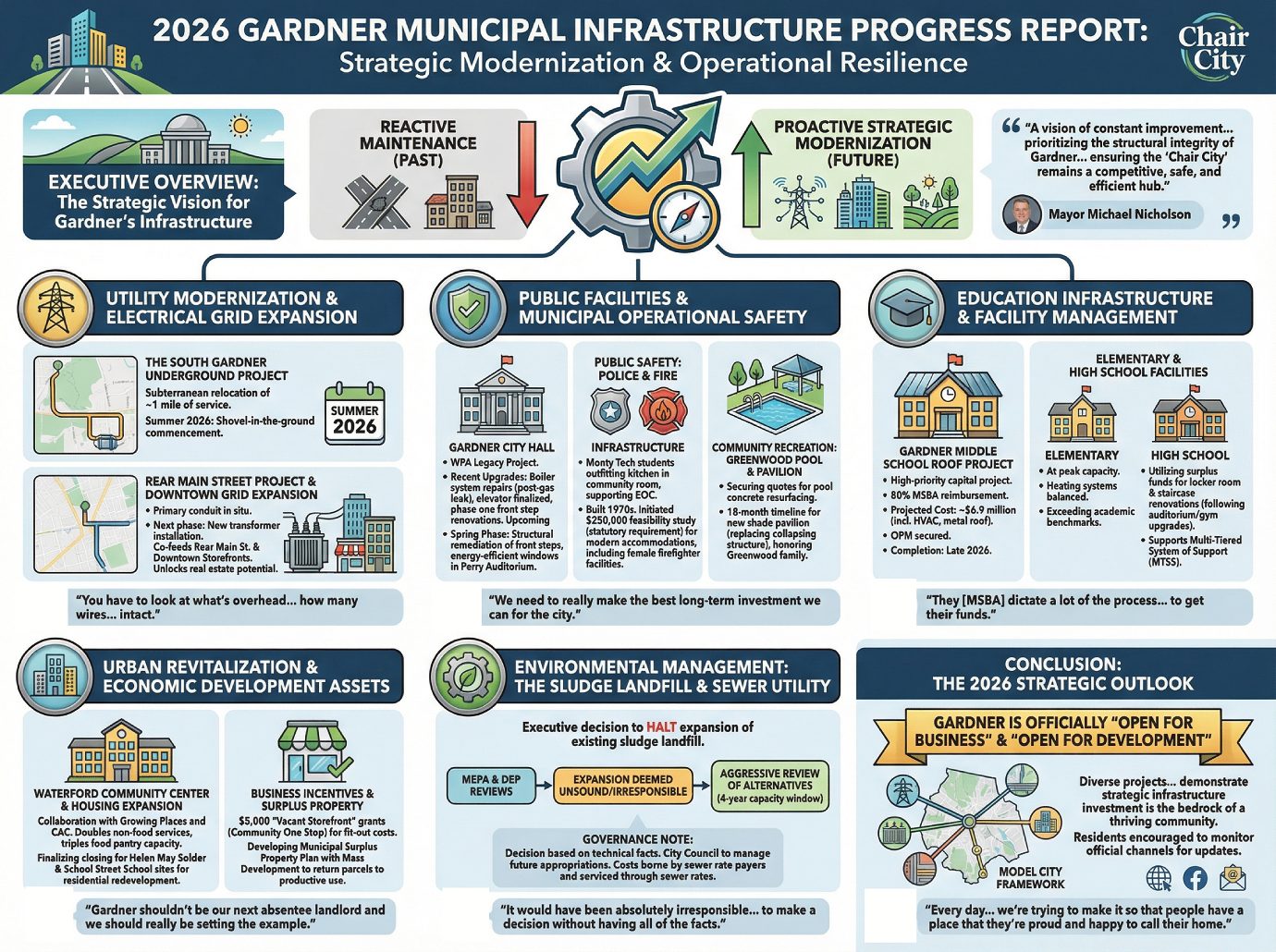
2026 Gardner Municipal Infrastructure Progress Report: Strategic Modernization & Operational Resilience
1. Executive Overview: The Strategic Vision for Gardner’s Infrastructure
Gardner is currently executing a transformative series of capital improvements, transitioning the city from a posture of reactive maintenance to one of proactive, strategic modernization. These initiatives represent historic investments essential for the city’s operational resilience and long-term economic trajectory. By prioritizing the structural integrity of Gardner—from subterranean water and sewer plant upgrades to high-visibility urban revitalizations—the administration is ensuring that the “Chair City” remains a competitive, safe, and efficient hub for residents and industry.
Mayor Michael Nicholson has articulated a vision of constant improvement, framing the current scale of work as a necessary evolution of the city’s foundational assets. This report provides a detailed analysis of sector-based progress across utilities, public safety, education, and community assets, outlining how these diverse projects integrate into a single, cohesive framework designed to support Gardner’s future growth.
2. Utility Modernization and Electrical Grid Expansion
The strategic transition from overhead utility lines to underground conduits is a critical component of Gardner’s modernization efforts. Moving beyond simple urban aesthetics, the burial of utilities significantly enhances service reliability by protecting the grid from weather-induced interruptions. Furthermore, expanding the electrical capacity of the downtown corridor is the functional prerequisite for the redevelopment of high-density historic assets, which require power loads exceeding the capabilities of 20th-century systems.
The South Gardner Underground Project
Preliminary engineering for the South Gardner project is currently being finalized in coordination with National Grid. This project involves the complex subterranean relocation of approximately one mile of service. A “shovel in the ground” commencement is projected for Summer 2026, following the completion of final utility coordination.
The Rear Main Street Project and Downtown Grid Expansion
Work on Rear Main Street is more advanced, with the primary conduit already in situ. The next critical phase is the installation of a new transformer, a vital asset for the remediation and redevelopment of the “Garbos” building at 2-10 Parker Street. These historic structures often still contain “knob and tube” wiring, which is wholly inadequate for modern residential or commercial occupancy. The new transformer will co-feed Rear Main Street and downtown storefronts, unlocking significant real estate potential.
Mayor Nicholson underscored the technical complexity of these utility shifts:
“You have to look at what’s overhead… how many wires are there? How many houses and buildings and businesses is this going to affect that we have to make sure that their electrical connections… still remain intact.”
3. Public Facilities and Municipal Operational Safety
Managing “New Deal” era facilities requires a strategic balance between historic preservation and modern safety standards. The city is systematically addressing these needs to ensure that municipal operations are conducted in environments that are safe, efficient, and legally compliant.
Gardner City Hall
City Hall, a legacy project of the Works Projects Administration (WPA), recently required emergency remediation after gas leaks were identified in the boiler system during a major winter event. Repairs were completed successfully, and the facility was secured. Recent milestones include finalized elevator upgrades and phase one of the front step renovations. The upcoming Spring phase will focus on the structural remediation of the primary ingress (the front steps) and the installation of energy-efficient windows in Perry Auditorium to optimize thermal retention.
Public Safety: Police and Fire Infrastructure
Reliable infrastructure serves as the backbone of Gardner’s public safety response.
• Police Station: Students from Monty Tech—specializing in plumbing, carpentry, and electrical trades—are currently outfitting a kitchen in the station’s community room. While serving daily needs, this kitchen is strategically vital as it supports the facility’s role as the headquarters for the city’s Emergency Operations Center (EOC).
• Fire Station: Built in the 1970s, the current facility lacks modern accommodations, including dedicated facilities for female firefighters. The city has initiated a $250,000 feasibility study. This is not merely an advisory document but a statutory requirement under the General Laws of the Commonwealth; without this study, the city is legally barred from going out to bid for construction.
Community Recreation: Greenwood Pool and Pavilion
Capital improvements extend to community assets like the Greenwood Pool and Pavilion. The city is currently securing quotes for concrete resurfacing of the pool. Additionally, an 18-month timeline has been established for the construction of a new shade pavilion. This project involves the removal of a building with a collapsing roof, replacing a safety hazard with a memorial and functional space that honors the Greenwood family.
Mayor Nicholson emphasized the commitment to long-term planning:
“We can’t just jump at whatever quick fix band-aid that we need to put on that. We need to really make the best long-term investment we can for the city.”
4. Education Infrastructure and Facility Management
There is a direct correlation between the quality of the physical school environment and academic excellence. By leveraging partnerships with the Massachusetts School Building Authority (MSBA), Gardner is modernizing its educational footprint while maintaining rigorous fiscal discipline.
Gardner Middle School Roof Project
The upcoming replacement of the Gardner Middle School roof is a high-priority capital project.
• Funding Mechanism: 80% reimbursement from the MSBA.
• Projected Cost: Approximately $6.9 million (inclusive of HVAC system upgrades and the installation of a metal roof).
• Management: The city has secured an Owner’s Project Manager (OPM), a mandatory requirement for any municipal project exceeding $1.5 million.
• Timeline: Completion is projected for late 2026.
Elementary and High School Facilities
Gardner Elementary has reached peak operational capacity, a testament to the city’s growth. Heating systems have been successfully balanced, and the facility is exceeding academic benchmarks established in the School Improvement Plan. At Gardner High School, the administration is utilizing surplus funds from the elementary project for the renovation of locker rooms and staircases, following the successful completion of the auditorium and gymnasium upgrades. These physical investments support the “Multi-Tiered System of Support” (MTSS), ensuring students have the environment necessary to excel.
Mayor Nicholson noted the necessity of strict adherence to state protocols:
“They [the MSBA] dictate a lot of the way the process goes in order for us to be eligible to continue to get their funds for the project.”
5. Urban Revitalization and Economic Development Assets
Gardner has pivoted from “absentee landlording” to an active redevelopment strategy for city-owned property. This proactive management is designed to mitigate the housing crisis and catalyze business growth.
Waterford Community Center and Housing Expansion
The Waterford Community Center transformation involves collaboration with Growing Places and the CAC. This facility will double non-food services and triple food pantry capacity. Simultaneously, the city is in the final closing processes for the Helen May Solder and School Street School sites, both slated for residential redevelopment.
Business Incentives and Surplus Property
To stimulate the downtown economy, the city provides $5,000 “Vacant Storefront” grants via the state’s Community One Stop program to cover fit-out costs such as engineering and interior modifications. Furthermore, the city is developing a Municipal Surplus Property Plan in conjunction with consultants from Mass Development to identify buildable or landlocked parcels and return them to productive use.
Mayor Nicholson stated:
“Gardner shouldn’t be our next absentee landlord and we should really be setting the example for others to follow.”
6. Environmental Management: The Sludge Landfill and Sewer Utility
Environmental and fiscal responsibility guided the executive decision to halt the expansion of the existing sludge landfill. Based on comprehensive reviews from the Massachusetts Environmental Protection Act (MEPA) office and the Department of Environmental Protection (DEP), expansion was deemed neither environmentally sound nor financially responsible.
While the city has a four-year window of remaining capacity, we are aggressively reviewing alternatives.
Governance and Funding Note: The decision to halt expansion was made at the executive level based on technical facts; however, the City Council will manage the appropriation of funds for future solutions. All costs associated with sludge management and future infrastructure loans will be borne by sewer rate payers and serviced through sewer rates.
Regarding this rigorous decision-making process, the Mayor stated:
“It would have been absolutely irresponsible… uneducated, irresponsible, and amateur at best if we were to make a decision without having all of the facts in front of us first.”
7. Conclusion: The 2026 Strategic Outlook
Gardner is officially “Open for Business” and “Open for Development.” From electrical transformers to school facilities, these diverse projects comprise a “Model City” framework, demonstrating that strategic infrastructure investment is the bedrock of a thriving community. Residents are encouraged to monitor official municipal channels and social media for real-time updates regarding construction detours and project milestones.
The mission remains centered on the quality of life for every citizen. As Mayor Nicholson concluded:
“Every day when we go into City Hall, we’re trying to make it so that people have a place that they’re proud and happy to call their home.” ——————————————-
Gardner Open for Business: A Strategic Framework for Sustainable Growth and Investment
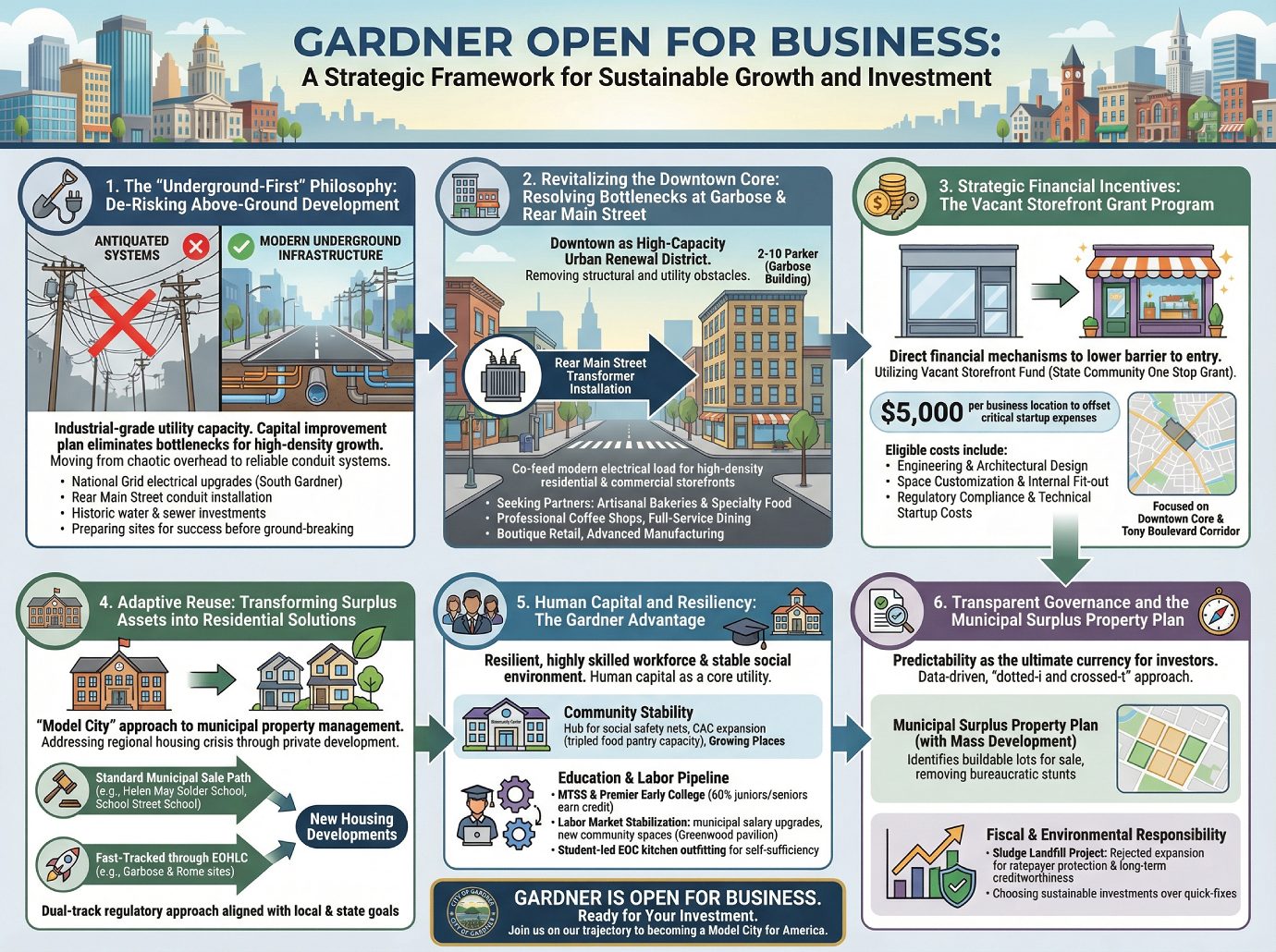
Gardner Open for Business: A Strategic Framework for Sustainable Growth and Investment
1. The “Underground-First” Philosophy: De-Risking Above-Ground Development
In the competitive landscape of regional economic development, the primary differentiator for a municipality is the reliability of its foundation. In Gardner, our “Underground-First” philosophy recognizes that modern commercial viability is impossible without industrial-grade utility capacity. Our capital improvement plan eliminates the utility bottlenecks that traditionally cannibalize developer margins, replacing antiquated systems with a modernized infrastructure designed specifically to facilitate high-density growth.
We are aggressively moving away from the chaotic overhead wiring that often complicates urban redevelopment. By transitioning to a sleek, reliable underground conduit system, we are ensuring that the visual and technical integrity of our districts matches the expectations of 21st-century investors. Currently, National Grid is performing preliminary work for significant electrical upgrades in South Gardner, with shovel-ready construction slated for this summer. Simultaneously, the Rear Main Street conduit installation is already underway. These projects are strategic interventions, designed to ensure that the “last mile” of electrical connection is never a barrier to entry.
Furthermore, we have made historic investments in future-proofing our water and sewer systems. By replacing aging pipes and upgrading our treatment facilities, we provide the high-intensity capacity required for sophisticated commercial and industrial operations. In Gardner, we don’t just maintain; we prepare the site for your success before you even break ground.
2. Revitalizing the Downtown Core: Resolving Bottlenecks at Garbose and Rear Main Street
Gardner’s downtown is the city’s economic engine, and we are treating it as a high-capacity “Urban Renewal District.” Our focus is on the removal of specific structural and utility obstacles that have historically stalled private investment. By proactively resolving these issues at the municipal level, we create a clear runway for developers to execute multi-use projects that combine retail, food service, and modern housing.
A prime example of this proactive intervention is the 2-10 Parker (Garbose Building) project. Recognizing that the project was hindered by obsolete “knob and tube” wiring and insufficient power, the City is actively installing a new transformer on Rear Main Street. This unit will co-feed both the Rear Main Street corridor and the Garbose Building, providing the modern electrical load required for high-density residential units upstairs and commercial storefronts below. We are not merely waiting for development to happen; we are providing the essential power upgrades to unlock dormant assets.
This infrastructure-led renewal has generated a robust pipeline of interest across several key sectors. We are currently seeking and evaluating partners in the following areas:
• Artisanal Bakeries & Specialty Food (High public demand niche)
• Professional Coffee Shops and Cafés
• Full-Service Dining and Restaurants
• Boutique Retail and Small Business Startups
• Advanced and Large-Scale Manufacturing
3. Strategic Financial Incentives: The Vacant Storefront Grant Program
To further accelerate commercial absorption, Gardner has established direct financial mechanisms to lower the “barrier to entry” for entrepreneurs. We understand that the initial fit-out is often the most capital-intensive phase of a business launch. Our goal is to convert vacant spaces into revenue-generating, tax-paying assets with minimal friction.
Utilizing the Vacant Storefront Fund—derived from the state’s Community One Stop Grant—we offer $5,000 per business location to offset critical startup expenses. This capital is specifically earmarked for:
• Engineering and Architectural Design
• Space Customization and Internal Fit-out
• Regulatory Compliance and Technical Startup Costs
These incentives are strategically concentrated within the Downtown core and the Tony Boulevard corridor. By easing the “So What?” factor for prospective tenants, we transform empty windows into vibrant storefronts, thereby stabilizing the tax base and increasing the overall valuation of the district.
4. Adaptive Reuse: Transforming Surplus Assets into Residential Solutions
Gardner is championing a “Model City” approach to municipal property management by refusing to remain an absentee landlord of underutilized buildings. Our strategy for surplus property is simple: identify, RFP, and transition to private development as quickly as possible to address the regional housing crisis.
We are currently in the closing process for the Helen May Solder School and the School Street School sites. These properties have navigated a rigorous RFP process and are moving toward deed filing to facilitate new housing developments. While these school sites follow a standard municipal sale path, our more complex “Urban Renewal Districts”—such as the Garbose and Rome sites—are being fast-tracked through the Executive Office of Housing and Livable Communities (EOHLC). This dual-track regulatory approach ensures that every redevelopment project is fully aligned with both local needs and state-level development goals.
5. Human Capital and Resiliency: The Gardner Advantage
For a corporate investor, Gardner offers more than just land; we offer a resilient, highly skilled workforce and a stable social environment. We view human capital as a core utility. Our investments in community services and education are designed to provide the stability and talent pool required for long-term corporate growth.
A key component of our community stability is the Waterford Community Center, which serves as a hub for collaborative social safety nets. This includes the expansion of the Community Action Committee (CAC)—which is tripling its food pantry capacity—and the presence of “Growing Places.” Furthermore, we have integrated municipal resiliency into our educational partnerships. Students from Monty Tech are currently outfitting a kitchen for the Emergency Operations Center (EOC) at the police station. This ensures that Gardner’s response headquarters is fully self-sufficient during climate events or emergencies, offering investors peace of mind regarding city continuity.
Our educational system, utilizing the Multi-Tiered System of Support (MTSS) and a premier Early College program, ensures a ready-made labor pipeline. With 60% of our juniors and seniors earning college credit, we are producing a workforce that is academically advanced and industry-ready. We pair this with proactive “Labor Market Stabilization” strategies, such as the recent salary upgrades for municipal roles like lifeguards, and the investment in “lifestyle markers” like the new Greenwood family shade pavilion—replacing a collapsing structure with a modern, high-value community space.
6. Transparent Governance and the Municipal Surplus Property Plan
Predictability is the ultimate currency for investors. Gardner’s administration is committed to a data-driven, “dotted-i and crossed-t” approach to governance that eliminates the risk of amateur or uneducated decision-making.
In partnership with Mass Development, we are finalizing a Municipal Surplus Property Plan. This initiative identifies buildable lots and landlocked parcels for sale to abutters or developers, removing the bureaucratic “stunts” that often prevent development. We treat city land as a dynamic asset, not a stagnant liability.
This commitment to fiscal and environmental responsibility is most evident in our handling of the Sludge Landfill project. After rigorous review by MEPA and the DEP, we rejected expansion as a protective measure for our ratepayers and the city’s long-term creditworthiness. With four years of capacity remaining, we are using this window to identify a solution that is both financially feasible and environmentally responsible. We do not choose the “quick-fix band-aid”; we choose the sustainable investment.
Gardner is a city that treats its infrastructure, its property, and its people as high-value assets. We invite you to join us as we continue our trajectory toward becoming a Model City for America. Gardner is open for business, and we are ready for your investment. ————————————————————————————————————–
The Pulse of the Chair City: A Citizen’s Guide to Gardner’s Infrastructure
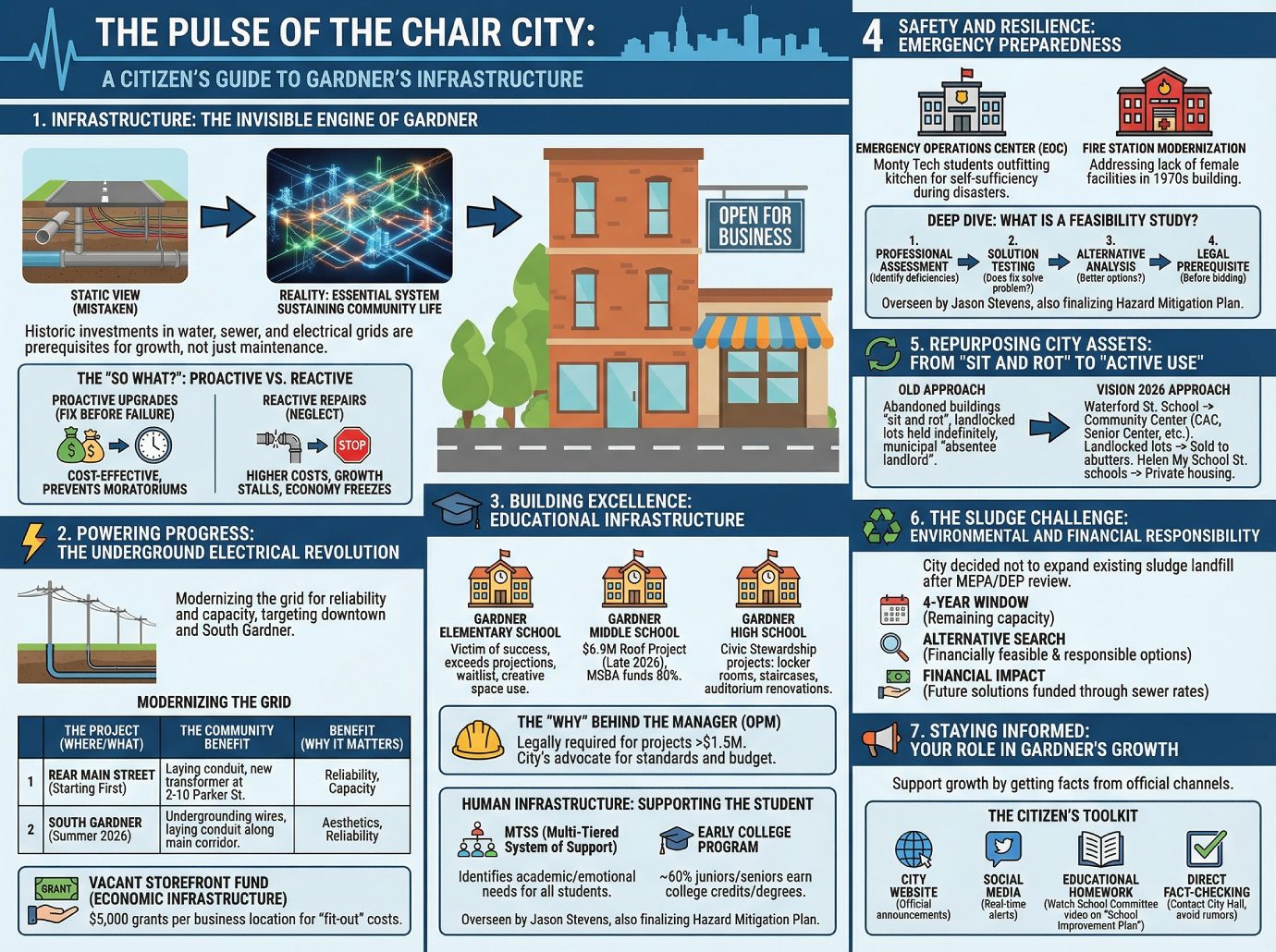
The Pulse of the Chair City: A Citizen’s Guide to Gardner’s Infrastructure
1. Infrastructure: The Invisible Engine of Gardner
Infrastructure is often mistakenly viewed as a static collection of pipes, wires, and pavement. In reality, it is the essential system that sustains community life. In Gardner, historic investments in water lines, sewer plant upgrades, and electrical grids are not merely maintenance—they are the prerequisite for the city’s current trajectory of growth.
By prioritizing these foundational systems, Gardner ensures it is “Open for Business.” When a developer looks at a city, they look at the capacity of the “invisible” support systems. If those systems are neglected, growth stalls.
The “So What?”: Proactive infrastructure upgrades—fixing a system before it fails—are significantly more cost-effective than reactive repairs. Beyond the direct dollar savings, proactive work prevents “moratoriums” on new construction. If a sewer or electrical system reaches its limit due to neglect, the state can legally halt all new housing and business permits, effectively freezing the local economy.
These foundational concepts represent active work currently occurring right beneath the feet of Gardner’s residents.
——————————————————————————–
2. Powering Progress: The Underground Electrical Revolution
Modern businesses and apartments require significantly more power than the systems of a century ago could provide. Gardner is currently executing a modernization of its electrical grid, specifically targeting the downtown core and the South Gardner area.
Working with National Grid, the city is moving toward undergrounding utilities. This isn’t just for aesthetics; it’s about reliability and capacity. Currently, National Grid is conducting preliminary work to check electrical connections to every existing house and business along these routes. This ensures that when the “shovels hit the ground,” service remains intact.
Modernizing the Grid
| The Project (Where/What) | The Community Benefit (Why it matters) |
|---|---|
| Rear Main Street (Starting First) | Laying conduit and installing a new transformer at 2-10 Parker Street. |
| South Gardner (Summer 2026) | Undergrounding wires and laying conduit along the main corridor. |
| Vacant Storefront Fund (Economic Infrastructure) | $5,000 grants per business location for “fit-out” costs. |
While electrical lines power our shops, our school buildings provide the environment where the city’s next generation is raised.
——————————————————————————–
3. Building Excellence: Educational Infrastructure
Gardner’s schools are the city’s most valuable physical and human assets. Managing these facilities requires a balance of celebrating growth and performing rigorous maintenance:
• Gardner Elementary School: Now in its third year, the school is a victim of its own success. The population has already exceeded original projections; every grade is full, and a waitlist currently exists, requiring administrators to use space creatively.
• Gardner Middle School: A $6.9 million roof project is scheduled for late 2026. Because the roof is an intricate metal design involving HVAC systems, the city secured funding from the Massachusetts School Building Authority (MSBA), which will cover 80% of the cost.
• Gardner High School: Using surplus bonds reappropriated from the elementary school project, the city is funding “Civic Stewardship” projects, including renovations to locker rooms, staircases, and the auditorium.
The “Why” Behind the Manager: Citizens may hear the term Owner’s Project Manager (OPM). In Massachusetts, an OPM is legally required for any municipal project exceeding $1.5 million. They act as the city’s professional advocate, ensuring the contractor meets technical standards and the project stays on budget.
Human Infrastructure: Supporting the Student
Physical buildings are only effective if the systems inside support the people. Gardner utilizes two key “human infrastructure” frameworks:
• MTSS (Multi-Tiered System of Support): A framework that identifies the unique academic and emotional needs of individual students, ensuring every child can rise to their capability regardless of their background.
• Early College Program: A partnership where approximately 60% of juniors and seniors earn college credits (sometimes even Associate degrees) before graduation, making Gardner students more competitive.
——————————————————————————–
4. Safety and Resilience: Emergency Preparedness
Municipal safety requires facilities that can handle modern emergencies and a diverse workforce. The city is currently addressing historical gaps through creative partnerships:
• Emergency Operations Center (EOC): Students from Monty Tech (plumbing, carpentry, and electrical) are outfitting a kitchen at the police station. This isn’t just for daily meals; it ensures that during major disasters like ice storms, the EOC—the city’s disaster headquarters—is fully self-sufficient.
• Fire Station Modernization: The current station was built in the 1970s, a time when there were no female firefighters. Today, Gardner is proud to have female firefighters, but the building lacks dedicated female locker rooms or facilities.
Deep Dive: What is a Feasibility Study?
Before spending millions on a building, the city must complete a Feasibility Study (projected to cost $250,000 for the fire station). By law, this study must follow these steps:
1. Professional Assessment: Hire an engineer and consultant team to identify specific building deficiencies.
2. Solution Testing: Determine if a proposed fix (like an addition) actually solves the long-term problem.
3. Alternative Analysis: If the initial plan is found wanting, the study provides better alternatives.
4. Legal Prerequisite: This study must be completed before the city is allowed to go out for bid on construction.
This process is overseen by Jason Stevens (Community Development), who is also finalizing the Hazard Mitigation Plan to identify vulnerabilities to climate change and disasters.
——————————————————————————–
5. Repurposing City Assets: From “Sit and Rot” to “Active Use”
Historically, Gardner followed the practice of abandoning old municipal buildings when new ones were built. Under the Vision 2026 Approach, the city has partnered with Mass Development to create a Municipal Surplus Property Plan.
| Old Approach | Vision 2026 Approach |
|---|---|
| Abandoned buildings left to “sit and rot.” | Transforming the Waterford Street School into a Community Center housing the CAC, Senior Center, Growing Places, and Historical Commission. |
| Holding “landlocked” or unbuildable lots indefinitely. | Identifying small parcels to sell to abutters (neighbors), returning the land to the tax rolls. |
| Municipal “absentee landlord” status. | Selling the Helen May Solder and School Street schools for private housing development to address the housing crisis. |
——————————————————————————–
6. The Sludge Challenge: Environmental and Financial Responsibility
One of the most complex infrastructure hurdles is waste management. After a rigorous multi-year review by MEPA and the DEP, the city has decided not to expand the existing sludge landfill.
Mayor Nicholson noted that making a decision without these state reports would have been “uneducated, irresponsible, and amateur at best.” The city must now face a hard reality:
• 4-Year Window: The current landfill has approximately four years of capacity remaining.
• Alternative Search: The city is now evaluating the most “financially feasible” and “responsible” disposal alternatives.
• Financial Impact: Any future solution or loan for waste disposal will be funded through sewer rates, making the search for a cost-effective path a high priority for residents.
——————————————————————————–
7. Staying Informed: Your Role in Gardner’s Growth
Infrastructure progress often brings temporary inconveniences, such as detours on Betty Spring Road or water main repairs on West Street. Mayor Nicholson emphasizes that the best way for residents to support Gardner’s growth is to get facts directly from official channels.
The Citizen’s Toolkit
• City Website: The primary source for official announcements on roadwork and project updates.
• Social Media: Follow the city’s platforms for real-time alerts on emergency repairs and traffic detours.
• Educational Homework: Watch the February School Committee video regarding the “School Improvement Plan.” It provides specific benchmarks and proof that Gardner’s “Human Infrastructure” is meeting its goals.
• Direct Fact-Checking: When in doubt, contact City Hall to verify projects happening in your neighborhood rather than relying on rumors. —————————————————————————-
Gardner’s Blueprint: A Citizen’s Glossary of Municipal Process
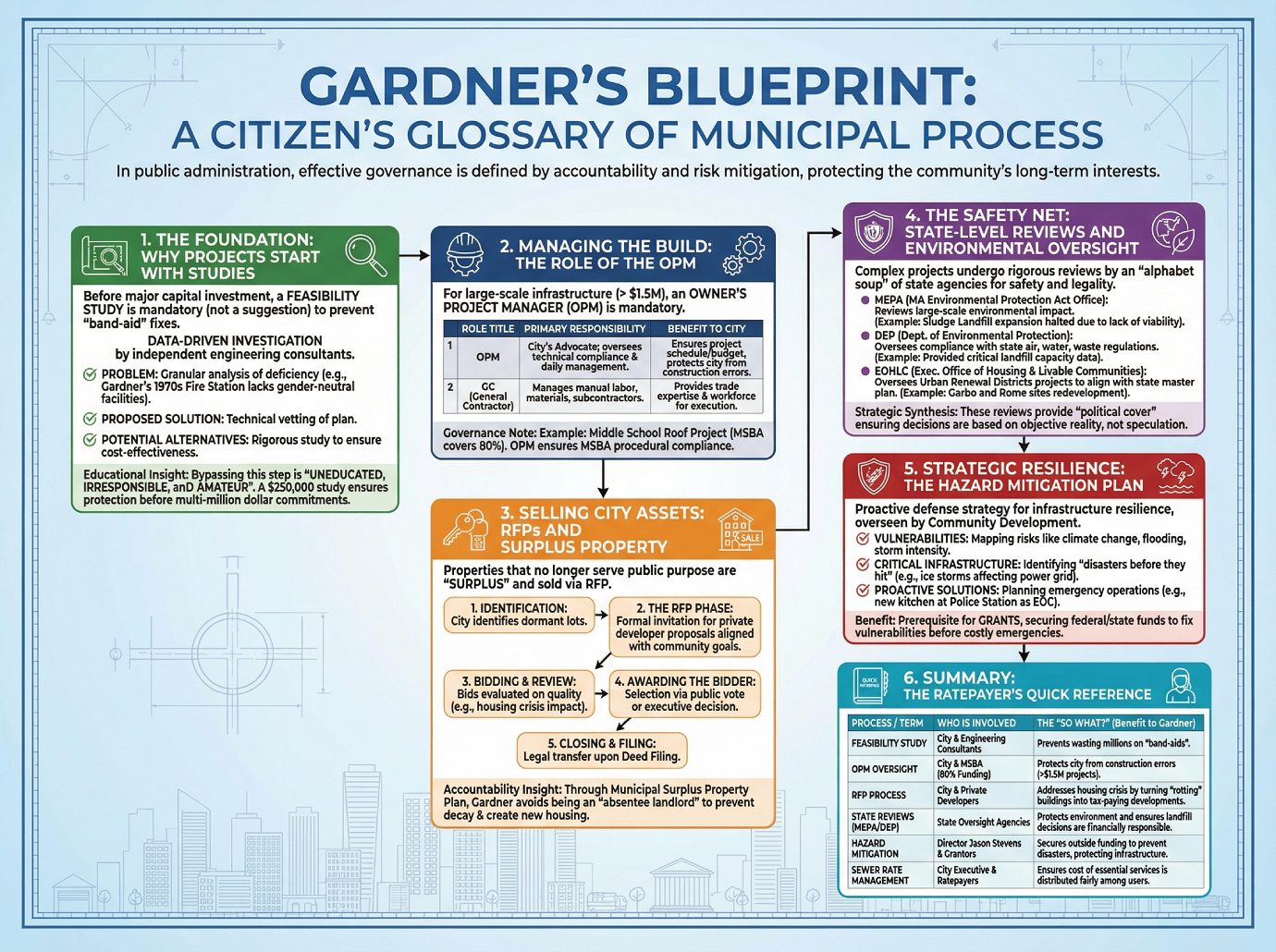
Gardner’s Blueprint: A Citizen’s Glossary of Municipal Process
In the realm of public administration, effective governance is defined by the mechanisms of accountability and risk mitigation that protect the community’s long-term interests. Building and maintaining a city requires more than just construction; it demands a rigorous adherence to legal, financial, and administrative frameworks designed to ensure the responsible stewardship of public funds. This blueprint serves as an educational guide for Gardner residents to understand the processes that ensure every major project is transparent, data-driven, and structurally sound.
——————————————————————————–
1. The Foundation: Why Projects Start with Studies
Before any significant capital investment is made, the city must engage in a Feasibility Study. This is not a mere suggestion but a strategic “check and balance” that prevents the “band-aid” approach—quick, temporary fixes that fail to provide long-term value.
• Concept: A Feasibility Study is a data-driven investigation conducted by independent engineering consultants. It serves as a legal prerequisite under the General Laws of the Commonwealth for significant building projects.
• Purpose: It acts as a fiduciary safeguard, ensuring the city does not waste millions in taxpayer dollars on solutions that do not address the core problem. It provides the empirical evidence required before a project can legally go out for construction bids.
The Evaluative Framework for Engineering Consultants
1. The Problem: A granular analysis of the deficiency. For example, Gardner’s 1970s-era fire station lacks modern, gender-neutral facilities, specifically lacking female-specific locker rooms and showers.
2. The Proposed Solution: A technical vetting of whether the suggested plan (e.g., an addition vs. a new build) will actually resolve the identified problem.
3. The Potential Alternatives: A rigorous study of other paths to ensure the final choice is the most cost-effective and efficient, avoiding the pitfalls of short-term thinking.
Educational Insight: In municipal governance, bypassing this step is categorized as “uneducated, irresponsible, and amateur.” While a study for a project like the Gardner Fire Station may cost approximately $250,000, this expenditure is a protective measure. It ensures that the city is “dotting every I and crossing every T” before committing to a multi-million dollar investment.
Once a project is deemed feasible, the city shifts from planning to management, ensuring that professional advocates are in place to oversee the build.
——————————————————————————–
2. Managing the Build: The Role of the OPM
For large-scale infrastructure, the city does not simply hand a check to a builder. To protect the “Owner” (the City of Gardner), an Owner’s Project Manager (OPM) is utilized. Under Massachusetts law, an OPM is mandatory for any municipal project exceeding $1.5 million, such as the Gardner Middle School roof replacement.
| Role Title | Primary Responsibility | Benefit to the City |
|---|---|---|
| Owner’s Project Manager (OPM) | Acts as the City’s Advocate; oversees technical compliance and daily project management. | Ensures the project stays on schedule and budget; protects the city from construction errors. |
| General Contractor (GC) | Manages manual labor, procurement of materials, and subcontractors. | Provides the trade expertise and physical workforce to execute the build. |
Governance Note: For the Middle School roof project, the OPM is essential because the Massachusetts School Building Authority (MSBA) is covering 80% of the cost. The OPM ensures the city adheres to the MSBA’s strict procedural requirements to maintain that funding eligibility.
While the city manages its internal assets with OPMs, it also employs a structured “Surplus” process to return unused land to the private sector for productive use.
——————————————————————————–
3. Selling City Assets: RFPs and Surplus Property
When the city identifies properties that no longer serve a public purpose—such as the Helen May Solder or School Street schools—it designates them as “Surplus.” The city then utilizes a Request for Proposal (RFP) process to find a developer.
The Lifecycle of a City Property Sale:
1. Identification: The City, assisted by consultants from Mass Development, identifies buildable or landlocked lots that are currently dormant.
2. The RFP Phase: The City formally invites private developers to submit proposals that align with community goals.
3. Bidding & Review: Bids are evaluated not just on price, but on the quality of the project (e.g., its impact on the housing crisis).
4. Awarding the Bidder: A developer is selected via a public vote or executive decision.
5. Closing & Filing: The process concludes only when the Deed is Filed at the Registry, signifying the legal transfer.
Accountability Insight: Through the Municipal Surplus Property Plan, Gardner seeks to avoid being an “absentee landlord.” Holding onto landlocked or tax-title lots “stunts development.” By moving these properties to private ownership, the city prevents neighborhood decay and creates new housing opportunities.
Local property decisions are often subject to the “safety net” of state-level oversight, particularly when environmental or master-plan concerns are at play.
——————————————————————————–
4. The Safety Net: State-Level Reviews and Environmental Oversight
To ensure that complex projects meet the highest standards of safety and legality, Gardner works within an “alphabet soup” of state agencies. These reviews provide the data-driven evidence necessary to make responsible decisions.
• MEPA (Massachusetts Environmental Protection Act Office):
◦ Function: Conducts rigorous reviews of the environmental impact of large-scale projects.
◦ Real-World Example: The Sludge Landfill expansion was halted because MEPA/DEP reviews showed it lacked financial and environmental viability. Using these facts, the administration determined expansion would be “uneducated and irresponsible.”
• DEP (Department of Environmental Protection):
◦ Function: Oversees compliance with state regulations regarding air, water, and waste.
◦ Real-World Example: Providing the critical data regarding the landfill’s remaining four-year capacity, allowing the city to plan for alternatives.
• Executive Office of Housing and Livable Communities (EOHLC):
◦ Function: Provides oversight for projects in “Urban Renewal Districts” to ensure they align with a state-approved master plan rather than local whim.
◦ Real-World Example: The Garbo and Rome sites, where redevelopment must be verified as consistent with Gardner’s long-term urban renewal strategy.
Strategic Synthesis: These reviews provide “political cover” for difficult choices. By obtaining “all of the facts,” the city ensures that decisions—especially those with high price tags—are based on objective reality rather than speculation.
——————————————————————————–
5. Strategic Resilience: The Hazard Mitigation Plan
Infrastructure is not only about growth; it is about resilience. The Hazard Mitigation Plan, overseen by Director Jason Stevens of the Community Development and Planning Department, is the city’s proactive defense strategy.
The Plan Identifies:
• Vulnerabilities: Mapping risks related to climate change, such as flooding or storm intensity.
• Critical Infrastructure: Identifying “disasters before they hit” (e.g., ice storms affecting the power grid).
• Proactive Solutions: Planning emergency operations, such as the new kitchen at the Police Station which serves as the City’s Emergency Operations Center.
The Benefit for Gardner: This plan is a prerequisite for “going out for grants.” By having a certified plan, Gardner can secure federal and state improvement funds to fix vulnerabilities before they become costly emergencies for the ratepayers.
——————————————————————————–
6. Summary: The Ratepayer’s Quick Reference
| Process / Term | Who is Involved | The “So What?” (Benefit to Gardner) |
|---|---|---|
| Feasibility Study | City & Engineering Consultants | Prevents wasting millions on “band-aids” by identifying the right long-term fix. |
| OPM Oversight | City & MSBA (80% Funding) | Protects the city from construction errors on projects over $1.5M. |
| RFP Process | City & Private Developers | Addresses the housing crisis by turning “rotting” buildings into tax-paying developments. |
| State Reviews (MEPA/DEP) | State Oversight Agencies | Protects the environment and ensures landfill decisions are financially responsible. |
| Hazard Mitigation | Director Jason Stevens & Grantors | Secures outside funding to prevent disasters, protecting city infrastructure and safety. |
| Sewer Rate Management | City Executive & Ratepayers | Ensures the cost of essential services (like sludge disposal) is distributed fairly among users. |