
Bullying Prevention Plan – Gardner Public Schools – A Report
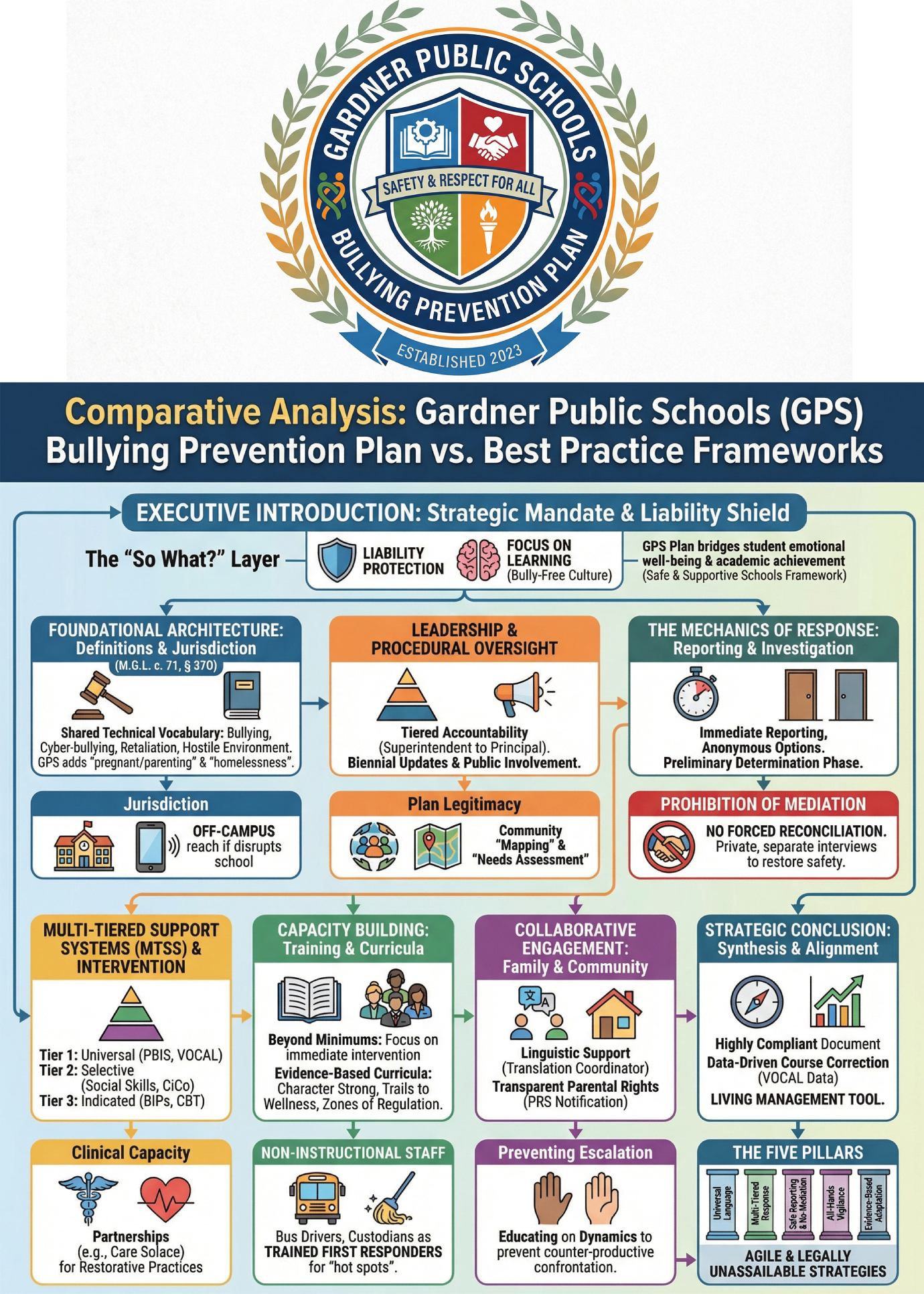
The Gardner Public Schools has a comprehensive Bullying Prevention and Intervention Plan. The video below covers the plan and the DEBATE discusses the District’s Plan in the context of best practice frameworks.
Listen to the DEBATE on any device. CLICK PLAY
Comparative Analysis: Gardner Public Schools Bullying Prevention Plan vs. Best Practice Frameworks
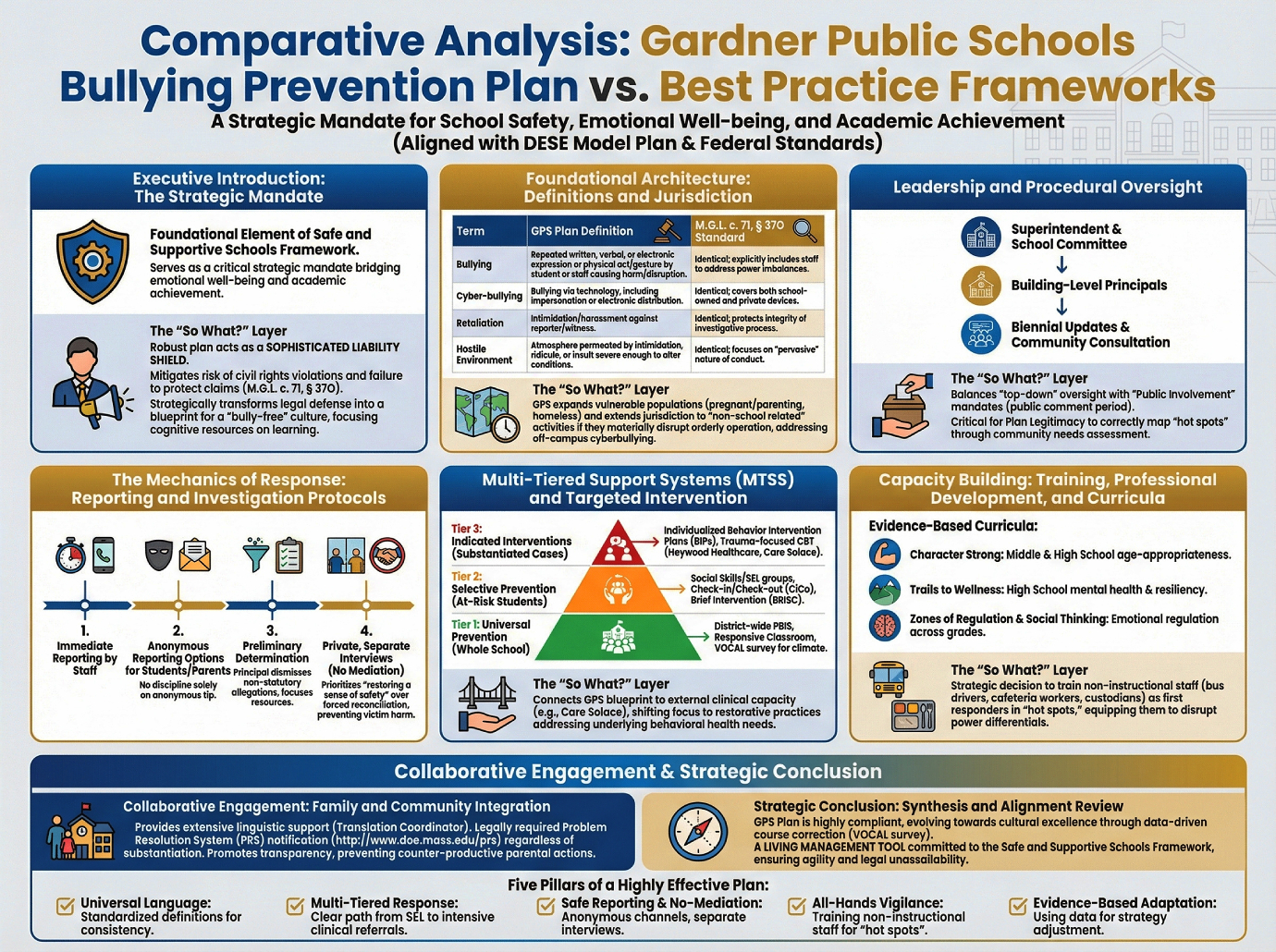
1. Executive Introduction: The Strategic Mandate for School Safety
In the current educational climate, a bullying prevention plan is not merely a regulatory requirement; it is a foundational element of the Safe and Supportive Schools Framework. For the Gardner Public Schools (GPS), the 2025 Bullying Prevention and Intervention Plan serves as a critical strategic mandate that bridges the gap between student emotional well-being and academic achievement. This analysis evaluates the GPS Plan against the Massachusetts Department of Elementary and Secondary Education (DESE) Model Plan and federal safety standards provided by SchoolSafety.gov and Stand for the Silent.
The “So What?” Layer From a leadership perspective, a robust plan functions as a sophisticated liability shield. By adhering strictly to M.G.L. c. 71, § 37O, the district mitigates the risk of “civil rights violations” and “failure to protect” claims. Strategically, the plan transforms from a legal defense into a blueprint for a “bully-free” culture, ensuring that cognitive resources remain focused on learning rather than survival.
——————————————————————————–
2. Foundational Architecture: Definitions and Jurisdiction
The efficacy of any safety policy is predicated on the precision of its legal nomenclature. GPS aligns its definitions with M.G.L. c. 71, § 37O, ensuring that all stakeholders operate from a shared technical vocabulary.
Table: Alignment of Definitions (GPS vs. M.G.L. c. 71, § 37O)
| Term | GPS Plan Definition | M.G.L. c. 71, § 37O Standard |
|---|---|---|
| Bullying | Repeated written, verbal, or electronic expression or physical act/gesture by a student or member of school staff causing harm or disrupting education. | Identical; explicitly includes staff (Chapter 86 of the Acts of 2014) to address power imbalances. |
| Cyber-bullying | Bullying via technology, including impersonation or electronic distribution to multiple persons. | Identical; covers both school-owned and private devices used for harassment. |
| Retaliation | Intimidation or harassment against any individual who reports or witnesses bullying. | Identical; protects the integrity of the investigative process. |
| Hostile Environment | A school atmosphere permeated by intimidation, ridicule, or insult sufficiently severe to alter educational conditions. | Identical; focuses on the “pervasive” nature of the conduct. |
The “So What?” Layer GPS demonstrates localized expertise by expanding its list of vulnerable student populations to include “pregnant or parenting status” and “homelessness.” Furthermore, the plan’s jurisdictional reach into “non-school related” activities allows administrators to intervene in cyberbullying that occurs off-campus if it materially disrupts the orderly operation of the school. This is essential for maintaining safety in an era where the digital and physical hallways are inextricably linked.
——————————————————————————–
3. Leadership and Procedural Oversight
Leadership at GPS is a tiered system of accountability, moving from the Superintendent and School Committee down to building-level Principals. Per DESE requirements, the plan is not a static document but a “living” strategy that must be biennially updated in consultation with community stakeholders.
The “So What?” Layer The GPS plan correctly balances “top-down” oversight with “Public Involvement” mandates, including a required public comment period before adoption. This is critical for Plan Legitimacy. If the community—including parents and law enforcement—is not involved in the “mapping” and “needs assessment” process, administrative efforts to identify “hot spots” (such as specific bus routes or cafeteria corners) may fail to reflect the actual student experience.
——————————————————————————–
4. The Mechanics of Response: Reporting and Investigation Protocols
The GPS Plan outlines a rigorous timeline for incident response, mandating that staff report suspected bullying immediately. To lower reporting barriers, students and parents are provided with anonymous reporting options, though no student can be disciplined solely on an anonymous tip.
The “So What?” Layer A key efficiency for administrators is the “Preliminary Determination” phase. This allows the Principal to dismiss allegations that do not meet the statutory definition of bullying, ensuring resources are focused on substantiated threats. Crucially, GPS follows the prohibition of mediation best practice. Unlike traditional conflict resolution, GPS conducts private, separate interviews with the target and aggressor. As noted in the Frameworks source, bringing the parties together can be harmful to the victim; GPS’s protocol prioritizes “restoring a sense of safety” over forced reconciliation.
——————————————————————————–
5. Multi-Tiered Support Systems (MTSS) and Targeted Intervention
GPS utilizes a three-tier MTSS framework to address the root causes of aggression and provide clinical support for targets.
1. Tier 1: Universal Prevention (Whole School)
◦ GPS Strategy: District-wide PBIS, Responsive Classroom, and the VOCAL survey to assess school climate.
2. Tier 2: Selective Prevention (At-Risk Students)
◦ GPS Strategy: Social Skills/SEL groups, Check-in/Check-out (CiCo), and Brief Intervention for School Clinicians (BRISC).
3. Tier 3: Indicated Interventions (Substantiated Cases)
◦ GPS Strategy: Development of Individualized Behavioral Intervention Plans (BIPs). For complex cases, the district leverages partnerships with Heywood Healthcare and Care Solace to provide Trauma-focused Cognitive-Behavioral Therapy (CBT).
The “So What?” Layer By connecting the GPS “blueprint” to external clinical capacity like Care Solace, the district ensures that the most severe cases receive professional intervention. This shifts the focus from purely punitive measures to restorative practices that address the underlying behavioral health needs of the students.
——————————————————————————–
6. Capacity Building: Training, Professional Development, and Curricula
GPS adheres to the six research-based training topics required by state law. However, the plan goes beyond the legal minimum by ensuring training focuses on “immediate, effective interventions to stop bullying.”
Evidence-Based Curricula in GPS:
• Character Strong: Leveraged for Middle and High School age-appropriateness.
• Trails to Wellness: Targeted mental health and resiliency for the High School level.
• Zones of Regulation & Social Thinking: Used across grade levels for emotional regulation.
The “So What?” Layer The strategic decision to include non-instructional staff (bus drivers, cafeteria workers, custodians) in the training mandate is vital. These employees are often the only adults present in “hot spots.” In this plan, a bus driver is not just a driver; they are a trained first responder equipped to disrupt power differentials the moment they manifest.
——————————————————————————–
7. Collaborative Engagement: Family and Community Integration
The GPS Plan recognizes that a home-school disconnect can derail an intervention. The district provides extensive linguistic support through its Family Engagement/Translation Coordinator (Appendix A), ensuring that all notices are available in the most prevalent languages of the home.
The “So What?” Layer GPS is legally required to inform parents of the Problem Resolution System (PRS) at http://www.doe.mass.edu/prs. This notification must occur regardless of whether bullying is substantiated. By being transparent about parental rights and the “dynamics of bullying,” the district prevents parents from taking counter-productive actions, such as direct confrontation with other families, which can escalate crises.
——————————————————————————–
8. Strategic Conclusion: Synthesis and Alignment Review
The Gardner Public Schools Plan is a highly compliant document that effectively maps resources to legal mandates. To evolve from compliance to cultural excellence, GPS should continue utilizing data-driven course correction by analyzing VOCAL survey data to measure curriculum effectiveness annually.
The Five Pillars of a Highly Effective Plan
• Universal Language: Standardized definitions across all student and staff handbooks to ensure legal and operational consistency.
• Multi-Tiered Response: A clear path from school-wide SEL to intensive, trauma-focused clinical referrals via partners like Care Solace.
• Safe Reporting & No-Mediation: Maintaining anonymous channels and strictly separate interview protocols to protect victims from secondary trauma.
• All-Hands Vigilance: Transforming non-instructional staff into trained monitors of high-risk “hot spots” like buses and cafeterias.
• Evidence-Based Adaptation: Using biennial updates and climate survey data to adjust strategies for emerging threats like new social media platforms.
Final Statement: The GPS Plan is a living management tool. Its commitment to the Safe and Supportive Schools Framework ensures that as the social and technological landscape shifts, the district’s strategies for student protection remain both agile and legally unassailable.