
D-Day was June 6, 1944
The Normandy landings, famously known as D-Day, represent the most massive maritime invasion in global history, launched on June 6, 1944. This pivotal World War II operation involved a complex combination of aerial bombardments, paratrooper drops, and amphibious assaults across five French beach sectors. Orchestrated by Allied forces under General Dwight D. Eisenhower, the campaign utilized sophisticated military deception and technical innovations to breach Germany’s Atlantic Wall defenses. Despite facing heavy casualties and unpredictable weather, the successful establishment of beachheads allowed the Allies to begin the liberation of Western Europe. Today, the region serves as a significant site for war memorials and historical tourism, honoring the thousands who participated in the struggle against Nazi Germany.
This Gardner Magazine video provides a great chronicle of D-Day.
The Chair Man and the Chair Lady discuss D-Day. Listen on any device, CLICK PLAY.
Max and Maxine Rogers debate D-Day. Listen on any device, CLICK PLAY.
Commentary “Reflections on D-Day” by Gardner Magazine Publisher Werner Poegel. Listen on any device, CLICK PLAY.
Operation Neptune: The Normandy Landings
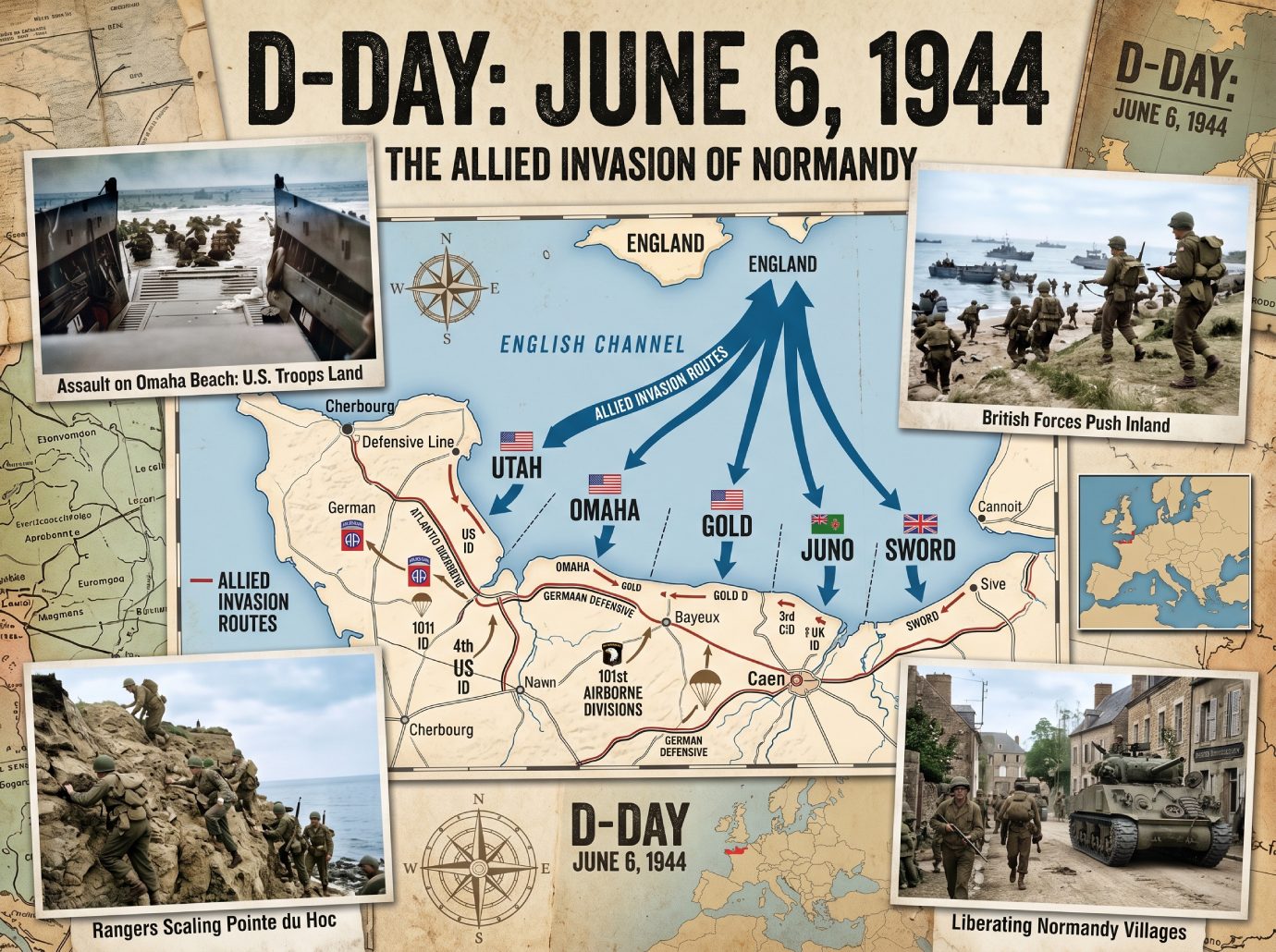
The Normandy landings, conducted on June 6, 1944, represent the largest seaborne invasion in history. Codenamed Operation Neptune and serving as the initial phase of Operation Overlord, the landings aimed to liberate German-occupied France and establish a second front in Western Europe. Despite facing significant environmental challenges and a heavily fortified German “Atlantic Wall,” Allied forces successfully established beachheads in five sectors: Utah, Omaha, Gold, Juno, and Sword.
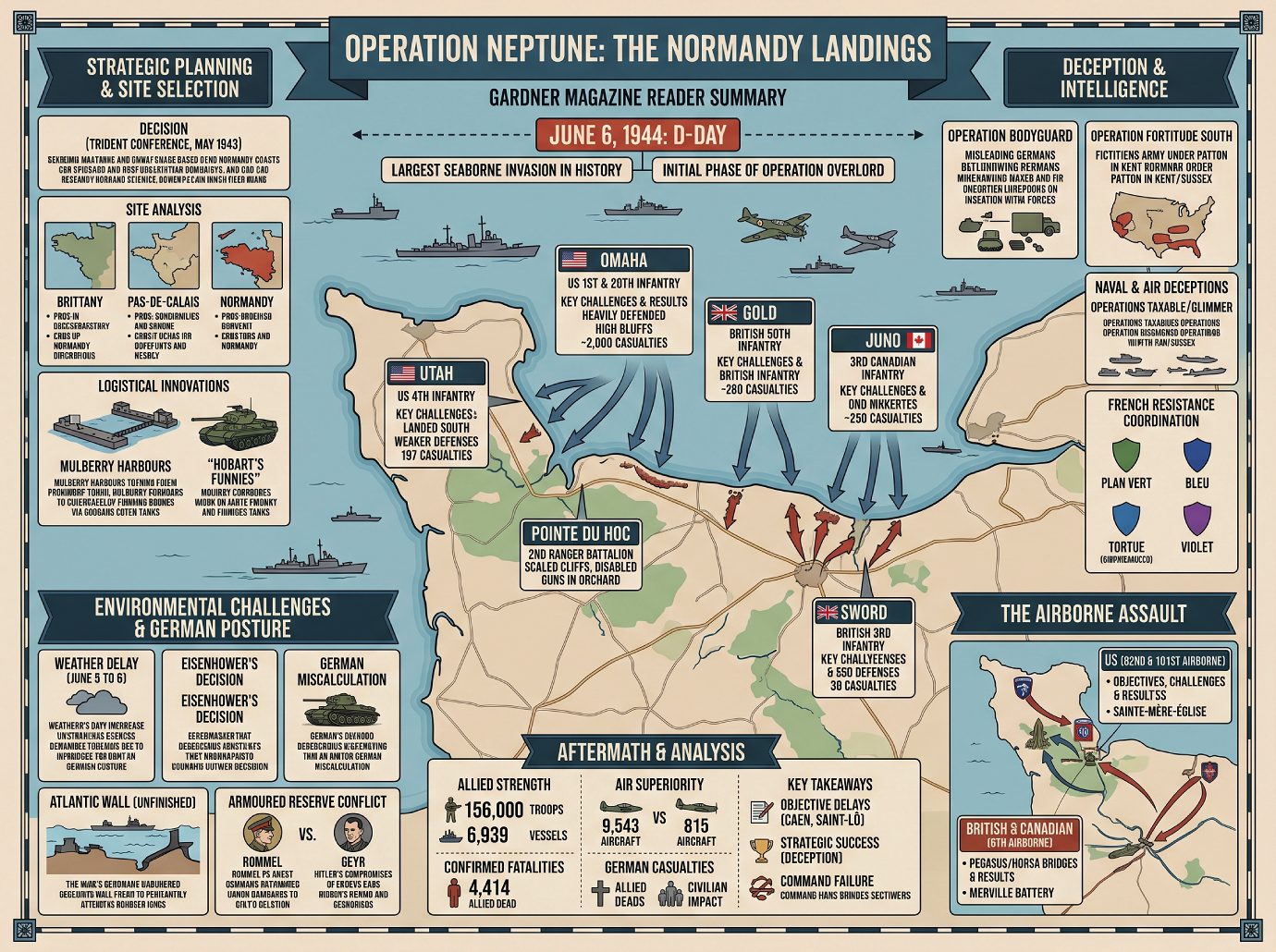
By the end of D-Day, approximately 156,000 Allied troops had landed, though at a cost of at least 10,000 casualties, including 4,414 confirmed dead. While several primary first-day objectives—such as the capture of Caen and Bayeux—were not achieved, the operation successfully laid the foundations for the Allied victory on the Western Front and the eventual retreat of German forces across the Seine by August 30, 1944.
——————————————————————————–
Strategic Planning and Site Selection
The decision to undertake a cross-channel invasion was finalized at the Trident Conference in May 1943. Planning was initially constrained by a shortage of landing craft, but the scale of the invasion was eventually expanded from three to five divisions under the insistence of Generals Dwight D. Eisenhower and Bernard Montgomery.
Site Analysis
Allied planners evaluated four potential sites for the invasion:
- Brittany and the Cotentin Peninsula: Rejected because the Germans could easily cut off Allied advances at the narrow isthmuses.
- Pas-de-Calais: Closest to Britain and heavily fortified; rejected because its numerous rivers and canals limited opportunities for expansion.
- Normandy: Selected because a broad front allowed for simultaneous threats against the port of Cherbourg and coastal ports in Brittany, while facilitating an overland attack toward Paris.
Logistical Innovations
To compensate for Normandy’s lack of port facilities, the Allies developed artificial Mulberry harbours. Additionally, specialized tanks known as “Hobart’s Funnies” were designed for mine clearing, bunker demolition, and mobile bridging.
——————————————————————————–
Deception and Intelligence
Operation Bodyguard was the overarching deception strategy used to mislead the Germans regarding the date and location of the invasion.
- Operation Fortitude South: Created a fictitious “First United States Army Group” under George S. Patton, supposedly based in Kent and Sussex, to convince the Germans that the main attack would occur at Pas-de-Calais.
- Naval and Air Deceptions: Operations Taxable and Glimmer involved dropping metal foil (“window”) to create radar illusions of naval convoys near Le Havre and Boulogne-sur-Mer.
- French Resistance Coordination: Through the Special Operations Executive, the Resistance executed sabotage plans:
- Plan Vert: Sabotage of the rail system.
- Plan Bleu: Destruction of electrical facilities.
- Plan Tortue: Delaying enemy reinforcements.
- Plan Violet: Cutting underground telecommunications.
Environmental and Weather Challenges
The invasion required specific tidal conditions, a full moon for airborne visibility, and a launch time shortly before dawn between low and high tide.
- Delay: Originally scheduled for June 5, the invasion was postponed 24 hours due to high winds and heavy seas.
- The Decision: Group Captain James Stagg predicted a temporary weather improvement for June 6. Eisenhower chose to proceed, noting that a further delay would mean waiting two weeks for suitable tides.
- German Miscalculation: German meteorologists predicted two weeks of stormy weather. Consequently, many German commanders, including Erwin Rommel, left their posts for war games or personal leave, leaving the defense disorganized.
German Defensive Posture
German defenses were hindered by a convoluted command structure and depleted resources.
- The Atlantic Wall: Hitler envisioned 15,000 coastal emplacements, but many remained unbuilt due to shortages of concrete and manpower.
- Personnel Quality: Many German units were understrength and comprised of Ostlegionen (conscripts from the Soviet Union) or older men, with an average age six years higher than their Allied counterparts.
- Armoured Reserve Conflict: A strategic disagreement occurred between Field Marshal Rommel and General Leo von Schweppenburg. Rommel wanted tanks near the coast to stop the invasion at the shore; Geyr wanted them held back near Paris. Hitler compromised, splitting control of the Panzer divisions, which delayed their deployment on D-Day.
The Airborne Assault
Beginning shortly after midnight, 24,000 American, British, and Canadian airborne troops landed behind enemy lines to secure the flanks.
United States (82nd and 101st Airborne)
- Objectives: Capture causeways behind Utah Beach and destroy bridges over the Douve River.
- Challenges: Thick clouds and flak caused extreme dispersal. Many paratroopers drowned in flooded fields intentionally created by the Germans.
- Successes: The 82nd captured Sainte-Mère-Église, the first town liberated in the invasion. The wide dispersal of troops confused German command, fragmenting their response.
British and Canadian (6th Airborne)
- Pegasus and Horsa Bridges: Captured in a glider assault at 00:16.
- Merville Battery: Disabled by the 9th Battalion under Lieutenant Colonel Terence Otway, preventing it from firing on the invasion fleet at Sword Beach.
Amphibious Beach Landings
The 80-kilometre stretch of coast was divided into five sectors.
| Beach | Primary Forces | Key Challenges and Results |
|---|---|---|
| Utah | US 4th Infantry | Landed 1,800m south of the target; the error proved beneficial as defenses were weaker. Casualties: 197. |
| Omaha | US 1st and 29th Infantry | The most heavily defended beach. Many Duplex-Drive (DD) tanks sank; high bluffs gave Germans a superior firing position. Casualties: ~2,000. |
| Gold | British 50th Infantry | Faced stiff resistance at Le Hamel and La Rivière. Captured Arromanches and Bayeux. Casualties: ~1,000. |
| Juno | 3rd Canadian Infantry | Faced choppy seas and heavy beach obstacles. Established a contiguous beachhead with Gold. Casualties: 961. |
| Sword | British 3rd Infantry | Successfully landed most DD tanks. Reached the outskirts of Caen but were pushed back by a counter-attack from the 21st Panzer Division. Casualties: ~1,000. |
Pointe du Hoc
The 2nd Ranger Battalion scaled 30m cliffs to destroy a coastal gun battery. Upon reaching the top, they discovered the guns had been moved to a nearby orchard, where the Rangers successfully disabled them with explosives.
Aftermath and Analysis
By the end of D-Day, the Allies had established all five beachheads, though they were not fully connected until June 12.
Statistics of the Invasion
- Allied Strength: 156,000 troops, 6,939 vessels, and 195,700 naval personnel.
- Air Superiority: Allies fielded 9,543 aircraft compared to the Luftwaffe’s 815.
- Confirmed Fatalities: 4,414 Allied dead (2,499 American; 1,915 from other Allied nations).
- German Casualties: Estimated between 4,000 and 9,000 men.
- Civilian Impact: Approximately 3,000 civilians died on June 6 and 7.
Key Takeaways
- Objective Delays: Major goals like the capture of Caen and Saint-Lô were not met on the first day; Caen was not fully captured until July 21.
- Strategic Success: The success of the deception plans (Operation Fortitude) kept German reinforcements tied down at Pas-de-Calais for weeks after the landings.
- Command Failure: The German command structure’s indecisiveness and Hitler’s personal control over armored reserves prevented a concentrated counter-attack that might have compromised the beachheads.
Beyond the Beachheads: 5 Surprising Realities of the D-Day Invasion
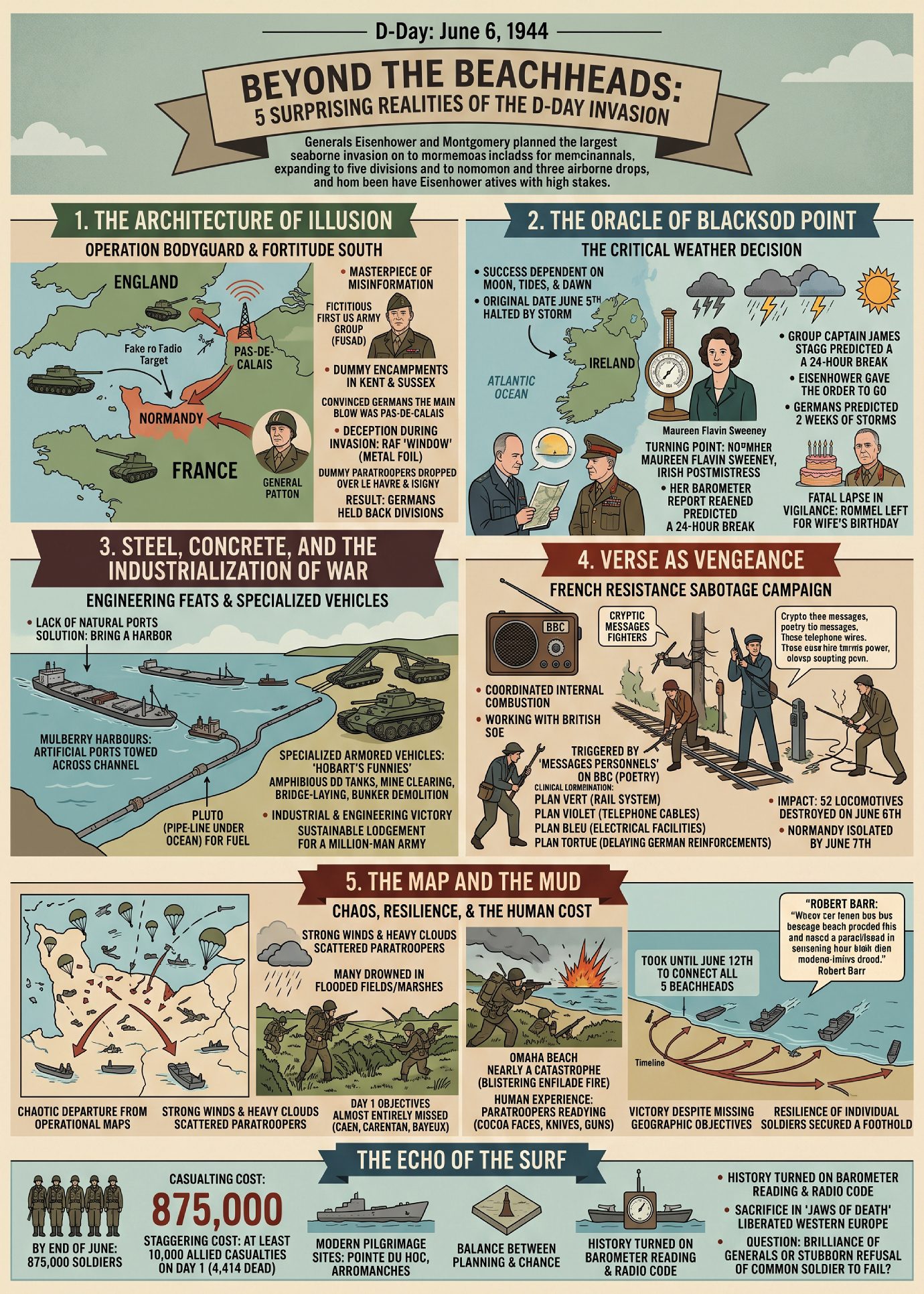
In the spring of 1944, the atmosphere within the Supreme Headquarters Allied Expeditionary Force was thick with a particular kind of calculated desperation. Operation Neptune was not merely a military maneuver; it was a logistical alchemy that seemed to defy the laws of probability. When Generals Dwight D. Eisenhower and Bernard Montgomery first scrutinized the blueprints, they found them wanting, demanding a massive expansion to five divisions supported by three airborne drops. They were planning the largest seaborne invasion in human history, knowing full well that a failure would not be a mere tactical setback, but a generational catastrophe that would stall the liberation of Western Europe for years.
While our collective memory of June 6th is often reduced to the black-and-white footage of men tumbling from Higgins boats into the surf, the “story behind the story” reveals a much more complex tapestry. The success of the invasion rested on a series of counter-intuitive gambles, “invisible” battles of the mind, and engineering feats that transformed the French coastline from a tactical obstacle into a functional industrial port.
The Architecture of Illusion
Before a single boot touched the sand, the Allies had to win a war of shadows. Under the broad umbrella of Operation Bodyguard, they executed a masterpiece of misinformation known as Fortitude South. This was shadow-play on a continental scale, involving the creation of a fictitious First United States Army Group (FUSAG) supposedly commanded by Lieutenant General George S. Patton. By using fake radio traffic and dummy encampments in Kent and Sussex, the Allies convinced the German High Command that the main blow would fall on the Pas-de-Calais.
The deception continued into the dark hours of the invasion itself. As the fleet crossed the Channel, the RAF utilized “window”—strips of metal foil dropped from aircraft—to create phantom radar returns that mimicked a massive naval convoy heading toward Le Havre. Simultaneously, dummy paratroopers were dropped over Le Havre and Isigny to simulate additional airborne landings. There is a profound irony in this “invisible” warfare: while men were dying in the very real carnage of Omaha Beach, the Germans were holding back entire divisions, waiting for a “main” attack that existed only on radar screens and in the imaginations of their intelligence officers.
The Oracle of Blacksod Point
The success of the invasion was a prisoner to the clock and the heavens. The planners required a precise alignment of the moon phase, the tides, and the first light of dawn—a convergence that occurred only a few days each month. Originally slated for June 5th, the operation was halted by a sudden onset of high winds and low cloud cover. Eisenhower faced an agonizing choice: proceed into the teeth of a gale or delay for at least two weeks, risking the detection of the entire fleet.
The turning point came from an unlikely source: Maureen Flavin Sweeney, a young postmistress at a remote weather station on the Irish coast. Her report of a falling barometer and subsequent pressure changes reached SHAEF, allowing Group Captain James Stagg to predict a brief, 24-hour break in the storm for June 6th. Based on this sliver of data, Eisenhower gave the order to go. Meanwhile, German meteorologists in Paris, lacking the Allies’ superior Atlantic data, predicted two weeks of uninterrupted storms. This discrepancy led to a fatal lapse in German vigilance. Believing an invasion was physically impossible, Field Marshal Erwin Rommel actually left his post to celebrate his wife’s birthday in Germany, while other senior commanders departed for war games in Rennes.
Steel, Concrete, and the Industrialization of War
One of the greatest tactical hurdles of the Normandy coast was its total lack of natural ports. The Allied solution was not to capture a harbor, but to bring one with them. This was the era of the Mulberry harbours—massive, artificial ports towed across the Channel—and PLUTO (Pipe-Line Under The Ocean), an unprecedented engineering feat designed to pump fuel directly from England to the French shore.
To navigate the treacherous Atlantic Wall defenses, Major General Percy Hobart developed a collection of specialized armored vehicles affectionately known as “Hobart’s Funnies.” These included amphibious Duplex-Drive (DD) tanks, as well as vehicles modified for mine clearing, bridge-laying, and the demolition of concrete bunkers. D-Day was an industrial and engineering victory as much as a tactical one; it was these high-tech solutions that transformed the “primitive” act of storming a beach into a sustainable lodgement capable of feeding a million-man army.
Verse as Vengeance
The liberation was not merely a sea-to-shore operation; it was a coordinated internal combustion. Working with the British Special Operations Executive, the French Resistance executed a sophisticated sabotage campaign triggered by “messages personnels” broadcast over the BBC. These cryptic snippets—often lines of poetry or literary quotations—masked the true orders for destruction.
The coordination was remarkably clinical. Resistance cells executed Plan Vert to cripple the rail system, Plan Violet to sever underground telephone cables, and Plan Bleu to destroy electrical facilities. Crucially, they also implemented Plan Tortue, a delaying operation designed to harass and slow the German reinforcements rushing toward the coast. The impact was devastating. According to a 1965 report, these efforts resulted in the destruction of 52 locomotives on June 6th alone. By June 7th, Normandy was effectively isolated, a tactical island cut off from the rest of the German occupation force.
The Map and the Mud
Despite the meticulous planning, the reality of June 6th was a chaotic departure from the operational maps. Strong winds and heavy cloud cover pushed landing craft far from their sectors and scattered paratroopers across the bocage—the dense, ancient hedgerow country of Normandy—where many drowned in flooded fields or marshes.
The “Day 1” objectives were almost entirely missed. Vital hubs like Caen, Carentan, and Bayeux remained in German hands, and it would take until June 12th for all five beachheads to be connected. At Omaha Beach, the situation nearly turned to catastrophe as troops faced blistering enfilade fire from high cliffs. The human experience of this transition from plan to chaos was captured by BBC correspondent Robert Barr, who watched the paratroopers in England as they were getting ready to board their aircraft:
“Their faces were darkened with cocoa; sheathed knives were strapped to their ankles; tommy guns strapped to their waists; bandoliers and hand grenades, coils of rope, pick handles, spades, rubber dinghies hung around them… This was the first combat jump for every one of them.”
That the operation remained a victory despite missing almost every geographic objective on the first day is a testament to the resilience of the individual soldier. The Allies had secured a foothold that the German command, hampered by their own complicated command structure, could not break.
The Echo of the Surf
By the end of June 1944, the trickle of men had become a flood, with 875,000 soldiers having passed through the Normandy lodgement. The cost of this entry was staggering: at least 10,000 Allied casualties on the first day, with 4,414 confirmed dead. Today, the sites of the invasion have become places of modern pilgrimage. One can still walk among the bomb craters at Pointe du Hoc or see the concrete remnants of the Mulberry harbour at Arromanches, silent witnesses to the scale of the effort.
The story of D-Day forces us to ponder the delicate, often terrifying balance between meticulous human planning and the sheer role of chance. History turned on the timing of a barometer reading in Ireland and the choice of a radio code. Ultimately, it was the sacrifice of those who waded into what many called the “Jaws of Death” that laid the foundations for the liberation of Western Europe. We are left to wonder: in the grand theater of war, was it the brilliance of the generals or the stubborn refusal of the common soldier to fail that truly won the day?