Gardner Magazine Weekly Briefing – July 19, 2026
The Chair Man and the Chair Lady have a complete weekly briefing in this podcast. Listen on any device, CLICK PLAY.
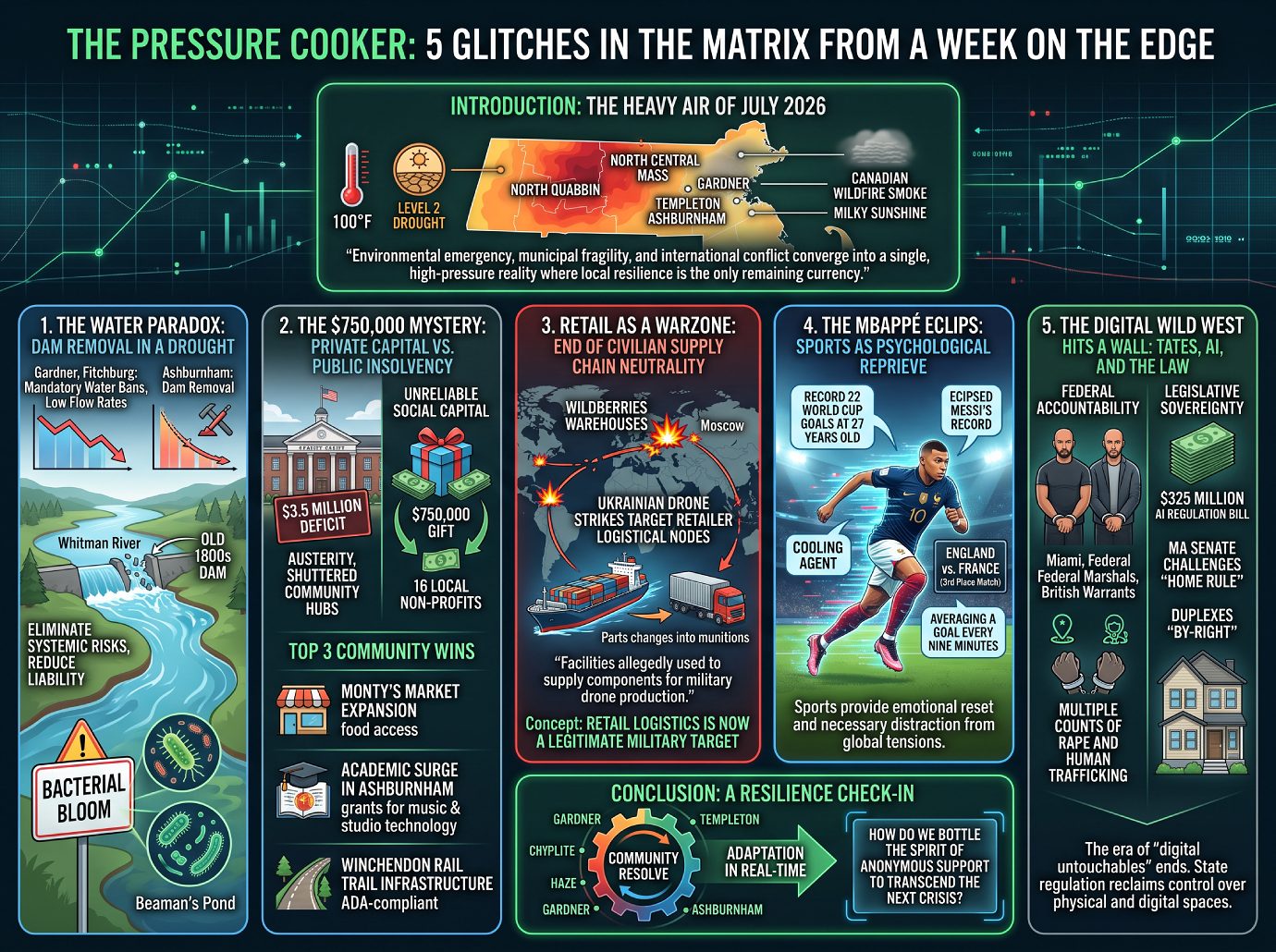
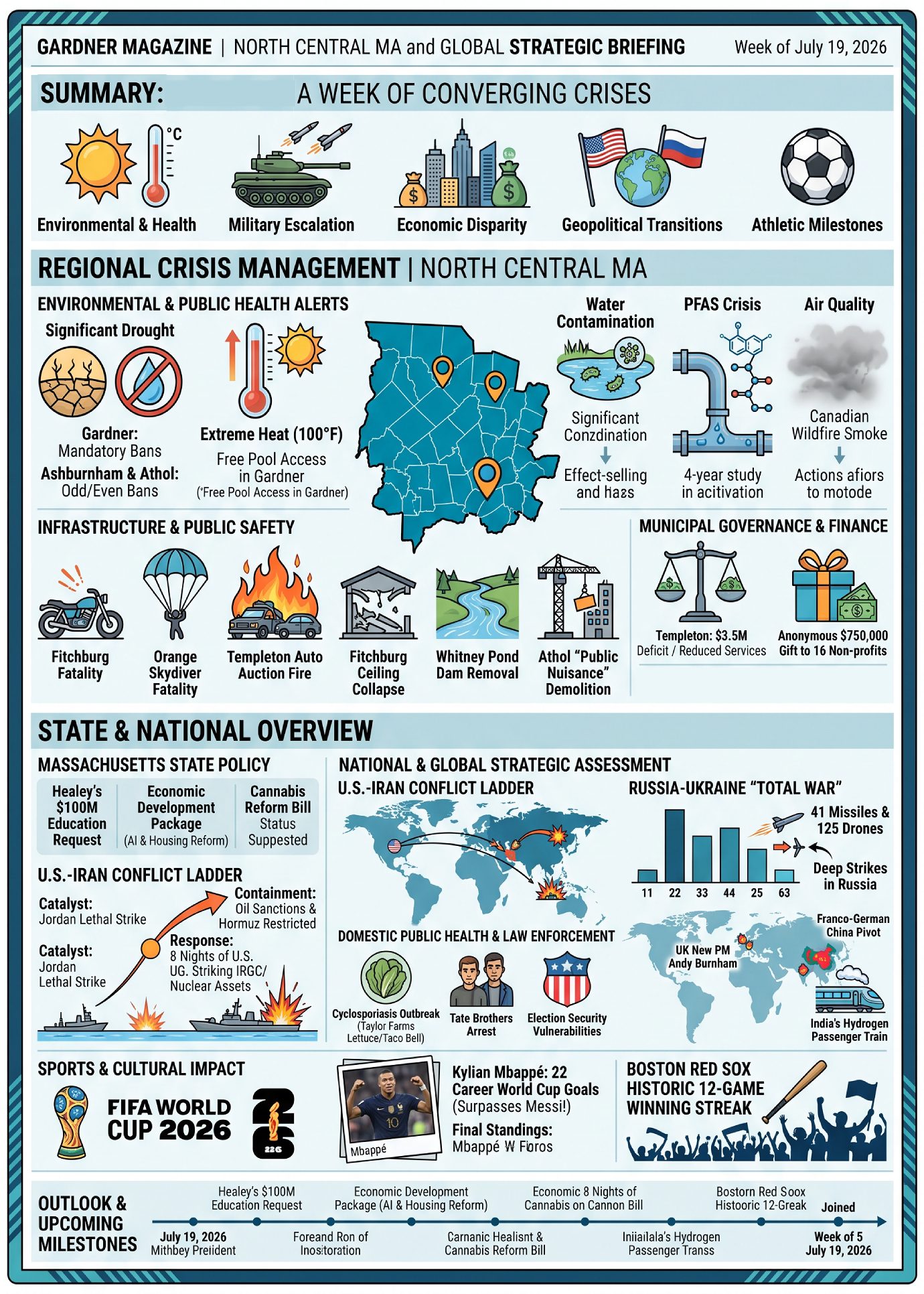
The week of July 19, 2026, has served as a grueling “stress test” for North Central Massachusetts. A convergence of environmental extremes—a Level 2 Significant Drought, a relentless 100°F heatwave, and a persistent haze from Canadian wildfire smoke—has collided with systemic fiscal fragility. This is no longer a matter of seasonal discomfort; it is a moment where the regional “pressure cooker” is forcing municipal leaders to make high-stakes decisions regarding public health, infrastructure safety, and the very survival of local governance. Spain won the FIFA World Cup 1-0 in extra time.
For more detail, Gardner Magazine has 4 separate additional sections covering North Central MA News, a Massachusetts News Roundup, U.S. National News, and World News, all updated on July 19, 2026. JUMP TO SECTION: North Central MA News — State News of the Week —- National News of the Week — World News of the Week
Environmental Crisis and Public Health
The declaration of a Level 2 Significant Drought has triggered emergency protocols across the region. As river flow rates drop to critical levels, the following mandates have been enacted to preserve dwindling supplies:
Municipal Water Restriction Status
| Municipality | Specific Action | Temporal Duration |
|---|---|---|
| Gardner | Strict Mandatory Water Use Ban | Active Immediately |
| Ashburnham | Mandatory Odd/Even schedule; Total ban on non-essential use (9 AM – 5 PM) | Active Immediately |
| Fitchburg | Mandatory restrictions tied to North Nashua River flow rates | Through Sept. 30 |
| Athol | Implementation of strict conservation schedules | Active Immediately |
| Phillipston | Strict voluntary conservation under regional declaration | Active Immediately |
The “So What?” of Scarcity
The closing of Beaman’s Pond in Templeton and several recreational sites in Ashby due to high E. coli and cyanobacteria levels represents a critical failure in community well-being. During a record heatwave, losing these cooling escapes creates a visceral public health vulnerability. Conversely, the $2.1 million removal of the Whitney Pond Dam in Ashburnham signifies a strategic shift from “storage to safety.” While removing a dam during a drought appears counter-intuitive, the move restores the Whitman River’s natural flow and eliminates a “significant hazard” to downstream residents. This multi-million-dollar state-level investment in climate adaptation stands in sharp contrast to the mere $16,000 “pittance” grant awarded for Winchendon’s Rail Trail upgrades—a disparity that highlights the uneven distribution of infrastructure capital.
Public Safety and Infrastructure Audit
The week was marked by community tragedy and aggressive blight removal. In Fitchburg, 44-year-old resident Shawn Clapper was killed in a motorcycle collision on Ashby State Road, while a 28-year-old skydiver died in Orange after a wind gust compromised a landing at Jumptown. In Templeton, a three-alarm fire at an auto auction destroyed 60 vehicles, threatening regional supply chains. Meanwhile, the Athol Selectboard approved the demolition of 465 Main St., a public nuisance whose owner faces $50,000 in housing code fines. Hubbardston has responded to infrastructure wear by strictly enforcing a 24/7 heavy truck ban on Brigham Street.
The Fiscal Paradox: Philanthropic Life Support
The region is currently navigating a sharp divide between public austerity and private intervention. In Templeton, a $3.5 million deficit following failed overrides has forced a retreat in public safety and community resources. This void is being partially filled by a “Wave of Mercy”—an anonymous $750,000 philanthropic gift distributed to 16 non-profits, including initiatives at Monty Tech (the regional technical school) like “Monty’s Market.” While vital, this gift acts as a “fragile bridge” for a region where municipal tax structures are increasingly failing to sustain basic services.
As our towns manage these localized crises, the broader legislative framework of the Commonwealth is entering a “crunch period” that will redefine municipal capabilities.
Massachusetts State Report: Legislative Urgency and Public Safety
The State House has entered a high-stakes legislative “crunch period” as the July 31st deadline looms. Lawmakers are racing to finalize frameworks for education funding, AI regulation, and housing reform, attempting to stabilize a Commonwealth currently oscillating between euphoric sports milestones and somber institutional scandals.
Budgetary and Economic Strategy
Governor Healey and the Senate are pushing a dual-track strategy to prevent municipal insolvency while modernizing the state’s economic ledger:
- Healey’s $100M Supplemental School Budget: Designed as a strategic corrective to prevent staff layoffs and program cuts in districts where local revenue has cratered.
- The $325M Economic Development Plan: A massive framework focusing on the nation’s first state-level AI ethical oversight, data privacy protections, and aggressive housing reform.
- The “Duplex Allowance”: A controversial zoning mandate aimed at bypassing “Home Rule” traditions to increase housing density near transit centers.
- Cannabis Modernization: A major overhaul bill has reached the Governor’s desk, signaling a shift toward market stabilization.
The “So What?” of Legal Precedents
Two major cases represent the collision of constitutional standards and public sentiment. In Quincy, a legal battle over religious statues (St. Michael and St. Florian) outside public safety headquarters may reach the U.S. Supreme Court, testing First Amendment boundaries. Simultaneously, jury selection has begun in the Lindsay Clancy trial in Duxbury, a case that continues to haunt the state’s collective conscience and highlight the complexities of mental health within the justice system.
Institutional Accountability
Investigations into the death at the Mattapan property owned by the husband of U.S. Representative Ayanna Pressley, alongside intense scrutiny of the RMV following a trooper fatality caused by an undocumented trucker, point to a systemic need for reform. These incidents suggest that modernizing the Commonwealth requires as much focus on law enforcement oversight as it does on digital infrastructure.
Commonwealth Cultural Pulse
The state found an emotional lift in the Red Sox’s 12-game winning streak and the $120 million economic impact of the World Cup and “Sail Boston.” Local morale was bolstered by “World Cup Mania” watch parties at Doyle Field (Leominster), Coolidge Park (Fitchburg), and the Robinson-Broadhurst Amphitheater (Winchendon). Adding to local color, Fitchburg introduced its new library mascot, “Wally” the owl, while Athol veterans installed signs designating the town as a “Purple Heart Town.”
This push for state-level stability is mirrored—and amplified—at the national level, where domestic health and international conflict have reached a boiling point.
United States National News: Military Escalation and Domestic Vulnerability
The nation faces a moment of profound instability, where a “Taco Bell” parasite outbreak and Middle Eastern missile strikes represent simultaneous threats to the domestic and international perimeters.
The Escalation in Jordan
The geopolitical landscape shifted following an Iranian missile barrage in Jordan that killed two U.S. service members and left a third missing. In response, the U.S. military has launched a sustained eight-night retaliatory bombing campaign. Notably, these strikes have moved beyond traditional targets to include Iranian nuclear facility sites, signaling a departure from standard deterrence toward a high-stakes theater of engagement.
The “So What?” of Economic Containment
The proposal to add Iran to the “Russia-style” sanctions bill represents a new doctrine of “total containment.” By targeting any nation purchasing Iranian oil, the U.S. is signaling an intent to leverage the global financial architecture to achieve total economic strangulation of Tehran.
Domestic Health and Security Crisis
The CDC is managing a Cyclosporiasis outbreak linked to Taylor Farms lettuce from Mexico. With over 1,600 sickened across 27 states, the “Taco Bell connection” has turned a supply chain failure into a public health emergency.
Crisis at a Glance: Federal Stability
- Election Infrastructure: The administration declassified intelligence detailing specific vulnerabilities in electronic voting machines.
- Congressional Scrutiny: Special Counsel Jack Smith has confirmed a review of private text messages from 44 members of Congress.
- Voter Integrity: DHS Secretary Markwayne Mullin released data regarding noncitizen voter rolls, mirroring the institutional scrutiny currently facing the Massachusetts RMV.
Federal Law Enforcement Milestones
In a landmark for international legal cooperation, federal marshals in Miami arrested Andrew and Tristan Tate on charges of rape and human trafficking filed by British authorities. Meanwhile, the House passed a bill to make Daylight Saving Time permanent—a rare moment of domestic alignment regarding the human desire for evening light.
Global Strategic Briefing: Tectonic Shifts and Competitive Spectacle
The global stage is undergoing a “re-indexing of power,” where the spectacle of the World Cup serves as a backdrop to hardening military and economic blocs.
Total War in Eastern Europe
Russia launched a massive aerial assault on Kyiv using 41 missiles and 125 drones. Ukraine responded with lethal drone strikes on “Wildberries” warehouses deep in Russian territory. This represents a strategic shift toward targeting “dual-use” retail infrastructure used for military drone production, effectively turning commercial logistics hubs into frontline targets.
The “So What?” of Leadership Transitions
The rise of Prime Minister Andy Burnham in the UK and the Franco-German pivot toward a unified China policy—following the collapse of the FCAS fighter jet initiative—mark a move toward “just-in-case” regional consolidation. European powers are increasingly abandoning integrated industrial projects in favor of forming hardened ideological and economic blocs.
Global Progress Pulse
- Athletic Legacy: During the Third-Place Match (England 6 – France 4), Kylian Mbappé (27) officially surpassed Lionel Messi for the most World Cup goals, reaching a career total of 22.
- Green Innovation: India successfully launched its first hydrogen-powered passenger train, a landmark achievement for the Global South’s push for sustainable infrastructure.
5. Conclusion: Synthesis and Regional Impact Analysis
The events of July 19, 2026, demonstrate that North Central Massachusetts does not exist in a vacuum; the region is the final destination for the ripple effects of global and national volatility.
The “Global-to-Local” Ripple Effect
The shipping restrictions in the Strait of Hormuz and global supply chain volatility have directly increased energy costs and insurance premiums. For towns like Templeton and Gardner, these rising fixed costs make local budgets impossible to maintain, leading to the failed overrides and austerity measures we see today. Simultaneously, the state-level zoning reforms and national election security debates will dictate the region’s governance for years to come.
Regional Outlook
North Central Massachusetts is at a definitive crossroads. The convergence of environmental hazards and man-made infrastructure failures—most notably the four-year-long DPH/DEP study in Westminster regarding birth weights and cancer data following PFAS contamination—requires a transition from “crisis response” to “long-term strategic modernization.” The $750,000 philanthropic gift and the $100 million state education supplement are vital lifelines, but they are philanthropic life support, not permanent solutions. The resilience of North Central Massachusetts remains its greatest asset, yet the “pressure cooker” of July 19, 2026, makes it clear that we must modernize our infrastructure and revenue models to survive an era of perpetual global and environmental instability.