
Gardner Magazine Reports on the Planet Mars
The Mars Reports – Gardner Magazine
The subject of Mars is fascinating and Gardner Magazine is exploring the discoveries about Mars in great detail. A Deep Dive podcast with the Chair Man and the Chair Lady, a DEBATE about life on Mars with Max and Maxine Rogers, a short video about Mars, a number of reports, and rich infographics with stunning visuals. We also have our reports in this ebook PDF, CLICK HERE.
Watch this fascinating video featuring some actual photos of the Red Planet Mars:
We have 2 podcasts. A DEBATE about Life on Mars and a DEEP DIVE about the Underground Oceans on Mars. Listen on any device, CLICK PLAY.
The Mars Reports – Gardner Magazine – October 27, 2026
Jump to various reports: Comprehensive Briefing Document: Findings from Decades of Robotic Mars Exploration —– Beyond the Rust Belt: 5 Mind-Bending Discoveries That Reveal Mars Was Once Habitable—and Still Holds Deep Secrets —– Mars In-Situ Technology & Operational Capabilities: An Engineering Assessment for Planetary Exploration —–Unlocking the Secrets of Mars: How Scientists Discovered Water and the Search for Alien Life —–Journey to the Center of Mars: Unlocking the Deep Secrets of the Red Planet ——Scientific Synthesis: Martian Habitability, Atmospheric Evolution, and Exploration Priorities
Comprehensive Briefing Document: Findings from Decades of Robotic Mars Exploration
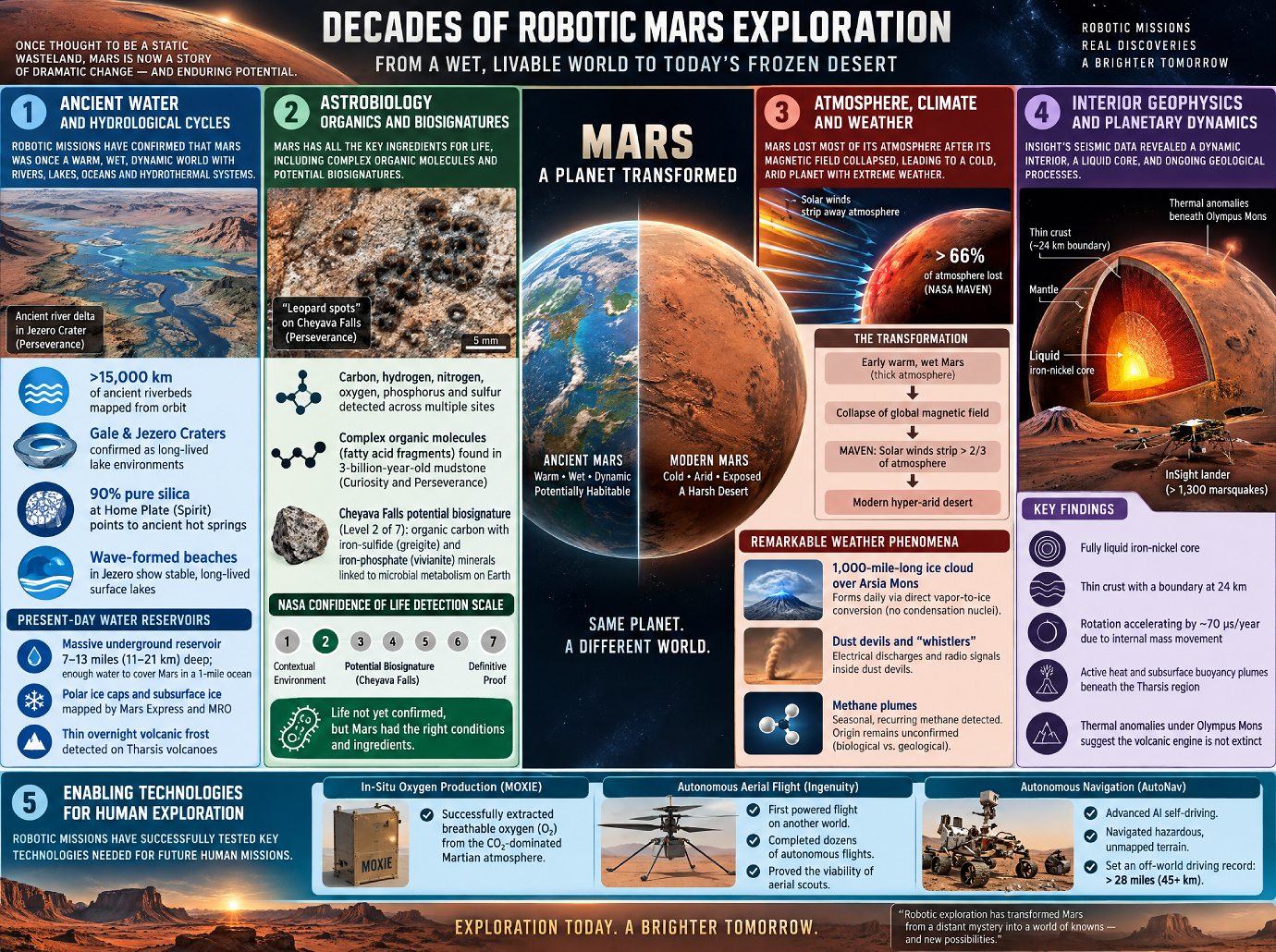
Comprehensive Briefing Document: Findings from Decades of Robotic Mars Exploration
Decades of robotic exploration by orbiters, landers, and rovers have fundamentally transformed scientific understanding of Mars. Once assumed to be an eternally static wasteland, Mars is now understood to have undergone a major planetary evolution—transitioning from a warm, wet, and dynamic world capable of supporting life to the frozen, hyper-arid desert seen today.
Key highlights of recent and historical discoveries include:
- Widespread Water History & Subsurface Reservoirs: Absolute confirmation of ancient liquid water across Mars, including over 15,000 kilometers of mapped riverbeds, long-lived lakes, and complex coastal/hydrothermal systems. A massive subterranean liquid water reservoir holding enough water to cover Mars in a 1-mile-deep ocean was recently detected 7 to 13 miles beneath the crust.
- Crucial Biosignatures & Organic Molecules: Discovery of complex organic molecules (fatty acid fragments) in 3-billion-year-old mudstone and the identification of “leopard spots” on the “Cheyava Falls” rock—a Level 2 out of 7 potential biosignature featuring iron-sulfide (greigite) and iron-phosphate (vivianite) minerals linked on Earth to microbial metabolism.
- Atmospheric Stripping and Extreme Weather: Discovery that Mars lost over two-thirds of its atmosphere to solar winds after its global magnetic field collapsed, leading to extreme localized weather phenomena such as 1,000-mile-long ice clouds over Arsia Mons and radio-emitting “whistlers” inside dust devils.
- Active Planetary Geodynamics: InSight lander seismic data reveals a fully liquid iron-nickel core, active heat deep within the interior, thermal anomalies under Olympus Mons, and an acceleration of the planet’s rotation by roughly 70 microseconds per year due to internal mass movement.
- Enabling Technologies for Human Exploration: Successful field testing of vital technologies, including localized oxygen production (MOXIE), autonomous aerial flight (Ingenuity), and long-distance autonomous rover navigation (AutoNav).
Core Mars Exploration Data Matrix
| Domain | Key Finding / Feature | Mission / Hardware Involved | Core Significance |
|---|---|---|---|
| Hydrology | Deep Subsurface Liquid Water | NASA InSight Lander | Detects liquid water in fractured rock 7–13 miles underground; enough to cover Mars in a 1-mile ocean. |
| Hydrology | Hydrothermal & Surface Evidence | Spirit Rover, Perseverance, Curiosity | Mapped >15,000 km of riverbeds; found 90% pure silica at Home Plate; confirmed lake basins in Gale & Jezero. |
| Astrobiology | “Leopard Spots” at Cheyava Falls | NASA Perseverance Rover | Level 2 potential biosignature in Bright Angel formation; contains greigite and vivianite minerals. |
| Astrobiology | Preservation of Fatty Acid Fragments | NASA Curiosity Rover | Detects complex organic carbon macromolecules preserved in 3-billion-year-old mudstone. |
| Atmosphere | Atmospheric Loss (>66%) | NASA MAVEN Mission | Confirmed solar winds stripped the majority of the air after global magnetic field loss. |
| Geophysics | Marsquake Map & Rotation Acceleration | NASA InSight Lander | Recorded 1,300+ quakes; identified liquid core, 24 km crustal boundary, and ~70 μs/yr rotation acceleration. |
| Technology | In-Situ $O_2$ Production | MOXIE (Perseverance Rover) | Successfully extracted breathable oxygen from the $CO_2$-dominated Martian atmosphere. |
| Technology | Autonomous Flight & Navigation | Ingenuity Helicopter, AutoNav AI | First powered off-world flight; set driving record (>28 miles) across hazardous terrain. |
1. The Secrets of Ancient Water and Hydrological Cycles
The absolute confirmation that Mars was once awash with liquid water represents a monumental shift in planetary science. Orbiters, landers, and surface rovers have categorized the planet’s aquatic history into detailed epochs and geological structures.
Surface Water Systems and River Networks
- Ancient River Beds and Lakes: High-resolution orbital imagery has mapped over 15,000 kilometers (thousands of miles) of ancient river channels and winding networks across the Martian terrain.
- Gale and Jezero Crater Basins: Ground exploration by the Curiosity and Perseverance rovers proved that these massive craters contained long-lived lake environments fed by complex river deltas billions of years ago.
- Wave-Formed Ancient Beaches: Sedimentary evidence within Jezero Crater’s “Margin Unit” includes wave-formed structures and rounded mineral grains. These features indicate that calm, stable surface lakes persisted for significantly longer durations than previously modeled.
Complex Multi-Stage Water Cycles
Data from Jezero Crater’s “Margin Unit” and other sedimentary formations reveals that early Mars possessed a dynamic water cycle characterized by three distinct aquatic eras:
- Carbon-Dioxide-Rich Groundwater: Early deep groundwater saturated with $CO_2$ seeped upward through subsurface fractures.
- Enduring Surface Lakes: Stable surface lakes experienced seasonal wet-and-dry cycles, evidenced by mud cracks formed by repeated shrinking and swelling of sedimentary layers.
- Boiling Hydrothermal Systems: Later-stage subterranean activity drove boiling hydrothermal fluids through fractures underground. Additional evidence comes from the Spirit rover at “Home Plate,” which discovered deposits of 90% pure silica, pointing to ancient steam vents or hot springs.
Present-Day Water and Ice Inventory
While surface liquid water is no longer stable, vast water deposits remain preserved across the planet:
- Deep Underground Reservoir: In 2024, scientists analyzing seismic data from the InSight lander identified a massive liquid water reservoir trapped inside fractured rock 7 to 13 miles (11 to 21 km) beneath the surface. This single reservoir contains enough liquid water to cover the entire surface of Mars in an ocean 1 mile deep.
- Polar Ice Caps and Subsurface Sheets: Mapped by orbiters including ESA’s Mars Express and NASA’s Mars Reconnaissance Orbiter (MRO), immense reservoirs of water ice are locked within the polar caps, layered under shallow subsurface dust, and situated in equatorial regions like the Medusae Fossae Formation.
- Volcanic Frost: Recent orbital observations detected thin, overnight volcanic frost deposits forming along the high-altitude peaks of the giant Tharsis volcanoes.
2. Astrobiology: Organics, Chemical Building Blocks, and Biosignatures
While definitive, conclusive evidence of past or present Martian life has not been established, exploration missions have confirmed that ancient Mars possessed all the fundamental conditions and raw chemical ingredients necessary to support life.
[NASA Confidence of Life Detection Scale]Level 1 ----------------> [ Level 2 ] ----------------> Level 7Contextual Environment Potential Biosignature Definitive Proof(Cheyava Falls Discovery)
Essential Chemical Ingredients and Macromolecules
- Building Blocks of Life: Powdered rock samples obtained by rover drills confirmed the presence of carbon, hydrogen, nitrogen, oxygen, phosphorus, and sulfur across multiple geological sites.
- Preserved Carbon Chains: The Curiosity and Perseverance rovers detected complex organic molecules—macromolecules with carbon chains structurally consistent with fragments of fatty acids—preserved inside 3-billion-year-old mudstones and sedimentary formations.
The “Cheyava Falls” Potential Biosignature
The most significant astrobiological discovery to date occurred in the Bright Angel formation within Jezero Crater, where the Perseverance rover analyzed a rock named Cheyava Falls:
- Chemical & Structural Composition: The rock contains organic carbon molecules integrated alongside microscopic, ringed features referred to as “leopard spots.”
- Mineral Signature: Analysis confirmed that these leopard spot rings are enriched with iron-sulfide (greigite) and iron-phosphate (vivianite).
- Biological Parallels: On Earth, these specific chemical reactions and mineral formations typically occur when subsurface microbes metabolize (“breathe”) iron and sulfur for energy.
- Detection Confidence: NASA has classified the Cheyava Falls finding as a strong potential biosignature, assigning it a Level 2 rating on the 7-level Confidence of Life Detection scale.
3. Atmospheric Evolution, Climate Dynamics, and Weather Phenomena
Mars transitioned over billions of years from a thick, protective atmospheric blanket into a thin, harsh, carbon-dioxide-dominated atmosphere exposed to space.
[ Early Warm, Wet Mars ]│├─► Collapse of Global Magnetic Field│├─► MAVEN: Solar Winds Strip > 2/3 of Atmosphere▼[ Modern Hyper-Arid Desert ]│├─► Methane Plumes (Unconfirmed Origin: Biological vs Geological)├─► Daily Arsia Mons Cloud (Direct Vapor-to-Ice Conversion)└─► Dust Storms & Devils (Hydrogen Escape & Radio "Whistlers")
Atmospheric Stripping and MAVEN Findings
Data from NASA’s MAVEN mission resolved how Mars lost its climate stability. After Mars lost its global magnetic field, powerful solar winds gradually stripped away more than two-thirds (66%+) of its total atmosphere into space, stripping the planet’s surface pressure and converting its wet surface into a frozen desert.
Unresolved Atmospheric Methane
Surface rovers and orbiters have recorded recurring seasonal plumes and unpredictable fluctuations of methane gas in the atmosphere. Because methane on Earth is generated almost exclusively by biological processes (microbes) or active geological processes (hydrothermal interactions), its precise origin on Mars remains a primary unconfirmed mystery.
Meteorological Phenomena and Cloud Physics
- The Arsia Mons Ice Cloud: Atmospheric scientists discovered a daily atmospheric phenomenon over the Arsia Mons volcano: a 1,000-mile-long water-ice cloud that forms and dissipates rapidly. Driven by massive atmospheric waves, water vapor transitions directly into ice crystals without requiring a condensation anchor point—a process indicating extreme localized relative humidity levels unique in planetary meteorology.
- Dust Storms and Space Loss: Regional and global dust storms act as a catalyst for planetary water depletion, forcing hydrogen molecules into the upper atmospheric layers where they escape into space.
- Dust Devil “Lightning” and Radio Signals: Sensor arrays have detected electrical discharges and high-frequency radio signals known as “whistlers” inside Martian dust devils. These localized electric sparks are energetic enough to trigger complex chemical reactions within atmospheric dust.
4. Interior Geophysics, Planetary Dynamics, and Volcanism
The deployment of the NASA InSight lander’s ultra-sensitive seismometer transformed Mars geophysics, using over 1,300 “marsquakes” to map the internal layer cake of the planet for the first time.
Internal Structural Architecture
- Crustal Boundaries: Seismic waves reveal a distinct compositional boundary located 24 kilometers down beneath the surface, indicating a historical sequence of complex internal volcanic processing.
- Crust Thickness: InSight revealed that the Martian outer crust is unexpectedly thin compared to early theoretical planetary models.
- Core State: Mars possesses a fully liquid core composed primarily of iron and nickel. Despite this liquid core, the planet lacks active plate tectonics.
Active Geodynamics and Rotational Acceleration
- Acceleration of Planetary Spin: High-precision radio tracking established that Mars’ rotation rate is accelerating by approximately 70 microseconds per year.
- Subsurface Buoyancy Plumes: This rotational shift is believed to be driven by a massive plume of warm, buoyant rock shifting deep within the interior beneath the Tharsis volcanic province, proving that the interior of Mars retains active thermal heat.
- Olympus Mons Anomalies: Orbital and seismic surveys detected massive solidified lava plumes alongside thermal anomalies directly beneath Olympus Mons (the largest volcano in the solar system), indicating that the planet’s internal volcanic engine is not completely extinct.
5. In-Situ Technology Demonstrations for Future Human Mission Architecture
Robotic platforms on Mars have served as operational testbeds for vital technologies necessary to support future human survival and long-term exploration missions.
Resource Extraction: Breathable Oxygen Production
The MOXIE (Mars Oxygen In-Situ Resource Utilization Experiment) instrument aboard the Perseverance rover successfully demonstrated the capability to extract pure, breathable oxygen ($O_2$) directly from the thin, $CO_2$-dominated Martian atmosphere using electrochemical processing.
Powered Off-World Aerial Flight
The Ingenuity Helicopter achieved a major milestone in aerospace history by executing dozens of autonomous, controlled, powered flights through the thin Martian atmosphere (which has a density under 1% of Earth’s surface pressure). Ingenuity proved the viability and utility of aerial scouts for planetary exploration.
High-Speed Autonomous Surface Navigation
Advanced onboard artificial intelligence, specifically the AutoNav self-driving system, allowed the Perseverance rover to navigate hazardous, unmapped terrain autonomously. This technology enabled Perseverance to shatter all previous off-world driving records, covering a total distance of over 28 miles across the surface.
=====================================================
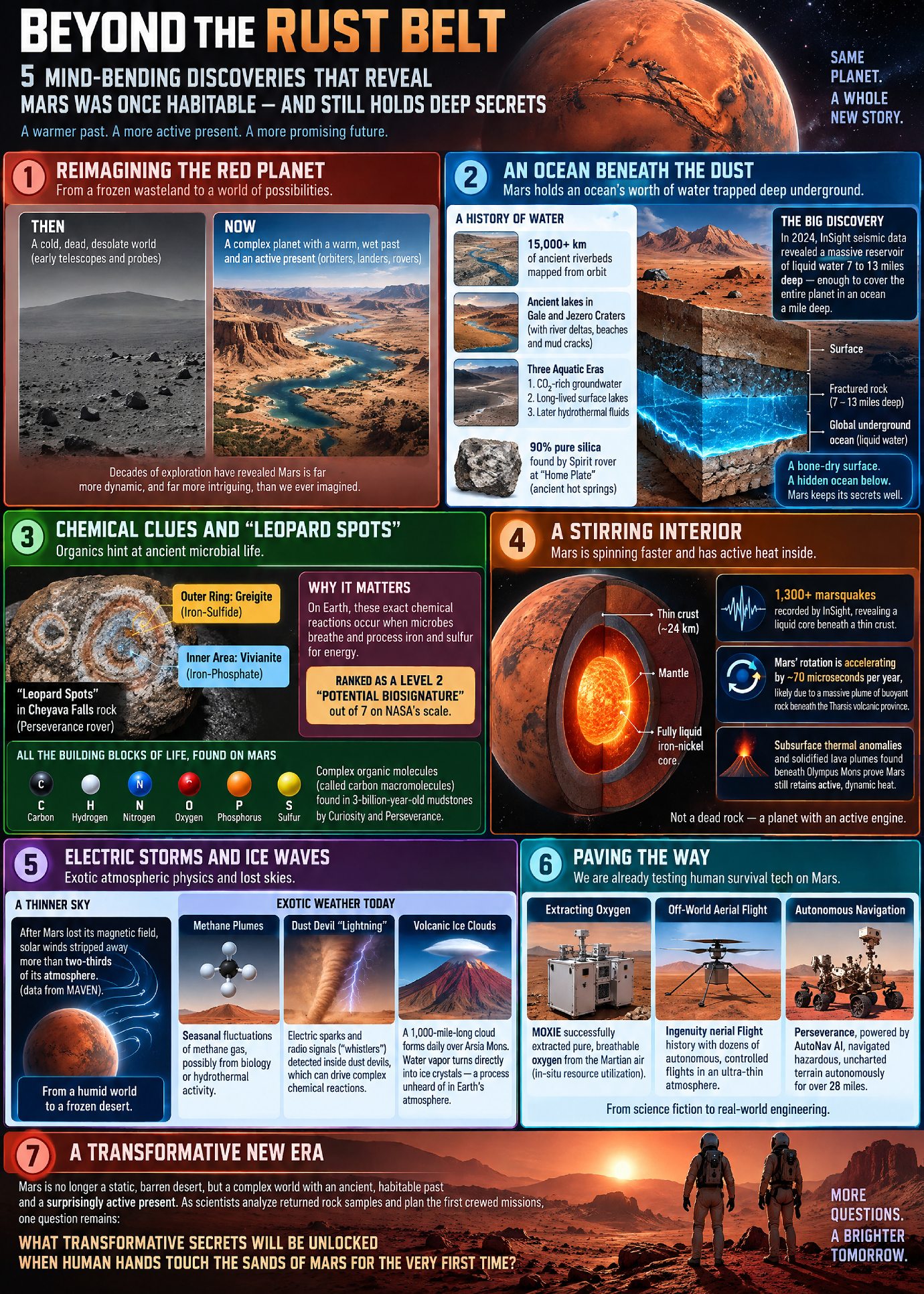
Beyond the Rust Belt: 5 Mind-Bending Discoveries That Reveal Mars Was Once Habitable—and Still Holds Deep Secrets
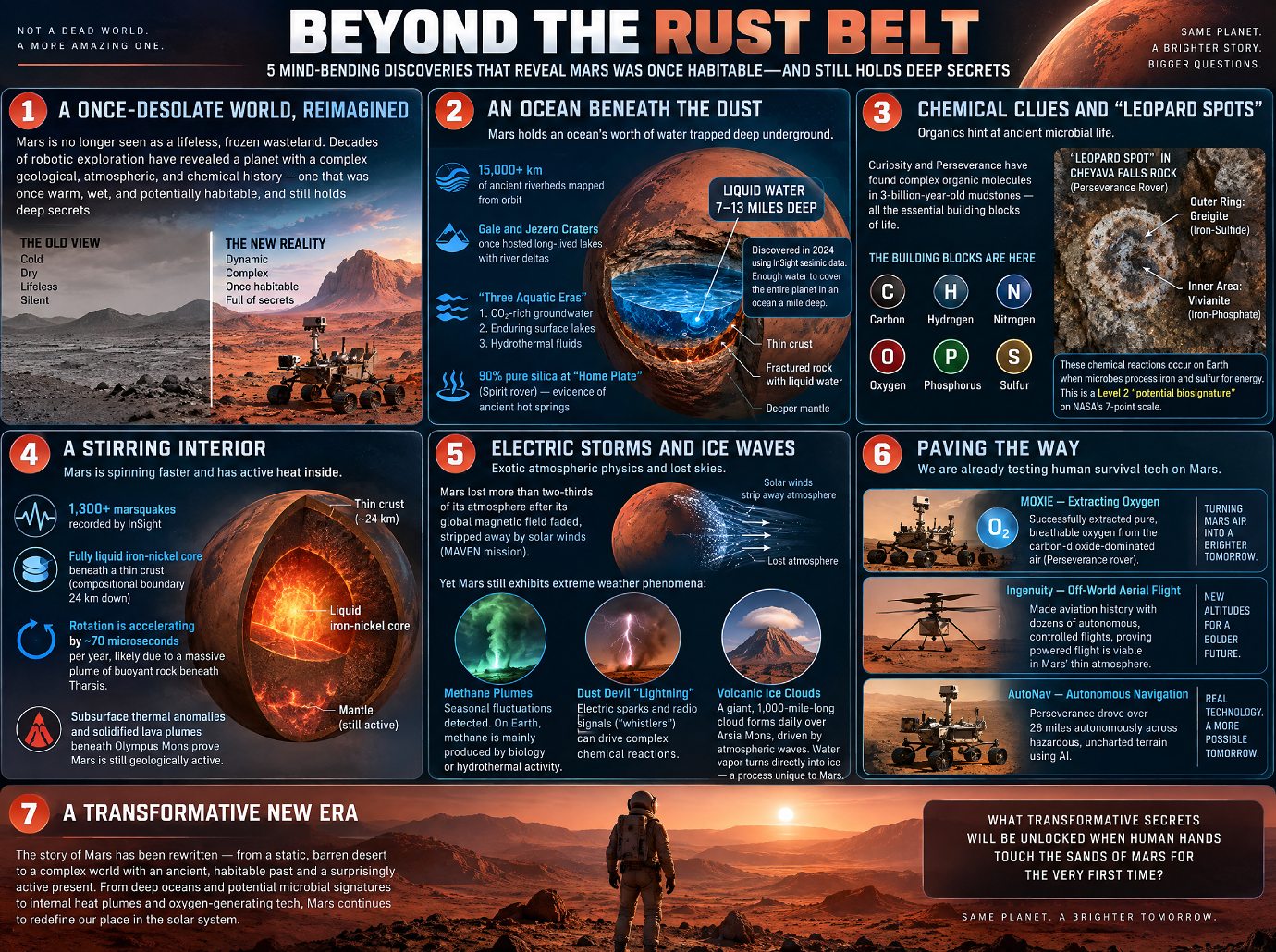
Beyond the Rust Belt: 5 Mind-Bending Discoveries That Reveal Mars Was Once Habitable—and Still Holds Deep Secrets
1. Introduction: Reimagining the Red Planet
For generations, Mars was viewed through telescopes and early probes as a frozen, desolate wasteland—a dead world locked in perpetual silence. However, decades of relentless robotic exploration by orbiters, landers, and rovers have shattered this simplistic image, revealing a planet defined by complex geological, atmospheric, and chemical systems. These missions have uncovered mind-bending realities about Mars’ past and present, proving it was once a warm, wet, and potentially habitable world that still holds deep secrets.
2. An Ocean Beneath the Dust: Mars Holds an Ocean’s Worth of Water Trapped Deep Underground
The absolute confirmation that Mars was once awash with liquid water is one of modern science’s greatest milestones. High-resolution orbital imagery has mapped over 15,000 kilometers of ancient riverbeds, while rovers like Curiosity and Perseverance have explored Gale and Jezero Craters, confirming these basins once hosted long-lived lakes fed by intricate river deltas. Modern analyses of Jezero’s “Margin Unit” have even revealed wave-formed ancient beaches, mud cracks from wet-and-dry seasonal cycles, and evidence that early Mars experienced “Three Aquatic Eras”: initial carbon-dioxide-rich groundwater seeping through rock fractures, enduring surface lakes, and later-stage boiling hydrothermal fluids moving underground. Elsewhere, the Spirit rover uncovered 90% pure silica at “Home Plate,” pointing to ancient hot springs or steam vents.
Yet, the most staggering water discovery came not from ancient surface rocks, but from deep within the planet itself.
“In 2024, scientists analyzing seismic data from the NASA InSight Lander discovered a massive reservoir of liquid water trapped in fractured rock 7 to 13 miles beneath the surface. It holds enough water to cover the entire planet in an ocean a mile deep.”
It is a striking irony that a planet celebrated for its bone-dry, hyper-arid surface conceals a global liquid ocean directly beneath its crust. While water ice remains locked away in polar caps, buried beneath equatorial regions like the Medusae Fossae Formation, and forming thin overnight frost atop giant Tharsis volcanoes, this deep liquid reservoir changes our entire understanding of the Martian hydrological story.
3. Chemical Clues and “Leopard Spots”: Organics Hint at Ancient Microbial Life
While scientists have not yet found definitive proof of past or present life, rovers have confirmed that ancient Mars possessed every required chemical ingredient for habitability. Both Curiosity and Perseverance have extracted rich deposits of complex organic molecules—carbon macromolecule chains resembling fragments of fatty acids—preserved within 3-billion-year-old mudstones.
The search reached an unprecedented milestone when Perseverance drilled into a rock named “Cheyava Falls” in the Bright Angel formation. The rock exhibited white, ringed features known as “leopard spots,” which are chemically enriched with iron-sulfide (greigite) and iron-phosphate (vivianite).
[Outer Ring: Greigite (Iron-Sulfide)]\( "Leopard Spot" )/[Inner Area: Vivianite (Iron-Phosphate)]
On Earth, these exact chemical reactions occur when subsurface microbes “breathe” and process iron and sulfur for energy. Because of this strong terrestrial parallel, the discovery ranks as a Level 2 “potential biosignature” out of 7 on NASA’s Confidence of Life Detection scale.
Analysis of drilled rock powder across multiple sites confirms the presence of all essential building blocks of life:
- Carbon
- Hydrogen
- Nitrogen
- Oxygen
- Phosphorus
- Sulfur
4. A Stirring Interior: Mars is Spinning Faster and Has Active Heat Inside
For decades, planetary scientists assumed Mars’ internal engine had cooled to a static state. NASA’s InSight lander fundamentally overturned this paradigm by acting as a stethoscope for the Red Planet, recording over 1,300 “marsquakes.” This seismic data revealed a fully liquid iron-nickel core wrapped beneath an unexpectedly thin crust, separated by a compositional boundary 24 kilometers down.
Even more surprising was the discovery that Mars’ rotation is accelerating by approximately 70 microseconds per year. Precise tracking indicates this acceleration is likely driven by a massive plume of buoyant rock shifting deep beneath the Tharsis volcanic province. Paired with subsurface thermal anomalies and solidified lava plumes detected beneath Olympus Mons, these findings prove that Mars is far from a geologically “dead” rock; its interior still retains active, dynamic heat.
5. Electric Storms and Ice Waves: Exotic Atmospheric Physics and Lost Skies
Mars was not always enveloped by its current thin atmospheric blanket. Data from NASA’s MAVEN mission revealed that after Mars lost its global magnetic field, powerful solar winds stripped away more than two-thirds of its atmosphere, transforming a humid world into a frozen desert.
Despite this thin air, Mars exhibits extreme, exotic weather phenomena:
- Methane Plumes: Robots periodically detect seasonal fluctuations of methane gas, a compound generated on Earth primarily through biology or hydrothermal activity.
- Dust Devil “Lightning”: Regional dust storms push hydrogen high into the atmosphere, accelerating water loss to space. Within these swirling dust devils, sensors have detected electric sparks and radio signals (“whistlers”) capable of driving complex chemical reactions.
- Volcanic Ice Clouds: A giant, 1,000-mile-long cloud forms and disappears daily over the Arsia Mons volcano, driven by massive atmospheric waves.
This Arsia Mons cloud phenomenon highlights a unique atmospheric mechanic: driven by extreme localized humidity, water vapor turns directly into ice crystals without requiring a solid condensation anchor point—a process unheard of in Earth’s atmosphere.
6. Paving the Way: We Are Already Testing Human Survival Tech on Mars
Mars is no longer just a subject of theoretical study; it is actively serving as a proving ground for technologies designed to sustain human life and expand off-world exploration.
- Extracting Oxygen: The MOXIE instrument aboard the Perseverance rover successfully demonstrated in-situ resource utilization by extracting pure, breathable oxygen directly from the carbon-dioxide-dominated Martian air.
- Off-World Aerial Flight: The Ingenuity helicopter made aviation history by executing dozens of autonomous, controlled flights, proving that powered flight is entirely viable within an ultra-thin atmosphere.
- Autonomous Navigation: Powered by AutoNav AI, Perseverance broke off-world driving records by navigating hazardous, uncharted terrain autonomously for over 28 miles.
These milestones represent the transition of planetary exploration from speculative science fiction into functional, operational engineering.
7. Conclusion: A Transformative New Era of Planetary Discovery
The story of Mars has been rewritten from that of a static, barren desert to a complex world defined by an ancient, habitable past and a surprisingly active present. From deep subsurface oceans and potential microbial signatures to internal heat plumes and oxygen-generating tech, the Red Planet continues to redefine our place in the solar system.
As scientists prepare to analyze returned Martian rock samples and space agencies plan the first crewed missions, one question remains: What transformative secrets will be unlocked when human hands touch the sands of Mars for the very first time?
=======================================================
Mars In-Situ Technology & Operational Capabilities: An Engineering Assessment for Planetary Exploration
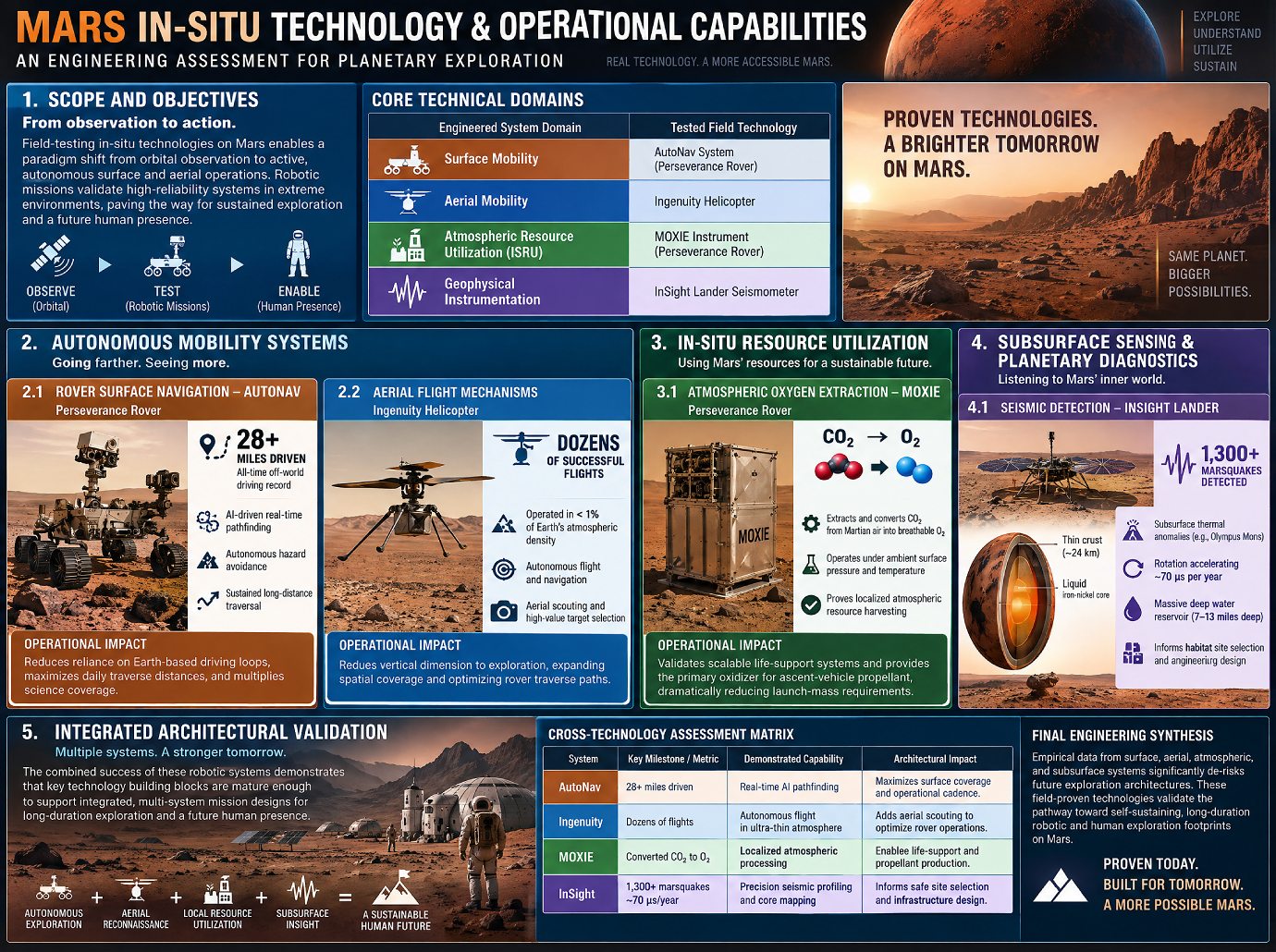
Mars In-Situ Technology & Operational Capabilities: An Engineering Assessment for Planetary Exploration
1. Scope and Objectives of the Engineering Assessment
Field-testing in-situ technologies directly on the Martian surface represents a vital paradigm shift in space systems engineering. Transitioning from purely orbital observation to active, autonomous ground and aerial operations allows engineering teams to validate the long-term mission architectures required for sustained planetary exploration and an eventual human presence. By deploying advanced autonomous systems, localized atmospheric processing units, and specialized subsurface instruments to Mars, robotic missions serve as operational testbeds for high-reliability systems operating in extreme, remote environments.
To systematically evaluate these field demonstrations, this engineering assessment synthesizes core technological capabilities across mobility, atmospheric resource conversion, and deep subsurface diagnostic domains using empirical data gathered from active surface missions.
Core Technical Domains
| Engineered System Domain | Tested Field Technology/Instrumentation |
|---|---|
| Autonomous Rover Surface Navigation | AutoNav System (Perseverance Rover) |
| Aerial Flight Mechanisms | Ingenuity Helicopter |
| Atmospheric Resource Utilization | MOXIE Instrument (Perseverance Rover) |
| Geophysical Diagnostic Instrumentation | InSight Lander Seismometer |
With this system evaluation framework established, the assessment turns first to the field performance of autonomous surface and aerial mobility platforms operating in harsh extraterrestrial environments.
2. Evaluation of Surface and Aerial Autonomous Mobility Systems
Operating mobile systems on Mars presents severe operational challenges, primarily driven by long signal-delay constraints inherent to remote teleoperations from Earth, hyper-arid and hazardous surface terrain, and an ultra-thin atmosphere that drastically restricts aerodynamic lift generation. Addressing these challenges requires high levels of onboard autonomy and resilient mechanical designs to reduce operational risk and maximize scientific return.
2.1 Autonomous Rover Surface Navigation (AutoNav)
Artificial Intelligence-driven navigation, embodied in the AutoNav system onboard the Perseverance rover, represents a major operational breakthrough in robotic surface traversal. Traditional rover driving relies heavily on ground-step command loops, where operators on Earth manually analyze terrain imagery before issuing tactical driving sequences over high-latency communication channels. AutoNav bypasses this tactical delay bottleneck by autonomously mapping hazardous terrain, identifying obstacles, and computing optimal driving paths in real time.
Field testing demonstrated AutoNav’s capacity for sustained, long-distance travel across complex planetary landscapes, culminating in Perseverance setting an all-time off-world driving record of over 28 total miles driven across the Martian surface.
Strategic Operational Impact: Autonomous surface navigation significantly reduces reliance on Earth-based tactical driving loops. By delegating real-time path planning and hazard avoidance to onboard AI systems, daily traverse distances are expanded, operational cadence is maximized, and the total spatial coverage of surface science missions is multiplied.
2.2 Aerial Flight Mechanisms in Ultra-Thin Atmospheres
Demonstrating powered, controlled flight on Mars required overcoming an atmospheric density that is less than one percent of Earth’s at sea level. The Ingenuity helicopter achieved this operational milestone by executing dozens of autonomous controlled flights through Mars’ extremely thin atmosphere.
Operating as an un-crewed technology demonstrator, Ingenuity proved the viability of off-world powered flight mechanisms, maintaining flight stability and navigating autonomously without human interaction during flight execution.
Strategic Operational Impact: The deployment of an aerial platform validates the architectural value of adding a vertical dimension to traditional surface operations. Aerial scouting expands spatial coverage far beyond the line-of-sight limits of ground rovers, facilitating rapid terrain assessment, high-value target selection, and hazard reconnaissance to optimize traverse path selection for surface rovers.
Beyond surface and aerial mobility platforms, expanding the scale of planetary missions requires localized resource harvesting, making atmospheric chemical processing a primary engineering focus.
3. In-Situ Resource Utilization (ISRU) and Atmospheric Processing
In-Situ Resource Utilization (ISRU) is an architectural necessity for long-duration planetary exploration. Launching all required consumables—particularly life-support breathing gases and return-trip propellant—from Earth imposes severe mass penalties on launch vehicles. Processing local atmospheric resources directly on Mars significantly reduces launch-mass requirements, mitigates payload penalties, and establishes the technological foundation for self-sustaining human outposts.
3.1 Atmospheric Oxygen Extraction (MOXIE Instrument)
The Mars Oxygen In-Situ Resource Utilization Experiment (MOXIE), integrated into the Perseverance rover, successfully demonstrated localized gas extraction and processing from ambient Martian air. The instrument draws in the thin, carbon-dioxide-dominated ($CO_2$) atmosphere and processes it through localized chemical conversion to isolate and generate breathable oxygen ($O_2$).
By continuously converting atmospheric carbon dioxide into elemental oxygen under ambient surface pressure and temperature constraints, MOXIE provided empirical validation of active atmospheric resource harvesting in an un-crewed space environment.
Strategic Operational Impact: Field-testing localized atmospheric conversion validates the foundational scalability of ISRU infrastructure. Proving that breathable $O_2$ can be extracted on-demand directly from Martian air establishes the technical baseline for future human life-support architectures. Furthermore, scaling this technology provides the primary oxidizer component required for local manufacturing of ascent-vehicle propellant, dramatically lowering the launch-mass infrastructure required for return missions to Earth.
Complementing surface mobility and atmospheric processing systems, subsurface diagnostic platforms provide essential physical data regarding internal planetary dynamics and structural integrity.
4. Planetary Geophysical Instrumentation and Subsurface Sensing
Evaluating subsurface planetary diagnostics is critical for understanding the internal dynamics, crustal composition, and seismic stability of an alien surface. Characterizing these geological and thermal properties directly informs structural engineering parameters, environmental safety bounds, and site selection for future surface infrastructure.
4.1 Seismic Detection and Interior Mapping (InSight Lander)
The InSight lander operated as a high-precision seismic station, utilizing its onboard seismometer to detect over 1,300 “marsquakes.” This extensive empirical dataset provided the baseline needed to construct the first detailed interior profile of Mars:
- Core and Crustal Architecture: Seismic wave propagation confirmed that Mars possesses a fully liquid iron-nickel core wrapped beneath an unexpectedly thin crust. This crust exhibits a distinct compositional boundary at a depth of 24 kilometers, reflecting a complex history of internal volcanic processing.
- Subsurface Thermal Anomalies: The seismometer identified deep thermal signatures and massive solidified lava plumes beneath prominent volcanic regions, including Olympus Mons and the broader Tharsis province.
- Rotational Acceleration Dynamics: Precision tracking of the lander demonstrated that Mars’ rotation is accelerating by approximately 70 microseconds per year. This dynamic acceleration is driven by a massive plume of buoyant rock shifting deep beneath the Tharsis volcanic region, proving that the planet’s interior retains active heat.
- Deep Fractured Rock Water Reservoirs: Seismic data analysis revealed a massive reservoir of liquid water trapped within fractured rock deep within the Martian crust, situated 7 to 13 miles below the surface. This deep underground reservoir holds enough liquid water to cover the entire planet in an ocean a mile deep.
Engineering Alignment & Site Selection: For systems engineers designing long-duration planetary infrastructure, these findings establish critical environmental baseline bounds. Mapping crustal stability, compositional boundaries, subsurface thermal plumes, and deep liquid water reservoirs ensures that future habitat structures, subsurface anchoring networks, and surface power infrastructure are engineered to withstand local seismic dynamics and geothermal conditions.
Synthesizing these localized technology demonstrations provides an integrated baseline for validating multi-system architectures required for sustained planetary footprints.
5. Integrated Architectural Validation for Future Human Presence
The operational successes achieved by individual robotic systems collectively demonstrate that key technology building blocks are mature enough to support integrated, multi-system mission designs. By validating autonomous navigation, aerial scouting, local resource extraction, and geophysical sensing in real Martian conditions, these technologies establish a multi-layered capabilities baseline for future exploration.
Cross-Technology Assessment Matrix
| In-Situ Technology System | Key Operational Milestone / Metric | Demonstrated Operational Capability | Architectural Impact for Future Missions |
|---|---|---|---|
| AutoNav (Perseverance Rover) | Smashed off-world driving record with 28+ miles driven | Real-time AI pathfinding and hazard avoidance over hazardous terrain | Mitigates tactical loop latency to maximize daily surface spatial coverage and operational cadence. |
| Ingenuity Helicopter | Executed dozens of autonomous flights through ultra-thin air | Autonomous, powered flight mechanisms operating in a thin atmosphere | Adds an aerial scouting dimension to surface operations, optimizing path selection for ground rovers. |
| MOXIE Instrument | Converted atmospheric $CO_2$ into breathable $O_2$ | Localized atmospheric gas extraction and chemical conversion | Validates field proof-of-concept for human life-support systems and scalable ascent-vehicle propellant production. |
| InSight Seismometer | Logged 1,300+ marsquakes; detected ~70 $\mu s$/year rotational acceleration | Precision seismic profiling, core mapping, and deep water reservoir identification | Informs habitat site selection, structural anchoring, and facility safety against crustal dynamics and thermal plumes. |
Final Engineering Synthesis
The empirical performance data gathered across these surface, airborne, and subsurface platforms significantly de-risks future planetary exploration architectures. By confirming that autonomous pathfinding, atmospheric resource conversion, extra-terrestrial flight, and deep geophysical diagnostics operate reliably under the extreme environmental conditions of Mars, these field-proven systems validate the technological pathway toward self-sustaining, long-duration robotic and human exploration footprints.
========================================================================
Unlocking the Secrets of Mars: How Scientists Discovered Water and the Search for Alien Life
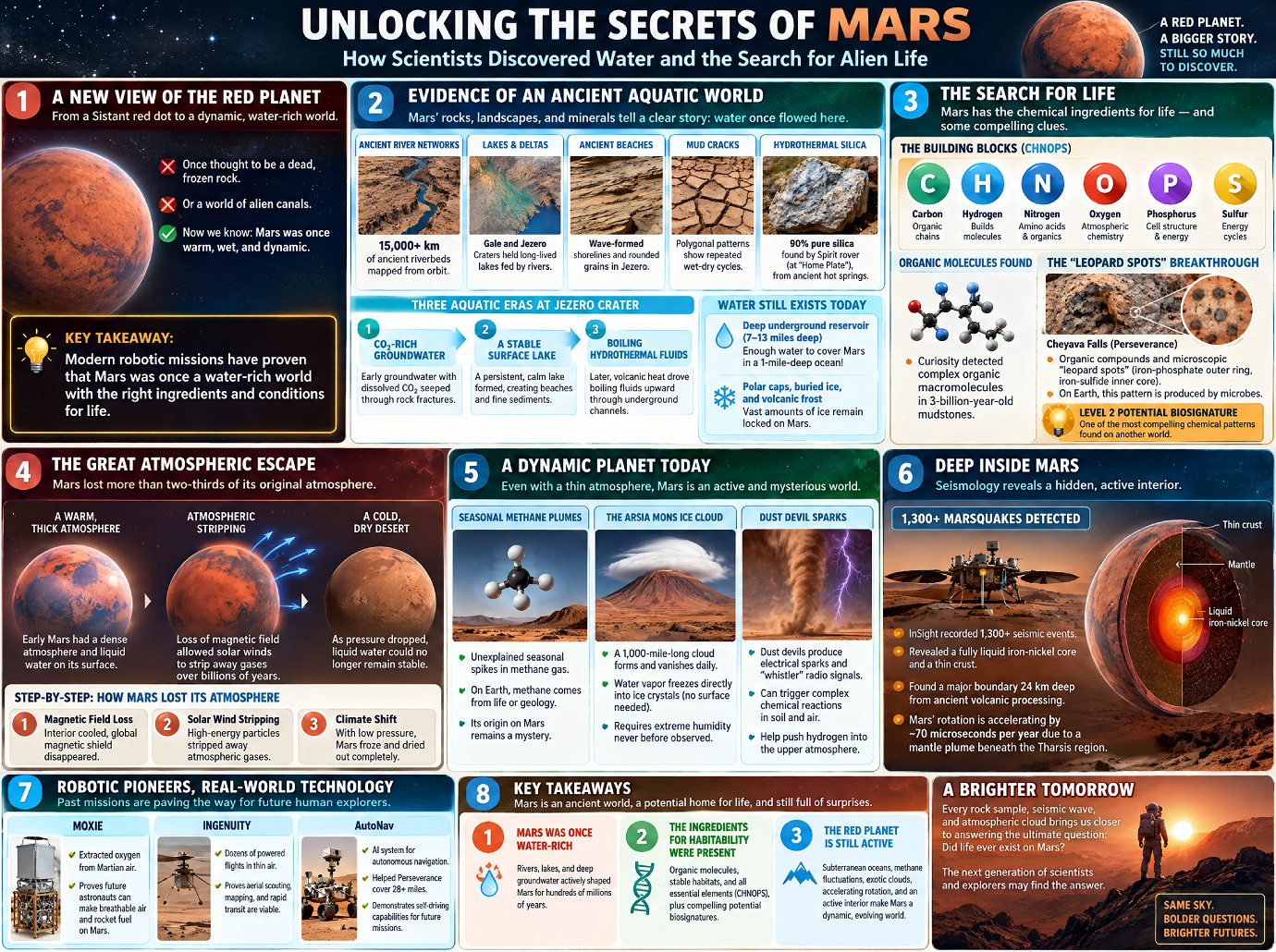
Unlocking the Secrets of Mars: How Scientists Discovered Water and the Search for Alien Life
1. Introduction: The Red Planet’s Greatest Mystery
When you look up at Mars in the night sky, it appears as a cold, distant, red pinpoint of light. For decades, popular culture imagined Mars as either a completely dead, frozen rock or a world crisscrossed by alien canals. Today, however, robotic exploration has revealed a far more dynamic and incredible truth: Mars was once a warm, wet world with complex geological, atmospheric, and chemical systems. This realization raises the ultimate question of modern planetary science: How do we know a cold, dry planet was once warm, wet, and potentially capable of hosting life?
Key Takeaway: Modern robotic missions have proven that Mars was once a water-rich, dynamic world equipped with the essential chemical ingredients and environmental conditions needed for life.
To understand this dramatic planetary transformation, we must turn from distant astronomical observations to the hard physical evidence written directly into the Martian rocks, atmosphere, and subsurface.
2. Following the Water: Evidence of an Ancient Aquatic World
2.1 Ancient Lakes, Rivers, and Shorelines
High-resolution cameras aboard orbital spacecraft have mapped more than 15,000 kilometers of ancient riverbeds and winding channels cutting across the Martian landscape. On the ground, the Curiosity and Perseverance rovers have explored giant impact basins like Gale Crater and Jezero Crater, confirming that these areas held long-lived lakes fed by complex river deltas billions of years ago.
The physical evidence for liquid water is preserved directly within the mineral textures and chemical patterns of the rock record:
| Geological Feature | What It Proves About Ancient Mars |
|---|---|
| Lake Beds & Deltas | Confirms that deep basins like Gale and Jezero held long-lived, stable bodies of liquid water fed by river networks billions of years ago. |
| Wave-Formed Ancient Beaches | Rounded mineral grains and wave-formed beach structures in Jezero Crater’s “Margin Unit” show that calm, stable lake surfaces persisted for extended periods. |
| Mud Cracks | Distinctive polygonal sedimentary patterns that reveal repeated wet-and-dry shrinking cycles, matching seasonal water cycles seen on Earth. |
| Hydrothermal Silica (90% Pure) | Discovered at “Home Plate” by the Spirit rover, indicating ancient hydrothermal (volcanically heated water or steam) environments such as hot springs or steam vents. |
2.2 The Three Aquatic Eras and Hidden Reservoirs
Detailed chemical analysis from Jezero Crater’s “Margin Unit” revealed that early Mars experienced a complex, evolving water cycle characterized by three distinct watery events:
- CO2-Rich Groundwater: Early in Martian history, subterranean groundwater saturated with dissolved carbon dioxide seeped through underground rock fractures.
- An Enduring Surface Lake: A stable early climate allowed a persistent, calm surface lake to form, carving shoreline beaches and depositing fine sedimentary layers over long periods.
- Boiling Hydrothermal Fluids: Later in the planet’s history, intense internal volcanic heat forced boiling hydrothermal fluids to migrate upward through subterranean rock channels.
While liquid surface water vanished long ago, vast quantities of liquid water and ice remain locked inside Mars today:
- The Deep Subterranean Reservoir: In 2024, scientists analyzing seismic data from the InSight lander discovered a massive reservoir of liquid water trapped in fractured rock 7 to 13 miles beneath the surface. This subterranean reservoir holds enough liquid water to cover the entire planet in an ocean a mile deep!
- Polar Caps & Glacial Ice: Vast reservoirs of water ice are frozen inside the polar ice caps, buried beneath equatorial dust layers in the Medusae Fossae Formation, and preserved as overnight volcanic frost atop the giant Tharsis volcanoes.
While proving that liquid water once flowed across Mars answers a fundamental geological question, it leads directly to an even deeper scientific mystery: did this ancient water contain the essential chemical building blocks required for life?
3. The Search for Life: Organics, Chemistry, and “Leopard Spots”
3.1 The Chemical Ingredients of Life
To evaluate whether Mars was ever inhabited, scientists search for organic molecules—carbon-based compounds that form the essential framework for living organisms. The Curiosity rover made a landmark discovery by drilling into 3-billion-year-old mudstones and detecting complex organic macromolecules (large, complex carbon chains resembling fragments of fatty acids).
Furthermore, laboratory tests conducted on drilled rock powder confirmed that ancient Mars possessed all the critical elemental building blocks of life, collectively known as CHNOPS:
- Carbon (C) & Hydrogen (H): The essential primary elements that form organic chains.
- Nitrogen (N) & Oxygen (O): Critical elements necessary for building amino acids, complex organic structures, and atmospheric chemistry.
- Phosphorus (P) & Sulfur (S): Crucial elements used by Earth organisms for cellular structure and energy transfer cycles.
3.2 Cheyava Falls and the “Leopard Spots” Breakthrough
The search for signs of ancient life reached an incredible milestone when the Perseverance rover analyzed a rock nicknamed “Cheyava Falls” inside the Bright Angel geological formation. The rock contains organic compounds, but what truly amazed scientists was the presence of microscopic “leopard spots”—small, light-colored patches bordered by dark, mineral-rich rings.
Chemical analysis revealed that these leopard spots possess a distinct mineral layout: an outer ring enriched with iron-phosphate (vivianite) and an inner core enriched with iron-sulfide (greigite). On Earth, these specific mineral combinations form in mudstones when microbes transfer electrons while “breathing” iron and sulfur to extract chemical energy.
Astrobiology Highlight: The discovery of “leopard spots” on Cheyava Falls ranks as a Level 2 Potential Biosignature on NASA’s 7-level Confidence of Life Detection scale. While not definitive proof of past biological life, it represents one of the most compelling chemical patterns found on another world—a specific mineral reaction that, on Earth, is routinely produced by living microbes.
As compelling as these signs of ancient habitability are, they raise a crucial question: how did such a wet, dynamically rich world lose its atmosphere and transform into a frozen desert?
4. The Great Atmospheric Escape: Why Mars Dried Up
4.1 Atmospheric Stripping and Lost Skies
Mars was not always the cold, thin-aired planet we see today. Data from NASA’s MAVEN (Mars Atmosphere and Volatile Evolution) mission revealed that Mars lost more than two-thirds of its original atmosphere to space over billions of years. This environmental collapse occurred through a step-by-step chain reaction:
- Magnetic Field Loss: As the small planet’s metallic interior cooled, Mars lost its protective global magnetic shield.
- Solar Wind Stripping: Without a magnetic field to deflect high-energy particles from the Sun, relentless solar winds slammed into the upper atmosphere, gradually stripping away its gases.
- Climate Shift to Frozen Desert: As atmospheric pressure plummeted, liquid surface water could no longer remain stable, causing the climate to freeze and dry out completely.
4.2 Exotic Martian Weather and Methane Mysteries
Even with its thin modern atmosphere, Mars exhibits remarkably dynamic and unusual weather phenomena:
🧪 Concept Card: Seasonal Methane Plumes Instruments on the surface have detected unexplained seasonal spikes and fluctuations in atmospheric methane gas. On Earth, methane is generated primarily by biological organisms (microbes) or active geological processes (hydrothermal reactions). Its exact origin on Mars remains one of planetary science’s greatest mysteries.
☁️ Concept Card: The Arsia Mons Ice Cloud A colossal, 1,000-mile-long cloud forms and vanishes daily over the Arsia Mons volcano. Driven by massive atmospheric waves over the peak, water vapor freezes directly into ice crystals without needing a physical condensation anchor point—a process requiring extreme relative humidity levels never before observed in planetary physics.
⚡ Concept Card: Dust Devil Sparks & Chemical “Lightning” Powerful regional dust storms act as environmental catalysts, pushing hydrogen gas into the upper atmosphere where it escapes into space. Inside Martian dust devils, instruments have detected radio signals known as “whistlers” and electrical sparks capable of triggering complex chemical reactions in the soil and air.
While atmospheric shifts and surface weather tell a story of dramatic changes above ground, scientists must peer deep beneath the surface to understand the planet’s internal engine.
5. Deep Inside Mars: Seismology and Robotic Pioneers
5.1 Listening to “Marsquakes” and Planetary Acceleration
In 2018, the NASA InSight lander arrived on Mars equipped with an ultra-sensitive seismometer—an instrument designed to detect and measure internal ground vibrations. Acting like a planet-sized stethoscope, InSight listened to seismic waves traveling through the interior to map Mars from the inside out.
Seismology Milestone: 1,300+ Marsquakes Detected By recording over 1,300 distinct seismic events, InSight allowed scientists to map the interior structure of Mars for the first time. The seismic data revealed that Mars possesses a fully liquid iron-nickel core wrapped beneath a surprisingly thin crust.
The seismic waves also revealed a distinct compositional boundary located 24 kilometers beneath the surface, pointing to an intense period of ancient volcanic crust processing. Furthermore, precision radio tracking from InSight yielded unexpected insights about the planet’s dynamic interior:
- Accelerating Planetary Rotation: Precise measurements revealed that Mars’ rotation speed is accelerating by roughly 70 microseconds per year.
- Active Interior Thermal Engine: This acceleration is driven by a massive plume of warm, buoyant rock (a mantle plume) shifting deep underground beneath the Tharsis volcanic region—matching subterranean thermal signatures detected beneath colossal volcanoes like Olympus Mons.
5.2 Next-Gen Robotic Tech for Future Explorers
Decades of scientific exploration have also served as a real-world testing ground for advanced technologies designed to support eventual human exploration of the Red Planet.
| Technology Name | What It Did | Why It Matters for Future Humans |
|---|---|---|
| MOXIE (Perseverance Instrument) | Successfully extracted oxygen molecules from the carbon-dioxide-dominated Martian air. | Proves that future astronauts can manufacture breathable air and rocket propellant directly on Mars. |
| Ingenuity (Autonomous Helicopter) | Executed dozens of controlled, powered flights through the thin Martian atmosphere. | Proves that aerial scouting, mapping, and rapid transit are viable on low-density planets. |
| AutoNav (AI Navigation System) | Enabled Perseverance to autonomously navigate complex hazards and avoid obstacles during its mission, covering over 28 total miles. | Demonstrates self-driving AI capabilities required for long-distance crewed and uncrewed rovers. |
These groundbreaking technological achievements not only decode Mars’ ancient past, but also build the vital bridge toward future human exploration.
6. Conclusion: The Legacy of Martian Exploration
Decades of robotic exploration have forever transformed our scientific textbooks. Mars is no longer understood as a dead, static rock drifting through space, but as an ancient world that once hosted sprawling river networks, deep lakes, organic molecules, active volcanoes, and dynamic chemical systems capable of supporting life.
While the fundamental question of whether life actually took root on Mars remains open, every rock sample drilled, seismic wave recorded, and atmospheric cloud tracked brings us closer to the answer. The ultimate discovery may well be made by the next generation of scientists and explorers.
3 Core Takeaways for the Aspiring Planetary Scientist
- Mars Was Once Water-Rich: Driven by river networks, long-lived lakes, and deep groundwater systems, liquid water actively shaped Mars for hundreds of millions of years before being lost to space or frozen underground.
- The Ingredients for Habitability Were Present: Curiosity and Perseverance proved that ancient Mars contained organic molecules, stable habitats, and all essential chemical elements (CHNOPS), alongside compelling potential biosignatures like “leopard spots.”
- The Red Planet Is Still Active: From deep subterranean oceans of liquid water and accelerating planetary rotations to seasonal methane fluctuations and exotic cloud physics, Mars remains a dynamic, evolving world.
========================================================================
Journey to the Center of Mars: Unlocking the Deep Secrets of the Red Planet
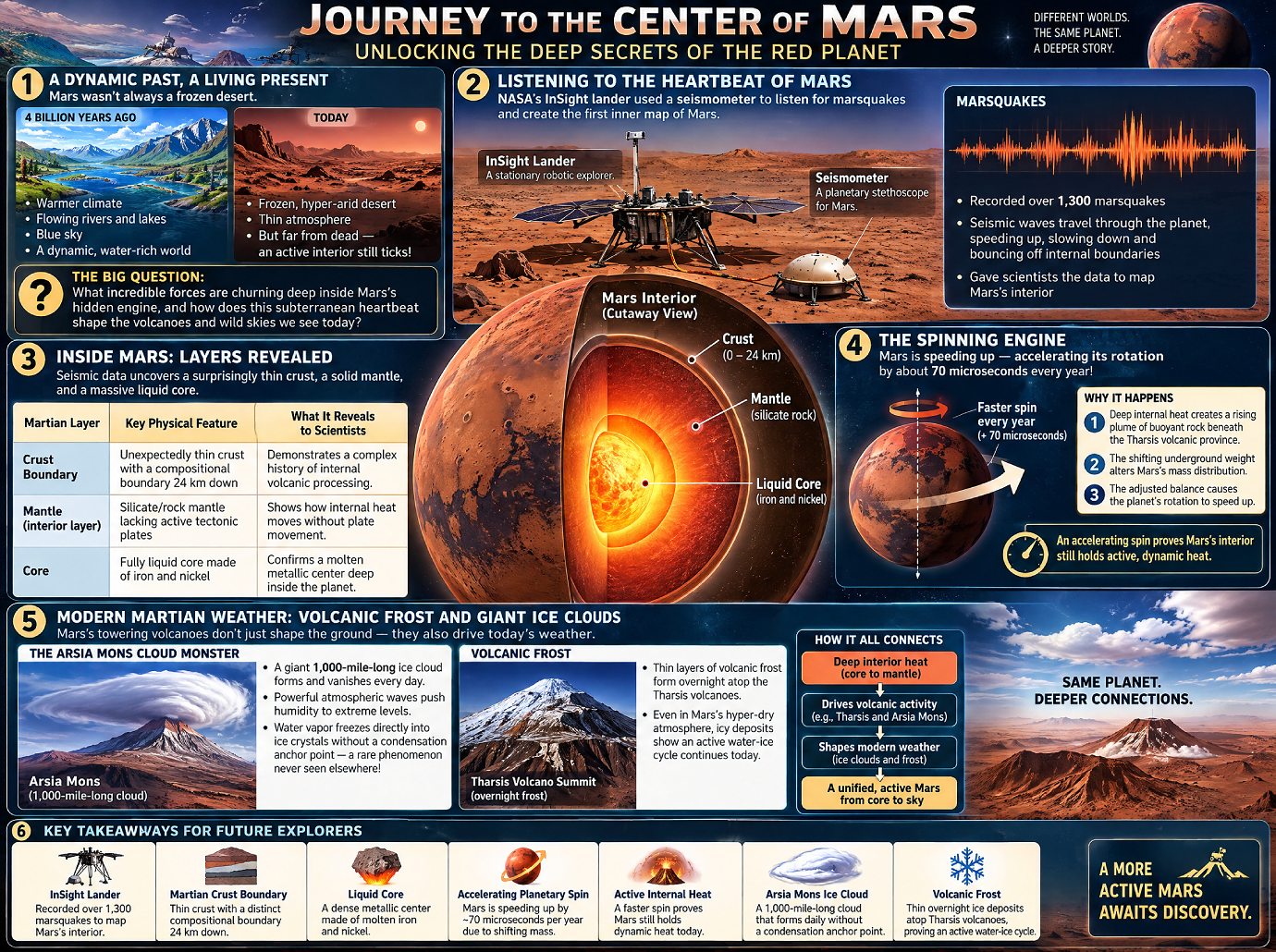
Journey to the Center of Mars: Unlocking the Deep Secrets of the Red Planet
1. Introduction: Uncovering the Hidden Interior of Mars
Imagine standing on Mars four billion years ago. Instead of a quiet red wasteland, you would feel warm breezes, watch roaring rivers carve across the landscape, and look up at a blue sky overhead! Back then, Mars was a dynamic world flowing with liquid water. Over billions of years, however, the planet underwent a dramatic planetary transformation, evolving from a warm, wet environment into the frozen, hyper-arid desert we see today. Yet beneath this quiet crust lies a secret: Mars is far from dead! Deep underground, an active planetary engine is still ticking. Scientists are actively uncovering this subterranean world to understand how the Red Planet evolved and what is happening within its mysterious interior.
The Big Question: What incredible forces are churning deep inside Mars’s hidden engine, and how does this subterranean heartbeat shape the fiery volcanoes and wild skies of the Red Planet today?
To answer this mystery, researchers had to look far beyond surface rocks and deploy super-smart robotic space tools designed to probe deep beneath the planet’s reddish dust.
2. Listening to the Heartbeat of Mars: Marsquakes and the InSight Lander
Humanity’s quest to peer deep inside Mars took a giant leap forward when NASA landed the InSight spacecraft on the Martian surface. Instead of driving around on wheels, InSight stayed in one spot and deployed a delicate, ultra-sensitive seismometer onto the ground. This tool acted like a planetary stethoscope, listening closely to the deep, rumbling vibrations traveling through the planet’s body.
2.1 The InSight “Stethoscope”
Unlike Earth, which is constantly reshaped by shifting tectonic plates that grind together and trigger massive earthquakes, Mars lacks moving surface plates. Even so, InSight’s planetary stethoscope recorded over 1,300 “marsquakes”—seismic vibrations caused by internal cooling, cracking, and stress. As these seismic waves traveled through the planet, they sped up, slowed down, and bounced off internal boundaries, giving scientists the data needed to draw the very first inner map of Mars.
2.2 The Crust and Upper Layers
Seismic data revealed that Mars has an unexpectedly thin outer crust. Exactly 24 kilometers beneath the surface, scientists discovered a sharp compositional boundary. Think of this layer like a cooling baked cake or warm wax floating on water: as ancient molten rock cooled, lighter minerals floated toward the top while denser elements sank, creating distinct geological layers. Beneath this boundary sits the rock mantle. Because Mars lacks moving tectonic plates, heat does not escape through shifting crustal plates; instead, thermal energy moves through this solid silicate mantle layer to drive slow subterranean volcanic processes beneath the crust.
2.3 The Hidden Core
At the very center of the planet rests a massive, dense core made entirely of liquid iron and nickel. This molten core sits beneath the mantle, giving scientists critical clues about how Mars formed and why its planetary evolution diverged so dramatically from Earth’s.
| Martian Layer | Key Physical Feature | What It Reveals to Scientists |
|---|---|---|
| Crust Boundary | Unexpectedly thin crust with a compositional boundary 24 kilometers down | Demonstrates a complex history of internal volcanic processing. |
| Interior Layer | Silicate/rock mantle lacking active tectonic plates | Shows how internal heat moves without plate movement. |
| Core | Fully liquid core made of iron and nickel | Confirms a molten metallic center deep inside the planet. |
By catching these faint seismic echoes to construct an inner map, scientists made another surprising discovery: tracking the motion deep inside Mars also allows us to measure subtle changes in how fast the whole planet spins through space.
3. The Spinning Engine: Core Dynamics and Accelerating Rotation
When scientists carefully tracked Mars’s spin, they made a mind-blowing discovery: the Red Planet is not spinning at a constant speed. Instead, Mars is actually speeding up, accelerating its rotation by about 70 microseconds every single year!
To understand why an entire planet would spin faster, imagine a figure skater pulling their arms tightly toward their chest to spin quicker. Deep inside Mars, massive shifts of material are altering the planet’s balance from the inside out:
- Deep internal heat creates a rising plume of buoyant rock beneath the colossal Tharsis volcanic province.
- The shifting of this massive underground weight alters the planet’s overall mass distribution and balance.
- The adjusted mass balance causes the entire planetary rotation to accelerate slightly each year.
This accelerating spin proves that Mars’s interior still holds active, dynamic heat.
This restless internal heat does not stop at shifting the planet’s spin; it also pushes its energy high above the surface, driving extreme weather patterns around giant volcanic peaks.
4. Modern Martian Weather: Volcanic Frost and Giant Ice Clouds
The gargantuan volcanoes built by Mars’s internal heat millions of years ago continue to play an active role in shaping the modern Martian climate today.
4.1 The Arsia Mons Cloud Monster
High atop the giant Arsia Mons volcano, atmospheric conditions trigger a mind-boggling phenomenon: a giant 1,000-mile-long ice cloud that forms and vanishes every single day. Massive atmospheric waves sweeping over the volcano push localized relative humidity to extreme levels. Normally, clouds or rain on Earth require a “condensation anchor point”—such as a microscopic spec of floating dust—for water vapor to cling to before freezing. But under Mars’s extreme atmospheric waves, water vapor freezes directly into pure ice crystals right out of thin air without needing an anchor point at all. This direct freezing mechanism is a rare atmospheric physics phenomenon never before seen anywhere else in planetary weather!
4.2 Volcano Tops and Overnight Frost
High above the Martian dust, orbiters scanning the summits of the giant Tharsis volcanoes spotted another cool surprise: thin layers of volcanic frost that form overnight. Even though the atmosphere on Mars is hyper-dry, these delicate icy deposits show that an active water-ice cycle continues to interact with the tallest peaks on the planet today.
| Weather Phenomenon | Location | Unique Atmospheric Condition | What It Tells Us |
|---|---|---|---|
| Arsia Mons Ice Cloud | Arsia Mons Volcano | Water vapor freezes directly into ice crystals under extreme humidity driven by atmospheric waves | Shows unique atmospheric wave physics and extreme localized humidity. |
| Volcanic Frost | Summits of Tharsis Volcanoes | Thin frost layers forming overnight atop massive peaks | Reveals ongoing modern water-ice cycling at extreme surface elevations. |
Connecting deep seismic echoes beneath the crust with high-altitude atmospheric clouds gives scientists a complete, unified understanding of how Mars operates as an active planetary engine from core to sky.
5. Summary: Key Takeaways for Future Explorers
Flashcard Review
- InSight Lander: A stationary robotic explorer equipped with a sensitive seismometer that acted like a planetary stethoscope, recording over 1,300 marsquakes to map Mars’s internal layout.
- Martian Crust Boundary: An unexpectedly thin outer layer marked by a distinct compositional boundary 24 kilometers down, revealing how ancient melting and chemical separation built the planet’s layers.
- Liquid Core: A dense metallic center made of molten iron and nickel located deep beneath Mars’s solid silicate mantle.
- Accelerating Planetary Spin: Precise measurements show Mars is speeding up its rotation by approximately 70 microseconds per year due to shifting mass deep underground.
- Active Internal Heat: The discovery that Mars is spinning faster proves that the Red Planet’s deep interior still retains active, dynamic heat today.
- Arsia Mons Ice Cloud: A 1,000-mile-long cloud that forms daily when powerful atmospheric waves force water vapor to freeze into ice crystals without a condensation anchor point.
- Volcanic Frost: Thin overnight ice deposits discovered atop the colossal Tharsis volcanic summits, proving that an active water-ice cycle interacts with surface features today.
=======================================================
Scientific Synthesis: Martian Habitability, Atmospheric Evolution, and Exploration Priorities
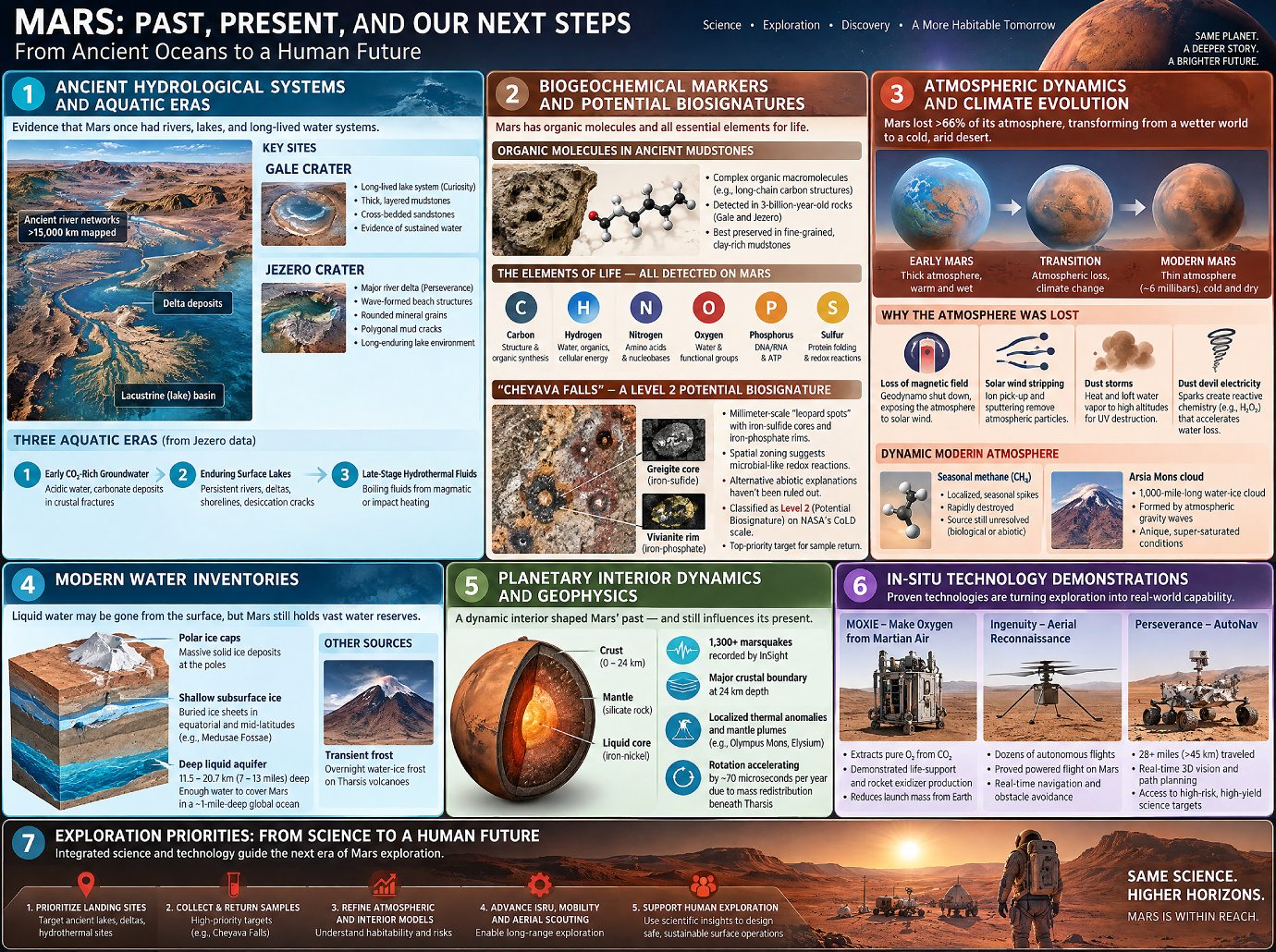
Scientific Synthesis: Martian Habitability, Atmospheric Evolution, and Exploration Priorities
1. Ancient Hydrological Systems and Aquatic Eras
The characterization of Martian paleohydrology provides the foundational empirical framework for reconstructing the planet’s early climate state, evaluating its thermal evolution, and constraining the temporal window of surface habitability. Over decades of orbital mapping and surface exploration, the identification and analysis of ancient aqueous systems have transformed our paradigm of Mars from a statically cold world to a dynamically evolving planet capable of sustaining stable surface and subsurface hydrological cycles. Mapping the duration, chemical activity, and physical manifestations of these ancient water networks is strategically vital for prioritizing high-yield landing sites, defining sample cache targets, and assessing the long-term biological potential of the Martian crust.
1.1 Surface Water Networks and Sedimentary Basins
Synthesized high-resolution orbital observations and direct ground-truth measurements from surface rovers confirm that liquid water was a major geomorphic agent on early Mars. Orbital imaging has identified over 15,000 kilometers of ancient riverbeds, branching valley networks, and sinuous deltaic channels carved into the Noachian and Hesperian terranes. In situ exploration by NASA’s Curiosity and Perseverance rovers within major impact structures has confirmed that these surface networks fed persistent, long-lived lacustrine systems capable of driving extensive sediment deposition and mineral alteration.
| Surface Water Site | Diagnostic Aqueous Features and Sedimentological Evidence |
|---|---|
| Gale Crater | Proven by the Curiosity rover to have hosted a prolonged lacustrine system sustained by regional alluvial and river networks. Sedimentological sequences reveal thick, stratified mudstone strata and cross-bedded sandstones that record long-duration aqueous deposition, fluvio-lacustrine transport, and sustained fluid-rock interactions within an ancient closed-basin lake. |
| Jezero Crater | Identified as an ancient impact basin that intercepted major river systems, forming extensive delta deposits. Analysis of Jezero’s key geochemical formations—specifically the “Margin Unit”—yields diagnostic evidence of wave-formed beach structures, rounded mineral grains produced by high-energy littoral agitation, and polygonal mud cracks formed during seasonal, wet-dry desiccation cycles in an enduring lake environment. |
1.2 Evolution of Aquatic Eras and Hydrothermal Environments
Detailed mineralogical and stratigraphical analyses derived from Jezero Crater’s “Margin Unit” reveal that Mars experienced a complex, multi-phase hydrological progression rather than a single uninterrupted wet period. Geochemical data indicate three distinct aquatic eras that altered the early crust:
- Early Carbon-Dioxide-Rich Groundwater: Fractures within foundational bedrock exhibit extensive carbonate deposition and aqueous alteration patterns, recording an early regime where carbon-dioxide-enriched, acidic groundwater percolated through subsurface crustal fracture networks.
- Enduring Surface Lake Systems: A period of persistent surface runoff and open-basin lakes, characterized by high-volume river deltas, wave-worked shoreline deposits, and seasonal desiccation cracking indicative of standing surface water under stable atmospheric pressures.
- Late-Stage Hydrothermal Fluids: Post-depositional intrusive events driven by localized magmatic or impact heating forced subterranean, boiling hydrothermal fluids through fracture networks, cross-cutting earlier sedimentary strata.
This chemical progression from early CO₂-rich acidic groundwater to neutral lacustrine waters and late-stage hydrothermal fluids directly dictated the concentration and preservation potential of pre-biotic chemistry. Neutral-to-alkaline surface waters facilitated the accumulation of clays capable of binding organic molecules, while late-stage hydrothermal systems supplied thermodynamic disequilibrium—the essential chemical energy gradients necessary to drive pre-biotic synthesis and concentrate bio-essential elements.
High-energy hydrothermal environments are further confirmed elsewhere on Mars. The Spirit rover’s discovery of 90% pure silica at the “Home Plate” formation in Gusev Crater provides direct evidence for ancient localized steam vents or hot springs. On Earth, high-silica hydrothermal discharge sites represent top-priority astrobiological targets because rapid silica precipitation entombs micro-organisms and preserves delicate organic structures, making these formations key analog targets for landing site qualification and in situ life-detection payloads.
1.3 Modern Water Inventories and Subsurface Reservoirs
While modern atmospheric pressures and surface temperatures preclude the long-term stability of liquid water on the Martian surface today, Mars retains a massive volatile inventory sequestered across distinct deep and shallow reservoirs:
- Deep Liquid Crustal Reservoir: Inversion of seismic dataset from the NASA InSight lander revealed a colossal deep aquifer composed of liquid water trapped within fractured crustal rock at depths between 7 and 13 miles (11.5 to 20.7 km). Quantitative modeling indicates this deep crustal reservoir contains sufficient liquid volume to cover the entire planet in a global ocean approximately 1 mile deep.
- Shallow Cryosphere and Polar Deposits: Massive volumes of solid water ice reside within the polar ice caps and layered terrain. In equatorial and mid-latitude regions, extensive ice sheets are buried beneath shallow dust layers, including sub-surface ice deposits within the Medusae Fossae Formation. Orbiters have also documented transient overnight water-ice frost forming topographically atop the elevated volcanic summits of the Tharsis region.
Understanding the temporal evolution and current spatial distribution of liquid and frozen water inventories establishes the necessary geochemical context for evaluating how organic compounds were synthesized, transported, and preserved across Martian history.
2. Biogeochemical Markers and Potential Biosignatures
Determining whether life ever emerged on Mars requires an rigorous astrobiological methodology centered on identifying organic carbon inventories, mapped spatial distributions of life-sustaining elements, and localized chemical anomalies that exhibit signs of biological processing. Frameworks for evaluates these biogeochemical markers govern candidate sample selection for Mars Sample Return (MSR) and guide environmental containment strategies under planetary protection directives.
2.1 Organic Molecule Inventories and Essential Elements
Analytical instruments aboard the Curiosity and Perseverance rovers have confirmed that ancient Martian sedimentary environments contained both complex organic compounds and the full suite of chemical elements required to sustain biological systems. Organic preservation is directly linked to fine-grained clay-rich mudstones:
- Complex Organic Macromolecules: Thermal evasion and gas chromatography-mass spectrometry analyses of 3-billion-year-old mudstone samples from Gale and Jezero craters have detected complex macromolecular carbon structures, including long-chain carbon structures consistent with fragments of fatty acids.
- Essential Elemental Building Blocks: Chemical assays of drilled rock powders have verified the continuous availability of the six key elemental ingredients of terrestrial biology:
- Carbon (C): The essential structural backbone for complex macromolecular architecture and biochemical synthesis.
- Hydrogen (H): Required for aqueous solvent dynamics, organic composition, and cellular membrane potential.
- Nitrogen (N): Crucial for the synthesis of amino acids, nucleobases, and nitrogenous metabolic intermediates.
- Oxygen (O): Primary constituent of biological water, structural oxides, and key functional groups in organic molecules.
- Phosphorus (P): Essential for nucleic acid backbones (DNA/RNA) and intracellular energy currency (ATP).
- Sulfur (S): Critical for structural protein folding and functioning as a metabolic electron donor/acceptor in microbial redox reactions.
2.2 Deep Dive: “Cheyava Falls” and the Search for Biosignatures
The Perseverance rover’s analysis of the “Cheyava Falls” outcrop within the Bright Angel formation identified a chemically complex rock matrix containing organic macromolecules spatialized alongside distinct mineralogical structures. The rock display millimeter-scale, multi-toned “leopard spots” embedded within an iron-rich mudstone fabric. Chemical mapping demonstrates that these spots feature a central core enriched in iron-sulfide (greigite) surrounded by outer rims enriched in iron-phosphate (vivianite).
The spatial zoning of greigite and vivianite within these spots provides compelling evidence for metabolic oxidation-reduction (redox) reactions. In terrestrial analog settings, such localized mineral distribution is driven by microbial electron transfer reactions during anaerobic respiration. Micro-organisms “breathe” iron and sulfur, reducing ferric iron ($Fe^{3+}$) and sulfate ($SO_4^{2-}$) in the surrounding rock matrix to precipitate insoluble ferrous sulfide (greigite) cores and iron phosphate (vivianite) outer boundaries. This spatial zoning reflects localized energy extraction along sharp redox interfaces.
Because abiotic mechanisms—such as late-stage hydrothermal alteration or non-biological redox fluid mixing—cannot be entirely excluded without returning the sample for atom-probe tomography and isotopic ratio mass spectrometry in terrestrial laboratories, “Cheyava Falls” is formally classified as a Level 2 “Potential Biosignature” on NASA’s 7-level Confidence of Life Detection (CoLD) scale. This finding represents the highest-priority target candidate for sample collection, defining strict operational protocols for sample caching, hermetic sealing, and biological containment analysis for future Mars Sample Return architectures.
While fine-grained sedimentary mudstones preserved localized biosignatures and organic molecules within the crust, global atmospheric erosion mechanisms systematically degraded surface habitability over geological timescales.
3. Atmospheric Dynamics, Stripping Mechanisms, and Climate Evolution
Reconstructing the operational drivers of Martian climate evolution is vital for understanding how a planet once capable of maintaining surface liquid water degraded into a hyper-arid, radiation-dominated desert. Atmospheric escape physics directly constrain the duration of the planet’s habitable surface window and inform atmospheric density models required for Entry, Descent, and Landing (EDL) operations.
3.1 Global Atmospheric Loss and Stripping Dynamics
Measurements collected by the NASA MAVEN (Mars Atmosphere and Volatile EvolutioN) spacecraft demonstrate that Mars lost more than two-thirds (>66%) of its total atmospheric mass to space over the past 4 billion years. The primary driver of this catastrophic loss was the decay and complete shutdown of the internal geodynamo, which eliminated the global protective magnetic field. Stripped of a magnetosphere, the upper atmosphere was directly exposed to unshielded solar wind ion impact, driving upper-atmospheric ion pick-up and sputtering processes.
This global atmospheric escape is significantly accelerated by seasonal low-altitude weather dynamics:
- Dust Storm Water Lofting: Regional and global dust storms act as thermal engines, warming the middle atmosphere and lofting water vapor to extreme altitudes. At high elevations, unshielded solar ultraviolet radiation dissociates water molecules into hydrogen and oxygen, allowing light hydrogen to rapidly escape into space.
- Dust Devil Electrochemistry: Intense electrical activity within Martian dust devils—manifested as high-frequency radio bursts (“whistlers”) and localized electric sparks—drives energetic chemical reactions. These discharge events break down atmospheric water vapor and carbon dioxide, forming reactive oxidants ($H_2O_2$) that further destabilize atmospheric water cycles and accelerate volatile loss.
3.2 Transient Atmospheric Phenomena and Chemical Anomalies
Despite its thin modern state (~6 millibars average surface pressure), the Martian atmosphere exhibits dynamic chemical and physical behaviors:
- Seasonal Methane Cycles: Orbiters and surface rovers have confirmed localized, seasonal spikes and background fluctuations of atmospheric methane ($CH_4$). Because methane is rapidly degraded by solar radiation and atmospheric oxidants, these detection spikes require active localized sources. The primary source remains unresolved, representing a competing signal between biological methanogenesis and abiotic serpentinization during subterranean fluid-rock reactions.
- Arsia Mons Cloud Dynamics: A recurring, 1,000-mile-long water-ice cloud routinely forms over the summit of the Arsia Mons volcano. Driven by massive atmospheric gravity waves forced over the volcanic structure, water vapor undergoes a direct phase change into ice crystals without requiring particulate condensation nuclei under localized, super-saturated relative humidity conditions previously unobserved in planetary atmospheric physics.
The primary driver responsible for atmospheric loss—the loss of the global magnetic field—is fundamentally controlled by the internal thermal history and geophysical structure of the Martian interior.
4. Planetary Interior Dynamics and Geophysics
Probing the internal architecture of Mars is critical for characterizing the planet’s thermal history, structural evolution, and mantle dynamics. Deep geophysical data explain the cessation of early crustal generation, clarify the structural stability of the lithosphere, and provide baseline constraints for long-term surface installation safety and human base placement.
4.1 Seismic Architecture and Core-Crust Structure
The NASA InSight lander operated as a high-precision geophysical station, recording over 1,300 distinct “marsquakes” during its surface deployment. Analyses of these seismic wave propagation profiles resolved the fundamental interior layer boundaries of the planet:
- Core Architecture: Mars possesses a fully liquid iron-nickel core, surrounded by an silicate mantle.
- Crustal Stratigraphy and Volcanic Differentiation: Seismic phase transitions revealed a sharp, major compositional boundary at a depth of 24 kilometers within the crust. This sharp structural boundary, revealed by seismic wave reflection and refraction, indicates early, highly efficient internal volcanic processing and magma ocean differentiation, rather than ongoing plate tectonics.
4.2 Internal Energy, Volcanism, and Rotational Dynamics
Seismic data and precision orbital radio tracking demonstrate that the Martian interior retains dynamic mantle processes and localized thermal activity:
- Subsurface Thermal Anomalies: Geophysical observations demonstrate localized thermal anomalies and massive, solidified lava plumes beneath major volcanic provinces, particularly Olympus Mons and Elysium Planitia, confirming that internal mantle convection and localized hotspot heating persist at low levels.
- Rotational Acceleration: Long-term precision tracking of InSight’s radio transponder established that Mars’ rotation rate is accelerating by approximately 70 microseconds per year. Geodynamical modeling indicates this rotational acceleration is driven by deep mass redistribution, specifically a massive, buoyant plume of warm silicate mantle rock rising slowly beneath the Tharsis volcanic province.
Understanding these interior geophysical conditions and structural constraints provides the engineering parameters needed to design surface assets and deploy advanced in-situ technology pathfinders.
5. In-Situ Technology Demonstrations and Future Exploration Architecture
Transitioning from robotic scientific scouting to integrated surface exploration requires validating key pathfinder technologies directly within the Martian environment. Demonstrating autonomous resource conversion, powered aerial mobility, and high-speed long-distance surface navigation bridges scientific discovery with operational landing site selection, sample collection, and future human exploration architectures.
5.1 Resource Extraction and Atmospheric Flight Capabilities
Recent surface operations have achieved groundbreaking technical benchmarks in resource utilization and flight dynamics:
- In-Situ Resource Utilization (MOXIE): The Mars Oxygen In-Situ Resource Utilization Experiment aboard the Perseverance rover successfully extracted pure, breathable oxygen ($O_2$) from the carbon dioxide ($CO_2$) atmospheric matrix using solid oxide electrolysis. MOXIE demonstrated that atmospheric ISRU can reliably produce life-support consumables and oxidizer for ascent vehicle propulsion directly from the ambient Martian air, reducing required launch mass from Earth.
- Autonomous Aerial Reconnaissance (Ingenuity): The Ingenuity helicopter performed dozens of controlled, autonomous flights in the thin atmospheric density of Mars (equivalent to >100,000 feet on Earth). Ingenuity proved the mechanics of planetary aerial flight, validating real-time optical-flow flight control algorithms and demonstrating low-altitude regional scouting outside the line-of-sight and physical obstacle limits of ground rovers.
5.2 Surface Mobility Metrics and Autonomous Navigation
Surface travel efficiency and site targeting criteria have been expanded through high-level autonomous navigation software (AutoNav) integrated directly into rover drive architectures:
- Autonomous Drive Software (AutoNav): By utilizing real-time 3D stereo vision processing, hazard mapping, and dynamic path-planning algorithms onboard, Perseverance circumvented traditional ground-command latency constraints. AutoNav allowed real-time obstacle avoidance over complex, high-risk crater terranes, enabling Perseverance to set off-world driving distance records by traversing over 28 total miles (>45 kilometers) across Jezero Crater.
This leap in autonomous surface mobility fundamentally redefines mission targeting criteria for future Mars Sample Return and human landing site selection. Historically, landing sites were strictly constrained to broad, topographically flat, and geologically uniform plains to avoid landing hazards. Autonomous high-speed mobility allows future landing architectures to select flat, safe touchdown ellipses located kilometers away from hazardous terrain, relying on long-range autonomous vehicles to traverse directly into high-risk, high-yield science targets—such as rugged delta fronts, fractured silica vents, and steep crater rim exposures.
Integrated scientific syntheses and validated technical pathfinders collectively redefine the future strategy of Mars exploration. Mapping ancient aquatic environments, identifying potential biosignatures like “Cheyava Falls,” modeling atmospheric loss dynamics, and unlocking internal geophysical structures directly inform payload selection and planetary protection protocols. Simultaneously, proven technological capabilities in atmospheric resource extraction, aerial scouting, and long-range autonomous mobility provide the operational architecture required to return pristine samples to Earth and establish a sustained human presence on the surface of Mars.
=======================================================