
Columbus Day – Complete Reports by Gardner Magazine
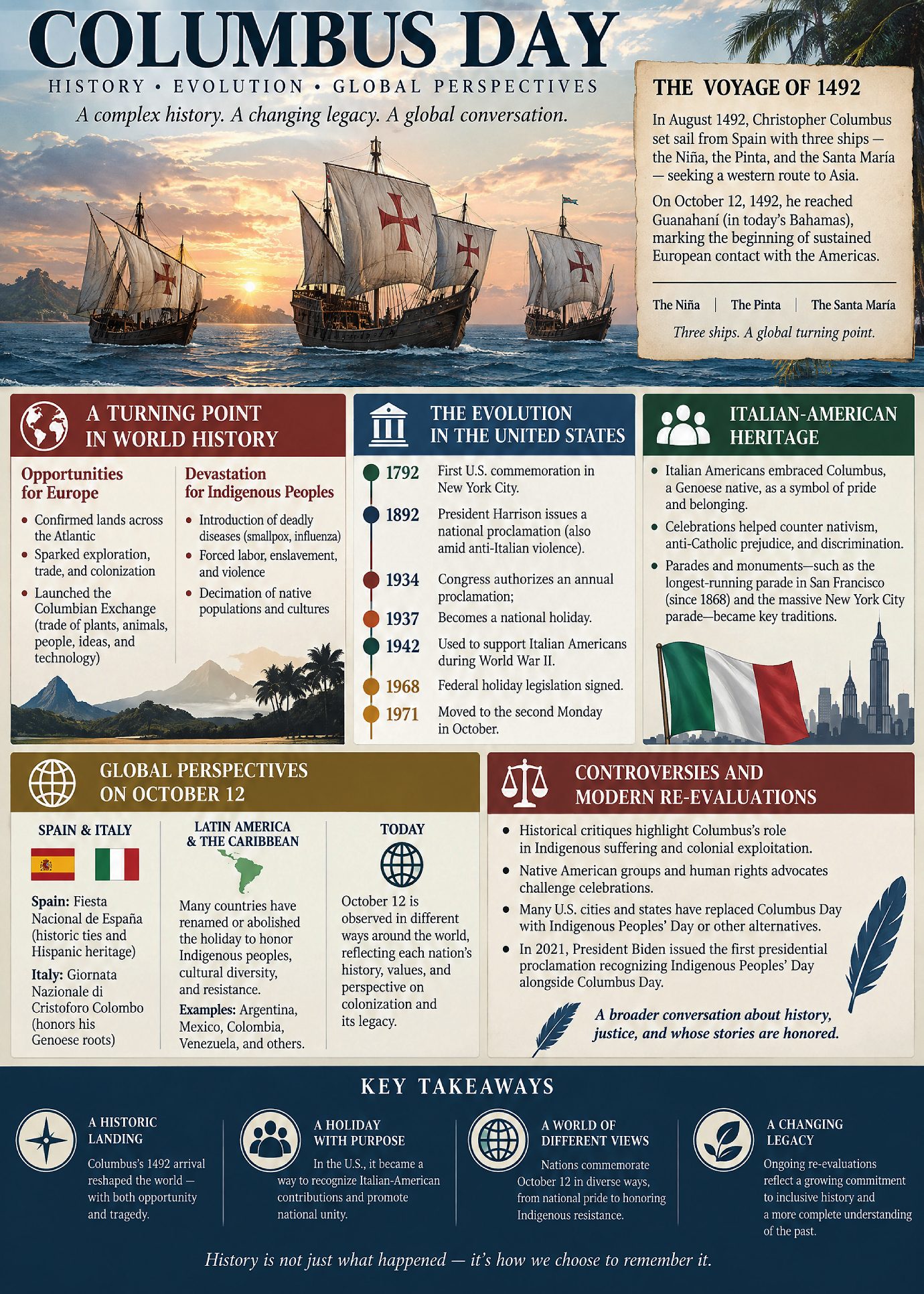
Columbus Day is Monday October 12, 2026
Listen to this Deep Dive podcast with the Chair Man and the Chair Lady about Columbus Day. CLICK PLAY.
Listen to this Debate over Columbus Day with Max and Maxine Rogers. CLICK PLAY.
Jump to various individual reports: Understanding Columbus Day — Surprising Truths — An Overview of Columbus Day —- Navigating the Legacy of Christopher Columbus
Watch this video about the surprising catalyst of Columbus Day.
Understanding Columbus Day: History, Evolution, and Global Perspectives
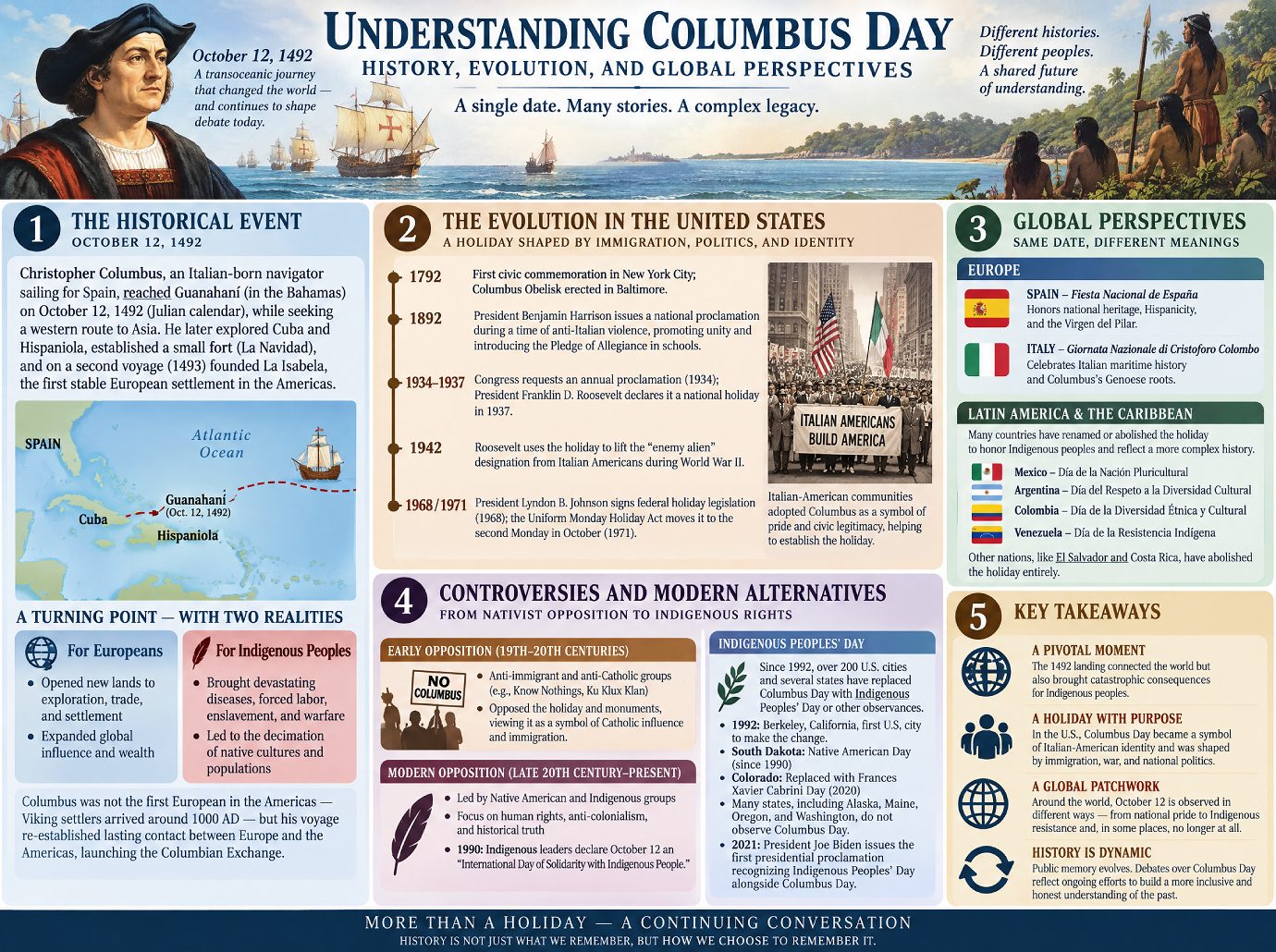
Understanding Columbus Day: History, Evolution, and Global Perspectives
1. Introduction: What Happened on October 12, 1492?
1.1 The Expedition and the Historical Event
In August 1492, the Italian-born navigator Christopher Columbus set sail from Palos de la Frontera, Spain, under the sponsorship of the Spanish monarchs, King Ferdinand and Queen Isabella. Commanding three ships—the Niña, the Pinta, and the Santa María—Columbus sought to chart a western ocean route to Asia to access the lucrative trade networks of China, India, and the East Indies. Operating under the contemporary geographical assumption that only the Atlantic Ocean separated Europe from the Far East, Columbus made landfall on October 12, 1492—a date recorded under the Julian calendar, which corresponds to October 21, 1492, on the proleptic Gregorian calendar. The landfall occurred at Guanahaní, an island in the Bahamas.
Believing he had successfully reached the East Indies, Columbus explored adjacent Caribbean islands, sighting Cuba (which he assumed to be mainland China) and Hispaniola (which he speculated might be Japan). On the northwestern coast of Hispaniola, near present-day Caracol in the Nord-Est Department of modern Haiti, Columbus established La Navidad in late December 1492 using the timber from the wrecked Santa María. This garrison, staffed by 39 crew members, constituted the first European fort built in the Americas during this era. Following the destruction of La Navidad by the native Taíno population, Columbus returned on a second voyage to establish La Isabela in late December 1493 on the central-northern coast of Hispaniola (in the present-day Dominican Republic), creating the first stable European settlement in the Western Hemisphere.
From a public history perspective, students must recognize that Columbus was not the first European to set foot in the Americas. Scandinavian Vikings established settlements in Greenland and at L’Anse aux Meadows in Newfoundland around 1000 AD, and Irish missionaries among others may have preceded them. However, Columbus’s 1492 expedition was uniquely pivotal because it re-established permanent contact between the Eastern and Western Hemispheres, launching sustained European exploration, military conquest, and permanent colonization. This contact initiated the “Columbian Exchange”—the biological and cultural transfer of plants, animals, human populations, communicable diseases, and technology across the Atlantic Ocean.
1.2 The Dual Impact of 1492
The landing on October 12, 1492, represents a dramatic turning point in world history with vastly contrasting consequences. For European powers, the voyage confirmed the existence of rich lands across the Atlantic, sparking centuries of exploration, global trade, and settlement. Conversely, for the approximately 10 million Indigenous inhabitants spread across the Americas, the arrival of Europeans initiated centuries of devastation. The introduction of Old World pestilences and infectious diseases—such as smallpox and influenza—alongside forced labor, enslavement, warfare, and severe mistreatment, led to the decimation of native cultures and the near extinction of Indigenous populations.
Curriculum Inquiry: Historic Encounter vs. Civic Myth How do the immediate material realities of the 1492 landfall—characterized by rapid ecological exchange and immediate Indigenous subjugation—contrast with the romanticized national narratives constructed centuries later? When examining public history, educators and students must ask: Whose historical agency is privileged when a transoceanic landfall is framed as a “discovery”?
Understanding the historical realities of 1492 provides the necessary foundation for analyzing how subsequent generations transformed a Caribbean landing into a highly contested national civic holiday across the Western Hemisphere.
2. The Evolution of Columbus Day in the United States
2.1 Key Historical Milestones (1792–1971)
The transformation of Christopher Columbus’s landfall into an official U.S. federal holiday was neither immediate nor politically neutral. It developed over two centuries through shifting domestic priorities, anti-immigrant tensions, and ethnic identity movements:
- 1792: The first recorded civic commemoration occurred in New York City, organized by the Tammany Society (also known as the Columbian Order) to mark the 300th anniversary of the landing. That same year, the Columbus Obelisk was erected in Baltimore.
- 1892: To mark the 400th anniversary, President Benjamin Harrison issued a national proclamation urging Americans to observe the quadricentennial with patriotic rituals. This presidential intervention directly followed the 1891 mob lynching of 11 Italian immigrants in New Orleans. The Harrison administration utilized the proclamation to soothe severe diplomatic tensions with the Kingdom of Italy and integrate Italian immigrants into American civic life. During these 1892 celebrations, teachers, preachers, poets, and politicians designed public ceremonies to define the boundaries of citizenship, cultivate national loyalty, and advance narratives of “social progress” during an era of heavy European immigration and anti-Catholic nativism. These rituals prominently introduced Francis Bellamy’s newly written Pledge of Allegiance in public schools.
- 1934–1937: Following sustained political lobbying by the Knights of Columbus (a Catholic fraternal benefit society) and New York Italian-American publisher Generoso Pope, Congress passed a statute in 1934 requesting an annual presidential proclamation for October 12. President Franklin D. Roosevelt issued the first proclamation under this statute, and in 1937, Columbus Day was declared an official national holiday.
- 1942: Following the U.S. entry into World War II, approximately 1,881 Italian citizens were interned and over 600,000 non-citizen Italian immigrants were classified as “enemy aliens.” On Columbus Day in 1942, President Roosevelt strategically used the holiday to lift the “enemy alien” designation from Italian Americans and announced plans to offer citizenship to 200,000 elderly Italian residents, boosting wartime morale and civilian unity.
- 1968/1971: Led by Mariano A. Lucca’s National Columbus Day Committee (founded in Buffalo, New York, in 1966), advocates successfully lobbied Congress for full federal holiday status. President Lyndon B. Johnson signed the legislation in 1968. In 1971, the Uniform Monday Holiday Act officially shifted the federal observance from October 12 to the second Monday in October.
2.2 Italian-American Cultural Heritage
Throughout the 19th and 20th centuries, Italian-American communities adopted Christopher Columbus—a native of the Republic of Genoa—as a symbol of civic legitimacy and cultural pride. Facing systemic xenophobia, anti-Catholic prejudice, and violent nativism, early Italian immigrants mobilized around Columbus to assert their contributions to the American republic.
Local activists were instrumental in establishing early state-level recognitions. Angelo Noce, an Italian-American immigrant and printer in Denver, lobbied Colorado Governor Jesse F. McDonald to issue the first statewide proclamation in 1905, leading to Colorado establishing the first statutory state holiday in 1907. In San Francisco, Nicola Larco established the nation’s oldest continuous Columbus Day Parade in 1868. Over time, major urban centers developed massive public celebrations; New York City’s annual parade grew to feature over 35,000 marchers and upwards of one million spectators.
2.3 Milestones in U.S. Columbus Day History
| Year | Historical Event / Proclamation | Primary Social/Political Goal |
|---|---|---|
| 1792 | Tammany Society holds 300th anniversary celebration in NYC; Baltimore obelisk erected. | Establish the first formal civic commemoration of the 1492 landfall in the early republic. |
| 1892 | Pres. Benjamin Harrison issues 400th anniversary proclamation introducing Bellamy’s Pledge of Allegiance. | Promote national unity, ease diplomatic conflict with Italy after the New Orleans lynchings, and define citizenship boundaries. |
| 1934–1937 | Congress passes 36 U.S.C. 107; Pres. Franklin D. Roosevelt designates a national holiday in 1937. | Recognize Italian and Catholic civic contributions following lobbying by the Knights of Columbus and Generoso Pope. |
| 1942 | Pres. Roosevelt removes “enemy alien” status from non-citizen Italian Americans on Columbus Day. | Bolster wartime domestic morale, demonstrate national inclusion, and integrate non-citizen Italian residents during WWII. |
| 1968 / 1971 | Pres. Lyndon Johnson signs federal holiday legislation; Uniform Monday Holiday Act takes effect in 1971. | Codify a standard federal holiday observed uniformly across the nation on the second Monday in October. |
Primary Source Focus: Presidential Proclamations and Civic Inclusion
Compare President Benjamin Harrison’s 1892 quadricentennial proclamation with President Franklin D. Roosevelt’s 1942 wartime announcement. Notice how both chief executives leveraged the historical memory of Columbus during acute national crises—the 1891 New Orleans lynchings and World War II domestic security fears—to reframe Italian immigrants and their descendants from social outsiders into loyal, patriotic American citizens.
While the United States constructed Columbus Day to address domestic civic and immigrant integration goals, nations across the Americas and Europe commemorated October 12 within entirely different political and cultural frameworks.
3. Global Perspectives: How October 12 is Observed Internationally
3.1 European Observances: Italy and Spain
In Europe, October 12 is observed with emphasis on transcontinental historical ties and national heritage:
- Spain: The observance traces back to 1642, when the city of Zaragoza designated the Virgen del Pilar (Our Lady of the Pillar) as a symbol of Hispanidad (Hispanicity) on the date of the transatlantic arrival. Declared a religious feast day across the Spanish Empire in 1730, October 12 was made a national holiday in 1918 under the names Día de la Raza and later Día de la Hispanidad. Re-established by Royal Decree in 1981, it was officially codified as Fiesta Nacional de España in 1987. This designation served as a parliamentary compromise between political conservatives, who emphasized the monarchy and historic legacy, and republicans, who sought to commemorate Spain’s modern democratic state alongside its ties to the global Hispanic community.
- Italy: Italian communities have honored Columbus’s Genoese roots since the 18th century. In 2004, Italy officially designated October 12 as Giornata Nazionale di Cristoforo Colombo. In Genoa, civic traditions include the preserved 18th-century reconstruction of the Christopher Columbus House (where Columbus lived between approximately 1455 and 1470), the annual Regata di Colombo, and the historic naming of civilian ocean liners and naval vessels in his honor.
3.2 Latin America and the Caribbean: Changing Concepts
In Latin America, October 12 was historically established as Día de la Raza (“Day of the Race”) to mark the cultural synthesis of Indigenous and European peoples (first adopted by Argentina in 1917, Venezuela and Colombia in 1921, Chile in 1922, and Mexico in 1928). In the United States, Día de la Raza served as a unifying concept for panethnic Latino social justice organizations, such as the National Council of La Raza (founded in 1968, renamed UnidosUS in 2017) and the 1996 Hispanic March on Washington.
Over the past three decades, however, governments and civil society movements across Latin America have renamed or abolished the holiday to repudiate colonial legacies and honor Indigenous resistance:
- Argentina: Renamed the holiday in 2010 under President Cristina Kirchner to Día del Respeto a la Diversidad Cultural (Day of Respect of Cultural Diversity). The government removed the prominent Columbus statue near the Casa Rosada, replacing it with a monument honoring Juana Azurduy, an independence hero of Indigenous descent.
- Colombia: In 2021, the Ministry of Culture officially changed the title from Día de la Raza to Día de la Diversidad Étnica y Cultural de la Nación Colombiana to center the nation’s multiethnic heritage.
- Mexico: Renamed the day in 2020 under President Andrés Manuel López Obrador to Día de la Nación Pluricultural. The prominent Columbus monument on Mexico City’s Paseo de la Reforma was removed and replaced with a replica of The Young Woman of Amajac, an Indigenous pre-Hispanic sculpture.
- Venezuela: Renamed the observance in 2002 under President Hugo Chávez to Día de la Resistencia Indígena (Day of Indigenous Resistance). In 2004, political activists pulled down the 1904 Columbus statue by Rafael de la Cova in Caracas; in 2008, the plaza was renamed the “Indigenous Resistance Walk,” and a statue of the 16th-century Indigenous leader Guaicaipuro was erected on the empty plinth.
- Peru: Designated October 12 in 2009 as Día de los pueblos originarios y el diálogo intercultural (Indigenous Peoples and Intercultural Dialogue Day).
- Costa Rica: Renamed Día de la Raza to Día del Encuentro de las Culturas in 1994, and subsequently abolished the holiday entirely in 2020, replacing it with Military Abolition Day on December 1.
- El Salvador: In October 2021, the Legislative Assembly explicitly abolished the official Fiesta de la Raza holiday (originally created in 1915) to vindicate the identity, dignity, and human rights of Indigenous populations forgotten by historic state policies.
- Belize: Renamed the holiday in 2021 to Indigenous Peoples’ Resistance Day (formerly Pan American Day) to dismantle colonial frameworks.
- The Bahamas: Formerly observed as Discovery Day, the nation officially replaced the holiday in 2001 with National Heroes Day.
3.3 International Titles for October 12
| Country | Official Holiday Name | Core Cultural Focus |
|---|---|---|
| Spain | Fiesta Nacional de España | Transcontinental ties to Hispanidad, democratic statehood, and the feast of the Virgen del Pilar. |
| Italy | Giornata Nazionale di Cristoforo Colombo | Commemoration of Italian maritime history and Columbus’s Genoese heritage. |
| Argentina | Día del Respeto a la Diversidad Cultural | Recognition of multiculturalism and honoring Indigenous anti-colonial freedom fighters. |
| Colombia | Día de la Diversidad Étnica y Cultural de la Nación Colombiana | Celebration of the nation’s ethnic plurality and Indigenous/Afro-descendant heritage. |
| Mexico | Día de la Nación Pluricultural | Official recognition of the pluricultural and Indigenous foundations of the state. |
| Venezuela | Día de la Resistencia Indígena | Commemoration of native resistance against European military conquest and colonization. |
| Peru | Día de los pueblos originarios y el diálogo intercultural | Honoring native cultures and fostering interethnic dialogue. |
| El Salvador | Holiday Abolished (2021) | Explicit elimination of Fiesta de la Raza to vindicate Indigenous human rights. |
| Belize | Indigenous Peoples’ Resistance Day | Re-evaluating colonial legacies and honoring native resistance. |
These international transformations demonstrate that public commemorations of October 12 are undergoing global re-evaluation, directly reflecting domestic debates over history, ethics, and memory within the United States.
4. Controversies, Re-evaluations, and Modern Alternatives
4.1 The Dual Strands of Opposition
Opposition to Columbus Day in the United States stems from two distinct historical trajectories:
- Historical Nativist and Anti-Catholic Opposition: During the 19th and early 20th centuries, anti-immigrant nativist political movements—including the Know Nothings, the Ku Klux Klan, and the Women of the Ku Klux Klan—aggressively rejected Columbus celebrations and monuments. Their opposition was rooted in anti-Catholic prejudice, opposition to Irish and Italian immigration, and hostility toward Catholic fraternal orders like the Knights of Columbus, viewing the holiday as an attempt to expand Catholic influence in a predominantly Protestant nation.
- Modern Human Rights and Indigenous Opposition: Beginning in the late 20th century, critique shifted toward human rights, anti-colonialism, and sovereignty, spearheaded by Native American groups such as the American Indian Movement (AIM). In July 1990, 350 representatives from Indigenous groups across the Americas gathered in Quito, Ecuador, at the first Intercontinental Gathering of Indigenous People to organize against the upcoming 1992 quin-centennial celebrations. In 1991, a follow-up conference in Davis, California, declared October 12, 1992, an “International Day of Solidarity with Indigenous People.”
Modern historiography and educational curricula evaluate Columbus’s governance through primary source documentation:
- Bartolomé de las Casas: The 16th-century Catholic priest who resided in Hispaniola recorded in History of the Indies that European colonizers were driven by “insatiable greed,” inflicting systemic violence, torture, and forced labor upon native populations.
- Howard Zinn: Spelman College historian Howard Zinn, in A People’s History of the United States, documented primary accounts showing that Columbus personally ordered the enslavement, physical mutilation, and systemic hunting of native Arawak people to yield gold quotas for his financial backers.
- Jack Weatherford & UCLA Scholars: Anthropologist Jack Weatherford argued that Columbus Day commemorates historical waves of genocide against Native Americans. Similarly, scholars working on the University of California, Los Angeles Repertorium Columbianum project concluded that while Columbus was an extraordinary mariner, his colonial governorship resulted in brutal exploitation and enslavement.
4.2 The Rise of Indigenous Peoples’ Day and Local Adjustments
In response to these historical re-evaluations, U.S. states, municipalities, and local governments have altered their calendars:
- Pioneering Municipalities: In 1992, Berkeley, California, became the first U.S. city to replace Columbus Day with Indigenous Peoples’ Day. Since then, over 200 cities—including Los Angeles, Seattle, San Francisco, Denver, Phoenix, Austin, Portland, Salt Lake City, and Philadelphia—have adopted Indigenous Peoples’ Day.
- State-Level Modifications & Deep Historical Backdrops:
- South Dakota: Replaced the holiday in 1990 with Native American Day.
- Hawaii: Replaced the holiday with Discoverers’ Day (honoring Polynesian navigators) or refrains from recognizing Columbus Day entirely.
- Alabama: Proclaimed American Indian Heritage Day in 2000, observed concurrently with or in place of Columbus Day. Historical Context: This state recognition holds deep historical resonance given Alabama’s complex Native history—most notably the Creek Indian War of 1814. Following a bitter civil conflict within the Creek Confederacy, the anti-expansionist Red Sticks faction was defeated after being betrayed by Allied Creek forces. The war ended with the Treaty of Fort Jackson, wherein General Andrew Jackson forced the Creek Confederacy to cede over 21 million acres of land spanning southern Georgia and central Alabama to the United States.
- Colorado: Officially abolished Columbus Day in 2020, replacing it with Frances Xavier Cabrini Day (honoring the patron saint of immigrants).
- Non-Observance: States including Alaska, Maine, Vermont, New Mexico, Minnesota, Oregon, Washington, Delaware, and the District of Columbia do not observe Columbus Day or have formally replaced it.
- Federal Executive Recognition: In 2021, President Joe Biden issued the first formal presidential proclamation recognizing Indigenous Peoples’ Day alongside Columbus Day, though Indigenous Peoples’ Day has not been enacted by Congress as an independent federal holiday.
Curriculum Focus: Core Concepts in Public History
- Public History and Collective Memory are Dynamic: National holidays are not permanent monuments to static truth; they are expressions of collective memory that reflect the changing socio-political values, civic priorities, and identity struggles of each generation.
- Deconstructing Monumentalization and Civic Myth-Making: Public history involves examining how historic figures are transformed into political symbols. Moving beyond 19th-century “monumentalization” allows historical analysis to replace romanticized origin myths with rigorous primary source evaluation that accounts for both maritime achievements and anti-Indigenous violence.
- Re-evaluating Public Space and Civic Honors: The physical and temporal spaces dedicated to history—whether bronze statues on city plinths or official calendar observances—are actively contested. Renaming holidays or replacing monuments reflects a broader societal effort to make public history inclusive, honoring marginalized resistance and historical truth over unilateral conquest.
5. Summary and Key Concept Review
To review the primary historical and pedagogical takeaways of this primer:
- 1492 Landing: Christopher Columbus’s arrival on October 12, 1492 (Julian) at Guanahaní initiated sustained European exploration, colonization, and the Columbian Exchange. However, it simultaneously brought catastrophic mortality, communicable disease, forced labor, and near extinction to the approximately 10 million Indigenous inhabitants of the Americas.
- U.S. Evolution: The holiday evolved from an 18th-century local civic event into an Italian-American symbol of cultural heritage and defense against nativist discrimination. It was institutionalized as a presidential proclamation day in 1934, a national holiday in 1937, and moved to the second Monday in October under the Uniform Monday Holiday Act in 1971.
- Global Diversity: Internationally, October 12 reflects distinct national priorities—ranging from Spain’s Fiesta Nacional to a sweeping realignment across Latin America (including Argentina, Colombia, Mexico, Venezuela, and El Salvador) toward recognizing pluricultural identity and Indigenous resistance.
- Modern Shift: Contemporary public history trends emphasize localized re-evaluations, with numerous U.S. states and over 200 municipalities adopting Indigenous Peoples’ Day or alternative cultural observances to align public memory with historical scholarship.
Surprising Truths About Columbus Day You Were Never Taught in School
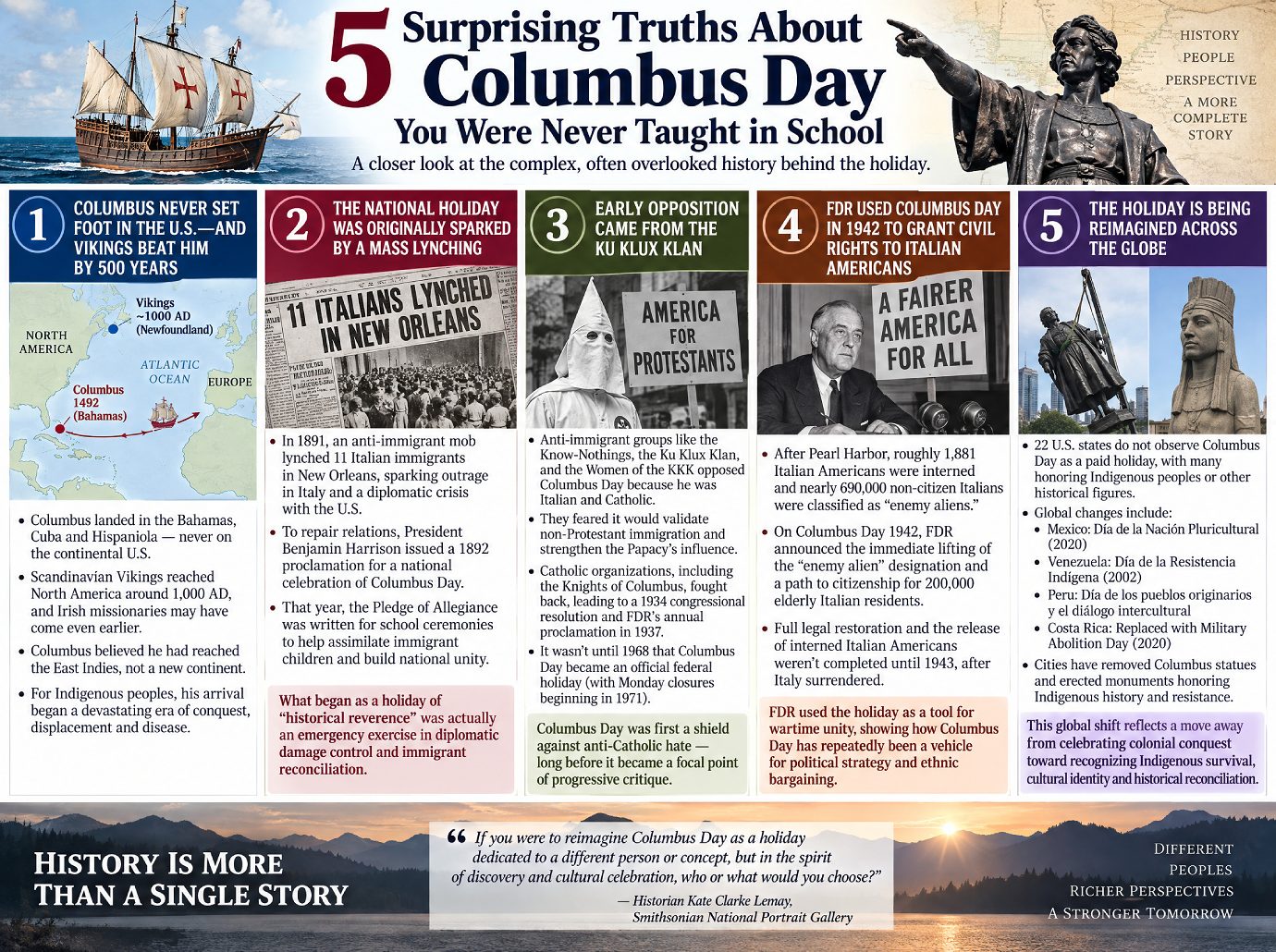
Surprising Truths About Columbus Day You Were Never Taught in School
For generations, American elementary classrooms presented a remarkably simplified narrative every October: Christopher Columbus sailed the Atlantic in 1492, discovered America, and established a triumphant foundation for national pride. Yet behind the childhood storybooks lies a far more intricate, conflicted historical reality.
Far from a static tribute to maritime exploration, Columbus Day has spent over a century serving as a battleground for contested public memory. Its history is a complex tapestry of political maneuvering, international diplomatic crises, nativist prejudice, and ethnic bargaining. The holiday has never been a static artifact of the past; rather, it has functioned as a flexible civic mirror reflecting the nation’s evolving values, racial anxieties, and struggles over identity.
Unpacking the documentable origins of this civic ritual reveals five eye-opening truths that fundamentally transform how we understand its creation, political utility, and global trajectory.
Columbus Never Set Foot in the Continental U.S.—and Vikings Beat Him by 500 Years
When Christopher Columbus made landfall on October 12, 1492, his ships dropped anchor at Guanahaní, an island in the Bahamas, before he proceeded to explore Cuba and Hispaniola. Across four transatlantic voyages, Columbus established Europe’s first foothold in the Caribbean—erecting the temporary fort of La Navidad in late December 1492 and the first permanent settlement of La Isabela in late December 1493 on Hispaniola—yet he never stepped foot on any land that constitutes the continental United States. Furthermore, he was by no means the first European to cross the ocean. Scandinavian Vikings established settlements in Greenland and at L’Anse aux Meadows in Newfoundland around 1,000 AD, and Irish missionaries may have traversed the North Atlantic centuries prior.
The enduring belief that Columbus “discovered” a new world misinterprets 15th-century geography. Educated Europeans in 1492 did not believe the Earth was flat; their fundamental error was a cartographic miscalculation. Unaware that the Pacific Ocean existed, they assumed only the Atlantic separated Western Europe from the riches of Asia. Consequently, Columbus went to his grave convinced he had reached the East Indies, identifying Cuba as mainland China and Hispaniola as Japan.
American popular culture eventually engineered a national origin myth around an explorer who never visited the country honoring him. For the millions of Indigenous inhabitants who had populated the hemisphere for millennia, this cartographic error initiated a devastating human catastrophe.
“For the approximately 10 million Indians, spread throughout the Americas at the time, the arrival of Columbus was significant in a different way—it changed the course of their lives, and eventually led to their near extinction and the decimation of their cultures.”
The National Holiday Was Originally Sparked by a Mass Lynching
The first presidential proclamation establishing a nationwide celebration of Columbus Day was born not out of tranquil historical reverence, but out of a horrific act of mob violence and an international diplomatic crisis. In March 1891, a anti-immigrant mob in New Orleans lynched 11 Italian immigrants following the acquittal of several Italian defendants in the murder of the city’s police chief. The massacre sparked fierce national outrage among Italian Americans and prompted the Italian government to sever diplomatic relations with the United States, bringing the two nations to the brink of war.
To repair this diplomatic breach and placate an enraged Italian-American electorate, President Benjamin Harrison issued a federal proclamation in 1892 declaring a one-time national celebration on the 400th anniversary of Columbus’s landing.
“On that day let the people, so far as possible, cease from toil and devote themselves to such exercises as may best express honor to the discoverer and their appreciation of the great achievements of the four completed centuries of American life.”
During these 1892 anniversary celebrations, civic leaders, clergy, and educators deployed schoolhouse rituals as mechanisms for rapid national assimilation and loyalty-building during an era of intense xenophobia. It was specifically for these patriotic exercises in October 1892 that Francis Bellamy authored the Pledge of Allegiance, creating a civic liturgy designed to bind immigrant children to the American flag. Thus, a holiday now viewed as a traditional staple of American patriotism actually began as an emergency exercise in diplomatic damage control and immigrant reconciliation.
Early Opposition to Columbus Day Came from the Ku Klux Klan
Long before late-20th-century protests by Indigenous rights activists, the primary political opposition to Columbus Day came from anti-immigrant “nativist” movements, including the Know-Nothings, the Ku Klux Klan, and the Women of the Ku Klux Klan.
During the late 19th and early 20th centuries, these white Protestant nationalist groups bitterly opposed honoring Columbus precisely because he was Italian and Catholic. They feared that elevating a Catholic historical figure would validate non-Protestant immigration, enhance the Papacy’s civic influence, and undermine the Protestant character of American democracy.
To counter this virulent prejudice, Catholic fraternal organizations—most notably the Knights of Columbus—and Italian-American newspaper publisher Generoso Pope organized a sophisticated lobbying campaign. Their efforts persuaded Congress to pass a 1934 resolution requesting annual presidential proclamations, leading President Franklin D. Roosevelt to proclaim Columbus Day an annual observance in 1937.
Crucially, however, FDR’s annual proclamation did not establish the modern federal holiday. Columbus Day remained an annual commemorative observance until 1968, when President Lyndon B. Johnson signed federal legislation establishing it as an official statutory federal holiday with uniform Monday closures, effective in 1971. History reveals a striking paradox: Columbus Day was originally weaponized as a shield against far-right anti-Catholic hate long before it became a focal point of progressive critique.
FDR Used Columbus Day in 1942 to Grant Civil Rights to Italian Americans During WWII
The entry of the United States into World War II brought renewed civil rights crises for Italian Americans. Following the attack on Pearl Harbor in December 1941, the federal government interned roughly 1,881 Italian Americans and classified nearly 690,000 non-citizen Italian immigrants as “enemy aliens,” imposing curfews, travel restrictions, and property confiscations due to fears of ideological loyalty to Fascist Italy.
Recognizing the crucial need for wartime domestic unity and political support, President Franklin D. Roosevelt strategically repurposed Columbus Day on October 12, 1942. In a broadcast address, the Roosevelt administration announced the immediate lifting of the “enemy alien” designation for Italian immigrants and established a pathway to citizenship for 200,000 elderly Italian residents who had previously been stymied by English literacy requirements.
However, historical records highlight an important caveat: while FDR’s Columbus Day decree removed restrictions for the vast majority of non-citizen residents, full legal restoration and the release of interned Italian Americans held in military camps were not completed until after Italy surrendered to the Allied powers on September 8, 1943. Roosevelt’s strategic maneuver underscores how political leaders repeatedly mobilized the civic symbol of Columbus as a tool for ethnic bargaining and national consolidation during times of existential crisis.
The Holiday Is Being Reimagined Across the Globe, Not Just in U.S. Cities
In recent decades, the recalibration of public memory has prompted governments across the Western Hemisphere to systematically alter, rename, or abolish Columbus Day. Today, 22 U.S. states do not observe Columbus Day as a paid state holiday, with many substituting alternative commemorations that reflect regional heritage:
- South Dakota established Native American Day as an official state holiday in 1990.
- Hawaii observes Discoverers’ Day, honoring the Polynesian navigators who navigated the Pacific Ocean.
- Colorado abolished Columbus Day in 2020, replacing it with Frances Xavier Cabrini Day to honor the Italian-American humanitarian saint.
- Alabama recognizes American Indian Heritage Day alongside Columbus Day. This state distinction carries deep historical resonance: it confronts the painful legacy of the Creek Indian War and the 1814 civil conflict among the Creek confederacy, which culminated in the Treaty of Fort Jackson, where General Andrew Jackson forced the Creek nation to cede over 21 million acres of ancestral land across central Alabama and southern Georgia.
This movement extends far beyond American borders, taking shape across Latin America through vivid physical and cultural replacements:
- Mexico formally re-designated October 12 as Día de la Nación Pluricultural in 2020. In Mexico City, municipal authorities removed the prominent Columbus statue from the Paseo de la Reforma, replacing it with a monument depicting The Young Woman of Amajac, a pre-Hispanic Indigenous sculpture.
- Venezuela transformed Día de la Raza into Día de la Resistencia Indígena in 2002. In 2004, activists in Caracas pulled down the historical Columbus monument sculpted by Rafael de la Cova; the city subsequently renamed the promenade the “Indigenous Resistance Walk” and erected a statue honoring the 16th-century Indigenous resistance leader Guaicaipuro.
- Peru officially marks the date as Día de los pueblos originarios y el diálogo intercultural (Indigenous Peoples and Intercultural Dialogue Day).
- Costa Rica renamed the date Día del Encuentro de las Culturas in 1994, before replacing the holiday entirely in 2020 with Military Abolition Day on December 1.
Rather than merely altering calendar titles, this global trend represents a profound cultural shift: a deliberate pivot away from celebrating colonial conquest toward elevating Indigenous survival, cultural identity, and historical reconciliation.
Conclusion
The evolution of Columbus Day proves that public traditions are never set in stone. From an emergency instrument of 19th-century diplomatic damage control to a shield against anti-Catholic nativism, a WWII tool of wartime assimilation, and a contemporary catalyst for historical reassessment, the holiday has continuously shifted to reflect the political and moral landscape of each era.
As societies across the globe re-evaluate the symbols that define their public spaces, civic calendars continue to adapt to present a more complete, rigorous truth about the Atlantic world. In reflecting on this ongoing transformation, historian Kate Clarke Lemay of the Smithsonian National Portrait Gallery offers a thought-provoking prompt regarding how we construct our shared civic memory:
“If you were to reimagine Columbus Day as a holiday dedicated to a different person or concept, but in the spirit of discovery and cultural celebration, who or what would you choose?”
An Overview of Columbus Day
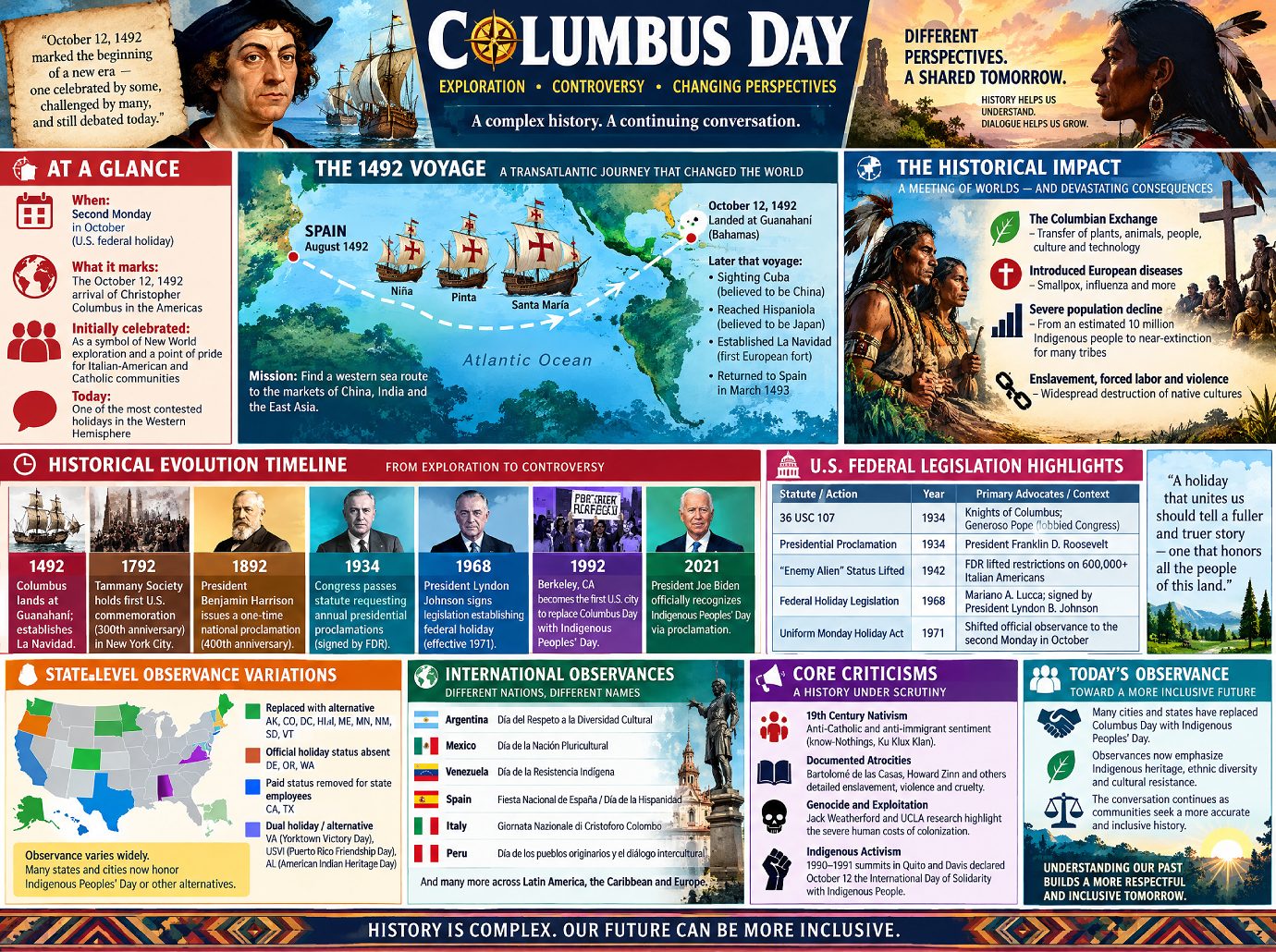
An Overview of Columbus Day
Columbus Day, officially commemorated on the second Monday in October in the United States, marks the October 12, 1492 arrival of Christopher Columbus in the Americas. While initially celebrated as a marker of New World exploration and a point of pride for Italian-American and Catholic communities, the holiday has become one of the most contested observances in the Western Hemisphere.
Over the last several decades, critical historical re-evaluations have highlighted the severe human costs of European colonization, including the mass enslavement, forced labor, and near-extinction of Indigenous populations resulting from violence and introduced European diseases. Consequently, a broad cultural and legal shift has transformed how the holiday is observed. Numerous U.S. states, municipalities, and foreign nations have formally replaced or restructured Columbus Day in favor of observances celebrating Indigenous heritage, ethnic diversity, and cultural resistance—such as Indigenous Peoples’ Day, Día de la Resistencia Indígena, and Día de la Nación Pluricultural.
+--------------------------------------------------------------------------------------------------+
|                                    HISTORICAL EVOLUTION TIMELINE                                 |
+--------------------------------------------------------------------------------------------------+
| 1492: Columbus lands at Guanahaní (Bahamas); establishes La Navidad on Hispaniola.               |
| 1792: Tammany Society holds first recorded US commemoration (300th anniversary) in New York City.|
| 1892: President Benjamin Harrison issues a one-time national proclamation (400th anniversary).  |
| 1934: Congress passes statute requesting annual presidential proclamations (signed by FDR).      |
| 1968: President Lyndon Johnson signs legislation establishing federal holiday (effective 1971). |
| 1992: Berkeley, CA becomes the first US city to replace Columbus Day with Indigenous Peoples' Day.|
| 2021: President Joe Biden officially recognizes Indigenous Peoples' Day via proclamation.         |
+--------------------------------------------------------------------------------------------------+
Historical Context and the 1492 Expedition
The First Voyage and Early European Settlements
Supported by King Ferdinand and Queen Isabella of Spain, Christopher Columbus—a Genoese mariner—set sail in August 1492 aboard three ships: the Niña, the Pinta, and the Santa María. His objective was to chart a direct western sea route to the gold and spice markets of China, India, and East Asia. Most educated Europeans of the era understood that the Earth was round, but were unaware of the existence of the Pacific Ocean and the American continents, assuming only the Atlantic lay between Europe and Asia.
On October 12, 1492 (Julian calendar; equivalent to October 21, 1492, on the proleptic Gregorian calendar), Columbus landed at Guanahaní, an island in the Bahamas. Subsequent exploration during the voyage led to:
- Sighting Cuba: Believed by Columbus to be mainland China.
- Hispaniola: Reached in December 1492 and believed to be Japan.
- La Navidad: The first European fort in the Americas, established in late December 1492 on the northwestern coast of Hispaniola (near modern-day Caracol, Haiti) using 39 crew members. After the indigenous Taíno destroyed the fort, Columbus founded La Isabela in late December 1493 in the present-day Dominican Republic, establishing the first stable European settlement in the Americas.
- Return to Spain: Columbus returned in March 1493 carrying gold, spices, and captive Indigenous people.
Pre-Columbian Precedents and Demographics
Historical context confirms that Columbus was not the first European to reach the Americas. Scandinavian Vikings established colonies in Greenland and Newfoundland (such as L’Anse aux Meadows) around 1000 AD, and Irish missionaries may have arrived during the same era.
Prior to 1492, an estimated 10 million Indigenous inhabitants lived across the Americas. The arrival of European settlers initiated the Columbian Exchange—the grand-scale transfer of plants, animals, culture, populations, and technology between the Old and New Worlds. However, it also introduced infectious diseases like smallpox and influenza, to which Native populations had no immunity, precipitating demographic collapse, widespread destruction of native cultures, and near-extinction of numerous tribes.
Establishment and History of Columbus Day in the United States
Early Commemorations and Ethnic Ties
- 1792: The Columbian Order of New York (Tammany Society) held the first recorded Columbus Day event to mark the 300th anniversary of the landing. The Columbus Obelisk was erected in Baltimore the same year.
- 1866 & 1868: New York City hosted an Italian-American celebration in 1866. In 1868, Nicola Larco established San Francisco’s Columbus Day Parade, now recognized as the nation’s oldest continuously existing celebration.
- 1892 Proclamation: Following the 1891 mob lynching of 11 Italian immigrants in New Orleans, President Benjamin Harrison declared a one-time national celebration for the 400th anniversary. This move was intended to ease diplomatic tensions with Italy and placate Italian Americans. The 1892 events incorporated nationalistic rituals, civic patriotism, and the introduction of Francis Bellamy’s Pledge of Allegiance in schools.
Statutory and Federal Recognition
Italian-American immigrant Angelo Noce lobbied heavily for the holiday’s legal adoption in Colorado. Governor Jesse F. McDonald proclaimed the first statewide holiday in 1905, and Colorado made it a statutory holiday in 1907.
+--------------------------------------------------------------------------------------------------+
|                               US FEDERAL LEGISLATION HIGHLIGHTS                                  |
+--------------------------------------------------------------------------------------------------+
| Statute / Action               | Year | Primary Advocates / Context                              |
+--------------------------------+------+----------------------------------------------------------+
| 36 USC 107                     | 1934 | Knights of Columbus; Generoso Pope (Lobbied Congress)    |
| Presidential Proclamation      | 1934 | President Franklin D. Roosevelt                          |
| "Enemy Alien" Status Lifted    | 1942 | FDR lifted restrictions on 600,000+ Italian Americans     |
| Federal Holiday Legislation    | 1968 | Mariano A. Lucca; Signed by President Lyndon B. Johnson  |
| Uniform Monday Holiday Act     | 1971 | Shifted official observance to the second Monday in Oct. |
+--------------------------------+------+----------------------------------------------------------+
In 1934, Congress passed a statute (36 USC 107) requesting annual presidential proclamations designating October 12 as Columbus Day. President Franklin D. Roosevelt fulfilled this request. On Columbus Day in 1942, Roosevelt notably used the occasion to announce the removal of the “enemy alien” designation from Italian Americans, thousands of whom had been interned or subjected to restrictions during World War II.
Efforts led by Mariano A. Lucca and the National Columbus Day Committee culminated in President Lyndon B. Johnson signing legislation in 1968 that elevated Columbus Day to a federal holiday, taking effect in 1971 under the Uniform Monday Holiday Act.
US Observance, Nonobservance, and Alternative Holidays
Observance of Columbus Day varies substantially across US jurisdictions. While federal offices, banks, the bond market, and the U.S. Postal Service generally close, many states and private businesses do not observe it as a paid holiday.
State and Regional Variations
- States Replacing or Rejecting Columbus Day: Alaska, Colorado, Hawaii, Maine, Minnesota, New Mexico, South Dakota, Vermont, and the District of Columbia do not observe Columbus Day, replacing it with Indigenous Peoples’ Day, Native American Day (South Dakota), or Discoverers’ Day (Hawaii). Colorado replaced Columbus Day in 2020 with Frances Xavier Cabrini Day, observed on the first Monday in October.
- Legislative and Paid Holiday Shifts: Delaware, Oregon, and Washington do not recognize Columbus Day as an official holiday (Washington categorizes it as a “legislatively recognized day”). California and Texas have removed Columbus Day as a paid holiday for state government employees.
- Proclamation-Only States: Iowa and Nevada authorize governors to issue annual proclamations, though Nevada avoids full state closure due to its proximity to Nevada Day.
- Dual Observances: Virginia observes both Columbus Day and Yorktown Victory Day on the same date. The U.S. Virgin Islands observe Columbus Day alongside Puerto Rico Friendship Day.
- Alabama’s Unique Model: Alabama was among the earliest states to officially recognize American Indian Heritage Day on the same day as Columbus Day (proclaimed in 2000). The state’s history highlights the Creek Indian War, which concluded with the 1814 Treaty of Fort Jackson, wherein General Andrew Jackson forced the Creek confederacy to cede over 21 million acres of land across southern Georgia and central Alabama.
+--------------------------------------------------------------------------------------------------+
|                                  STATE-LEVEL OBSERVANCE MATRIX                                   |
+--------------------------------------------------------------------------------------------------+
| Category                       | Jurisdictions                                                   |
+--------------------------------+-----------------------------------------------------------------+
| Replaced with Alternative      | AK, CO, DC, HI, ME, MN, NM, SD, VT                            |
| Official Holiday Status Absent | DE, OR, WA                                                       |
| Paid Status Removed for State  | CA, TX                                                          |
| Dual Holiday / Alternative     | VA (Yorktown Victory Day), USVI (Puerto Rico Friendship Day),   |
|                                | AL (American Indian Heritage Day)                               |
+--------------------------------+-----------------------------------------------------------------+
Municipal Shifts and Indigenous Peoples’ Day
The movement to replace Columbus Day with Indigenous Peoples’ Day began at the municipal level in Berkeley, California, in 1992. Dozens of major cities have since eliminated Columbus Day, including Austin, Boise, Cincinnati, Denver, Los Angeles, Philadelphia, Phoenix, Portland, Salt Lake City, San Francisco, Santa Fe, Seattle, and Tacoma.
- Columbus, Ohio: Ceased observing Columbus Day in 2018, redirecting resources to honor military veterans.
- Akron, Ohio: Following council divisions, Akron established North American First People’s Day on the first Monday of October in 2018, and later renamed Columbus Day to Italian-American Heritage and Culture Day in 2020.
- Federal Recognition: In 2021, the administration of President Joe Biden issued an official presidential proclamation recognizing Indigenous Peoples’ Day, though it remains separate from the established list of official federal bank holidays.
International Observances and Rebrandings
The anniversary of Columbus’s landing is marked across Latin America and Europe under diverse titles reflecting distinct cultural perspectives.
+----------------------------------------------------------------------------------------------------+
|                                    INTERNATIONAL HOLIDAY TITLES                                    |
+----------------------------------------------------------------------------------------------------+
| Country              | Official Title / Status                                                     |
+----------------------+-----------------------------------------------------------------------------+
| Argentina            | Día del Respeto a la Diversidad Cultural (Renamed 2010)                     |
| Belize               | Indigenous People's Resistance Day (Renamed 2021)                          |
| Colombia             | Día de la Diversidad Étnica y Cultural de la Nación Colombiana (Renamed 2021)|
| Costa Rica           | Military Abolition Day (Dec 1; holiday removed 2020)                        |
| El Salvador          | Fiesta de la Raza (Abolished 2021)                                          |
| Italy                | Giornata Nazionale di Cristoforo Colombo (Established 2004)                 |
| Mexico               | Día de la Nación Pluricultural (Renamed 2020)                               |
| Peru                 | Día de los pueblos originarios y el diálogo intercultural (Renamed 2009)    |
| Spain                | Fiesta Nacional de España / Día de la Hispanidad                            |
| Uruguay              | Pan American Day / Día de las Américas                                      |
| Venezuela            | Día de la Resistencia Indígena (Renamed 2002)                               |
+----------------------+-----------------------------------------------------------------------------+
Latin America and the Caribbean
- Argentina: Established Día de la Raza in 1916 under President Hipólito Yrigoyen. In 2010, President Cristina Kirchner renamed it Día del Respeto a la Diversidad Cultural, removing a prominent statue of Columbus near the Casa Rosada and replacing it with a monument to patriot Juana Azurduy.
- Venezuela: Transitioned from Día de la Raza (established 1921) to Día de la Resistencia Indígena in 2002 under President Hugo Chávez. In 2004, pro-government activists toppled Rafael de la Cova’s statue of Columbus in Caracas; the site was renamed “Indigenous Resistance Walk” and populated with a statue of Indigenous leader Guaicaipuro.
- Mexico: Formerly celebrating Día de la Raza (since 1928), President Andrés Manuel López Obrador issued a decree in December 2020 renaming October 12 as Día de la Nación Pluricultural. A statue of Columbus on Mexico City’s Paseo de la Reforma was replaced by a replica of The Young Woman of Amajac.
- El Salvador & Costa Rica: El Salvador abolished its national Fiesta de la Raza holiday in October 2021. Costa Rica altered Día de la Raza to Día del Encuentro de las Culturas in 1994, before eliminating the holiday entirely in 2020 in favor of Military Abolition Day on December 1.
- Dominican Republic & The Columbus Lighthouse: Pope John Paul II visited Santo Domingo in October 1992 for the 500th anniversary, concluding with a mass at the cathedral. In 1992, the country inaugurated the Columbus Lighthouse (Faro a Colón) in Santo Domingo Este—a 680-foot cross-shaped concrete mausoleum and museum designed to house Columbus’s remains. (Spanish authorities claim DNA evidence proves Columbus is buried in the Cathedral of Seville, a claim Dominican officials have not independently verified via DNA testing).
Europe
- Spain: Commemorated on October 12 as Fiesta Nacional de España and Día de la Hispanidad, coinciding with the religious feast of La Virgen del Pilar (Our Lady of the Pillar) in Zaragoza and Our Lady of Guadalupe in Cáceres. The date was celebrated as early as 1642 and formally codified in royal decrees in 1981 and 1987.
- Italy: Established Giornata Nazionale di Cristoforo Colombo in 2004. Celebrations include the Regata di Colombo hosted by the Lega Navale Italiana. Genoa maintains an 18th-century reconstruction of the house Columbus inhabited between 1455 and 1470 outside the city’s 14th-century walls.
Core Criticisms and Historical Controversies
Opposition to Columbus Day spans multiple centuries and stems from radically different political, religious, and social viewpoints.
+----------------------------------------------------------------------------------------------------+
|                                    HISTORICAL CRITICISM MATRIX                                     |
+----------------------------------------------------------------------------------------------------+
| Period / Source             | Core Argument / Nature of Criticism                                  |
+-----------------------------+----------------------------------------------------------------------+
| 19th Century Nativism       | Anti-Catholic and anti-immigrant sentiment aimed at Irish/Italians;  |
|                             | spearheaded by Know-Nothings and Ku Klux Klan.                       |
| 1990–1991 Indigenous Summits| Quito and Davis gatherings protesting the 500th quin-centennial;     |
|                             | declared Oct 12 as Day of Solidarity with Indigenous People.         |
| Bartolomé de las Casas      | Documented "insatiable greed," torture, and extreme cruelty by       |
|                             | Spanish colonizers in "History of the Indies."                       |
| Jack Weatherford            | Argued Columbus Day celebrates the largest waves of genocide of      |
|                             | American Indians in recorded history.                                |
| UCLA Repertorium Columbianum| Detailed Columbus's brilliant seamanship alongside his direct        |
|                             | exploitation and enslavement of native populations.                  |
| Howard Zinn                 | Documented Columbus’s orders regarding the forced labor,             |
|                             | enslavement, and mutilation of the Arawak population.                |
+-----------------------------+----------------------------------------------------------------------+
Historical Anti-Catholic Opposition
In the 19th and early 20th centuries, opposition to Columbus Day was championed by nativist and anti-Catholic political factions, including the Know-Nothing Party, the Ku Klux Klan, and the Women of the Ku Klux Klan. These groups opposed monuments and holidays dedicated to Columbus because of his Catholic faith and his adoption as an ethnic icon by Italian and Irish immigrants, which nativists believed expanded papal influence in the Protestant-majority United States.
Human Rights Violations and Indigenous Activism
Modern opposition centers on the brutal treatment of Indigenous populations during Columbus’s governorship of Hispaniola and the Bahamas:
- Enslavement and Violence: Primary accounts detail how Columbus forced native populations into slave labor and enacted severe punishments, including mutilation and torture, to extract gold for financial backers.
- Bartolomé de las Casas: The 16th-century Catholic priest documented Spanish atrocities in his History of the Indies, writing that colonizers driven by “insatiable greed” committed acts “so foreign to human nature” that he trembled to record them.
- Howard Zinn & Jack Weatherford: In A People’s History of the United States, Howard Zinn documented the systematic mutilation and enslavement of the Arawak people. Anthropologist Jack Weatherford asserted that Columbus Day honors historical waves of genocide.
- UCLA Research: The Repertorium Columbianum, published by UCLA’s Medieval and Renaissance Center, concluded that while Columbus was an extraordinary mariner, his colonial administration relied heavily on the subjugation and enslavement of native peoples.
- Intercontinental Indigenous Mobilization: In July 1990, 350 Indigenous representatives from across the Americas met in Quito, Ecuador, to organize counter-demonstrations against the upcoming 1992 quin-centennial. A follow-up summit in Davis, California, in 1991 formally declared October 12, 1992, as the “International Day of Solidarity with Indigenous People,” laying the foundation for modern alternative observances.
Navigating the Legacy of Christopher Columbus—History, Myth, and Perspective
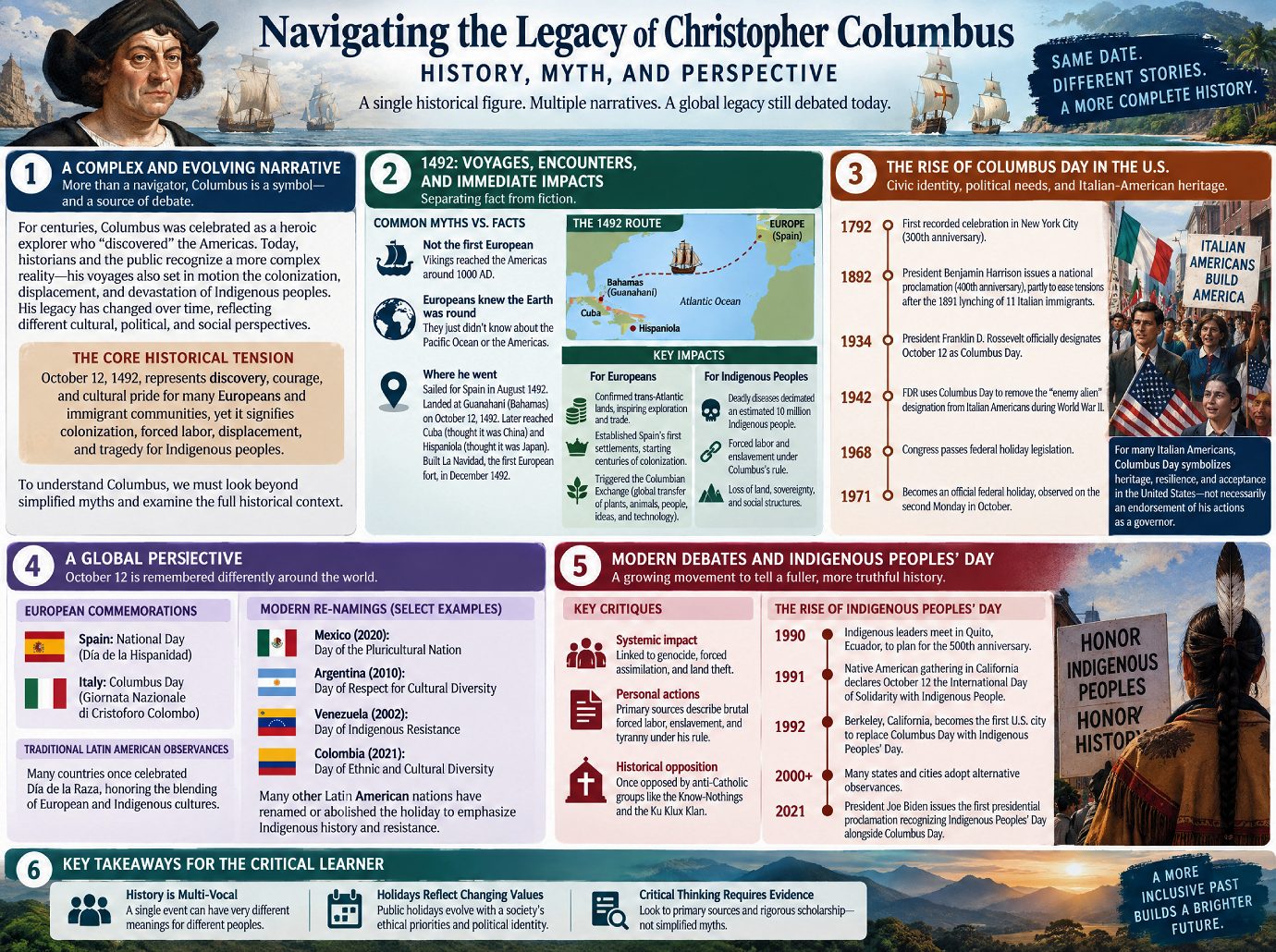
Navigating the Legacy of Christopher Columbus—History, Myth, and Perspective
Learning Objective & Tone Guidance
This topic summary provides an engaging, intellectually curious, and critical examination of Christopher Columbus’s historical context and evolving legacy. Rather than relying on a dry chronological timeline, this guide helps learners explore why interpretations of Columbus have transformed across five centuries and how different societies remember historical events based on cultural, political, and social perspectives.
1. Introduction: The Evolution of a Historical Narrative
Christopher Columbus is far more than a 15th-century maritime navigator; he remains one of the most complex, debated, and enduring symbols in modern history. For centuries, popular narratives presented Columbus through a singular lens of heroic discovery, celebrating his trans-Atlantic voyages as the dawn of global expansion. However, contemporary historical scholarship and public discourse have expanded this perspective, re-examining the direct relationship between his expeditions and the subsequent colonization, displacement, and devastation of Indigenous populations. The primary goal of this topic summary is to trace this evolution—exploring how a simple celebratory story transformed into a nuanced, multi-faceted historical reality.
Core Historical Tension: A single historical arrival on October 12, 1492, represents “discovery,” courage, and cultural pride for European and immigrant communities, yet signifies colonization, forced labor, displacement, and tragedy for Indigenous peoples of the Americas.
Understanding this dual legacy requires stepping past simplified national mythology to examine the raw facts of the late 15th century and the geopolitical impacts that followed.
2. Historical Realities of 1492: Voyages, Encounters, and Immediate Impacts
To evaluate Columbus’s legacy objectively, learners must separate long-standing popular myths from established historical facts regarding his 1492 expedition.
Clarifying Misconceptions
- Pre-Dating Columbus: Columbus was not the first European to set foot in the Americas. Scandinavian Vikings and Irish missionaries reached the continent centuries earlier, with Norse settlements established as early as 1000 AD in places like Greenland and Newfoundland.
- Spherical Earth Knowledge: Contrary to popular belief, most educated Europeans in 1492 understood that the Earth was round. However, they were entirely unaware of the Pacific Ocean and the American landmass, assuming that only the Atlantic Ocean separated Europe from the riches and gold of the East Indies.
- Geography of Arrival: Backed by King Ferdinand and Queen Isabella of Spain, Columbus set sail in August 1492 aboard the Niña, Pinta, and Santa María. On October 12, 1492, he made landfall at Guanahaní, an island in the Bahamas. Later that month, he sighted Cuba (believing it was mainland China) and Hispaniola (believing it was Japan). On Hispaniola, he constructed La Navidad in late December 1492—the first European fort in the Americas—and later established La Isabela in late December 1493 after the original fort was destroyed by the native Taíno people.
Impacts of the Encounter
| European Outcomes & Motives | Indigenous Consequences |
|---|---|
| Confirmation of Trans-Atlantic Lands: Confirmed rich territories across the ocean, inspiring widespread European exploration and trade in gold and spices. | Decimation & Extinction: Exposure to lethal pestilence and infectious diseases (e.g., smallpox, influenza) brought by Europeans, leading to the near extinction of native cultures and the decimation of an estimated 10 million Indigenous peoples. |
| Initiation of Imperial Colonization: Established Spain’s first permanent American settlements, initiating centuries of broad European colonization. | Forced Labor & Enslavement: Direct imposition of brutal forced labor and enslavement under Columbus’s governance in the Bahamas and Hispaniola. |
| The Columbian Exchange: Triggered a massive global transfer of plants, animals, human populations, culture, and technology between the Eastern and Western Hemispheres. | Loss of Land & Sovereignty: Immediate displacement, loss of ancestral territories, and destruction of native social infrastructures. |
While these 15th-century encounters permanently altered global geography and demographics, the actual celebration and mythologizing of Columbus in the United States did not take root until several centuries later.
3. The Rise of Columbus Day in the United States: Civic Identity and Italian-American Heritage
The establishment of Columbus Day in the United States was historically tied to themes of civic integration, national loyalty, and the struggle against prejudice. Though Columbus never set foot on any part of what is now the mainland United States, early Americans embraced him as a non-British founding symbol to forge a distinct post-Revolutionary national identity. Decades later, Italian immigrants adopted his Genoese birth to assert their own rightful place in American civic life.
Chronological Milestones
- 1792 (300th Anniversary): The first recorded celebration was organized in New York City by the Columbian Order (popularly known as the Tammany Society), establishing an early patriotic tradition around the landing.
- 1892 (400th Anniversary & Civic Identity): Following the brutal 1891 mob lynching of 11 Italian immigrants in New Orleans, President Benjamin Harrison issued a national proclamation declaring a one-time celebration. The proclamation sought to ease severe diplomatic tensions with Italy, placate marginalized Italian Americans, and foster patriotic unity. Rituals designed to teach civic loyalty were introduced across American schools, including Francis Bellamy’s Pledge of Allegiance.
- 1934–1937 (Federal Statutory Recognition): Responding to intense lobbying by the Knights of Columbus (a Catholic fraternal group) and New York Italian-American leader Generoso Pope, Congress passed a statute (36 USC 107) requesting annual presidential proclamations. President Franklin D. Roosevelt officially designated October 12 as Columbus Day in 1934.
- 1942 (World War II Impact): Following the internment of nearly 1,881 Italian citizens as “enemy aliens” during World War II, President Roosevelt used his Columbus Day address in 1942 to officially remove the “enemy alien” designation from Italian Americans and outline a citizenship pathway for 200,000 elderly Italian immigrants.
- 1968–1971 (Official Federal Holiday): President Lyndon B. Johnson signed federal holiday legislation in 1968. Effective in 1971 under the Uniform Monday Holiday Act, Columbus Day became an official federal holiday observed on the second Monday in October.
Heritage and Civic Identity
For many Italian-American organizations and communities, Columbus Day evolved into a symbol of cultural heritage, resilience, and acceptance within American society. Because Columbus was born in Genoa, Italy, early Italian immigrants embraced him as an emblem of their contributions to the nation. For these communities, participating in annual parades and festivities represents a celebration of Italian-American heritage and overcoming historical discrimination, rather than an explicit endorsement of Columbus’s personal governance or colonial actions.
As the United States integrated Columbus into its domestic civil calendar, nations across Latin America and Europe were constructing their own distinct interpretations of October 12.
4. Global Perspectives: International Commemorations and Re-Namings
The anniversary of October 12 is observed across the globe under a variety of names and cultural frameworks, reflecting vastly different post-colonial historical perspectives.
European Commemorations
- Spain: Observes October 12 as its National Day (Fiesta Nacional de España) and Día de la Hispanidad (Hispanicity Day). The celebration highlights Spain’s historical and cultural ties to the broader international Hispanic community and coincides with the major religious feast of La Virgen del Pilar (Our Lady of the Pillar) in Zaragoza.
- Italy: Commemorates the date as Giornata Nazionale di Cristoforo Colombo (introduced in 2004), honoring Columbus’s Genoese origins and historical maritime accomplishments through regattas and civic programs.
Traditional Latin American Observances
Throughout the early 20th century, many Latin American nations designated October 12 as Día de la Raza (“Day of the Race” or “Day of the [Hispanic] People”). First established in Argentina (1917), Venezuela (1921), Colombia (1921), Chile (1922), and Mexico (1928), the holiday originally celebrated the blending of European and Indigenous cultures and the resulting Hispanic heritage.
Modern Latin American Re-Namings
In recent decades, state governments across Latin America have rejected colonial celebrations, renaming or abolishing the date to emphasize Indigenous resistance, pluricultural identity, and historical truth:
- Venezuela (2002): Renamed the holiday Día de la Resistencia Indígena (Day of Indigenous Resistance) under President Hugo Chávez. In 2004, activists pulled down a statue of Columbus in Caracas; its pedestal was later occupied by a statue of the Indigenous leader Chief Guaicaipuro.
- Peru (2009): Officially established the day as Día de los pueblos originarios y el diálogo intercultural (Indigenous Peoples and Intercultural Dialogue Day).
- Argentina (2010): Renamed the day Día del Respeto a la Diversidad Cultural (Day of Respect for Cultural Diversity). The prominent Columbus statue near the Casa Rosada was removed and replaced by a monument to Juana Azurduy, an independence hero with Indigenous ancestry.
- Costa Rica: Shifted the holiday to Día del Encuentro de las Culturas in 1994 to honor the synthesis of European, Native American, African, and Asian heritages. In 2020, Costa Rica eliminated the holiday entirely, replacing it with Military Abolition Day on December 1.
- Mexico (2020): Renamed October 12 to Día de la Nación Pluricultural (Day of the Pluricultural Nation). The Columbus statue on Mexico City’s Paseo de la Reforma was removed and replaced with a replica of The Young Woman of Amajac, depicting a pre-Hispanic Indigenous woman.
- Colombia (2021): Renamed the holiday from El Día de la Raza y de la Hispanidad to Día de la Diversidad Étnica y Cultural de la Nación Colombiana (Day of Ethnic and Cultural Diversity of the Colombian Nation).
- El Salvador (2021): The Legislative Assembly abolished the official Fiesta de la Raza holiday in October 2021 to vindicate the origin, identity, and human rights of forgotten Indigenous peoples.
- Belize (2021): Renamed the day Indigenous People’s Resistance Day (formerly Pan American Day) to intentionally move away from its colonial legacy.
These international re-evaluations mirror a parallel movement within the United States to critically re-examine Columbus’s legacy and establish alternative holidays.
5. Modern Debates, Critical Re-Evaluation, and Indigenous Peoples’ Day
Contemporary critiques of Columbus focus on both the systemic consequences of European colonization and primary evidence detailing Columbus’s personal actions as a governor, alongside a complex history of domestic political pushback.
Two Strands of Criticism and Historical Opposition
- Systemic & Cultural Impact: Critics, led by organizations such as the American Indian Movement (AIM) and scholars like anthropologist Jack Weatherford, argue that celebratory myths surrounding Columbus mask centuries of genocide, forced assimilation, land theft, and ongoing systemic injustices. Spelman College historian Howard Zinn documented how traditional histories obscured these harsh realities. This critical view is anchored in early primary observations, such as those by Catholic priest Bartolomé de las Casas in his History of the Indies:
“The Spaniards were driven by ‘insatiable greed’ as they killed and tortured native populations with ‘the strangest and most varied new methods of cruelty’… my eyes have seen these acts so foreign to human nature, and now I tremble as I write.”
Historically, opposition to Columbus Day also came from a very different source: 19th- and early 20th-century anti-Catholic nativist groups. The Know-Nothing political movement, the Ku Klux Klan (KKK), and the Women of the Ku Klux Klan opposed Columbus Day celebrations and monuments because of their deep-seated hostility toward Catholic immigrants from Ireland and Italy and Catholic organizations like the Knights of Columbus.
- Personal Character of Columbus: Published compilations of period documents, such as UCLA’s Repertorium Columbianum, conclude that while Columbus was an extraordinarily skilled mariner, his administration as governor of Hispaniola was characterized by extreme tyranny. Primary historical documents reveal that Columbus personally ordered the brutal enslavement, forced labor, and physical mutilation of Taíno and Arawak populations to generate wealth for his Spanish backers.
The Rise of Indigenous Peoples’ Day
In response to these historical revelations, a widespread movement emerged to replace or complement Columbus Day with Indigenous Peoples’ Day.
- 1990 Intercontinental Gathering: In the summer of 1990, 350 representatives from Indigenous groups across the Western Hemisphere met in Quito, Ecuador, at the first Intercontinental Gathering of Indigenous People in the Americas to mobilize against the upcoming 500th anniversary (quincentennial) of Columbus’s arrival.
- 1991 Davis Conference: The following summer, over 100 Native Americans gathered in Davis, California, for a follow-up meeting to the Quito conference, declaring October 12, 1992, as the “International Day of Solidarity with Indigenous People.”
- 1992 (First Municipal Replacement): Berkeley, California, became the first U.S. city to officially abolish Columbus Day and institute Indigenous Peoples’ Day.
- State & Local Adoption: States across the country began enacting alternative observances. Alabama stood as an early pioneer, officially proclaiming American Indian Heritage Day in 2000 on the same day as (and for many, in place of) Columbus Day. South Dakota celebrates Native American Day, Hawaii observes Discoverers’ Day (honoring Polynesian navigators), and states such as Alaska, Vermont, Maine, New Mexico, and Minnesota observe Indigenous Peoples’ Day. Dozens of major cities—including Seattle, Los Angeles, Denver, Phoenix, and Austin—have made the same transition.
- 2021 Federal Recognition: President Joe Biden issued the first official presidential proclamation recognizing Indigenous Peoples’ Day alongside Columbus Day in 2021, though Indigenous Peoples’ Day remains a non-federal holiday.
This ongoing transformation of public holidays offers a practical case study in how history is understood, re-evaluated, and applied in modern society.
6. Conclusion: Key Learning Takeaways for the Critical Learner
Re-examining Christopher Columbus allows learners to develop critical thinking skills essential for studying history.
- History is Multi-Vocal: A single event cannot be accurately reduced to a one-dimensional narrative. The landing of 1492 carries radically different meanings for European colonizers, Italian immigrants seeking civic acceptance, and Indigenous nations facing territorial and cultural loss.
- Holidays Reflect Changing Values: Public holidays are not static; they are cultural reflections of a society’s evolving ethical priorities, civic needs, and political identities over time.
- Critical Thinking Requires Primary Evidence: Deconstructing national myths requires consulting primary sources (such as Columbus’s logs or Las Casas’s records) and rigorous scholarship rather than accepting traditional, simplified folklore.