
Benjamin Netanyahu at United Nations 9-24-26
Complete Coverage
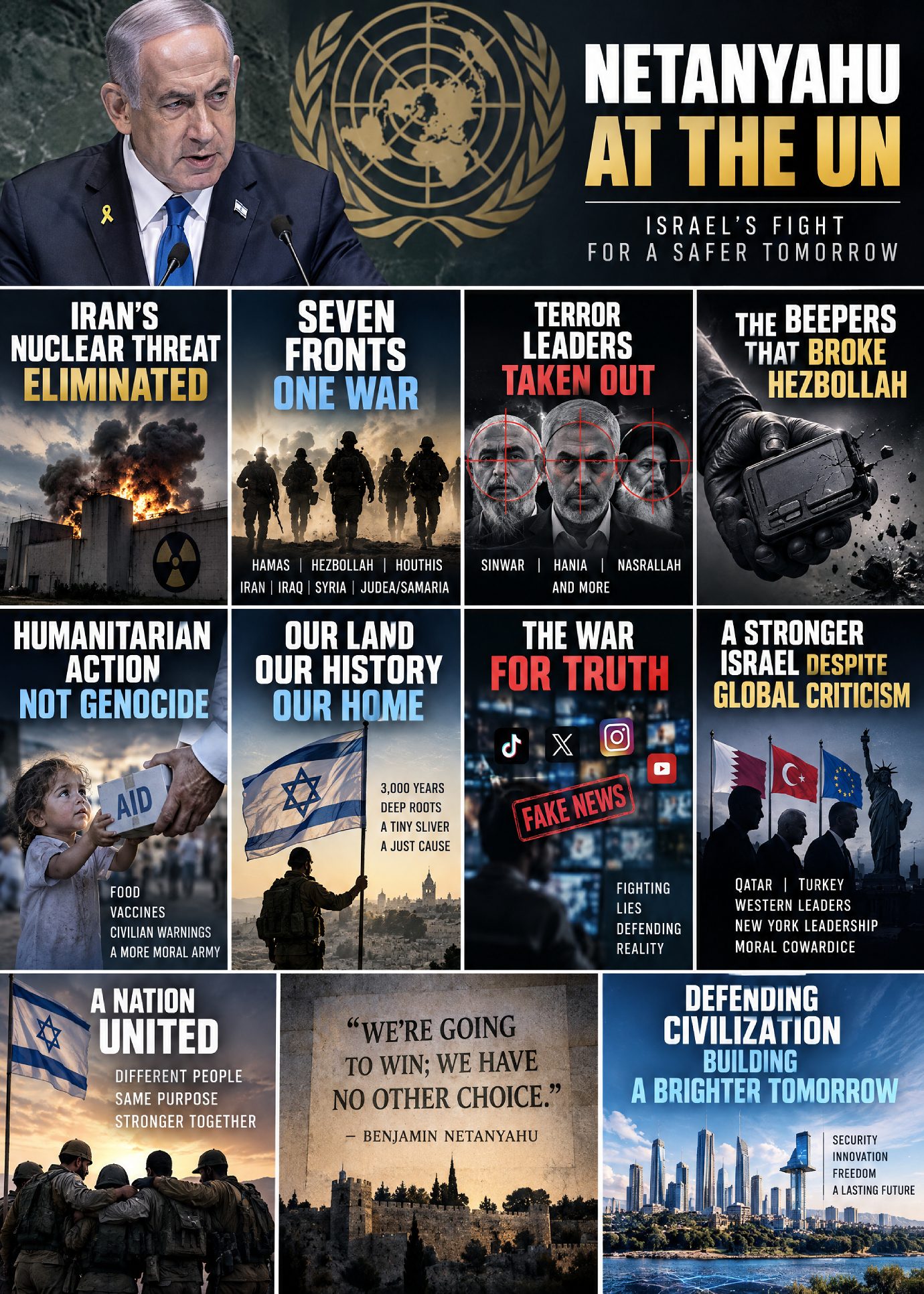
Israeli Prime Minister Benjamin Netanyahu spoke at the United Nations on September 24, 2026. Listen to the speech on any device, CLICK PLAY.
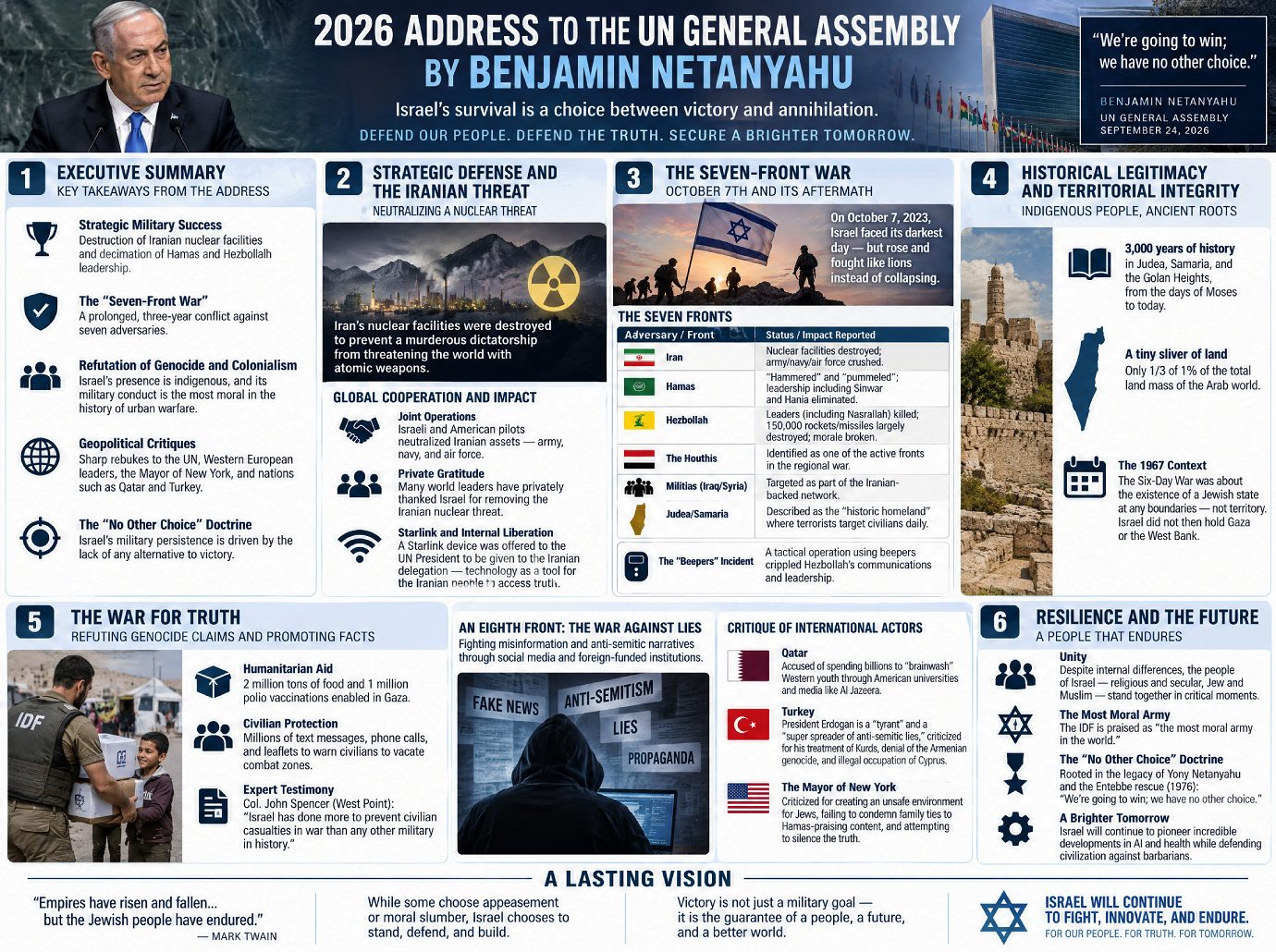
Gardner Magazine synthesizes the key themes, strategic arguments, and historical context presented in Benjamin Netanyahu’s address to the United Nations on September 24, 2026. The address centers on the existential necessity of Israel’s military actions, framing the nation’s survival as a choice between victory and annihilation.
Critical Takeaways:
- Strategic Military Success: The address reveals the successful destruction of Iranian nuclear facilities and the decimation of leadership within Hamas and Hezbollah.
- The “Seven-Front War”: Israel identifies itself as being engaged in a prolonged, three-year conflict against seven distinct adversaries: Hamas, Hezbollah, the Houthis, Iran, and militias in Iraq, Syria, and Judea/Samaria.
- Refutation of Genocide and Colonialism: Using historical, biblical, and expert military testimony, the document argues that Israel’s presence in the region is indigenous and that its military conduct is the most moral in the history of urban warfare.
- Geopolitical Critiques: The address delivers sharp rebukes to the United Nations, specific Western European leaders, the Mayor of New York, and nations such as Qatar and Turkey for their roles in spreading “anti-semitic lies” and “moral cowardice.”
- The “No Other Choice” Doctrine: A recurring theme emphasizes that Israel’s military persistence is driven by the lack of any alternative to victory in the face of annihilation.
Strategic Defense and the Iranian Threat
A central pillar of the address is the neutralization of the Iranian nuclear threat. It is asserted that the decision to devastate Iran’s nuclear facilities was an “easy decision” necessitated by the goal of preventing a “murderous dictatorship” from threatening the world with atomic weapons.
Cooperation and Global Defense
- Joint Operations: The address highlights that the neutralization of Iranian assets—including their army, navy, and air force—was a result of joint missions between Israeli and American pilots.
- Private Gratitude: Despite public condemnation from various UN delegates, it is claimed that many world leaders have privately thanked Israel for removing the Iranian nuclear threat.
- Starlink and Internal Liberation: The address predicts the eventual fall of the Iranian regime. A Starlink device was symbolically offered to the UN President to be given to the Iranian delegation, framing technology as a tool for the Iranian people to access truth and exercise freedom.
The Seven-Front War: October 7th and its Aftermath
The conflict is characterized as an ongoing battle against seven fronts orchestrated by Iran. The “darkest day” in Israel’s history—October 7, 2023—is framed as the catalyst for a war in which Israel “rose and fought like lions” rather than collapsing.
Key Conflict Statistics and Entities
| Adversary / Front | Status / Impact Reported |
|---|---|
| Iran | Nuclear facilities destroyed; army/navy/air force crushed. |
| Hamas | “Hammered” and “pummeled”; leadership including Sinwar and Hania eliminated. |
| Hezbollah | Leaders (including Nasrallah) killed; 150,000 rockets/missiles largely destroyed; morale broken. |
| The Houthis | Identified as one of the active fronts in the regional war. |
| Militias (Iraq/Syria) | Targeted as part of the Iranian-backed network. |
| Judea/Samaria | Described as the “historic homeland” where terrorists target civilians daily. |
The “Beepers” Incident
The address makes specific reference to a tactical operation involving “beepers” used against Hezbollah, citing it as a memorable blow that crippled the group’s communications and leadership.
Historical Legitimacy and Territorial Integrity
The address rejects the label of “colonialism,” arguing that the Jewish people are indigenous to the land.
- Ancient Roots: References to the Bible and the days of Moses are used to establish a 3,000-year history in Judea, Samaria, and the Golan Heights.
- Territorial Comparisons: Israel is described as a “tiny sliver of land” representing only 1/3 of 1% of the total land mass of the Arab world.
- The 1967 Context: It is argued that the 1967 Six-Day War was not about territory, as Israel did not then hold Gaza or the West Bank, but about the “existence of a Jewish state at any boundaries.”
The “War for Truth” and Moral Conduct
A significant portion of the discourse is dedicated to an “eighth front”: the war against misinformation and “anti-semitic lies” propagated through social media and foreign-funded institutions.
Refuting Genocide Claims
The address categorically denies the accusation of genocide, citing several pieces of evidence:
- Humanitarian Aid: Israel enabled the distribution of 2 million tons of food and 1 million polio vaccinations to the population in Gaza.
- Civilian Protection: The IDF utilized millions of text messages, phone calls, and leaflets to warn civilians to vacate combat zones.
- Expert Testimony: Colonel John Spencer, head of urban warfare studies at West Point, is cited as stating that “Israel has done more to prevent civilian casualties in war than any other military in history.”
Critique of International Actors
- Qatar: Accused of spending billions to “brainwash” Western youth through American universities and media outlets like Al Jazeera.
- Turkey: President Erdogan is labeled a “tyrant” and a “super spreader of anti-semitic lies,” criticized for his treatment of Kurds, denial of the Armenian genocide, and illegal occupation of Cyprus.
- The Mayor of New York (Zohran Mamdani): Critiqued for creating an unsafe environment for Jews, failing to condemn family ties to Hamas-praising content, and attempting to silence the truth regarding the conflict.
The Concept of Resilience
The address concludes with a focus on the enduring nature of the Jewish people and their commitment to the future.
Internal Unity and Values
Despite internal differences, the address posits that the people of Israel—religious and secular, Jew and Muslim—stand together in critical moments. The IDF is praised as “the most moral army in the world.”
The “No Other Choice” Doctrine
The legacy of Yony Netanyahu and the rescue mission at Entebbe (1976) serve as the moral foundation for current operations. The phrase “We’re going to win; we have no other choice” is presented as the definitive ethos of the Israeli state.
Final Vision
Drawing on the words of Mark Twain, the document emphasizes the historical survival of the Jewish people over ancient empires. It asserts that while some Western nations choose “appeasement” or “moral slumber,” Israel will continue to “pioneer incredible developments” in AI and health while defending civilization against “barbarians.”
The Red Line and the Eighth Front: Why Israel’s Most Difficult Choice is its Simplest
The Red Line and the Eighth Front: Why Israel’s Most Difficult Choice is its Simplest
Introduction: The Empty Seats and the Red Line
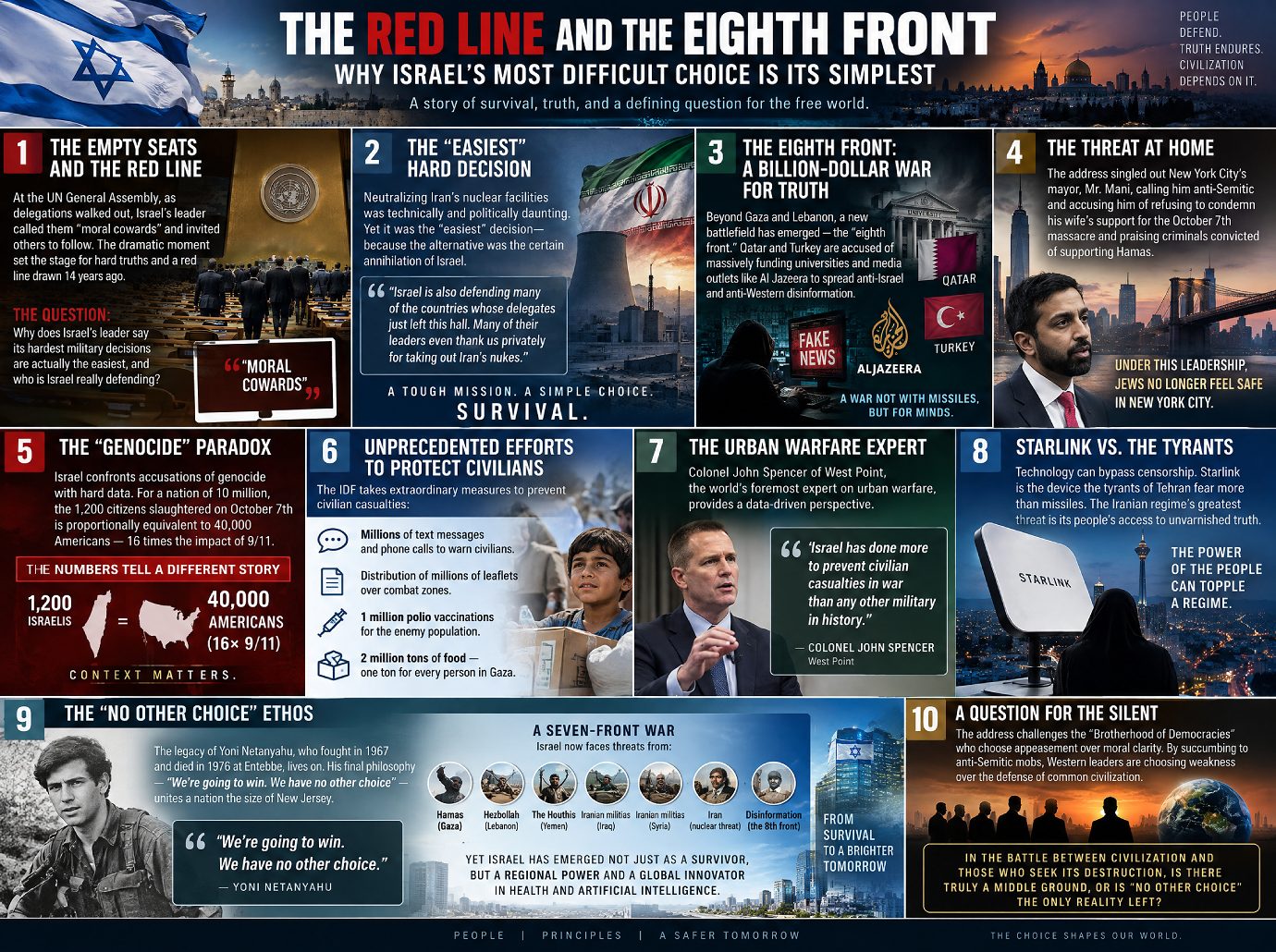
The atmosphere inside the United Nations General Assembly was heavy with tension as several delegations rose to depart. Before beginning his address, the speaker orchestrated a theatrical purging of the audience, labeling those walking out as “moral cowards” and inviting anyone else with similar sensibilities to follow them.
This dramatic opening set the stage for a narrative of “hard truths” centered on a “red line” established 14 years ago. The central curiosity of the speech remains: why does Israel’s leader claim that the nation’s hardest military decisions are actually their easiest, and who is Israel really defending?
As a narrative strategist, it is clear this was not just a speech, but a challenge to the “Brotherhood of Democracies” to wake from their moral slumber. It promises to distill the most counter-intuitive takeaways from a conflict that has transcended physical borders.
The “Easiest” Hard Decision: The Irony of Modern Defense
The speaker addressed the immense difficulty of neutralizing Iran’s nuclear facilities, describing the operations as technically and politically daunting. However, he presented a strategic paradox: while these actions were “very hard,” they were the “easiest” decisions to make because the alternative was the certain annihilation of the state.
There is an ultimate irony at play in the current geopolitical landscape. By taking out Iran’s nuclear capabilities, Israel is effectively “subsidizing the security” of the very nations whose delegates exited the hall.
“Now, you want to hear the ultimate irony in defending itself? Israel is also defending many of the countries whose delegates just left this hall. In fact, I want you to know that many of their leaders even thank us privately for taking out Iran’s nukes.”
The 8th Front: The Billion-Dollar War for Truth
Beyond the physical battlefields of Gaza and Lebanon, a new conflict has emerged: the “eighth front.” This is a war for the Western mind, fought not with missiles, but through what the speaker identifies as “institutional capture.”
The address calls out Qatar and Turkey as “super spreaders” of anti-Semitic disinformation. By massively funding American and European universities and media outlets like Al Jazeera, these actors are accused of “brainwashing” young minds to hate the West, not just Israel.
This war for truth extends into the heart of the United States, specifically targeting the “anti-semitic mayor of New York, Mr. Mani.” The speaker claimed that under this leadership, Jews no longer feel safe in New York City, citing the mayor’s refusal to condemn his wife’s support for the October 7th massacre and his praise for criminals convicted of supporting Hamas.
The “Genocide” Paradox and the Urban Warfare Expert
The address confronts the international accusation of genocide by contrasting it with hard humanitarian data. For a nation of 10 million people, the 1,200 citizens slaughtered on October 7th is proportionally equivalent to 40,000 Americans—or 16 times the impact of 9/11.
The speaker detailed the unprecedented lengths the IDF goes to in order to prevent civilian casualties, contrasting data against social media trends:
- Millions of text messages and phone calls to warn civilians.
- The distribution of millions of leaflets over combat zones.
- Facilitating 1 million polio vaccinations for the enemy population.
- Enabling the delivery of 2 million tons of food—one ton for every person in Gaza.
To validate these claims, the speaker introduced Colonel John Spencer of West Point, the world’s foremost expert on urban warfare. Spencer’s data-driven perspective provides a sharp counter-narrative to the prevailing digital outcry.
“Israel has done more to prevent civilian casualties in war than any other military in history.” — Colonel John Spencer
Starlink vs. The Tyrants: The Fear of Truth in Tehran
From the lens of a narrative strategist, technology is more than a tool; it is a “narrative delivery system” that bypasses state-controlled censorship. The speaker highlighted Starlink as the device the “tyrants of Tehran” fear more than kinetic missiles.
The Iranian regime’s greatest threat is its own people having access to unvarnished truth. By symbolically offering a Starlink device to the Iranian delegation, the speaker predicted that the “power of the people” would eventually topple the regime through the exercise of freedom of thought.
This reflects a shift in modern warfare: the realization that the most effective way to subvert a murderous regime is to ensure they can no longer control the story their citizens believe.
The “No Other Choice” Ethos: From 1967 to Today
The narrative of survival is rooted in the personal history of Yoni Netanyahu, who fought in 1967 and died during the 1976 rescue at Entebbe. His final philosophy—”We’re going to win. We have no other choice”—has become the unifying doctrine for a nation the size of New Jersey.
This ethos is currently being tested in a seven-front war against Hamas, Hezbollah, the Houthis, and various Iranian-backed militias in Iraq and Syria. Despite internal political differences, the “No Other Choice” reality acts as the ultimate stabilizer for the Israeli public.
The speaker emphasized that the days of Jews being “defenseless victims” are over. Israel has transitioned from a state fighting for its life to a regional power that pioneers global innovations in health and Artificial Intelligence.
Conclusion: A Question for the Silent
The address concluded with a direct challenge to the “Brotherhood of Democracies” that have chosen the path of appeasement over moral clarity. The speaker argued that by succumbing to anti-Semitic mobs, Western leaders are choosing weakness over the defense of common civilization.
As the battle between the values of the free world and those who seek its destruction intensifies, a single, provocative question remains for the global community to ponder:
In the battle between civilization and those who seek its destruction, is there truly a middle ground, or is “no other choice” the only reality left?
=======================================================================================
Historical Context Guide: Survival and Identity in the Modern Narrative
Historical Context Guide: Survival and Identity in the Modern Narrative
1. Introduction: The “No Other Choice” Doctrine
In the study of modern Middle Eastern geopolitics, the concept of existential survival is not merely a rhetorical device; it is a foundational doctrine that dictates the strategic and psychological parameters of a nation. This “Learning Narrative” explores how specific historical milestones have forged a national psyche rooted in a teleological necessity—the belief that victory is the only alternative to total annihilation.
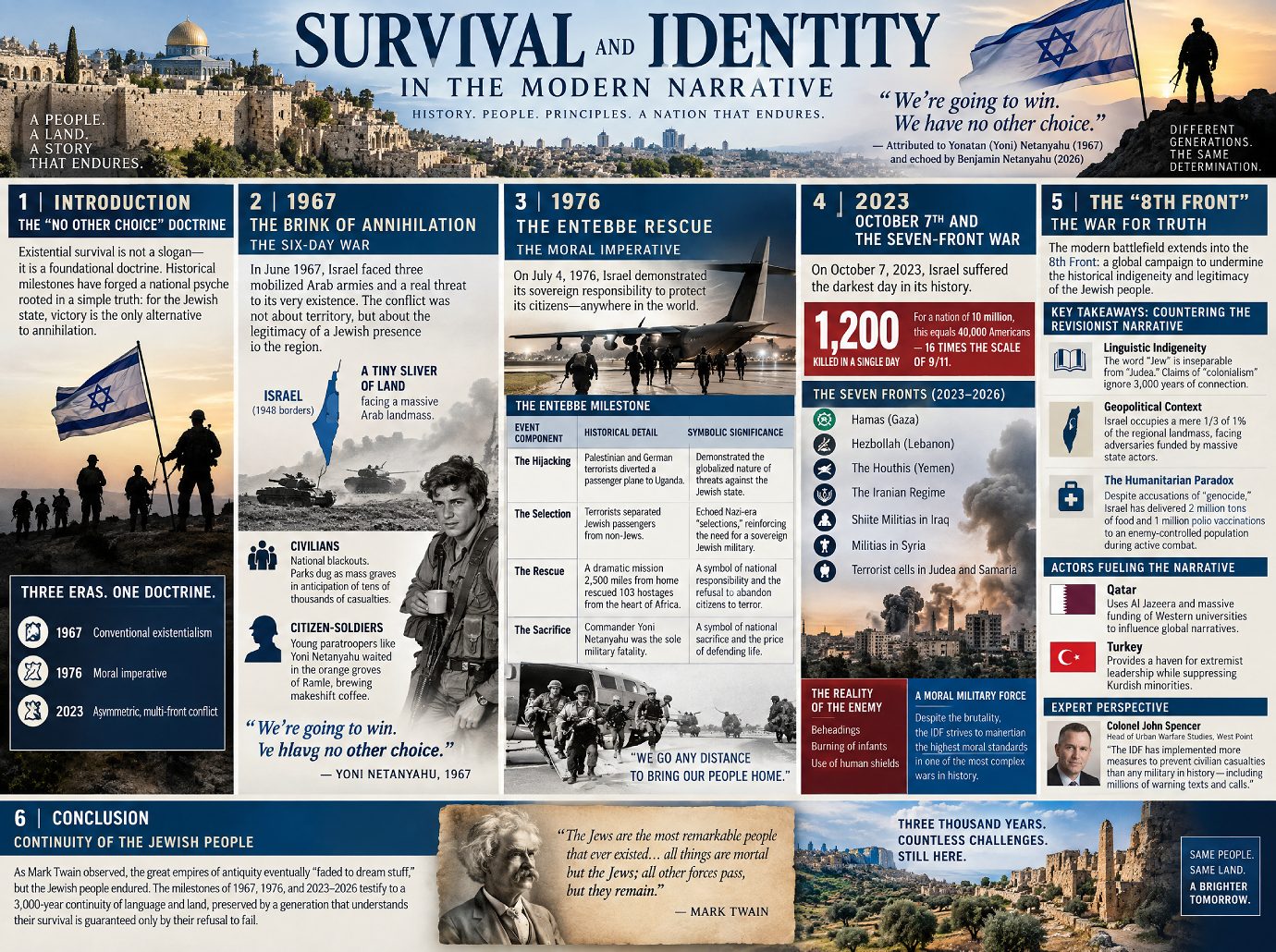
“We’re going to win. We have no other choice.” — Attributed to Yonatan (Yoni) Netanyahu (1967) and echoed by Benjamin Netanyahu (2026)
This mindset serves as the connective tissue between three distinct eras: the conventional existentialism of 1967, the moral imperative of the 1976 rescue missions, and the contemporary asymmetric, multi-front conflict. Each era reinforces the premise that for the Jewish state, survival is a persistent struggle against the “odds of history.”
2. 1967: The Brink of Annihilation (The Six-Day War)
The antebellum atmosphere of June 1967 was defined by a profound existential dread. Before the outbreak of hostilities on June 5th, the state existed within a “tiny sliver of land,” a geographic reality representing a mere fraction of a percent of the surrounding Arab landmass. The conflict was notably not centered on territorial disputes over Judea, Samaria, or Gaza—which were not under Israeli control—but on the very legitimacy of a Jewish presence in the region.
- Territorial Reality: Prior to the war, Israel did not possess Judea, Samaria, Gaza, or the Golan Heights. The struggle was defined by the vulnerability of the “1948 borders” against three mobilized Arab armies (Egypt, Jordan, and Syria) sworn to its destruction.
- Psychological Climate: The civilian population prepared for a catastrophe of historic proportions. National blackouts were enforced, and public parks in major cities were consecrated and excavated as mass graves in anticipation of tens of thousands of casualties.
- Personal Connection: This era is personified by the “citizen-soldier” ethos. In the orange groves of Ramle, young paratroopers like Yoni Netanyahu waited in the orchards, brewing makeshift coffee. It was here that the foundational phrase was uttered—a recognition that the upcoming battle allowed for no outcome other than victory.
Learning Narrative: This transition from the defensive crouch of a conventional citizen-army in 1967 to a decisive, preemptive victory provided the tactical and psychological foundation for the specialized, high-stakes rescue operations that would define the following decade.
3. 1976: The Entebbe Rescue (The Moral Imperative)
On July 4, 1976, the “No Other Choice” doctrine evolved into a global moral imperative: the sovereign responsibility to protect citizens regardless of geographic distance. The hijacking of an Air France flight to Entebbe, Uganda, forced a confrontation with the echoes of the mid-20th century.
The Entebbe Milestone
| Event Component | Historical Detail | Symbolic Significance |
|---|---|---|
| The Hijacking | Palestinian and German terrorists diverted a passenger plane to Uganda. | Demonstrated the globalized nature of threats against the Jewish state. |
| The Selection | Terrorists separated Jewish passengers from non-Jews, a chilling echo of Nazi-era “selections.” | Reinforced the necessity of a sovereign Jewish military to prevent a second Holocaust. |
| The Rescue | A dramatic mission 2,500 miles from home rescued 103 hostages from the heart of Africa. | A symbol of national responsibility and the refusal to abandon citizens to terror. |
| The Sacrifice | Commander Yoni Netanyahu was the sole military fatality of the mission. | Transformed the mission into a symbol of national sacrifice and the price of defending life. |
Learning Narrative: The success of the Entebbe mission, though tempered by the loss of its commander, institutionalized the ethos that the state would traverse any distance to uphold the sanctity of Jewish life, bridging the survivalism of 1967 with modern military ethics.
4. 2023: October 7th and the Seven-Front War
Looking back from the vantage point of 2026, the events of October 7, 2023, stand as the darkest chapter in the nation’s history. The scale of the tragedy necessitated a shift from localized defense to a massive, protracted engagement against a coordinated coalition of adversaries.
- Proportionality of Impact: The slaughter of 1,200 casualties in a single day holds a staggering demographic weight. For a nation of 10 million, this is the equivalent of 40,000 Americans—a tragedy 16 times the scale of 9/11.
- The Seven-Front Reality: The subsequent three years of conflict (2023–2026) saw the military engaged in a simultaneous struggle against:
- Hamas (Gaza)
- Hezbollah (Lebanon)
- The Houthis (Yemen)
- The Iranian Regime
- Shiite Militias in Iraq
- Militias in Syria
- Terrorist cells in Judea and Samaria
The conflict highlights a sharp dichotomy between the “monstrosity” of an adversary that utilizes beheadings, the burning of infants, and the systematic use of human shields, and the IDF’s efforts to maintain its status as a moral military force. Despite the intensity of this multi-theater war, the doctrine of survival remains unchanged.
Learning Narrative: These contemporary struggles are analyzed not as a new conflict, but as the latest iteration of the 1967 struggle for the right to exist—a continuation of the war for the “historic homeland.”
5. Synthesis: The “8th Front” and the War for Truth
Historians must recognize that the modern battlefield extends into the “8th Front”: the war for truth and legitimacy waged across global media and social platforms. This front involves a systematic campaign to undermine the historical indigeneity of the Jewish people.
| Key Takeaways: Countering the Revisionist Narrative |
|---|
| • Linguistic Indigeneity: The word “Jew” is etymologically and historically inseparable from “Judea.” To label the Jewish presence in the region as “colonial” is a historical distortion of a 3,000-year-old continuous connection. |
| • Geopolitical Context: The claim of “colonialism” is contradicted by the fact that the state occupies a mere 1/3 of 1% of the regional landmass, facing adversaries funded by massive state actors. |
| • The Humanitarian Paradox: Accusations of “genocide” are challenged by the unprecedented delivery of 2 million tons of food and 1 million polio vaccinations to an enemy-controlled population during active combat. |
The “8th Front” is fueled by specific geopolitical actors, most notably Qatar, which utilizes Al Jazeera and massive funding of Western universities to influence global narratives, and Turkey, under the leadership of Erdogan, who provides a haven for extremist leadership while simultaneously suppressing Kurdish minorities.
Military scholars, such as Colonel John Spencer, head of urban warfare studies at West Point, provide a critical counter-narrative to these accusations. Spencer notes that the IDF has implemented more measures to prevent civilian casualties than any military in history—including millions of warning texts and calls—thereby setting a new, albeit difficult, standard for asymmetric warfare.
6. Conclusion: Continuity of the Jewish People
The historical trajectory of the Jewish state is best summarized by the observations of Mark Twain, who noted that while the great empires of antiquity—the Babylonians, Egyptians, and Persians—eventually “faded to dream stuff,” the Jewish people endured. The milestones of 1967, 1976, and 2023–2026 serve as a testament to this endurance. They reinforce the “No Other Choice” doctrine as a permanent feature of a people who have successfully “beaten the odds of history” through a combination of unwavering resolve and the lack of a geographic or historical alternative.
The Modern Narrative of Identity is defined by a 3,000-year continuity of language and land, preserved by a generation that understands their survival is guaranteed only by their refusal to fail.