Templeton at a Fiscal Crossroads – The Candace Graves Interview
Listen to the interview on any device, CLICK PLAY.
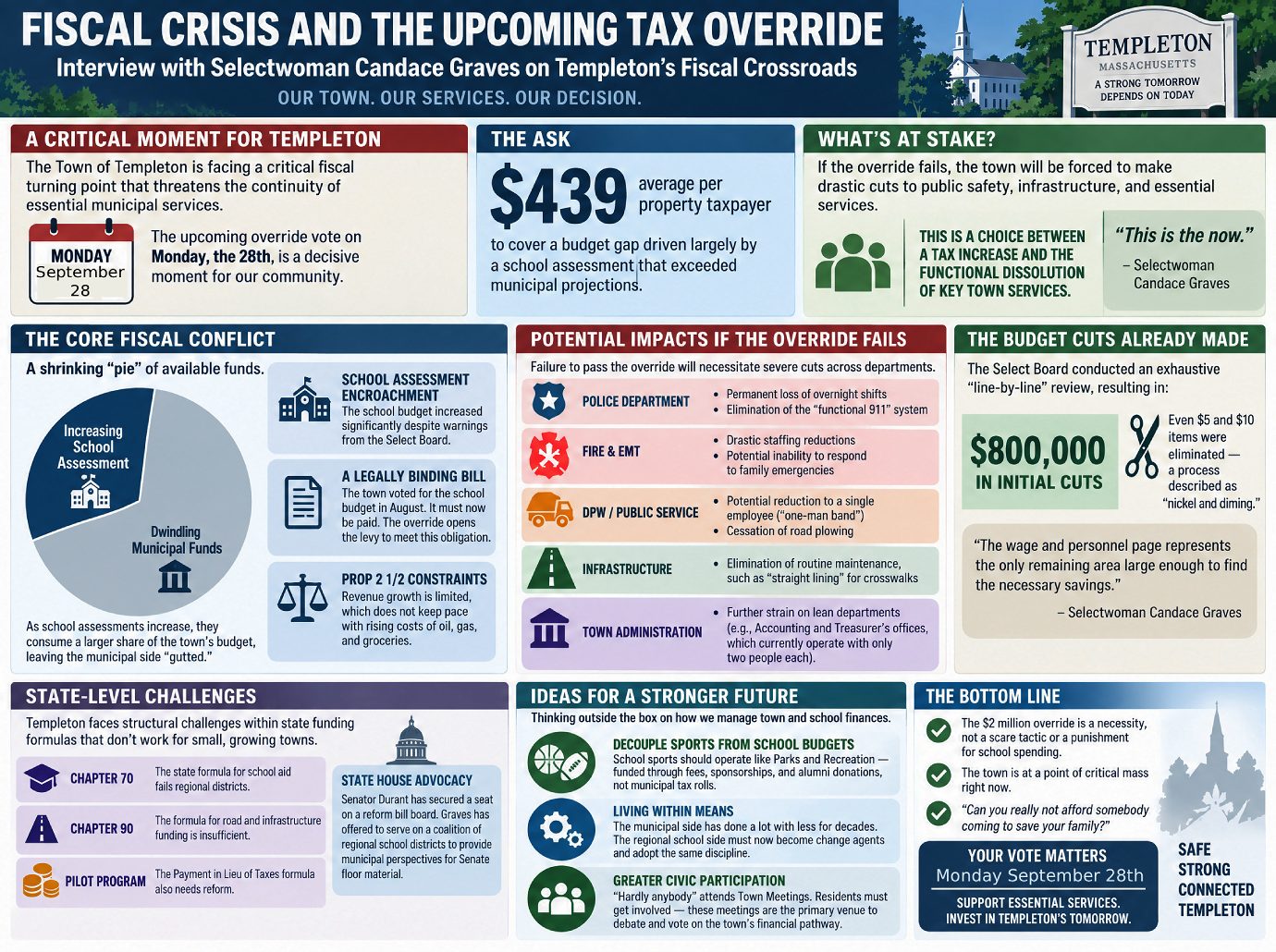
In this interview, Selectwoman Candace Graves discusses the severe fiscal crisis facing the town of Templeton, Massachusetts. She advocates for a tax override to address a massive budget shortfall caused by rising regional school district assessments and stagnant state funding formulas. Graves warns that failing to approve the measure in the Special Election on Monday, September 28th will result in devastating cuts to essential services, including public safety and road maintenance. By detailing the “line by line” cuts already made to municipal departments, she emphasizes that the town can no longer function without additional revenue. Ultimately, she calls on residents to vote yes to preserve the community’s core infrastructure while pushing for long-term legislative reform at the state level.
The Core Fiscal Conflict: The “Pie” and the School Assessment: Templeton’s financial distress is defined by a structural imbalance between revenue and mandated costs. The “pie” of available funds must cover both municipal services (public safety, roads, administration) and regional school assessments.
- School Assessment Encroachment: Graves notes that the school district is taking an increasing share of the town’s budget, leaving the municipal side “gutted.” Despite warnings from the Select Board in the fall of the previous year regarding a lack of surplus funds, the school budget increased significantly.
- The “Payable Bill”: Because the town voted for the school budget in August, it is now a legally binding “bill” that must be paid. The override is the mechanism to “open the levy” to meet this obligation.
- Prop 2 1/2 Constraints: Like many Commonwealth communities, Templeton’s revenue growth is limited by Proposition 2 1/2, which Graves argues does not provide enough funding to keep pace with the rising costs of oil, gas, and groceries.
The Choice for Voters: Residents are faced with a choice between a tax increase and the functional dissolution of public safety and public works. As Graves states: “Can you really not afford somebody coming to save your family? … This is the now.”