JUMP TO MORE WEEKLY BRIEFINGS: North Central — State News —- National News — World News
For the entire Weekly Briefing 11-8-26 120 page ebook, CLICK FOR PDF.
Weekly News Briefing – Gardner Magazine – for the Week of November 8, 2026
A Big News Week in the region, state, nation, and world. Listen to the Weekly News Briefing on any device, CLICK PLAY.
Top News of Greater Gardner, North Central, and North Quabbin MA
1.1 Regional Elections, Governance Shifts, and Civic Transitions
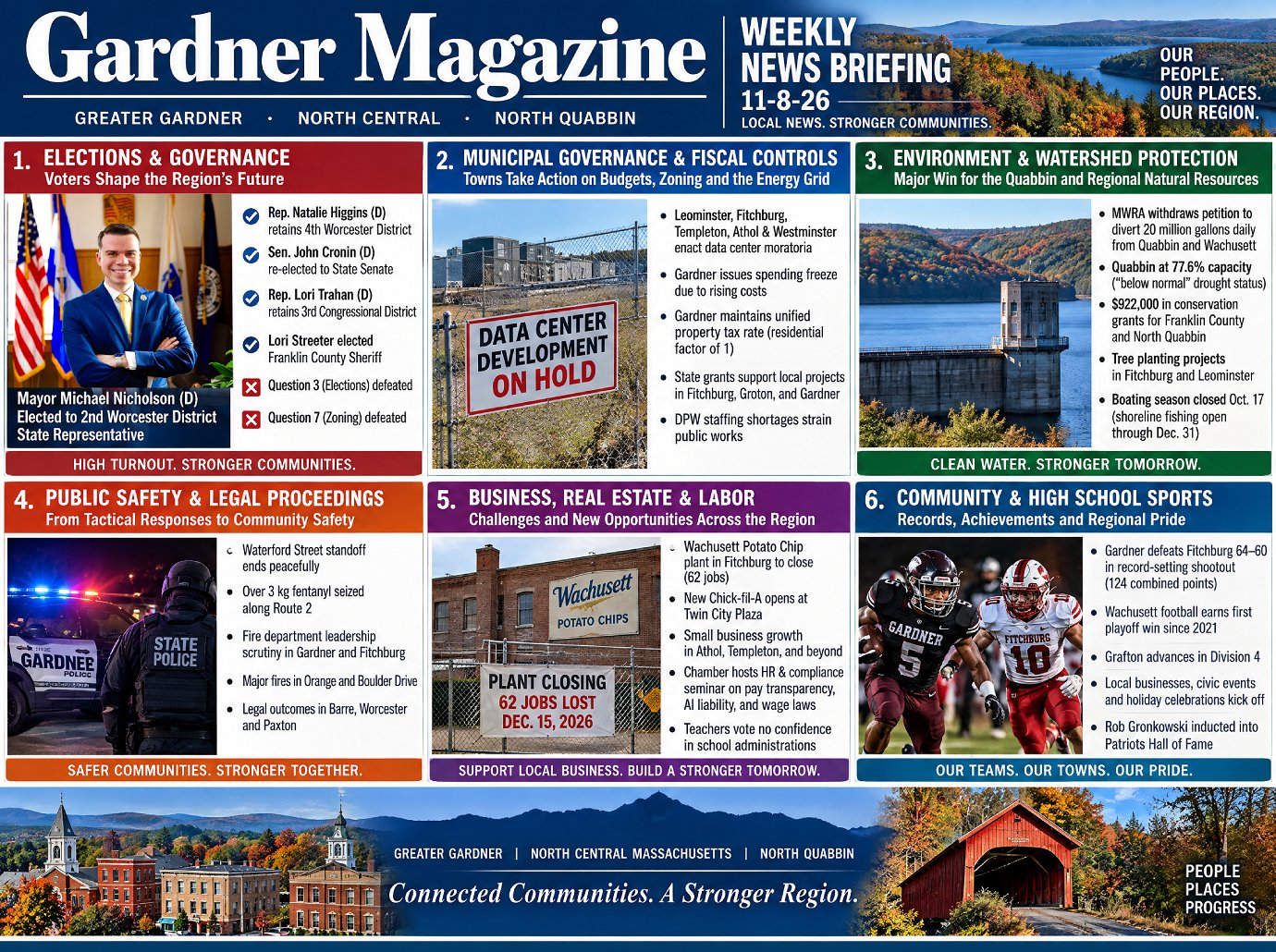
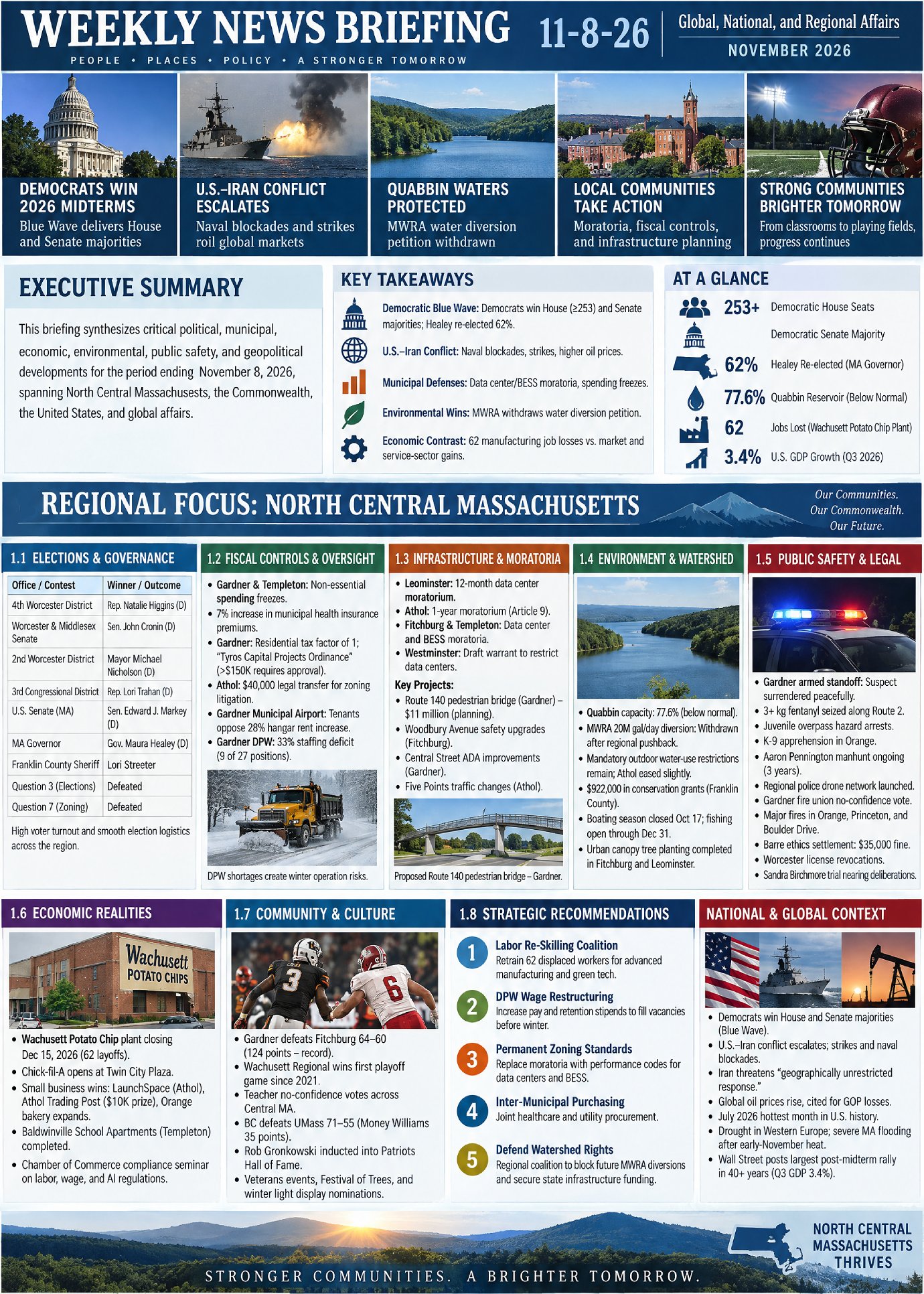
The November 2026 General Election marked a defining political moment across Greater Gardner, North Central Massachusetts, and the North Quabbin region. High voter turnout across early voting windows and Election Day demonstrated strong civic engagement, with local electorates overwhelmingly favoring incumbent retention in key legislative contests while simultaneously initiating critical transitions in municipal leadership. This regional prioritization of political continuity comes at a pivotal juncture, offering administrative stability as local governance structures confront severe fiscal inflation, regional electrical distribution constraints, and state-level regulatory shifts. To accommodate heavy voting volume and ensure seamless polling logistics, regional school districts—including Narragansett, Ashburnham-Westminster, Winchendon, and Quabbin—successfully coordinated staff development days, allowing municipal election clerks to manage record-tying ballot processing without operational conflict.
North Central MA Regional Election Results (Nov 2026)
| Office / Contest | Winner / Outcome | Strategic Local Impact |
|---|---|---|
| 2nd Worcester District (State Rep) | Mayor Michael Nicholson (D) | Defeated competition with formal backing from 35 municipal leaders; triggers executive charter succession planning in Gardner City Hall. |
| 4th Worcester District (State Rep) | Rep. Natalie Higgins (D) | Retained Leominster house seat by defeating Republican challenger Josh Bowdridge, preserving legislative seniority. |
| Worcester & Middlesex Senate | Sen. John Cronin (D-Fitchburg) | Secured re-election against unenrolled challenger Ming Zhang, maintaining regional Senate representation for Fitchburg and surrounding towns. |
| 3rd Congressional District | Rep. Lori Trahan (D) | Retained federal representation across northern Worcester County as part of a statewide Democratic federal sweep. |
| Franklin County Sheriff | Lori Streeter | Won election with 22,181 votes to complete the remainder of the term following her tenure as interim sheriff. |
| Statewide Question 3 (Elections) | Defeated | Statewide election reform and ballot access initiative rejected by regional voters, preserving existing municipal election administration protocols. |
| Statewide Question 7 (Zoning) | Defeated | Proposal mandating 5,000-square-foot statutory minimum lot sizes rejected, preserving local home-rule zoning authority over residential density. |
The election of Gardner Mayor Michael Nicholson to the 2nd Worcester District State Representative seat triggers an immediate administrative domino effect within the city’s executive branch. Under the provisions of the Gardner City Charter, Mayor Nicholson’s pending resignation requires the City Council to initiate formal succession protocols, elevating the Council President to serve as Acting Mayor or calling a special municipal election depending on the exact timing of his legislative swearing-in. This executive vacancy occurs precisely as the city navigates complex FY27 municipal budget execution, creating potential administrative friction during key department funding reviews. However, from a macro-policy perspective, transferring a sitting municipal executive directly into the State House equips Greater Gardner with an advocate on Beacon Hill who possesses intimate knowledge of local Chapter 90 road infrastructure formulas, PILOT (Payment in Lieu of Taxes) shortfalls, and municipal utility grant needs.
With local legislative representation anchored on Beacon Hill, regional leaders must immediately turn their attention toward managing acute municipal fiscal strains and structural energy grid challenges.
1.2 Municipal Governance, Fiscal Controls, and Land-Use Moratoria
Faced with expanding systemic bottlenecks, municipal leaders across Gardner, Fitchburg, Leominster, Athol, Templeton, and Westminster are executing aggressive regulatory interventions to shield local infrastructure and municipal budgets. Rising fixed operational costs, structural revenue limits imposed by Proposition 2 ½ property tax ceilings, and escalating electrical distribution grid constraints have forced municipal boards to deploy emergency land-use moratoria alongside rigorous executive spending controls.
Land-Use & Energy Grid Moratoria Breakdown
Severe concerns regarding electrical grid bandwidth, regional substation transformation capacity, and acute public safety hazards have driven a multi-jurisdictional, defensive wave of municipal land-use freezes targeting energy-intensive commercial developments:
- Leominster: Enacted a binding 12-month zoning moratorium on commercial data center developments to protect municipal electrical grid capacity from unprecedented megawatt draw demands.
- Fitchburg & Templeton: Advanced parallel land-use moratoria governing commercial data centers and Battery Energy Storage Systems (BESS) due to distribution grid bottlenecks and acute fire safety hazards—specifically severe thermal runaway risks that exceed local volunteer and call-fire department suppression capabilities.
- Athol: Approved Article 9 at its Special Town Meeting, establishing a one-year temporary zoning moratorium on the construction, conversion, and permitting of commercial data centers.
- Westminster: Scheduled a 15-article warrant for its November 17 Special Town Meeting to institute comprehensive data center zoning restrictions while addressing capital stabilization, pension transfers, and public safety operational needs.
Synthesized across these five contiguous jurisdictions, these individual zoning freezes represent a unified regional defensive posture. Municipal planning boards are actively refusing to allow Big Tech computing draw and unmitigated BESS installations to cannibalize localized sub-station bandwidth or compromise municipal fire safety while state energy policy remains in flux.
Fiscal Oversight & Municipal Cost Controls
Simultaneously, municipal executive bodies are managing severe budget pressures driven by double-digit fixed-cost inflation and unexpected municipal liabilities:
- Gardner Executive Spending Freeze: Mayor Michael Nicholson issued an executive order placing an immediate spending freeze on non-essential municipal operating expenditures. The intervention was mandated to absorb financial strain caused by a 7% premium jump in municipal health insurance plans alongside rising municipal utility debt.
- Templeton Spending Controls: Leadership in Templeton executed parallel non-essential spending freezes to offset structural budget deficits and manage rising employee healthcare overhead under strict Proposition 2 ½ statutory tax caps.
- Gardner Tax Classification & Oversight: The Gardner City Council and Board of Assessors adopted a residential factor of 1 during their annual tax classification hearing under M.G.L. c. 59 § 38A principles, maintaining a unified property tax rate across residential and commercial classes for FY27 to prevent tax shifts onto local businesses. To prevent unbudgeted capital exposure, the council advanced the “Tyros Capital Projects Ordinance,” which mandates City Council approval for any capital project exceeding $150,000 and requires citizen advisory panels for major infrastructure initiatives exceeding $500,000.
- Athol Legal Reserve Transfer & Traffic Controls: Athol officials posted a 10-article Special Town Meeting warrant featuring a $40,000 reserve transfer to cover town legal fees stemming from settled land-use litigation regarding sober houses in single-family residential zones. Concurrently, public works crews installed new “No Parking” restrictions on Goodale Street and Wilson Avenue as part of the ongoing Five Points Project traffic management initiative.
State Infrastructure & Municipal Grant Inflows
Despite widespread local fiscal tightening, targeted state capital grant awards provided essential funding for municipal infrastructure and public services across northern Worcester County:
- Fitchburg Outdoor Recreation Stage: Awarded a $260,000 state capital grant to construct a permanent outdoor performance and recreation stage to boost downtown commercial foot traffic.
- Groton Station Avenue Gateway: Secured a $60,000 state grant for the “Groton Gateway Upgrade” project to improve commercial wayfinding and physical pedestrian infrastructure along Station Avenue.
- Gardner Senior Healthcare Support: The Gardner Council on Aging received a $50,000 state grant to expand SHINE (Serving the Health Insurance Needs of Everyone) Medicare counseling services for low-income seniors navigating rising healthcare costs.
Infrastructure Deficits & Public Works Strain
Operational strains on regional public works are compounding municipal management challenges. The Gardner Public Service Committee reported a critical 33% staffing deficit within the Department of Public Works (DPW)—representing 9 vacant positions out of a 27-person workforce. This severe shortage directly threatens winter snow removal route coverage and delays priority municipal paving projects on Chestnut Street and South Gardner. Concurrently, tenants at the Gardner Municipal Airport strongly challenged a proposed 28% retroactive hangar rent hike introduced by the Airport Commission—a dispute illustrating the sharp structural tension between local tenant affordability and mandatory Federal Aviation Administration (FAA) self-sustainability compliance rules. Despite these operational bottlenecks, major civil engineering projects are moving forward: MassDOT held public hearings for Woodbury Avenue pedestrian safety enhancements in Fitchburg (incorporating heavy granite curbing and Rectangular Rapid Flashing Beacons), Gardner completed Central Street accessibility upgrades (flashing pedestrian signals, refreshed crosswalks, ADA ramps), and engineering evaluations advanced for Gardner’s $11 million Route 140 pedestrian bridge project.
Beyond internal infrastructure and financial governance, northern Worcester and Franklin counties face an equally vital imperative: protecting regional watershed integrity from external resource demands.
1.3 Environmental Management & Watershed Governance
Environmental governance across northern Worcester and Franklin counties in late 2026 has been defined by a resolute defense of regional natural resources. Local leaders and grassroots coalitions have increasingly framed resource governance as an essential stand for regional equity, rejecting efforts by state water authorities to extract local assets to serve metropolitan expansion.
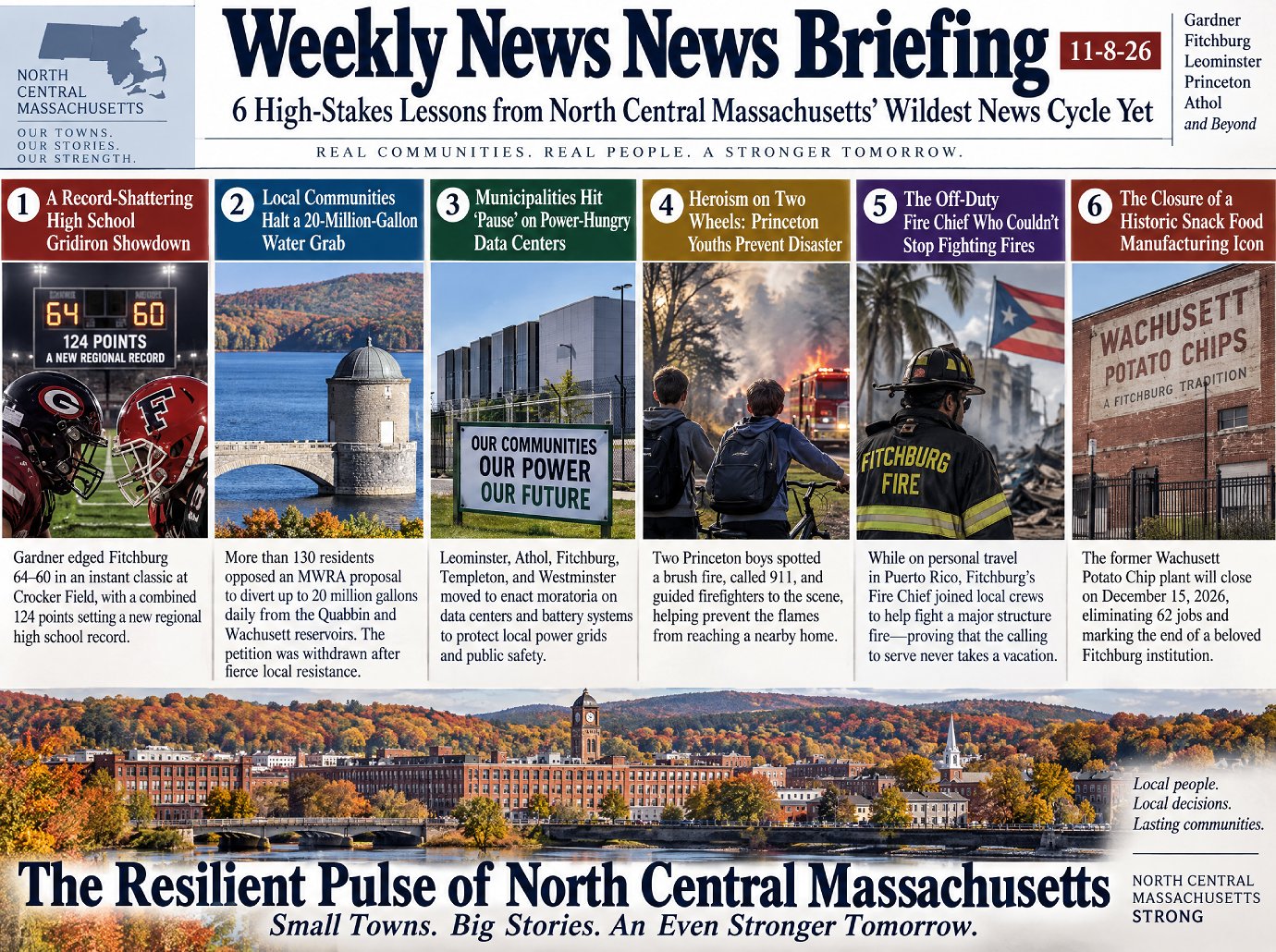
The defining environmental outcome of the period was the complete victory of regional watershed communities over the Massachusetts Water Resources Authority (MWRA). Facing sustained opposition from local officials, environmental advocates, and a public hearing featuring testimony from 130 local residents, the MWRA formally withdrew its petition to divert 20 million gallons of water daily from the Quabbin and Wachusett reservoirs to Eastern Massachusetts. Regional stakeholders successfully challenged the MWRA’s proposed entrance fee waiver policies through 2027, arguing that siphoning millions of gallons daily while local towns operated under mandatory water conservation orders posed severe ecological and economic risks to the donor basin.
Environmental Metrics & Conservation Status
- Quabbin Reservoir Capacity: Storage levels dropped to 77.6% capacity, formally triggering a “below normal” drought status under Massachusetts drought management guidelines and requiring northern Worcester County towns to maintain mandatory outdoor water-use restrictions (though Athol marginally eased local rules following autumn rain).
- Recreational Operations: The official 2026 Quabbin Reservoir boating season closed on October 17. Shoreline fishing remains open through December 31, strictly contingent on seasonal ice formation.
This watershed victory was complemented by significant state land conservation investments. State environmental agencies allocated $922,000 in landscape-level conservation grants to protect open spaces, wetlands, and contiguous forestlands across Franklin County and the North Quabbin region. Regional land trusts leveraged these funds to secure vital conservation buffer acquisitions along the Swift River and Quabbin watershed boundaries. Concurrently, the Greening the Gateway Cities Urban Canopy project entered its final seasonal week, completing targeted neighborhood tree plantings across Fitchburg and Leominster.
While ecological vigilance safeguards regional water supplies, public safety agencies across the corridor are navigating complex operational challenges and intense administrative scrutiny.
1.4 Public Safety, Emergency Services, and Legal Proceedings
Public safety operations across North Central Massachusetts continue to balance high-stakes tactical responses with operational oversight and legal accountability. Local law enforcement and emergency service departments have managed critical incidents while addressing internal administrative friction.
Tactical Operations & Law Enforcement Interdictions
- Waterford Street Standoff (Gardner): Over the night of November 6 into November 7, Gardner Police and the Massachusetts State Police Crisis Negotiation Team responded to an armed barricade incident at 53 Waterford Street. A 42-year-old resident, David Margeson, barricaded himself inside and threatened violence. Following multi-hour negotiations, Margeson surrendered peacefully at 2:30 AM without injury and was booked on charges of Assault with a Dangerous Weapon.
- Route 2 Narcotics Interdiction: State and regional drug task forces executed targeted interdictions along the Route 2 transit corridor, seizing over three kilograms of fentanyl alongside commercial processing and packaging equipment.
- Regional Enforcement Initiatives: Police apprehended several juveniles involved in dropping heavy objects from highway overpasses onto active motor vehicle traffic. In Orange, Police K-9 Zeus successfully tracked and located a break-in suspect hiding in dense woods following an early-morning break-in and knife threat on Lenox Circle. Meanwhile, regional law enforcement maintained active leads in the search for wanted Gardner murder suspect Aaron Pennington as the manhunt reached its three-year mark, and regional departments expanded a shared drone technology network for search-and-rescue deployments.
Fire Department Leadership Scrutiny & Operational Heroics
- Gardner Fire Department: The Gardner Fire Fighters Association (IAFF Local 3128) passed a formal Vote of No Confidence against the department’s Fire Chief, citing escalating disputes over administrative policies, operational safety protocols, and departmental leadership.
- Fitchburg Fire Department: Municipal leadership faced public inquiries after reports surfaced that Fitchburg’s Fire Chief assisted active firefighting crews with a major structure fire in Puerto Rico while placed on administrative leave from his home city.
- Winchendon Command Transition: Winchendon appointed Chief Harding as head of the department following the retirement of long-serving Chief Thomas Smith.
- Emergency Incident Responses: Emergency crews responded to a devastating 2-alarm fire on Packard Road in Orange that destroyed a home, displaced five residents, killed a pet dog, and hospitalized one resident for smoke inhalation (drawing mutual aid from ten regional departments). A duplex fire on Boulder Drive severely damaged the structure and displaced five residents without injuries. In Princeton, two boys riding bicycles were publicly commended by fire officials after spotting a fast-moving brush fire and alerting dispatchers, allowing crews to suppress the flames before they reached a nearby residence.
Judicial Outcomes & Legal Settlements
In judicial matters, former Barre DPW Superintendent Jason Pimental paid a $35,000 civil fine to resolve state ethics violations regarding conflict of interest laws. In Worcester, municipal licensing boards revoked operating licenses for a local strip club following a fatal shooting and safety violations, and shut down a gaming venue found hosting hundreds of patrons in a space rated for 16 people. In federal court proceedings tracking high-profile regional law enforcement prosecutions, defense testimony wrapped in the trial of ex-detective Matthew Farwell regarding the death of Sandra Birchmore. Meanwhile, active land-use litigation against Anna Maria College in Paxton was dismissed after an alumnus agreed to purchase a disputed parcel.
The operational demands on emergency services reflect broader societal and economic pressures, directly echoing the structural realignments taking place within the region’s industrial and commercial base.
1.5 Business, Real Estate, Labor Dynamics, and Regional Sports
The economic landscape of North Central Massachusetts displays a sharp duality: structural industrial deindustrialization is directly colliding with new commercial retail entries, small business incubation, and vibrant civic life.
Industrial Deindustrialization vs. Commercial Retail Shifts
The region’s industrial base suffered a major blow with the announced permanent shutdown of the historic commercial snack food manufacturing facility in Fitchburg (formerly the Wachusett Potato Chip plant), effective December 15, 2026. The closure eliminates 62 specialized manufacturing jobs. This loss of high-wage industrial positions ($25 to $35+ per hour with comprehensive healthcare and retirement benefits) triggers a decay in the local payroll multiplier, reducing secondary spending in local retail and compressing Fitchburg’s industrial property tax base.
Conversely, commercial retail growth continues along key transit corridors. A new Chick-fil-A opened at Twin City Plaza on the Fitchburg–Leominster border, creating entry-level service jobs and establishing food-surplus donation partnerships with local pantries. Meanwhile, small business capitalization advanced through targeted programs: the North Central Massachusetts Development Corporation (NCMDC) approved development financing for LaunchSpace, an Athol makerspace; the Athol Trading Post won the $10,000 grand prize at the NewVue/Athol Credit Union Small Business Showcase; an Orange bakery completed commercial build-outs for a second location in Templeton; and real estate developers MPZ Development and Capstone Communities initiated tenant move-ins at the redeveloped Baldwinville School Apartments in Templeton.
Employer HR & Regulatory Compliance Seminars
To assist regional business owners navigating complex employment statutes, the North Central Massachusetts Chamber of Commerce hosted an executive legal seminar led by law firm Mirick O’Connell. The briefing detailed strict corporate compliance mandates across three core areas:
- Massachusetts Pay Transparency Act: Enforcing mandatory wage-range disclosure rules in all job postings and establishing state reporting standards for gender and racial pay equity tracking.
- Artificial Intelligence (AI) Liability: Establishing corporate liability standards governing automated hiring tools, algorithmic employee evaluations, and workplace AI integration.
- Statutory Wage & Hour Auditing: Conducting internal audits of employee classification standards, independent contractor designations, and overtime tracking systems under Massachusetts Blue Laws.
Regional Labor Disputes
Public sector labor friction intensified as public school educators across Central Massachusetts passed a vote of no confidence against school administrations. Participating teachers have been operating without an active collective bargaining agreement since the expiration of their contract in June.
High School Sports & Community Highlights
- Crocker Field Record Shootout: At Fitchburg’s historic Crocker Field, the Gardner Wildcats defeated the Fitchburg Red Raiders 64–60 in an unprecedented high school football shootout. The 124 combined points set a regional record for the highest-scoring game in local memory.
- MIAA Postseason & Collegiate Athletics: Grafton preserved a Division 4 playoff victory over South High with a late fourth-quarter interception, while Wachusett Regional secured its first postseason football win since 2021. Small-school athletic directors initiated preliminary talks regarding an 8-man football format to address shrinking rosters. In collegiate soccer, the Fitchburg State Falcons were eliminated in the opening round of the MASCAC Men’s Soccer Tournament. In college basketball, Money Williams scored 35 points to lead Boston College past UMass 71–55 at TD Garden, while former New England Patriots tight end Rob Gronkowski was inducted into the Patriots Hall of Fame.
- Civic Dedications & Tourism: Fitchburg Housing Authority completed modernizations at Wallace Tower, dedicating the Mark Cunningham Community Hall and the Isabel Demmon Veterans Memorial Park. Gardner finalized plans for its annual Veterans Day Ceremony on November 11 at Perry Auditorium and announced the 21st Annual Festival of Trees (Nov 11–Dec 5). The Greater Gardner Chamber launched its holiday lighting campaign targeting 1,200 light sponsorships, while Red Apple Farm in Phillipston and the New England Botanic Garden in Boylston earned nominations for USA TODAY’s 10Best national holiday display awards.
As North Central Massachusetts navigates localized business shifts and civic life, these municipal developments directly reflect broader legislative debates and executive mandates radiating from Beacon Hill. For the entire Weekly Briefing 11-8-26 120 page ebook, CLICK FOR PDF.