Gardner City Council Meeting
The Gardner City Council met on November 2, 2026. Listen to the meeting on any device, CLICK PLAY.
The meeting encompassed critical policy votes, municipal appointments, financial oversight reporting, and discussions on administrative efficiency.
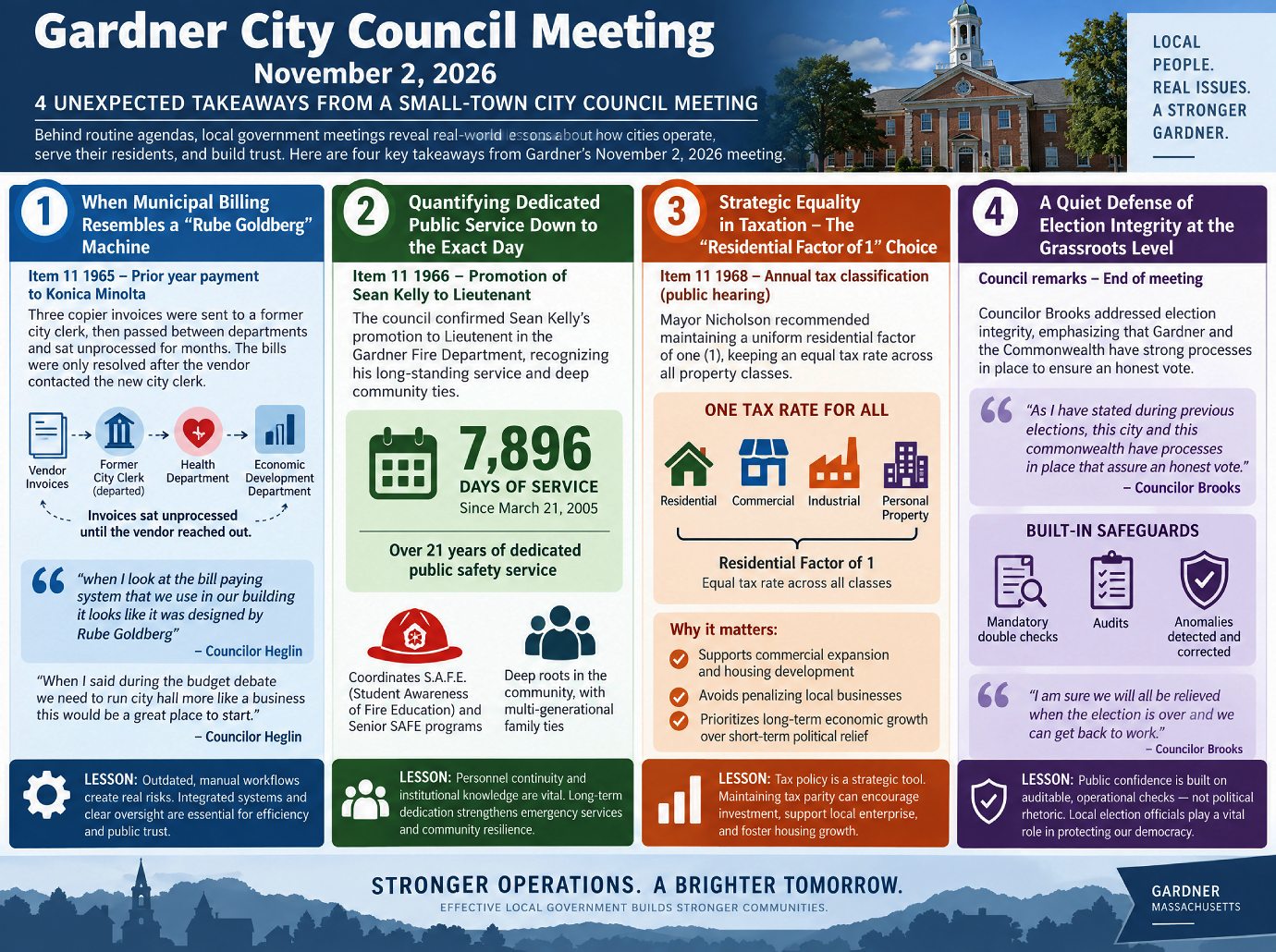
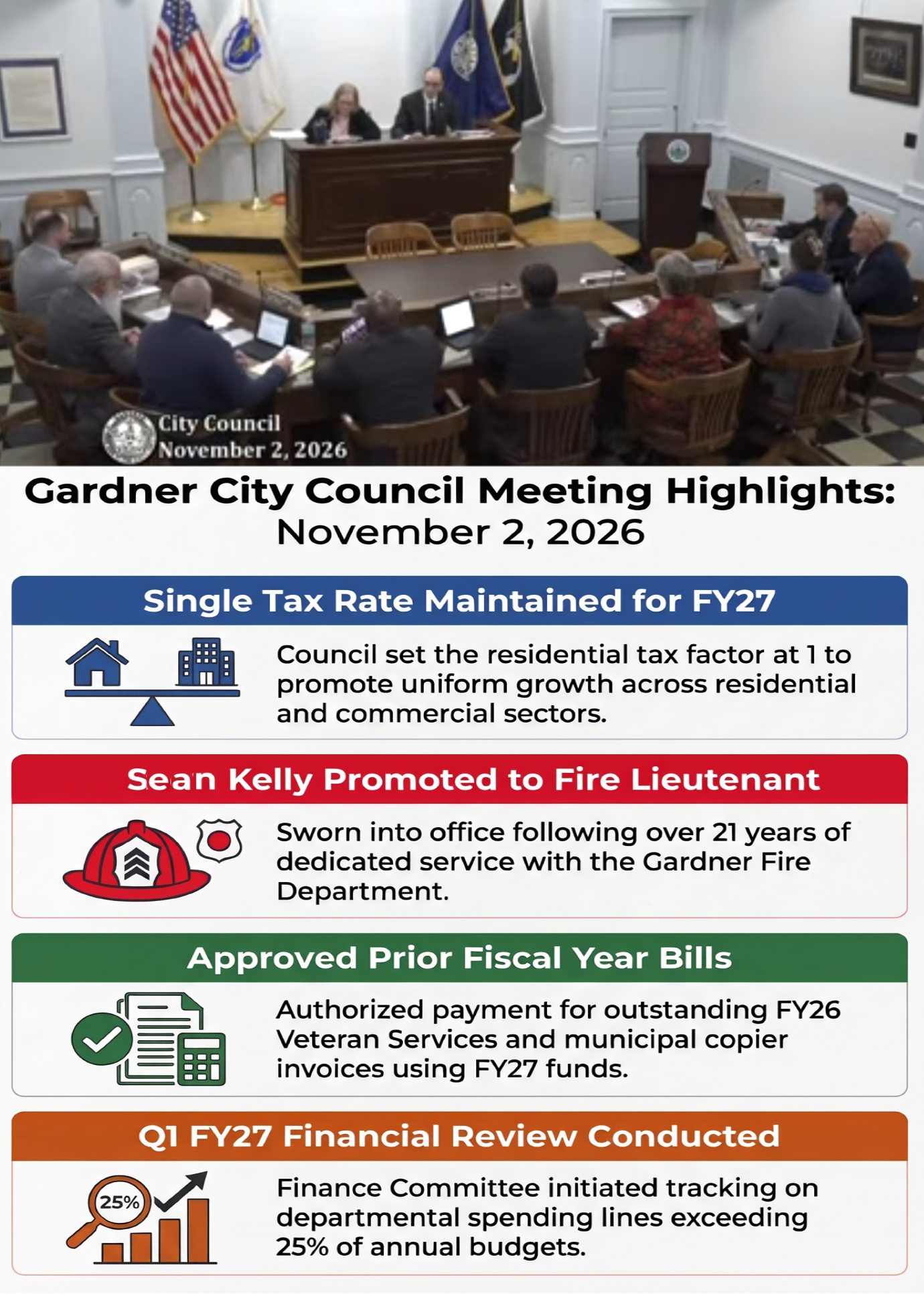
- Tax Classification Policy: The Council officially voted to establish a residential tax factor of 1 for Fiscal Year 2027 (July 1, 2026 – June 30, 2027). Supported by Mayor Nicholson, this maintains a uniform tax rate across residential, commercial, industrial, and personal property classes to encourage both housing and commercial development.
- Fire Department Promotion: Sean Kelly was formally promoted to the rank of Lieutenant in the Gardner Fire Department following over 21 years (7,896 days) of service and notable leadership in community safety programs.
- Financial Oversight & Prior-Year Bills: The Council approved two measures to pay unpaid Fiscal Year 2026 bills using Fiscal Year 2027 funds. The debate over these payments brought to light significant administrative inefficiencies in City Hall’s decentralized billing processes, prompting calls for operational modernization.
- Electoral Integrity Statement: Councillor Brooks reaffirmed public trust in local and state election infrastructure, emphasizing robust auditing and verification procedures.
During discussion on Item 11965, Councilor Brad Heglin delivered a detailed critique regarding internal workflow flaws within City Hall’s financial operations:
- Copier Billing Disconnect: City Hall operates three commercial copiers under contract across three departments (City Clerk, Health, and Economic Development). All invoices were historically routed to a single point of contact—the former City Clerk. Upon that clerk’s departure, incoming invoices went unnoticed and unpaid, eventually triggering late notices to the incoming City Clerk a year later.
- Systemic Redundancies: Councillor Heglin pointed out that similar decentralized issues exist across other basic recurring utility bills, noting that City Hall receives “well over a dozen separate invoices every month for cell phones for all employees who work in the same building.”
- Lack of Centralized Tracking: The city currently lacks a centralized roster of recurring vendor bills and designated department managers responsible for paying them, creating severe operational vulnerabilities during staff leaves or turnover.
- Operational Critique: Councillor Heglin characterized the current bill-paying infrastructure as looking like it was “designed by Rube Goldberg,” describing it as “horrifically inefficient,” “redundant,” and relying on “unnecessary or overcomplicated tasks.” He urged the administration to restructure internal operations to “run City Hall more like a business.”