Beyond Turkey and Pumpkin Pie: Insights on Thanksgiving, Generosity, and Community From CSUMC
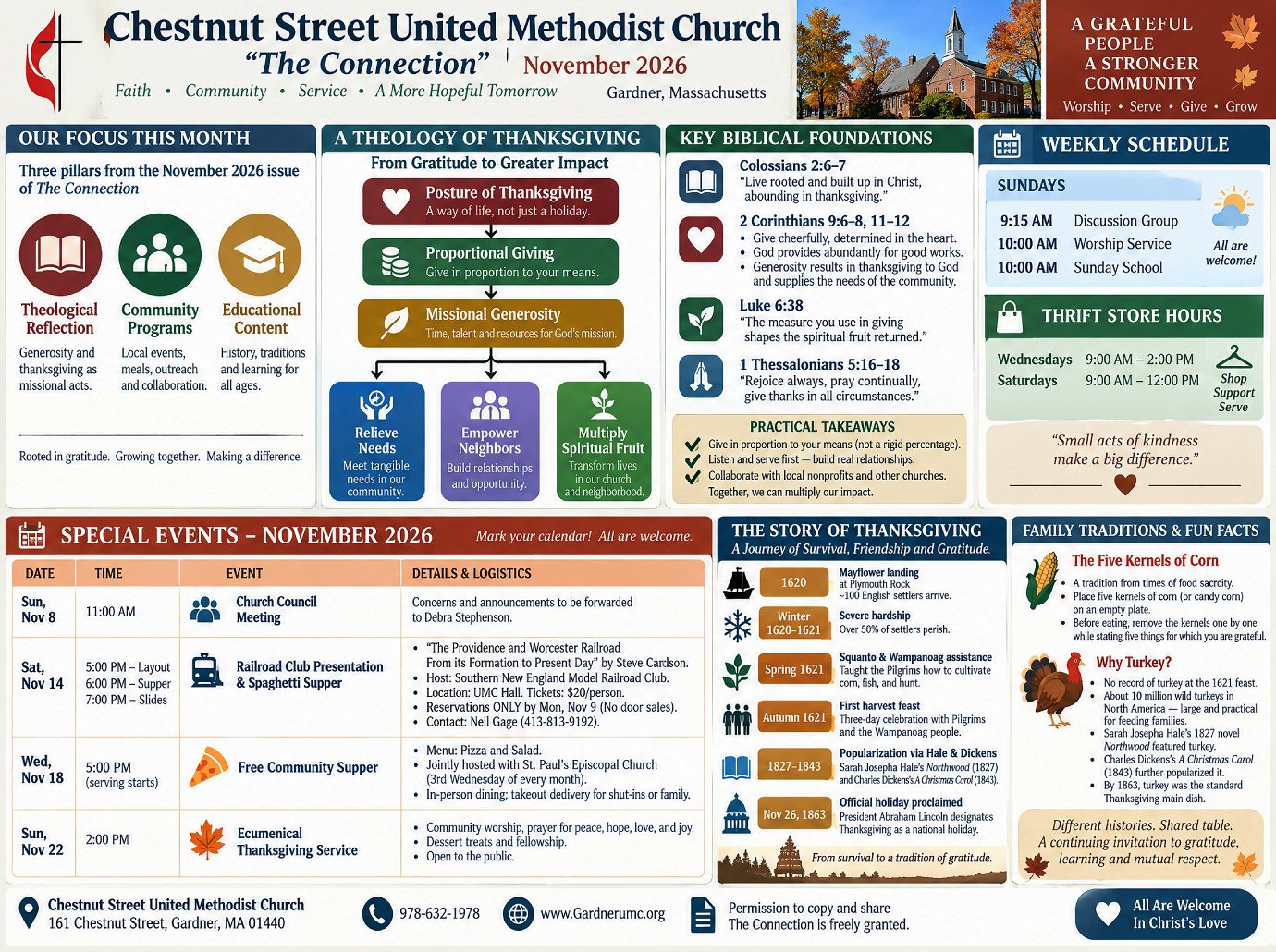
The Chestnut Street United Methodist Church of Gardner MA publishes a Connection Newsletter, November edition, CLICK HERE for PDF.
This newsletter offers some incredible and valuable insights into Thanksgiving, Generosity, Community, and God. The Chair Man and the Chair Lady share their reflections in this podcast, CLICK PLAY.
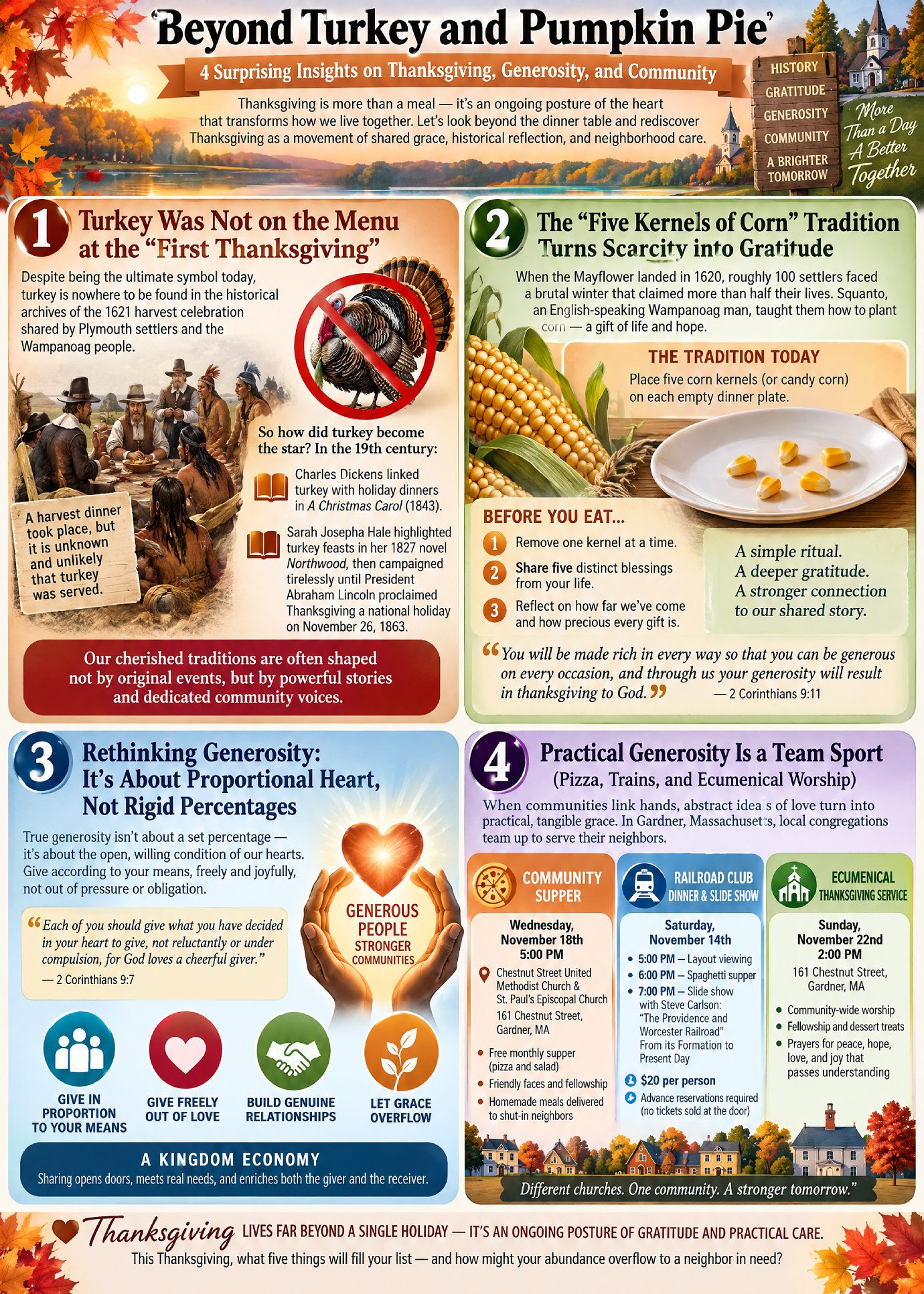
While Thanksgiving is often pictured as a single afternoon spent around a roasted turkey and pumpkin pie, it was always meant to be an ongoing posture of the heart that transforms how we live together.
Beneath our familiar holiday rituals lie unexpected historical origins, deeply symbolic family traditions, and a vibrant call to active generosity. By looking beyond the dinner table, we can rediscover Thanksgiving as a powerful movement of shared grace, historical reflection, and neighborhood care.
Turkey Was Not on the Menu at the “First Thanksgiving”
Despite standing as the ultimate symbol of modern Thanksgiving feasts, turkey is nowhere to be found in the historical archives of the 1621 harvest celebration shared between Plymouth settlers and the Wampanoag people. While a historic harvest dinner certainly took place, historians note it is unknown and unlikely that turkey was served that day. The bird’s rise to fame came much later in the 19th century, driven primarily by simple practicalities: an estimated 10 million wild turkeys roamed America at European contact, making these abundant, large-bodied birds an accessible way to feed a full family table.
The shift from practical farm food to iconic centerpiece was sparked by creative storytelling and persistent civic passion. Authors like Charles Dickens helped link holiday dinners with turkey in A Christmas Carol (1843), while writer Sarah Josepha Hale highlighted turkey feasts in her 1827 novel Northwood. Hale turned that literary inspiration into a tireless advocacy campaign, eventually persuading President Abraham Lincoln to proclaim Thanksgiving an official national holiday on November 26, 1863, where turkey finally took center stage at the national table. Her journey shows us how our most cherished cultural traditions are often sculpted not by original events, but by powerful stories and dedicated community voices.
The “Five Kernels of Corn” Tradition Turns Scarcity into Gratitude
When the Mayflower landed at Plymouth Rock in late 1620, roughly 100 settlers faced a brutal New England winter that claimed more than half their lives. Survival hung in the balance until Squanto, an English-speaking Wampanoag man, stepped forward to teach the newcomers how to plant corn—turning a simple crop into an essential gift of life and hope. Today, families honor that historic bridge from desperation to abundance through the “Five Kernels of Corn” tradition, placing five corn kernels (or sweet candy corn for a modern twist) on each empty dinner plate before serving the feast.
This simple table ritual transforms a meal into an intentional moment of shared reflection. Before anyone fills their plate, family members take turns removing their five kernels one by one, sharing five distinct blessings from their lives. It connects historical perseverance directly to daily gratitude, reminding us how precious every gift truly is.
“You will be made rich in every way so that you can be generous on every occasion, and through us your generosity will result in thanksgiving to God.” — 2 Corinthians 9:11
Rethinking Generosity: It’s About Proportional Heart, Not Rigid Percentages
True generosity isn’t about checking off a rigid financial percentage or meeting a cold obligation—it is about the open, willing condition of our hearts. Looking at the Apostle Paul’s guidance in 2 Corinthians, biblical giving encourages us to share in proportion to our actual means. Generosity should never feel like a painful loss (“reluctantly”) or come from outside pressure (“under compulsion”), because true joy blossoms when we give freely out of love.
“Each of you should give what you have decided in your heart to give, not reluctantly or under compulsion, for God loves a cheerful giver.” — 2 Corinthians 9:7
This warm framework invites us directly into a “Kingdom Economy,” where sharing our time and resources opens natural doors to connect with people around us. When we give according to our ability, we build genuine relationships by listening to our neighbors, serving their needs, and earning the right to share real hope. Rather than keeping generosity contained inside church walls, proportional giving lets grace overflow, relieving brokenness and enriching both the giver and the receiver.
Practical Generosity Is a Team Sport (Pizza, Trains, and Ecumenical Worship)
When communities link hands, abstract ideals of love turn into practical, tangible grace. In Gardner, Massachusetts, local congregations show what this looks like by teaming up across denominational lines. Chestnut Street United Methodist Church (161 Chestnut Street, Gardner, MA) partners with St. Paul’s Episcopal Church to host a free monthly Community Supper on the third Wednesday—specifically Wednesday, November 18th, starting at 5:00 PM—serving up warm pizza and salad to offer friendly faces after a busy day. And because true hospitality leaves no one behind, volunteers gladly pack up homemade meals for home delivery to shut-in neighbors and family members who cannot travel.
Community connection also shines through fun neighborhood gatherings and unified worship:
- Railroad Club Dinner & Slide Show: On Saturday, November 14th, the Southern New England Model Railroad Club hosts a special event at the church hall (161 Chestnut Street). Presenter Steve Carlson guides guests through “The Providence and Worcester Railroad” From its Formation to Present Day. The event opens layout viewing at 5:00 PM, serves a hearty Spaghetti Supper at 6:00 PM, and starts the Slide Show at 7:00 PM ($20 per person, with advance reservations required—no tickets sold at the door).
- Ecumenical Thanksgiving Service: On Sunday, November 22nd at 2:00 PM, neighbors gather at 161 Chestnut Street for a community-wide service filled with worship, fellowship, dessert treats, and prayers for peace, hope, love, and joy that passes understanding.
Whether sharing a hot slice of pizza, exploring regional train history, or praying together under one roof, these events prove that practical care breaks down barriers and transforms local neighborhoods well beyond institutional walls.
At its heart, Thanksgiving lives far beyond a single holiday calendar entry—it is an ongoing posture of missional gratitude and practical care. When we blend historical reflection, personal gratitude traditions, and hands-on community service, we create places where everyone experiences shared grace. We thank the CSUMC for sending us a copy of their November newsletter. Would you like your church and/or newsletter featured FREE on Gardner Magazine? Just email News@GardnerMagazine.com and we would be honored to receive it. May God Bless each and every one of you.