Publisher’s Note: Gardner Magazine does not agree with all of the assertions made in the DEBATE, but we present it here because it results from an objective analysis and will help create discussion.
Who Should Lead Gardner – An Objective Gardner Magazine Report
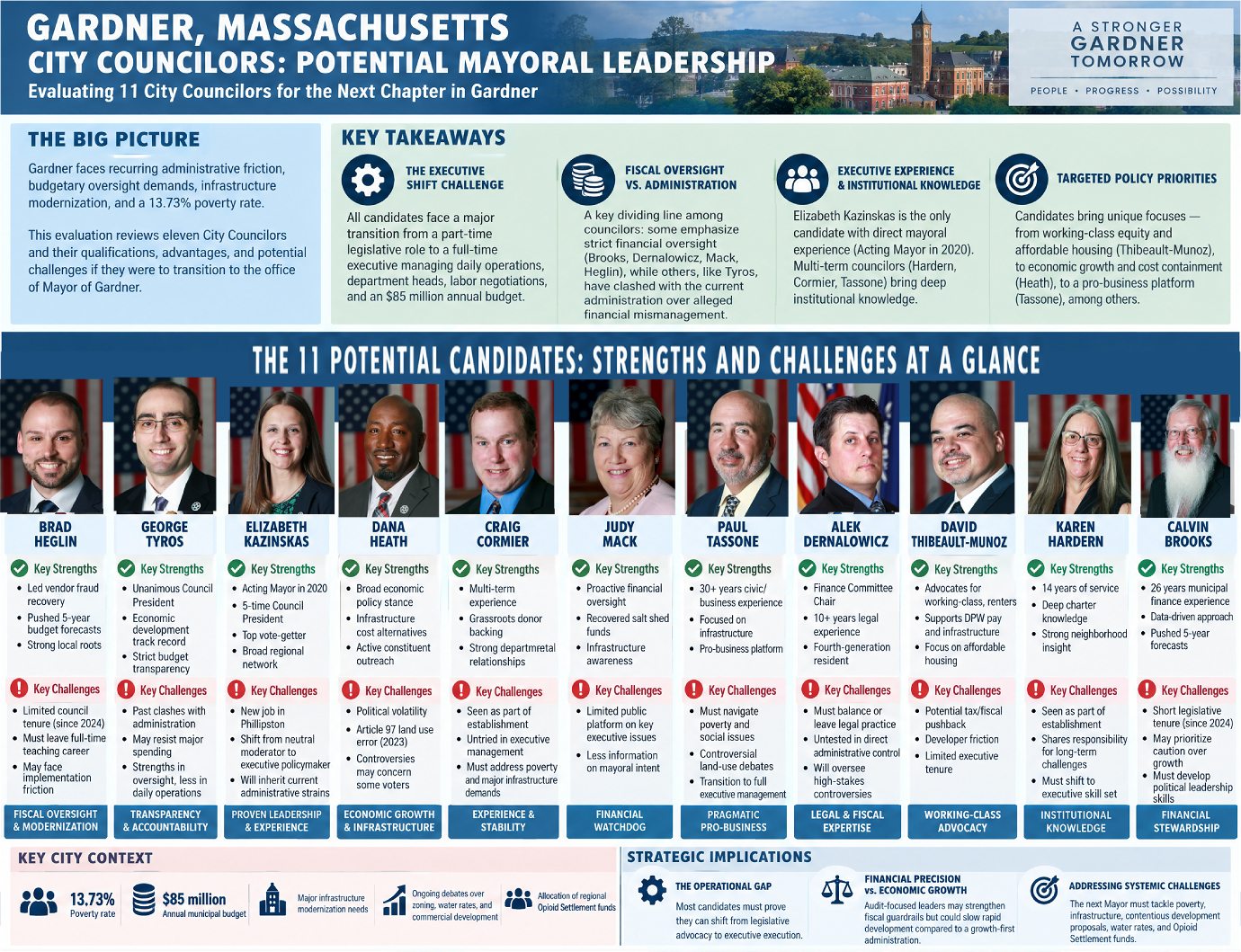
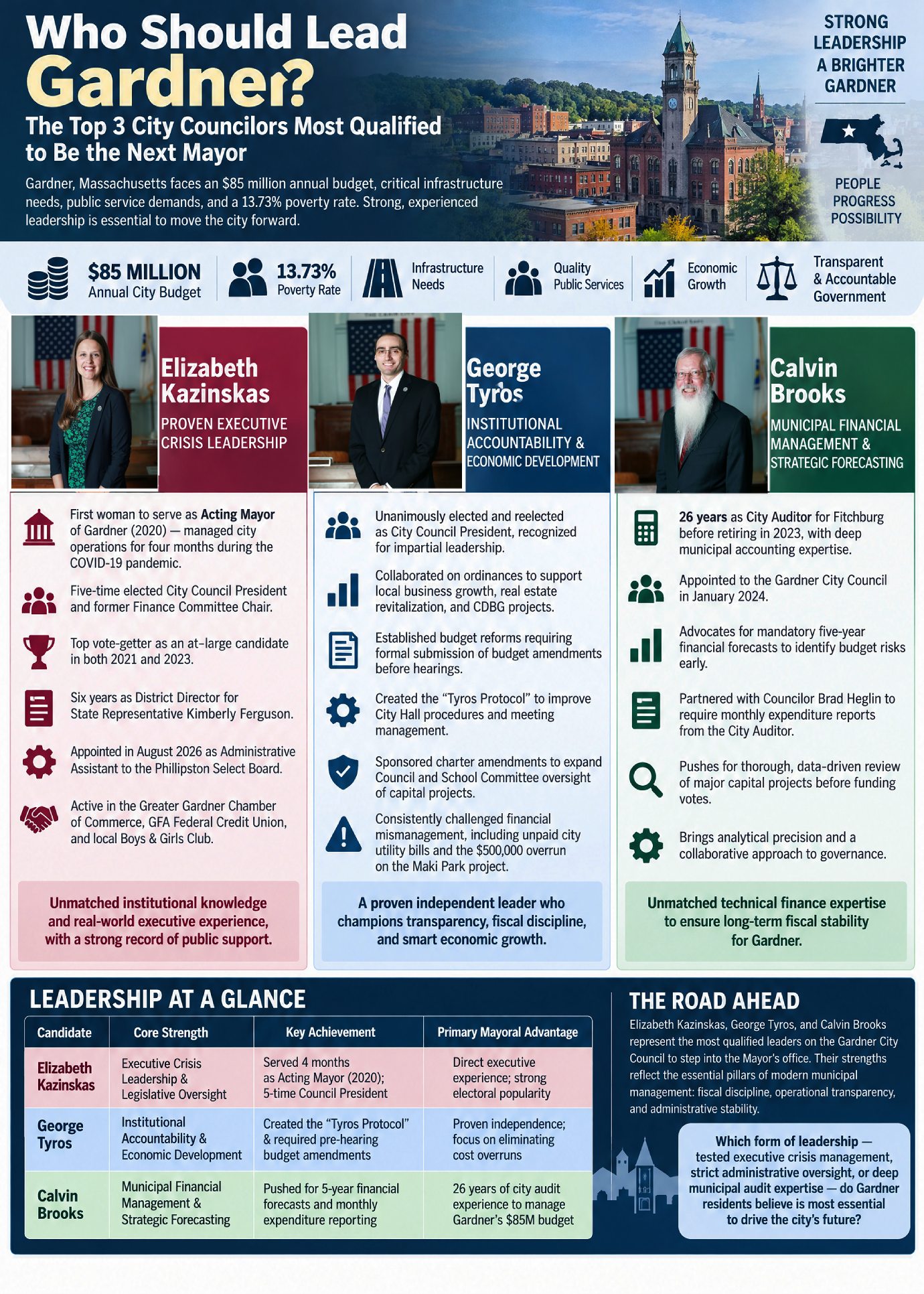
Gardner Magazine put all the Pros and Cons through the paces and we ran all the data through an extensive and comprehensive AI examination. What emerged was that Elizabeth Kazinskas, George Tyros, and Calvin Brooks are the Gardner City Councilors most qualified to be Mayor should current Mayor Nicholson win a seat in the State Legislature. A City Council President will be elected in January and that person would be Acting Mayor if there is a vacancy.
Listen to this debate about Who Should Lead Gardner on any device, CLICK PLAY.
Listen to this DEEP DIVE report about Who Should Lead Gardner on any device. CLICK PLAY.
Transitioning from a legislative role within the Gardner City Council to the executive office of the Mayor represents a fundamental shift in leadership scope, operational accountability, and administrative responsibility. While a city councilor functions within a collective body focused on policy deliberation, legislative voting, ordinance formulation, and constituent advocacy, the Mayor serves as the Chief Executive Officer. In Gardner’s municipal governance structure, the executive office demands direct management of daily city administration, supervision of municipal department heads, oversight of collective bargaining and public safety unions, and full accountability for executing Gardner’s $85 million annual operating budget. Evaluating a sitting councilor’s readiness for executive office requires assessing not only their legislative record, but also their capacity to command administrative processes, navigate complex municipal financial systems, and manage systemic operational risks.
Analytical Evaluation Criteria
To evaluate the prospective executive readiness of Gardner’s sitting councilors, this assessment applies a standardized, four-pillar framework:
- Fiscal Oversight & Budgetary Management: The demonstrated capacity to analyze, manage, and modernize Gardner’s $85 million annual budget. This includes identifying financial discrepancies, implementing long-range financial forecasting, establishing structural audit procedures, and exercising prudence regarding capital investments and municipal stabilization funds.
- Administrative & Executive Experience: Direct experience in managing personnel, leading organizational processes, executing daily municipal or professional operations, navigating crisis environments, and collaborating across governmental departments and regional boards.
- Legislative Track Record & Policy Initiatives: A proven history of formulating and enacting local ordinances, championing charter amendments, driving economic development projects, and advocating for structural governance reforms or community-level improvements.
- Governance Risk & Operational Friction: An analysis of potential vulnerabilities, including personal or professional conflicts of interest, external employment commitments, policy vetting oversights, political friction with the administrative branch, or challenges in transitioning from legislative moderation to executive decision-making. Here is the complete 25 page report on PDF, CLICK HERE.