
Inside the Board of Assessors: Lessons from this 3-Minute Meeting
On Thursday, October 15, 2026, at precisely 9:01 AM, Assessor Christine Kumar and Member Paulette Burns convened in an empty room. There were no packed public benches, no grand speeches, and no heated debates. , the Board of Assessors meeting wrapped up in just minutes. Yet behind this brief, unassuming gathering lies the unseen machinery of local government—the precise administrative mechanisms that establish community property tax rates and defend local assessments in state legal proceedings.
For municipal observers and local taxpayers, a close look at this micro-meeting reveals surprising lessons about local tax administration, legal procedural rigor, and the deliberate pacing of civic governance.
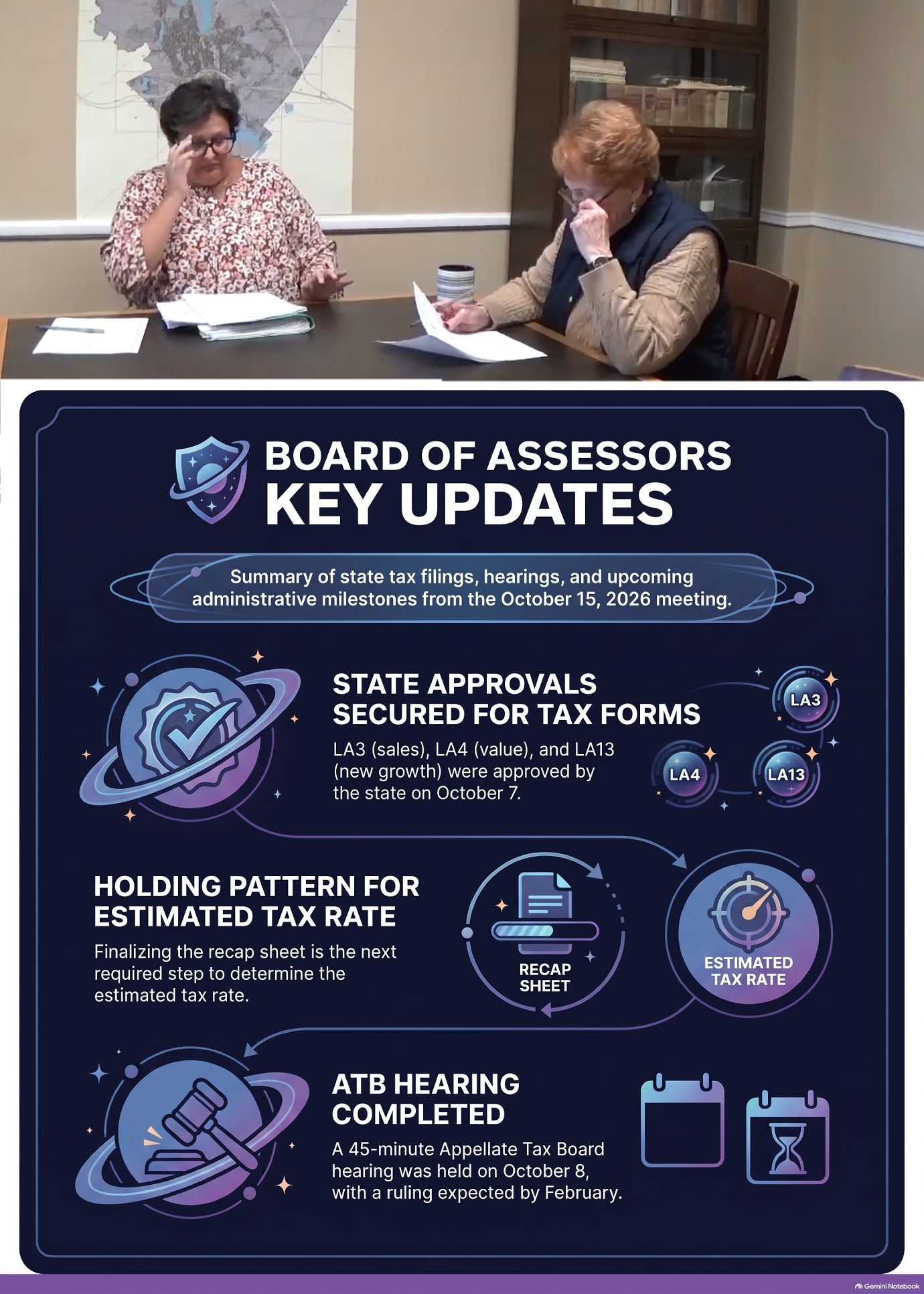
Major Pre-Tax Hurdles Are Cleared (Now Comes the “Holding Pattern”): Before a municipality can determine its local tax rate, it must satisfy a rigorous gauntlet of state-level reporting requirements. During the October 15 meeting, the board received an essential status update: three foundational filings had officially crossed the finish line on October 7, 2026. LA3 (Sales): The official compilation and reporting of local real estate sales data, establishing baseline market transactions. LA4 (Value): The comprehensive catalog of property valuations calculated across the entire community. LA13 (New Growth): The specific valuation figures attributed to new construction, physical developments, and parcel improvements.
Together, these three forms form the structural bedrock of municipal tax assessment. Until state authorities review and approve this triad, local assessors are legally constrained—the municipality literally cannot complete its official recap sheet or finalize the local tax rate. With all three forms signed, submitted, and approved by the state on October 7th, the assessment office successfully cleared its largest regulatory hurdles. However, clearing these hurdles does not lead to immediate public action; instead, it triggers a mandatory administrative “holding pattern.” The board must now wait while the final recap sheet is assembled to establish an estimated tax rate. For local taxpayers and municipal observers, this transition illustrates the inherent rhythm of assessment work: intense periods of data gathering and state submission followed by necessary, patient pauses while formal calculations align.
The 5-Minute Word Count in a 45-Minute Appeal: While setting the municipal tax rate requires navigating state approvals internally, defending those property valuations externally presents an entirely different administrative test.
During the meeting, the assessor briefed the board on an Appellate Tax Board (ATB) hearing held the previous week, on Thursday, October 8, 2026. The report offered a vivid look into modern municipal tax adjudication, highlighting both the hybrid format of present-day hearings and the multi-month lag built into municipal justice.
The hearing took place via Zoom, featuring a distinct technological split: the ATB commissioner and the clerk were visible on video, while the appealing property owner participated strictly via a telephone call. Despite the formal 45-minute block allotted for the hearing, the town’s active testimony was surprisingly brief. The assessor noted speaking for “all of about five minutes in total” while presenting the municipality’s case.
“I spoke for all of about five minutes in total. So I I think it went well. Uh, we should last year for the same. I believe we did not get the determination until February. So, it’ll it’ll be a while before we know, but I I think we’re in pretty good shape.”