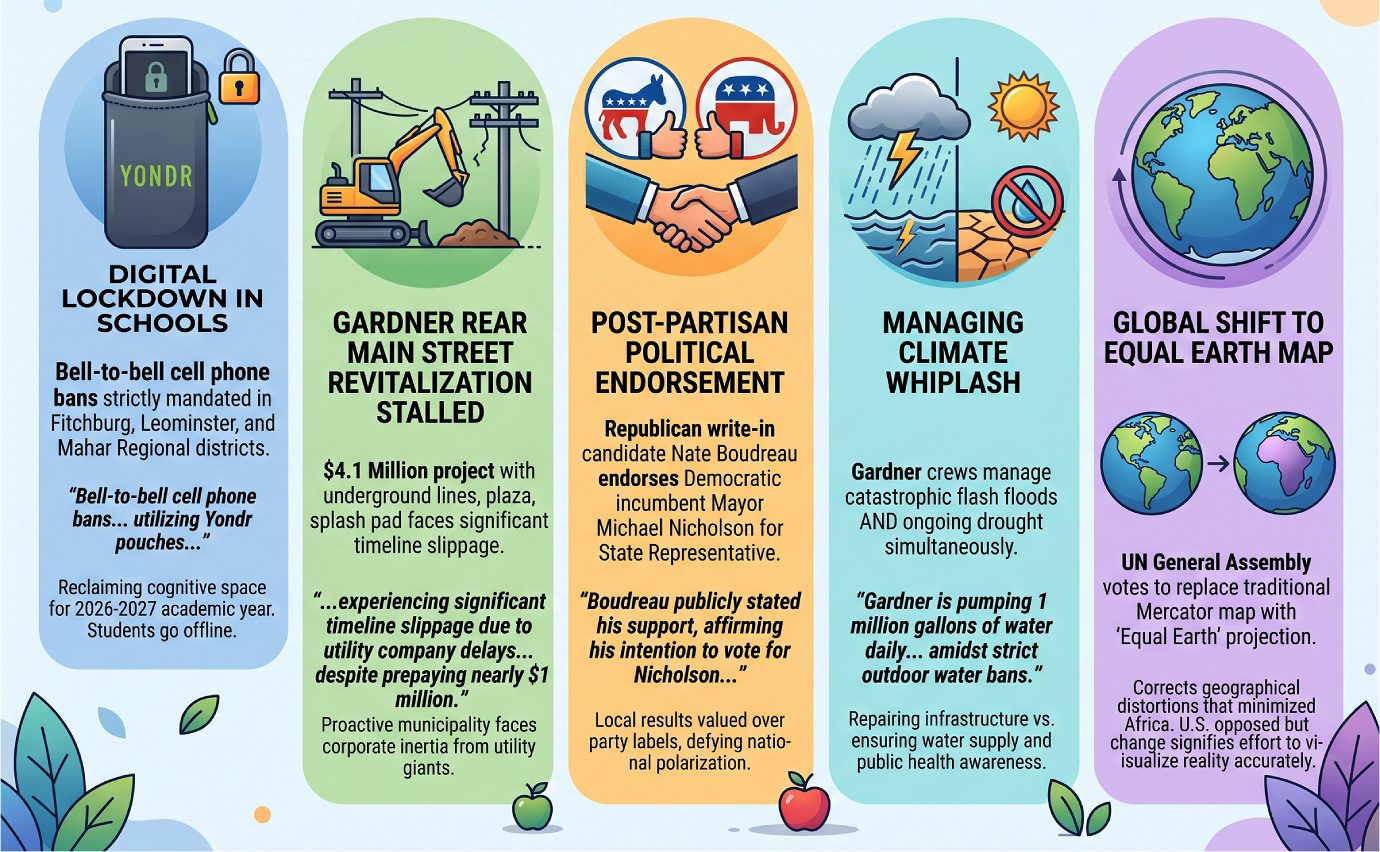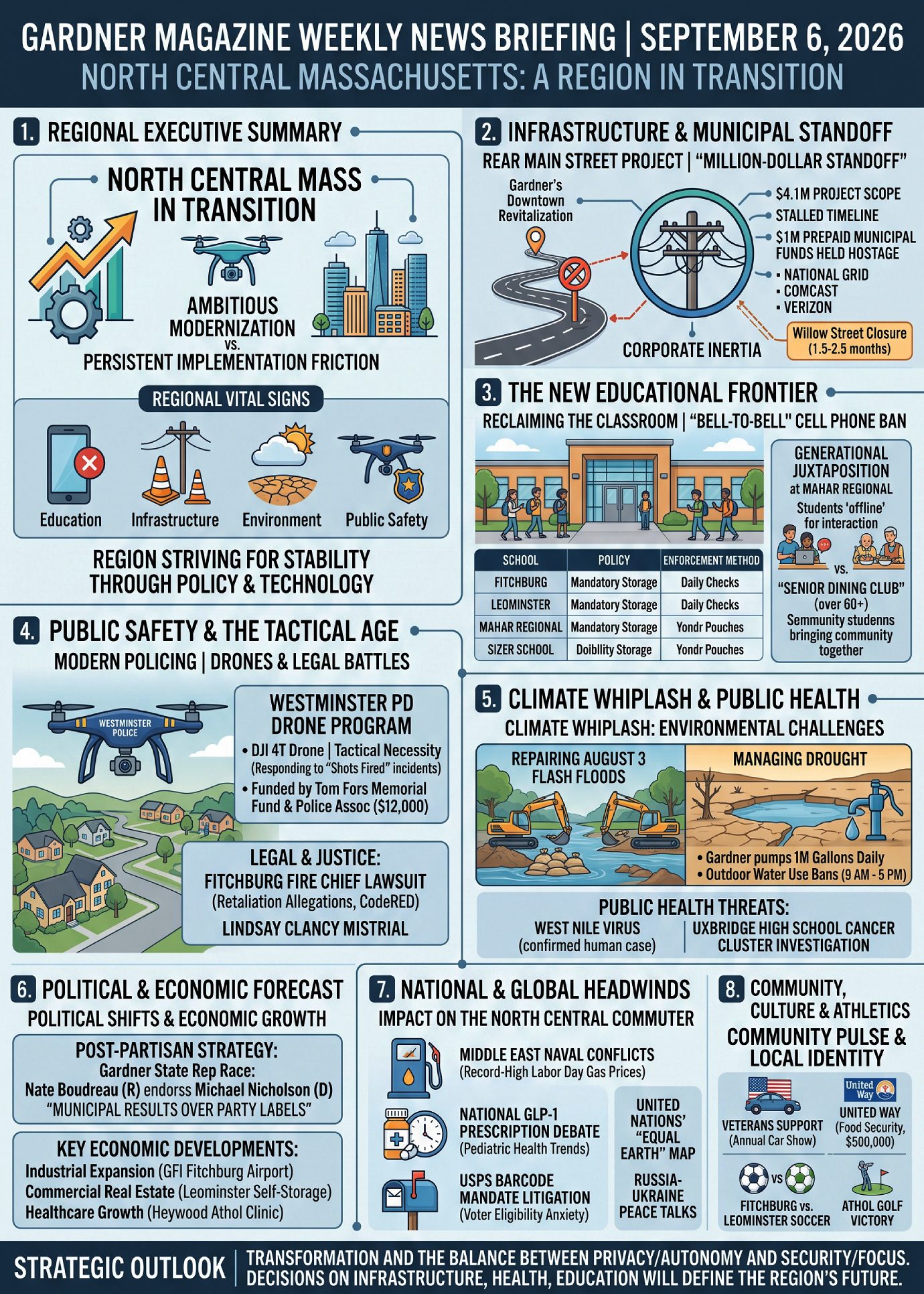
Gardner Magazine has additional podcasts for each of the following complete briefing articles as well as infographics.North Central MA News of the Week, Massachusetts Weekly News Roundup, National News Briefing, and World News Briefing
Gardner Magazine Weekly News Briefing – September 6, 2026
Listen to this week’s comprehensive Weekly News Briefing on any device, CLICK PLAY.
North Central Massachusetts in Transition
As of September 6, 2026, North Central Massachusetts is navigating a complex period of significant transition. This era is defined by an ambitious push toward modernization—evidenced by high-tech public safety tools and aggressive downtown revitalizations—vying against the persistent friction of implementation.
Regional progress is currently caught between the promise of digital and physical upgrades and the sobering reality of corporate inertia and environmental instability.
While municipal leaders have demonstrated proactivity, their initiatives are frequently held hostage by the logistical whims of utility providers and the unpredictability of a changing climate.
The overarching themes of this week reflect a region attempting to stabilize its social and physical foundations. The “bell-to-bell” digital lockdown in schools represents a strategic effort to reclaim the learning environment, while the tactical evolution of local law enforcement through drone technology seeks to address modern volatility. However, the ongoing infrastructure standoff in Gardner serves as a critical warning regarding the failures of public-private coordination. Collectively, these developments suggest a region in the midst of a profound identity transformation, attempting to engineer its future through strict policy and advanced surveillance.
Regional Vital Signs
- Education: Expansion of “bell-to-bell” cell phone bans to eliminate digital distraction across primary districts.
- Infrastructure: The $4.1M Rear Main Street project remains stalled despite nearly $1M in prepaid municipal funds.
- Environment: Managing “climate whiplash” as the region pivots from the structural damage of the August 3 flash floods to a persistent drought requiring massive daily water pumping.
- Public Safety: Launch of the Westminster tactical drone program to provide aerial oversight in response to regional “shots fired” incidents.
This regional movement toward a more structured and high-tech future is currently being tested by the specific municipal hurdles facing the City of Gardner.
Infrastructure & Municipal Standoff: The Rear Main Street Revitalization
The strategic revitalization of the Rear Main Street corridor is foundational to Gardner’s economic future. By undergrounding utility lines and establishing community assets like a splash pad and event plaza, the city aims to foster a modern, accessible downtown. However, the current delays represent a critical failure in public-private coordination. This project has devolved into a “Million-Dollar Standoff” where municipal proactivity is being undermined by a lack of corporate urgency from utility giants.
The $4.1 million project scope is currently paralyzed by timeline slippage, despite the City of Gardner having already prepaid nearly $1 million for services. The delay is a direct result of corporate inertia:
- National Grid: Significant delays in equipment delivery and transformer installation.
- Comcast & Verizon: Failure to coordinate the timely removal of existing wires.
- Economic Impact: Prepaid public funds are effectively being held hostage by the logistical whims of these providers, stalling progress on Downtown Phase 5.
The immediate local impact of this standoff includes the impending month-long closure of Willow Street. This closure is necessary for safety and aesthetic upgrades, including the installation of perpendicular crosswalks. As the city struggles to align its physical infrastructure with its vision, a parallel effort is underway to stabilize the social infrastructure of the regional school systems.
The New Educational Frontier: Reclaiming the Classroom
For the 2026–2027 academic year, school districts across North Central Massachusetts have initiated a strategic “bell-to-bell” ban on cell phones. This state-mandated shift is a decisive attempt to reclaim the learning environment from the constant hum of digital distraction, prioritizing focused instruction over the “digital distraction” era that has dominated the last decade.
Implementation strategies vary, with specific schools adopting physical barriers to ensure a total digital lockdown:
| District/School | Policy Detail | Enforcement Method |
|---|---|---|
| Fitchburg Schools | “Bell-to-bell” ban | Mandatory storage of devices |
| Leominster Schools | “Bell-to-bell” ban | Daily compliance checks |
| Mahar Regional | District-wide restriction | Implementation at start of year |
| Sizer School | Full-day digital lockdown | Yondr pouches (magnetic-locking sleeves) |
A unique “generational juxtaposition” is occurring at Mahar Regional. While students are being pushed “offline” to encourage face-to-face interaction, the school is simultaneously launching the “Senior Dining Club” for residents aged 60+. By bringing seniors into the building for community meals, the school is transforming into a multi-generational hub that emphasizes human connection. This reclamation of the internal school environment is mirrored by a push for enhanced safety in the external community.
Public Safety & The Tactical Age: Drones and Legal Battles
Regional law enforcement is entering a tactical age, characterized by an increasing reliance on high-tech surveillance to manage modern volatility. As departments modernize, they are shifting from reactive patrolling to proactive oversight to ensure community stability in an era of rapid escalation.
The Westminster Police Department recently launched its drone program, providing aerial oversight typically reserved for major metropolitan areas.
- Equipment & Funding: Funded by a $12,000 donation from the Tom Fors Memorial Fund and the Westminster Police Association, the department has deployed a DJI 4T Drone.
- Tactical Necessity: The requirement for such technology was underscored by recent “shots fired” incidents in Gardner, which necessitated a coordinated tactical response from local, Westminster, and State Police.
Simultaneously, the region is grappling with legal developments that test administrative accountability. Fitchburg Fire Chief Dante Suarez is pursuing a federal lawsuit against Mayor Squailia, alleging retaliation after his opposition to cutting the CodeRED emergency alert system. Meanwhile, the mistrial in the Lindsay Clancy case—where the defendant remains under psychiatric care at a state hospital—highlights the complexities of regional justice. These human-led conflicts are occurring against a backdrop of environmental pressures testing the region’s resilience.
Climate Whiplash: Water Scarcity and Public Health
The region is currently caught in a cycle of “climate whiplash,” a strategic challenge where municipalities must simultaneously repair structural scars from the August 3 flash floods while managing the immediate crisis of a persistent drought. This dual pressure creates a volatile environment for public works and municipal liability.
In Gardner, the impact of water scarcity is acute. The city is forced to pump 1 million gallons of water daily just to maintain supply levels. To protect these dwindling resources, strict outdoor water use bans are in effect between 9:00 AM and 5:00 PM.
Beyond infrastructure, environmental pressures have manifested as critical public health threats:
- West Nile Virus: Health officials have confirmed the second human case of the virus in 2026, prompting heightened regional awareness.
- Uxbridge Investigation: Experts are currently investigating a worrying cancer cluster involving faculty and staff at Uxbridge High School.
These health crises present a long-term threat to regional economic productivity and municipal stability, connecting environmental health directly to the broader political landscape.
Political & Economic Forecast: Alliances and Industry Growth
A shift in political currency is becoming evident in North Central Massachusetts, where municipal results are beginning to outweigh traditional party labels. A “Post-Partisan Strategy” has emerged in the Gardner State Representative race, where former Republican Nate Boudreau has endorsed the Democratic incumbent, Mayor Michael Nicholson. This endorsement suggests that the value of a proven municipal track record now transcends the ballot box in the eyes of local leadership.
Key Economic Developments:
- Industrial Expansion: Investment firm GFI has purchased 22 acres near the Fitchburg Airport for a planned industrial facility.
- Commercial Real Estate: A self-storage facility in Leominster was sold to a New York investment firm for $7.9 million.
- Healthcare Growth: Heywood Healthcare has completed the acquisition of the South Main Street clinic site in Athol.
While local industry grows, the region remains sensitive to the national and global forces that impact the daily lives of its residents.
National & Global Headwinds: Impact on the North Central Commuter
Global volatility is no longer a distant concern for the North Central Massachusetts resident. The ongoing U.S.-Iran naval conflict has directly impacted local energy costs, leading to record-high Labor Day gas prices.
| National Event | Local Impact |
|---|---|
| Middle East Naval Blockades | Record-high Labor Day gas prices at the pump. |
| National GLP-1 Prescription Debate | Increased local concern regarding pediatric health trends. |
| USPS Barcode Mandate Litigation | Heightened anxiety over voter eligibility and mail-in disenfranchisement. |
These stressors are framed by a shifting global reality. The United Nations’ adoption of the “Equal Earth” map—intended to correct historical distortions that minimized the size of the African continent—and the Russia-Ukraine peace talks led by envoys Jared Kushner and Steve Witkoff provide the geopolitical backdrop for the region’s current reality. Amidst these shifts, the region finds its pulse in local philanthropy and athletics.
Community, Culture, & Athletics: The Regional Pulse
Despite rapid technological and political changes, community events and youth athletics remain vital to maintaining regional identity. These traditions provide a sense of continuity in an era of upheaval.
Philanthropic efforts continue to bolster the region’s social safety net:
- Veterans Support: The 4th Annual Car Show for the Montachusett Veterans Outreach Center highlights local dedication to those who served. Will be held Sunday, September 13th at Meineke Car Care Center,, 412 Main Street Gardner with use of the Mack Prototype lot for the event.
- Food Security: The United Way has deployed $500,000 to address regional food security needs.
In athletics, the week was marked by the storied Fitchburg vs. Leominster soccer rivalry at Doyle Field and a notable golf victory for Athol High School.
Strategic Outlook As we look toward the horizon, the shifts unfolding across North Central Massachusetts reveal a region in the midst of a profound transformation. From the deployment of police drones to the locking of cell phone pouches, residents are increasingly asked to trade privacy for security and autonomy for focus. The central question for the coming months is whether these restrictive measures are building a more resilient community or if the friction of implementation will ultimately stall the region’s progress. Decisions regarding infrastructure, public health, and education will define the answer.