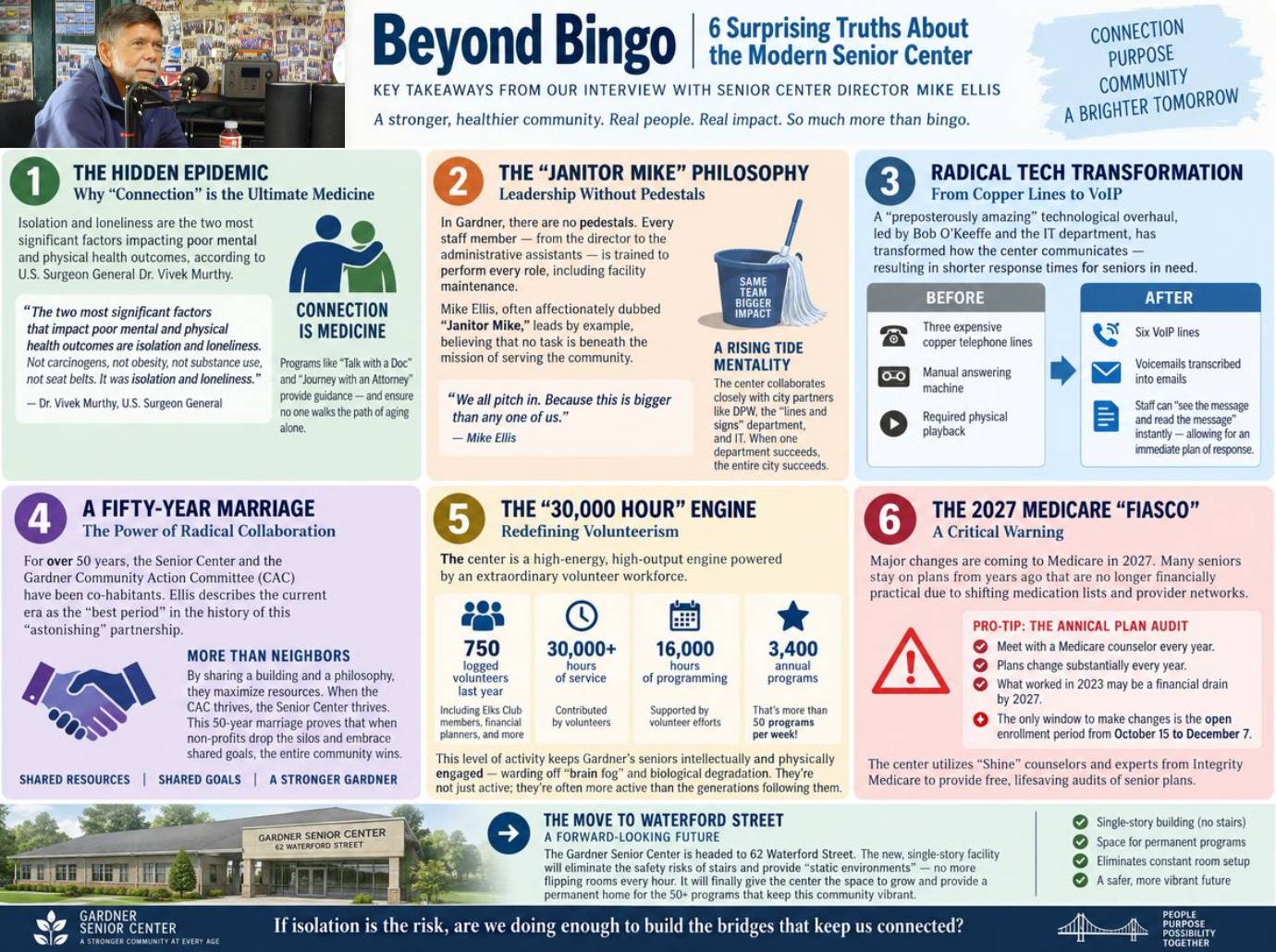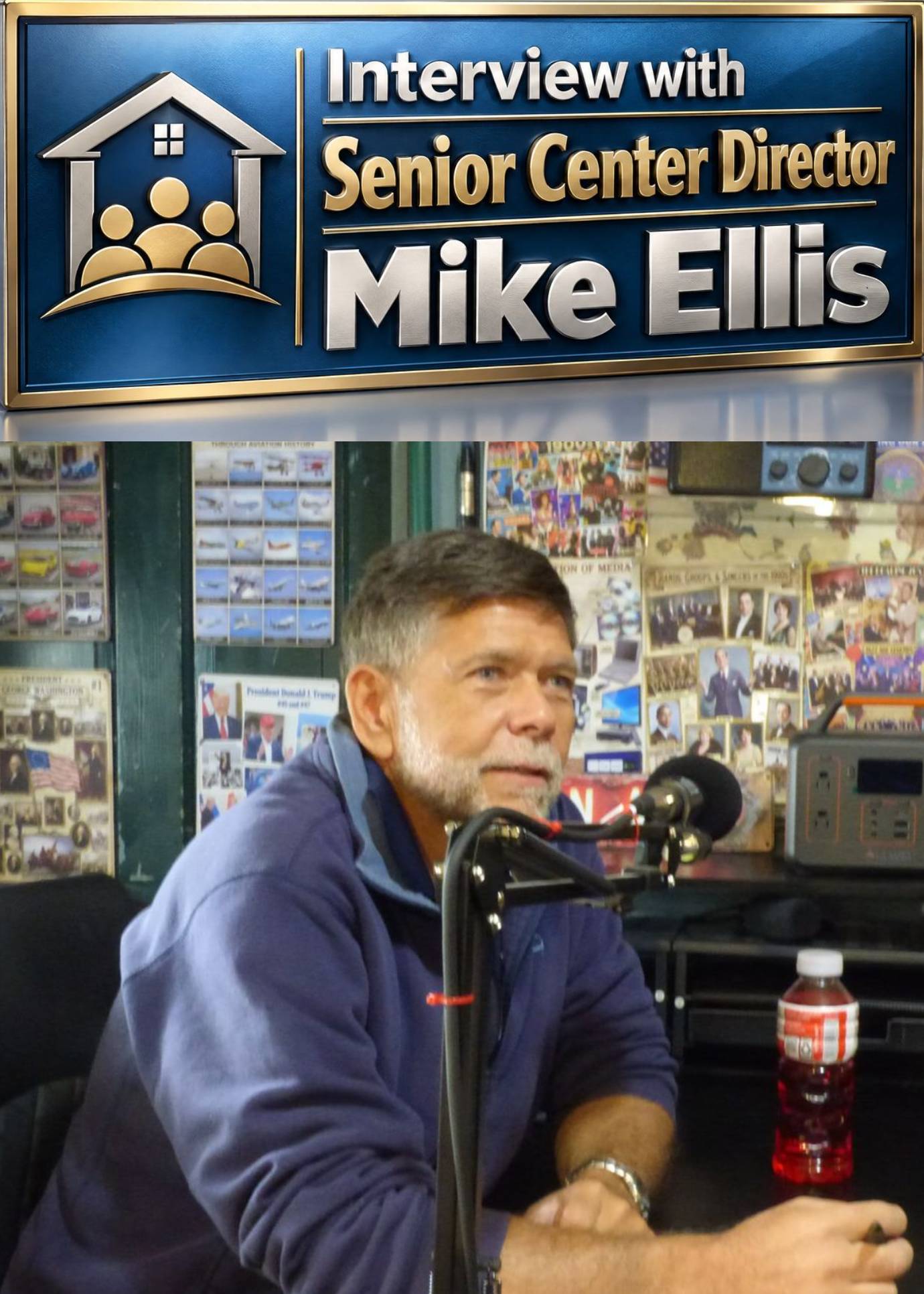
The September 25, 2026 interview with Gardner Senior Center Director Mike Ellis reveals a “Model Senior Center” which does over 3000 programs every single year. Each of the 5 infographics below can be viewed as a larger image simply by clicking on it. There’s an overview summary of the interview, a Partnership Strategy Report, a Medicare Navigation Roadmap, Discover Your Community, and Beyond Bingo. The Gardner Senior Center is currently located on Pleasant Street and will be moving to the Waterford Street facility sometime next year.
6 Years of Service and Progress – An Interview with Gardner Senior Center Director Mike Ellis
Listen to the entire interview on any device, CLICK PLAY.
When asking Mike Ellis about his substantial accomplishments over the past 6 years, Ellis is quick to divert the conversation to praising others. Nevertheless, Senior Center Director Mike Ellis is arguably creating the “Model Senior Center” which is appropriate in Gardner, the “Model City for America.” In this article, you’ll see a number of infographics summarizing the interview and focusing in more detail on specific topics brought up during the session.
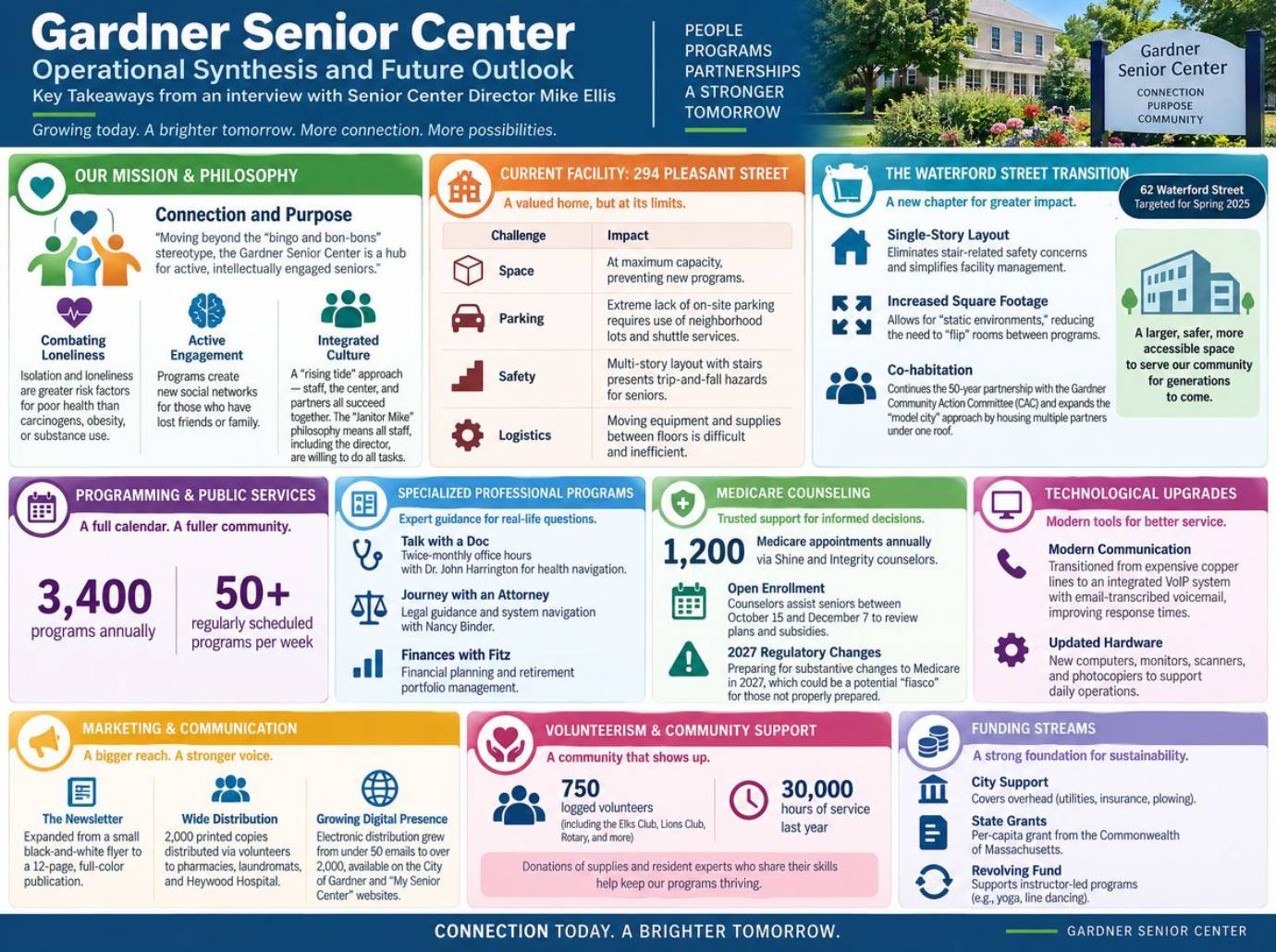
The Gardner Senior Center is currently undergoing a period of significant growth and modernization under the leadership of Director Mike Ellis. Moving away from the stereotypical “bingo and bon-bons” image, the center has adopted a rigorous philosophy of “Connection and Purpose” to combat the health risks of isolation and loneliness. While currently limited by the physical constraints of its Pleasant Street facility—specifically regarding parking, space, and multi-story safety concerns—the center is preparing for a strategic move to a single-story facility on Waterford Street. This transition is expected to facilitate program expansion and deepen partnerships with organizations like the Gardner Community Action Committee (CAC). Key to the center’s success is a robust volunteer network of 750 individuals contributing 30,000 hours annually, alongside a modernized technological and marketing infrastructure.
Strategic Philosophy: Connection and Purpose: The center’s operations are driven by a specific medical and social imperative: the mitigation of isolation.
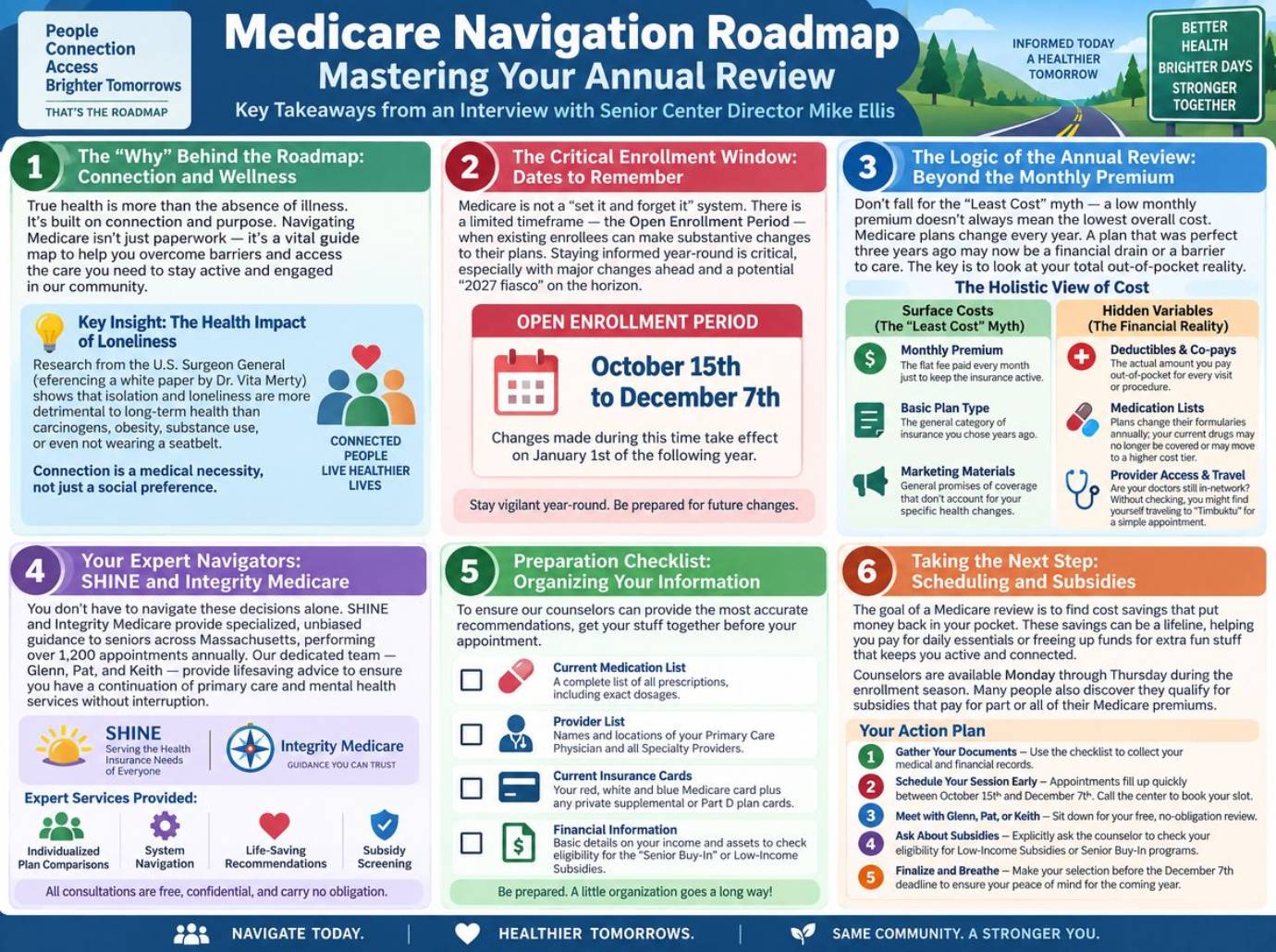
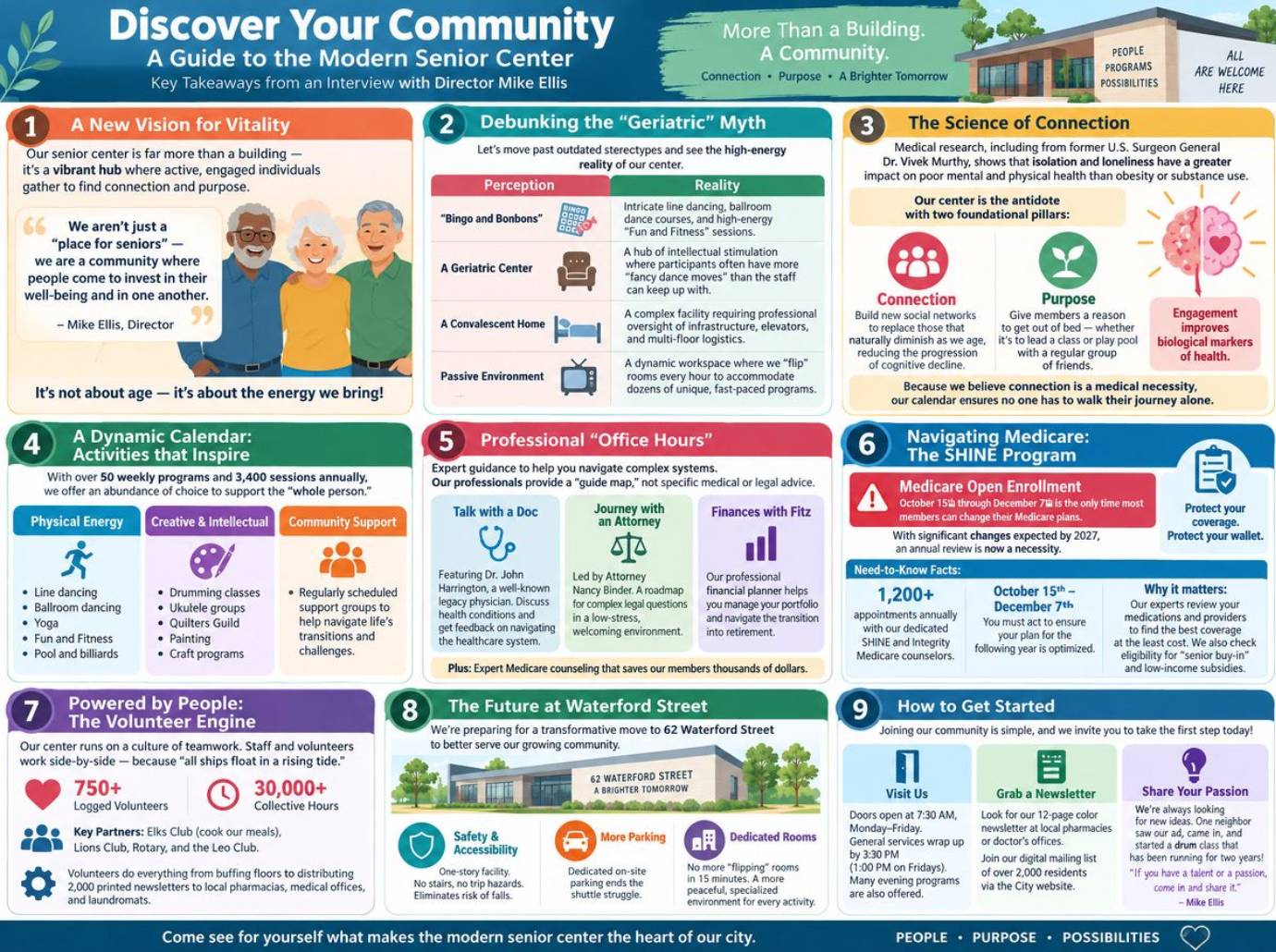
- Combating Loneliness: Citing research by the U.S. Surgeon General (referenced as Dr. Vivek Murthy), the center recognizes isolation and loneliness as more significant factors in poor mental and physical health outcomes than carcinogens, obesity, or substance use.
- Active Engagement: The center rejects the “geriatric center” label, positioning itself as a hub for active, intellectually engaged seniors. Programming is designed to create new social networks for those who have lost friends or family.
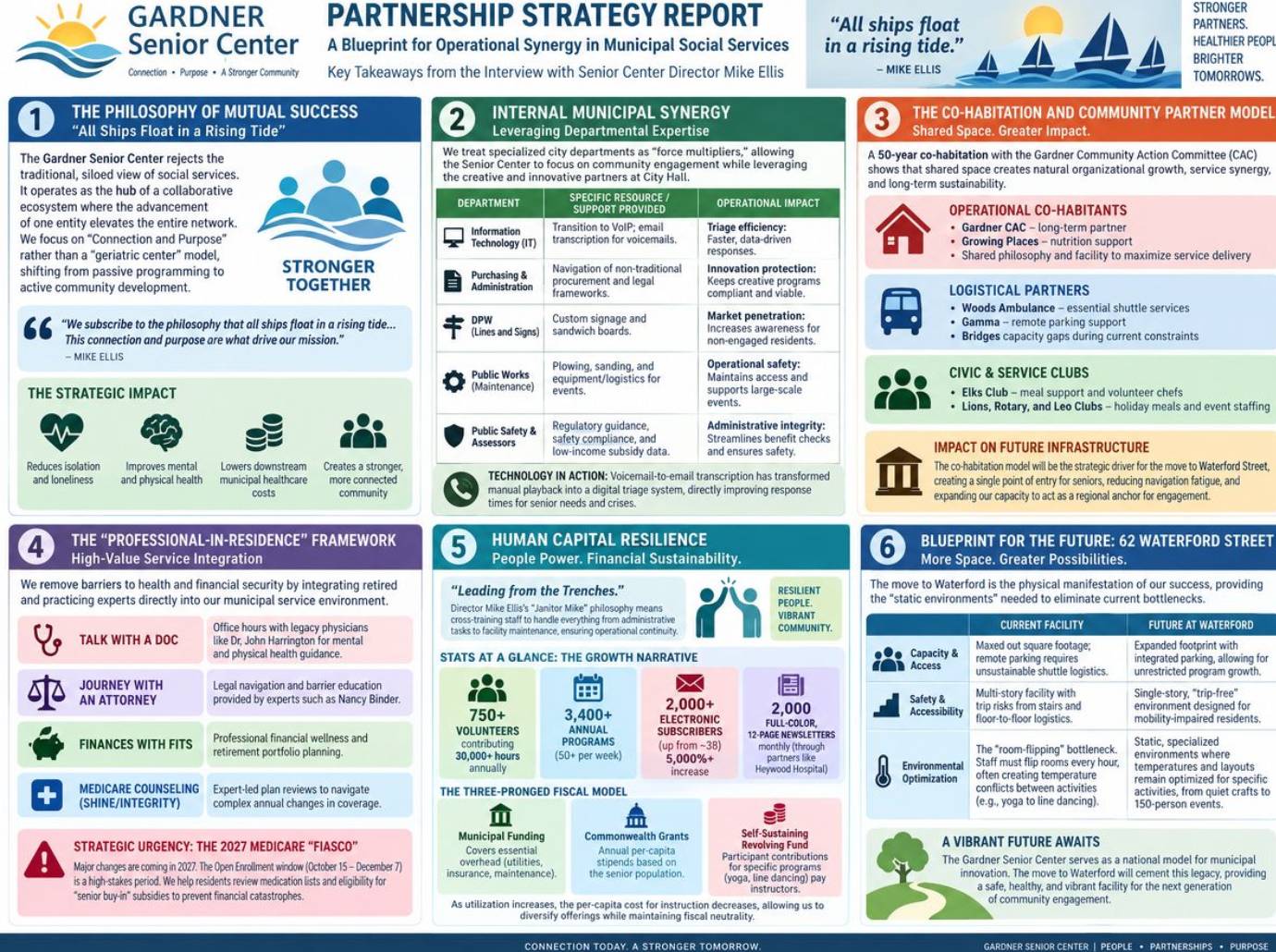
- Integrated Culture: Director Mike Ellis promotes a “rising tide” philosophy where the success of the staff, the center, and partner organizations like the CAC are interdependent. This includes a “Janitor Mike” (JM) approach to leadership, where all staff, including the director, are cross-trained and willing to perform all tasks, including maintenance.
Operational Analysis and Facilities: The center is currently managed through a mix of municipal funding, state grants, and revolving funds. Current Facility Constraints (294 Pleasant Street)
| Challenge | Impact |
|---|---|
| Space | The facility is at maximum capacity, preventing the addition of new programs. |
| Parking | Extreme lack of on-site parking necessitates unsustainable reliance on neighborhood lots and shuttle services. |
| Safety | Multi-story layout with stairs presents trip-and-fall hazards for seniors, despite mitigation efforts. |
| Logistics | Moving equipment and supplies between floors is difficult and inefficient. |
The Waterford Street Transition: The upcoming move to 62 Waterford Street (targeted for Spring 2025) is viewed as a solution to these systemic issues:
- Single-Story Layout: Eliminates stair-related safety concerns and simplifies facility management.
- Increased Square Footage: Allows for “static environments,” reducing the need to “flip” rooms (reconfigure furniture/setup) between every program.
- Co-habitation: Continues the 50-year partnership with the Gardner CAC and expands the “model city” approach by housing multiple partners under one roof.
Programming and Public Services: The center executes approximately 3,400 programs annually, averaging over 50 regularly scheduled programs per week.
Specialized Professional Programs: To provide meaningful resources, the center hosts “Retired Professional” sessions:
- Talk with a Doc: Twice-monthly office hours with Dr. John Harrington for health navigation.
- Journey with an Attorney: Legal guidance and system navigation with Nancy Binder.
- Finances with Fitz: Financial planning and retirement portfolio management.
Medicare Counseling: The center provides a critical service through 1,200 annual Medicare appointments via Shine and Integrity Medicare counselors.
- Open Enrollment: Counselors assist seniors between October 15 and December 7 to review plans and subsidies.
- 2027 Regulatory Changes: The center is preparing for substantive changes to Medicare in 2027, which Director Ellis characterizes as a potential “fiasco” for those not properly prepared.
Infrastructure and Outreach: Modernization of the center’s infrastructure has been a priority over the last six years.
Technological Upgrades
- Communication: Transitioned from expensive copper lines to an integrated VoIP system with email-transcribed voicemail, improving response times.
- Hardware: Updated computers, monitors, scanners, and photocopiers to support daily operations.
Marketing and Communication: The center has significantly expanded its reach through a multifaceted marketing strategy:
- The Newsletter: Expanded from a small black-and-white flyer to a 12-page, full-color publication.
- Distribution: 2,000 printed copies are distributed via a volunteer cadre to pharmacies, laundromats, and Heywood Hospital.
- Digital Presence: Electronic distribution grew from under 50 emails to over 2,000, supplemented by availability on the City of Gardner and “My Senior Center” websites.
Volunteerism and Community Support: The center operates on a high-engagement model involving substantial community contribution.
- Volunteer Force: 750 logged volunteers (including organizations like the Elks Club, Lions Club, and Rotary) performed over 30,000 hours of service last year.
- Resource Needs: The center relies on a “fluid wish list” of donations, such as craft supplies and specialized equipment (e.g., drums for music classes), as well as resident experts willing to share their skills.
- Funding Streams: While the city covers overhead (utilities, insurance, plowing), the center utilizes a per-capita grant from the Commonwealth of Massachusetts and a revolving fund for instructor-led programs (e.g., yoga, line dancing).