Gardner Magazine research shows that music is the “Academic Multiplier”. The decision to fund music in Gardner Public Schools pays many academic dividends as the rest of this article will demonstrate. Listen to this podcast on any device, CLICK PLAY.
Years after Brilliant Music Decision, Gardner Mayor Nicholson is All SMILES
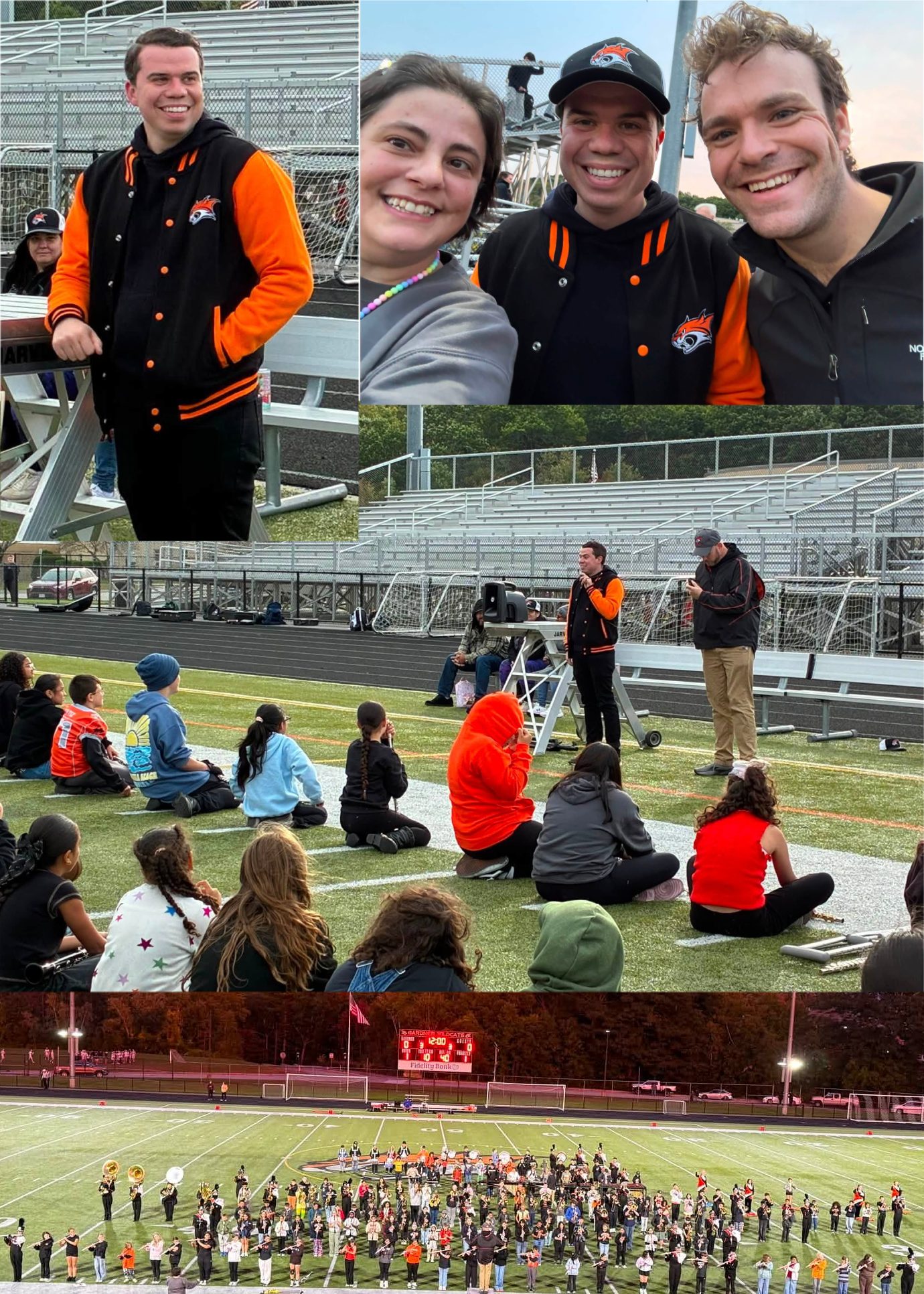
Mayor Nicholson was “Beaming with Smiles” at the Gardner High Football Game Band Night. The reason was obvious as the Mayor stated in a post: “Just over 200 of our band students across Gardner Public Schools took the field before the game to play together.”
Gardner Mayor Nicholson stated the reason for being all smiles in his post: “In my first full budget cycle as mayor, we were able to reinstate the Elementary School program that had been cut in 2010. Today, 198 students in grades 3 and 4 at Gardner Elementary Schools are in Band, 130 students at Gardner Middle School, and 36 at Gardner High. We’re already seeing the fruits of reinstating band as a feeder program in our elementary school and I’m very proud to have worked to support music in our schools.
Unlike many sports programs there are no private youth band “leagues,” so providing band and choral programs for our younger students really is one of the only ways they get to experience this type of performance together. It was a great night for sure! Thank you to all of our music instructors at all of our schools and thank you for inviting me to talk to the students during rehearsal!”
The decision was brilliant because it has also assisted in the academic success of these students as the rest of this article will prove.
The Music Advantage: A Comparative Analysis of Student Achievement
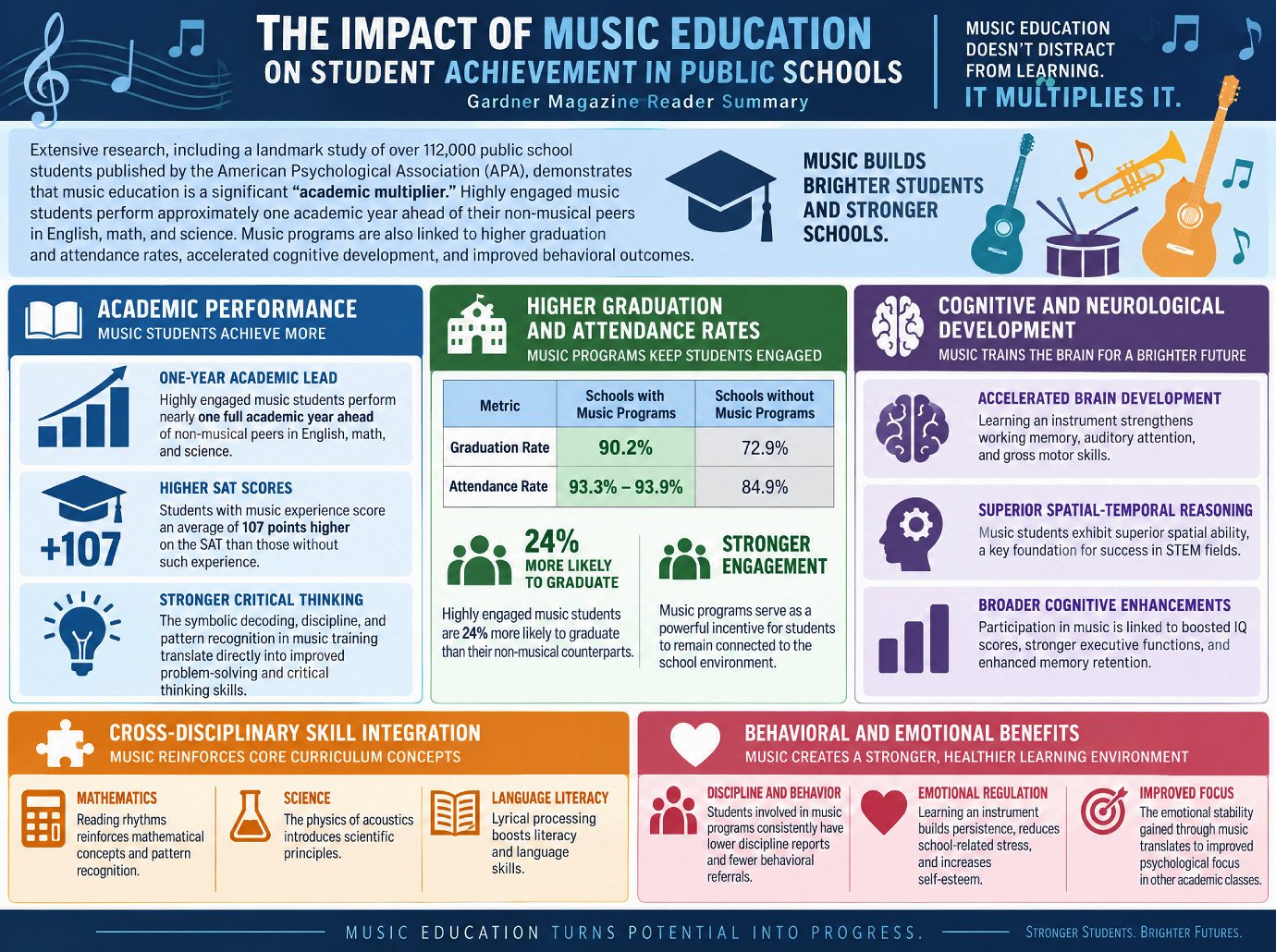
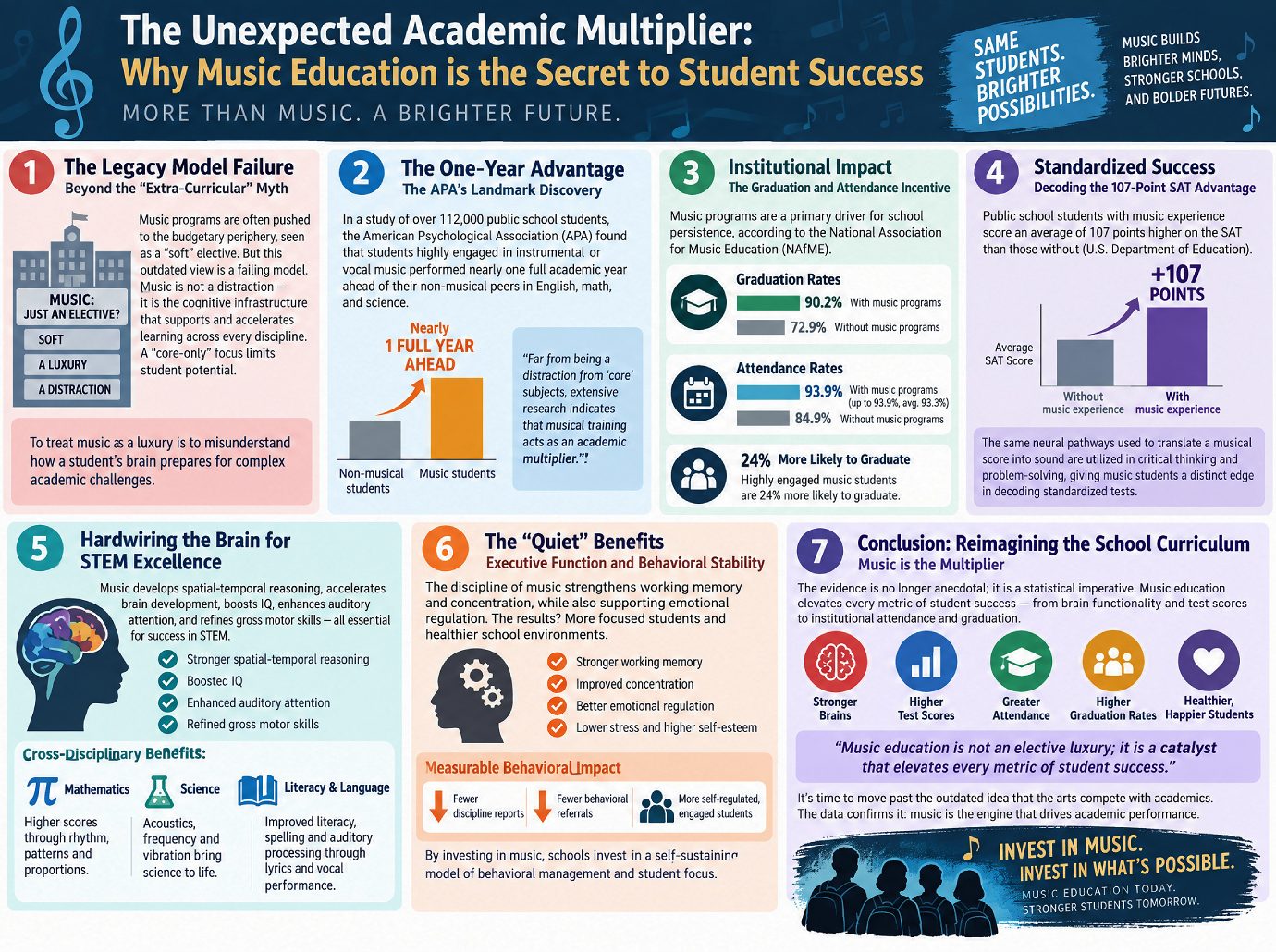
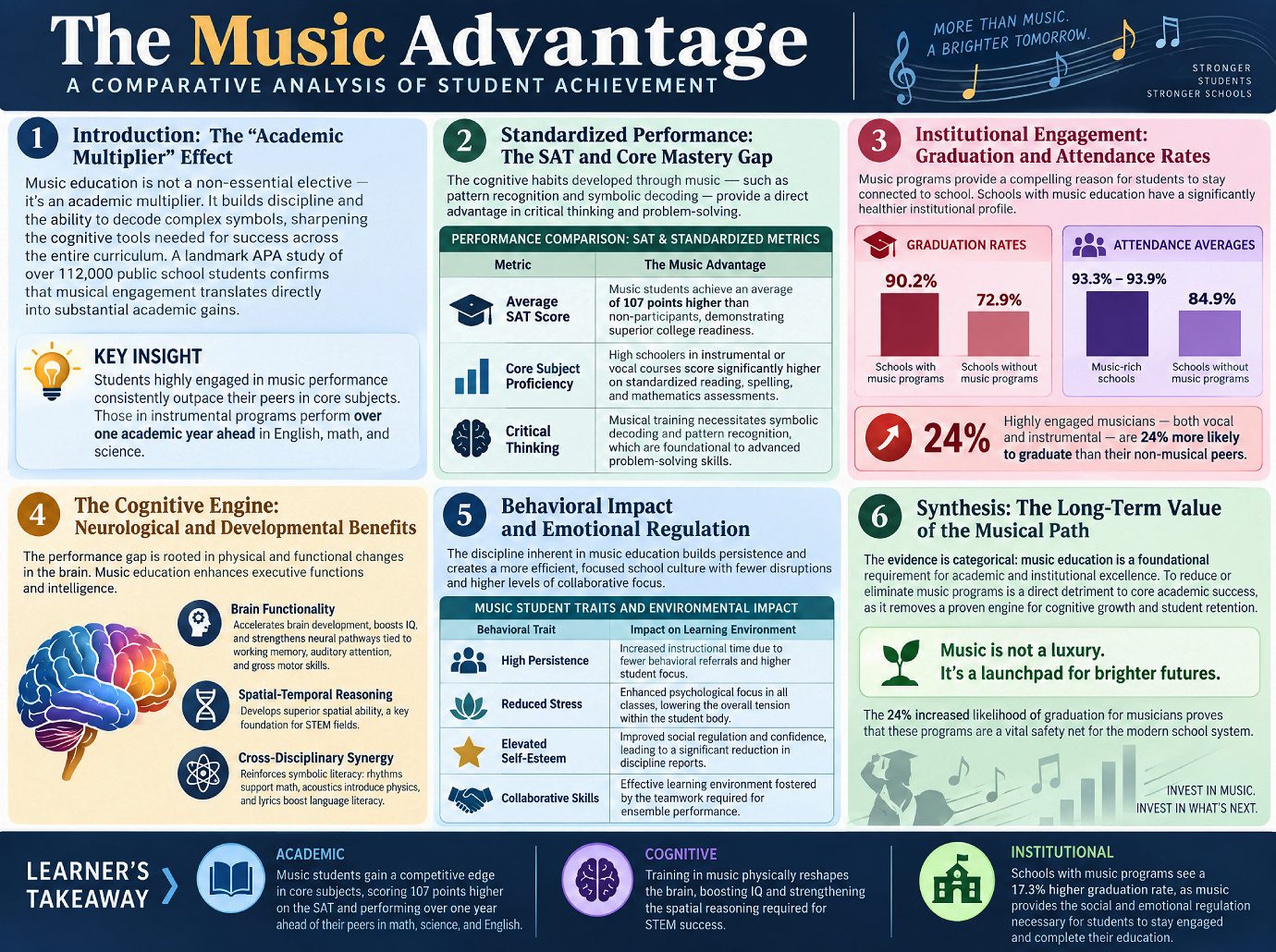
The “Academic Multiplier” Effect: In contemporary educational discourse, music programs are often mischaracterized as non-essential electives. However, rigorous data suggests that music education functions as a potent “academic multiplier,” amplifying a student’s capacity for success across the entire curriculum. This effect is driven by the development of discipline and “symbolic decoding”—the ability to translate complex notations into real-time action—which sharpens the cognitive tools necessary for core mastery. A landmark study published by the American Psychological Association (APA), evaluating over 112,000 public school students, confirms that the engagement required for musical proficiency translates directly into substantial academic gains.
Key Insight: Students highly engaged in music performance consistently outpace their peers in core subjects. Specifically, those in instrumental programs perform over one academic year ahead of non-musical peers in English, math, and science. This significant lead is not an isolated phenomenon but is consistently reflected across standardized testing benchmarks and institutional performance metrics.
Standardized Performance: The SAT and Core Mastery Gap: The “Core Mastery Gap” between music students and non-musicians is most visible in standardized testing results. The cognitive habits developed through music—such as pattern recognition and symbolic decoding—provide a direct advantage in critical thinking and problem-solving. According to data from the U.S. Department of Education, this translates into a quantifiable scoring advantage on college entrance exams.
Performance Comparison: SAT & Standardized Metrics
| Metric | The Music Advantage |
|---|---|
| Average SAT Score | Music students achieve an average of 107 points higher than non-participants, demonstrating superior college readiness. |
| Core Subject Proficiency | High schoolers in instrumental or vocal courses score significantly higher on standardized reading, spelling, and mathematics assessments. |
| Critical Thinking | Musical training necessitates symbolic decoding and pattern recognition, which are foundational to advanced problem-solving skills. |
These superior test scores are a byproduct of a more fundamental advantage: music students are more consistently present and engaged in the classroom.
Institutional Engagement: Graduation and Attendance Rates: Music programs serve as a vital institutional anchor, providing students with a compelling incentive to remain connected to their school environment. Data from the National Association for Music Education (NAfME) indicates that “music-rich” schools possess a significantly healthier institutional profile than those without such programs.
- Graduation Rates: Schools with active music programs boast a 90.2% graduation rate, a stark contrast to the 72.9% average found in schools without music education.
- Attendance Averages: Music-rich environments maintain high attendance levels between 93.3% and 93.9%, while schools lacking these programs see attendance drop to an average of 84.9%.
- Likelihood of Completion: Highly engaged musicians—both vocal and instrumental—are 24% more likely to graduate than their non-musical peers, representing a vital safety net for student retention.
The institutional health of these schools is driven by the specific neurological and developmental changes occurring within the students themselves.
The Cognitive Engine: Neurological and Developmental Benefits: The performance gap is rooted in physical and functional changes in the brain. Whether through instrumental practice or vocal training, music education serves as a comprehensive mental workout that enhances executive functions and intelligence.
- Brain Functionality: Music training accelerates brain development and results in a boosted IQ. It specifically strengthens neural pathways tied to working memory, auditory attention, and gross motor skills.
- Spatial-Temporal Reasoning: Music students develop superior spatial ability, which is a foundational requirement for STEM fields. This development is critical for long-term career readiness in science, technology, engineering, and mathematics.
- Cross-Disciplinary Synergy: Musical study reinforces symbolic literacy across the curriculum. Reading rhythms reinforces mathematical concepts; studying acoustics introduces the physics of science; and lyrical processing significantly boosts language literacy and symbolic decoding.
These cognitive gains foster behavioral outcomes that improve the learning environment for the entire school community.
Behavioral Impact and Emotional Regulation: The discipline inherent in music education builds “persistence”—the resilience to stay with a task until mastery is achieved. This individual trait scales up to create a more efficient and focused school culture, characterized by fewer disruptions and higher levels of collaborative focus.
Music Student Traits and Environmental Impact
| Behavioral Trait | Impact on Learning Environment |
|---|---|
| High Persistence | Increased instructional time due to fewer behavioral referrals and higher student focus. |
| Reduced Stress | Enhanced psychological focus in all classes, lowering the overall tension within the student body. |
| Elevated Self-Esteem | Improved social regulation and confidence, leading to a significant reduction in discipline reports. |
| Collaborative Skills | Effective learning environment fostered by the teamwork required for ensemble performance. |
The Long-Term Value of the Musical Path: The evidence is categorical: music education is not a luxury or a secondary elective; it is a foundational requirement for academic and institutional excellence. To reduce or eliminate music programs is a direct detriment to core academic success, as it removes a proven engine for cognitive growth and student retention. The 24% increased likelihood of graduation for musicians proves that these programs are a vital safety net for the modern school system.
Key Conclusions on why Music is the Academic Multiplier and even more!
- Academic: Music students gain a competitive edge in core subjects, scoring 107 points higher on the SAT and performing over one year ahead of their peers in math, science, and English.
- Cognitive: Training in music—both vocal and instrumental—physically reshapes the brain, boosting IQ and strengthening the spatial reasoning required for STEM success.
- Institutional: Schools with music programs see a 17.3% higher graduation rate, as music provides the social and emotional regulation necessary for students to stay engaged and complete their education.