World News – Week of August 2, 2026
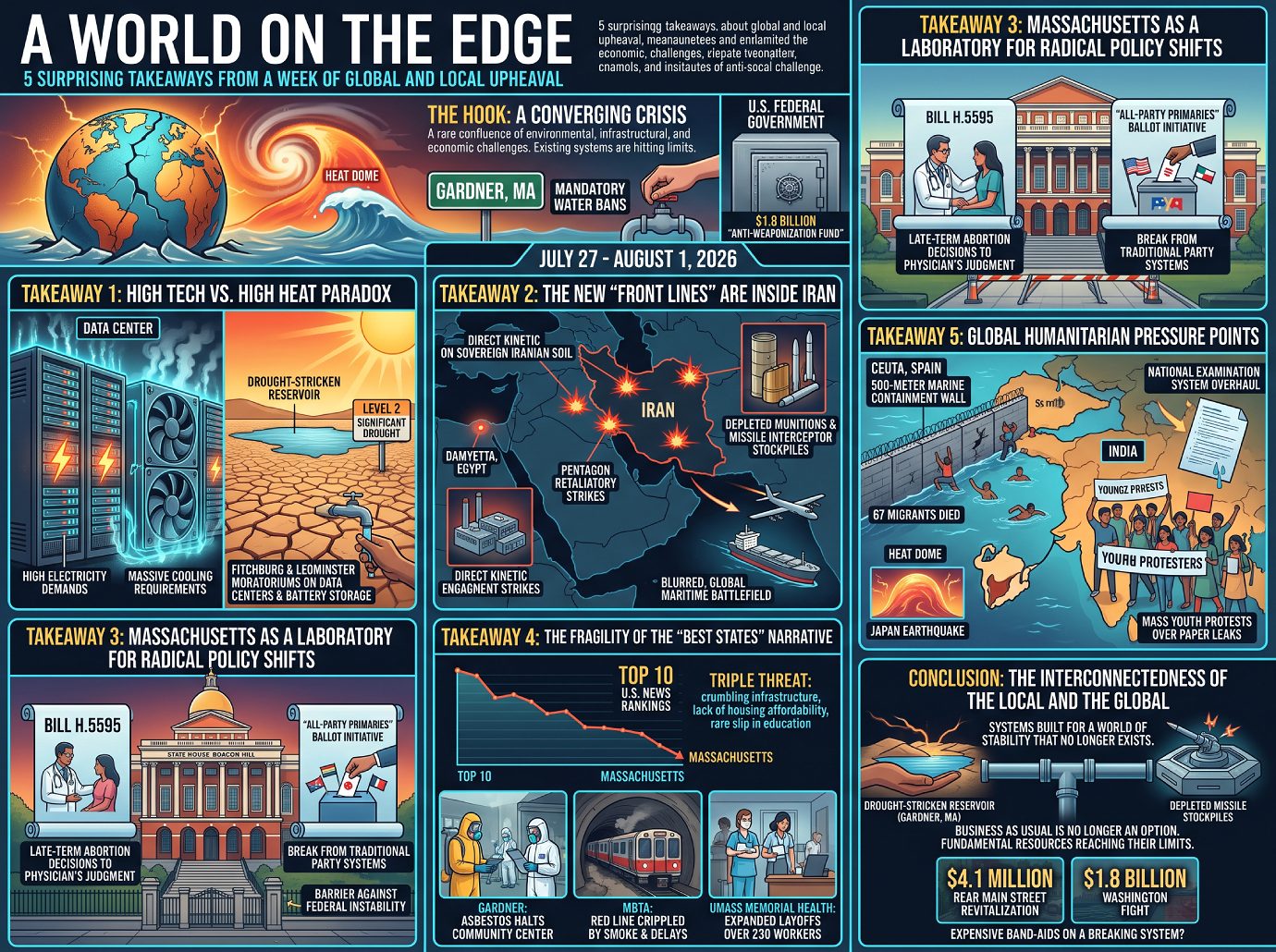
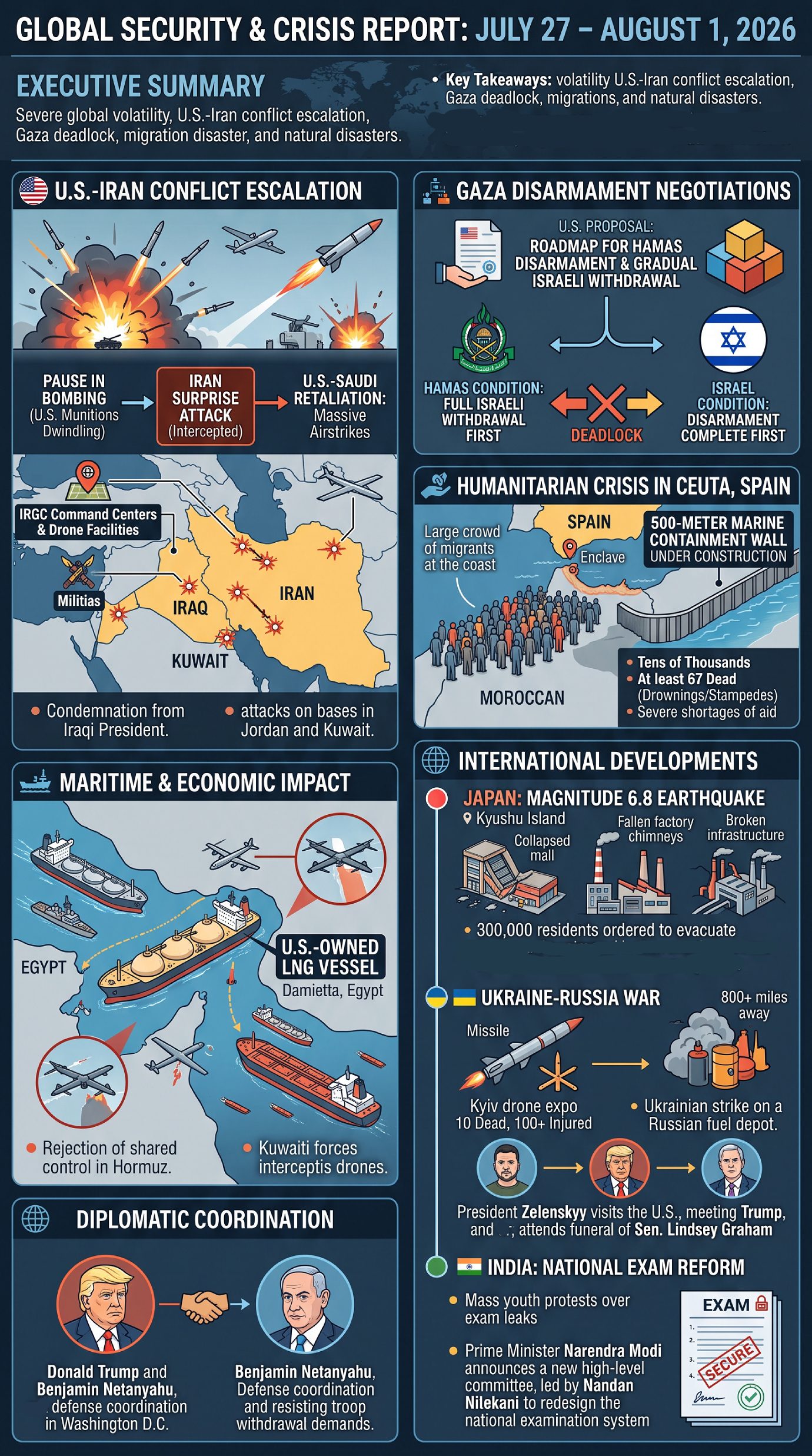
The week of July 27 to August 1, 2026, was marked by a significant escalation in global volatility, centered primarily on a widening conflict between the United States and Iran. Following a brief pause in hostilities necessitated by dwindling U.S. munition stockpiles, military operations resumed with increased intensity, drawing in regional actors including Saudi Arabia, Iraq, and Egypt. Concurrently, diplomatic efforts regarding Gaza reached a stalemate, while Europe faced a severe humanitarian disaster at the Spanish-Moroccan border. Significant domestic events in Japan, Ukraine, and India further contributed to a week of intense international strain.
Critical Takeaways:
- U.S.-Iran Conflict Expansion: The war has entered a more aggressive phase, with direct strikes on Iranian soil and the first instances of maritime spillover into Egyptian waters.
- Diplomatic Deadlock in Gaza: A proposed disarmament roadmap announced by the U.S. remains non-functional due to fundamentally opposing preconditions from Israel and Hamas.
- Migration Crisis in Spain: Tens of thousands of migrants attempted to enter the enclave of Ceuta, resulting in high casualties and the implementation of emergency border infrastructure.
- Natural Disasters and Domestic Unrest: Japan is managing the aftermath of a major earthquake, and India has initiated a total overhaul of its national examination system following mass protests.
Listen to this podcast on the World News on any device, CLICK PLAY.
Middle East Conflict and U.S.-Iran Escalation
The confrontation between U.S. forces and Iran dominated the global landscape this week, transitioning from a brief operational pause to a heavy, multi-front exchange.
Resumption of Military Operations
The U.S. military initially enacted a temporary pause in its 13-night bombing campaign against Iran. This decision followed warnings from defense officials regarding the depletion of U.S. munition stockpiles. However, the pause ended abruptly after the U.S. intercepted an attempted “surprise attack” by Iranian forces.
In response, the Pentagon and Saudi Arabian forces launched a massive wave of retaliatory airstrikes. These strikes targeted:
- Inside Iran: Islamic Revolutionary Guard Corps (IRGC) command centers and drone production facilities.
- Iraq: Iran-backed militia positions, leading to a diplomatic rift as the Iraqi president condemned the strikes as violations of national sovereignty.
- Regional Bases: Retaliation followed earlier Iranian attacks on U.S. and allied bases in Jordan and Kuwait.
Maritime and Economic Impact
The conflict has increasingly targeted international shipping and energy infrastructure:
- Strait of Hormuz: Iran rejected a proposal to divide control of the strategic waterway and began targeting shipping tankers under U.S. escort.
- Egypt’s Involvement: For the first time, the conflict reached the Mediterranean port of Damietta, where a drone strike hit a U.S.-owned natural gas vessel.
- Oman and Kuwait: A tanker was struck off the coast of Oman, and Kuwaiti forces intercepted hostile drones in their airspace, citing “Iranian aggression.”
Diplomatic Coordination
During the height of the escalation, Israeli Prime Minister Benjamin Netanyahu met with President Donald Trump in Washington, D.C. The discussions focused on:
- Coordinating defense strategies against Iranian maneuvers.
- Resisting domestic and international demands for a broad troop withdrawal.
Gaza Disarmament Negotiations
A major diplomatic announcement regarding the Gaza Strip was met with immediate skepticism and procedural deadlock.
| Negotiating Factor | Position/Status |
|---|---|
| U.S. Proposal | A roadmap for the complete disarmament of Hamas and other armed groups paired with a gradual Israeli withdrawal. |
| Hamas Condition | Disarmament is strictly contingent upon a full Israeli withdrawal occurring first. |
| Israel Condition | No withdrawal will be initiated until disarmament is complete. |
This fundamental disagreement on the sequencing of the roadmap has stalled hopes for a near-term breakthrough in the five-month-old war.
Humanitarian Crisis in Ceuta, Spain
A massive migration event at the border of Ceuta, a Spanish enclave in North Africa, has triggered an emergency humanitarian response.
- Casualties and Scale: Tens of thousands of migrants attempted to cross from Morocco into Ceuta by sea. At least 67 people are confirmed dead due to drownings and stampedes near a breakwater barrier.
- Infrastructure Response: In addition to temporary emergency border controls, Spain has begun construction of a 500-meter marine containment wall to manage the influx and prevent further crossings at the breakwater.
- Shortages: The sudden arrival of thousands has led to severe humanitarian shortages within the enclave.
International Developments
Japan: Magnitude 6.8 Earthquake
A powerful earthquake struck Kyushu Island near Kumamoto City, leading to widespread destruction.
- Damage: A crowded shopping mall collapsed, factory chimneys fell, and critical infrastructure, including roads and bridges, was severed.
- Evacuations: Approximately 300,000 residents were ordered to evacuate as Prime Minister Son Takichi warned of potential landslides and significant aftershocks.
Ukraine-Russia War
The conflict in Eastern Europe continues to escalate with long-range strikes and high-level diplomacy.
- Kyiv Strike: A Russian ballistic missile targeted a drone technology exhibition, resulting in at least 10 deaths and nearly 100 injuries.
- Ukrainian Retaliation: Ukrainian forces conducted a strike on a Russian fuel depot located more than 800 miles from the border.
- Diplomatic Mission: President Volodymyr Zelenskyy visited the U.S. for meetings with President Trump and to attend the funeral of Senator Lindsey Graham.
India: National Exam Reform
Following days of mass protests by the nation’s youth over frequent exam paper leaks, Prime Minister Narendra Modi announced a systemic overhaul.
- New Task Force: A high-level committee led by tech entrepreneur Nandan Nilekani has been tasked with redesigning India’s national examination system to ensure security and transparency.