Top U.S. National News – Week of August 16, 2026
Listen to our National News Briefing on any device, CLICK PLAY.
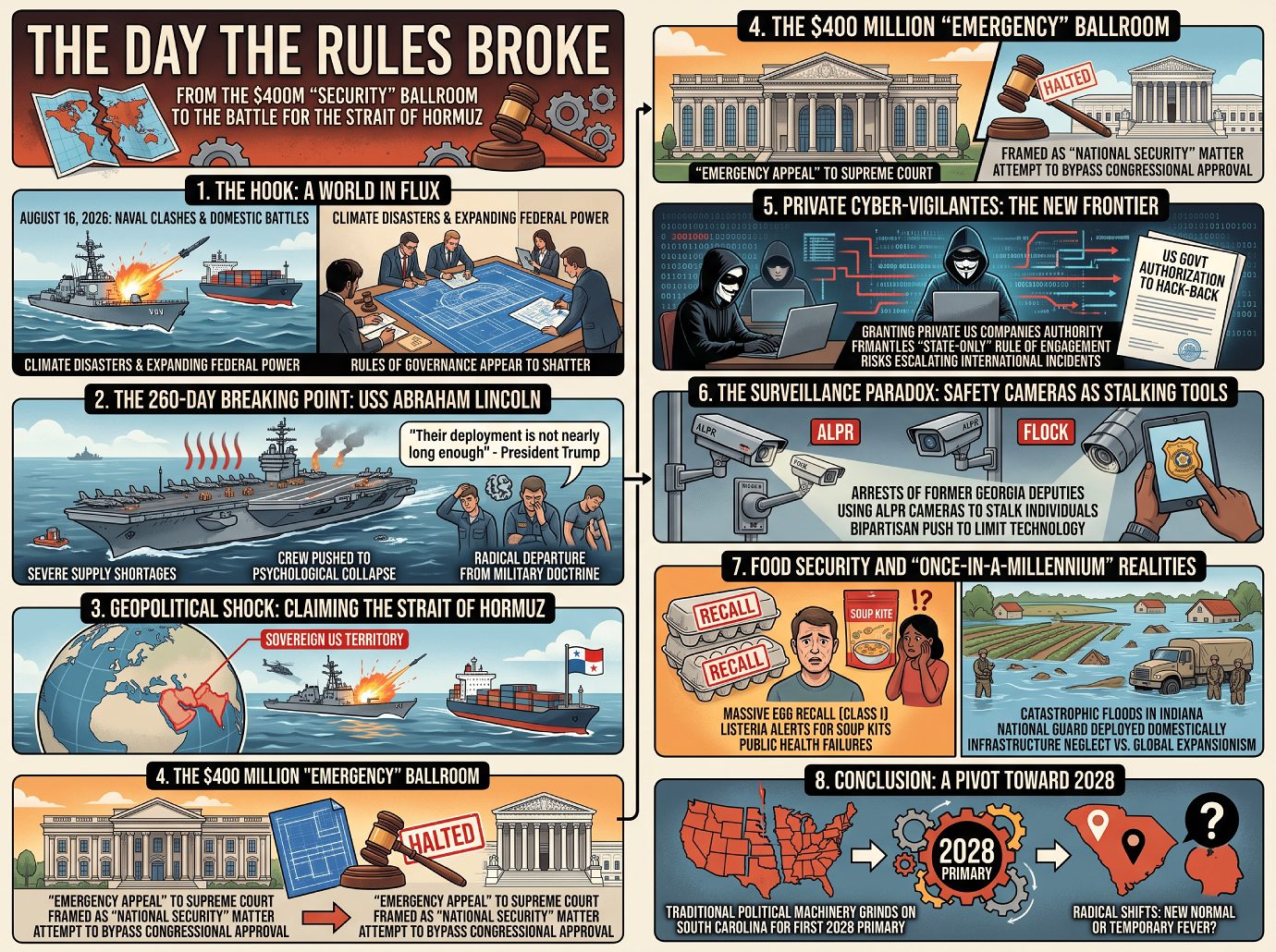
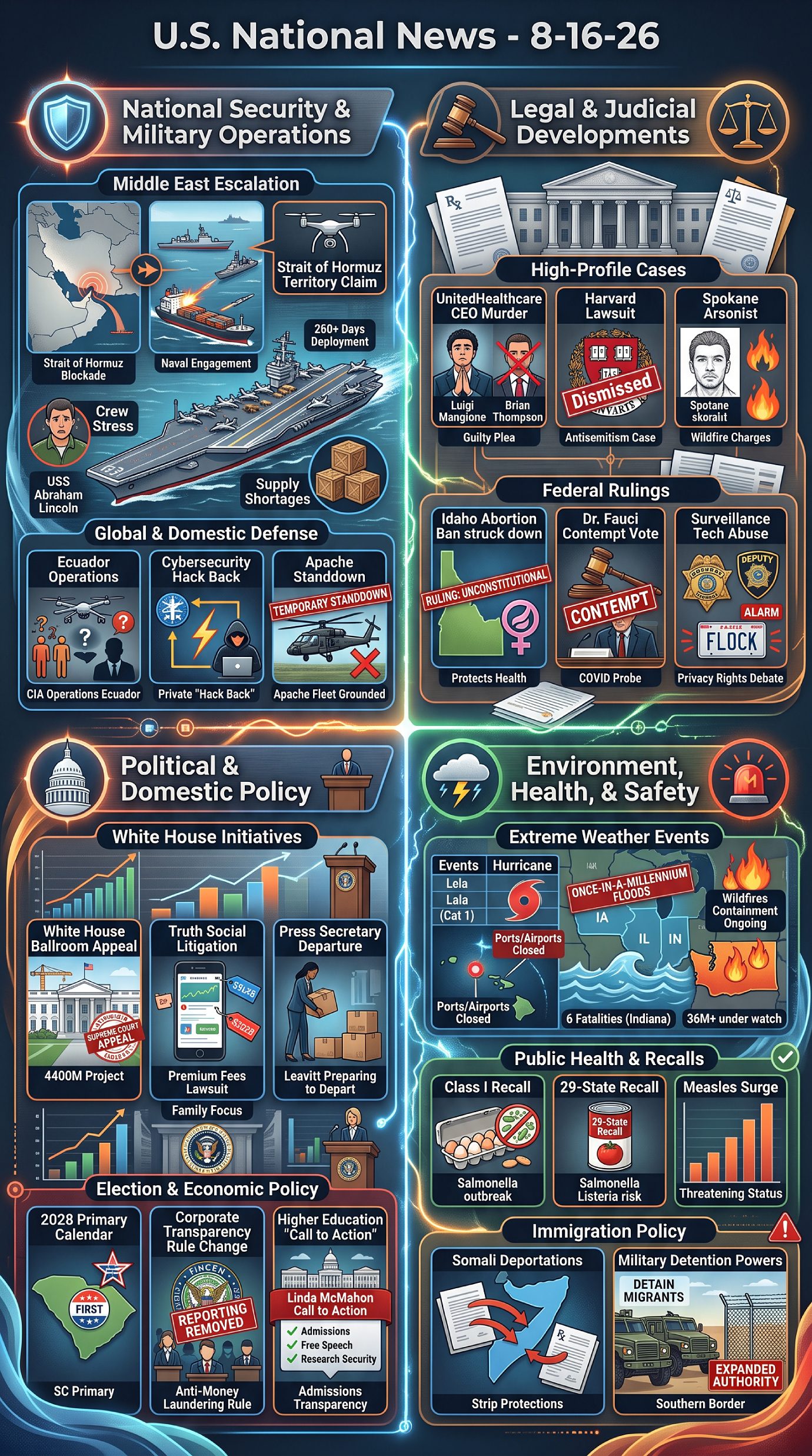
As of August 16, 2026, the United States is navigating a period of heightened geopolitical tension, significant legal shifts, and severe environmental challenges. Internationally, the administration has adopted an aggressive posture in the Middle East, characterized by a territorial claim over the Strait of Hormuz and the enforcement of a naval blockade. Domestically, the federal judiciary has issued pivotal rulings on reproductive rights and institutional liability, while the criminal justice system has seen a resolution in the high-profile murder of UnitedHealthcare’s CEO.
Public health and safety are under pressure from “once-in-a-millennium” flooding in the Midwest, a Category 1 hurricane approaching Hawaii, and a series of massive food safety recalls. Meanwhile, the political landscape is shifting as the Democratic National Committee (DNC) formalizes its 2028 primary schedule and the White House navigates legal battles over infrastructure projects and military detention powers.
National Security and Military Operations
Middle East Escalation and Naval Operations
The U.S. has significantly increased its military footprint and assertiveness in the Middle East:
- Strait of Hormuz: President Trump announced intentions to declare the Strait of Hormuz a U.S. territory. This follows an incident where the U.S. Navy fired on a Panama-flagged cargo ship attempting to breach an American blockade of Iranian ports.
- USS Abraham Lincoln: Public and congressional concern is mounting regarding the mental health and supply shortages aboard the aircraft carrier. Despite the crew’s continuous 260-plus day deployment, the administration dismissed these concerns, stating the duration is “not nearly long enough.”
- Intelligence Updates: Officials have downgraded the threat level regarding a suspected Iranian missile plot against Air Force One, determining the previous intelligence was not credible.
Global and Domestic Defense Initiatives
- Ecuador Operations: Reports indicate a secret CIA operation involving drone strikes and the alleged torture of fishermen off the coast of Ecuador occurred earlier this year.
- Cybersecurity: A White House memo proposes granting private U.S. companies the authority to conduct “hack back” operations against foreign cybercriminals.
- Aviation Safety: The U.S. Army has ordered a temporary training standdown for all Apache helicopters following a fatal crash near Fort Hood, Texas.
Legal and Judicial Developments
High-Profile Criminal and Civil Cases
- UnitedHealthcare CEO Murder: Luigi Mangione has pleaded guilty in federal court to the killing of Brian Thompson. During the hearing, Mangione revealed his explicit motives for the attack.
- Harvard University: A federal judge dismissed a lawsuit against Harvard regarding campus antisemitism, ruling that the reported instances were “isolated and episodic” rather than a result of institutional failure.
- Spokane Arson: A serial arsonist has been formally charged in connection with multiple devastating wildfires in the Spokane area.
Federal Rulings and Oversight
- Idaho Abortion Ban: A federal judge struck down the state’s near-total ban, ruling it unconstitutional because it failed to protect the broader health of pregnant women beyond life-saving measures.
- Congressional Contempt: Republicans voted to hold Dr. Anthony Fauci in contempt of Congress after he invoked the Fifth Amendment more than 100 times during a Senate COVID-19 probe.
- Surveillance Technology: A national debate over privacy has intensified following the arrest of former Georgia deputies for using “Flock” automated license plate readers to stalk individuals.
Political and Domestic Policy
White House Initiatives and Administration
- White House Ballroom: The administration has filed an emergency appeal with the Supreme Court to resume construction on a $400 million, 90,000-square-foot ballroom. The project was previously halted by a lower court for lacking congressional approval.
- Truth Social Litigation: A federal lawsuit challenges a plan by the President’s social media platform to charge premium fees for expedited access to market-moving posts.
- Personnel Changes: Press Secretary Karoline Leavitt is preparing to depart the administration to focus on her family.
Election and Economic Policy
- 2028 Primary Calendar: The DNC has officially and permanently selected South Carolina to host the first primary vote for the 2028 presidential cycle.
- Corporate Transparency: FinCEN has eliminated beneficial ownership reporting requirements for small businesses, removing a controversial anti-money laundering rule.
- Higher Education: Education Secretary Linda McMahon has issued a “Call to Action,” requiring university presidents to report on admissions transparency, free speech, and research security by year-end.
Environment, Health, and Safety
Extreme Weather Events
| Event | Location | Impact/Status |
|---|---|---|
| Hurricane Lala | Hawaii | Category 1; Major ports and airports closed on the Big Island. |
| “Once-in-a-Millennium” Floods | Indiana | Six fatalities; National Guard deployed; Statewide disaster emergency. |
| Midwest Flood Alerts | Iowa to West Virginia | Over 36 million people under flood watches or warnings. |
| Wildfires | Washington State | Ongoing containment and community recovery operations. |
Public Health and Recalls
- Egg Recall: The FDA elevated an egg recall to Class I (highest risk) due to a Salmonella outbreak affecting nearly 100 people across 17 states.
- Tomato Soup Recall: Walmart and the FDA issued a 29-state recall for tomato soup kits due to potential Listeria contamination.
- Measles Surge: A significant spike in measles cases is currently threatening the United States’ status regarding official disease elimination.
Immigration Policy
- Somali Deportations: A federal judge cleared the way for the administration to strip legal protections from approximately 1,100 Somalis, making them eligible for deportation.
- Military Enforcement: The Justice Department has expanded the military’s authority to detain migrants near designated sections of the southern border.