World News – Week of July 26, 2026
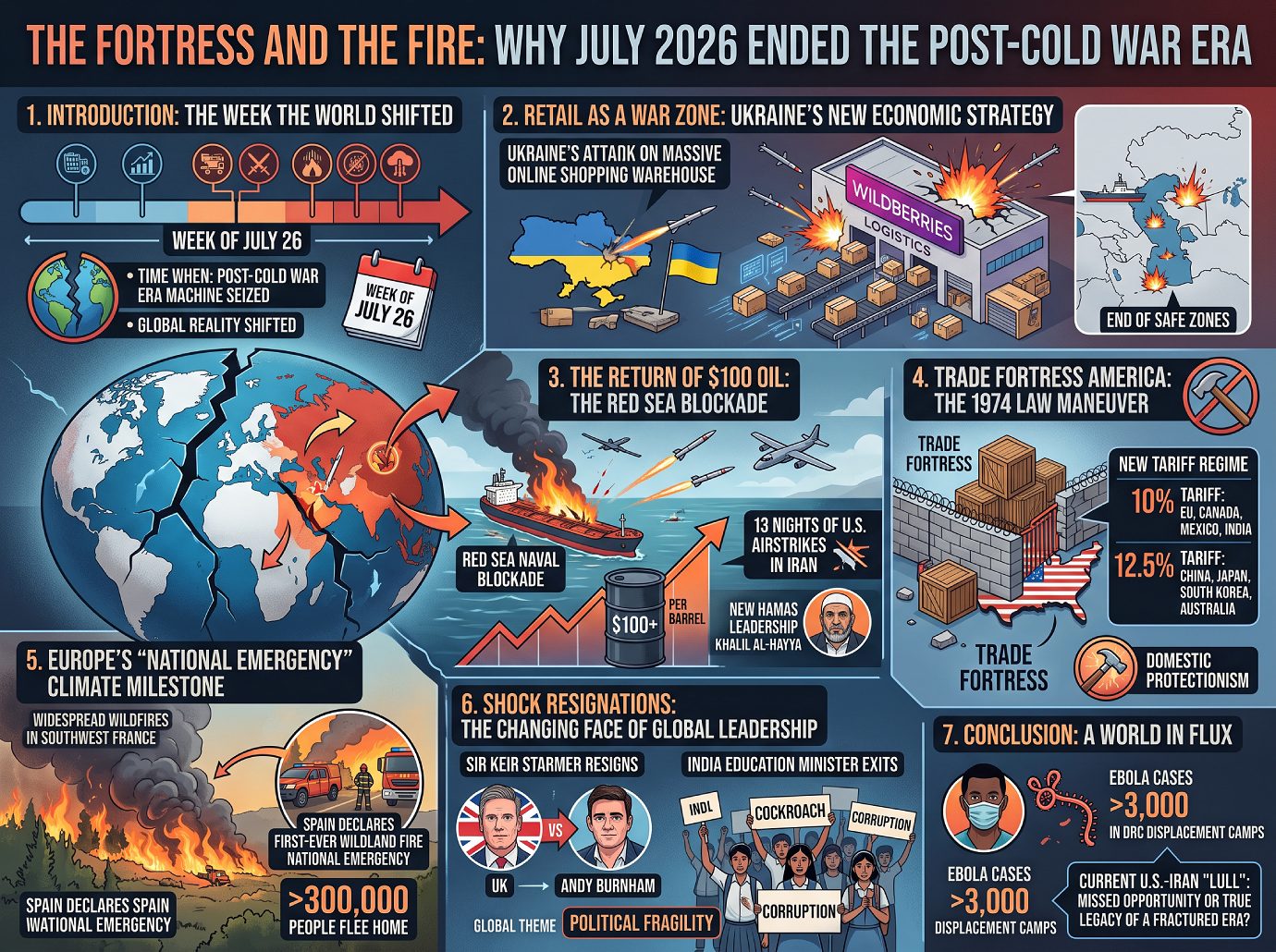
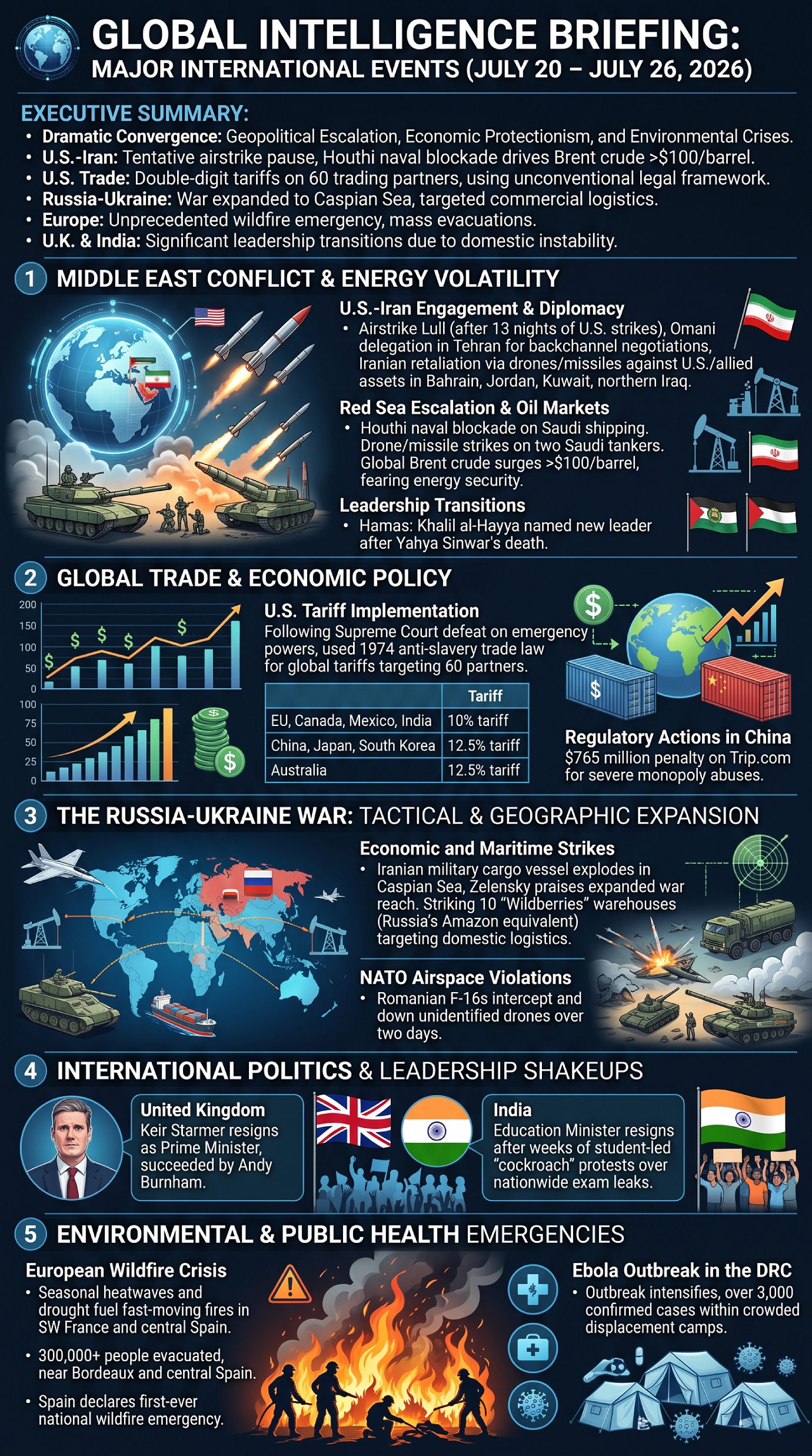
The final week of July 2026 was characterized by a dramatic convergence of geopolitical escalation, economic protectionism, and environmental crises.
In the Middle East, a tentative pause in direct U.S.-Iran airstrikes was overshadowed by a Houthi-led naval blockade that propelled Brent crude oil prices beyond the $100-per-barrel threshold.
Simultaneously, the United States fundamentally reshaped global trade by implementing double-digit tariffs on 60 trading partners, leveraging unconventional legal frameworks to bypass judicial setbacks.
The Russia-Ukraine war expanded its economic and geographic footprint, with strikes reaching into the Caspian Sea and targeting Russian commercial infrastructure.
In Europe, an unprecedented wildfire emergency forced the evacuation of hundreds of thousands, while the United Kingdom and India experienced significant leadership transitions driven by domestic instability.
Middle East Conflict and Energy Volatility
The regional security environment shifted from direct state-on-state engagement toward maritime economic warfare and backchannel diplomacy.
U.S.-Iran Engagement and Diplomacy
- Airstrike Lull: After 13 consecutive nights of intensive U.S. airstrikes targeting Iranian cities and infrastructure, U.S. Central Command paused operations to facilitate diplomatic discussions.
- Backchannel Negotiations: Omani delegations emerged in Tehran to lead mediation efforts.
- Regional Retaliation: Prior to the pause, Iranian forces launched drones and missiles against U.S. and allied assets in Bahrain, Jordan, Kuwait, and northern Iraq.
Red Sea Escalation and Oil Markets
- Naval Blockade: Iran-backed Houthi forces declared a naval blockade on Saudi shipping. This was punctuated by drone and missile strikes on two Saudi oil tankers in the Red Sea.
- Market Impact: These strikes caused global Brent crude oil prices to surge past $100 per barrel for the first time in months, reflecting heightened fears regarding global energy security.
Leadership Transitions
- Hamas: Following the death of Yahya Sinwar, Khalil al-Hayya was officially named as the new leader of Hamas.
Global Trade and Economic Policy
Significant shifts in U.S. trade policy and Chinese regulatory actions have introduced new frictions into the global economy.
U.S. Tariff Implementation
Following a defeat in the Supreme Court regarding the use of emergency powers, the Trump administration utilized a 1974 anti-slavery trade law to impose a new wave of global tariffs. These levies target 60 trading partners:
| Trading Partner(s) | Tariff Rate |
|---|---|
| European Union, Canada, Mexico, India | 10% |
| China, Japan, South Korea | 12.5% |
| Australia | 12.5% |
Regulatory Actions in China
- Monopoly Crackdown: Chinese authorities levied a $765 million penalty against the travel platform Trip.com, citing severe monopoly abuses.
The Russia-Ukraine War: Tactical and Geographic Expansion
The conflict between Russia and Ukraine has seen a strategic shift toward targeting economic logistics and an expansion of the theater of operations.
Economic and Maritime Strikes
- Caspian Sea Engagement: An Iranian military cargo vessel exploded in the Caspian Sea, an incident praised by Ukrainian President Volodymyr Zelensky as the war reached into new territory.
- Targeting Retail Logistics: Ukrainian forces have shifted strategies to disrupt the Russian economy by striking ten “Wildberries” warehouses—Russia’s equivalent to Amazon—targeting their domestic logistics network.
NATO Airspace Violations
- Romanian Intervention: For two consecutive days, the Romanian military deployed F-16 fighter jets to intercept and down unidentified drones that had violated its airspace.
International Politics and Leadership Shakeups
Domestic pressures and student-led movements have led to the resignation of key officials in the U.K. and India.
- United Kingdom: In a sudden political shift, Sir Keir Starmer resigned as Prime Minister. He was succeeded by Andy Burnham.
- India: Education Minister resigned following weeks of “cockroach” protests led by students. The unrest was triggered by nationwide exam leaks.
Environmental and Public Health Emergencies
Natural disasters and disease outbreaks have placed extreme strain on international relief systems and national infrastructures.
European Wildfire Crisis
- Mass Evacuations: Severe seasonal heatwaves and drought conditions fueled fast-moving fires in southwest France and central Spain. Over 300,000 people were forced to flee, particularly near Bordeaux and central Spain.
- State of Emergency: Spain declared its first-ever national wildfire emergency in response to the intensifying blazes.
Ebola Outbreak in the DRC
- Case Surge: Health officials in the Democratic Republic of the Congo reported that the Ebola outbreak has intensified, with over 3,000 confirmed cases identified within crowded displacement camps.