Massachusetts Weekly News Briefing for the week of November 22, 2026
Listen to the Massachusetts Weekly News Briefing on any device, CLICK PLAY.
Massachusetts enters Thanksgiving week following a consequential statewide election almost 3 weeks ago, with major developments involving Governor Maura Healey, government transparency, housing affordability, transportation, public health, education, environmental protection and public safety.
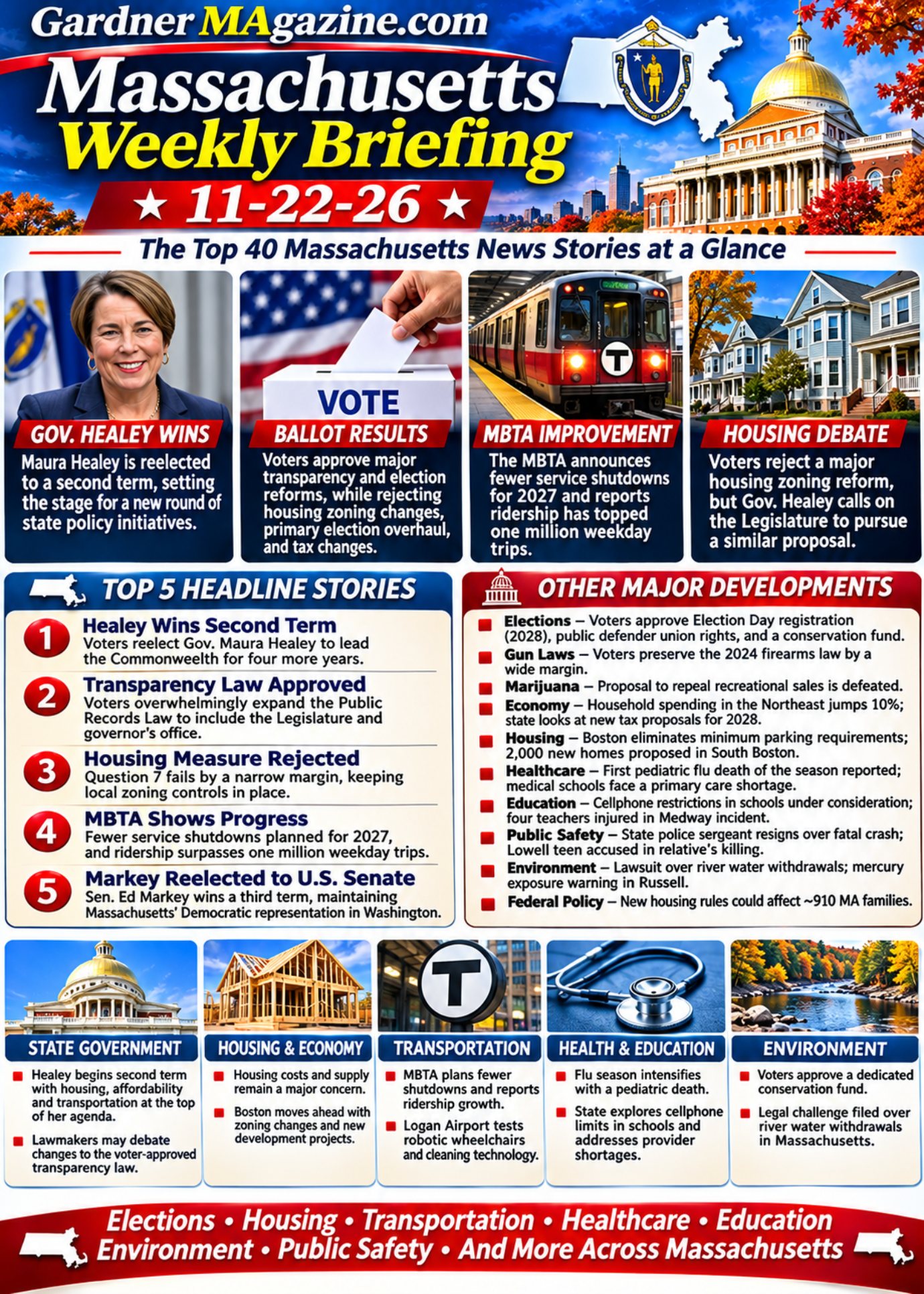
This briefing covers 40 significant Massachusetts news developments, ranked by their statewide importance, potential consequences and public interest. It includes both major continuing stories and developments reported during the past week and the recent election.
The biggest Massachusetts story heading into November 22, 2026, is the aftermath of the statewide election. Governor Maura Healey secured a second term, Senator Ed Markey won reelection, and voters made consequential decisions on government transparency, election administration, firearms regulation, marijuana policy and conservation funding.
Housing affordability remains one of the Commonwealth’s most pressing challenges. The narrow defeat of Question 7, followed by Governor Healey’s call for similar legislation, has created a potentially contentious debate over zoning, local authority and the need for additional housing.
Transportation offers a more encouraging development. The MBTA’s recovery in ridership and plans for fewer service interruptions suggest that years of infrastructure investment are producing measurable improvements.
Meanwhile, public-health concerns, rising household expenses, school safety, environmental protection and healthcare access continue to affect Massachusetts residents.
Top 40 Massachusetts News Stories
State Government, Elections and Public Policy
1. Governor Maura Healey Wins Second Term in Massachusetts
Governor Maura Healey secured reelection on November 3, defeating Republican challenger Mike Minogue. Her victory gives the Democratic governor another four-year term beginning in January 2027. The election also preserves the Healey-Driscoll administration’s leadership of state government. The governor faces continuing challenges involving housing affordability, transportation, healthcare costs, state spending and the economic competitiveness of Massachusetts. The coming legislative session will determine how aggressively the administration pursues changes to housing policy, infrastructure investment and government operations.
2. Massachusetts Voters Overwhelmingly Approve Government Transparency Law
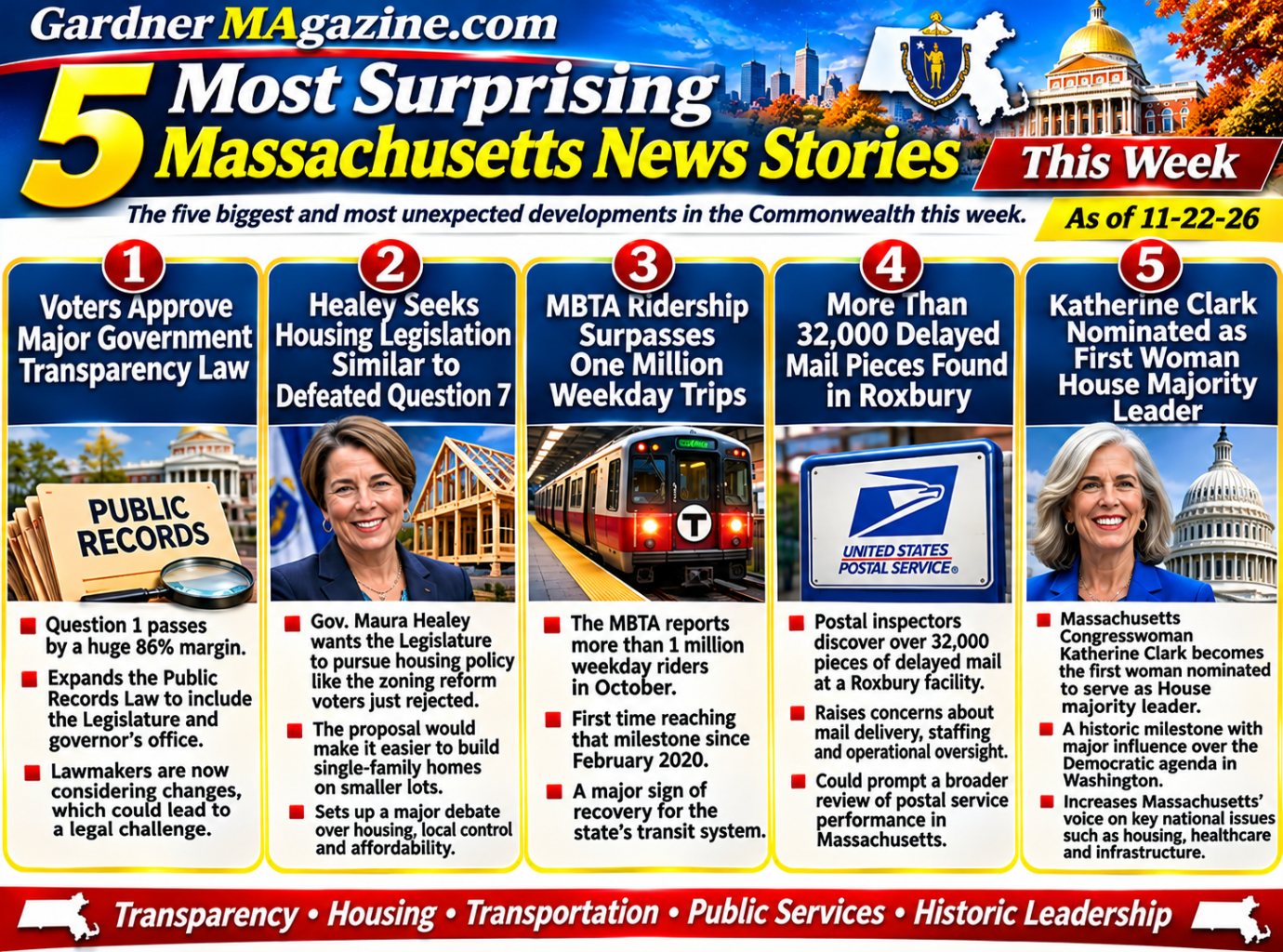
Voters approved Question 1, expanding the Massachusetts Public Records Law to cover the Legislature and governor’s office. The measure passed by an overwhelming margin, with approximately 86% voting in favor according to early results. However, lawmakers have been considering legislation that could modify or limit the new requirements. State Auditor Diana DiZoglio, a leading advocate for transparency, has indicated that she may pursue legal action if lawmakers undermine the voter-approved measure. The dispute could become one of the most consequential government-accountability battles in Massachusetts history.
3. U.S. Senator Ed Markey Wins Third Term
Democratic Senator Ed Markey won reelection after defeating Republican John Deaton. Markey, 80, previously defeated Congressman Seth Moulton in a closely watched Democratic primary. His victory maintains Massachusetts’ Democratic representation in the U.S. Senate and positions him to participate in the new Democratic Senate majority beginning in January. Markey has emphasized climate policy, healthcare, consumer protection and economic issues throughout his Senate career.
4. More Than 2.7 Million Massachusetts Residents Vote in Midterm Election
Massachusetts recorded exceptionally strong participation in the November 3 election. More than 2.7 million voters cast ballots, nearly matching the state’s midterm turnout record. The combination of competitive races, nine statewide ballot questions and intense national political interest contributed to voter engagement. The unusually long ballot also produced lines at some polling locations, renewing discussion about election administration and voting accessibility.
5. Massachusetts Voters Approve Election Day Voter Registration
Question 4 passed, allowing eligible Massachusetts residents to register to vote at polling places on Election Day. The change is scheduled to take effect in 2028. Previously, Massachusetts was the only New England state without a form of Election Day registration. Municipal election departments will need to prepare staffing, verification procedures and technology systems to implement the new law. Supporters believe the change will improve voter participation, while election administrators must address logistical and security considerations.
6. Voters Reject Proposal to Eliminate Party Primaries
Massachusetts voters rejected Question 3, which would have changed the state’s primary election system. The proposal sought to replace the existing party-primary structure with a different system for advancing candidates to general elections. Its defeat preserves the traditional Democratic and Republican primary process. The outcome reflects continuing debate over whether election reform should prioritize party participation or broader access for independent voters.
7. Massachusetts Rejects Changes to Taxpayer Refund Formula
Voters rejected Question 5, a proposal affecting the state’s revenue limit and taxpayer rebate system. The measure was defeated by a relatively narrow margin, with slightly more than 52% voting against it. The decision preserves the existing framework associated with Massachusetts’ tax-revenue limitation law, commonly called Chapter 62F. The result is significant because the law can require taxpayer refunds when state revenue collections exceed a prescribed limit.
8. Public Defender Employees Win Collective Bargaining Rights
Question 2 passed, allowing employees of the Committee for Public Counsel Services to organize and bargain collectively. The measure represents a significant labor-policy development for Massachusetts’ public defense system. Implementation will require workers to establish union representation and negotiate employment agreements. Supporters argue that collective bargaining could improve recruitment, retention and working conditions for employees providing legal representation to people who cannot afford private attorneys.
9. Massachusetts Voters Preserve Strict 2024 Gun Control Law
Voters rejected Question 9, which sought to repeal the state’s 2024 firearms legislation. More than two-thirds of voters supported retaining the existing law. The legislation addresses ghost guns, firearms licensing, assault-style weapons, extreme-risk protection orders and other gun regulations. The outcome represents a major victory for supporters of Massachusetts’ gun-control framework and a setback for organizations seeking repeal.
10. Massachusetts Voters Reject Repeal of Recreational Marijuana Sales
Question 8 was overwhelmingly defeated. Approximately three-quarters of voters opposed the proposal to end licensed recreational marijuana sales. The result preserves Massachusetts’ legal adult-use cannabis industry, including dispensaries, employment and associated tax revenue. The election also reinforces the state’s existing approach to regulating recreational marijuana, although lawmakers may continue considering changes to the industry.
Housing, Affordability and the Massachusetts Economy
11. Voters Reject Major Housing Zoning Reform by Narrow Margin
Question 7, which would have made it easier to construct single-family homes on smaller lots, failed in one of the closest contests of the election. Approximately 1.29 million residents voted against the proposal, compared with nearly 1.26 million supporting it. The measure was intended to reduce certain local zoning barriers and encourage construction of more affordable starter homes. Opponents raised concerns about local control, infrastructure capacity and neighborhood development. The outcome leaves Massachusetts facing its persistent housing shortage without the statewide zoning changes proposed in the ballot measure.
12. Healey Calls for Legislature to Enact Housing Policy Voters Rejected
Governor Healey announced that she wants lawmakers to consider legislation similar to the defeated Question 7. The governor argues that increasing housing production is essential to economic growth and affordability throughout Massachusetts. Her position has created a debate over whether the Legislature should enact a policy that voters recently rejected. The proposal could become a significant issue during the 2027 legislative session, particularly in suburban and rural communities where zoning decisions are closely connected to local infrastructure and community character.
13. Massachusetts Continues Losing Residents to Other States
New reporting highlights the continuing movement of Massachusetts residents to other states. Housing costs, taxes, retirement decisions and employment opportunities are among the factors commonly associated with interstate migration. Population losses can affect the state’s workforce, tax base and long-term economic competitiveness. The issue is especially significant for younger families, retirees and workers who may find more affordable housing elsewhere.
14. Northeast Household Spending Jumps 10% in One Year
A new report indicates that household spending in the Northeast increased approximately 10% over one year. Massachusetts residents generally earn higher wages than residents of many other states, but they also face substantial housing, transportation and living expenses. The increase reinforces concerns about the affordability of everyday life. Higher spending does not necessarily mean families are better off, particularly when a substantial portion of the increase reflects higher prices rather than greater consumption.
15. Boston Eliminates Minimum Parking Requirements for New Housing
The Boston City Council voted to eliminate minimum off-street parking requirements for new residential development. Supporters believe the change will reduce construction costs and make housing projects more financially feasible. Opponents and neighborhood residents may remain concerned about parking availability and traffic. The decision is part of a broader effort to encourage additional housing construction in one of the nation’s most expensive metropolitan areas.
16. Nearly 2,000 New Homes Proposed in South Boston
Developers are advancing proposals for approximately 2,000 residential units in South Boston. Some projects involve converting or redeveloping properties previously used for warehouses and other commercial purposes. The proposals reflect the continuing pressure to increase housing production in Greater Boston. Their eventual impact will depend on zoning approvals, financing, infrastructure capacity and the number of affordable units included.
17. Federal Housing Rules Could Affect Approximately 910 Massachusetts Families
New federal housing regulations concerning mixed-immigration-status households could affect an estimated 910 families in Massachusetts. The rule requires residents of federally subsidized housing to demonstrate qualifying citizenship or immigration status. Federal officials argue that assistance should be reserved for eligible households. Housing advocates warn that the rule could force some families, including households with American children, to separate or lose affordable housing. The policy is scheduled to take effect December 14.
18. Massachusetts Rideshare Drivers Push for Historic Union Contract
Unionized Uber and Lyft drivers rallied in Massachusetts as negotiations continued over what could become a first-of-its-kind labor agreement. Drivers are seeking improved compensation, benefits and job protections. The negotiations follow Massachusetts’ efforts to establish collective bargaining rights for app-based transportation workers. The outcome could influence labor policies in other states and the operating costs of major rideshare companies.
19. Greater Boston Food Bank Prepares Record Holiday Food Distribution
The Greater Boston Food Bank expects to distribute a record amount of food during the holiday season. Nonprofit organizations report growing demand associated with higher living costs and changes to federal assistance programs. The increased need is affecting families, older residents and people who are employed but still struggle to afford groceries. The situation highlights the continuing importance of food pantries, charitable organizations and community donations across Massachusetts.
20. Massachusetts Considers New Tax Proposals for 2028 Ballot
Petitioners have submitted proposals for 18 potential new state laws, including two major tax-cut measures. These proposals are in the early stages of the initiative petition process and must satisfy additional requirements before reaching voters. The measures could create another major debate about taxation, government revenue and affordability. Their potential impact will depend on the final language and whether enough signatures are collected to qualify for the 2028 ballot.
Transportation, Infrastructure and Development
21. MBTA Announces Fewer Service Shutdowns for 2027
The Massachusetts Bay Transportation Authority announced a significant reduction in planned service shutdowns. The agency expects approximately 100 days of disruptions in 2027, compared with 132 in 2026, 190 in 2025 and 274 in 2024. MBTA General Manager Phillip Eng attributed the improvement to progress in track repairs, signal modernization and accessibility projects. Most remaining disruptions are expected to occur on weekends. The announcement offers hope that riders will experience more reliable service after years of extensive repairs.
22. MBTA Weekday Ridership Surpasses One Million Trips
The MBTA reported averaging more than one million weekday passenger trips in October. It was the first time the system had reached that milestone since February 2020. The recovery reflects changing commuting patterns and renewed use of public transportation. Higher ridership could improve fare revenue and strengthen the argument for continued investment in the transit system.
23. Blue Hill Avenue Bus Lane Project Faces Renewed Scrutiny
The proposed Blue Hill Avenue transportation project remains controversial. Federal funding has advanced, but Boston city councilors have called for an independent review of safety, accessibility and potential effects on local businesses. Supporters believe dedicated bus lanes could improve travel times and service reliability. Critics question whether the design adequately considers traffic patterns, parking, pedestrian safety and neighborhood concerns. The project has become a prominent example of the difficult choices involved in urban transportation planning.
24. Logan Airport Begins Testing Robotic Wheelchairs and Cleaning Equipment
Massport is experimenting with robotic technology at Boston Logan International Airport. The pilot program includes automated wheelchairs and cleaning equipment intended to improve airport operations and passenger assistance. Airport officials are evaluating whether the technology can operate effectively within Logan’s existing terminal layouts. The initiative illustrates how artificial intelligence and automation are beginning to reshape transportation facilities.
25. Massachusetts Launches $4 Million Initiative to Attract Major Events
Governor Healey’s administration announced $4 million in grant opportunities to help Massachusetts attract major sporting and entertainment events. The program follows the economic activity generated by the state’s participation in the 2026 FIFA World Cup. Officials hope additional events will stimulate tourism, hotel occupancy, restaurant spending and employment. The initiative is part of a broader effort to strengthen Massachusetts’ tourism and hospitality economy.
Healthcare, Education and Scientific Research
26. Massachusetts Reports First Pediatric Flu Death of the Season
Massachusetts health officials reported the state’s first pediatric influenza death of the 2026–2027 flu season. The announcement comes as families prepare for Thanksgiving gatherings and increased holiday travel. Public-health officials are emphasizing influenza vaccination, early recognition of serious symptoms and precautions to reduce respiratory virus transmission. The death is a reminder that influenza can cause severe illness in children as well as older adults and people with underlying medical conditions.
27. Boston University Research Advances Potential Blood Test for CTE
Researchers associated with Boston University reported progress toward a possible blood test for chronic traumatic encephalopathy, or CTE. The neurodegenerative condition is associated with repeated head impacts and has received extensive attention in professional football and other contact sports. Currently, definitive CTE diagnosis generally requires examination of brain tissue after death. A reliable blood test could eventually improve research, clinical evaluation and understanding of the disease. However, additional validation is necessary before such testing could become a routine diagnostic tool.
28. Massachusetts Medical Schools Face Questions About Primary Care Physician Shortage
New reporting examines whether medical-school training and professional incentives are contributing to the shortage of primary care physicians. Specialist careers frequently offer higher compensation and greater professional recognition than general practice. The imbalance can make it difficult for Massachusetts residents to find family physicians and obtain timely appointments. The issue is especially important in rural communities and smaller cities where healthcare providers may already be scarce.
29. Massachusetts Considers Restrictions on Cellphones During School Hours
State lawmakers are considering legislation that would restrict student cellphone use during the school day. Supporters argue that limiting phones could improve classroom attention, reduce distractions and help address concerns about student mental health. Opponents and some parents question how restrictions would affect family communication and emergency situations. School districts are also evaluating their own approaches to smartphone and social media use. The legislation remains under consideration rather than being an enacted statewide requirement.
30. Four Teachers Injured at Medway School Amid Student Mental Health Crisis
Four educators were injured at a school in Medway during an incident involving a student experiencing a reported mental health crisis. The case has drawn attention to the challenges schools face when responding to serious behavioral and emotional emergencies. It raises questions about staff training, crisis intervention, specialized student support and classroom safety. The incident also highlights the need to balance student privacy and appropriate care with the protection of school employees.
31. School Attendance Concerns Grow Over Outside Sports Commitments
Massachusetts educators are examining the relationship between extracurricular athletic commitments and student absenteeism. Reporting indicates that some students are missing school because of travel and participation in sports programs outside their schools. The issue raises questions about academic priorities, family scheduling and the growing demands of competitive youth athletics. School leaders face the challenge of supporting student opportunities while maintaining consistent classroom attendance.
Public Safety, Courts and Environmental Protection
32. Massachusetts Supreme Judicial Court to Hear Lindsay Clancy Appeal
The Massachusetts Supreme Judicial Court will hear arguments in January concerning Lindsay Clancy’s effort to dismiss murder charges. Clancy is accused in connection with the deaths of her three young children in Duxbury. The court’s review will address legal questions surrounding the prosecution before a second trial scheduled for March. The case has attracted extensive national attention, including discussion of postpartum mental health, criminal responsibility and the legal standards governing retrials. The charges remain allegations unless and until resolved through the judicial process.
33. State Police Sergeant Accused in Fatal Drunk-Driving Crash Resigns
A Massachusetts State Police sergeant accused of driving while intoxicated in connection with a fatal crash has resigned. The case has intensified scrutiny of professional accountability within law enforcement. It also raises questions about departmental disciplinary procedures and how agencies respond when their own personnel face serious criminal allegations. The criminal allegations must be distinguished from any final determination of guilt.
34. Lowell Teen Accused of Murdering Elderly Relative
Prosecutors reported that a Lowell woman initially believed to have died after a fall was actually the victim of a homicide. Her 14-year-old grandnephew has been accused in connection with her death. The case has attracted attention because of the defendant’s age and the relationship between the accused and the victim. The investigation and subsequent court proceedings will determine the legal outcome.
35. More Than 32,000 Delayed Mail Pieces Discovered at Roxbury Post Office
Postal inspectors reportedly found more than 32,000 pieces of delayed mail at a Roxbury postal facility in a single day. The discovery has raised concerns about mail delivery performance and operational oversight. Delayed mail can affect residents waiting for checks, bills, medical correspondence and important government notices. The findings may prompt further examination of staffing, management and delivery procedures.
36. Environmental Groups Sue Massachusetts Over River Water Withdrawals
Environmental organizations have filed litigation challenging state management of water withdrawals affecting the Ipswich and Parker rivers. The groups argue that excessive withdrawals threaten river ecosystems and aquatic habitats. The dispute involves the difficult balance between municipal drinking-water supplies, development and environmental conservation. The outcome could influence water-management policies in communities throughout eastern Massachusetts.
37. Massachusetts Warns About Mercury Exposure Following Russell Incident
State officials issued warnings about potential mercury exposure following an incident in Russell, Massachusetts. Mercury is a hazardous substance that can pose health risks, particularly when vapor is inhaled. Public-health responses to mercury incidents may require environmental testing, specialized cleanup and restrictions on access to affected areas. The incident underscores the importance of proper handling and disposal of hazardous materials.
Environment, Labor and Community Developments
38. Massachusetts Voters Approve Dedicated Conservation Fund
Question 6 passed, directing the creation of a fund supported by designated sales-tax revenue associated with sporting goods, recreational vehicles and golf-related purchases. Supporters estimate that the program could eventually generate approximately $65 million annually. The funding is intended to support conservation priorities such as forests, waterways, parks and natural resources. Lawmakers will retain authority over appropriations, meaning implementation details and actual spending will remain important issues.
39. Massachusetts Examines New Rules for Data Center Development
A growing debate over data centers is taking shape as communities consider the implications of artificial intelligence infrastructure. Some Massachusetts residents and lawmakers are exploring restrictions on data center development, including possible ballot measures. Concerns include electricity consumption, water use, environmental impacts and whether nearby residents will face higher utility costs. Supporters of data center construction point to economic development, tax revenue and technology investment. The issue could become increasingly important as artificial intelligence companies expand their computing capacity.
40. Massachusetts Congressional Leader Katherine Clark Makes History
Massachusetts Congresswoman Katherine Clark became the first woman nominated to serve as majority leader of the U.S. House of Representatives. The nomination represents a historic milestone in congressional leadership. Clark’s advancement would give Massachusetts an influential voice in shaping the Democratic majority’s legislative priorities. Her position could also increase the state’s influence in debates involving federal funding, healthcare, education, infrastructure and economic policy.