North Central Massachusetts News Briefing for the week of November 22, 2026
Listen to the North Central MA Extended Briefing on any device, CLICK PLAY.
The extended briefing this week covers North Central MA, Greater Gardner MA, and North Quabbin MA.
Financial Emergencies, Political Transitions, Water Protection, Winter Assistance and Community Developments Dominate Regional News
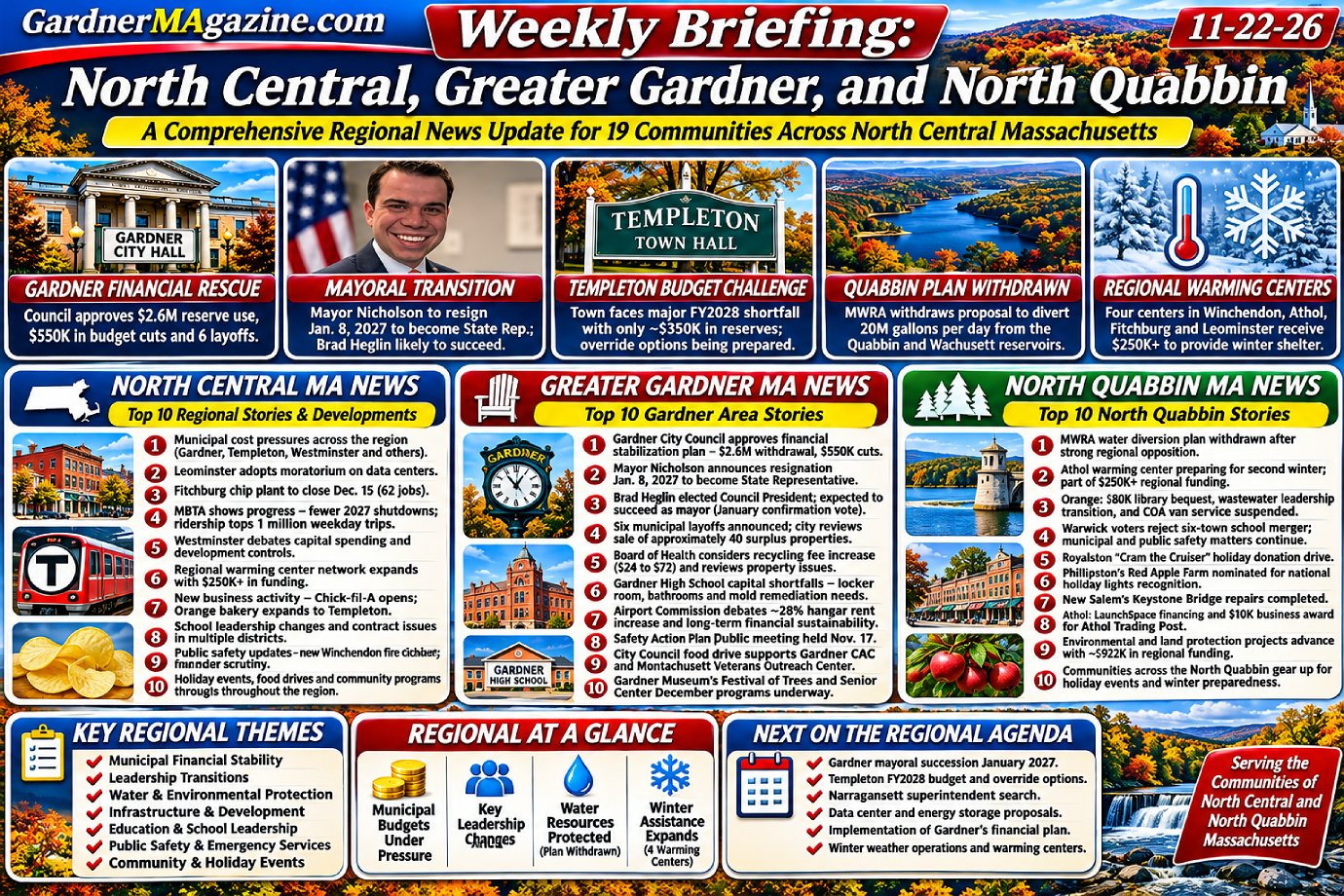
The week ending November 21, 2026, has brought major developments across Greater Gardner, North Central Massachusetts and the North Quabbin region. Municipal financial difficulties, significant political transitions, environmental decisions and expanding community assistance programs are shaping the future of communities throughout northern Worcester and Franklin counties.
At the center of the news is Gardner, where Mayor Michael Nicholson and the City Council have confronted a substantial municipal financial emergency while simultaneously preparing for a change in leadership. Nearby Templeton is facing its own serious budget challenges, and communities throughout the region are reviewing infrastructure needs, public services and economic development.
Meanwhile, a major water diversion proposal affecting the Quabbin and Wachusett reservoirs has been withdrawn following regional opposition. Emergency warming centers are preparing to assist vulnerable residents, and holiday activities are bringing communities together as Thanksgiving approaches.
Gardner Approves Major Financial Stabilization Plan
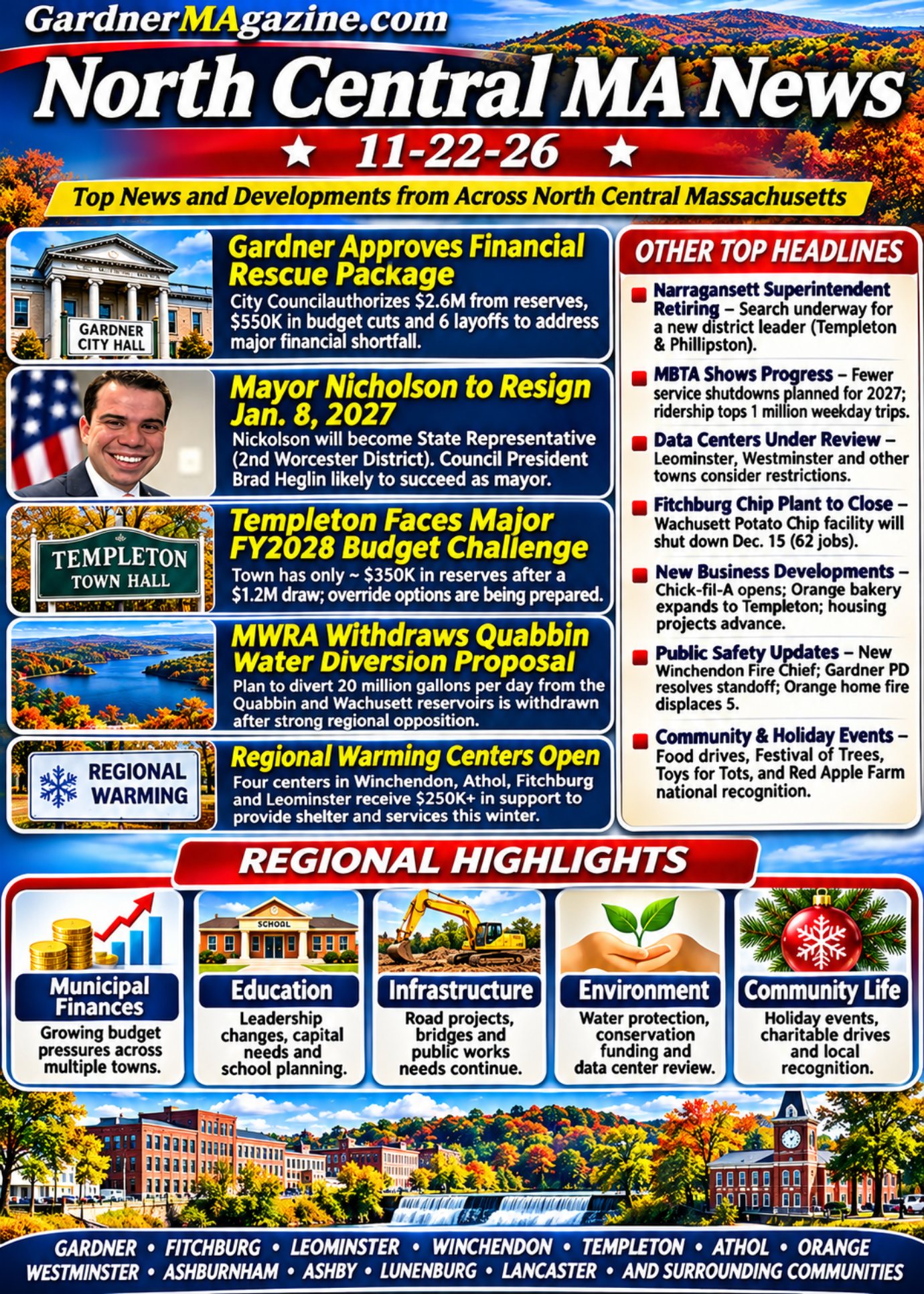
The most consequential local government development occurred on November 16, when the Gardner City Council unanimously approved nine supplemental budget orders intended to address serious financial problems in the city’s FY2027 budget. The package includes approximately $550,000 in departmental spending reductions and a $2.6 million withdrawal from the city’s stabilization fund, leaving an estimated $1 million in reserves. Mayor Michael Nicholson acknowledged that financial assumptions and accounting errors contributed to the situation. Among the problems identified were a seven-year-old enterprise-fund spreadsheet error, approximately $1 million in underfunded reimbursements and a multiyear health insurance deficit of approximately $3.4 million. The financial difficulties have also resulted in municipal layoffs, affecting six positions across several departments. The administration has argued that immediate corrective action is necessary to prevent even greater financial difficulties in FY2028. The decisions represent a significant turning point for Gardner. The city must now rebuild its financial reserves, improve budget controls, manage employee benefit expenses and maintain essential public services with fewer resources.
Gardner Prepares for Historic Mayoral Transition
The financial emergency comes as Gardner prepares for a change in leadership. Mayor Nicholson, elected November 3 to represent the 2nd Worcester District in the Massachusetts House of Representatives, has announced that he intends to resign as mayor effective January 8, 2027, at noon. The district includes Gardner, Ashburnham, Templeton and part of Winchendon.
Gardner City Council President George Tyros stepped down from the presidency, and Councilor Brad Heglin was elected to the position during the November 16 meeting. Under Gardner’s charter, the council president serving when the mayoral vacancy occurs is expected to succeed Nicholson for the remainder of the term. Heglin is therefore positioned to become mayor, provided he is again selected as council president in January. The transition is particularly significant because Gardner’s incoming mayor will inherit the responsibility of implementing the financial stabilization package and preparing the next municipal budget. The possibility of a council vacancy has also prompted discussion of Jeffrey Palmieri as a potential successor to Heglin’s council seat, subject to the applicable succession process.
Templeton Confronts Its Own Financial Crisis
Gardner is not the only community facing difficult municipal financial decisions. In Templeton, officials have warned of substantial challenges for Fiscal Year 2028. The town previously used approximately $1.2 million from its stabilization fund to support its FY2027 budget, leaving roughly $350,000 in reserves. Interim Town Administrator Carter Terenzini has outlined an approach that would establish a basic budget supported by recurring revenues and then present voters with additional spending choices through potential Proposition 2½ overrides. The concept would allow residents to evaluate specific services and associated costs rather than simply voting on one large override proposal. The challenge reflects rising pension, health insurance and educational expenses that are increasing faster than the revenue available through ordinary property tax increases. Templeton’s financial decisions will affect public services, staffing and the community’s long-term fiscal stability.
North Central Massachusetts Faces Wider Municipal Cost Pressures
The financial challenges in Gardner and Templeton illustrate a broader issue confronting communities throughout North Central Massachusetts. Municipal governments are experiencing increasing pressure from employee benefits, infrastructure maintenance, school costs, utility expenses and limited revenue growth. In Westminster, officials have been considering capital and financial transfers, public safety facility planning and development restrictions. Other communities are reviewing staffing, infrastructure investment and municipal operating costs. The central challenge is how to maintain essential services while avoiding excessive burdens on taxpayers. The coming FY2028 budget cycle may prove particularly difficult for municipalities that have already used significant portions of their financial reserves.
Major Victory for Quabbin and Wachusett Watershed Communities
One of the region’s most consequential environmental developments involves the Massachusetts Water Resources Authority. The agency withdrew its proposal to divert an additional 20 million gallons of water daily from the Quabbin and Wachusett reservoirs following opposition from residents, municipal leaders and state officials. The proposal had raised concerns about water availability, conservation and the long-term implications of directing additional supplies toward development in eastern Massachusetts. Earlier reporting indicated that Quabbin Reservoir storage had fallen to approximately 77.6%, adding urgency to the discussion. The withdrawal represents a significant development for the North Quabbin region and other communities that depend on responsible watershed management. However, the broader questions surrounding future water demand, drought preparedness and environmental protection remain unresolved.
Communities Debate Data Centers and Battery Energy Storage
A second major environmental and infrastructure issue involves commercial data centers and battery energy storage systems. Leominster, Fitchburg, Athol, Templeton, Westminster and other communities have been considering development restrictions or regulatory changes. The concerns involve electricity consumption, public safety, land use, infrastructure capacity and the long-term costs associated with large industrial energy facilities. Supporters of these developments point to potential tax revenue, investment and economic growth. Opponents question whether the benefits outweigh the potential demands on local electrical systems and municipal infrastructure. The issue is becoming increasingly important as artificial intelligence and other technologies create greater demand for computing facilities.
Four Communities Prepare Emergency Warming Centers
As winter approaches, a regional partnership is preparing emergency warming centers in Winchendon, Athol, Fitchburg and Leominster. The United Way of North Central Massachusetts announced more than $250,000 in support from participating organizations and government partners. Winchendon will have a new warming center coordinated by the Winchendon Community Action Committee. Athol’s warming center, managed by the North Quabbin Community Coalition, is preparing for its second winter. Fitchburg’s facility is entering its fourth year and serves approximately 40 people during each activation. Leominster’s program is coordinated through local emergency management officials. The centers are intended to provide temporary protection during dangerous cold weather and connect people with additional services. The expansion demonstrates increasing recognition of the challenges facing individuals experiencing homelessness or housing insecurity.
Regional Schools Face Leadership and Financial Changes
Education is another important focus of regional news. Narragansett Regional School District Superintendent Chris Casavant has announced his retirement, beginning a leadership search affecting Templeton and Phillipston. The district plans to involve community members in developing a candidate profile and evaluating applicants. The schedule calls for interviews and other selection activities during the winter, with a new superintendent expected to begin July 1, 2027. Elsewhere, Gardner continues reviewing capital funding problems associated with improvements at Gardner High School. Regional school districts are also confronting higher operational costs, staffing challenges and labor negotiations. In Warwick, voters rejected a proposed six-town school district merger in October, leaving participating communities to consider their future educational arrangements. Together, these developments demonstrate the difficult balance between maintaining educational quality and controlling costs.
North Quabbin Communities Address Local Government and Infrastructure Needs
Athol, Orange, Royalston, Warwick, New Salem, Petersham and Phillipston continue to confront issues important to smaller rural communities. In Athol, the community is preparing for winter assistance programs while supporting local economic development. LaunchSpace has received regional development financing, and the Athol Trading Post was recognized with a $10,000 small business award. Orange is addressing wastewater department staffing changes and has received an $80,000 bequest benefiting Wheeler Memorial Library. The suspension of Orange’s Council on Aging van service has also raised concerns about transportation access for older residents. New Salem completed repairs to the historic Keystone Bridge, while Royalston’s police department is organizing its annual charitable Cram the Cruiser campaign. These developments demonstrate how infrastructure, public services and community organizations remain central to life in the North Quabbin region.
Business Developments Bring Both Challenges and Opportunities
The regional economy presents a mixture of encouraging developments and difficult adjustments. In Fitchburg, the former Wachusett Potato Chip manufacturing facility is scheduled to close in December, affecting 62 employees. The closure represents a loss of manufacturing employment and a reminder of the challenges facing established regional industries. At the same time, new commercial activity continues. A Chick-fil-A location has opened at Twin City Plaza near the Fitchburg-Leominster line. An Orange bakery has expanded toward a second location in Templeton. The former Baldwinville School has been redeveloped into apartments, demonstrating how older public buildings can find new uses. Fitchburg also received state funding for a permanent outdoor recreation and entertainment stage. Together, these developments illustrate a regional economy experiencing both business investment and employment uncertainty.
Public Safety and Emergency Services Remain Important
Winchendon has welcomed Andrew Harding as its new fire chief following the retirement of longtime Chief Thomas Smith. Gardner has continued reviewing public safety operations, staffing and emergency preparedness. The city is also advancing its Safety Action Plan, which focuses on transportation and pedestrian safety. In Orange, a major residential fire earlier in November displaced five people and required assistance from multiple fire departments. The response demonstrated the importance of mutual aid, particularly in rural communities where individual departments may have limited resources. Across the region, emergency responders are preparing for winter weather and the additional challenges it can create.
Gardner Community Organizations Prepare for the Holiday Season
Despite the difficult financial news, community activity remains strong. On November 14, members of the Gardner City Council participated in a food drive benefiting the Gardner Community Action Committee and Montachusett Veterans Outreach Center. Councilor Judy Mack played a significant organizing role in the effort. The Gardner Museum’s annual Festival of Trees is underway, providing a popular seasonal attraction. The Gardner Senior Center has announced a December schedule that includes educational programs, energy conservation information and activities for older residents. Ashburnham is participating in Toys for Tots collections, and charitable organizations throughout the region are preparing holiday assistance programs. Phillipston’s Red Apple Farm has also attracted national attention through a nomination for a holiday light display award. These activities highlight the importance of volunteerism, community organizations and local traditions.
Regional Transportation and Public Services Receive Attention
Transportation and infrastructure remain important issues throughout Greater Gardner and North Central Massachusetts. Winchendon has undertaken paving work on Elmwood Road and Central Street. Gardner’s Department of Public Works continues confronting staffing and operational challenges. The Gardner Airport Commission has debated rent adjustments and the airport’s long-term financial sustainability. Local governments are also preparing for winter road maintenance, snow removal and public safety demands. Maintaining reliable infrastructure will remain a major challenge as municipal budgets come under increasing pressure.
What the Region Should Watch Next
Several developments are likely to shape the coming weeks. Gardner must implement its supplemental budget and prepare for the January mayoral transition. Templeton will continue developing its FY2028 budget and potential override options. Narragansett Regional School District will move forward with its superintendent search. Communities reviewing data center and energy storage proposals will continue weighing economic opportunities against infrastructure and safety concerns. Regional warming centers will begin responding as weather conditions require. And throughout North Central Massachusetts, local officials will face the challenge of preparing future budgets while preserving essential services.
Conclusion: A Region Facing Challenges but Demonstrating Resilience
The week ending November 21, 2026, illustrates the complexity of life across Greater Gardner, North Central Massachusetts and the North Quabbin region.Municipal financial pressures are serious. Gardner has approved substantial budget corrections and reserve withdrawals, while Templeton is preparing for difficult decisions about future spending. The coming political transitions will place new leaders in positions of responsibility at an important moment.
Environmental issues, particularly water protection and energy-intensive development, are creating debates with long-term consequences. Yet the region also continues to demonstrate resilience. Businesses are investing, communities are supporting vulnerable residents, schools are preparing for leadership changes, and volunteers are organizing food drives and holiday events. The central story is not simply that the region faces financial and infrastructure challenges. It is that communities are being asked to make important decisions about the services they value, the development they want, and the future they hope to build. For Gardner Magazine’s readers across the region, the months ahead will be an important period of transition, decision-making and community involvement.