World News Briefing for the Week of November 22, 2026
Listen to the World News Briefing on any device, CLICK PLAY.
Major Conflicts, Security and International Diplomacy
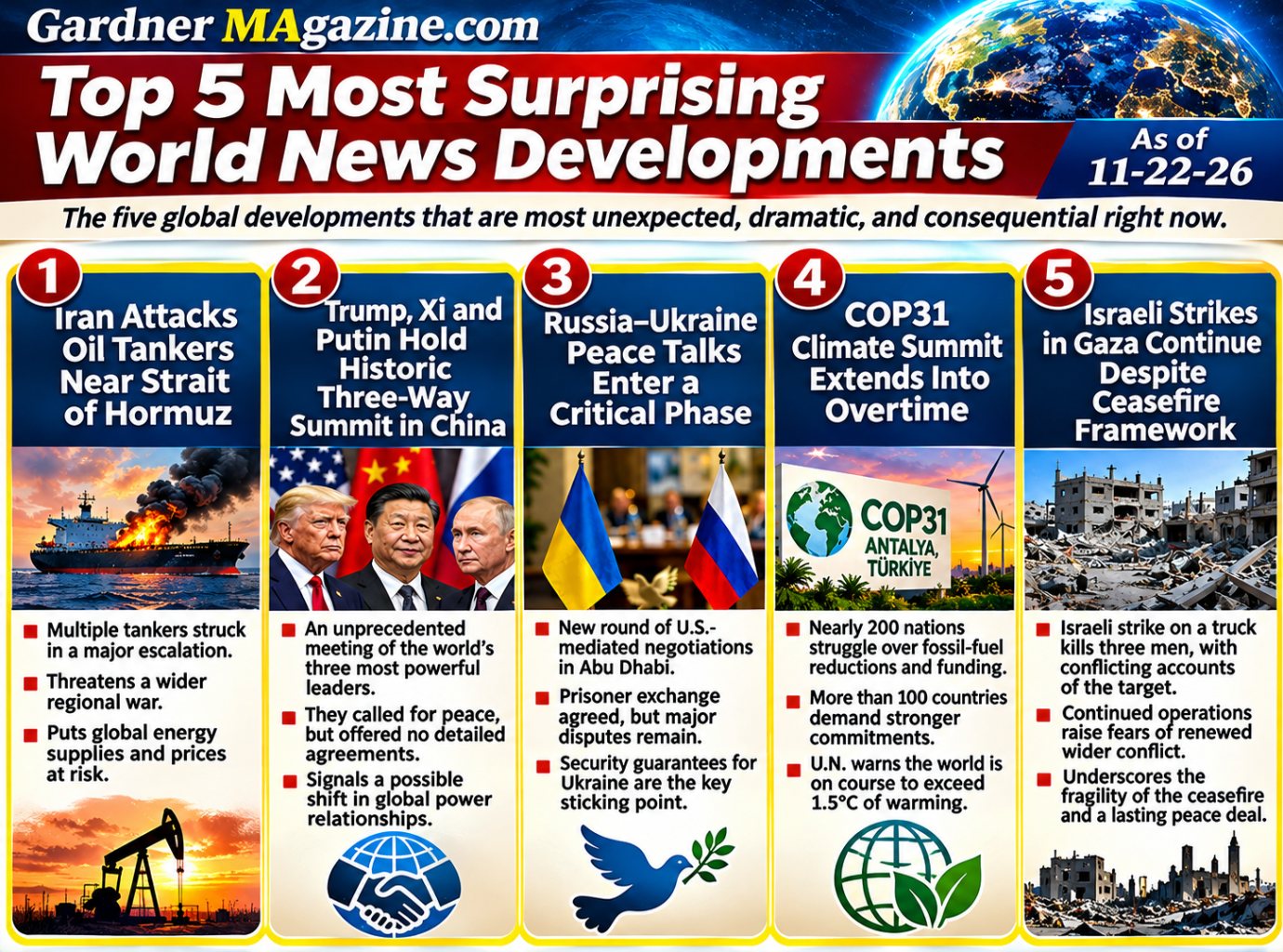
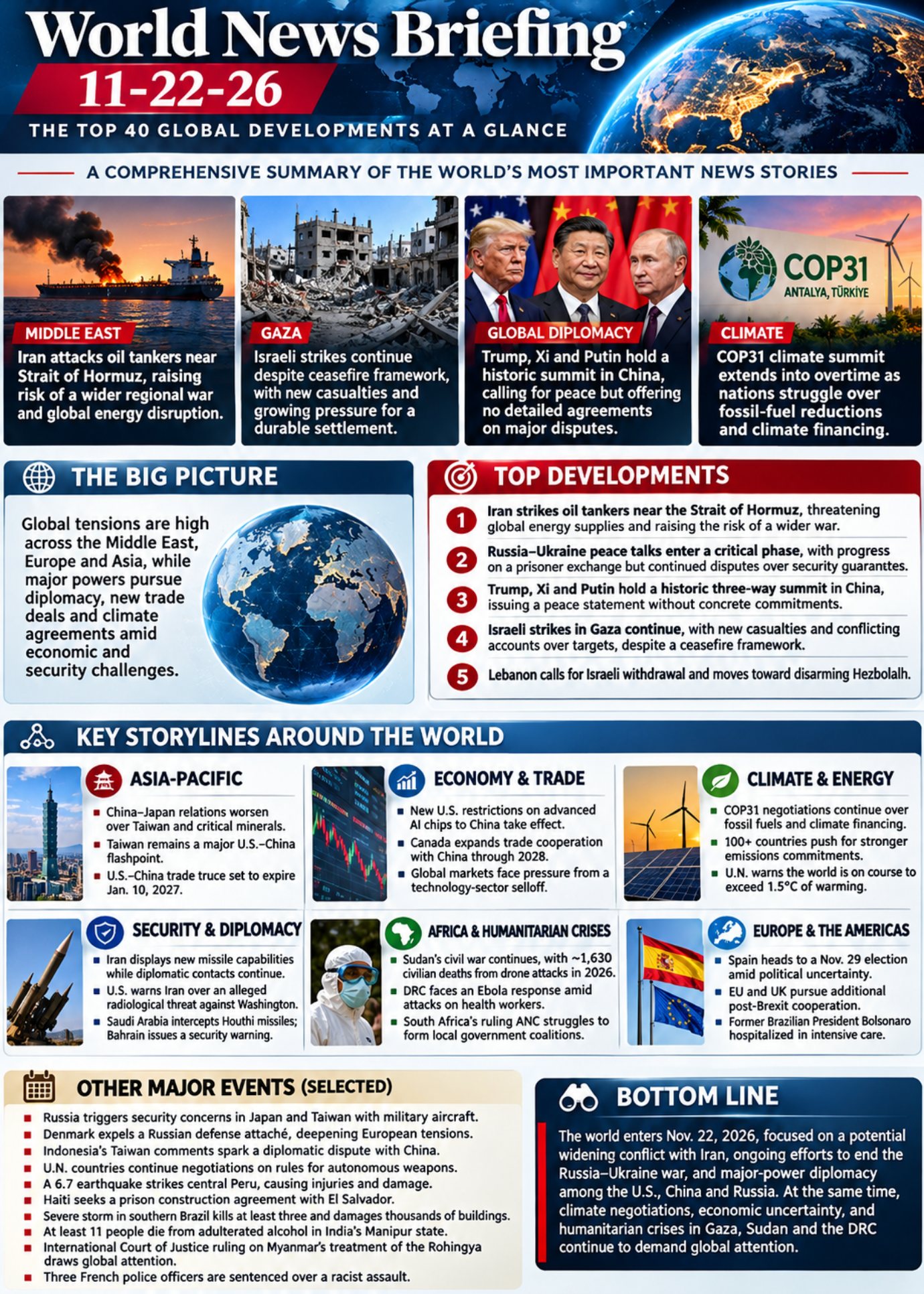
The international news picture heading on Sunday, November 22, 2026, is dominated by three developments: the widening security crisis around Iran and the Strait of Hormuz, renewed attempts to negotiate an end to the Russia-Ukraine war, and the extraordinary diplomatic gathering of American, Chinese and Russian leaders.
At the same time, COP31 negotiators are struggling to reconcile competing demands over fossil fuels and climate financing. Economic concerns are mounting as technology-sector market volatility, energy insecurity and trade restrictions create additional uncertainty.
Beyond these major geopolitical developments, humanitarian emergencies in Sudan, Gaza and the Democratic Republic of Congo continue to demand international attention. Political transitions, severe weather and public-health emergencies are also shaping events across Africa, Europe, Asia and Latin America.
Here are 40 World News stories dominating our planet on November 22, 2026:
1. Iran Strikes Oil Tankers Near Strait of Hormuz as Regional War Threatens Global Energy Supplies
Iranian military activity around the Strait of Hormuz intensified Saturday, November 21, with at least three oil tankers struck or damaged. British maritime security authorities reported projectile strikes, while Iranian state media described a separate incident involving a naval mine. Iran also displayed an underground missile-launching system and asserted that its forces were conducting increasingly aggressive operations to restrict shipping.The developments threaten one of the world’s most important petroleum transportation routes. Continued attacks could increase oil prices, shipping insurance costs and international inflation.
2. Russia-Ukraine Peace Negotiations Enter Critical Phase Amid Disputes Over Security Guarantees
U.S.-mediated negotiations involving Russia and Ukraine resumed in Abu Dhabi during November, producing an agreement on a prisoner exchange but no comprehensive peace settlement. Russia has resisted proposals for NATO-style security guarantees for Ukraine. Ukrainian President Volodymyr Zelenskyy continues pressing for meaningful protections against future Russian attacks. European governments are seeking greater participation in negotiations, while Moscow has objected to the involvement of certain European officials. The central questions remain territorial control, military security and enforcement of any eventual agreement.
3. Trump, Xi and Putin Hold Historic Three-Way Summit in China
Presidents Donald Trump, Xi Jinping and Vladimir Putin met during the Asia-Pacific Economic Cooperation summit in Shenzhen, China, in an extraordinary diplomatic gathering involving the leaders of the world’s three largest nuclear powers. The leaders issued a broad declaration emphasizing peace, but analysts noted the absence of detailed commitments resolving major international disputes.The meeting highlighted China’s growing diplomatic influence and raised questions about how Washington, Beijing and Moscow might reshape international relationships.
4. Israeli Strikes in Gaza Continue Despite Ceasefire Framework
Israeli military operations in Gaza remain a major international concern. On November 21, an Israeli strike on a truck in Gaza City killed three men, according to hospital officials. Israel maintained that the vehicle was transporting Islamic Jihad militants and supplies associated with attacks. Palestinian medical authorities reported civilian deaths and continued casualties since the October 2025 ceasefire. The conflicting accounts underscore the continuing difficulty of stabilizing Gaza, protecting civilians and establishing a durable political settlement.
5. Lebanon Faces Continued Israeli Military Pressure and Hezbollah Disarmament Dispute
Lebanese President Joseph Aoun called for Israeli withdrawal from Lebanese territory while supporting efforts to end the possession of weapons outside government control. The remarks address the central controversy surrounding Hezbollah’s military capabilities and Lebanon’s sovereignty. Lebanon’s government is attempting to balance security, diplomacy and domestic political stability while avoiding a broader escalation with Israel.
6. Iran Displays New Missile Capabilities While Diplomatic Contacts Continue
Iranian state television showcased an underground launcher reportedly capable of firing two liquid-fueled missiles. At the same time, Tehran indicated that it was discussing with Qatari mediators whether negotiations could resume.The combination of military demonstrations and diplomatic outreach illustrates the competing pressures shaping the confrontation between Iran, Israel and the United States.
7. Trump Warns Iran Over Alleged Radiological Threat Against Washington
President Trump warned Iran against any involvement in a reported plot involving a radiological or so-called dirty bomb targeting Washington. The allegation was not independently established in the reporting reviewed, and it should not be treated as a confirmed Iranian operation. Nevertheless, the president’s warning illustrates the severity of tensions between Washington and Tehran. Anadolu Agency
8. Saudi Arabia Reports Interception of Houthi Missiles
A Saudi-led coalition reported intercepting three Houthi missiles over Riyadh on November 21. The reported attack highlights the continuing danger of missile and drone warfare across the Arabian Peninsula and the potential for regional conflicts to expand beyond their immediate battlefields. The incident also raises renewed concerns about civilian aviation, critical infrastructure and energy security.
9. Russian Military Aircraft Trigger Security Concerns in Japan and Taiwan
Japan reported that suspected Russian military aircraft violated its airspace near Okinoshima, prompting fighter-jet responses and a diplomatic protest. Taiwan separately monitored Russian military aircraft operating near its eastern coast. The incidents occurred shortly before President Putin’s visit to China and highlighted increasingly close Russian-Chinese security relationships.
10. Denmark Expels Russian Defense Attaché Amid European Security Tensions
Denmark moved to expel a Russian defense attaché and restrict nonessential visas for Russian citizens. The measures represent another deterioration in relations between Russia and European governments already concerned about military threats, intelligence activities and the continuing war in Ukraine. The diplomatic dispute reflects broader security concerns across NATO countries.
Asia-Pacific and Global Power Relationships
11. China-Japan Relations Deteriorate Over Taiwan and Critical Minerals
Japanese Prime Minister Sanae Takaichi received a noticeably restrained diplomatic reception during the APEC summit in China. Relations have deteriorated following her earlier comments concerning Japan’s possible military response to a conflict involving Taiwan. China has also restricted exports of critical minerals important to Japanese automobile, electronics and aerospace industries. The dispute could disrupt supply chains throughout Asia.
12. Taiwan Remains Central Flashpoint in U.S.-China Relations
President Xi reiterated that American policy toward Taiwan is fundamental to maintaining stable relations with Beijing. China claims sovereignty over democratically governed Taiwan, while Taiwan rejects Beijing’s claim. The issue remains one of the most consequential potential sources of conflict between major powers, particularly because of Taiwan’s importance to semiconductor manufacturing and international shipping.
13. U.S.-China Trade Truce Faces January Expiration
The current trade arrangement between Washington and Beijing is scheduled to expire January 10, 2027. Although China is progressing toward its soybean-purchasing commitments, other agricultural purchases and rare-earth exports have fallen short of American expectations. The two countries are expected to revisit trade questions at the December G20 summit. Renewed tariff escalation could affect manufacturers, farmers and consumers worldwide.
14. Washington Tightens Restrictions on Advanced Artificial Intelligence Chips Entering China
New American restrictions on China’s access to advanced AI semiconductors took effect during the week of November 16. The Trump administration is also considering additional disclosure requirements concerning American companies’ use of Chinese artificial intelligence models. Beijing has threatened retaliation. The dispute underscores how semiconductor technology has become a central issue in national security and international economic competition.
15. Canada Expands Trade Cooperation With China to Reduce Economic Dependence
Canadian Prime Minister Mark Carney negotiated an extension of tariff arrangements with China through 2028. The agreement provides additional Chinese tariff relief for Canadian products, including pork and prawns, while Canada eases certain restrictions on Chinese steel and aluminum. The arrangement illustrates Canada’s effort to diversify international economic relationships amid uncertainty over American trade policy.
16. Japan Strengthens Partnerships With Southeast Asia and South Korea
Japan is pursuing stronger supply-chain, energy and critical-mineral partnerships with Southeast Asian countries and South Korea. The strategy is designed to reduce dependence on Chinese materials while maintaining Japan’s traditional security relationship with the United States. These developments could influence the future production of electric vehicles, electronics, batteries and defense equipment.
17. Russian and Chinese Leaders Criticize Western Sanctions and Protectionism
Xi Jinping and Vladimir Putin used the APEC gathering to criticize Western economic restrictions and promote their positions on international trade. Their statements emphasized growing coordination between Beijing and Moscow on questions of economic policy and international influence. The development comes as many countries attempt to avoid becoming overly dependent on either Western or Chinese-dominated supply chains.
18. Indonesia’s Position on Taiwan Sparks Diplomatic Disagreement
Taiwan’s foreign ministry challenged China’s interpretation of comments attributed to Indonesian President Prabowo Subianto. Taiwanese officials said Indonesian government statements did not mention Taiwan in the manner suggested by Beijing. The disagreement illustrates China’s efforts to reinforce its diplomatic position on Taiwan throughout Southeast Asia.
Climate, Energy and the Global Economy
19. COP31 Climate Summit Extends Into Overtime as Nations Struggle to Reach Agreement
Nearly 200 national delegations continued negotiations in Antalya, Turkey, after the scheduled conclusion of the United Nations climate summit. The principal disagreements involve fossil-fuel reductions and financial assistance for developing countries confronting rising temperatures, flooding, drought and other climate-related damage. A revised agreement was being prepared Saturday evening, but final approval had not been established at the reporting cutoff.
20. More Than 100 Countries Press for Stronger Fossil-Fuel Commitments
A coalition led by European governments and climate-vulnerable nations pushed to restore language calling for a transition away from fossil fuels. Saudi Arabia and other major fossil-fuel producers resisted stronger commitments and favored greater recognition of carbon-capture technology. The dispute illustrates the continuing divide between countries seeking rapid emissions reductions and those whose economies depend heavily on petroleum and natural gas.
21. Developing Nations Demand More Climate Adaptation Funding
Developing countries called for stronger financial commitments from wealthy nations to help protect communities against worsening climate conditions. A previous COP31 negotiating draft eliminated a proposed $120 billion adaptation-finance target. Small island nations and poorer African countries argue that they face disproportionate climate risks despite contributing relatively little to historical greenhouse gas emissions.
22. United Nations Warns World Is on Course to Exceed 1.5-Degree Warming Threshold
United Nations findings indicate that global warming is on course to exceed the 1.5°C threshold established as an important goal under the Paris Agreement. Scientists warn that higher temperatures increase the likelihood and severity of extreme weather, coastal flooding, ecosystem damage and agricultural disruption. The warning has become a central argument for governments seeking stronger commitments at COP31.
23. Global Stock Markets Face Pressure From Technology-Sector Selloff
Technology shares have experienced substantial selling pressure, contributing to broader weakness in American stock indexes and concerns about international financial markets. Investors are reassessing the valuations of companies associated with artificial intelligence and other high-growth technologies. Because American financial markets influence investment flows worldwide, a sustained decline could affect retirement portfolios, international capital markets and business investment.
24. Global Oil Markets Remain Vulnerable to Middle East Conflict
Military attacks around the Strait of Hormuz continue to threaten energy transportation. The waterway is essential to petroleum shipments from major Gulf producers. Even limited disruptions can affect tanker availability, shipping insurance and global energy prices. The economic consequences could extend well beyond the Middle East, affecting transportation, manufacturing and household energy expenses.
25. Clean-Energy Transition Accelerates in Some Countries Despite Political Disputes
Higher fossil-fuel costs and improving renewable-energy economics are encouraging greater investment in electrification and clean technologies. China remains particularly well positioned in international clean-energy manufacturing, while American policy restrictions and tariffs create additional challenges for U.S. renewable-energy businesses. The developments highlight the increasingly close relationship between climate policy, energy security and international industrial competition.
Africa, Humanitarian Crises and International Law
26. Sudan’s Civil War Continues With Major Civilian Casualties From Drone Attacks
Sudan’s conflict between the national military and the Rapid Support Forces continues to produce widespread civilian suffering. Reporting based on United Nations human rights documentation indicates that approximately 1,630 civilian deaths during January through October 2026 were attributed to drone strikes. Fighting in Kordofan and disputed territorial claims in Blue Nile underscore the continuing instability. Humanitarian access and protection of civilians remain major international concerns.
27. United Nations Countries Agree to Continue Negotiations on Autonomous Weapons
Governments participating in the Convention on Certain Conventional Weapons agreed to continue developing rules for lethal autonomous weapons, with a target of 2028. Such systems can identify and engage targets with limited human involvement. Approximately 100 countries favor legally binding restrictions, but major military powers have resisted those proposals. The latest agreement leaves unresolved whether the eventual rules will be enforceable international law.
28. South Africa’s Ruling ANC Struggles to Form Local Government Coalitions
South Africa’s African National Congress is attempting to negotiate power-sharing arrangements following a historically poor local election performance. The results reflect growing dissatisfaction with the country’s longstanding governing party. Coalition negotiations could affect municipal administration, public services, infrastructure investment and South Africa’s broader political direction.
29. South Africa Mourns Former Deputy President and UN Women’s Leader
Phumzile Mlambo-Ngcuka, South Africa’s first female deputy president and a former executive director of UN Women, died at age 71. She served as deputy president from 2005 to 2008 and led UN Women from 2013 to 2021.Her career was closely associated with the anti-apartheid movement, women’s rights and international gender equality efforts.
30. Democratic Republic of Congo Faces Ebola Response and Security Challenges
Healthcare workers responding to Ebola in the Democratic Republic of Congo face security threats, including violence reportedly fueled by misinformation. Attacks against medical personnel can interfere with testing, treatment, vaccination and public-health surveillance. The situation demonstrates how armed insecurity and distrust can undermine efforts to contain infectious diseases.
Europe and the Americas
31. Spain Confronts Political Uncertainty Ahead of November 29 Election
Spain is approaching an early national election scheduled for November 29, with Prime Minister Pedro Sánchez and opposition parties competing amid political controversies. The outcome could influence Spain’s economic direction, European Union policy and relations with other European governments. The election is particularly significant as several European countries experience increased political fragmentation. The Rio Times
32. European Union and United Kingdom Pursue Additional Post-Brexit Cooperation
Britain and the European Union have pursued new agreements intended to strengthen cooperation following Brexit.
The developments are part of a broader effort to improve working relationships on trade, security and other shared priorities.
The arrangements are important because the United Kingdom and European Union remain deeply connected economically and strategically.
33. Former Brazilian President Jair Bolsonaro Hospitalized in Intensive Care
Former Brazilian President Jair Bolsonaro was admitted to intensive care in Brasília on November 21 after developing an acute abdominal obstruction. Bolsonaro has been serving a 27-year sentence following his conviction for involvement in a plot to overturn the results of Brazil’s 2022 presidential election. His hospitalization has renewed attention to his medical condition and the continuing political divisions surrounding his prosecution.
34. Powerful Earthquake Strikes Central Peru
A magnitude 6.7 earthquake struck central Peru’s Andean region near Junín. Initial reports indicated no major casualties, although subsequent local reporting described injuries, damaged homes and infrastructure problems. Authorities continued assessing conditions in affected communities, including remote areas where damage may take longer to document.
35. Haiti Seeks Prison Construction Agreement With El Salvador Amid Security Crisis
Haiti reached an agreement with El Salvador concerning the construction of additional prisons. The initiative comes amid continuing gang violence, weakened government institutions and major security challenges. Prison capacity is only one part of Haiti’s broader crisis, which also involves displaced populations, political instability and international efforts to restore public security.
36. Severe Storm Kills at Least Three in Southern Brazil
A powerful storm struck Tupanciretã in Brazil’s Rio Grande do Sul state, killing at least three people and damaging thousands of buildings. Brazilian meteorological authorities reported wind gusts reaching approximately 114 kilometers per hour, or 71 miles per hour. Emergency crews were assessing damage and responding to residents affected by the destructive weather.
37. Adulterated Alcohol Kills at Least 11 People in India’s Manipur State
Authorities in northeastern India reported that at least 11 people died and more than 180 were hospitalized after consuming contaminated locally produced alcohol. Manipur’s chief minister ordered an investigation and directed hospitals to provide appropriate treatment. The incident highlights the public-health risks associated with unregulated alcohol production and distribution. Reuters
38. Bahrain Issues Security Warning Amid Continuing Iranian Attacks
Bahrain’s Interior Ministry warned residents on November 21 about a potential security threat and urged them to seek safety. The country, which hosts the U.S. Navy’s Fifth Fleet, reported intercepting several Iranian aerial attacks during the preceding week. Bahrain’s strategic position makes its security especially important to American naval operations and international shipping in the Persian Gulf. Reuters
39. International Court of Justice Ruling on Myanmar’s Treatment of Rohingya Draws Global Attention
Reporting from November 19 described a major International Court of Justice ruling finding that Myanmar committed genocide against the Rohingya. The development carries potential consequences for international accountability, the protection of ethnic minorities and the treatment of displaced Rohingya refugees. The ruling is particularly important because international legal findings can influence future diplomatic pressure and accountability efforts, even when enforcement remains difficult. One Turn
40. French Police Officers Sentenced Over Racist Assault
Three French police officers were sentenced in connection with a racist assault, according to international reporting from November 21.The case renewed attention to discrimination, police accountability and public confidence in law enforcement. Although primarily a French domestic matter, the proceedings contribute to wider European debates about policing standards, civil rights and institutional accountability.