
What’s Up Warwick – News of Warwick MA
Listen to What’s Up Warwick on any device, CLICK PLAY.
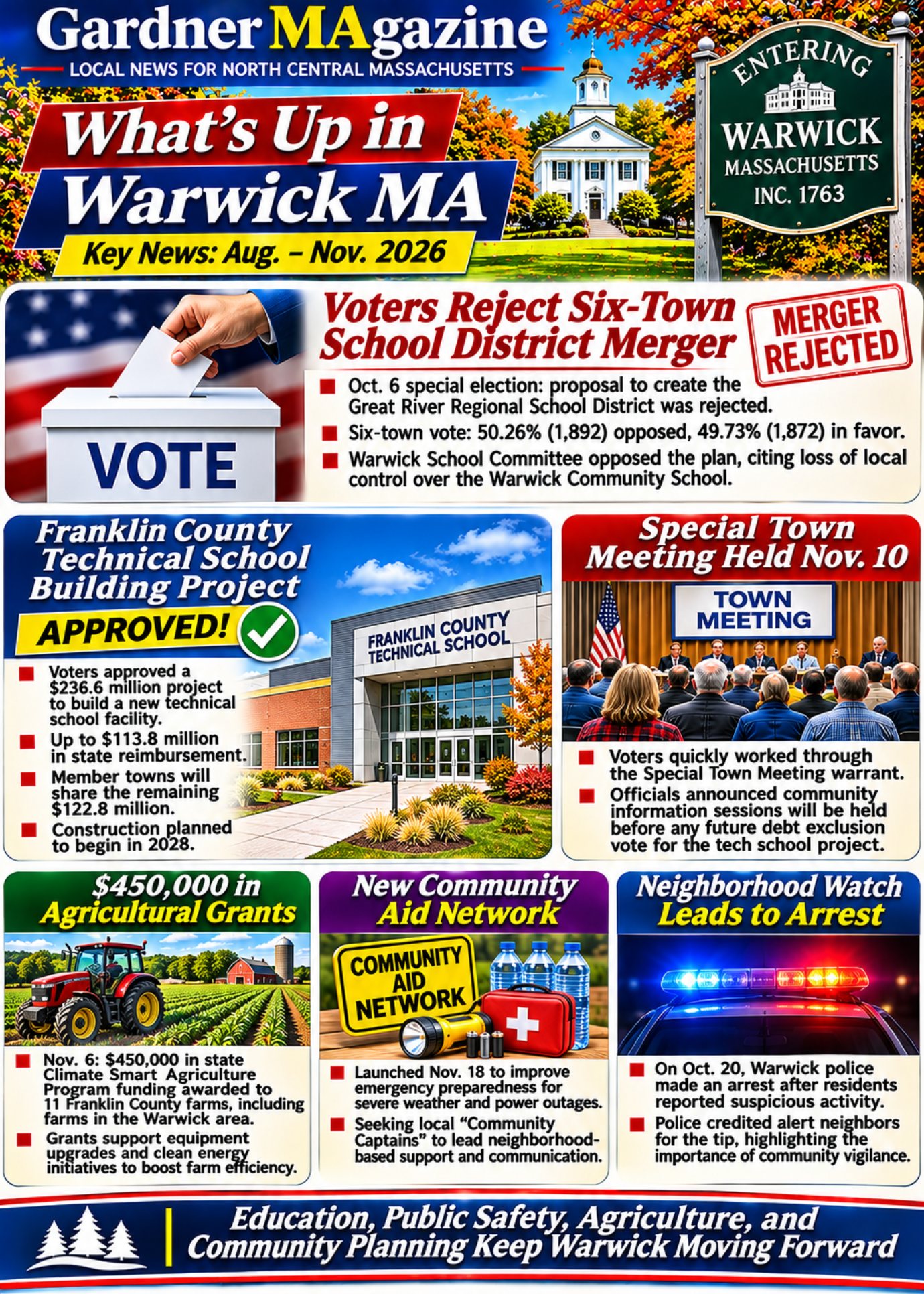
Voters Reject Six-Town School Merger, $236.6 Million Technical School Project Advances, Agricultural Grants Support Local Farms, and Neighborhood Watch Helps Police
From a closely contested regional school district merger to a major investment in vocational education, agricultural grants, and an example of neighborhood cooperation with police, Warwick, Massachusetts, has experienced an eventful autumn.
Between late August and November 2026, residents of this small Franklin County community have participated in decisions that could influence local education, municipal finances, and the future of regional cooperation for years to come.
The most significant developments have involved two major school-related votes, including the rejection of a proposed six-town school district merger and approval of a $236.6 million Franklin County Technical School construction project.
Here is a look at what’s been happening in Warwick.
Voters Reject Proposed Six-Town Great River Regional School District
One of the biggest regional education stories of the fall unfolded on October 6, when voters in Warwick and five neighboring communities considered a proposal to create the Great River Regional School District. The proposal would have combined the Pioneer Valley and Gill-Montague regional school districts into a new educational organization involving six communities: Warwick, Bernardston, Gill, Leyden, Montague, and Northfield. Supporters argued that combining the districts could provide opportunities for administrative efficiencies, improved educational coordination, and a more sustainable regional school structure. Opponents raised concerns about local control, governance arrangements, and the possible consequences for individual communities. When the votes were counted, the proposal failed by an exceptionally narrow margin.
Across the participating communities, 1,892 voters opposed the merger, while 1,872 supported it. That represented approximately 50.26% opposed and 49.73% in favor, a difference of just 20 votes. The result demonstrated how closely divided residents were over the proposed restructuring. Although the proposal contained provisions that could have allowed a five-town district to proceed if Warwick alone rejected participation, opposition across the broader region prevented the merger from moving forward. The outcome leaves the participating school districts to consider other approaches to regional educational cooperation and long-term financial sustainability.
Warwick School Committee Raises Concerns About Local Control
Warwick’s position in the merger debate was particularly significant because of the community’s independent elementary school. Before the October election, members of the Warwick School Committee publicly opposed the proposed Great River Regional School District. Their concerns centered on the possibility that Warwick would lose local control over the Warwick Community School. For a small rural town, the local elementary school represents more than an educational facility. It is also an important community institution. School Committee members argued that Warwick should preserve its independent elementary education structure while exploring alternative arrangements for secondary education. One possibility discussed was a regional agreement focused on middle and high school grades rather than a complete merger involving elementary schools. The debate illustrated the challenges facing small Massachusetts communities as they attempt to balance educational opportunities, financial pressures, and local decision-making authority. Although the merger was rejected, questions about future regional school arrangements remain.
Voters Approve $236.6 Million Franklin County Technical School Project
While voters rejected the proposed Great River merger, another major education proposal received approval during the October 6 election. Voters in the Franklin County Technical School District approved a $236.6 million project to construct a new school building. The project represents one of the most substantial educational infrastructure investments proposed in the region. According to the project figures provided, up to $113.8 million is expected to come from state reimbursement funding. The remaining approximately $122.8 million would be the responsibility of participating member communities through the district’s financing arrangements. Construction is currently anticipated to begin in 2028. The proposed facility is intended to support vocational and technical education for students throughout the district. Technical schools provide students with opportunities to develop career skills in fields such as construction, manufacturing, automotive technology, healthcare, and other skilled trades. Modern facilities can be particularly important for technical education because programs often require specialized equipment, workshops, laboratories, and instructional spaces. For Warwick residents, the approval raises important questions about the town’s eventual share of project costs and how those expenses will affect local finances.
November Special Town Meeting Addresses Municipal Business
Warwick residents gathered for a Special Town Meeting on November 10. According to reporting by the Greenfield Recorder, voters worked through the meeting warrant relatively quickly. The meeting also provided an opportunity for local officials to discuss upcoming financial considerations associated with the Franklin County Technical School construction project. Officials indicated that community information sessions would be held before any future debt exclusion vote concerning the project. Debt exclusions allow Massachusetts municipalities to raise additional property tax revenue outside the normal Proposition 2½ levy limit for specified debt-service obligations, subject to voter approval. Such votes can have important implications for property owners because they determine whether additional taxes may be raised to pay for qualifying capital expenditures. The planned information sessions would give Warwick residents an opportunity to learn more about the project’s costs, financing structure, and potential local tax consequences. Approval of the districtwide building project does not, by itself, establish the outcome of any future Warwick debt exclusion vote.
State Agricultural Grants Support Clean Energy Improvements
Agriculture also received attention during November as Massachusetts announced new funding intended to help farms improve energy efficiency and adopt climate-related technologies. On November 6, the Massachusetts Department of Agricultural Resources announced approximately $450,000 in Climate Smart Agriculture Program funding for 11 farms in Franklin County. The program supports projects intended to improve agricultural efficiency, reduce energy consumption, and help farms adapt to changing environmental conditions. Eligible improvements may include energy-efficient equipment, clean energy systems, and other approved agricultural infrastructure investments. For rural communities such as Warwick, farming remains an important part of the local economy and landscape. Agricultural grant programs can help farms manage operating expenses while investing in equipment and practices that support long-term productivity. The supplied information does not identify which individual farms received awards or confirm the amount awarded specifically within Warwick. Nevertheless, the regional funding announcement represents an important investment in Franklin County agriculture.
Alert Neighbors Help Warwick Police Make Arrest
An example of community involvement in public safety occurred during October. According to an October 20 report, Warwick police made an arrest after residents reported suspicious activity in their neighborhood. Local law enforcement credited the information provided by alert neighbors with helping officers respond and intervene. The incident highlighted the importance of residents communicating concerns to police rather than attempting to investigate potentially dangerous situations themselves. In small communities, cooperation between residents and public safety personnel can be especially valuable. Warwick’s experience illustrates how timely reporting of unusual activity may help law enforcement identify and respond to potential problems. The supplied summary does not identify the individual arrested, the charges involved, or the eventual disposition of the case.
Looking Ahead: Education and Municipal Finances Remain Major Issues
As Warwick approaches the end of 2026, education and municipal finances are likely to remain among the community’s most important concerns. The rejection of the Great River Regional School District proposal leaves unanswered questions about how neighboring communities will address future educational cooperation. Warwick officials and residents will continue considering how to preserve local control over the Warwick Community School while providing appropriate secondary education opportunities. Meanwhile, the approved Franklin County Technical School construction project represents a major long-term investment that will require additional financial planning. Residents will have opportunities to learn more about the project before any future local debt exclusion vote. Agricultural grants and community public safety efforts provide additional examples of the regional partnerships and local involvement that help sustain rural communities. The events of the past three months demonstrate that even a small town such as Warwick can play an important role in decisions affecting education, public investment, agriculture, and community safety throughout Franklin County.