
MidTerms 2026 – Gardner Magazine Reports – Electoral Risk Assessment
Gardner Magazine has a complete reports page with all of the narrative content in our 52 page ebook. Data has been derived from the latest polls and shows the probability of each party having control of the Senate and the House. We have a 17 minute DEBATE, a 4 minute video, a number of reports, and fully illustrated informative infographics. CLICK for the Complete page, CLICK HERE.
Jump to section: Data-Driven Midterm Shakeup – 4 Surprising Takeaways —– Demystifying U.S. Midterm Elections: A Learner’s Guide to Congress, Polling, and Probabilities —–Electoral Risk Assessment: Midterm Congressional Balance of Power & Strategic Projections —–Demystifying Political Forecasting: How Pollsters Measure Elections and Predict Majorities —– Executive Memorandum: Midterm Electoral Landscape and Legislative Power Dynamics —–Various Analysis Infographics
Listen to this DEBATE about the MidTerms on any device, CLICK PLAY.
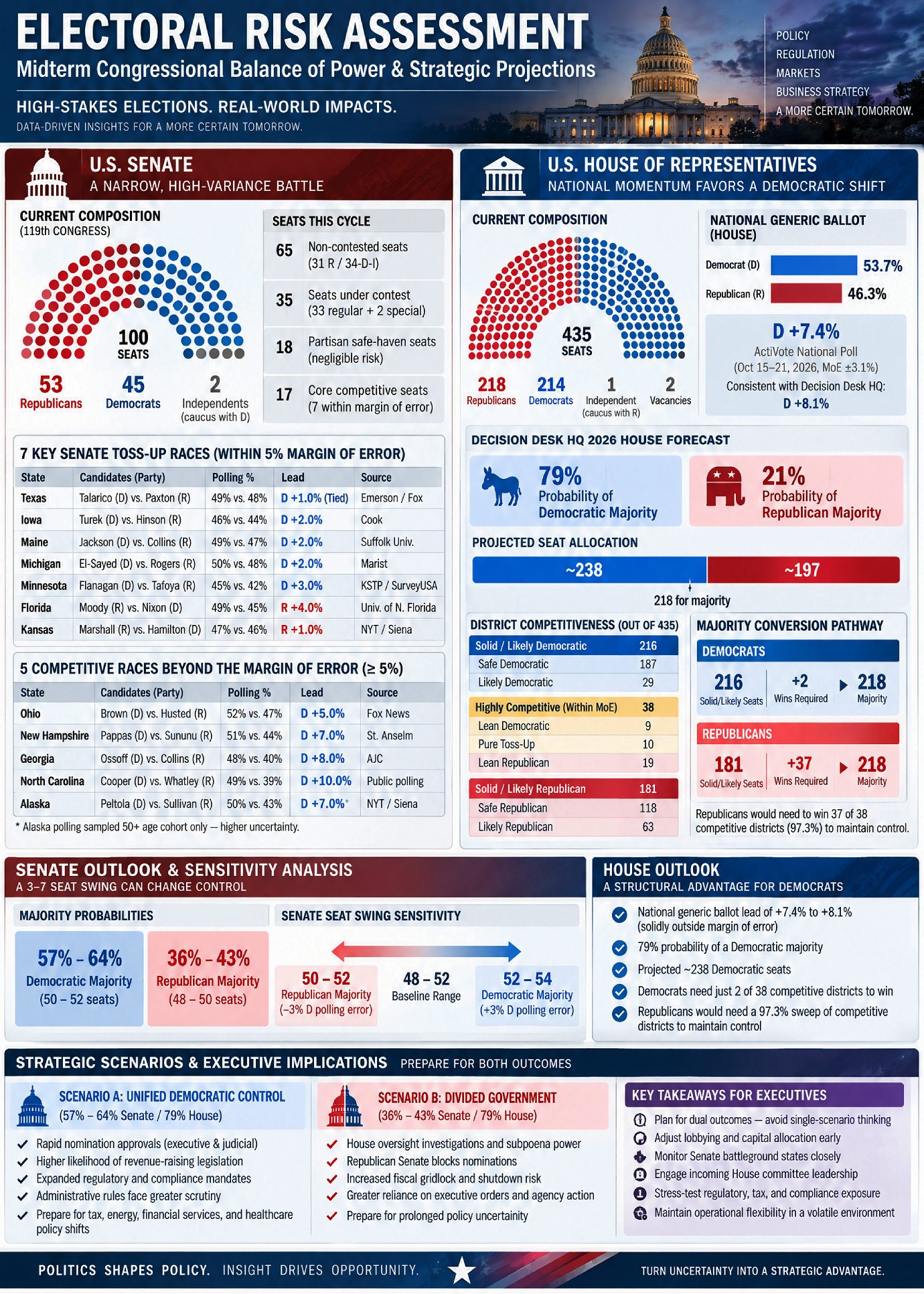
Statistical modeling and recent public opinion polling indicate a shifting landscape in the upcoming United States mid-term elections for both the U.S. Senate and the U.S. House of Representatives.
- U.S. Senate Control: Democrats hold a slight statistical edge to capture or retain the majority, projected at a 57% to 64% probability (translating to 50–52 seats). Republicans hold a 36% to 43% probability of securing the majority (48–50 seats). However, with 7 high-profile races currently polling within the 5-point margin of error (including Texas, Iowa, Maine, Michigan, Minnesota, Florida, and Kansas), a minor systemic polling error could alter the balance by 3 to 7 seats.
- U.S. House Control: Democrats are positioned as strong favorites to seize control of the House of Representatives, holding a 79% probability of winning a majority (~238 seats) compared to Republicans’ 21% probability (~197 seats). This projection is driven by a lead outside the statistical margin of error on the national generic ballot (Democrats leading by +7.4% to +8.1%).
- Key Electoral Dynamics: Out of 435 House seats, only 38 are classified as highly competitive (within the margin of error), while 18 of the 35 contested Senate seats reside in deeply partisan states with negligible risk of flipping. For much more detail on the topic and our 52 page ebook on the Midterms, CLICK HERE for the complete page.