For more news check out the individual news briefings for: North Central MA News — State News of the Week —- National News of the Week — World News of the Week
Publisher’s spotlight: This week’s WGAW Hotline Radio Show features both episodes of a lengthy podcast on the murder of Brianne Pennington and features an interview with renowned reporter Steve Landry of the Gardner News. Here’s the article and link to the show.
Weekly Briefing – Gardner Magazine Reports – for the Week of October 25, 2026
This week there was so much news the Weekly Briefing went over an hour again. Listen on any device, CLICK PLAY.
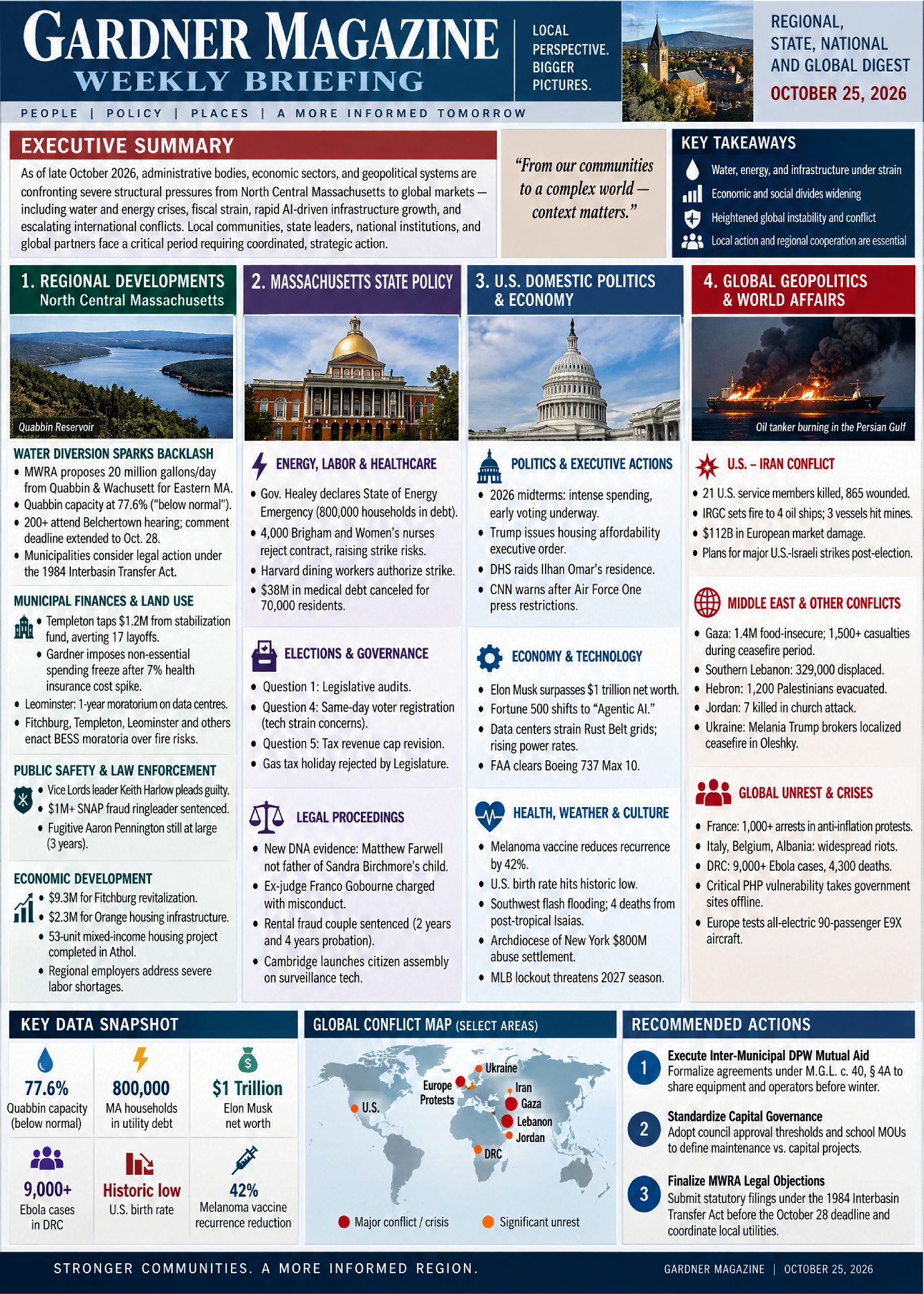
Gardner Magazine Weekly Briefing: Regional, State, National, and Global Digest (October 25, 2026)
North Central Massachusetts & North Quabbin Regional Developments
Regional Environmental & Water Policy Battles
Environmental stewardship in Central Massachusetts has reached a critical juncture defined by an intensifying structural tension between state-mandated growth strategies in Eastern Massachusetts and localized natural resource depletion across donor basins. For decades, the watershed communities of northern Worcester County and the North Quabbin region have served as the primary ecological reservoir for the Commonwealth’s urban east. However, as localized drought conditions worsen and regional storage levels drop, municipal leaders and residents are confronting state policies that prioritize metropolitan real-estate expansion at the direct expense of local environmental stability and municipal sovereignty.
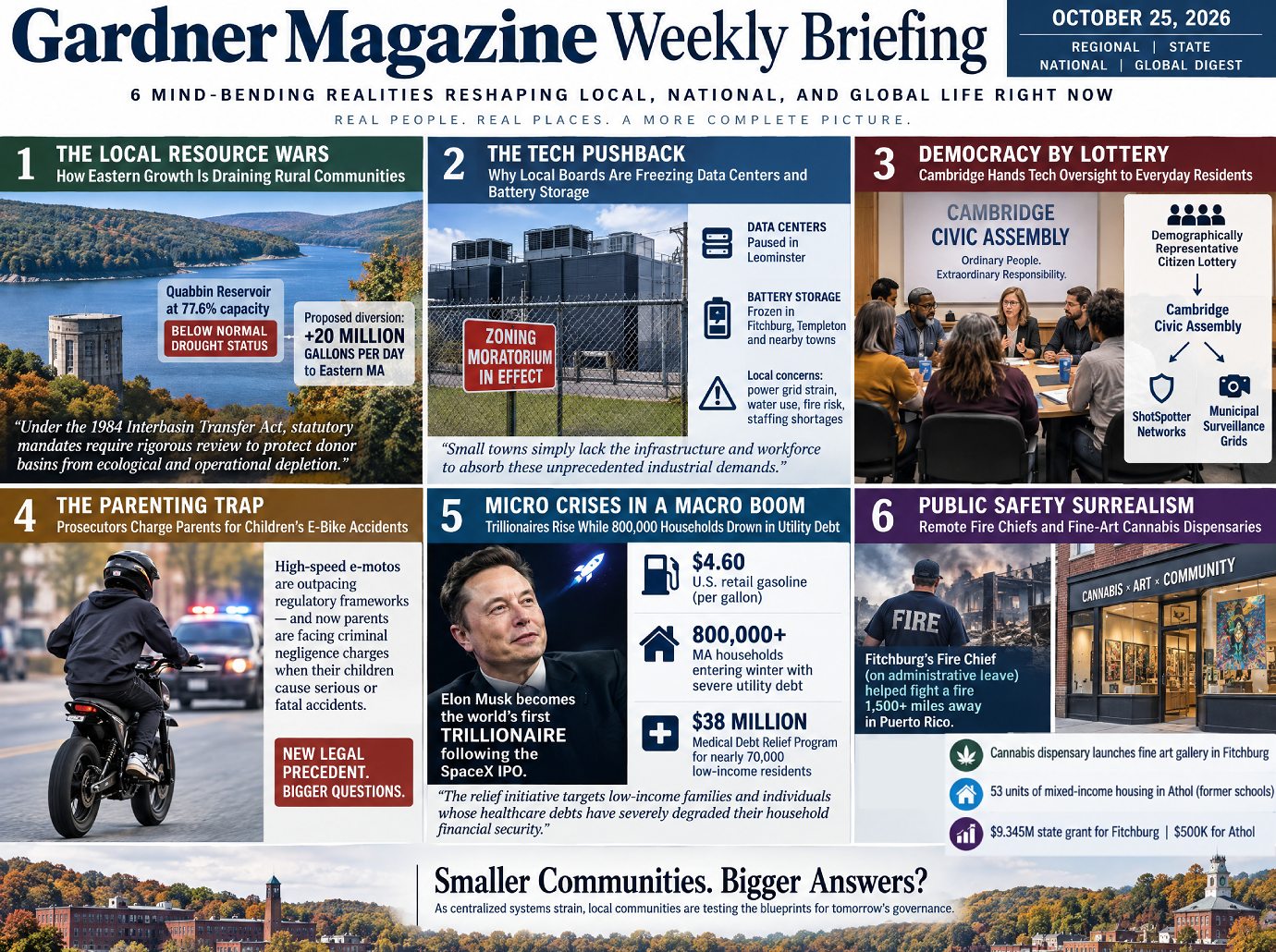
The primary regional flashpoint centers on a proposal by the Massachusetts Water Resources Authority (MWRA) to extract an additional 20 million gallons of water per day (MGD) from the Quabbin and Wachusett Reservoirs. This diverted volume is intended to support ongoing commercial and residential real-estate development across expanding eastern municipalities. The plan has ignited fierce, unified resistance across Athol, Orange, New Salem, Belchertown, and Greater Gardner. Public opposition culminated in a marathon four-hour public hearing in Belchertown, which drew over 200 municipal officials, conservationists, and residents. In response to intense regional pressure, state regulatory authorities extended the public review deadline to October 28, 2026. Regional legislators and municipal councils are actively evaluating statutory legal challenges under the 1984 Interbasin Transfer Act, arguing that the MWRA proposal circumvents statutory protections explicitly designed to protect donor basins from ecological depletion. Frustration is further compounded by state policies that waive the standard $5 million entrance fee for new eastern municipal members, even as payments in lieu of taxes (PILOT) granted to local watershed towns remain persistently low.
Executive Callout: Quabbin Diversion Controversy & Local Impact
- Proposed MWRA Diversion: Extract an additional 20 MGD from Quabbin and Wachusett Reservoirs for Eastern MA growth.
- Financial Friction: Standard $5M entrance fees waived for eastern towns while donor basin PILOT rates remain static.
- Local Hydrological Status: Quabbin capacity down to 77.6% (“below normal” drought index); mandatory local water restrictions enforced.
- Statutory Pushback: Interbasin Transfer Act legal challenges mobilized prior to the extended October 28, 2026 review deadline.
This export strategy directly conflicts with deteriorating localized hydrological metrics. The Quabbin Reservoir’s storage capacity has dropped to 77.6%, placing it in “below normal” status under official drought indices. While state planners evaluate large-scale water transfers, municipalities across northern Worcester County continue enforcing mandatory outdoor water-use restrictions on their own property owners—though Athol temporarily eased certain limits following autumn rainfall. Public recreational access has also shifted under seasonal and environmental schedules: the official 2026 Quabbin Reservoir boating season closed on October 17, 2026, though shoreline fishing remains open through December 31, subject to ice conditions.
At the municipal level, water departments and ecological groups are executing necessary utility shifts and conservation measures. The Gardner Water Department announced a scheduled transition for October 28, 2026, reverting to standard chloramine treatment after temporarily utilizing free chlorine sourced from Snake Pond. Concurrently, volunteer conservation groups completed fall biomonitoring and stream health assessments along Athol’s Mill Brook basin, while the Friends of Quabbin collaborated with the Department of Conservation and Recreation (DCR) to finish stone masonry stabilization on the historic Keystone Bridge within the watershed.
| MWRA Export Policy & Incentives | Local Hydrological Realities & Restrictions |
|---|---|
| Proposed Extraction: Divert +20 MGD from Quabbin/Wachusett for Eastern MA growth. | Reservoir Status: Quabbin storage dropped to 77.6% (“below normal” drought status). |
| Financial Incentives: State waives standard $5M entrance fee for new eastern towns. | Local Mandates: Mandatory outdoor water-use restrictions imposed on donor town residents. |
| Statutory Framework: Proposal relies on state-level interbasin allocation waivers. | Legal Response: Regional leaders preparing 1984 Interbasin Transfer Act challenges. |
| Local Fiscal Impact: Watershed towns operate under persistently low state PILOT payments. | Public Impact: 2026 boating season closed Oct 17; local public hearings draw massive protests. |
These escalating natural resource vulnerabilities directly mirror the severe operational and fiscal hurdles currently confronting local governing boards across the region.
Municipal Governance, Fiscal Controls, and Land-Use Moratoria
Small-town municipal governments across North Central Massachusetts are increasingly deploying defensive administrative instruments—ranging from emergency non-essential spending freezes to multi-year zoning moratoria—to protect public budgets and local infrastructure. Confronted by non-discretionary operational inflation, strict statutory tax caps under Proposition 2½, and rapid technological development, local boards are reasserting statutory authority to maintain basic fiscal solvency and municipal safety.
To guard against unsustainable demands on municipal utility networks and protect local emergency services, regional planning boards are executing temporary land-use freezes on high-density tech and energy facilities:
- Leominster Commercial Data Center Moratorium: City officials enacted a one-year municipal moratorium on commercial data center developments to protect the municipal power grid and local water tables from heavy industrial consumption.
- Battery Energy Storage Systems (BESS) Moratoria: Planning boards in Fitchburg, Templeton, and neighboring North Quabbin towns have drafted and enforced zoning moratoria on utility-scale BESS installations, establishing a regulatory pause to evaluate thermal runaway fire hazards, specialized fire suppression requirements, and grid stability factors.
Strategic Context: These localized planning pauses are not isolated NIMBYism; rather, they represent the leading edge of a national infrastructure boundary where small-town planning boards are forcing a pause on Big Tech’s unconstrained grid demands, directly foreshadowing national energy grid crises unfolding across the Rust Belt.
Executive Callout: Regional Municipal Fiscal Interventions
- City of Gardner: Executive non-essential spending freeze instituted by Mayor Nicholson to absorb a 7% Medics health insurance cost spike. Legislative advancement of Item 1184 (Tyros Ordinance / Chapter 676).
- Town of Templeton: Special Town Meeting approved Article 2, transferring $1.2M from General Purpose Stabilization to FY27 operating budget after failed tax overrides, preventing ~17 municipal layoffs but reducing reserves to ~$300k. Debt rescissions of $4.2M approved under Articles 4 & 5.
In the City of Gardner, Mayor Michael Nicholson issued an executive spending freeze on non-essential operations to absorb unexpected non-discretionary cost spikes, highlighted by a 7% premium increase during the renewal of the Medics municipal health insurance plan. On the legislative front, the Gardner City Council advanced Item 1184 (proposed Chapter 676, commonly known as the “Tyros Ordinance,” introduced by Council President George Tyros) to its second printing. The ordinance mandates explicit City Council approval for capital projects exceeding $150,000 and requires the creation of citizen advisory committees for projects exceeding $500,000.
This legislative push has created jurisdictional debate with School Superintendent Dr. Mark Pellegrino regarding City Charter Section 40, which governs authority over school facility maintenance versus capital alterations. This friction is highly significant: it represents a fundamental constitutional dispute between municipal legislative oversight over capital debt obligations versus school department autonomy over day-to-day facility operations. In municipal administration, the City Council confirmed Dane Arnold as Public Works Director (who takes leadership over a DPW operating at a severe 33% vacancy rate, short 9 positions) and appointed Tyler Chase Ellison as Conservation Agent. Additionally, the Board of Assessors completed state LA3, LA4, and LA13 recapitalization tax filings.
In the Town of Templeton, voters at the October 21 Special Town Meeting approved Article 2 by a two-thirds majority, authorizing a $1.2 million transfer from the General Purpose Stabilization Fund into the FY27 operating budget following failed property tax override votes. The emergency drawdown averted approximately 17 municipal layoffs across the police, fire, and highway departments. However, the Templeton Advisory Committee formally opposed the transfer, warning that drawing emergency reserves down to roughly $300,000 threatens the town’s municipal bond rating and breaches state-recommended reserve buffers (5%–10%). Voters also approved Articles 4 and 5, rescinding over $4.2 million in authorized but unissued debt from completed or abandoned historical landfill and capital projects, while citizen petitions regarding non-disclosure agreements, Saturday town meetings, and randomized warrants were defeated.
These fiscal pressures and administrative adjustments directly influence the capacity of local governments to maintain public safety operations and manage high-stakes law enforcement actions across the region.
Regional Crime, Public Safety, and Judicial Enforcement
Public safety management across northern Worcester County requires a continuous operational intersection between municipal emergency services, regional tactical response units, and federal law enforcement agencies. Managing community safety involves addressing organized drug distribution networks and systemic public fraud alongside localized emergency deployments and administrative leadership disputes.
| Defendant / Case | Jurisdiction / Court | Charges & Key Details | Current Status / Outcome |
|---|---|---|---|
| Jacob Comeau-Karlon (35) | South Ashburnham / Gardner District Court | Disturbance at All Town Convenience Store; flight; drone and K9 search forcing shelter-in-place across 3 schools. | Apprehended; formal criminal charges filed in Gardner District Court. |
| Keith Harlow (“Lord Savage”) | Athol / Federal Court | Leader of Vice Lords gang; firearm trafficking, armed robbery conspiracy, narcotics distribution, home invasion. | Federal guilty plea entered. |
| Raul Fernandez Vicioso | Fitchburg / Federal Court | Ringleader of multi-tiered “El Primo” SNAP benefit fraud ring diverting over $1M in food assistance. | Sentenced to 2 years in federal prison; $1.1M restitution ordered. |
| LaMar Cook | Federal Court | Wire fraud, SNAP benefit fraud, and regional drug trafficking charges. | State bail officially revoked following federal indictments. |
| Aaron Pennington | Gardner Area / State & Federal | High-profile primary suspect in ongoing fugitive murder investigation. | Multi-agency manhunt active (3 years). |
Beyond judicial prosecutions, public safety departments are navigating internal administrative friction and evolving operational methodologies. The Gardner Firefighters Association (Local 3128) executed a formal Vote of No Confidence against their Fire Chief, citing escalating leadership disputes and administrative policies. In Fitchburg, news surfaced that the city’s Fire Chief, while placed on administrative leave, actively assisted local emergency crews in suppressing a major structure fire while traveling in Puerto Rico.
Tactically, police departments across Northern Worcester County report an expanding reliance on regional drone support units and K9 assets for emergency searches and high-risk operations. Meanwhile, regional narcotics task forces secured indictments targeting distribution networks along the Route 2 corridor, supported by a major federal seizure of over 3 kilograms of fentanyl and commercial packaging equipment in Worcester County. On campus security, Fitchburg High School administrators and local police conducted comprehensive security protocol reviews following back-to-back disciplinary incidents.
These law enforcement interventions and operational stabilization efforts provide the foundational security required for regional political engagement, economic investment, housing development, and commercial revitalization.
Regional Political Dynamics, Housing, Economic Revitalization, and Infrastructure
Electoral competition and civic engagement across North Central Massachusetts are heating up as the 2026 midterms approach. In the 1st Congressional District, incumbent Democratic Representative Richard Neal and Independent challenger Nadia Milleron engaged in sharp debates regarding regional economic access and rural priorities. Milleron built her platform around eliminating federal income taxes on earnings below $100,000, funded by foreign military spending cuts, while criticizing Neal for declining a separate televised debate. Neal countered by emphasizing his legislative seniority and established track record of delivering federal infrastructure funding to Central and Western Massachusetts. Gardner Mayor Michael Nicholson faces off against John Reilly in the State Representative race. Notably, John Reilly has not participated in any interviews with Gardner Magazine, WGAW Radio, or the Gardner News despite being afforded the opportunity.
Voter engagement is further driven by Ballot Question 1 (Legislative Audits), which has generated high interest across northern Worcester County regarding public records transparency and state legislative oversight. Grassroots mobilization was highlighted by Indivisible North Quabbin hosting a “No Kings – Vote Early Block Party” in Orange, drawing over 200 attendees and collecting food donations for local pantries, while local groups partnered with the ACLU and Common Cause to train non-partisan poll monitors across North Quabbin voting sites.
Simultaneously, communities across North Central Massachusetts are actively leveraging state discretionary capital allocations, public-private partnerships, and adaptive reuse projects to counter post-industrial economic decline and mitigate chronic housing shortages:
- Fitchburg Urban Core: Allocated a $9.345 million state downtown revitalization grant dedicated to downtown infrastructure updates and mixed-income development.
- Athol Residences at the Park: Non-profit developer NewVue Communities hosted a ribbon-cutting ceremony for a 53-unit mixed-income housing complex created through the adaptive reuse of the historic Riverbend and Ellen Bigelow elementary schools.
- Athol Commercial Corridor: Secured nearly $500,000 through the state One Stop for Growth program for vacant storefront restoration, downtown parking redesigns, and the scheduled demolition of the blighted York Theater.
- Orange Residential Infrastructure: Received $2.3 million from the Executive Office of Housing and Livable Communities (EO HLC) for utility extensions to support affordable housing expansion.
Commercial shifts reflect ongoing economic adaptation. Organic grocer and café Roots Natural Foods completed its relocation from Leominster into an expanded storefront in downtown Fitchburg. In a novel fusion of culture and retail, a licensed adult-use cannabis dispensary in Fitchburg launched an ongoing fine art gallery series showcasing local painters and mixed-media artists. To support industrial retention, the North Central Mass Chamber of Commerce convened regional business leaders to address labor shortages affecting the region’s 445 plastics and manufacturing facilities. Environmentally, the Town of Athol received a statewide Mass Save Impact Award for municipal weatherization projects and carbon reduction initiatives. In community recreation, the Orange YMCA completed facility expansions within the Orange Innovation Center, adding a 2,400-square-foot functional training room and hosting the Spartan DEKA STRONG competition.
Regional social safety nets and educational institutions are also expanding programs:
- Social & Health Services: State Representative Natalie Higgins and Senator John Cronin secured $65,000 for Ginny’s Helping Hand in Leominster, which supports over 5,000 monthly visits. Worcester County Sheriff Lew Evangelidis conducted his annual winter coat drive for the Spanish American Center (Leominster), Compass Clubhouse (Fitchburg), and Alyssa’s Place (Gardner), while distributing inmate-grown organic produce to regional pantries. The Spanish American Center celebrated 60 years of service, and the United Way of North Central Mass deployed volunteers across 43 sites for its 31st Day of Caring. Athol Hospital qualified for up to $2.5 million in federal rural healthcare stabilization funds. Furthermore, under the Healey-Driscoll administration’s $13 million federal pass-through traffic safety pool, targeted road safety grants were awarded to Petersham ($13,320), Athol ($9,422), and Royalston ($7,991).
- Education Infrastructure: The Board of Higher Education authorized Fitchburg State University to launch a new Bachelor of Science in Finance degree focused on corporate finance and market analytics. Following the statewide elimination of the MCAS graduation requirement, regional school committees are re-evaluating local high school graduation standards, while several districts contracted the Massachusetts Association of School Committees (MASC) for superintendent searches. In Paxton, the bankrupt Anna Maria College received no qualified bids during its campus auction. Finally, Gardner Public Schools rolled out the Beacon Connect Family App for real-time municipal bus tracking.
These regional developments reflect broader statewide policy shifts, legislative friction, and executive interventions across the Commonwealth of Massachusetts.
Massachusetts Commonwealth Policy & Statewide News Digest
Statewide Energy Emergency, Labor Strain, and Economic Relief
The Commonwealth of Massachusetts is navigating systemic energy affordability challenges and widespread labor disputes, prompting high-level executive interventions and state-backed economic relief programs.
Mounting utility debt has created an acute financial strain for low- and middle-income households. Over 800,000 Massachusetts utility customers have accumulated severe energy debt amid surging electric and home heating rates. This crisis is hit by a direct regional catalyst: surging heating oil costs directly impacting over 200,000 Massachusetts households heading into winter, many concentrated in Central and Western Massachusetts. In response, Governor Maura Healey issued an executive order declaring a proactive state of energy emergency to accelerate regulatory relief measures. However, legislative leaders on Beacon Hill officially rejected Governor Healey’s concurrent proposal to suspend the state gas tax, maintaining that fuel tax revenues are necessary to safeguard state transportation infrastructure funds.
Executive Callout: Commonwealth Energy & Labor Emergency
- Utility Debt Crisis: Over 800,000 customers in severe debt; Gov. Healey declares Energy Emergency driven by heating oil surges affecting >200,000 households.
- Legislative Resistance: House leadership officially rejects Governor’s gas tax suspension proposal.
- Labor Volatility: ~4,000 Brigham & Women’s nurses reject contract; Harvard dining staff authorize strike; RegalCare nursing homes face state quality intervention.
This state-level energy shock is not occurring in a vacuum; it is directly connected to global Middle East oil transit disruptions, where Persian Gulf maritime volatility directly compounds home heating costs across Central Massachusetts.
Simultaneously, labor friction is escalating across critical healthcare and academic sectors:
- Brigham and Women’s Hospital: Approximately 4,000 nurses represented by the Massachusetts Nurses Association (MNA) voted overwhelmingly to reject management’s latest contract offer, citing inadequate base pay increases and patient safety concerns. The vote re-establishes the immediate threat of an extended strike following a period of reliance on temporary travel nurses.
- Harvard University: Campus dining staff voted to authorize a strike following unresolved contract negotiations regarding wage scales and healthcare benefit contributions.
- RegalCare Facilities: State health inspectors launched a major quality intervention across RegalCare nursing homes after leaked internal employee logs exposed systemic oversight and staffing failures.
To mitigate compounding cost-of-living pressures, state officials executed a targeted economic relief initiative that erased $38 million in medical debt for nearly 70,000 low-income residents, targeting households whose financial security has been compromised by unpaid healthcare bills.
These economic and labor pressures directly color the political landscape as the Commonwealth approaches the 2026 midterm elections.
Midterm Election Dynamics, Legislative Controversies, and Ballot Questions
With the 2026 midterm elections less than two weeks away, political activity across Massachusetts is marked by high-stakes constitutional ballot measures, competitive executive campaigns, and unexpected electoral disruptions.
In the gubernatorial contest, The Boston Globe editorial board formally endorsed incumbent Democratic Governor Maura Healey for reelection while calling on state lawmakers to address slowing private-sector job growth. Republican challenger Mike Minogue, a businessman and West Point graduate, centered his campaign platform on expanding charter school capacity and enacting a state-level Scholarship Tax Credit program. The Republican executive ticket experienced significant late-stage disruption following the arrest of its lieutenant governor candidate. Meanwhile, high-profile incumbents, including Senator Elizabeth Warren, deployed out-of-state to assist Democratic candidates in midwestern swing-state races. Grassroots groups, such as the “No Kings” movement, pivoted away from large Boston Common demonstrations toward targeted early-voting turnout drives.
| Measure / Policy | Proposed Action | Impact / Municipal Concerns |
|---|---|---|
| Question 1 | Legislative Audit Authority | Proposes granting State Auditor authority to audit the Legislature; high voter interest in North Central MA, opposed by Beacon Hill leadership. |
| Question 4 | Same-Day Voter Registration | Proposes same-day voter registration; municipal clerks warn of severe technical and IT infrastructure strain on local networks. |
| Question 5 | Revision of State Tax Cap (Ch. 62F) | Revises the 40-year-old state tax cap baseline; could increase taxpayer refunds while tightening state operating budget limits. |
| Gas Tax Relief | Gas Tax Suspension | Proposed by Gov. Healey but officially rejected by House leaders to safeguard transportation infrastructure revenue. |
| Cannabis Rollback | Rollback of Adult-Use Legalization | Public campaign advocating to roll back legal marijuana laws, alleging traffic safety risks; contested by data researchers. |
Municipal governance controversies have also surfaced across the state. The Lawrence City Council executed a formal vote of no confidence against the sitting mayor, escalating an administrative crisis. In Springfield, a Superior Court judge referred a compliance dispute between the City of Springfield and MGM Springfield regarding host community agreement terms back to the Massachusetts Gaming Commission. Additionally, federal law enforcement agencies initiated investigations after suspicious mail was delivered to multiple state and local government offices across Massachusetts.
These political and legislative battles unfold alongside major judicial proceedings and novel municipal policy experiments.
Judicial Reckonings, Law Enforcement Operations, and Municipal Experiments
State and federal courts across Massachusetts are processing high-profile criminal trials, judicial misconduct inquiries, and landmark fraud sentencings, while municipalities test novel administrative policies.
In federal court, the trial of former police officer Matthew Farwell—charged in connection with the death of Sandra Birchmore—advanced with FBI testimony regarding recovered text messages. Court-admitted forensic DNA results conclusively established that Farwell was not the father of Sandra Birchmore’s unborn child, forcing both prosecution and defense teams to recalibrate core trial arguments. In judicial oversight, the Massachusetts Commission on Judicial Conduct filed formal charges against retired Fall River District Court Judge Franco Gobourne for judicial misconduct, alleging he improperly detained a defense attorney in a holding cell without legal justification. In housing fraud, “Professional Tenants” Russell and Linda Callahan were sentenced in Worcester Superior Court (Russell to two years in jail; Linda to four years of probation) after pleading guilty to a systematic scheme where they exploited statutory housing protections to live rent-free across multiple properties. In Uxbridge, the Worcester District Attorney’s Office concluded its investigation into the death of Police Officer Stephen LaPorta, ruling that no criminal charges will be filed against the truck driver involved in the icy highway collision.
Federal agencies also executed major operations, including a Boston cruise line child exploitation bust resulting in over 120 arrests of crew members, and the dismantling of an Eastern Massachusetts marriage fraud ring. Additional law enforcement actions include a homicide investigation into an officer-involved shooting outside a Stoughton pub, the extradition of a Reading matricide suspect from Vermont, a Wellesley grand jury indictment regarding the deaths of two children, a civil rights lawsuit against the Southwick school superintendent over proposed lunch privilege withholdings, an Abington Walmart bodycam release showing a foot pursuit of an armed teenager, and a $700,000 trip-and-fall lawsuit filed against the historic Witch House in Salem.
Executive Callout: Urban Policy & Civic Governance Experiments
- Somerville Path Speed Controls: Municipal crews installed physical rumble strips along the multi-use Community Path to forcibly slow down fast-moving e-bikes and e-scooters.
- Cambridge Lotterocracy: Launched inaugural Civic Assembly selecting a demographically representative, randomly selected citizen panel with binding advisory authority over surveillance tech (including ShotSpotter).
At the municipal level, infrastructure and governance experiments are drawing national attention. Somerville’s physical rumble strips reflect an escalating urban culture war over micromobility speeds. Cambridge’s Civic Assembly tests whether lottocracy can manage technology policy more effectively than traditional political bodies. Additionally, state officials announced structural reforms for the Massachusetts State Police Academy, and West Springfield initiated litigation against a local Chick-fil-A over severe drive-thru traffic gridlock.
These Commonwealth-level developments reflect broader macroeconomic trends, federal executive actions, and national policy debates across the United States.
Publisher’s Notes: From the municipal council chambers of Greater Gardner to national economic debates and global security flashpoints, late October 2026 reveals a connected landscape defined by institutional adaptation and resource management. Whether local planning boards in Leominster and Templeton are enacting defensive moratoria to protect local power grids from AI data center demands, state leaders are managing energy emergencies linked to global oil volatility, or international bodies are navigating complex geopolitical crises, the ability of local communities to maintain strategic planning, fiscal discipline, and self-determination remains essential to navigating broader global volatility. For more news check out the individual news briefings for: North Central MA News — State News of the Week —- National News of the Week — World News of the Week