
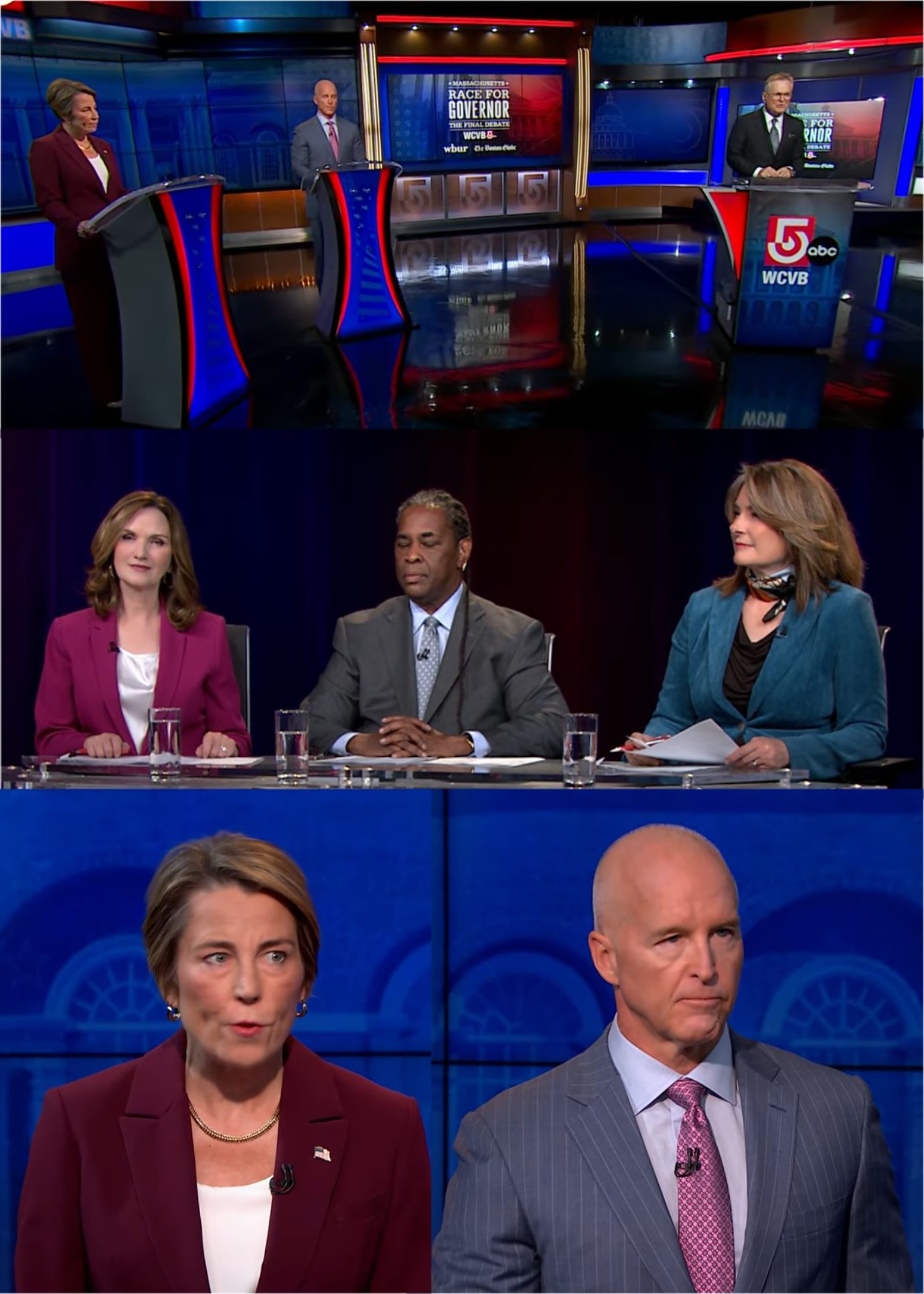
Last Debate for MA Governor – October 15, 2026 – FULL COVERAGE
Listen to the debate on any device, CLICK PLAY.
The final Massachusetts gubernatorial debate between incumbent Democratic Governor Maura Healey and Republican challenger Mike Manogue.
The debate centered on acute economic pressures facing Massachusetts residents—including high housing, energy, and living costs—alongside contrasting visions for state governance, public safety, law enforcement oversight, energy policy, and reproductive rights.
Gardner Magazine has coverage of the key takeaways from the debate and detailed candidate positions on the various issues.
- Economy & Cost of Living: Both candidates acknowledge severe affordability pressures (food prices up 35% since 2020, median listing prices near $800,000, gas at $4.30/gallon). Governor Healey highlights her tax cuts for seniors, parents, and small businesses, alongside a 4th-in-the-nation GDP growth rate. Challenger Mike Manugg advocates for immediate gas tax cuts, eliminating a third of state utility fees, and opting into federal scholarship tax credits ($10,000–$20,000 back to families).
- Housing & Migration: Manugg highlights out-migration statistics (>33,000 people in a single year, 60% aged 25–44) and blames restrictive stretch codes and slow local permitting (1.5+ years). Healey points to state-level permitting reform (slashed from 1 year to 30 days), accessory dwelling unit (ADU) legislation, and 100,000 homes permitted or under development.
- Ethics, Law Enforcement & Oversight: Manugg sharply criticizes the Healey administration over state police misconduct scandals, the arrest of former administration staffer Lamar Cook (involving 18 lbs of delivered cocaine, SNAP fraud, and a $22,000 vacation payout), and a 12.5% SNAP error rate that risks a $300 million taxpayer penalty. Healey defends her zero-tolerance policy, stating Cook was fired immediately before arraignment, and points to the appointment of Colonel Jeffrey Noble to oversee State Police reform.
- Energy & Climate Policy: Manugg claims Healey’s past opposition to natural gas pipelines as Attorney General drove utility bills up, forcing the state to import European LNG at six times the cost. Healey defends an “all-of-the-above” strategy (wind, solar, hydro, geothermal, and expanded gas capacity in existing pipelines), arguing that tariffs and federal policies are driving up regional energy costs.
- Immigration & Federal Authorities: Healey signed the Protect Act and calls ICE a “public safety threat” that pulls taxpaying parents from communities. Manugg emphasizes local, state, and federal law enforcement coordination to remove violent criminals while protecting law-abiding undocumented workers.
Candidate Comparative Summary
| Topic Area | Governor Maura Healey (D) | Challenger Mike Manugg (R) |
|---|---|---|
| Tax Relief & Cost of Living | Proposes temporary gas tax suspension targeting drivers; highlights earlier tax cuts for seniors, parents, and small businesses. | Calls for immediate gas tax elimination, cutting 1/3 of utility fees, and adopting federal scholarship tax credits. |
| Housing & Permitting | Reduced state permitting from 1 year to 30 days; created ADU build-by-right policies; target to build/permit 200,000 homes. | Targets 45-day local permitting; advocates eliminating strict stretch codes; opposes state lawsuits against towns over condo mandates. |
| Education & Wealth Gap | Expanded vocational seats by 25,000; implemented free community college; offered $25,000 for first-time homebuyers. | Focuses on literacy (60% non-proficient); supports school choice via federal scholarship tax credits; advocates vocational training. |
| Law Enforcement & ICE | Signed Protect Act; opposes non-criminal ICE deportations; appointed Colonel Jeffrey Noble to lead State Police reforms. | Calls for law enforcement cooperation across local/state/federal levels; prioritizes removing violent criminals and drug dealers. |
| Energy Policy | Promotes “all-of-the-above” approach; supports expanding flow in existing gas pipelines alongside wind, solar, hydro, and geothermal. | Advocates new natural gas pipelines and nuclear energy; calls for suspending the 1/3 utility fee labeled a “climate tax.” |
| Ethics & State Oversight | Claims zero tolerance; fired Lamar Cook day of arrest; referred fraud cases to state/federal prosecutors. | Cites $298B in bond debt, 12.5% SNAP error rate ($300M taxpayer risk), state house drug deliveries, and demands an independent state audit. |
| Reproductive Rights | Stockpiled mifepristone; signed healthcare shield law; made prenatal vitamins free. | Pledges to uphold state abortion laws and separation of church and state; calls stockpiling unnecessary fearmongering. |
Detailed Examination of Debate Themes
1. Economy, Cost of Living, and Taxation
Massachusetts faces severe macroeconomic headwinds, including food prices rising nearly 35% nationwide since 2020, median home listing prices approaching $800,000, and regular gas averaging $4.30 per gallon.
Cost of Living Context (Massachusetts):
├── Food Prices: +35% (since 2020)
├── Gas Prices: $4.30 / gallon average
└── Housing: Listing closing prices approaching $800,000
- Governor Healey’s Position:
- Highlights being the first Massachusetts governor in 20 years to enact tax cuts, focusing relief on seniors, parents, young people, and small businesses rather than the wealthy.
- Supports a limited, temporary gas tax suspension designed to ensure oil companies do not profit at the expense of drivers.
- Attributes broad inflation and energy price spikes to foreign wars and federal tariffs.
- Emphasizes that Massachusetts maintains the 4th fastest-growing state economy in the U.S., driven by strong healthcare, innovation, and education sectors.
- Mike Manogue’s Position:
- References Healey’s past statement that “Massachusetts is a great place to live if you can afford it,” arguing that working families cannot afford current state policies.
- Demands an immediate suspension of the gas tax to provide direct relief.
- Advocates cutting one-third of utility bill fees, describing non-energy fees as a “climate tax.”
- Proposes opting into the Federal Scholarship Tax Credit to return $10,000 to $20,000 directly into parents’ pockets.
2. Housing Production, Permitting, and Out-Migration
Concerns were raised regarding domestic out-migration, with Greater Boston Chamber of Commerce data showing over 33,000 people leaving the state in a single year—60% of whom are between the ages of 25 and 44.
- Mike Manogue’s Analysis & Proposals:
- Cites an exodus of young professionals fleeing high rents to cities like Austin, Texas, where housing costs are a fraction of Boston’s.
- Asserts Massachusetts ranks last in the nation in building permits per capita due to excessive bureaucracy, local permitting delays (1.5+ years for single-family homes; 3+ years for commercial properties), and unrealistic building stretch codes regarding ventilation and hookups.
- Proposes incentivizing municipalities with state funds to adopt a universal stretch code and streamline local permitting down to 45 days, rather than suing municipalities that resist building large condo developments.
- Criticizes the Healey administration for putting $298 billion on bond debt over four years—nearly double former Governor Charlie Baker’s first term—while expanding state employee payrolls.
- Governor Healey’s Analysis & Proposals:
- Rejects claims of stalled development, noting that her housing legislation cut state-level permitting times from 1 year down to 30 days.
- Enacted policies making Accessory Dwelling Units (ADUs) allowed by right, released surplus state land for development, and offered tax credits to developers.
- Reports that 100,000 homes have been permitted, built, or placed under development during her term, with a goal to double that figure in a second term.
- Points to job growth (15,000 jobs created last year) and corporate expansions by Takeda, Whoop, and Gillette as proof of economic vitality.
3. Education and the Racial Wealth Gap
A Federal Reserve Bank of Boston study highlighted that the median Black family in Massachusetts holds less than 2% of the wealth of the median white family.
Racial Wealth Gap Context:
Median Black Family Wealth < 2% of Median White Family Wealth (Federal Reserve Bank of Boston)
- Healey’s Initiatives:
- Homeownership & Housing: Created a first-time homebuyer program offering $25,000 in direct assistance to close the historical racial wealth gap driven by homeownership barriers; eliminated real estate broker fees for renters.
- Higher Education & Workforce: Made community college free across the state; doubled public funding for K-12 students; expanded vocational and career-technical education seats by 25,000.
- Manogue’s Counterarguments:
- Argues that free community college fails to solve underlying systemic issues when 60% of high school and elementary students cannot read or write at a proficient level—a decline from 2019 levels.
- Claims urban core achievement gaps are among the worst in the nation despite high state spending.
- Demands the state opt into the Federal Scholarship Tax Credit (school vouchers) to give low-income families options outside their zip codes, alongside expanded support for vocational facilities like Essex Tech.
4. Law Enforcement, Governance Ethics, and Administrative Oversight
State Police Culture
Following an internal affairs investigation into a trooper who allowed a friend to stay at the Martha’s Vineyard barracks—resulting in an alleged sexual assault of a woman by a civilian—both candidates addressed law enforcement accountability.
- Manogue: Condemns Healey’s response that “sometimes things happen,” arguing that true leadership requires zero tolerance, strict accountability, and high integrity standards. Opposes special union deals and promises regular ride-alongs.
- Healey: Defends State Police leadership under Colonel Jeffrey Noble (hired from outside the agency in New Jersey). Highlights state police achievements, including locating a lost 4-year-old boy in the woods and supporting fallen officers via the Blue Star plate program.
Lamar Cook & DTA SNAP Fraud Scandal
- Manogue’s Allegations:
- Claims administration staffer Lamar Cook had 18 lbs of cocaine delivered directly to the State House, received $22,000 in unused vacation pay upon termination, and subsequently received SNAP benefits.
- Accuses the administration of failing to cooperate with U.S. Attorney Leah Foley or provide recipient identification data to federal oversight bodies.
- States the Department of Transitional Assistance (DTA) SNAP error rate spiked to 12.5% (compared to 4.5% under Governor Baker). Because states pay penalties for error rates exceeding 6%, Manugg asserts this will cost Massachusetts taxpayers $300 million in new taxes and jeopardize $3 billion in federal funding.
- Healey’s Defense:
- Clarifies that Cook was fired immediately on the day of his arrest, before he was even arraigned, and that the state worked with prosecutors to recoup funds.
- Reaffirms zero tolerance for public trust breaches, noting she routinely refers fraud cases to the U.S. Attorney, Attorney General, State Auditor, and Inspector General.
- Explains that broad SNAP administrative actions were necessary after federal disruptions cut off SNAP benefits for 900,000 Massachusetts residents.
SNAP Program Error Rate Comparison:
├── Baker Administration Error Rate: 4.5%
├── Current Healey Administration Error Rate: 12.5%
├── Federal Penalty Threshold: 6.0%
└── Estimated Taxpayer Penalty Exposure: $300 Million
Federal Immigration Enforcement (ICE) & Public Safety
- Healey: Signed the Protect Act to restrict state involvement with ICE, calling current ICE operations an “out-of-control rogue agency” and a “public safety threat” that detains taxpaying parents (e.g., recent fish plant raids in New Bedford). Distinguishes non-criminal families from violent criminals, highlighting joint state/federal task force operations that seized 20 kilograms of fentanyl and cocaine in September.
- Manogue: Argues that refusing to cooperate with federal detainer requests for violent criminals and drug dealers places immigrant communities in danger. Advocates for coordinated operations between local, state, and federal authorities to target violent offenders while protecting law-abiding undocumented workers.
5. Energy Policy, Climate Objectives, and Public Works
Energy Grid and Utility Bills
- Mike Manogue:
- Attributes high regional electricity costs to Healey’s actions as Attorney General in 2015, when she opposed natural gas pipeline expansion into Massachusetts.
- Notes that because domestic pipeline capacity was blocked, Massachusetts imports Liquefied Natural Gas (LNG) from Europe at six times the domestic cost.
- Points out that wind and solar provide under 6% of the state’s energy despite billions in investments, while nuclear energy (Seabrook facility) provides 20%.
- Advocates building natural gas pipelines, exploring nuclear expansion, and removing non-usage climate charges from utility bills.
- Governor Healey:
- Promotes an “all-of-the-above” strategy including wind, solar, geothermal, hydro (via Canadian interconnections), and natural gas.
- Notes she petitioned federal regulators to increase gas flow volume through existing regional pipelines.
- Recalls that her 2015 pipeline legal challenge protected consumers because the developer wanted ratepayers—rather than company shareholders—to shoulder the construction risk.
- Filed legislation aimed at reforming regional energy markets to save ratepayers an estimated $13 billion.
Climate Goals
- Healey: Opposes rolling back state climate goals, emphasizing operational progress in siting, permitting, and clean energy development to lower long-term costs.
- Manogue: Accuses the administration of delaying penalty fee implementations until after the election. Warns that attempting to run state infrastructure solely on intermittent renewables will cost taxpayers $300 billion and disrupt industrial operations.
Infrastructure Disputes (Springfield Courthouse)
- Manogue: Criticizes a proposed $2 billion, 40-year lease agreement for a new Springfield courthouse, noting local sheriff and community opposition regarding safety and lack of on-site parking.
- Healey: Defends the procurement process, stating a judge verified the process was flawless. Replaces a contaminated “sick building” to protect worker health while creating 1,000 local jobs and 550 housing units in Springfield.
6. Reproductive Rights and Legislative Oversight
Abortion Access & Shield Laws
- Mike Manogue: Reiterates his personal pro-life views but pledges absolute adherence to state law, the state constitution, and the separation of church and state. Argues that FDA-approved Mifepristone remains legally available through standard supply chains, rendering state-funded stockpiles an unnecessary use of taxpayer funds.
- Governor Maura Healey: Highlights her proactive stockpiling of Mifepristone and passage of the nation’s strongest healthcare shield law following the overturning of Roe v. Wade. Emphasizes that her administration expanded free prenatal care and maternal health investments, arguing that government should not interfere in private medical decisions.
Legislative Performance & State Transparency
When asked to evaluate the Massachusetts Legislature—frequently ranked among the least productive in the nation—the candidates offered starkly different assessments:
- Monogue (Grade: F): Cites the Legislature’s failure to audit state operations, refusal to address gas tax proposals, and efforts to block Ballot Question 1 (designed to mandate legislative transparency). Promises to hire an independent financial auditing firm and increase funding for the State Auditor to investigate the MBTA and energy authorities.
- Healey (Grade: Incomplete): Notes that key bills, including her $13 billion energy reform measure, remain pending before the Legislature. Highlights her willingness to utilize executive actions to bypass legislative gridlock when necessary to deliver economic relief.