World News – Week of September 6, 2026
Listen to the Weekly World News Briefing on any device, CLICK PLAY.
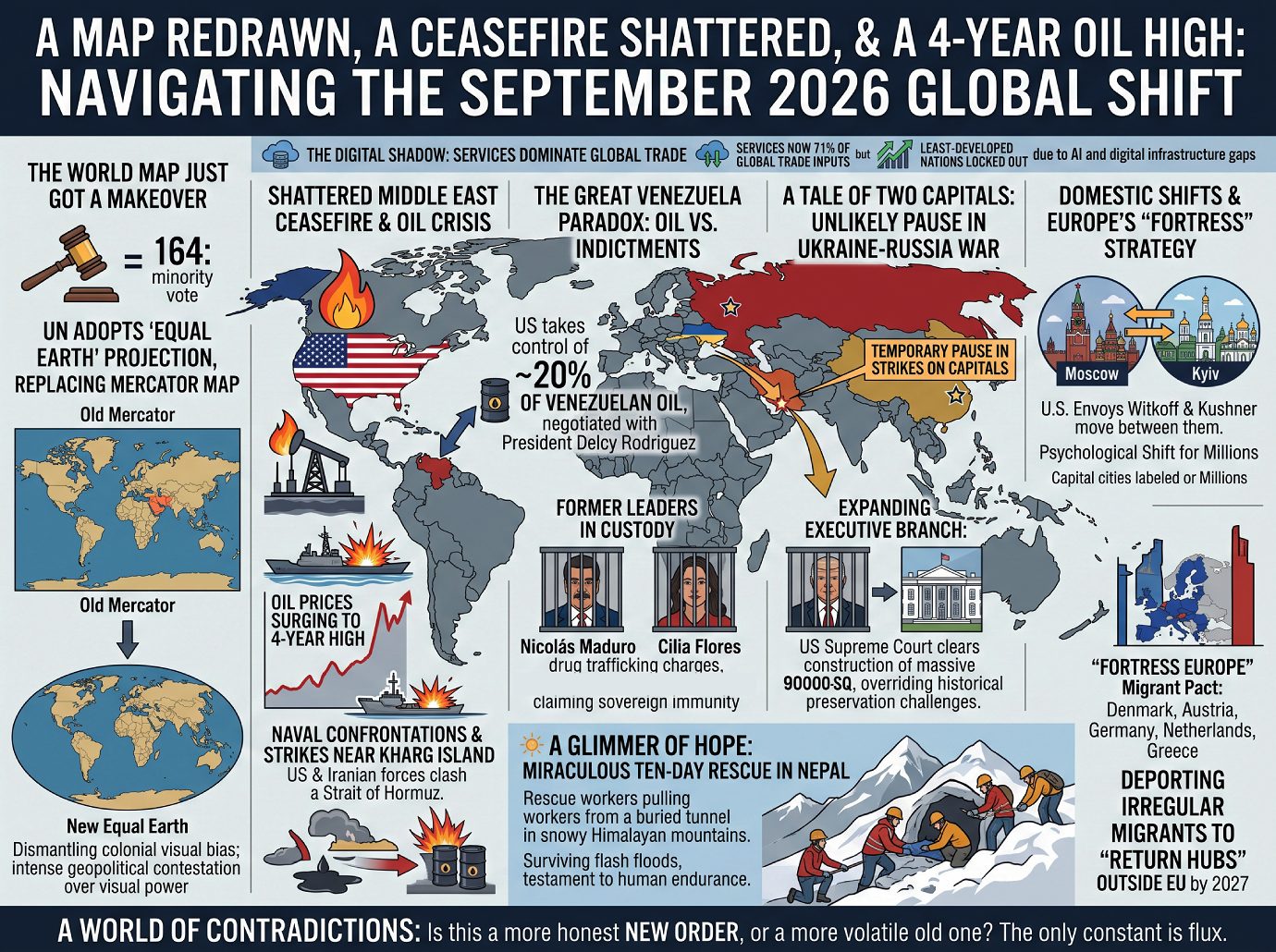
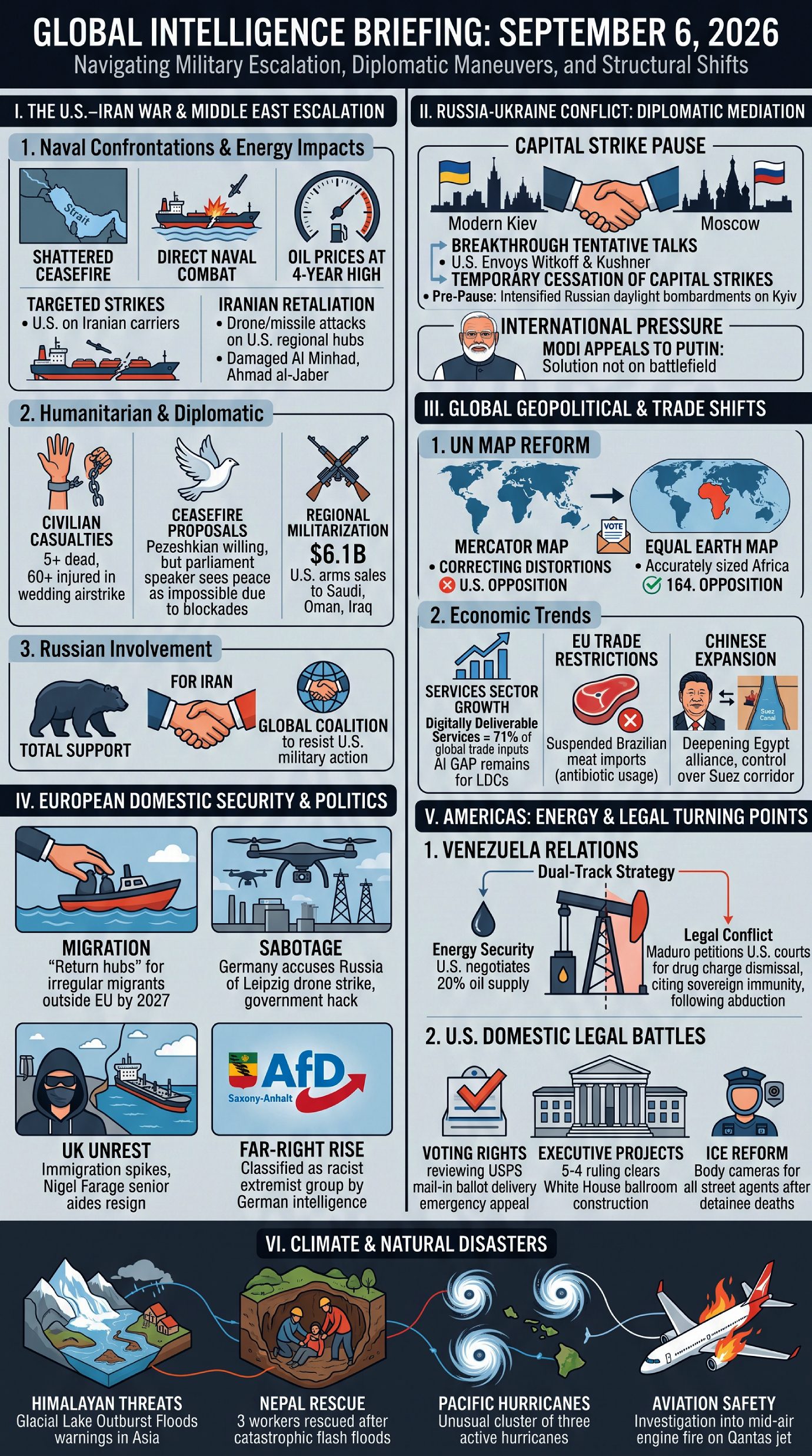
As of September 2026, the global landscape is defined by a volatile mix of military escalation, high-stakes diplomatic maneuvering, and significant structural shifts in international relations. The primary driver of instability is the shattered ceasefire between the United States and Iran, which has devolved into direct naval combat and regional base attacks, threatening global energy markets. Simultaneously, a fragile diplomatic opening has emerged in the Russia-Ukraine conflict, marked by a temporary cessation of strikes on capital cities facilitated by U.S. envoys.
On the geopolitical stage, the United Nations has taken the historic step of adopting a new world map to rectify historical distortions, despite U.S. opposition. Domestically, both Europe and the Americas face internal pressures ranging from migration crises and infrastructure sabotage to legal battles over executive authority and voting rights.
The U.S.–Iran War and Middle East Escalation
The one-month ceasefire between the United States and Iran has collapsed, leading to a sharp escalation in direct military engagements and regional spillover.
1. Naval Confrontations and Energy Impacts
The conflict has centered on the Strait of Hormuz and critical energy infrastructure. Global oil prices have reached a four-year high following these engagements:
- Targeted Strikes: U.S. forces struck three Iranian oil carriers linked to the Islamic Revolutionary Guard Corps (IRGC). Additionally, severe airstrikes targeted an Iranian crude carrier near Kharg Island.
- Iranian Retaliation: Iran targeted three tankers operating on “unauthorized routes” and launched drone and missile attacks against U.S. regional hubs.
- Base Impacts: Significant damage was reported at Ahmad al-Jaber Air Base (Kuwait) and Al Minhad Air Base (UAE), targeting satellite communications, warehouses, and radar stations.
2. Humanitarian and Diplomatic Developments
- Civilian Casualties: A U.S. airstrike in Sirik, intended for military targets, struck a wedding party, resulting in at least 5 deaths and over 60 injuries, sparking international condemnation.
- Ceasefire Proposals: President Masoud Pezeshkian expressed willingness to return to the June “Islamabad Memorandum.” However, the Iranian parliament speaker warned that naval blockades by the U.S. and Israel make peace nearly impossible.
- Regional Militarization: The U.S. State Department approved $6.1 billion in arms sales to Saudi Arabia, Oman, and Iraq to bolster allies against Tehran.
3. Russian Involvement
President Vladimir Putin has pledged “total support” for Iran and is actively encouraging the formation of a global coalition to resist U.S. military action in the Persian Gulf.
Russia-Ukraine Conflict: Diplomatic Mediation
A rare diplomatic breakthrough is underway, led by U.S. envoys Steve Witkoff and Jared Kushner.
- Capital Strike Pause: Presidents Putin and Zelenskyy have agreed to a temporary cessation of strikes targeting Moscow and Kyiv while talks proceed.
- Pre-Pause Tactics: Prior to this agreement, Russia had intensified its campaign, utilizing daytime bombardments of Kyiv to disrupt civil operations.
- International Pressure: Indian Prime Minister Narendra Modi issued a direct appeal to Putin, stating that a solution cannot be found on the battlefield and urging an end to the war.
Global Geopolitical and Trade Shifts
1. United Nations Map Reform
In a 164-country resolution, the UN General Assembly voted to replace the Mercator map with the Equal Earth map.
- Objective: To visually correct geographical distortions that minimized the size of the African continent.
- Opposition: The United States officially voted against the measure.
2. Economic and Infrastructure Trends
- Services Sector Growth: According to UNCTAD, digitally deliverable services now comprise 71% of global trade inputs, growing at 7.1% annually. A significant “AI gap” remains for least-developed nations.
- EU Trade Restrictions: The European Commission suspended all Brazilian meat imports (beef, poultry, eggs, honey) due to failures in meeting antibiotic usage standards, threatening the EU-Mercosur trade deal.
- Chinese Expansion: President Xi Jinping’s visit to Egypt signaled a deepening alliance aimed at securing control over the Suez Canal corridor.
IV. European Domestic Security and Politics
Europe is grappling with a combination of external state-backed threats and internal political volatility.
| Issue | Details |
|---|---|
| Migration | Denmark, Austria, Germany, the Netherlands, and Greece agreed to establish “return hubs” outside the EU for deporting irregular migrants by 2027. |
| Sabotage | Germany has formally accused Russia of a drone strike on infrastructure in Leipzig. Berlin is also managing a crisis following a hack of sensitive government data. |
| UK Unrest | Masked protestors blocked the Port of Dover over immigration spikes; senior aides to Nigel Farage resigned following a scandal. |
| Far-Right Rise | The AfD branch in Saxony-Anhalt has been classified as a “racist extremist group” by German intelligence. |
Americas: Energy and Legal Turning Points
1. Venezuela Relations
The U.S. is pursuing a dual-track strategy with Venezuela:
- Energy Security: Negotiating a deal with interim President Delcy Rodriguez to control 20% of Venezuela’s oil supply to lower domestic prices.
- Legal Conflict: Former President Nicolás Maduro and Cilia Flores are petitioning U.S. courts to dismiss drug trafficking charges, citing sovereign immunity following their abduction by U.S. forces.
2. U.S. Domestic Legal Battles
- Voting Rights: The Supreme Court is reviewing an emergency appeal regarding USPS delivery of mail-in ballots after a lower court blocked restrictions that threatened “major disenfranchisement.”
- Executive Projects: A 5-4 Supreme Court ruling cleared the construction of a 90,000-square-foot ballroom at the White House, dismissing historical preservation concerns.
- ICE Reform: Following detainee deaths, ICE has completed the rollout of body cameras for all street agents.
Climate and Natural Disasters
- Himalayan Threats: Rising temperatures have triggered urgent warnings regarding “glacial lake outburst floods” in Asia.
- Nepal Rescue: In a rare success, three workers were rescued alive from a buried hydropower tunnel 10 days after catastrophic flash floods.
- Pacific Hurricanes: Meteorologists are tracking an unusual cluster of three active hurricanes simultaneously threatening Hawaii.
- Aviation Safety: An investigation is underway following a mid-air engine fire on a Qantas jet in the South Pacific.