Publisher’s Note: At its November 16th meeting, the Gardner City Council approved all of the Mayor’s request by unanimous vote.
Gardner Mayor Nicholson Details Financial Crisis, Budget Cuts, and $2.6 Million Stabilization Fund Withdrawal
Listen to Gardner Mayor Nicholson’s entire statement to the City Council on any device, CLICK PLAY.
Read a PDF of the statement, CLICK HERE.
Mayor Acknowledges Budget Errors, Explains Employee Layoffs, Defends Community Center Project, and Calls for Immediate Action to Restore Gardner’s Financial Stability
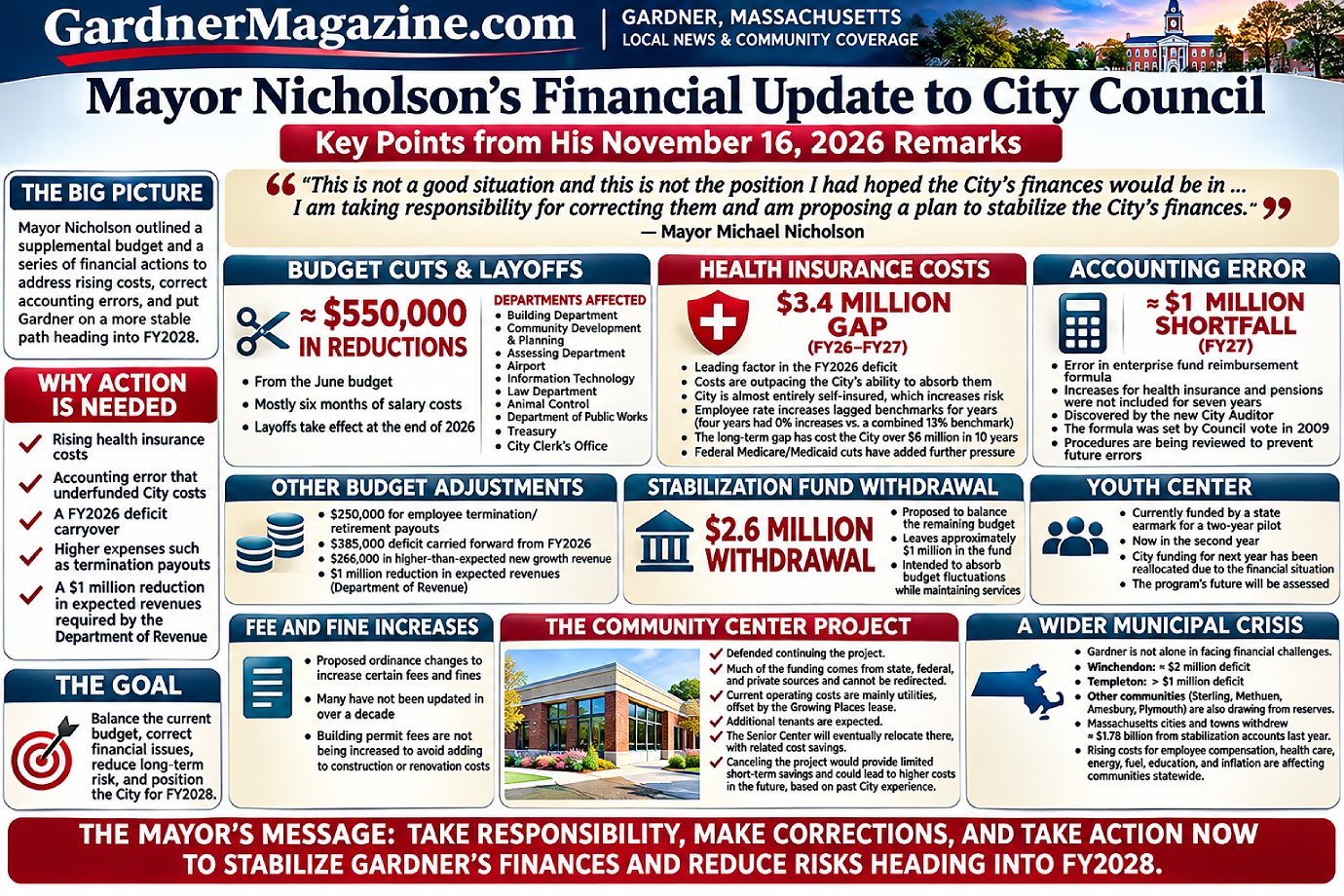
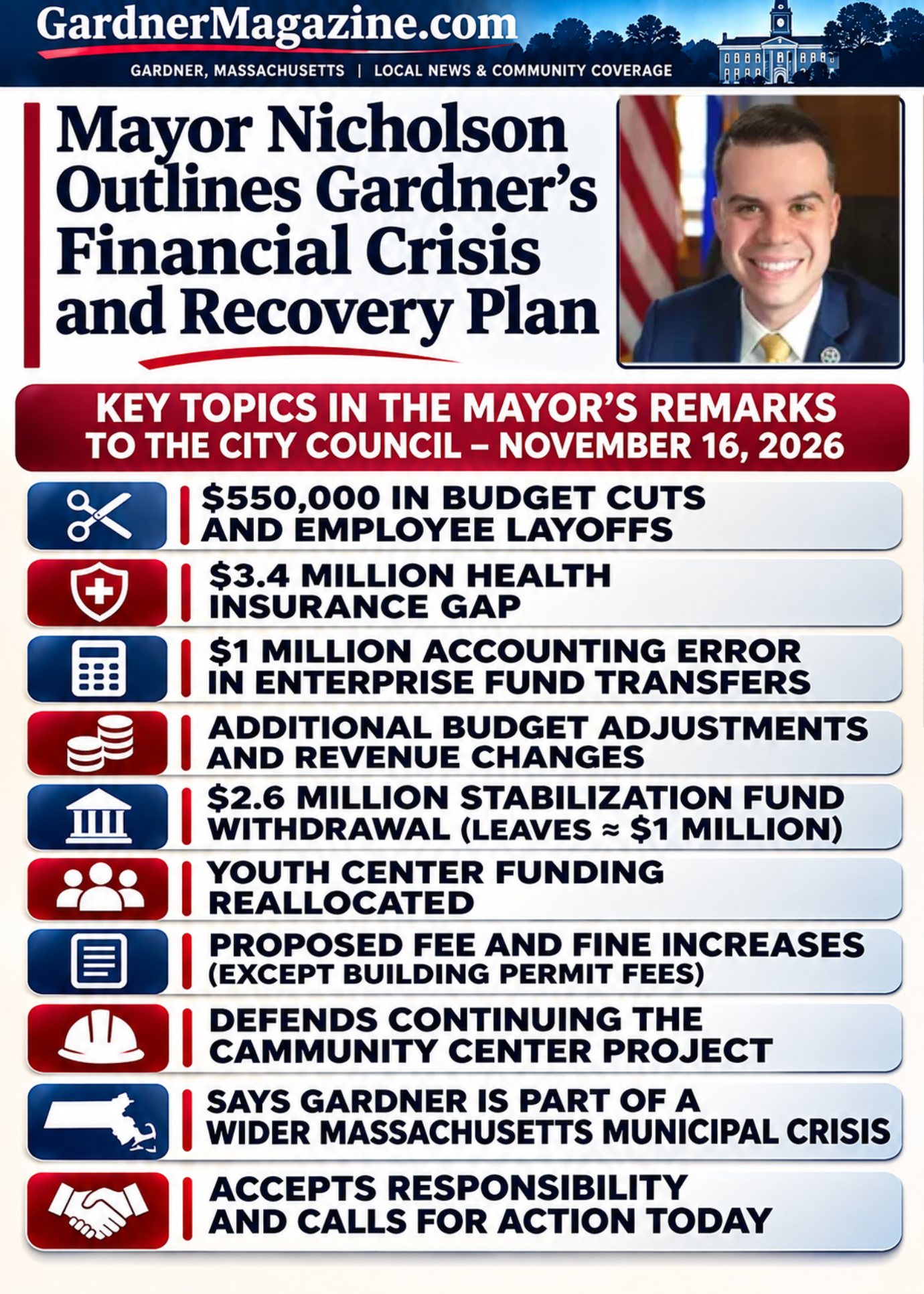
Gardner Mayor Michael Nicholson delivered a detailed and candid assessment of the City’s financial difficulties to the Gardner City Council on Monday, November 16, 2026, outlining a sweeping supplemental budget proposal designed to address mounting expenses, correct significant accounting errors, and prevent even more severe financial problems in Fiscal Year 2028.
The Mayor’s proposal included approximately $550,000 in budget reductions, municipal employee layoffs, a $2.6 million withdrawal from the City’s Stabilization Fund, and corrections to accounting procedures that resulted in approximately $1 million in underfunded reimbursements for the current fiscal year.
Nicholson acknowledged that the financial situation was not what he had envisioned and accepted responsibility for presenting a plan to address the problems. “I want to start by acknowledging that this is not a good situation and this is not the position I had hoped the City’s finances would be in,” Nicholson told councilors. However, he emphasized that delaying corrective action could create an even more serious financial situation. “We are already deep into this fiscal year, and these cuts and other budget changes will avoid deeper cuts needing to be made down the line and minimize the impact of this crisis on FY2028.”
Approximately $550,000 in Budget Cuts and Employee Layoffs:
One of the most consequential elements of the Mayor’s proposal involves reducing municipal spending by approximately $550,000 from the budget he signed in June. Nicholson explained that most of these reductions reflect approximately six months of salary expenditures because the employee layoffs he has implemented will take effect at the end of calendar year 2026. The reductions affect positions across numerous municipal departments, including:
- Building Department
- Community Development and Planning
- Assessing Department
- Gardner Municipal Airport
- Information Technology
- Law Department
- Animal Control
- Department of Public Works
- Treasury
- City Clerk’s Office
The Mayor did not specify the exact number of affected positions in his prepared remarks, but emphasized the personal consequences of eliminating municipal jobs. “Every one of these positions represents a person who has served this community, and I do not take the decision to eliminate any of them lightly,” Nicholson stated. He explained that his responsibility requires balancing the impact on individual employees against the long-term financial stability of the entire municipality.
Health Insurance Costs: A $3.4 Million Budget Problem
Perhaps the most significant financial challenge identified by Nicholson involves the rapidly increasing cost of municipal employee health insurance. “Health insurance is devouring the budget,” the Mayor declared. Nicholson reported that the combined health insurance funding gap for Fiscal Years 2026 and 2027 totals approximately $3.4 million. He identified health insurance expenses as the leading factor contributing to the FY2026 budget deficit. Gardner operates an almost entirely self-insured health insurance system. Unlike municipalities participating in larger insurance pools, Gardner assumes much of the financial risk associated with employee medical claims. Because Gardner is a relatively small employer, unusually expensive medical claims can have a disproportionate effect on the City’s finances.
Nicholson also identified a longer-term problem involving the rates charged to employees for health insurance. Over the past decade, the City’s employee health insurance rate increases have frequently fallen below benchmark increases. According to Nicholson, four years included no increase at all, even though the combined benchmark increases during those years would have totaled approximately 13%. He estimated that the cumulative gap between actual rate increases and benchmark increases now exceeds 20%. The Mayor stated that the compounding effect of these decisions has cost the City’s health insurance pool more than $6 million over the past decade. Nicholson also attributed some of the broader pressure on health care costs to federal Medicare and Medicaid funding reductions, which he argued have shifted additional costs elsewhere in the health care system.
Accounting Formula Error Created Approximately $1 Million Shortfall
One of the most significant revelations in Nicholson’s presentation concerned an accounting spreadsheet error affecting transfers from municipal enterprise funds to the City’s general fund. Enterprise funds reimburse the general fund for municipal services and resources used by enterprise operations, including accounting, administrative support, and employee benefits. The Mayor explained that the formula governing these reimbursements was established by City Council vote in 2009. However, the spreadsheet used to calculate the reimbursements contained an error recently discovered by Gardner’s new City Auditor. As a result, increases in health insurance and pension costs had not been incorporated into the calculations for seven years.
Nicholson reported that this mistake resulted in approximately $1 million in underfunded reimbursements for FY2027 alone. “This error should have been identified earlier. It was not, and that is unacceptable,” the Mayor stated. He said the City is reviewing the procedures used to calculate and verify these transfers to prevent similar mistakes in the future. The discovery highlights how longstanding accounting practices can produce significant financial consequences when calculations are not regularly reviewed and updated.
Additional Budget Adjustments and Revenue Reductions
Beyond employee layoffs and health insurance expenses, Nicholson outlined several other significant adjustments necessary to address the City’s current financial position. Employee termination and retirement payouts: The existing budget did not fully account for payments owed to employees retiring or otherwise leaving municipal employment during the fiscal year. The additional expense is approximately $250,000. FY2026 deficit: The supplemental budget incorporates a $385,000 deficit carried forward from Fiscal Year 2026. New growth revenue: Higher-than-anticipated new growth is expected to provide approximately $266,000 in additional revenue beyond the original budget estimate. Revenue estimate reduction: The Massachusetts Department of Revenue is requiring Gardner to reduce its expected revenue projections by approximately $1 million based on the City’s overall financial condition and actual FY2026 revenue figures. Together, these changes require significant adjustments to the financial assumptions underlying the City’s current budget.
$2.6 Million Stabilization Fund Withdrawal Would Leave Approximately $1 Million
To balance the remaining budget shortfall after the proposed reductions and corrections, Nicholson is requesting a substantial withdrawal from Gardner’s Stabilization Fund. The proposed withdrawal totals $2.6 million, leaving approximately $1 million in the fund. The Stabilization Fund serves as a municipal financial reserve intended to help communities manage unexpected expenses, revenue shortfalls, and other financial emergencies. Nicholson acknowledged the magnitude of the proposed withdrawal but defended its necessity. “I realize this is a large withdrawal. However, it exists for this purpose. To help absorb budget fluctuations while maintaining services,” he explained. The Mayor expressed confidence that combining the stabilization withdrawal with expenditure reductions and accounting corrections would reduce financial risks heading into FY2028. Nevertheless, the proposal would leave Gardner with a considerably smaller financial cushion should additional unexpected expenses or revenue problems arise.
Gardner Youth Center Funding Reallocated
Nicholson also addressed the financial future of Gardner’s Youth Center. The program is currently supported by a state earmark intended to fund a two-year pilot program. Gardner is now in the second year of that arrangement, with the original intention that the City would evaluate the program and determine whether to continue supporting it after state funding expires. However, because of the current financial situation, Nicholson said he has reallocated municipal funding that had been set aside during the current fiscal year for the program’s potential continuation next year. The decision reflects the financial pressure on programs that may eventually require ongoing local funding. The Mayor’s remarks did not establish a final decision regarding the Youth Center’s future after the state-supported pilot period ends.
Proposed Increases in Municipal Fees and Fines
Separate from the supplemental budget, Nicholson has submitted an extensive package of proposed ordinance changes. Many of the proposed changes involve municipal financial matters, including increases in certain fees and fines that have not been adjusted in more than a decade. The Mayor indicated that updating these charges is another component of his broader effort to improve the City’s financial position. However, one notable exception is building permit fees. Nicholson specifically stated that he is not proposing an increase in building permit fees because he does not want to make construction or property renovations more expensive in Gardner. He emphasized that the supplemental budget and related financial measures should be considered together rather than as isolated proposals.”This is time sensitive and really needs to be looked at as a complete package,” Nicholson told the Council.
Mayor Defends Community Center Project Despite Financial Crisis
A substantial portion of Nicholson’s remarks addressed questions about whether Gardner should discontinue its Community Center project in light of the City’s financial difficulties. The Mayor acknowledged that the project has become a subject of concern, particularly while municipal employees face layoffs. “The Community Center. It’s an easy political target. I understand why the question is being raised, and it deserves a serious answer,” Nicholson stated. However, he strongly defended continuing the project, arguing that abandoning it would produce limited immediate savings while creating greater long-term costs.
Much of the Project Funding Cannot Be Redirected
Nicholson explained that a significant portion of the funding already spent or committed to the Community Center comes from state, federal, and private sources. Those funds are restricted to their intended purposes and cannot simply be redirected to cover general municipal operating expenses. Consequently, canceling the project would not provide the City with the full amount of money that some might assume would become available.
Operating Costs and Future Tenants
The Mayor also argued that the City’s ongoing financial exposure is smaller than it may initially appear. He said the principal ongoing operating expense is utilities, with those costs currently offset by the lease agreement with Growing Places. Additional tenants are expected to further reduce the City’s net financial burden. Nicholson pointed to the eventual relocation of the Senior Center as another factor. Once the Senior Center moves into the Community Center, some expenses currently associated with maintaining the Charlie McKean building would instead be considered part of the financial picture at the new location. According to Nicholson, the current net cost associated with the Community Center is barely enough to reverse one of the proposed municipal staff reductions. He acknowledged that choosing to continue the project while eliminating municipal positions is difficult. Nevertheless, he argued that the long-term benefits outweigh the limited short-term savings.
Lessons From Gardner’s History of Neglected Buildings
Nicholson connected his defense of the Community Center to Gardner’s longstanding problems with deteriorating municipal and industrial properties. He argued that postponing necessary repairs and redevelopment frequently results in substantially greater expenses for future city administrations. The Mayor cited the former Greenwood Pool as an example, stating that decisions made years before his administration ultimately forced the City to spend more addressing the problem than timely repairs would have cost. He also referenced several other properties that have presented long-term challenges, including School Street School, Helen Mae Sauter School, Prospect Street School, the Rome Square building, the Consentino Finishing Factory, and former industrial properties on Rock, Leamy, and Stuart Streets. Nicholson warned that abandoning the Community Center could leave future mayors and city councilors responsible for a deteriorating property while sacrificing opportunities to transform it into a useful community asset. “Abandoning this project now, just kicks the can down the road, and sticks future Mayors and Councilors with the problem when it will cost a lot more money,” he stated. The Mayor maintained that continuing the project represents the better long-term financial decision, even under Gardner’s present budget constraints.
Nicholson Says Gardner Is Not Alone in Municipal Financial Crisis
Toward the conclusion of his remarks, Nicholson placed Gardner’s difficulties within the broader financial challenges facing Massachusetts cities and towns. He pointed to neighboring communities experiencing significant budget problems. According to the Mayor, Winchendon is examining a deficit of approximately $2 million, while Templeton faces a deficit exceeding $1 million. He also identified Sterling, Methuen, Amesbury, and Plymouth as municipalities making sizable withdrawals from stabilization accounts to balance their budgets. Nicholson stated that municipalities across Massachusetts withdrew approximately $1.78 billion from stabilization accounts during the previous year to address budgetary needs. He described the situation as a systemic crisis affecting communities of different sizes, including Gardner, Winchendon, Templeton, Phillipston, and Boston. The Mayor cited several common financial pressures, including rising employee compensation, health insurance, energy, fuel, education expenses, and inflation. “This is not good. This is a systemic crisis,” Nicholson stated. His comments underscored his argument that Gardner’s financial problems are not entirely unique, although he also acknowledged that some of the City’s difficulties resulted from local decisions and mistakes.
Mayor Accepts Responsibility for Budget Problems
One of the most notable aspects of Nicholson’s presentation was his repeated acknowledgment that mistakes had been made and that some problems should have been identified sooner. He did not attribute the entire crisis to outside economic forces. Instead, he distinguished between circumstances beyond municipal control, decisions accumulated over time, and identifiable errors. “As Mayor, the responsibility for presenting a balanced and sustainable budget ultimately rests with me,” Nicholson told councilors. He acknowledged that assumptions used in preparing the current budget had proven incorrect and that accounting errors should have been discovered earlier.
“I am not here tonight to minimize those problems or shift responsibility for them. I am here to explain what happened, what we are doing to correct it, and why I believe this proposal is the responsible path forward.” The Mayor also addressed the timing of the financial crisis as his administration approaches its conclusion. With approximately seven weeks remaining before his anticipated departure from office in January 2027, Nicholson emphasized that he was unwilling to leave the problems unresolved for the next administration. “We have serious financial problems. Some were beyond our control, some resulted from decisions made over time, and some were mistakes. I am taking responsibility for correcting them rather than simply waiting for it to be someone else’s problem in seven weeks because it’s the responsible and right thing to do.”
The Financial Challenge Facing Gardner in FY2028
Although the supplemental budget is intended to correct significant problems in the current fiscal year, Nicholson cautioned that the proposal does not resolve every financial challenge facing Gardner. The City’s remaining financial risks include continuing health insurance cost increases, the need to maintain essential municipal services with fewer employees, and a substantially reduced Stabilization Fund balance. At the same time, the proposed accounting corrections and reductions in recurring expenses are intended to establish a more sustainable foundation for future budgets. Nicholson emphasized that the decisions being presented to the Council are difficult but necessary. “None of us wanted to be in this position, and none of us ran for office hoping to make decisions like these. But we have a responsibility to deal with the financial situation as it exists, not as we wish it existed.” He warned that delaying action would not eliminate existing expenses or undo past errors. Instead, the Mayor argued, postponement would likely make future decisions more painful for municipal employees, residents, and elected officials.
A Defining Financial Decision for Gardner’s City Council
The November 16 presentation placed Gardner’s City Council in the position of considering major financial adjustments with consequences extending beyond the current fiscal year. The proposed package involves immediate reductions in municipal staffing, the use of a substantial portion of the City’s financial reserves, corrections to longstanding accounting procedures, and potential increases in municipal fees and fines. It also raises important questions about how Gardner will rebuild its reserves, control employee health insurance expenses, and maintain municipal services as the City prepares for Fiscal Year 2028. Nicholson made clear that he considers the supplemental budget a necessary first step rather than a complete solution. “This proposal will not solve every financial challenge facing the City. But it will correct significant problems in the current budget, reduce recurring expenditures, and put us in a more sustainable position as we prepare for FY2028.” In his closing appeal, the Mayor asked councilors to evaluate the proposal based on the City’s current financial realities rather than on whether the reductions are desirable. “I am not asking you to approve this budget because it is an ideal solution. I am asking you to approve it because, given the circumstances before us, I believe it is the responsible solution.” Nicholson concluded by urging the Council to make the difficult decisions he believes are necessary to protect Gardner’s financial future.
The Gardner City Council approved all of the Mayor’s requests unanimously. View our article on the November 16, 2026 City Council meeting, CLICK HERE.