Gardner City Council FY2027 Financial Emergency and Leadership Transition
Listen to the entire meeting on any device, CLICK PLAY.
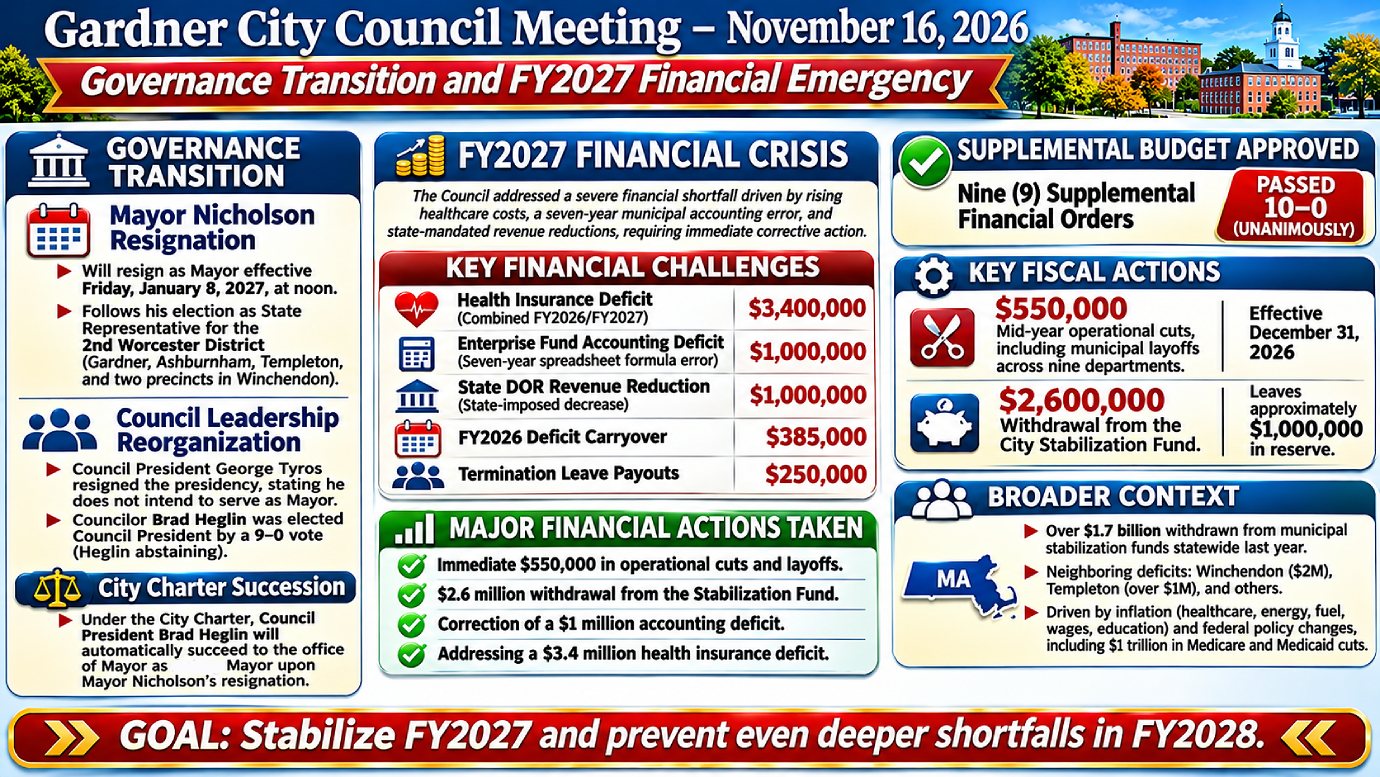
The November 16, 2026 meeting of the Gardner City Council marked a critical juncture for the city, dominated by two interconnected events: the planned resignation of Mayor Michael Nicholson following his election to state office, and the passage of an emergency supplemental budget package designed to rectify a multi-million-dollar fiscal crisis.
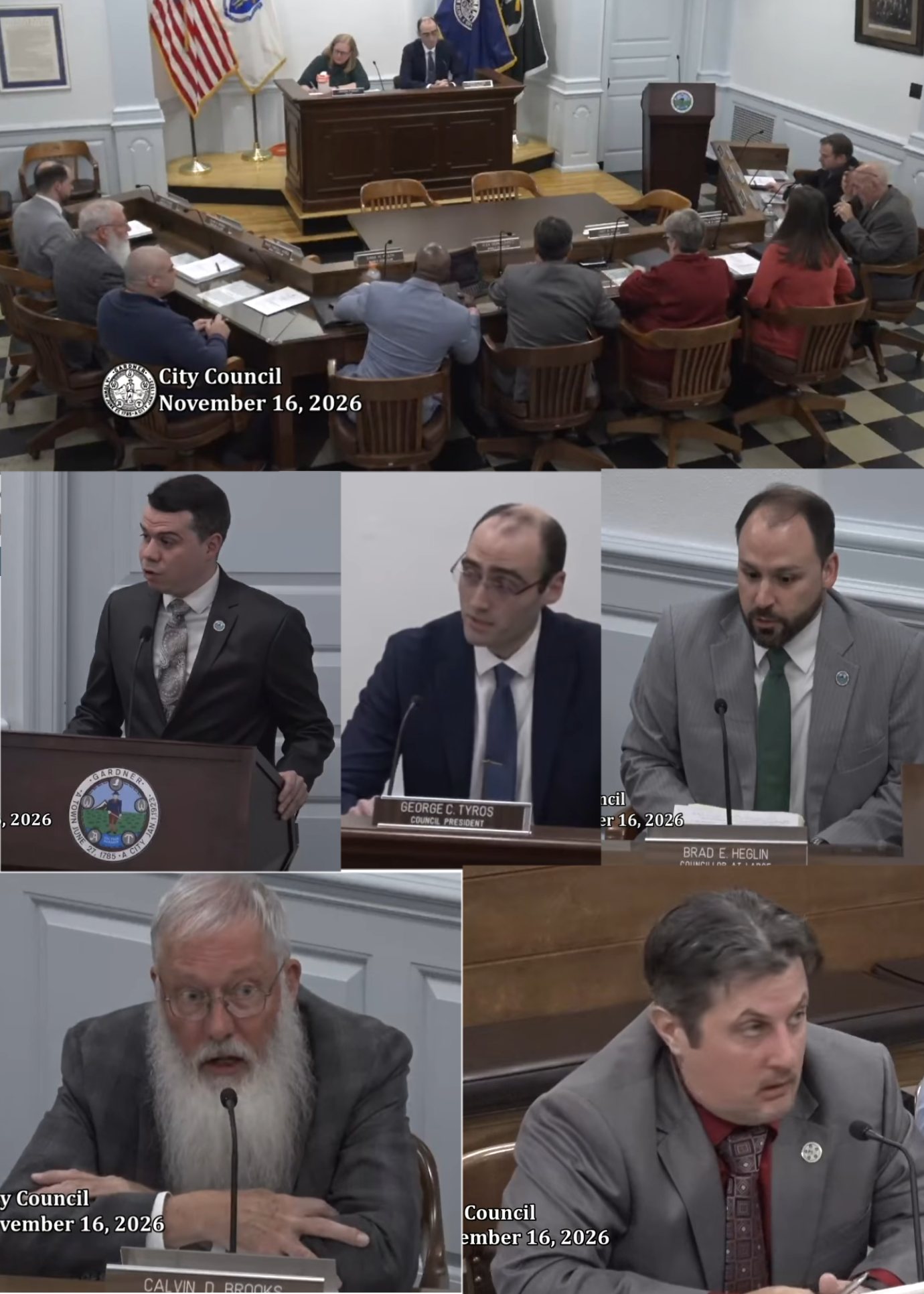
Mayor Nicholson formally announced his intent to resign effective Friday, January 8, 2027, at noon, following his election as State Representative for the 2nd Worcester District. To ensure an orderly transition and provide advance preparation time for mayoral succession, Council President George Tyros resigned his council presidency. The Council subsequently elected Councilor Brad Heglin as the new Council President (9-0 vote, Heglin abstaining). Under the city charter, President Heglin will automatically succeed Mayor Nicholson as Acting Mayor upon his departure in January.
Concurrently, the Mayor and Council presented a sobering assessment of the city’s immediate financial emergency. Driven by compounding healthcare costs, an uncorrected seven-year municipal accounting spreadsheet error, and state-mandated revenue reductions, the city faced severe structural deficits. To stabilize FY2027 and prevent catastrophic shortfalls in FY2028, the Council unanimously approved a complex package of nine financial orders. Key components include:
- $550,000 in immediate mid-year operational cuts, resulting in municipal layoffs across nine departments taking effect at the end of the calendar year.
- A $2.6 million withdrawal from the City Stabilization Fund, leaving approximately $1 million in reserve.
- Correcting a $1 million accounting deficit stemming from a seven-year-old enterprise fund formula spreadsheet error uncovered by the city’s new auditor.
- Addressing a $3.4 million multi-year health insurance deficit exacerbated by static employee contribution rates and broader systemic healthcare inflation.
1. Executive Transition and Mayoral Succession
Mayoral Resignation Announcement
Mayor Michael Nicholson officially informed the City Council of his intention to resign from the Office of Mayor effective January 8, 2027, at noon. This announcement follows his victory in the November 3, 2026 election as State Representative for the 2nd Worcester District (encompassing Gardner, Ashburnham, Templeton, and two precincts in Winchendon). Nicholson noted that his early seven-week notification was intended to foster a smooth, collaborative transition across departments, the city clerk’s office, and the council.
Historical Contrast and Governance Standards
Council President George Tyros highlighted the strategic rationale behind the transparent timeline, contrasting it with the city’s previous unexpected mayoral vacancy in late 2019/early 2020:
- 2019–2020 Transition (Mayor Hawke): Former Mayor Hawke announced his departure via a Facebook post to become Town Administrator of Westminster, leaving the city in operational limbo for 68 days. Official notification was delivered to the city clerk less than four hours before taking effect on the day of a January council meeting, while official actions and appointments continued without council oversight until the final moment.
- 2026–2027 Transition (Mayor Nicholson): Mayor Nicholson provided seven weeks’ advance notice, communicating intentions openly to allow formal preparation for succession and budgetary continuity.
Realignment of City Council Leadership
Under the Gardner City Charter, the sitting President of the City Council automatically succeeds to the Mayor’s office upon a vacancy.
- Resignation of President Tyros: Stating clearly that he had no interest or intention of serving as Mayor in January, President Tyros resigned the council presidency during the meeting. He argued that the incoming leader required immediate standing to collaborate with department heads, review finances, and prepare for the acting mayoralty from day one.
- Election of Brad Heglin: Councilor Brad Heglin was nominated by Tyros and elected Council President by a roll-call vote of 9–0 (Heglin abstaining). Tyros cited Heglin’s financial acumen, independence, oversight, and past legislative contributions—such as authoring the city’s 5-year budget planning ordinance and identifying previous municipal accounting discrepancies—as essential qualifications for leading the city through its financial crisis.
2. FY2027 Financial Crisis & Supplemental Budget Analysis
Mayor Nicholson presented an emergency supplemental budget package to mitigate a severe financial shortfall mid-way through Fiscal Year 2027. The Mayor emphasized that while the measures require painful sacrifices, failure to act immediately would trigger deeper structural damage in FY2028.
Macroeconomic and Systemic Context
The financial crisis facing Gardner is part of a broader municipal funding crisis across Massachusetts. The Mayor noted:
- Over $1.7 billion was withdrawn from municipal stabilization funds statewide last year to balance municipal budgets.
- Neighboring communities face similar deficits, including Winchendon ($2 million deficit) and Templeton (over $1 million deficit), alongside challenges in Amesbury, Sterling, Waltham, Plymouth, and Boston.
- Pressures are driven by rapid inflation in healthcare, energy, fuel, wages, and education, compounded by federal policy shifts including $1 trillion in federal Medicare and Medicaid cuts that pushed systemic costs onto municipal healthcare plans.
Financial Adjustments & Supplemental Budget Components
| Budget Line / Mechanism | Amount / Impact | Description & Cause |
|---|---|---|
| Operational Staffing Cuts | -$550,000 | Half-year expenditure reductions resulting from mid-year municipal workforce layoffs taking effect at the end of the calendar year. |
| Enterprise Indirect Cost Recovery Error | +~$1,000,000 shortfall | A formula spreadsheet error discovered by the new city auditor left health insurance and pension cost increases uncalculated in enterprise fund transfers for 7 years. |
| Health Insurance Deficit | $3,400,000 total gap (FY26/FY27) | Escalating self-insurance pool costs; primary factor driving the FY2026 budget deficit and destabilizing FY2027. |
| DOR Revenue Adjustment | -$1,000,000 expected revenue | Mandated reduction in revenue expectations by the MA Department of Revenue based on actual FY26 receipts and current financial posture. |
| Stabilization Fund Draw | -$2,600,000 withdrawal | Capital draw from reserves to balance remaining FY27 gaps, reducing the fund balance to approximately $1 million. |
| FY2026 Deficit Carry-Over | -$385,000 | Deficit carried forward directly from FY2026 into the supplemental budget package. |
| Termination Leave Payouts | -$250,000 expense increase | Unbudgeted contractual leave payouts for retiring or departing municipal employees. |
| New Growth Revenue | +$266,000 | Higher-than-anticipated real estate and commercial new growth revenue applied to offset deficits. |
| Youth Center Earmark Reallocation | Funding reallocation | City funds set aside for post-grant operations reallocated to address immediate general fund shortfalls during year two of a state-funded pilot. |
Structural Root Causes
1. Healthcare Escalation and Self-Insurance Exposure
Gardner operates as a self-insured municipality with a small employee pool, leaving it vulnerable to high-cost individual claims. Over the past decade, local premium rates charged to employees failed to keep pace with benchmark rate increases:
- In 4 of the last 10 years, municipal premium increases were set at 0%, despite combined benchmark increases averaging 13%.
- Overall premium rates lagged benchmark trends by more than 20%, starving the self-insurance pool of over $6 million in compounding revenue over ten years.
2. Seven-Year Enterprise Fund Formula Error
Enterprise accounts (water, sewer, etc.) reimburse the General Fund for administrative overhead, legal, and accounting services based on a council-established formula dating back to 2009.
- A spreadsheet error omitted compounding increases for employee health insurance and pension costs for enterprise workers over a seven-year period.
- The oversight was uncovered by the city’s new municipal auditor, revealing that enterprise funds had under-reimbursed the general fund by approximately $1 million for FY2027 alone.
Municipal Layoffs and Departmental Impacts
The $550,000 operational budget reduction relies on staff layoffs across nine municipal departments, taking effect December 31, 2026:
- Building Department
- Community Development & Planning Department
- Assessing Department
- Gardner Municipal Airport Administration
- Information Technology (IT)
- Law Department
- Animal Control
- Department of Public Works (DPW)
- Treasury & City Clerk’s Office
3. Defense of Infrastructure & The Community Center Project
During his address, Mayor Nicholson defended continuing the city’s Community Center project against public and political suggestions that it be canceled to save municipal jobs.
Rationale for Maintaining the Community Center:
- Restricted Funding Streams: The vast majority of committed capital consists of federal grants, state earmarks, and private donations. By law, these funds cannot be repurposed to cover municipal operating expenses or salary lines.
- Minimal Net Operational Exposure: Operational costs are limited to utilities. These are currently offset by a lease agreement with Growing Places, with further expense reductions planned once the Senior Center relocates to the facility (eliminating maintenance and upkeep costs for the aging Charlie McKeen building). Abandoning the project would save “barely one position” while triggering massive long-term liabilities.
- Cost of Historic Inaction: The Mayor warned against returning to past practices where abandoned city properties rotted, ultimately costing millions more to abate or demolish than timely maintenance would have required.
Historical Examples of Neglected Properties Cited:
- Greenwood Pool (doomed by delayed decisions, resulting in higher eventual remediation costs)
- School Street School
- Helen Mae Solder School
- Prospect Street School
- Rome Square (corner building)
- Cosantino Finishing Factory
- Industrial factories on Rock Street, Lemy Street, and Stewart Street
4. Summary of City Council Action & Votes
The Council suspended Rule 22 to act on the entire financial package in a single session, emphasizing that setting the tax rate immediately was time-sensitive.
Approved Financial Orders (All Votes 10-0 Unanimous)
[11998] Transfer from General Fund Accounts -> Landfill Closure Expenditures└──Status: ADOPTED (10-0)[11999] Transfer from Debt Service Interest Outside Debt -> Employee Benefits & Health Insurance└──Status: ADOPTED (10-0)[12000] Appropriation: Receipts Reserved (Sale of City Property) -> Debt Service Interest Outside Debt└──Status: ADOPTED (10-0)[12001] Appropriation: Receipts Reserved (Parking Meter Fees) -> FY2027 Tax Levy (To Reduce Tax Rate)└──Status: ADOPTED (10-0)[12002] Transfer: Enterprise Expense Accounts -> General Fund Expenditures (Correcting Auditor Error)└──Status: ADOPTED (10-0)[12003] Appropriation: Enterprise Receipts Reserved -> Employee Benefits & Health Insurance (FY27)└──Status: ADOPTED (10-0)[12004] Two-Thirds Vote: Appropriation from Stabilization Fund -> FY2027 Tax Levy (To Reduce Tax Rate)└──Status: ADOPTED (10-0)[12005] Transfer: Various General Fund Accounts -> Employee Benefits & Health Insurance└──Status: ADOPTED (10-0)[12006] Two-Thirds Vote: Appropriation from Stabilization Fund ($2.6M) -> FY2027 Operating Expenses└──Status: ADOPTED (10-0)
Key Council Commentary
- Councilor Heglin: Noted that the Finance Committee and the new auditor spent extensive hours isolating structural line-item deficits. Emphasized that while the Council can only reduce budgets (and cannot reallocate or increase items), aggressive oversight identified these issues early.
- Councilor Brooks: Cautioned that the city has historically used one-time revenues to balance operating budgets and pay ongoing salaries—a practice that must end in FY2028. Called on the community to remain united rather than pointing fingers.
- Councilor Mack: Stated that cutting municipal personnel must always be a absolute last resort (“people are more important than things”), emphasizing that lost positions are rarely recovered and public services must be safeguarded.
- Councilor Tassone: Stated that the city was forced into a reactive posture to solve an immediate crisis, but insisted that moving forward into FY2028, municipal leadership must operate proactively with strategic foresight.
Regarding the election of Brad Heglin, Gardner Mayor Nicholson stated in a post after the meeting: “I extend my congratulations to Councilor Brad Heglin, on his unanimous election as the next President of the Gardner City Council. President Heglin has been a true friend during my time in office, and I look forward to working with him in this new capacity. He is a dedicated public servant and a strong leader for our City. The two of us have worked closely for Gardner over the last several years, and I truly believe he is who Gardner needs at this moment. Over the course of the next weeks, I pledge to work closely with him over the course of the next eight weeks to ensure the smoothest possible transition for this City as I leave the Office of Mayor to become our region’s next State Representative. I would also like to thank Councilor George Tyros for his service and partnership as Council President over the last two years. While Councilor Tyros and I have not seen eye to eye on some issues or had the same style in office – we both had the best interest of the City at heart and Gardner is a better place for it.”