
Nationwide FAA Ground Stop Raises Questions About Critical Air Traffic Communications Failure
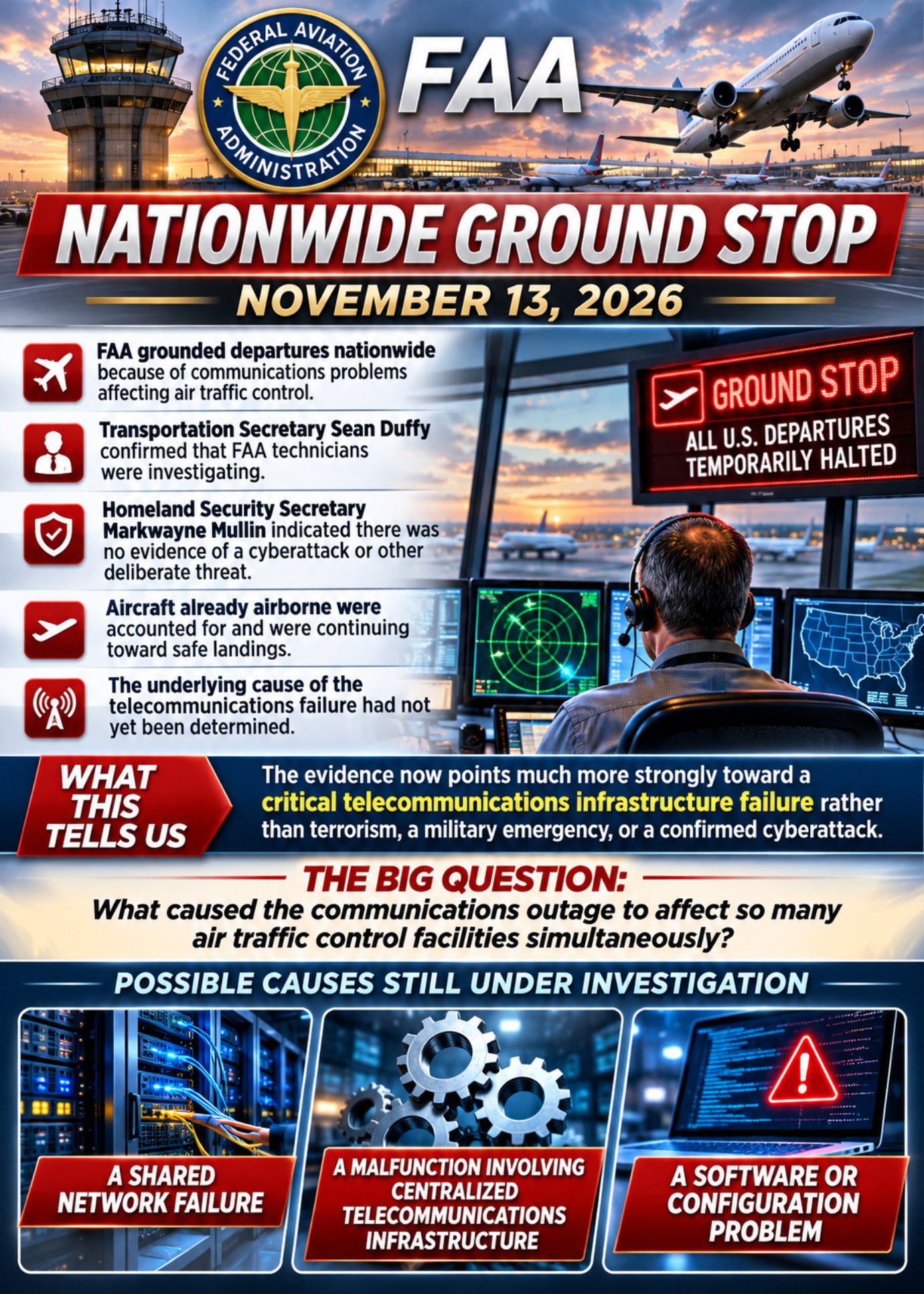
A nationwide ground stop ordered by the Federal Aviation Administration (FAA) on Friday, November 13, 2026, has raised serious questions about the reliability of the nation’s aviation communications infrastructure after problems affecting air traffic control prompted the temporary suspension of aircraft departures across the United States.
The extraordinary action was taken amid concerns about communications systems essential to the safe operation of the national airspace. While the FAA worked to investigate the disruption, aircraft already airborne were accounted for and continued toward safe landings.
Transportation Secretary Sean Duffy confirmed that FAA technicians were investigating the communications problems in an effort to determine what had gone wrong and how normal operations could be safely restored.
Homeland Security Secretary Markwayne Mullin indicated that there was no evidence suggesting the disruption resulted from a cyberattack or another deliberate threat.
Nevertheless, the incident raises important questions about how a telecommunications failure could disrupt air traffic operations on such a widespread scale.
Communications Failure Emerges as Central Concern
The available information points toward a critical telecommunications infrastructure failure rather than a terrorist incident, military emergency, or confirmed cyberattack.
Modern air traffic control depends upon an interconnected network of communications equipment, computer systems, radar facilities, and coordination centers. These systems allow controllers to monitor aircraft movements, communicate with pilots, coordinate flight paths, and maintain safe separation between aircraft.
When a critical part of that infrastructure becomes unavailable, the consequences can extend far beyond the location where the original problem occurs.
A nationwide ground stop represents one of the FAA’s most significant operational responses to a potentially dangerous situation. By preventing additional aircraft from departing, officials can reduce pressure on the air traffic control system while technicians work to identify and correct the problem.
Importantly, a ground stop does not necessarily mean that aircraft already in flight must immediately land. In this case, aircraft already airborne were accounted for and continued toward safe landings.
What Could Have Caused the Widespread Failure?
Although the underlying cause of the telecommunications disruption had not been determined, several possibilities warrant investigation.
A Shared Network Failure
One possibility involves a failure within a communications network shared by multiple air traffic control facilities.
Air traffic control centers depend on telecommunications networks to exchange critical operational information. A disruption involving shared infrastructure could potentially affect numerous facilities simultaneously.
Such a failure might originate with a telecommunications provider, network equipment, or another component supporting communications between facilities.
A Centralized Telecommunications Infrastructure Malfunction
Another possibility involves a malfunction within centralized infrastructure serving multiple FAA facilities.
Although air traffic control operations are geographically distributed, certain communications and information systems depend on interconnected infrastructure.
A problem involving a critical shared component could produce disruptions across a much larger geographic area than the location of the original failure.
Investigators would likely examine whether any common infrastructure was involved in the affected communications systems.
A Software or Configuration Problem
A third possibility involves a software malfunction or an improperly implemented system configuration.
Modern telecommunications networks rely heavily on software to route information, manage network connections, and maintain reliable communications.
A defective software update, configuration error, or unexpected interaction between systems could potentially interrupt communications across multiple facilities.
However, there is currently no established evidence identifying a software or configuration problem as the cause of this particular incident.
Why a Nationwide Ground Stop Is So Significant
The United States operates one of the world’s largest and most complex aviation systems, coordinating thousands of commercial, private, cargo, and other aircraft operations every day.
A nationwide interruption to departures can have consequences extending well beyond the immediate safety concerns.
Airlines may experience scheduling disruptions, aircraft and flight crews can be displaced from their planned routes, and passengers may face delays and missed connections.
Even after a ground stop is lifted, the effects can continue as airlines and airports work to restore normal schedules.
The duration of the disruption, the number of affected flights, and the resulting economic consequences will depend upon how quickly the communications problems can be resolved.
No Evidence of Cyberattack, but Questions Remain
One of the most significant early developments was the indication from Homeland Security Secretary Markwayne Mullin that investigators had found no evidence of a cyberattack or other deliberate threat.
That distinction is important.
A widespread failure involving critical national infrastructure can naturally raise concerns about malicious activity, particularly when the disruption affects a system as essential as aviation.
However, the absence of evidence of a cyberattack does not establish the precise technical cause of the failure.
Investigators must still determine whether the disruption resulted from equipment failure, telecommunications infrastructure problems, software issues, or another previously unidentified cause.
Until that investigation is completed, attributing the incident to any specific technical failure would be premature.
The Bigger Question: How Could So Many Facilities Be Affected?
Perhaps the most troubling aspect of the incident is the possibility that a problem involving shared infrastructure could affect air traffic control operations across the country.
The FAA’s aviation system is designed with multiple facilities, operational procedures, and safety safeguards. Nevertheless, widespread communications disruptions can reveal dependencies that may not be immediately apparent during normal operations.
The investigation will need to establish not only what failed, but also why existing systems and safeguards were unable to prevent the disruption from affecting operations on such a large scale.
Among the questions investigators may need to answer are:
- Did multiple air traffic control facilities depend on the same communications infrastructure?
- Was there a single point of failure within a shared network?
- Were backup communications systems available, and did they function as intended?
- Did a software malfunction or configuration change contribute to the outage?
- What additional safeguards could prevent a similar nationwide disruption?
These questions go beyond the immediate restoration of air traffic operations. They concern the long-term resilience of infrastructure essential to public safety and the national economy.
A Reminder of the 2023 FAA Ground Stop
The November 13 incident also recalls the nationwide aviation disruption of January 11, 2023, when the FAA temporarily halted domestic departures following a failure involving its Notice to Air Missions (NOTAM) system.
That incident demonstrated how a technical malfunction involving aviation information systems could have consequences throughout the national airspace.
Although the circumstances of the two incidents are not necessarily related, both underscore the importance of reliable technology, effective backup systems, and procedures designed to maintain aviation safety when critical infrastructure fails.
What Happens Next?
The immediate priority for federal aviation officials is determining the extent of the communications disruption, identifying its cause, and ensuring that affected systems can operate safely.
A broader technical investigation may be necessary to establish whether the failure exposed weaknesses in the nation’s aviation telecommunications infrastructure.
For travelers, airlines, and aviation personnel, the most immediate concerns involve the restoration of normal operations and the potential for continuing flight disruptions.
For federal officials, the longer-term challenge may be ensuring that a similar incident cannot again interrupt aviation operations on a nationwide scale.
The central question remains unanswered: What caused the communications outage to affect so many air traffic control facilities simultaneously?
Until investigators establish the underlying cause, the November 13, 2026, FAA ground stop remains a significant aviation safety and infrastructure story with potentially important implications for the future reliability of America’s air traffic control system.
Gardner Magazine will continue monitoring developments as federal officials investigate the communications failure and provide additional information about the nationwide aviation disruption.