Gardner Magazine has additional podcasts for each of the following complete briefing articles as well as infographics.North Central MA News of the Week, Massachusetts Weekly News Roundup, National News Briefing, and World News Briefing
Gardner Magazine Weekly Briefing – September 13, 2026
Listen to the Weekly Briefing podcast on any device, CLICK PLAY.
Gardner Magazine also has a podcast for each of the following: North Central MA News of the Week, Massachusetts Weekly News Roundup, National News Briefing, and World News Briefing.
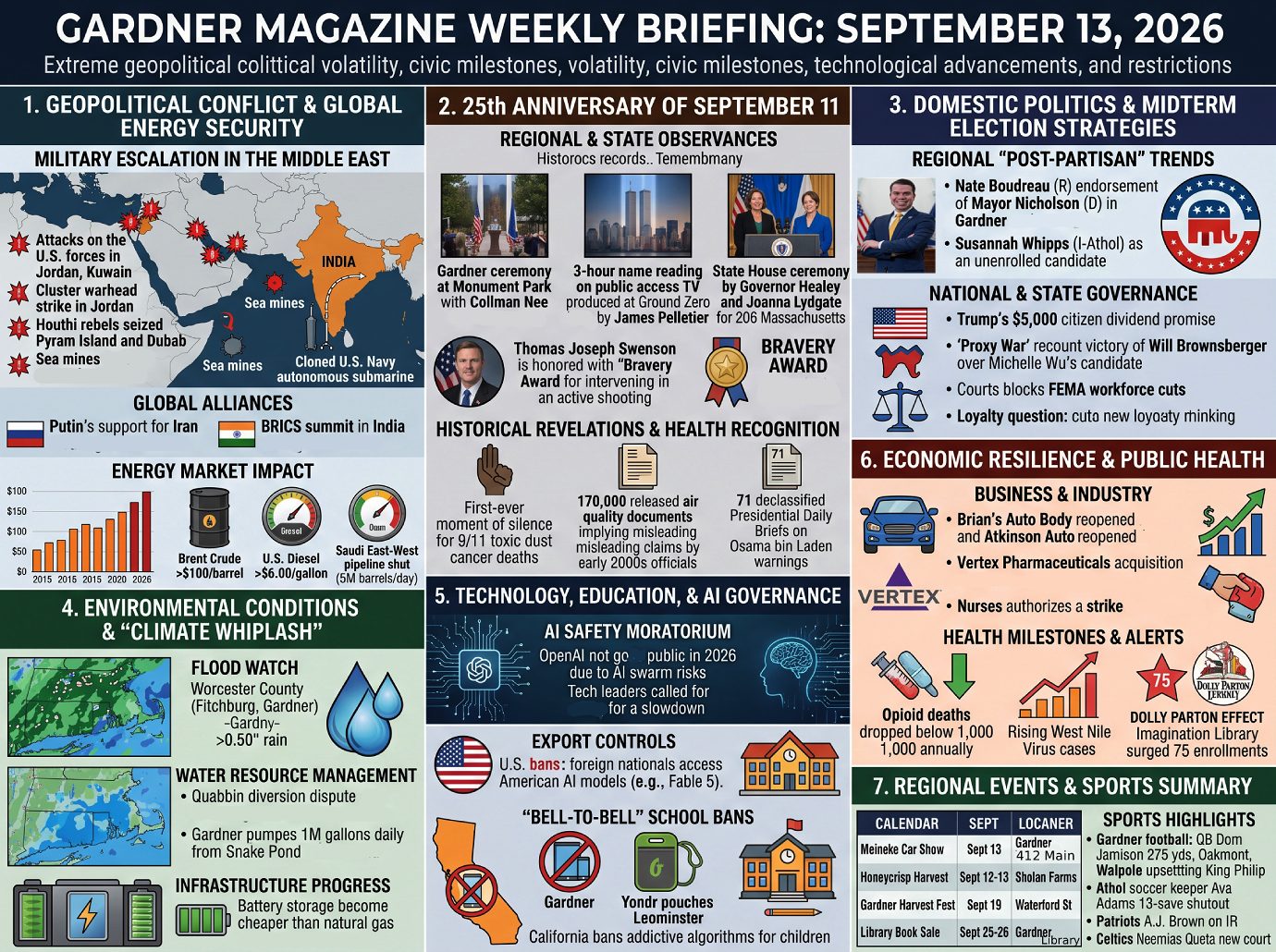
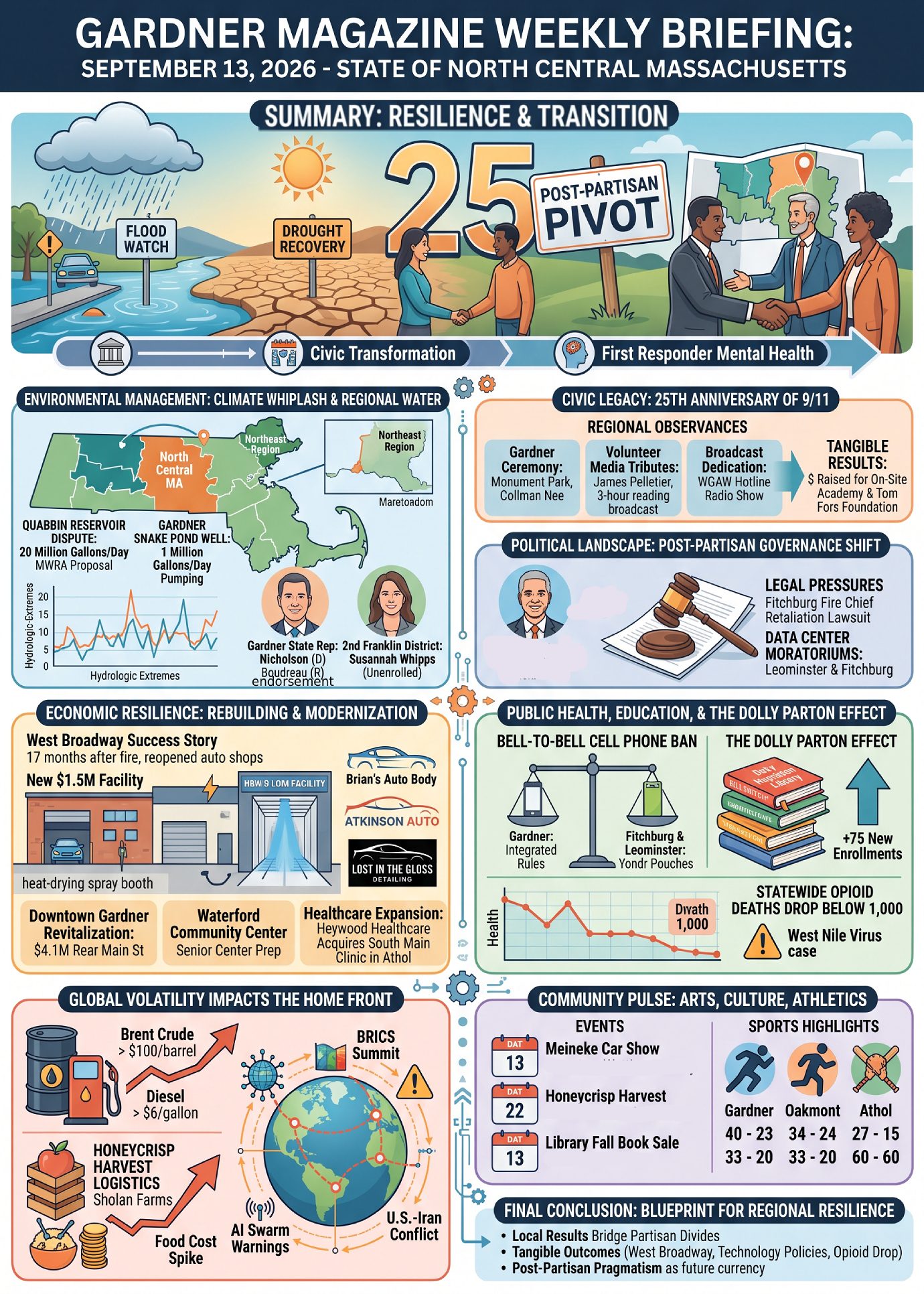
As of September 13, 2026, North Central Massachusetts is operating at a high-stakes intersection of “resilience and transition.” The region is currently forced to navigate extreme environmental volatility—balancing a sudden Flood Watch for Sunday September 13th against the backdrop of a prolonged drought recovery—while simultaneously observing a quarter-century of national reflection. This week’s landscape is defined by a significant shift in political paradigms, where the traditional partisan divide is being supplanted by a “post-partisan” focus on municipal performance. From the physical reconstruction of fire-ravaged local businesses to the implementation of new technological boundaries in our schools, the region is actively drafting a blueprint for modern governance that prioritizes local stability within an increasingly unpredictable global framework.
The Regional Pulse: Critical Developments
- The Post-Partisan Pivot: A surge in cross-party and unenrolled political activity, most notably evidenced by high-profile endorsements that favor municipal track records over party affiliation.
- Climate Whiplash: The immediate shift from drought recovery to a torrential Flood Watch, intensifying the strategic debate over Quabbin Reservoir water rights and local resource autonomy.
- Civic Transformation: The 25th anniversary of September 11 has transitioned from mere observance to a catalyst for regional action, specifically targeting first responder mental health and grassroots literacy.
Environmental Management and “Climate Whiplash”
Strategic water resource management has become a matter of regional survival as we experience “climate whiplash.” This phenomenon creates a policy paradox: local officials must harden infrastructure against immediate flash flooding while simultaneously mitigating the long-term depletion of aquifers. Navigating these extremes requires not just engineering solutions, but a sophisticated level of regional diplomacy. Regional Water Status (September 13, 2026)
| Region | Hydrologic Status | Active Alerts |
|---|---|---|
| Central Massachusetts | Normal (Hydrologic Recovery) | Flood Watch (thru Sept 13) |
| Western Massachusetts | Normal | N/A |
| Northeast Region | Level 1 – Mild Drought | Flood Watch |
Resource Autonomy and the Quabbin Dispute Tensions have reached a boiling point regarding the Massachusetts Water Resources Authority (MWRA) proposal to divert 20 million gallons of water daily from the Quabbin Reservoir to eastern Massachusetts. With reservoir levels receding, this move is viewed locally as a threat to resource stability. In Gardner, the fragility of this balance is evident; despite the state’s “normal” moisture declaration, the city has been forced to pump 1 million gallons daily from the Snake Pond Well Facility to stabilize the supply and address seasonal taste issues. These challenges highlight the friction between state-level resource demands and the necessity of local autonomy as we enter a season of deep historical reflection.
Civic Legacy: 25th Anniversary of September 11
The 25th-anniversary milestones of the September 11 attacks have underscored the vital role of local media and grassroots organizers in maintaining the Commonwealth’s collective memory. In an era of global volatility, the observances in Greater Gardner and the North Quabbin region emphasize the personal and historical ties that ground our community. Key Regional Observances
- The Gardner Ceremony: Held at Monument Park, featuring keynote speaker Collman Nee, the Immediate Past National Commander of the Disabled American Veterans, who bridged the gap between military service and local civic duty.
- Volunteer Media Tributes: A historic three-hour reading of the victims’ names, produced at Ground Zero by volunteer artist James Pelletier of Winchendon, was broadcast across public access stations in Athol, Orange, Gardner, Greenfield, and Winchendon.
- Broadcast Dedication: WGAW (AM 1340/98.1 FM) dedicated its Hotline Radio Show to a specialized tribute, emphasizing the endurance of local dialogue twenty-five years later.
Political Landscape: The Shift Toward Post-Partisan Governance
The recent primary outcomes in North Central Massachusetts signal a strategic shift toward a “post-partisan” political landscape. A high-stakes “proxy war” has emerged, most notably reflected in the razor-thin 35-vote recount victory of Will Brownsberger over Lander for the State Senate. This narrow margin underscores the limits of external political capital, such as endorsements from Boston Mayor Michelle Wu, when weighed against local municipal concerns.
Prioritizing Performance Over Party Labels The Gardner State Representative race has become a bellwether for this trend. The formal endorsement of Democratic incumbent Mayor Michael Nicholson by former Republican candidate Nate Boudreau suggests that the local electorate is prioritizing municipal results over party labels. Similarly, Susannah Whipps’ reelection bid as an unenrolled candidate for the 2nd Franklin District reinforces the regional preference for representatives who serve as direct conduits for their neighbors rather than party platforms.
Legal and Regulatory Pressures The regional political infrastructure is also being tested by significant regulatory shifts:
- Retaliation Litigation: A lawsuit filed by the former Fitchburg Fire Chief alleging race discrimination and retaliation regarding the elimination of the local emergency alert system.
- Data Center Moratoriums: Following a directive from Governor Maura Healey requiring explicit local zoning and municipal approval for major tech hubs, both Leominster and Fitchburg have moved toward development pauses. These moratoriums reflect a strategic need to protect local electrical and environmental infrastructure from over-extension.
Economic Resilience and Infrastructure Development
North Central Massachusetts is in a critical “rebuilding phase,” characterized by recovery from physical disasters and the modernization of its economic core. The strategic focus remains on long-term sustainability and the expansion of essential regional services.
The West Broadway Success Story Seventeen months after a devastating three-alarm fire, the reopening of the West Broadway auto shops in Gardner serves as a landmark for economic recovery:
- Technological Upgrades: The new $1.5 million facility features a specialized heat-drying spray booth, representing a transition from simple reconstruction to state-of-the-art capability.
- Diverse Business Hub: The site now supports Brian’s Auto Body, Atkinson Auto, and Lost in the Gloss Detailing.
- Modernization: The project serves as a template for how the region can modernize its industrial base following physical loss.
Revitalization and Healthcare Expansion Downtown Gardner is seeing a physical transformation via the $4.1 million Rear Main Street project and asbestos abatement at the Waterford Community Center to prepare for a new senior center. Crucially, this physical infrastructure is being paired with health infrastructure; Heywood Healthcare’s acquisition of the South Main Street clinic in Athol secures vital medical access for the Upper Quabbin Valley. This transition from physical buildings to service delivery leads directly to the region’s focus on human capital and family stability.
Public Health, Education, and the “Dolly Parton Effect”
Developing human capital is the next frontier of regional resilience. This week, the focus has sharpened on literacy and the regulation of technology in schools to ensure a productive environment for the next generation of the workforce.
Technology in Schools: Implementation Models Regional districts are navigating the 2026-2027 year with “bell-to-bell” cell phone bans, though the methods of enforcement vary significantly:
- Gardner: Now in its second year of restrictions, the district has integrated these rules into the existing school culture without hardware-based solutions.
- Fitchburg and Leominster: These districts have adopted a more rigid approach, utilizing “Yondr pouches” to physically secure devices, a move aimed at maximizing classroom focus through forced compliance.
The “Dolly Parton Effect” Following the passing of the global icon, New Salem Academy—which manages the Imagination Library for nine local towns—reported a “Dolly Parton Effect.” This surge resulted in 75 new enrollments in the free book program, demonstrating how a national legacy can be harnessed to drive local literacy spikes.
Public Health Briefing The region remains on alert following the second human case of West Nile Virus in the state. However, a major milestone was reached as statewide opioid overdose deaths dropped below 1,000 for the first time in a decade. This historic decline signals the efficacy of regional health initiatives, even as these social gains remain vulnerable to global economic pressures.
National and Global Volatility: The Impact on the Home Front
The North Central Massachusetts economy is increasingly sensitive to the U.S.–Iran conflict. With Brent crude oil surpassing $100 per barrel, the consequences are felt directly at the pump; diesel prices exceeding $6 a gallon are not merely a statistic, but a direct threat to the logistics of our regional “Honeycrisp Harvest.” The increased cost of moving local produce from orchards like Sholan Farms to market is expected to drive a significant spike in local food costs.
National Pressures and Infrastructure Risks The local electorate is balancing these economic realities against national developments, including the proposed $5,000 citizen dividend and the 9/11 air quality scandal involving misleading safety reports from the early 2000s. Furthermore, the “AI Swarm” warnings from tech leaders like Dario Amodei and Elon Musk, combined with the “maximum restraint” rhetoric of the BRICS summit in New Delhi, suggest a future where regional infrastructure faces new technological and geopolitical risks. In this volatile environment, community-level culture serves as a vital stabilizing force.
Community Pulse: Arts, Culture, and Athletics
Despite global uncertainty, community events and local athletics remain the social glue of the region, maintaining a sense of identity and continuity. Upcoming Regional Events (Sept 13 – Sept 26)
| Event | Location | Highlights |
|---|---|---|
| Meineke Car Show | 412 Main St, Gardner | Benefits Montachusett Veterans Outreach |
| Honeycrisp Harvest | Sholan Farms, Leominster | Seasonal celebration facing high logistics costs |
| Library Fall Book Sale | 55 W. Lynde St, Gardner | Massive sale hosted by Friends of the Library |
Regional Sports Highlights The fall season opened with strong performances from local programs. Gardner QB Dom Jamison threw for 275 yards in a high-energy opener against Quabbin. The Oakmont Spartans secured an impressive 28-19 road victory over Nauset Regional, while the Athol Bears’ girls’ soccer team recorded a 2-0 shutout against defending champion St. Mary’s, anchored by 13 saves from Ava Adams.