North Central MA News – Weekly of August 9, 2026
Listen to a Deep Dive update on any device, CLICK PLAY.
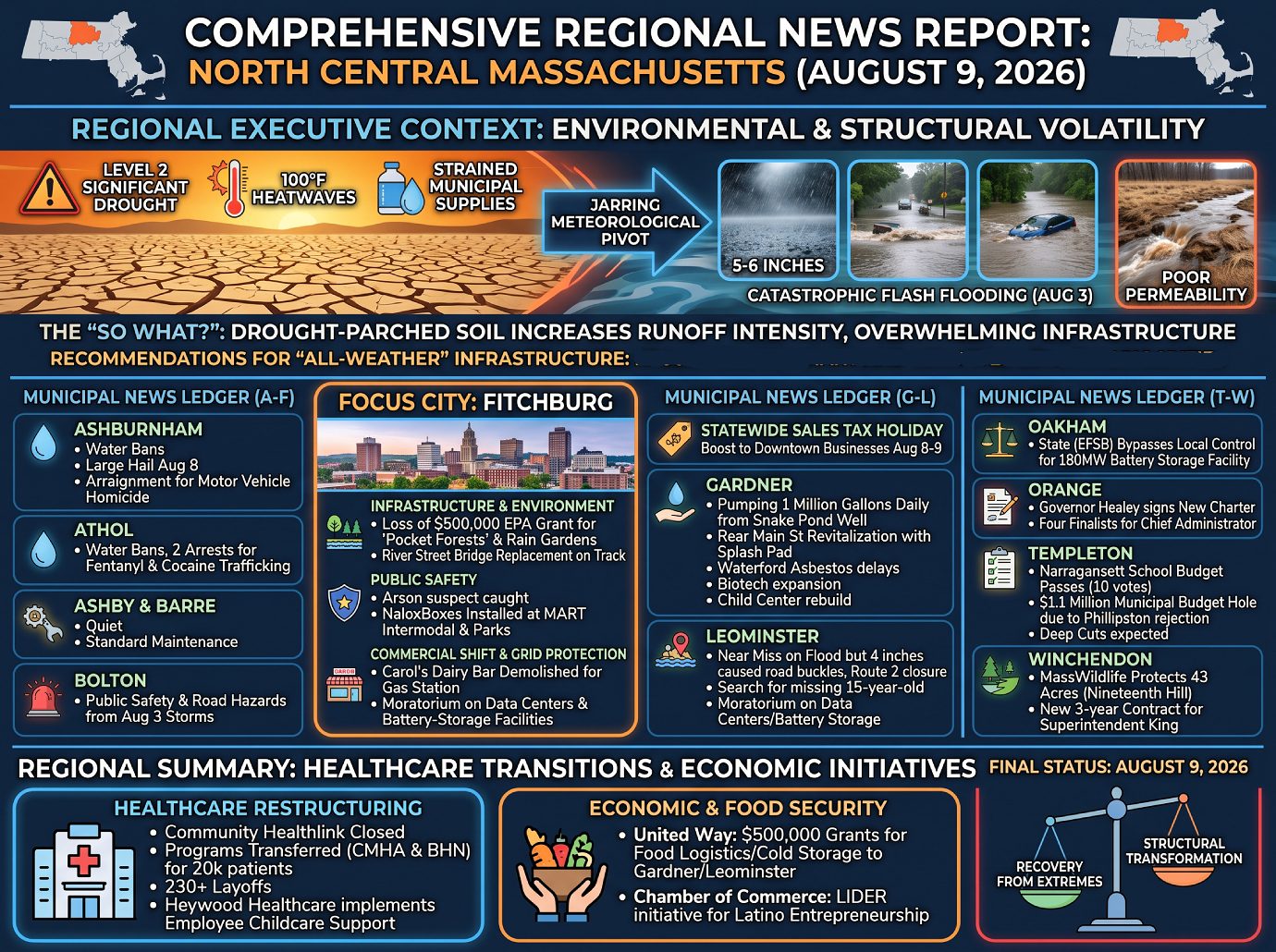
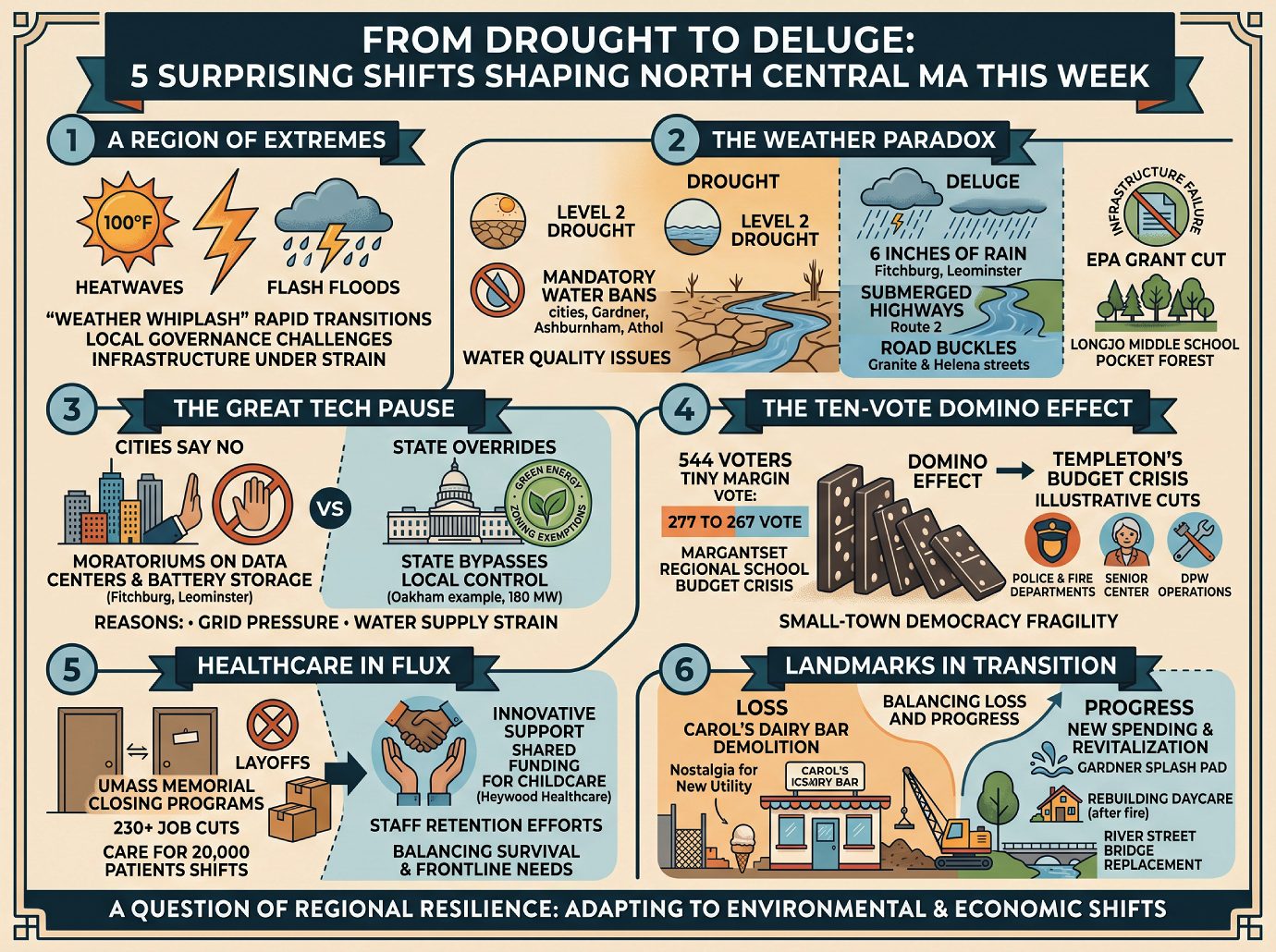
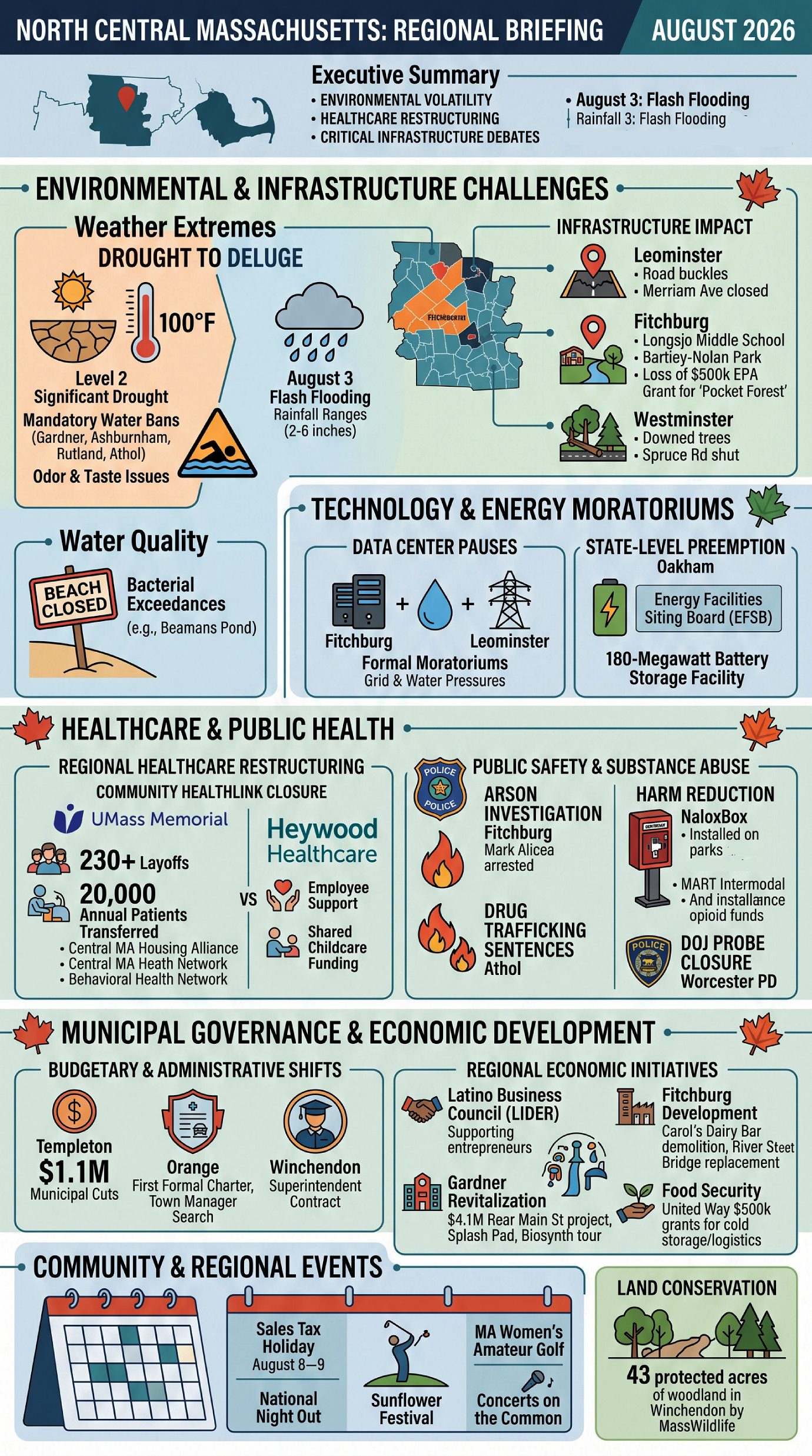
The first week of August 2026 in North Central Massachusetts was defined by a jarring meteorological pivot that tested the limits of regional infrastructure. For weeks, the area had been gripped by a Level 2 Significant Drought, exacerbated by 100°F heatwaves that degraded water quality and strained municipal supplies. This period of extreme heat and dry conditions was abruptly punctuated on August 3 by catastrophic flash flooding. Powerful morning rainstorms dumped between 5 and 6 inches of water across the region in a single morning, triggering emergency responses and exposing critical vulnerabilities in stormwater management and roadway resilience.
The “So What?” of this transition lies in the physics of the landscape. Because the ground was parched and compacted by prolonged drought, it lacked the permeability to absorb such an intense influx of water. Instead of replenishing aquifers, the rainfall became immediate, high-velocity runoff. This resulted in localized washouts, submerged vehicles, and structural damage that far exceeded what a standard 5-inch rainfall would cause on healthy, hydrated soil. For municipal planners, this week serves as a stark case study in the necessity of “all-weather” infrastructure capable of withstanding the rapid oscillation between extreme dryness and sudden inundation.
The following municipal breakdown details how these regional pressures manifested in specific local challenges and strategic policy shifts.
2. Municipal News Ledger: Alphabetical Breakdown (A-F)
While regional weather affects the entire population, the specific responses—ranging from data center moratoriums to emergency budget shifts—reveal how individual towns are navigating the mounting tension between commercial development and resource preservation.
- Ashburnham: The town continues to struggle with environmental and legal volatility. Mandatory water bans remain in effect due to the Level 2 drought, even as the town recently endured large hail (up to one inch) during the August 8 storms.
- Athol: A sharp contrast exists between the town’s environmental restrictions and its judicial activity. While mandatory water bans are strictly enforced, the Northwestern District Anti-Crime Task Force successfully concluded a significant trafficking case. Residents Erica Adams and Jason Maxim were sentenced to state prison (five and three years, respectively) for trafficking fentanyl and cocaine following a local overdose investigation.
- Ashby & Barre: These municipalities have reported a period of relative quiet, focusing on standard summer maintenance, infrastructure upkeep, and preparations for the upcoming state primary.
- Bolton: The primary focus remains on public safety and road maintenance following the August 3 storms, which created exceptionally slick road conditions and hazards for regional commuters.
Focus City: Fitchburg
Fitchburg is currently managing a complex intersection of infrastructure setbacks and public safety initiatives.
- Infrastructure & Environment: The city’s stormwater management capabilities suffered a significant blow with the loss of a $500,000 EPA grant intended for Longsjo Middle School and Bartley-Nolan Park. The loss of this funding abandoned planned “pocket forests” and rain gardens designed to mitigate heavy runoff—the exact type of runoff that overwhelmed the city on August 3. Conversely, the River Street Bridge replacement is a rare bright spot, on track for completion by Labor Day.
- Public Safety: Authorities apprehended Mark Alicea in Connecticut following an arson investigation related to a Myrtle Avenue fire and a high-speed pursuit. Additionally, the Health Department is utilizing opioid settlement funds to install “NaloxBox” rescue stations at the MART Intermodal terminal and city parks.
- Commercial Shift & Grid Protection: The local landscape is changing as the iconic Carol’s Dairy Bar was demolished to make way for a new gas station. Simultaneously, city officials have initiated formal proceedings for a moratorium on new data centers and battery-storage facilities to protect the local power grid and water resources from industrial over-saturation.
The infrastructure pressures and tech-sector pauses in Fitchburg mirror the proactive resource management strategies emerging in the neighboring regional hub of Gardner.
3. Municipal News Ledger: Alphabetical Breakdown (G-L)
In the Greater Gardner area, economic and community development strategies are being recalibrated to offset environmental and budgetary stressors. By focusing on industrial partnerships and infrastructure revitalization, local leaders are attempting to stabilize the economy against a backdrop of volatile weather. This weekend (August 8–9), the Statewide Sales Tax Holiday provided a necessary boost, driving high foot traffic to downtown small businesses and providing a brief reprieve from the prevailing fiscal anxiety.
- Gardner: The city is currently an epicenter of proactive resource management. To address drought-related supply shortages and water quality issues affecting the region, Gardner is pumping one million gallons of fresh water daily from the Snake Pond Well Facility. On the development front, the $4.1 million Rear Main Street revitalization is nearing completion, featuring a new downtown splash pad. Despite delays in the Waterford Community Center project due to asbestos remediation, city leaders are aggressively pursuing growth, recently touring the Biosynth facility to strengthen biotech ties, while the 1 2 3 Grow Child Center is rapidly rebuilding after a total-loss fire.
- Hardwick: Reporting indicates a focus on standard municipal operations and seasonal preparations.
- Hubbardston: The town is in a period of leadership transition following the departure of Interim Town Administrator Sean Fitzgerald. A search committee has been formed to identify a permanent replacement.
- Leominster: The city experienced a “near miss” on August 3, narrowly avoiding a repeat of the 2023 flood disaster. However, the impact was still significant: four inches of rain caused road buckles on Granite and Helena streets and forced the closure of Route 2 at the Merriam Avenue interchange. Beyond the weather, public safety remains a priority as police search for missing 15-year-old Jeilyann Rodriguez. Critically, Leominster has joined Fitchburg in pursuing a moratorium on data centers and battery-storage facilities, signaling a regional trend of municipal resistance to high-impact tech infrastructure.
4. Municipal News Ledger: Alphabetical Breakdown (N-R)
In the rural and suburban sectors of the region, legislative and zoning shifts are exposing a growing conflict between state-level energy mandates and the tradition of “Home Rule.” This tension is fundamentally reshaping the boundaries of local control.
- Oakham: The town has become a primary flashpoint for the debate over municipal authority. The state’s Energy Facilities Siting Board (EFSB) recently bypassed local restrictions to unanimously approve a 180-megawatt battery storage facility. This decision is a significant blow to Local Control, as the state used zoning exemptions to override municipal resistance in favor of regional energy goals.
- Orange: The town is undergoing a historic structural transformation. Governor Healey has signed legislation creating the town’s first formal charter, prompting a search for a new Chief Administrator. Four finalists have been identified for this newly created executive role.
- Phillipston & Princeton: Activities here are centered on fiscal governance. Phillipston voters participated in the Narragansett School budget vote, though the political fallout of Phillipston’s previous override rejection continues to ripple through the district’s financial planning.
- Royalston & Rutland: Both towns remain under strict water restrictions due to the Level 2 drought. Municipal operations have been characterized by routine maintenance and regional National Night Out events.
5. Municipal News Ledger: Alphabetical Breakdown (T-W)
The northern border of the region is defined by fiscal crises and landmark conservation efforts, highlighting the dual challenge of funding essential services while protecting the natural landscape.
- Templeton: The town is facing a severe municipal budget crisis. While the Narragansett Regional School District budget passed by a razor-thin 10-vote margin on August 3, the approval was necessitated by Phillipston’s earlier override rejection. This has left Templeton officials to reconcile a $1.1 million hole in the municipal budget. Cuts are expected to be deep, heavily impacting police, fire, senior services, and the DPW.
- Westminster: The town is recovering from a localized microburst on Spruce Road that caused significant tree damage. Additionally, municipal boards are navigating a citizen’s petition regarding the Crocker Pond Recreation Area, which faced unanimous opposition from local boards ahead of the August 4 vote.
- Winchendon: In contrast to the development pressures elsewhere, Winchendon has secured a victory for land preservation. MassWildlife permanently protected 43 acres of woodland, expanding the Nineteenth Hill Wildlife Management Area. To stabilize the district after years of turnover, Superintendent Charlotte King was signed to a new three-year contract.
This mix of preservation and fiscal austerity leads into a broader regional look at how healthcare and economic initiatives are being reorganized for the long term.
6. Regional Summary: Healthcare Transitions and Economic Initiatives
The regional landscape is undergoing a structural transformation that extends beyond municipal borders, particularly in the sectors of healthcare and economic equity.
Healthcare Restructuring The closure of Community Healthlink has reached its final phase, with substance abuse and mental health programs being transferred to the Central Massachusetts Housing Alliance and the Behavioral Health Network to ensure continuity for 20,000 patients. However, this transition has come at a high human cost, resulting in over 230 layoffs across the UMass Memorial system. In a vital counter-maneuver to support the regional workforce, Heywood Healthcare has implemented new employee support systems, including shared-funding initiatives for childcare, aimed at retaining staff during this period of volatility.
Economic and Food Security Addressing immediate community needs, the United Way of North Central Massachusetts has deployed $500,000 in grants targeted at the logistical “last mile” of food security. This funding focuses on cold storage and transportation to move donations effectively into Gardner and Leominster. Simultaneously, the North Central Massachusetts Chamber of Commerce has launched LIDER (Latino Initiative for Development of Entrepreneurship and Resources) to provide capital and networking for the region’s fastest-growing entrepreneurial segment.
Final Status: August 9, 2026 As of this report, North Central Massachusetts stands at a crossroads of Recovery from Extremes and Structural Transformation. While the region clears the debris from the August 3 floods and manages the ongoing drought, it is simultaneously rewriting its foundational rules—from Orange’s new charter to the regional pushback against tech infrastructure. The coming weeks will determine if these new administrative and environmental strategies can provide the stability needed to survive a climate of increasing volatility.