
More Than Just a Name: Positive Lessons in Community from the Appointments Committee Meeting – Article and Commentary.
Listen to the entire meeting on any device, CLICK PLAY.
On Tuesday, June 9, 2026, at 5:30 p.m., the air in the Gardner City Hall was thick with the quiet hum of municipal procedure. To an outsider, the scene was the very definition of local bureaucracy: the “Rules of Order” posted strictly on the wall, the steady “roll call” of councilors, and the unblinking eye of the camera in the corner recording for the city’s YouTube channel. Yet, as the Appointments Committee began its work, the rigid framework of “Robert’s Rules” couldn’t quite contain the humanity that spilled out.
A city is more than its ordinances or its budget lines. It is a living mosaic—a collection of characters, histories, and specific lifetimes of service. In this one hour of governance, we find that the “heart” of a community beats most clearly in the people who step forward to care for its past, its youth, and its shared spaces.
When Service Becomes a “Lifestyle,” Not Just a Job
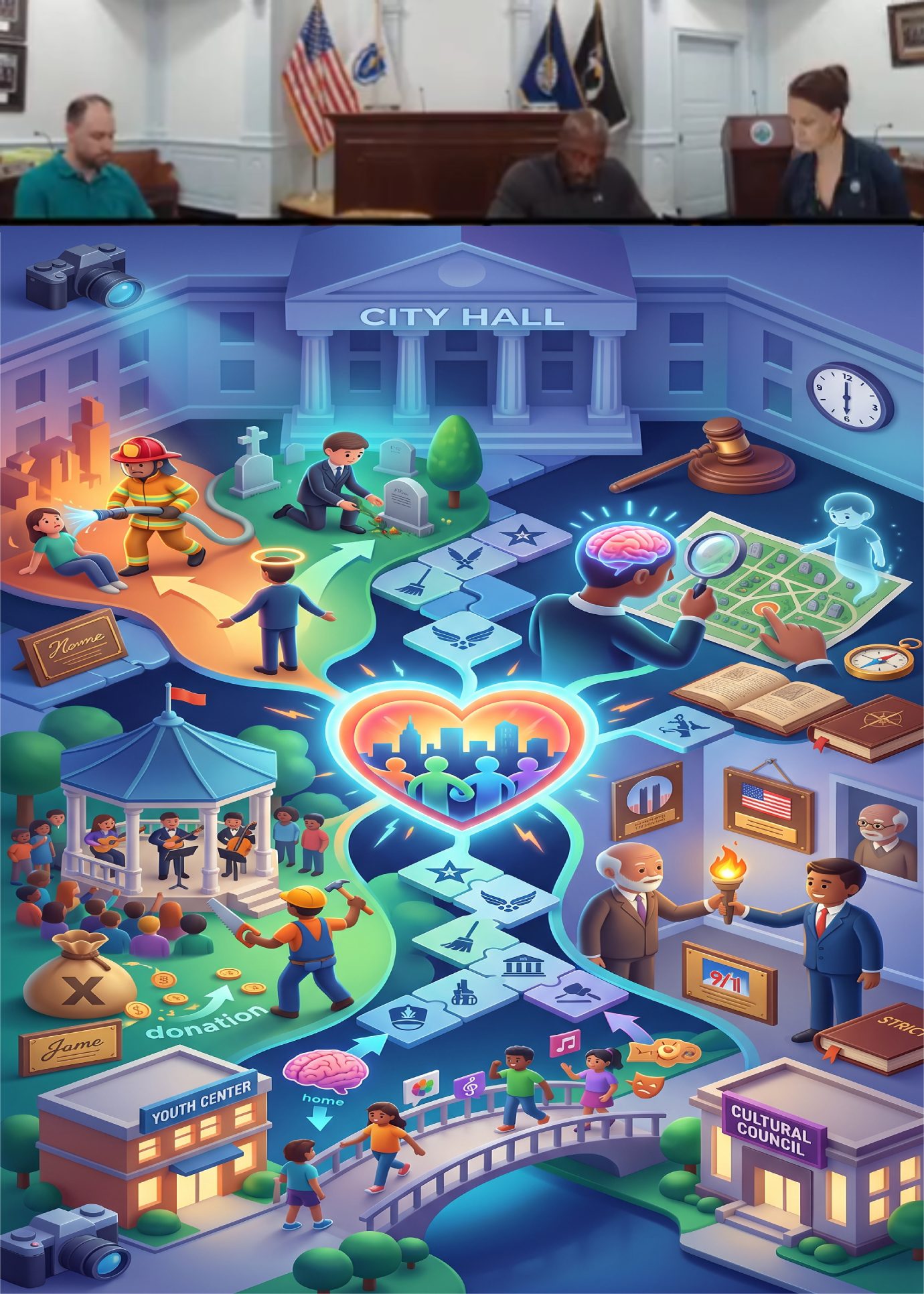
The appointment of Brighton Cormier to the Cemetery Commission revealed the profound duality that often defines small-town service. Cormier isn’t just a community volunteer; he is a local firefighter who also spent his life working in his family’s funeral home.
There is a quiet poetry in this combination. During the day, he operates in the high-stakes world of emergency services, fighting to save lives. In his “off” hours, he draws on a lifetime of experience in the funeral industry to honor those who have already passed. For Cormier, this isn’t just work; it is a spiritual orientation toward his neighbors at their most vulnerable.
“Death is pretty much like a lifestyle, as everyone always says… being able to give your whole heart and soul to the people in the community who are dying, as well as trying to save them in the other part of it.” — Brighton Cormier
The Practical Power of Local Institutional Memory
The case of Don Robinson’s appointment to the Cemetery Commission served as a reminder that some of a city’s most vital assets aren’t stored in a computer, but in the memories of its residents. Robinson recently retired after twenty years of managing the three Catholic cemeteries in Gardner—a job that involved overseeing 30 acres of hallowed ground and 150 burials a year.
This kind of hyper-local knowledge is irreplaceable. The Mayor shared a poignant example: years ago, his own grandfather had lost the location of an infant sister’s grave. It was Robinson who, through decades of intimacy with the land, was able to provide the family with a map to finally find her. In an era of digital records, there is still no substitute for the man who knows the history of every acre and the stories buried within them.
The “Zero-Dollar” Model of Civic Pride
Sustainability is a buzzword in government, but the Gardner Bandstand Committee—highlighted during the reappointments of Nancy Binder and Michael Zlotnik—offers a masterclass in how to achieve it. This committee produces a full summer of concerts without using a single penny of taxpayer money, relying entirely on sponsorships and local donations.
What makes this model remarkable is its evolution. Councilor Brad Heglin noted that the committee wasn’t always a formalized city body; it began as a purely grassroots, volunteer effort. Today, that spirit remains. Members like Michael Zlotnik embody this “sweat equity” legacy—he was actually part of the original volunteer crew that physically built the bandstand. If you look closely at the structure today, you’ll find his name etched on the plaque, a tangible symbol of the ten Saturdays every summer these volunteers sacrifice to keep the music playing.
The Tangible “Torch” of Leadership
Small-city governance is often a relay race, and the appointment of former Mayor Daniel Kelly to the Council on Aging provided a moving look at the “baton” being passed. Current Mayor Michael Nicholson recounted the story of a “United We Stand” 9/11 plaque that his own grandfather had made for Kelly back in 2001.
The plaque stayed in Kelly’s office throughout his term and followed him into private life. But in 2010, at the grandfather’s funeral, Kelly returned the plaque to the family, offering it back as a source of strength during their own “hard times.” On the current Mayor’s first day in office, he hung that same plaque back on the wall where his grandfather and Kelly had first placed it. It serves as a reminder that the stability of a city is built on these intergenerational gestures of kindness and professional respect.
Reimagining “Culture” Through the Eyes of the Youth
Perhaps the most forward-thinking lesson came from the appointment of Brandon Huey to the Cultural Council. Huey is the city’s Youth Center Director, and he intentionally sought this role to bridge the gap between the Youth Commission and the city’s cultural programming.
Huey’s philosophy is a strategic one for any town facing a “brain drain.” He argues that a person’s decision to stay in their hometown—to view it as their permanent home—is often decided during the experiences of their youth. By intentionally marketing “culture” to young people, the city isn’t just providing entertainment; it is building a sense of belonging. It is a holistic approach to municipal health: you save the future by engaging the present.
The Vibrant Mosaic of the “Model City for America”
A functioning municipality requires a diverse cast of characters to truly work. It needs people like Richard Ru, a 12-year Vietnam-era Air Force veteran who spent 50 years in the industry, starting as a janitor and draftsman before working his way up to marketing manager and engineer. He is the man who “knows when to talk and when to be silent.”
It needs people like Marion Knoll, the Gardner Museum curator whose energy is described as “infectious.” Knoll represents the deep social fabric of Gardner; long before she was an official appointee, she was the Mayor’s “band parent” during his high school marching band days.
When these individuals step out from behind the “camera in the corner” and take their seats at the table, they are doing more than filling vacancies. They are mapping the future while preserving the past and contributing to why we call Gardner the “Model City for America.”
Werner Poegel – Publisher