U.S. National News Briefing for the week of November 22, 2026
Listen to the National News Briefing on any device, CLICK PLAY.
The United States enters Thanksgiving week following a historic midterm election, with major developments involving President Donald Trump, the incoming Democratic-controlled Congress, the war with Iran, economic uncertainty, immigration enforcement, artificial intelligence, and the federal courts.
This briefing ranks 40 important national developments by their potential consequences for Americans, their national significance, and their continuing relevance. It includes breaking news, ongoing stories, and major policy developments.
Because November 22 has not yet begun in the Eastern United States, this is an advance Sunday edition. The summaries distinguish completed actions from proposals, investigations, and developments still unfolding.
This Week’s Top 40 U.S. National News Stories
Politics, the White House and Congress
1. Democrats Win Control of Both Houses of Congress in Historic Midterm Election
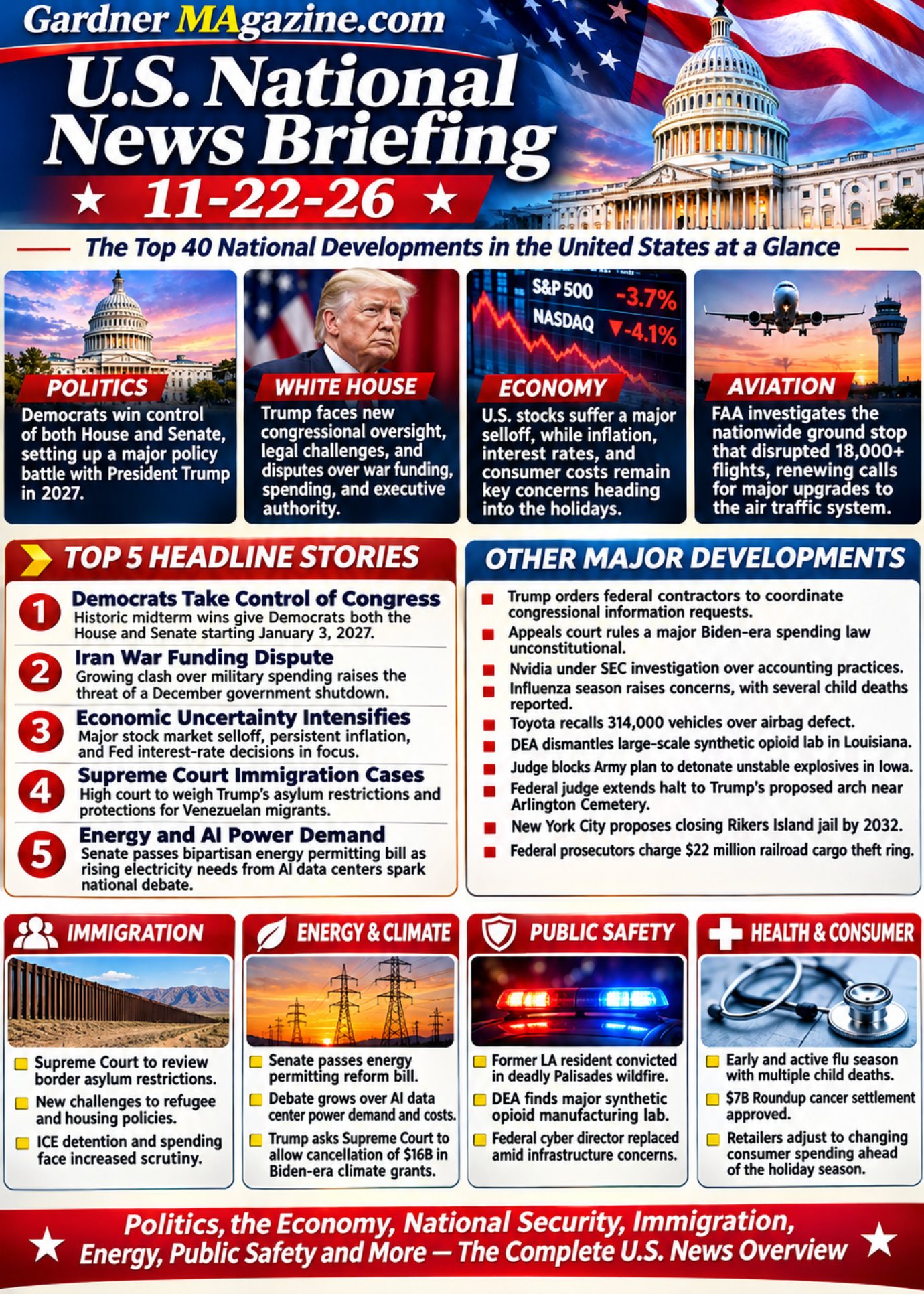
The November 3 midterm elections delivered a sweeping Democratic victory, giving the party control of both the House of Representatives and the Senate beginning January 3, 2027. Reuters reports that Democrats are expected to enter the new Congress with a 56–44 Senate majority and at least a 257–172 House advantage, with some House seats not yet reflected in those totals. The election represents a major setback for President Trump and congressional Republicans. Voter concerns about living costs, the war with Iran, and government accountability contributed to the outcome. The results set up a potentially contentious final two years of Trump’s presidential term, with Democrats able to advance legislation and conduct investigations, while the president retains his veto power.
2. Democrats Prepare Major Legislative Agenda for January 2027
Democratic leaders are preparing an ambitious legislative agenda following their election victory. Their priorities include reducing living costs, reversing cuts to Medicaid and food assistance, restricting presidential authority to wage war without congressional approval, and prohibiting congressional insider stock trading. Progressives are also pressing for a higher federal minimum wage, increased taxes on wealthy Americans, campaign-finance reform, and stronger environmental protections. However, the party’s 56-seat Senate majority falls short of the 60 votes generally required to overcome a filibuster on ordinary legislation. President Trump could also veto measures that reach his desk.
3. Iran War Funding Dispute Raises Threat of December Government Shutdown
A developing confrontation over funding for the war with Iran is increasing the possibility of a federal government shutdown in December. Lawmakers are debating the administration’s military expenditures and the authority of Congress to oversee continuing operations. The disagreement comes at a politically sensitive moment as Democrats prepare to take control of Congress. A shutdown could disrupt federal services, delay government operations, and create additional economic uncertainty.
4. Trump Administration Orders Federal Contractors to Coordinate Congressional Information Requests
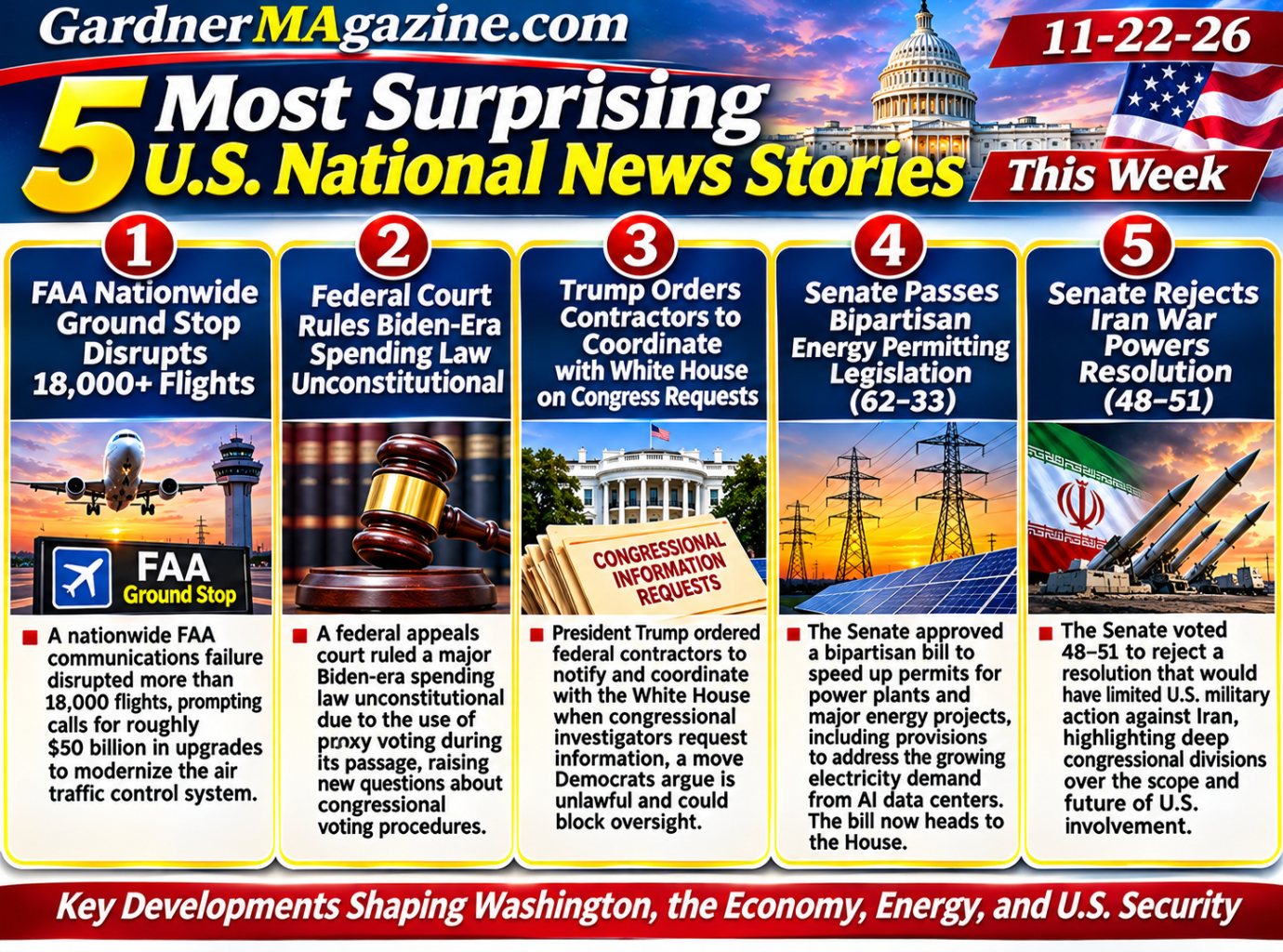
President Trump has directed federal contractors to notify the White House when congressional investigators request information concerning their government work. The contractors are also being instructed to coordinate responses with the administration. Democrats argue that the directive is unlawful and could interfere with congressional oversight, particularly as they prepare investigations after taking control in January. The controversy could develop into a major constitutional dispute over executive authority and Congress’s investigative powers.
5. Federal Appeals Court Rules Major Biden-Era Spending Law Unconstitutional
A federal appeals court ruled that a large pandemic-era spending law passed during the Biden administration was unconstitutional because lawmakers used proxy voting during its passage. The ruling raises significant questions about congressional voting procedures and the legal status of legislation approved under emergency arrangements.The eventual consequences will depend on further litigation and any higher-court review.
6. Trump-Endorsed Republican Candidates Face Scrutiny Following Election Defeats
The midterm results have intensified debate within the Republican Party about President Trump’s influence over electoral outcomes. An analysis of Senate, House, and gubernatorial races found substantial setbacks among Trump-endorsed candidates. Republicans are now debating whether their future electoral strategy should continue emphasizing Trump’s political style or shift toward candidates with broader appeal. The discussion is particularly consequential as the party begins considering potential presidential candidates for 2028.
7. Vice President JD Vance Faces Questions About His Political Future
Following Republican losses in the midterms, party leaders and activists are beginning to debate their options for the 2028 presidential election. Vice President JD Vance remains a prominent potential candidate, but some Republicans are exploring alternatives, including current and former governors. The election results have created uncertainty about which political approach could restore Republican support among independent and moderate voters.
8. Vice President Vance and Michigan’s Abdul El-Sayed Move Toward Meeting
Vice President JD Vance and Michigan political figure Abdul El-Sayed are reportedly moving toward a meeting following a contentious midterm election. The development has attracted national attention because of the sharp political disagreements that characterized the election. Whether such discussions produce meaningful cooperation remains uncertain.
9. Trump Nominee to Lead Federal Election Security Agency Faces January 6 Controversy
A Trump administration nominee to lead a federal election security agency has drawn attention for asserting that the January 6, 2021, attack on the U.S. Capitol was not an “attack.” The comments have raised questions about the nominee’s interpretation of political violence and election security. The nomination could become a significant issue as Congress examines federal election administration and institutional independence.
10. Justice Department Investigation Examines Alleged Alaska Senate Election Scheme
The Justice Department’s investigation into an alleged scheme involving a spoiler candidate in Alaska’s Senate election has reportedly shifted toward the campaign of Senator-elect Mary Peltola and Democratic political operatives. Investigators are examining whether efforts were made to influence the election by manipulating the candidate field. The investigation does not establish wrongdoing by those being examined, and its outcome remains uncertain.
Economy, Inflation, Energy and Technology
11. U.S. Stock Market Suffers Major Selloff as Technology Shares Plunge
American financial markets experienced a sharp decline during the week ending November 20. The S&P 500 fell 3.7% on Friday, while the Nasdaq Composite moved into negative territory for the year. Investors are questioning the valuations of artificial intelligence companies and the sustainability of enormous technology-sector investment. The decline has implications for retirement accounts, investment portfolios, business confidence, and the broader economy.
12. Inflation and Consumer Confidence Become Central Concerns Ahead of Thanksgiving
Americans are approaching the holiday season facing persistent pressure from grocery prices, gasoline costs, housing expenses, and other necessities. Economic reports scheduled for Thanksgiving week will provide important new information about inflation, consumer confidence, economic growth, and unemployment claims. The Federal Reserve’s preferred inflation measure, the Personal Consumption Expenditures price index, is expected Wednesday. These figures could influence future interest-rate decisions and expectations for the economy in 2027.
13. Federal Reserve Faces Difficult Interest-Rate Decision
The Federal Reserve is confronting conflicting economic signals. Inflation remains a concern, partly because of higher energy prices associated with the Iran conflict and continuing trade tensions. Meanwhile, economic growth has remained positive, with third-quarter GDP initially estimated at 3.4%. Higher interest rates could help control inflation but also increase borrowing costs and discourage hiring and investment. The central bank must balance price stability against the risk of slowing economic activity.
14. Trump Threatens Heavy Taxes on American Companies Building AI Data Centers Overseas
President Trump has proposed imposing substantial taxes on American technology companies that construct artificial intelligence data centers outside the United States. The president argues that major AI infrastructure investment should remain in America, supporting domestic employment and technological leadership. The proposal could affect multinational technology companies and the international distribution of computing infrastructure. The precise tax mechanism and its potential legal implementation remain uncertain.
15. Nvidia Faces Reported SEC Investigation Into Accounting Practices
The Securities and Exchange Commission is reportedly investigating accounting practices at Nvidia, one of the world’s most influential artificial intelligence chip manufacturers. The investigation comes amid increased scrutiny of technology valuations and AI-related spending. An investigation does not establish wrongdoing, but the matter is attracting attention because Nvidia plays a central role in the artificial intelligence economy.
16. Senate Passes Bipartisan Energy Permitting Reform Legislation
The U.S. Senate approved the Bipartisan American Affordability and Jobs Act of 2026 by a vote of 62–33. The legislation would accelerate federal approvals for power plants, transmission lines, and other major energy projects. It also includes provisions intended to require data centers to pay for the electricity they consume, reducing the risk that residential customers will bear those costs. Supporters say the legislation could expand energy supplies and lower prices. Critics argue that changes to environmental review requirements could weaken protections for wildlife, waterways, and public lands. The bill still requires House approval.
17. Electricity Costs and AI Data Center Expansion Become Major National Issue
The rapid growth of artificial intelligence is increasing electricity demand and raising concerns about the capacity of America’s power grid. Lawmakers are debating whether technology companies should be required to finance additional generating capacity and transmission infrastructure. The issue is increasingly important to households because utility companies may need expensive improvements to meet rising demand. The Senate’s energy legislation attempts to address some of these concerns, but questions remain about environmental protections and the pace of new construction.
18. American Economic Growth Remains Positive Despite Consumer Anxiety
The government’s initial estimate showed third-quarter economic growth of 3.4%, compared with 2.2% in the second quarter. Investment associated with artificial intelligence has contributed significantly to growth. However, many consumers continue to report dissatisfaction with everyday living costs. The contrast between positive economic statistics and household financial pressure is likely to remain an important political issue.
19. Trump Administration Asks Supreme Court to Permit Cancellation of $16 Billion in Climate Grants
The Trump administration has asked the Supreme Court to intervene in a dispute over approximately $16 billion in Biden-era clean-energy grants. The Environmental Protection Agency canceled the grants, which were intended to support clean-energy financing through nonprofit organizations. The administration has alleged mismanagement and possible fraud, but a federal judge said the agency had not provided evidence supporting its fraud allegations. An appeals court ruled that the cancellations were improper. The Supreme Court has not yet decided whether to review the case. The outcome could significantly affect the executive branch’s authority to terminate federal grant programs.
20. American Retailers Face Uncertainty as Consumer Spending Patterns Shift
Major retailers are monitoring consumer spending as Thanksgiving and the Christmas shopping season approach. Gap lowered its business outlook as warmer weather reduced demand for seasonal clothing. The development illustrates how retailers are confronting changing weather patterns, cautious consumers, and uncertainty about discretionary spending. Holiday sales will provide an important indication of household confidence and the health of the consumer economy.
Immigration, the Courts and Federal Policy
21. Supreme Court Agrees to Review Trump’s Border Asylum Restrictions
The Supreme Court will examine the legality of President Trump’s policy restricting asylum applications at the southern border. The administration argues that the restrictions are necessary to protect national security and control unlawful immigration. Immigration advocates maintain that federal law provides protections for people seeking asylum from persecution. The case could determine how much authority a president possesses to restrict asylum access without additional congressional legislation.
22. Trump Administration Returns to Supreme Court Over Venezuelan Deportation Protections
The administration has again asked the Supreme Court to intervene in litigation concerning Temporary Protected Status for Venezuelan migrants. The dispute involves humanitarian protections previously granted to hundreds of thousands of Venezuelans. The Justice Department is seeking to prevent a lower-court ruling from restoring protections while litigation continues. The case could affect employment authorization, deportation proceedings, and legal residency for many people currently living in the United States.
23. Federal Judge Questions Changes to Refugee Immigration Procedures
A federal judge in Boston has raised concerns about Trump administration changes affecting refugees admitted during the Biden presidency. The policies reportedly suspended approximately 113,000 pending permanent-residence applications and reduced the time refugees have to challenge termination of their legal status. The judge questioned whether a shortened appeal period provides sufficient opportunity for individuals to gather evidence and respond. The administration argues that the changes support public safety and immigration enforcement.
24. Lawsuits Challenge Federal Housing Assistance Restrictions on Mixed-Status Immigrant Families
Legal challenges have been filed against a Trump administration rule ending certain housing assistance for families containing members with different immigration statuses. The controversy involves the eligibility of households that include both citizens or legally present residents and people without qualifying immigration status. Supporters of the administration’s approach argue that federal housing assistance should be restricted to eligible recipients. Opponents warn that entire families, including American children, could lose housing stability.
25. ICE Detention and Deportation Spending Face Growing Scrutiny
Immigration and Customs Enforcement is facing questions about detention planning, federal spending, and oversight of deportation operations. Government accountability concerns include detention capacity and the use of private contractors. A separate report identified a noncompetitive aviation staffing arrangement worth up to $305.7 million and a larger contract supporting deportation flights. Critics argue that outsourcing and restrictions on flight-tracking information may make enforcement activities harder to monitor.
26. Immigration Judges Challenge Restrictions on Public Speech
Immigration judges are asking the Supreme Court to allow a legal challenge to a Trump administration policy restricting their public comments about immigration matters. The judges argue that the policy infringes on their First Amendment rights and limits public understanding of the immigration court system. The Justice Department maintains that judges may express personal opinions but must avoid undermining public confidence in their official roles. The dispute raises broader questions about free speech and the independence of immigration adjudicators.
Public Safety, Transportation and National Security
27. FAA Investigates Nationwide Ground Stop That Disrupted More Than 18,000 Flights
The Federal Aviation Administration continues investigating the November 13 communications failure that temporarily halted departing aircraft nationwide. The disruption affected more than 18,000 flights and approximately one million passengers. Investigators have focused on network equipment and data overload associated with telecommunications upgrades. Transportation Secretary Sean Duffy has requested approximately $50 billion in additional funding to modernize air traffic control systems, although lawmakers have questioned the amount. The incident exposed vulnerabilities in aging aviation infrastructure shortly before the Thanksgiving travel period.
28. Thanksgiving Travel Rush Approaches Amid Aviation Reliability Concerns
Millions of Americans are preparing to travel for Thanksgiving, with approximately 29 million people expected to fly during the holiday period. The recent nationwide FAA outage has intensified concerns about flight delays, cancellations, and the resilience of the air traffic control system. Airlines and federal officials are working to maintain reliable operations during one of the busiest travel periods of the year. Travelers are being encouraged to monitor flight schedules and allow additional time for airport travel.
29. Federal Court Halts Army Plan to Detonate Five Tons of Unstable Explosives in Iowa
A federal court has temporarily blocked a U.S. Army plan to detonate approximately five tons of deteriorating lead azide at the Iowa Army Ammunition Plant. The Army argues that the material has become unstable and poses an explosion risk if moved. Environmental organizations and local residents fear that detonation could spread toxic lead dust into nearby communities. The dispute has raised questions about public notification, environmental protection, and emergency military disposal procedures.
30. DEA Discovers Large-Scale Manufacturing Laboratory Producing Extremely Potent Synthetic Opioids
Federal authorities have dismantled what the Drug Enforcement Administration describes as the first known large-scale nitazene manufacturing laboratory uncovered in the United States. The laboratory, discovered in Louisiana, was reportedly producing etonitazene, an extremely potent synthetic opioid. Nitazenes are particularly dangerous because some compounds can be substantially more powerful than fentanyl. The discovery raises concerns that illicit domestic manufacturing could create new challenges for law enforcement, addiction treatment, and overdose prevention.
31. Toyota Recalls More Than 300,000 Vehicles Over Dangerous Airbag Defect
Toyota is recalling approximately 314,000 older Toyota and Lexus vehicles because of concerns that certain Takata passenger-side airbag inflators could rupture during a crash. Affected vehicles include selected model years of the Corolla, Tundra, Sequoia, 4Runner, and several Lexus models. Toyota says dealers will provide replacement repairs without charge. Owners can check their vehicle identification number through the National Highway Traffic Safety Administration recall database. The 0400 Report
32. Former Los Angeles Resident Convicted of Starting Fire That Became Deadly Palisades Wildfire
A federal jury convicted a former Los Angeles resident of deliberately starting a fire that subsequently developed into the devastating 2025 Palisades Fire. The wildfire caused extensive destruction and became one of California’s most consequential recent disasters. The conviction represents a significant development in the investigation into the fire’s origins. The case also highlights the enormous public-safety consequences that intentional fires can have under dangerous weather and vegetation conditions.
33. Federal Government Replaces National Cyber Director Amid Technology Outage Concerns
The White House has replaced National Cyber Director Sean Cairncross during a period of heightened concern about major technology disruptions and infrastructure reliability. The change comes as federal officials examine vulnerabilities involving aviation communications and other critical systems. The administration’s cybersecurity leadership will face questions about protecting federal networks, coordinating with private industry, and responding to future outages.
Health, Environment and Major Legal Developments
34. Early Influenza Season Raises Concerns as Pediatric Deaths Are Reported
Health officials are monitoring an early increase in influenza activity. National reporting indicates that at least seven children have died and approximately 50,000 people have received hospital treatment amid the seasonal increase in flu-related illness. The Centers for Disease Control and Prevention is warning that influenza cases and hospitalizations could continue rising. The situation is particularly important as holiday gatherings and travel increase opportunities for respiratory viruses to spread.
35. Judge Approves $7 Billion Settlement Over Roundup Cancer Claims
A judge has approved a proposed $7 billion settlement involving claims that exposure to the herbicide Roundup caused cancer. The nationwide class-action agreement is intended to resolve tens of thousands of lawsuits involving allegations of non-Hodgkin lymphoma. The litigation has drawn national attention because of the widespread agricultural and residential use of glyphosate-based weed killers. The settlement represents a major development in long-running litigation involving product safety, corporate responsibility, and environmental health.
36. Supreme Court Declines to Review State Restrictions on Firearms in Sensitive Locations
The Supreme Court declined to take up a case challenging restrictions on carrying firearms in designated sensitive locations. Such locations can include government buildings, public transportation facilities, hospitals, stadiums, and parks. The decision leaves the challenged restrictions in place without establishing a new nationwide rule. The dispute reflects continuing disagreements over the scope of the Second Amendment and the authority of states to regulate firearms in public spaces.
37. Federal Judge Blocks Construction of Trump’s Proposed Monumental Arch Near Arlington
A federal judge has extended an order preventing the Trump administration from beginning construction of a proposed 250-foot memorial arch near Arlington National Cemetery. The project has attracted opposition from preservation advocates, local governments, and other plaintiffs. Critics argue that the structure could interfere with historic views and may require additional congressional authorization. The administration maintains that the project is lawful and intends to continue defending it in court.
38. New York City Mayor Proposes Closing Rikers Island Jail by 2032
New York City Mayor Zohran Mamdani has proposed a plan to close the city’s notorious Rikers Island jail complex by 2032. The plan includes reducing the jail population and transitioning to four smaller borough-based facilities. The proposal has national significance because Rikers Island has long been at the center of debates about correctional conditions, detainee rights, public safety, and criminal justice reform. Questions remain about financing, construction schedules, and whether the city can meet the proposed deadline.
39. Federal Prosecutors Pursue Alleged $22 Million Railroad Cargo Theft Operation
Federal prosecutors have charged men accused of participating in an organized railroad cargo theft operation involving more than $22 million in merchandise. Authorities allege that the defendants targeted trains carrying products for major retailers and disabled trains to steal their cargo. The case illustrates the growing concern over organized theft affecting American freight transportation and commercial supply chains. Cargo security has become an important issue for railroads, logistics companies, and retailers.
40. Women’s Professional Soccer Championship Highlights Growth of American Women’s Sports
The 2026 National Women’s Soccer League championship between the Washington Spirit and Kansas City Current is drawing attention to the expanding profile of women’s professional sports. The league’s growth is raising questions about investment in stadiums, training facilities, player development, and long-term financial sustainability. The championship provides a national showcase for women’s soccer at a time when interest in the sport continues to grow.