An Interview with Superintendent Dr. Chris Casavant and Business Manager Ann Marie Geyster of the Narragansett Regional School District.
Listen to the interview on any device, CLICK PLAY.
Key operational, financial, and programmatic insights regarding the Narragansett Regional School District (NRSD), derived from an interview conducted by Gardner Magazine Publisher Werner Poegel with Narragansett Regional School Superintendent Dr. Chris Casavant and Business Manager Ann Marie Geyster.
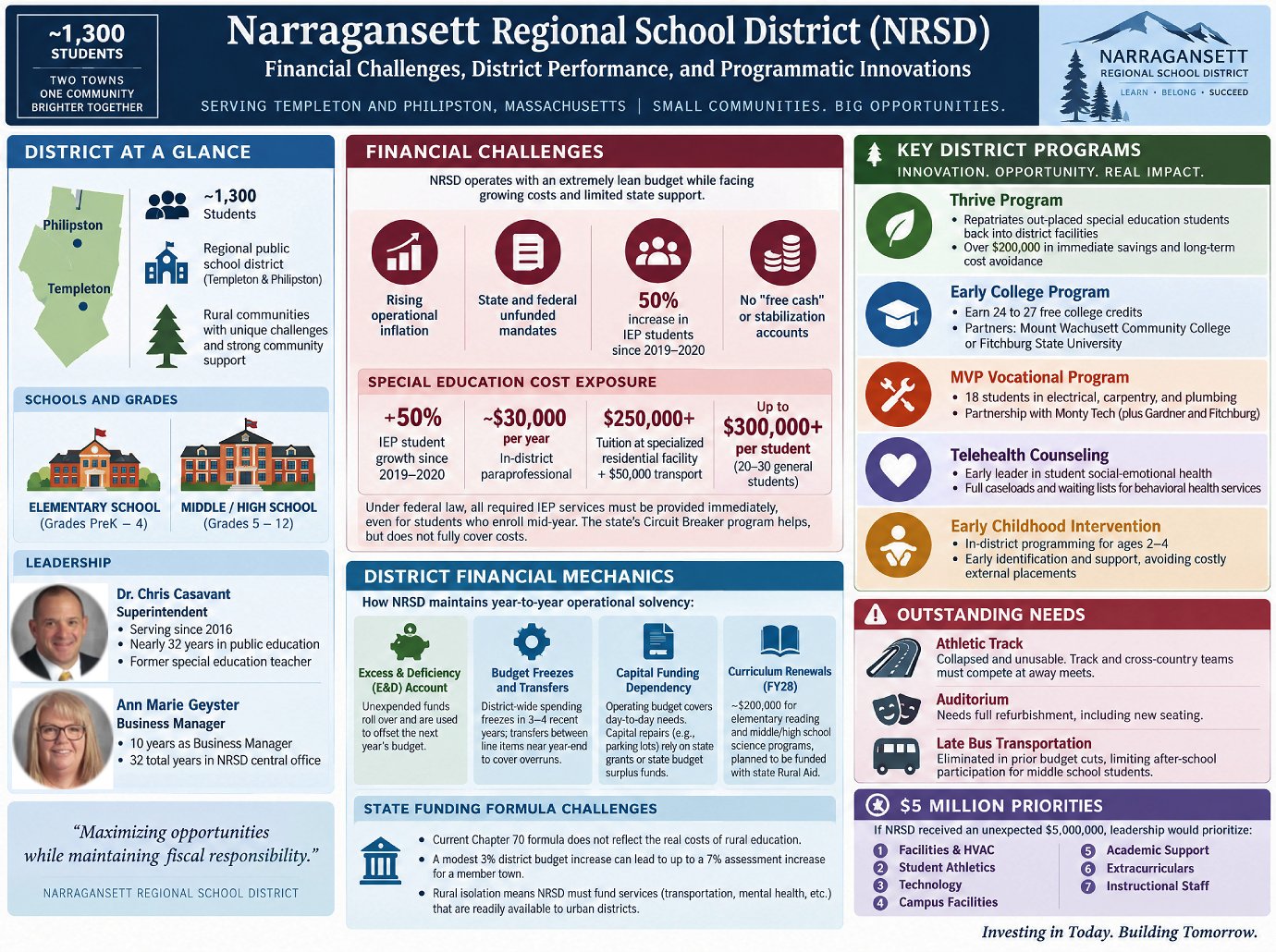
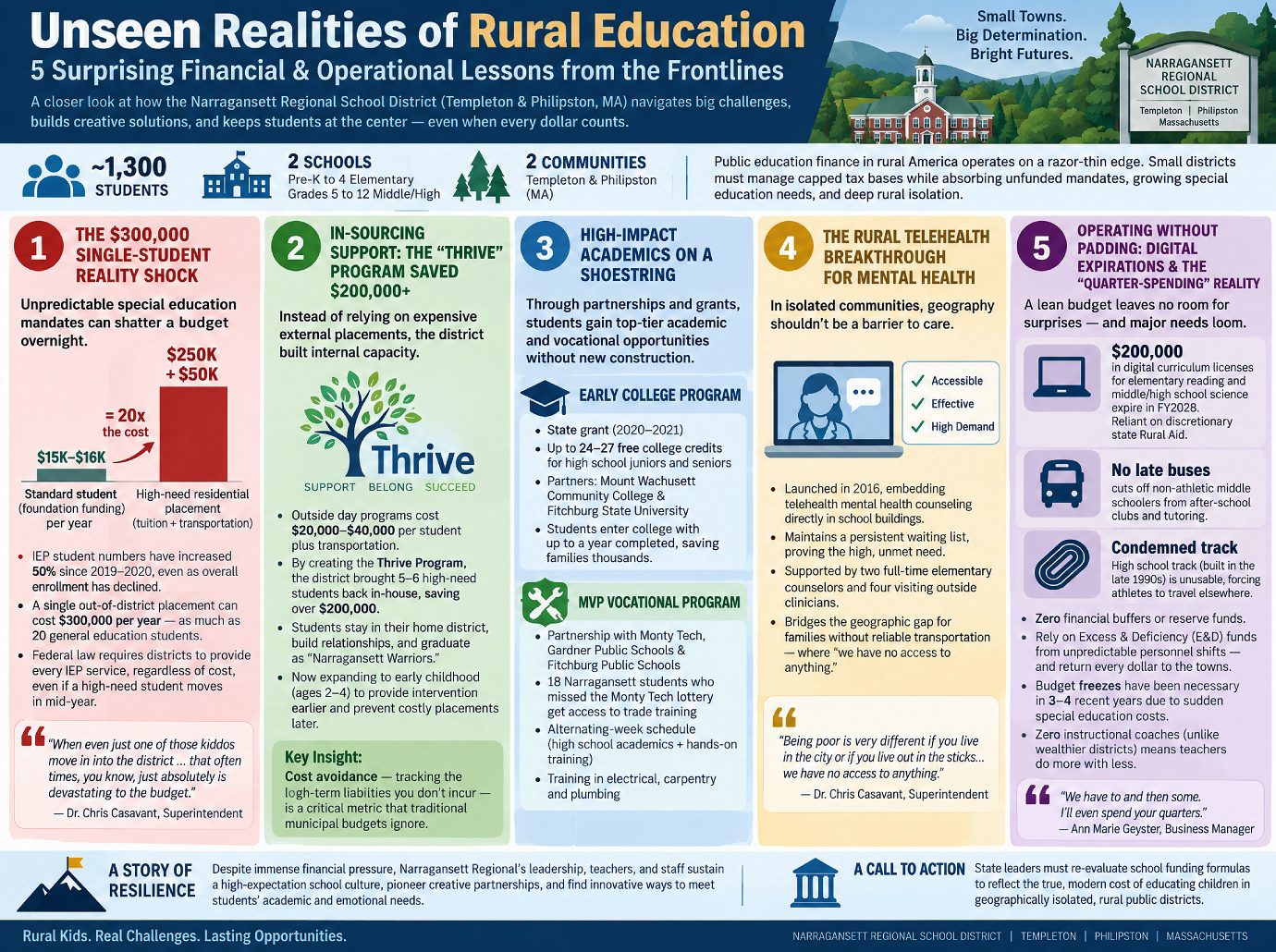
Serving the rural towns of Templeton and Philipston, NRSD operates an extremely lean financial structure while confronting systemic budgetary pressures. Primary financial drivers include rising operational inflation, state and federal unfunded mandates, and a dramatic 50% increase in students requiring Individualized Education Programs (IEPs).
Since the 2019–2020 school year. Because unexpected out-of-district special education placements can cost up to $300,000 per student annually, the district frequently enforces internal budget freezes and utilizes non-standard revenue streams—such as Excess and Deficiency (E&D) funds and state Rural Aid—to cover basic operating and capital necessities. Despite severe fiscal constraints and a lack of baseline academic support staff (e.g., literacy or math coaches), district leadership has established successful cost-avoidance programs and expanded student opportunities:
- The Thrive Program: Repatriates out-placed special education students back into district facilities, generating over $200,000 in immediate savings and long-term cost avoidance.
- Early College Program: Enables high school students to earn 24 to 27 free college credits through Mount Wachusett Community College or Fitchburg State University.
- MVP Program: Provides 18 students vocational training in electrical, carpentry, and plumbing through a regional partnership with Monty Tech.
- Telehealth Counseling: Established early leadership in student social-emotional health, maintaining full caseloads and waiting lists for behavioral health services.
District Composition and Governance Structure: NRSD is a regional public school district serving approximately 1,300 students across two member towns in Massachusetts: Templeton and Philipston. Our Interviewees: Dr. Chris Casavant, Superintendent: Serving as the superintendent since 2016, with nearly 32 years of experience in public education (formerly a special education teacher by trade).Ann Marie Geyster, Business Manager: Served 10 years as Business Manager and 32 total years within the central office of NRSD.
Financial Landscape and Operational Mechanics
Lean Budgetary Operations and Surplus Management: NRSD maintains no “free cash” or internal stabilization accounts, unlike traditional municipal structures. The district relies on specific mechanics to maintain year-to-year operational solvency:
- Excess and Deficiency (E&D) Account: Any unexpended funds at the end of a fiscal year drop into the district’s E&D account (derived from mid-year staff resignations, maternity leave savings, or spending freezes). For the past 10 years, the School Committee has systematically applied E&D balances to offset the following fiscal year’s operating budget.
- Budget Freezes and Transfers: Due to dynamic, mandatory costs, NRSD has been forced to institute district-wide spending freezes in three to four recent fiscal years. Essential transfers between line items are processed near the close of the fiscal year to cover overruns (e.g., special education transportation).
- Capital Funding Dependency: The general operating budget covers only day-to-day operational needs. Capital repairs—such as parking lot paving—depend entirely on competitive state grants or state budget surplus funds.
Special Education and Mandate Cost Drivers
While overall enrollment at NRSD has declined slightly, the population of students requiring specialized services has escalated sharply.
SPECIAL EDUCATION COST EXPOSURE |
+———————————-+—————————————————————-+
| Metric / Service Level | Detail / Cost Range |
+———————————-+—————————————————————-+
| IEP Student Growth | +50% increase since the 2019–2020 school year |
| In-District Paraprofessional | ~$30,000 annually per staff member |
| Specialized Residential Facility | $250,000+ tuition + $50,000 specialized transport |
| Total Single Out-Placement Risk | Up to $300,000+ per student (equivalent to 20–30 general students)|
Under federal law, the district is mandated to provide all specified IEP services immediately upon a student’s enrollment, regardless of whether the student moved into the district after the spring budget cycle was finalized. A single out-placed residential student moving into the district can cause severe budgetary disruption. While the state’s “Circuit Breaker” program offers partial cost mitigation, it does not fully shelter the district from mid-year spending shocks.
Curriculum Renewal and Grant Reliance: Curriculum models across grades PreK–12 rely heavily on digital access components that require periodic multi-year license renewals. NRSD’s general fund budget lacks the baseline capacity to absorb major curriculum renewals.
- FY28 Renewal Horizon: Approximately $200,000 in curriculum renewals will come due for the elementary reading program and the middle/high school science programs.
- Rural Aid Allocation: NRSD intends to fund these FY28 renewals using state Rural Aid, a discretionary state grant the district has received annually for six years to fund capital expenses and items beyond general operating budget limits.
Municipal Dynamics and State Funding Formula Deficits: NRSD represents two rural, economically constrained communities. Leadership notes that the current state Chapter 70 funding formula fails to account for the real modern costs of educating students in rural districts:
- Assessment Impact: Due to relative student population ratios and local wealth factors, a modest 3% total district budget increase can result in a disproportionately high assessment increase (e.g., up to 7%) for an individual member town.
- Rural Isolation: Unlike urban districts, rural student populations lack local access to public transportation, regional mental health networks, or municipal service hubs, forcing the school district to fund and provide these services internally.
Key District Initiatives and Cost-Avoidance Programs: To mitigate rising expenditures and broaden student access, NRSD has implemented several targeted educational and specialized programs.
SUMMARY OF KEY DISTRICT PROGRAMS |
+———————+—————————————————————————–+
| Program Name | Primary Function and Operational Benefit |
+———————+—————————————————————————–+
| Thrive Program | Repatriates special ed students to in-district classrooms; saved $200k+ |
| Early College | Offers up to 27 free college credits with local higher-ed institutions |
| MVP Vocational | Partnership yielding 18 vocational slots (electrical, carpentry, plumbing) |
| Telehealth Services | Early-adopted virtual mental health therapy to address social-emotional needs |
1. The Thrive Program (Special Education Repatriation) : Established approximately four to five years ago, the Thrive Program was designed to bring students with intensive day-program needs back from costly out-of-district placements into NRSD facilities.
- Financial Impact: Initial repatriation of 5 to 6 students yielded an immediate direct savings of over $200,000, transitioning into long-term structural cost avoidance.
- Educational Outcome: Allows high-needs students to remain within their local educational community, participate in native district activities, and graduate alongside their local peers.
2. Early Childhood Intervention: NRSD is experiencing an unprecedented increase in early childhood special education needs, identifying toddlers aged 2, 2½, 3, and 4 years old with formal diagnoses (including autism) prior to kindergarten entry.
- Strategy: Construct internal early-childhood special education programming directly within the elementary building.
- Dual Benefit: Secures early intervention for district youth (“Narragansett Warriors”) while avoiding external early-placement tuition and long-distance transport costs.
3. Early College Program: Launched via a competitive state grant around the 2020–2021 school year, this initiative targets college-bound juniors and seniors.
- Structure: Students can complete 24 to 27 college credits free of charge through Mount Wachusett Community College (“the Mount”) or Fitchburg State University.
- Impact: Reduces higher education costs for local families, effectively shaving off a half to full academic year of college tuition.
4. MVP Vocational Program:To address community demand for vocational training beyond the limited enrollment capacity of Montachusett Regional Vocational Technical School (Monty Tech), NRSD formed a cooperative agreement with Monty Tech, Gardner Public Schools, and Fitchburg Public Schools.
- Capacity: Enrolls 18 NRSD students who were not selected through the primary Monty Tech admissions process.
- Schedule: Alternates on a two-week cycle: one week of academic instruction at NRSD, followed by one week of practical trade training in electrical, carpentry, or plumbing.
5. Behavioral Health and Telehealth Leadership: Addressing systemic post-COVID social-emotional needs, NRSD was among the earliest public school districts in Massachusetts to implement on-site telehealth counseling.
- Capacity & Demand: Maintains continuous waiting lists for telehealth mental health services.
- Elementary Coverage: Supplements two full-time internal elementary school guidance counselors (who maintain maxed caseloads) with four externally contracted on-site counselors.
School Culture, Arts, and Operational Climate
Student Culture and Behavioral Standards: District leadership reports strong behavioral standards and a culture of respect across student bodies:
- External administrators, athletic directors, and visiting official reviewers frequently submit unsolicited commendations regarding student decorum, quiet hallways, and sportsmanship.
- Cell Phone Regulation: NRSD has experienced fewer disruptions from mobile devices relative to state trends. The district is actively drafting an updated local cell phone policy while awaiting finalized formal policy directives from the Massachusetts Department of Elementary and Secondary Education (DESE).
Arts, Music, and Extra-Curricular Status
- Post-COVID Decline: Fine arts, theater, marching band, and choral programs experienced a significant decline in participation following the COVID-19 pandemic.
- Targeted Recovery: To rebuild music participation, NRSD allocated resources to hire two additional music teachers at the middle school level. This investment has generated a steady, ongoing recovery in the high school concert band enrollment.
Unmet Needs and Priority Resource Allocations: When evaluated against neighboring school districts—particularly those within the Route 495 belt or closer to Boston—NRSD operates without standard baseline academic supports, such as dedicated literacy or math coaches. Furthermore, regular classroom teachers often lack secondary support staff unless a classroom contains a student with an IEP that mandates a paraprofessional.
Outstanding Capital and Operational Deficits
- Athletic Track: The outdoor running track, originally constructed during a late-1990s facility expansion, collapsed due to deferred maintenance stemming from past budget cuts. It is entirely unusable, forcing the track and cross-country teams to compete exclusively in away meets.
- Auditorium: Requires comprehensive physical refurbishing, including seat replacements, to properly host school assemblies and municipal public meetings.
- Late Bus Transportation: Eliminated in prior budget reduction cycles, leaving middle school students who lack private transportation unable to participate in after-school extracurricular activities.